
Introduction to Vectors Honors PreCalc 8 1 Vectors
- Slides: 12
Introduction to Vectors Honors Pre-Calc 8. 1
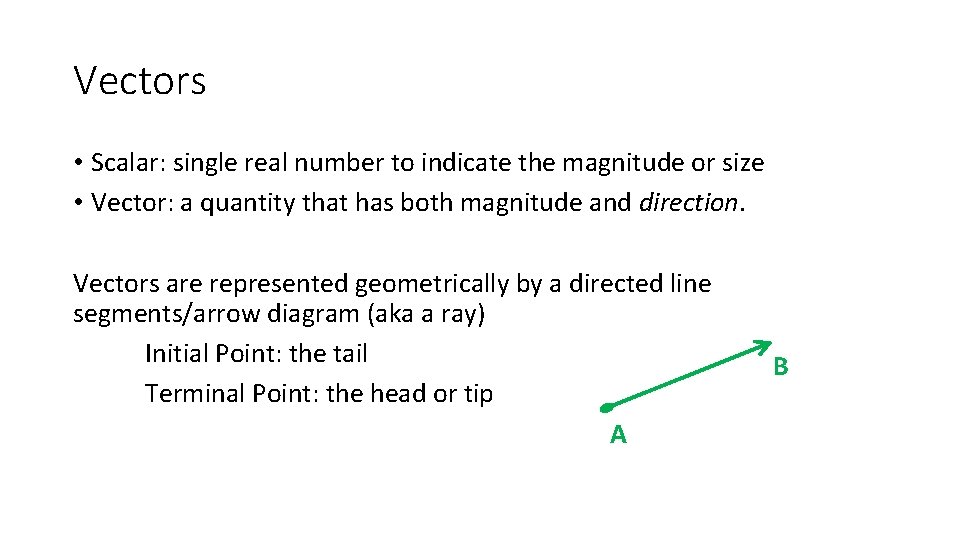
Vectors • Scalar: single real number to indicate the magnitude or size • Vector: a quantity that has both magnitude and direction. Vectors are represented geometrically by a directed line segments/arrow diagram (aka a ray) Initial Point: the tail Terminal Point: the head or tip A B
Vectors in Standard Position • Initial point at the origin • Direction determined by angle between vector and the horizontal line that could be used to represent the x-axis. • Length is proportional to the magnitude of the vector.
Bearings • Another way the direction of a vector can be given. • Quadrant bearings: directional measurement between 0 o and 90 o east or west of the north-south line. • True Bearings: directional measurement where angle is measured clockwise from north. • True bearings are always given using three digits. So a direction that measures 25 o clockwise from north would be written as a true bearing 025 o
Important Vector Types • Parallel Vectors: Same or Opposite Direction; magnitudes can differ • Equivalent Vectors: Same magnitude and direction • Opposite Vectors: same magnitude but opposite directions • Vector opposite of a is denoted as -a
Multiplying Vectors by a Scalar If a vector v is multiplied by a real number scalar k, the scalar multiple kv has a magnitude of |k| |v|. Its direction is determined by the sign of k. If k > 0, kv has the same direction as v. If k < 0, kv has the opposite direction as v.
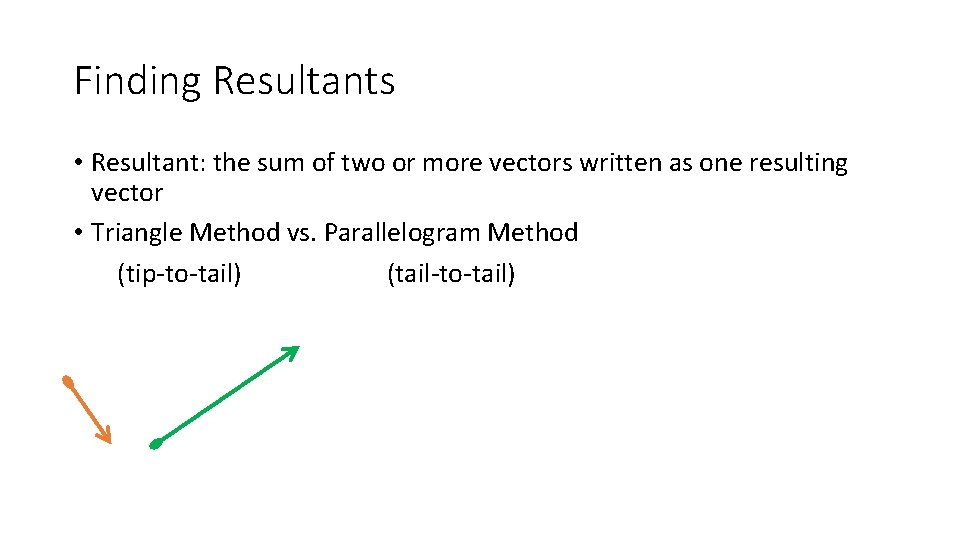
Finding Resultants • Resultant: the sum of two or more vectors written as one resulting vector • Triangle Method vs. Parallelogram Method (tip-to-tail) (tail-to-tail)
Example 1: • An airplane is flying with an airspeed of 310 knots on a heading of 050 o. If a 78 -knot wind is blowing from a true heading of 125 o, determine the speed and direction of the plane relative to the ground. ***heading is the direction in which a vessel, such as an airplane is steered to overcome other forces, such as wind or current.
Example 2: • Mitchell swims due east at a speed of 3. 5 feet per second across a river directly toward the opposite bank. At the same time, the current of the river is carrying him south at a rate of 2 feet per second. Find Mitchell’s speed and direction relative to the shore.
Components • Two or more vectors with a sum that is a vector r are called components of r. • Rectangular components of a vector are horizontal and vertical and will allow us to use right triangle trig.
Example 3: • Heather is pushing the handle of a lawn mower with a force of 450 newtons at an angle of 56 o with the ground. • Draw a diagram that shows the resolution of the force that Heather exerts into its rectangular components, then find the magnitudes of the horizontal and vertical components of the force.
Practice Problems • An airplane is flying with an airspeed of 475 miles per hour on a heading of 070 o. If an 80 mile per hour wind is blowing from a true heading of 120 o, determine the velocity and direction of the plane relative to the ground. • A player kicks a soccer ball so that it leaves the ground with a velocity of 44 feet per second at an angle of 33 o with the ground. Draw a diagram and find the magnitude of the horizontal and vertical components of the velocity.