
INTRODUCTION TO URBAN PLANNING THEORY TOPICS I WHAT
INTRODUCTION TO URBAN PLANNING & THEORY
TOPICS I WHAT IS A THEORY? II PLANNING & SCIENCE III KEY ISSUES IN URBAN PLANNING IV WHAT IS PLANNING? V PLANNING TRADITIONS
WHAT IS A THEORY? • A logical explanation that is accepted until proven wrong or refuted by another one. • The above explanation comes from the falsificationism of Karl Popper, who stated that the objective of science is not to prove but to disprove theories
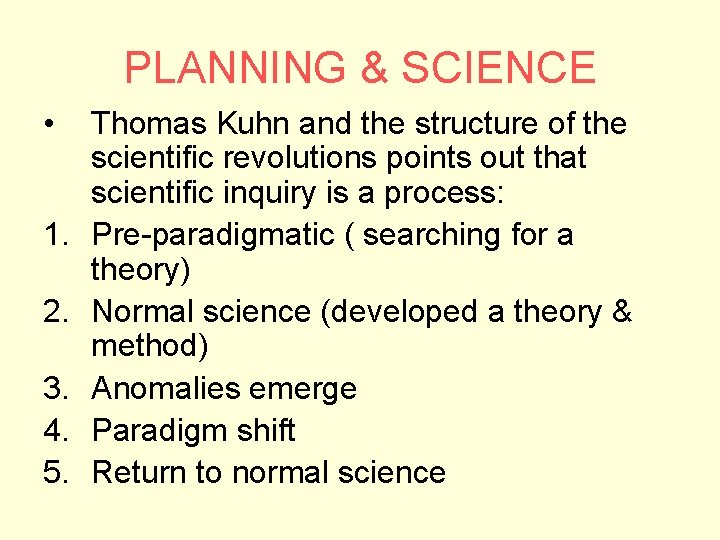
PLANNING & SCIENCE • 1. 2. 3. 4. 5. Thomas Kuhn and the structure of the scientific revolutions points out that scientific inquiry is a process: Pre-paradigmatic ( searching for a theory) Normal science (developed a theory & method) Anomalies emerge Paradigm shift Return to normal science
KEY ISSUES IN URBAN PLANNING • • Is planning a normal science or preparadigmatic scientific discipline? What is the difference between theory of planning (process) and planning theory (substance)? Should planning emphasize a positive (cause-effect) or normative (value judgment) analysis? What is the subject/object of analysis of urban planning?

WHAT IS PLANNING? • Friedmann states that ". . all planning must confront the meta-theoretical problem of how to make technical knowledge in planning effective in informing public actions" • In sum, Friedmann defines planning as the component that links knowledge & action. KNOWLEDGE ACTION • Planning is what links technical knowledge and actions in the public domain.
WHAT IS PLANNING? • Campbell & Fainstein (1997: 1) state that “What role can planning play in developing the city and region within the constraints of a capitalist political economy and a democratic political system” • Planning cannot be isolated from the political context of the city or region because the policy decisions affect local interests. Thus, planning becomes a practice of what is feasible politically instead of what is technically efficient and effective. • The question of power becomes relevant in the planning process.
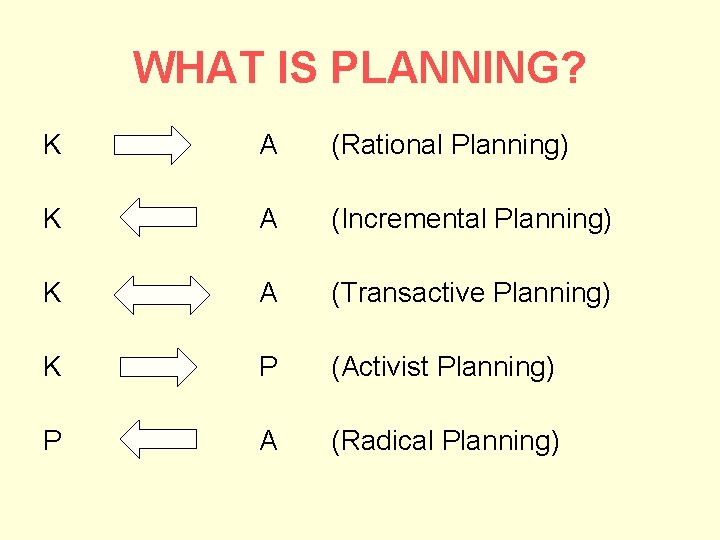
WHAT IS PLANNING? K A (Rational Planning) K A (Incremental Planning) K A (Transactive Planning) K P (Activist Planning) P A (Radical Planning)
WHAT IS PLANNING? • 1. 2. 3. 4. 5. Friedmann identifies five important aspects where planning plays a role: Every planning activity involves a territorial/spatial component Planning activities respond to a social rationality Planning facilitates market activities while restricting noxious ones or even substituting the market Planning in the public domain is political and therefore conflictive Planning requires massive support and ability to mobilize society in order to be successful
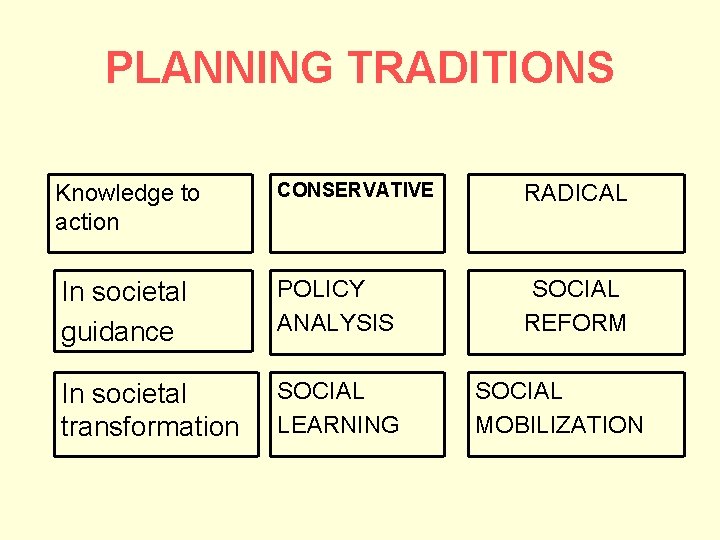
PLANNING TRADITIONS Knowledge to action CONSERVATIVE RADICAL In societal guidance POLICY ANALYSIS SOCIAL REFORM In societal transformation SOCIAL LEARNING SOCIAL MOBILIZATION
PLANNING TRADITIONS POLICY ANALYSIS • The fields of policy analysis are system analysis, welfare & social choice, and policy science • Emphasizes the application of scientific knowledge to social issues • Searches for “correct” solutions to social problems becoming “social physics” • The planner becomes a technocrat whose role is to “serve the existing centers of power”
PLANNING TRADITIONS SOCIAL REFORM • This tradition draws from the fields of sociology, institutional economics and pragmatism. • Social reform is concerned with how to reform government to behave in a rational way (efficiency, effectiveness, and transparency). • It is concerned with what is the proper relationship between planning and politics and whose ultimate goal is to institutionalize planning as a governmental function. • The key goal is what government can do to achieve its goals of economic growth and prosperity. • It coincides with public policy in the idea of making planning a scientific endeavor applied to solve social problems.
PLANNING TRADITIONS SOCIAL LEARNING • It is draws from the organization development theory • How society learns to solve its problems • Learning comes through an iterative process of trial and error • The planner becomes a community facilitator, instead of the scientist, whose role is to promote community participation in the search for solutions • Emphasizes a bottom-up approach and attempts to empower communities to solve their own problems. Planning’s gravity center is moved from government and City Hall to the community.
PLANNING TRADITIONS SOCIAL MOBILIZATION • Traces its roots to utopian socialists, radical anarchists, historical materialism, and Neomarxism • “Planning appears as a form of politics, conducted without the mediation of science” • Planning also moves away from the notion that the state is neutral and attempting to mediate competing interests. • Perceives the state as an instrument of a social class whose sole purpose is to facilitate capital accumulation against the interest of labor.
- Slides: 14