
Introduction to Transformations What does it mean to
- Slides: 24
Introduction to Transformations
What does it mean to transform something?
Geometrical Transformation • a change in the position, size, or shape of a geometric figure
What does rigid mean?
2 Types of Transformations 1. rigid motion (congruent motion)preserves the size and shape of a figure Ø translations Ø reflections Ø rotations 2. non-rigid motion Ø dilation
Transformations • are functions that take points in the plane as inputs and give other points as outputs
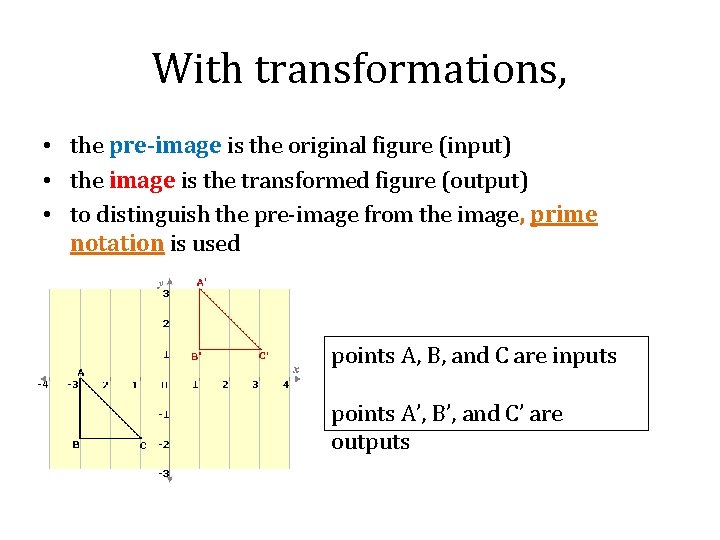
With transformations, • the pre-image is the original figure (input) • the image is the transformed figure (output) • to distinguish the pre-image from the image, prime notation is used points A, B, and C are inputs points A’, B’, and C’ are outputs
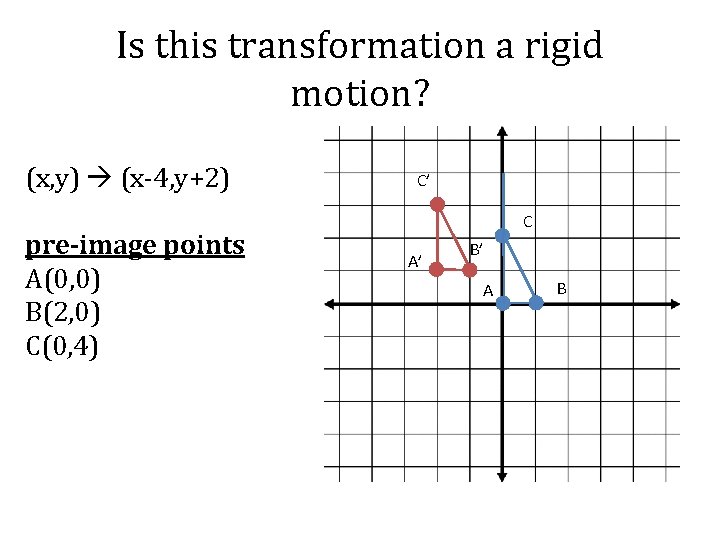
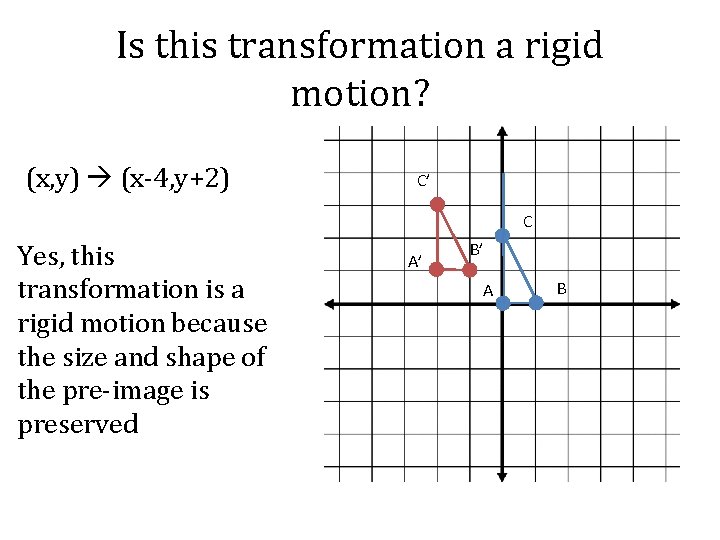
Is this transformation a rigid motion? (x, y) (x-4, y+2) pre-image points A(0, 0) B(2, 0) C(0, 4) C’ C A’ B’ A B
Is this transformation a rigid motion? (x, y) (x-4, y+2) C’ C Yes, this transformation is a rigid motion because the size and shape of the pre-image is preserved A’ B’ A B
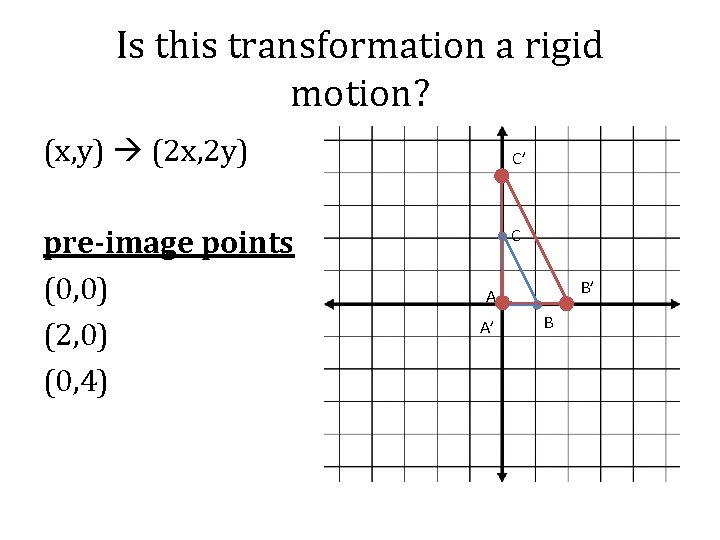
Is this transformation a rigid motion? (x, y) (2 x, 2 y) pre-image points (0, 0) (2, 0) (0, 4) C’ C B’ A A’ B
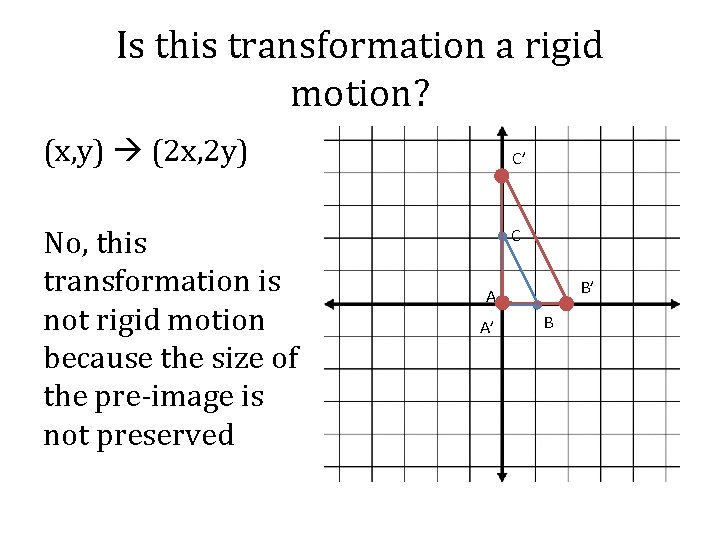
Is this transformation a rigid motion? (x, y) (2 x, 2 y) No, this transformation is not rigid motion because the size of the pre-image is not preserved C’ C B’ A A’ B
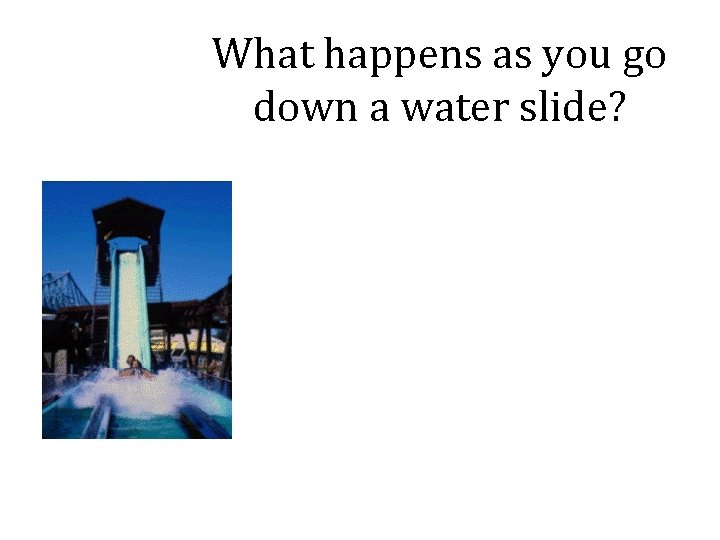
What happens as you go down a water slide?
Define Translate In Latin: Translate means “carried across”
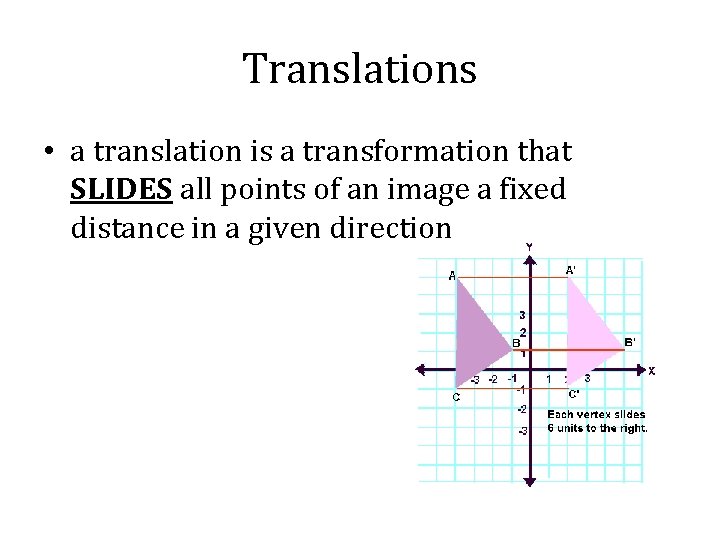
Translations • a translation is a transformation that SLIDES all points of an image a fixed distance in a given direction
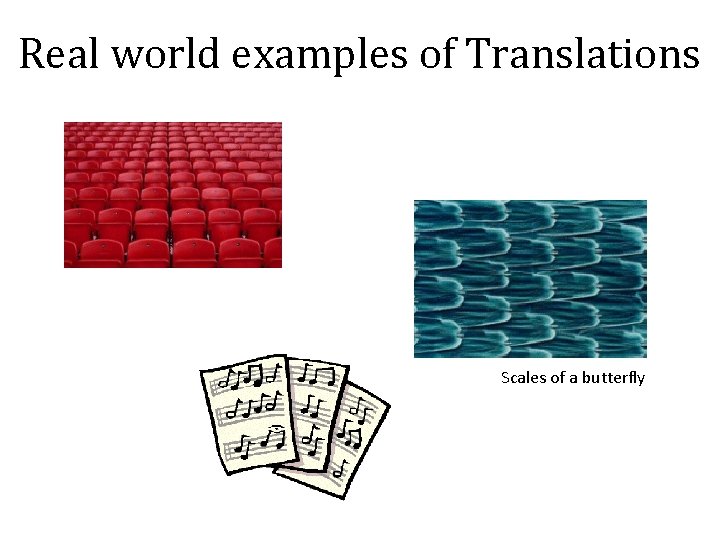
Real world examples of Translations Scales of a butterfly
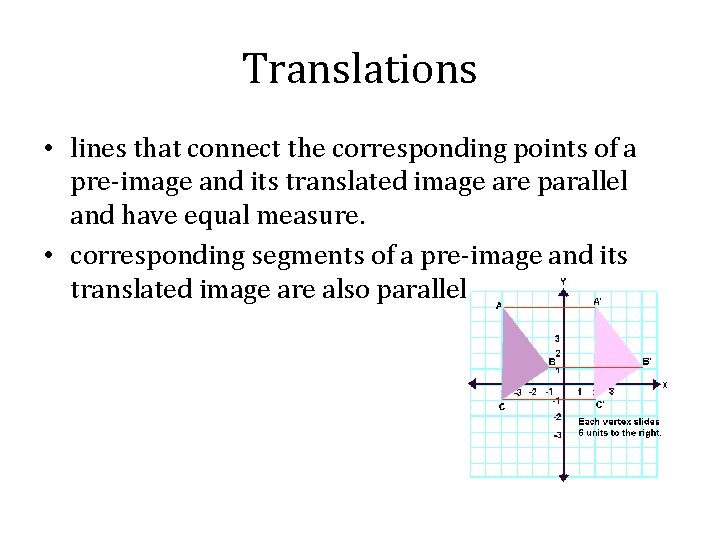
Translations • lines that connect the corresponding points of a pre-image and its translated image are parallel and have equal measure. • corresponding segments of a pre-image and its translated image are also parallel
Descriptive Notation • Description using words to characterize a given translation • Example: 7 units to the left and 3 units up
Coordinate Notation • coordinate notation is a way to write a function rule for a transformation in the coordinate plane • example: T(x, y) (x+2, y-3) T(x+2, y-3) is our function rule written in coordinate notation the pre-image is moving 2 units right and 3 units down applying this rule • if (6, 12) is a point on our pre-image, then (6, 12) becomes (6+2, 12 -3), which is point (8, 9) • so point (6, 12) on our pre-image transformed to point (8, 9) on our image
Vector Notation • Utilizes a vector to describe the translation. • A vector is a quantity that has magnitude (size) and direction – Velocity is a vector (3 mph due north)
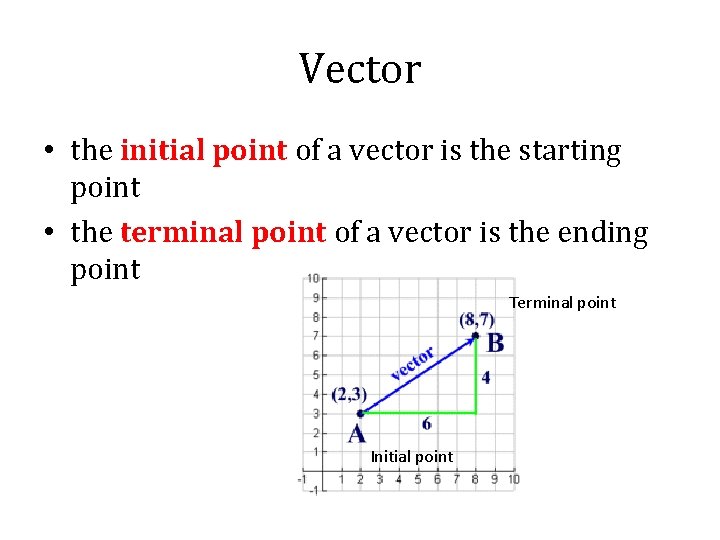
Vector • the initial point of a vector is the starting point • the terminal point of a vector is the ending point Terminal point Initial point
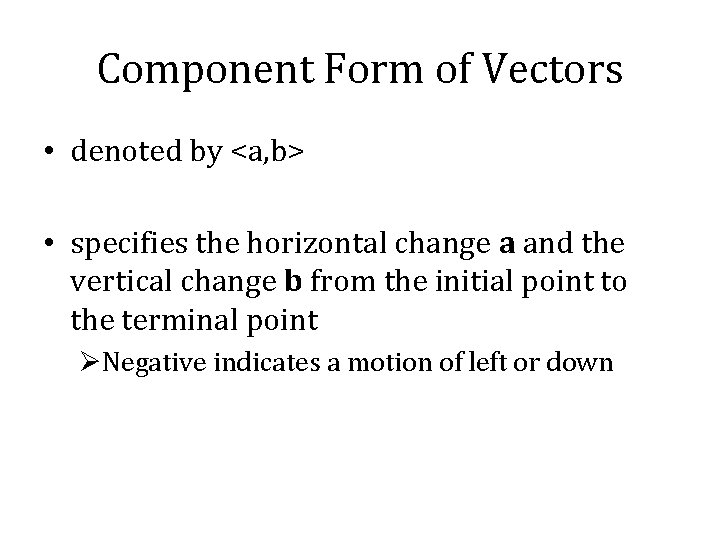
Component Form of Vectors • denoted by <a, b> • specifies the horizontal change a and the vertical change b from the initial point to the terminal point ØNegative indicates a motion of left or down
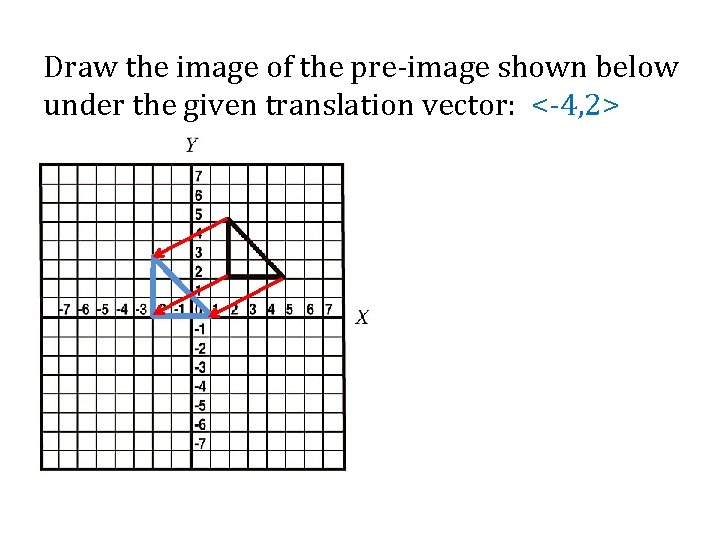
Draw the image of the pre-image shown below under the given translation vector: <-4, 2>
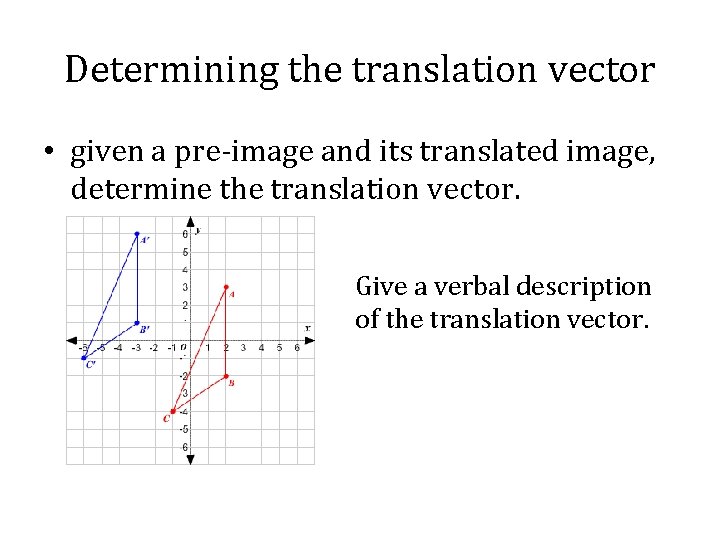
Determining the translation vector • given a pre-image and its translated image, determine the translation vector. Give a verbal description of the translation vector.
Practice http: //www. regentsprep. org/Regents/math/geometry/GT 2/Prac. T. htm