
Introduction to Theory of Automata Formal Languages Feodor
- Slides: 19
Introduction to Theory of Automata, Formal Languages, (Feodor F. Dragan) Computation Department of Computer Science Kent State University Spring, 2003 Automata & Formal Languages, Feodor F. Dragan, Kent State University 1
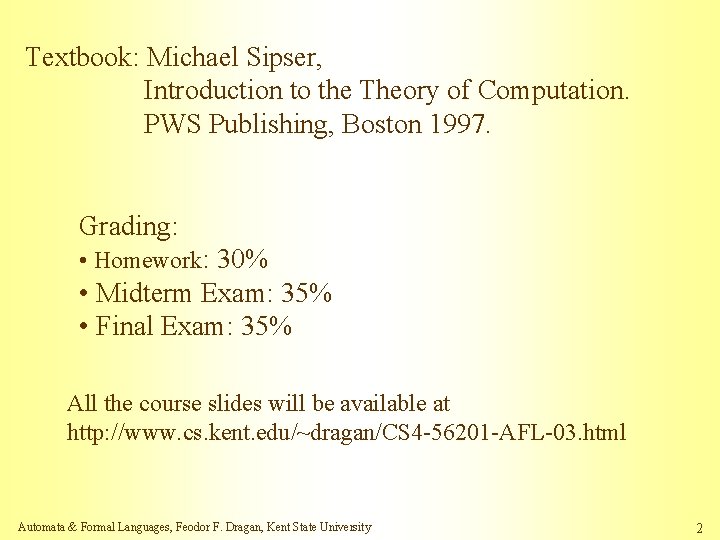
Textbook: Michael Sipser, Introduction to the Theory of Computation. PWS Publishing, Boston 1997. Grading: • Homework: 30% • Midterm Exam: 35% • Final Exam: 35% All the course slides will be available at http: //www. cs. kent. edu/~dragan/CS 4 -56201 -AFL-03. html Automata & Formal Languages, Feodor F. Dragan, Kent State University 2
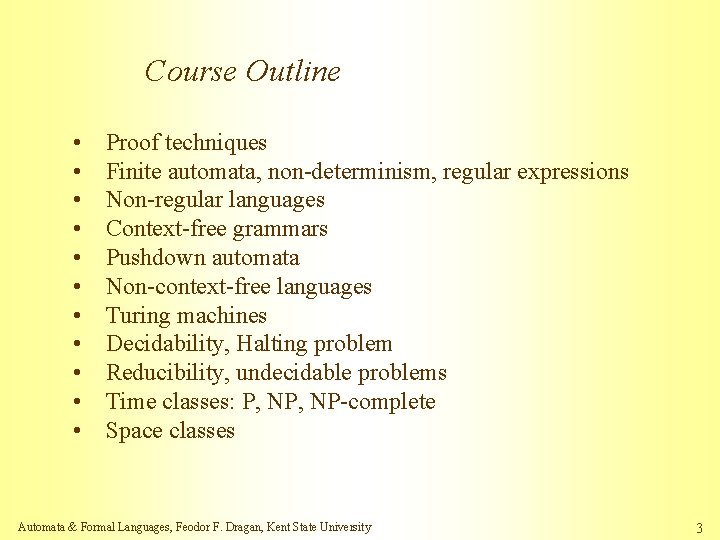
Course Outline • • • Proof techniques Finite automata, non-determinism, regular expressions Non-regular languages Context-free grammars Pushdown automata Non-context-free languages Turing machines Decidability, Halting problem Reducibility, undecidable problems Time classes: P, NP-complete Space classes Automata & Formal Languages, Feodor F. Dragan, Kent State University 3
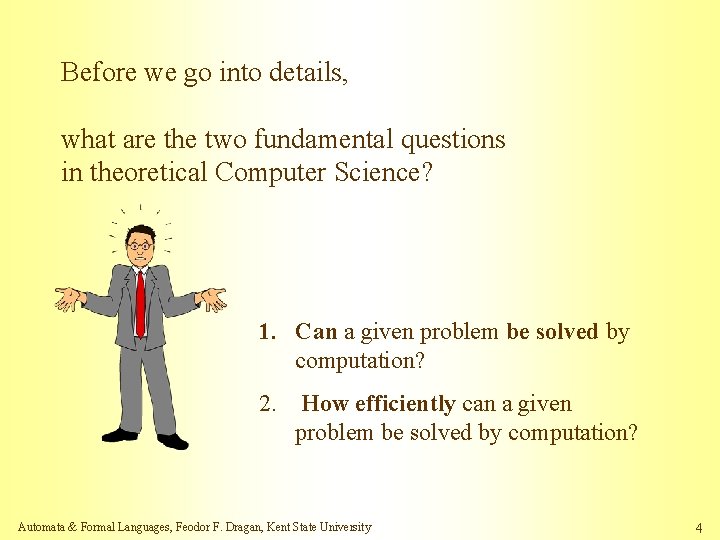
Before we go into details, what are the two fundamental questions in theoretical Computer Science? 1. Can a given problem be solved by computation? 2. How efficiently can a given problem be solved by computation? Automata & Formal Languages, Feodor F. Dragan, Kent State University 4
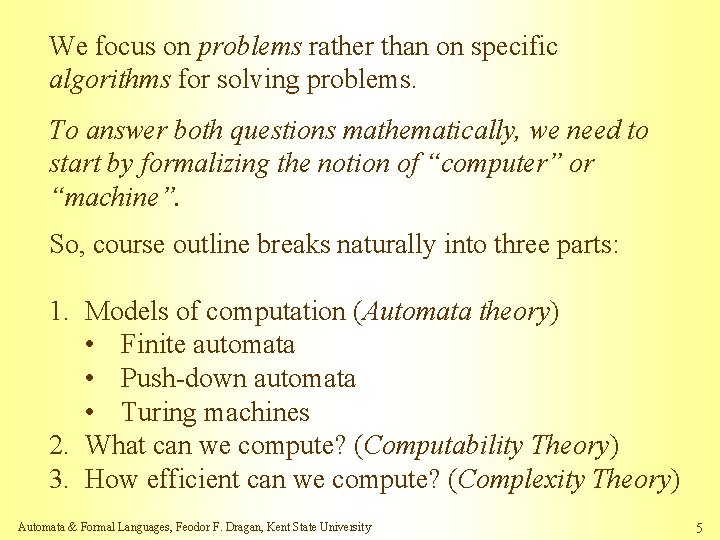
We focus on problems rather than on specific algorithms for solving problems. To answer both questions mathematically, we need to start by formalizing the notion of “computer” or “machine”. So, course outline breaks naturally into three parts: 1. Models of computation (Automata theory) • Finite automata • Push-down automata • Turing machines 2. What can we compute? (Computability Theory) 3. How efficient can we compute? (Complexity Theory) Automata & Formal Languages, Feodor F. Dragan, Kent State University 5
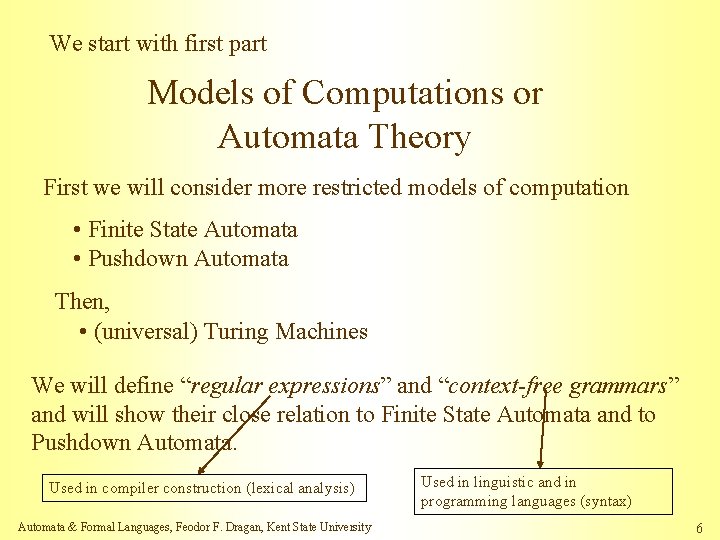
We start with first part Models of Computations or Automata Theory First we will consider more restricted models of computation • Finite State Automata • Pushdown Automata Then, • (universal) Turing Machines We will define “regular expressions” and “context-free grammars” and will show their close relation to Finite State Automata and to Pushdown Automata. Used in compiler construction (lexical analysis) Automata & Formal Languages, Feodor F. Dragan, Kent State University Used in linguistic and in programming languages (syntax) 6
CHAPTER 0 Introduction Contents • Mathematical notions and terminology (read pp. 3 -16). • Definitions, theorems, proofs. • Type of proof: • By construction, • By contradiction, • By induction. Automata & Formal Languages, Feodor F. Dragan, Kent State University 7
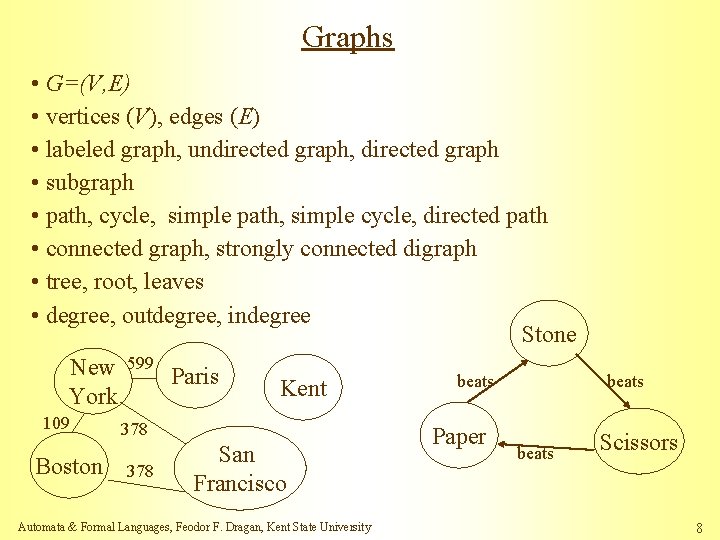
Graphs • G=(V, E) • vertices (V), edges (E) • labeled graph, undirected graph, directed graph • subgraph • path, cycle, simple path, simple cycle, directed path • connected graph, strongly connected digraph • tree, root, leaves • degree, outdegree, indegree Stone New 599 Paris beats Kent York 109 Boston 378 San Francisco Automata & Formal Languages, Feodor F. Dragan, Kent State University Paper beats Scissors 8
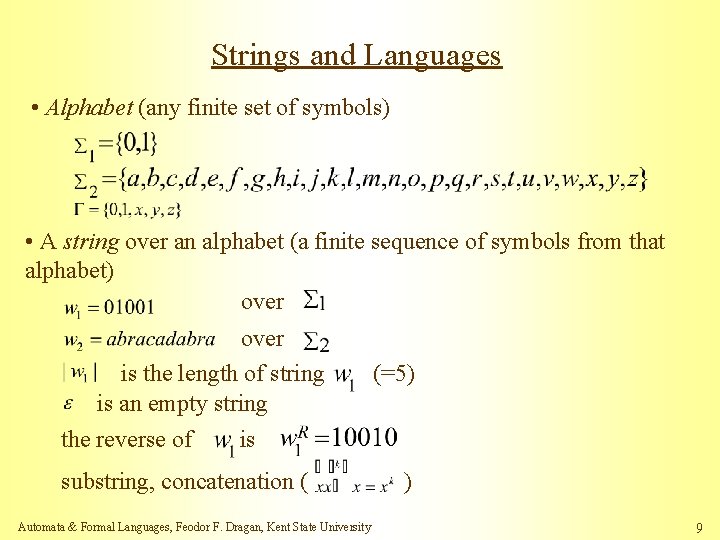
Strings and Languages • Alphabet (any finite set of symbols) • A string over an alphabet (a finite sequence of symbols from that alphabet) over is the length of string is an empty string the reverse of (=5) is substring, concatenation ( Automata & Formal Languages, Feodor F. Dragan, Kent State University ) 9
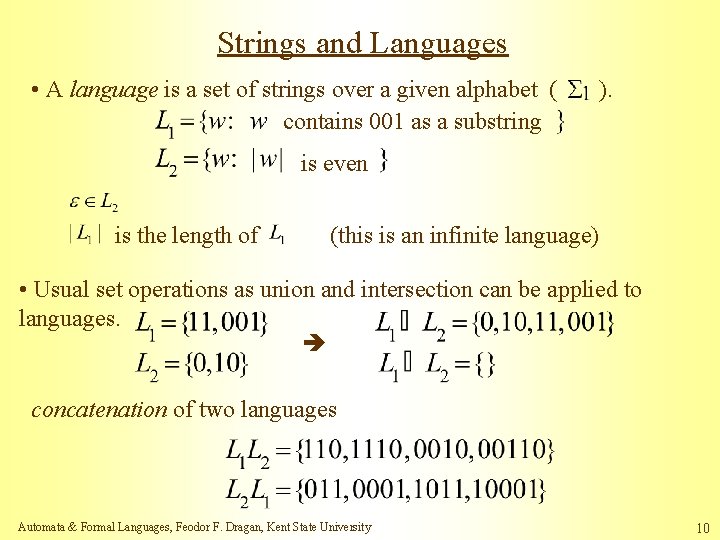
Strings and Languages • A language is a set of strings over a given alphabet ( contains 001 as a substring ). is even is the length of (this is an infinite language) • Usual set operations as union and intersection can be applied to languages. concatenation of two languages Automata & Formal Languages, Feodor F. Dragan, Kent State University 10
Definitions, theorems, proofs • Definitions describe the objects and notations • Defining some object we must make clear what constitutes that object and what does not. • Mathematical statements about objects and notions • a statement which expresses that some object has a certain property • it may or may not be true, but must be precise • A proof is a convincing logical argument that a statement is true • A theorem is a mathematical statement proved true • this word is reserved for statements of special interest • statements that are interesting only because they assist in the proof of another, more significant statement, are called lemmas • a theorem or its proof may allow us to conclude easily that another, related statements are true; these statements are called corollaries of theorem Automata & Formal Languages, Feodor F. Dragan, Kent State University 11
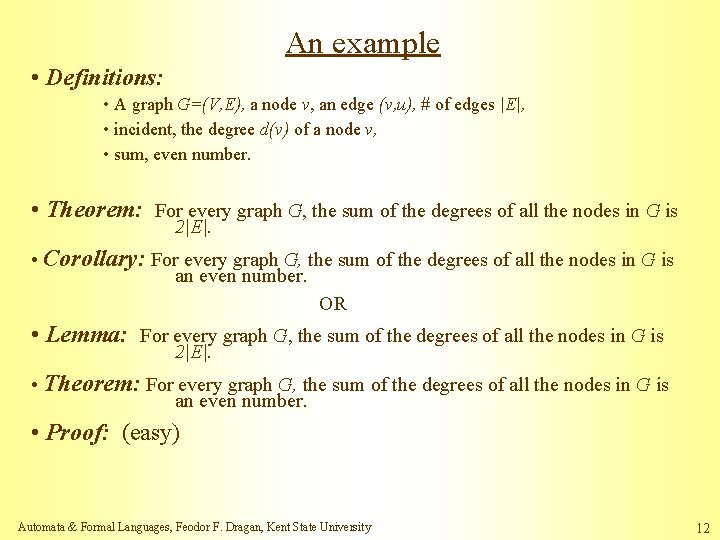
An example • Definitions: • A graph G=(V, E), a node v, an edge (v, u), # of edges |E|, • incident, the degree d(v) of a node v, • sum, even number. • Theorem: For every graph G, the sum of the degrees of all the nodes in G is 2|E|. • Corollary: For every graph G, the sum of the degrees of all the nodes in G is an even number. OR • Lemma: For every graph G, the sum of the degrees of all the nodes in G is 2|E|. • Theorem: For every graph G, the sum of the degrees of all the nodes in G is an even number. • Proof: (easy) Automata & Formal Languages, Feodor F. Dragan, Kent State University 12
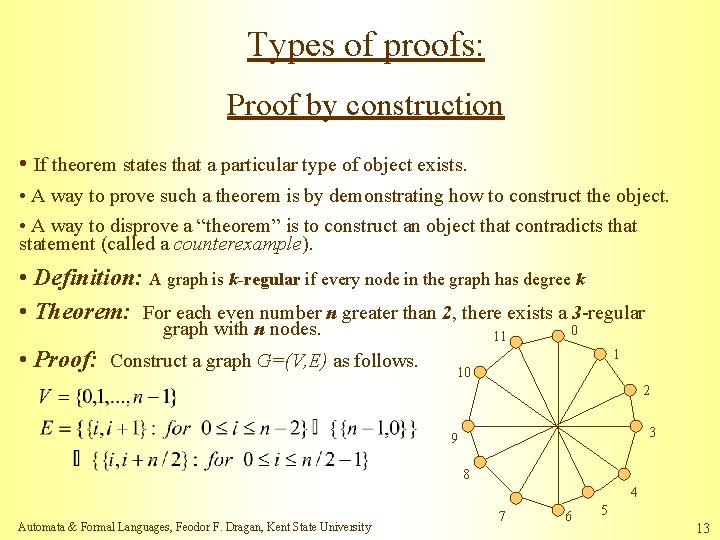
Types of proofs: Proof by construction • If theorem states that a particular type of object exists. • A way to prove such a theorem is by demonstrating how to construct the object. • A way to disprove a “theorem” is to construct an object that contradicts that statement (called a counterexample). • Definition: A graph is k-regular if every node in the graph has degree k • Theorem: For each even number n greater than 2, there exists a 3 -regular graph with n nodes. • Proof: Construct a graph G=(V, E) as follows. 11 0 1 10 2 3 9 8 4 Automata & Formal Languages, Feodor F. Dragan, Kent State University 7 6 5 13
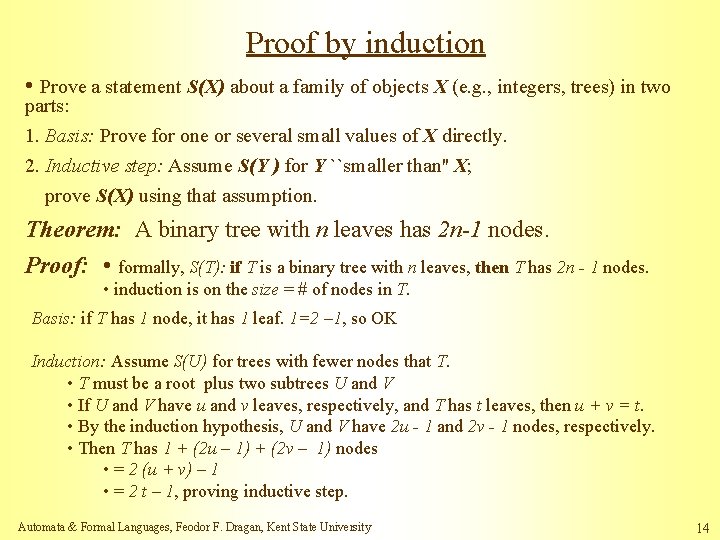
Proof by induction • Prove a statement S(X) about a family of objects X (e. g. , integers, trees) in two parts: 1. Basis: Prove for one or several small values of X directly. 2. Inductive step: Assume S(Y ) for Y ``smaller than'' X; prove S(X) using that assumption. Theorem: A binary tree with n leaves has 2 n-1 nodes. Proof: • formally, S(T): if T is a binary tree with n leaves, then T has 2 n - 1 nodes. • induction is on the size = # of nodes in T. Basis: if T has 1 node, it has 1 leaf. 1=2 – 1, so OK Induction: Assume S(U) for trees with fewer nodes that T. • T must be a root plus two subtrees U and V • If U and V have u and v leaves, respectively, and T has t leaves, then u + v = t. • By the induction hypothesis, U and V have 2 u - 1 and 2 v - 1 nodes, respectively. • Then T has 1 + (2 u – 1) + (2 v – 1) nodes • = 2 (u + v) – 1 • = 2 t – 1, proving inductive step. Automata & Formal Languages, Feodor F. Dragan, Kent State University 14
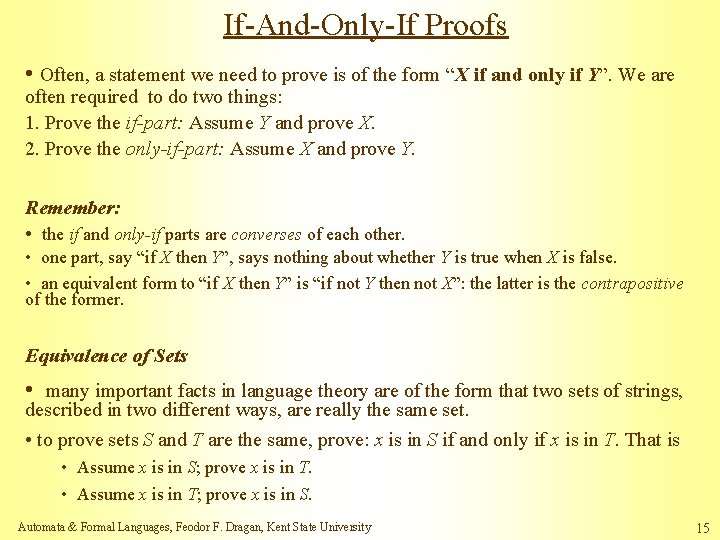
If-And-Only-If Proofs • Often, a statement we need to prove is of the form “X if and only if Y”. We are often required to do two things: 1. Prove the if-part: Assume Y and prove X. 2. Prove the only-if-part: Assume X and prove Y. Remember: • the if and only-if parts are converses of each other. • one part, say “if X then Y”, says nothing about whether Y is true when X is false. • an equivalent form to “if X then Y” is “if not Y then not X”: the latter is the contrapositive of the former. Equivalence of Sets • many important facts in language theory are of the form that two sets of strings, described in two different ways, are really the same set. • to prove sets S and T are the same, prove: x is in S if and only if x is in T. That is • Assume x is in S; prove x is in T. • Assume x is in T; prove x is in S. Automata & Formal Languages, Feodor F. Dragan, Kent State University 15
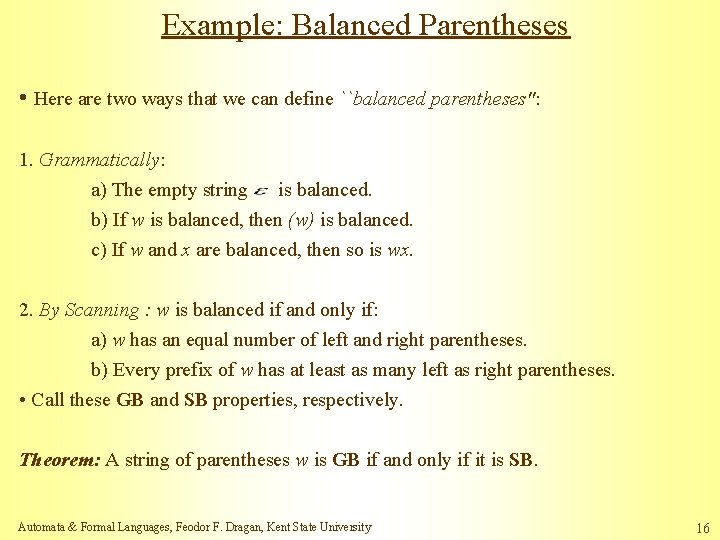
Example: Balanced Parentheses • Here are two ways that we can define ``balanced parentheses'': 1. Grammatically: a) The empty string is balanced. b) If w is balanced, then (w) is balanced. c) If w and x are balanced, then so is wx. 2. By Scanning : w is balanced if and only if: a) w has an equal number of left and right parentheses. b) Every prefix of w has at least as many left as right parentheses. • Call these GB and SB properties, respectively. Theorem: A string of parentheses w is GB if and only if it is SB. Automata & Formal Languages, Feodor F. Dragan, Kent State University 16
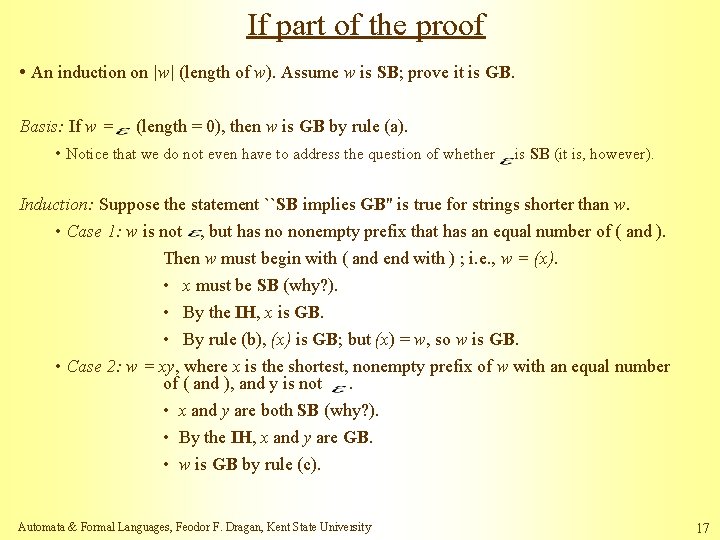
If part of the proof • An induction on |w| (length of w). Assume w is SB; prove it is GB. Basis: If w = (length = 0), then w is GB by rule (a). • Notice that we do not even have to address the question of whether is SB (it is, however). Induction: Suppose the statement ``SB implies GB'' is true for strings shorter than w. • Case 1: w is not , but has no nonempty prefix that has an equal number of ( and ). Then w must begin with ( and end with ) ; i. e. , w = (x). • x must be SB (why? ). • By the IH, x is GB. • By rule (b), (x) is GB; but (x) = w, so w is GB. • Case 2: w = xy, where x is the shortest, nonempty prefix of w with an equal number of ( and ), and y is not. • x and y are both SB (why? ). • By the IH, x and y are GB. • w is GB by rule (c). Automata & Formal Languages, Feodor F. Dragan, Kent State University 17
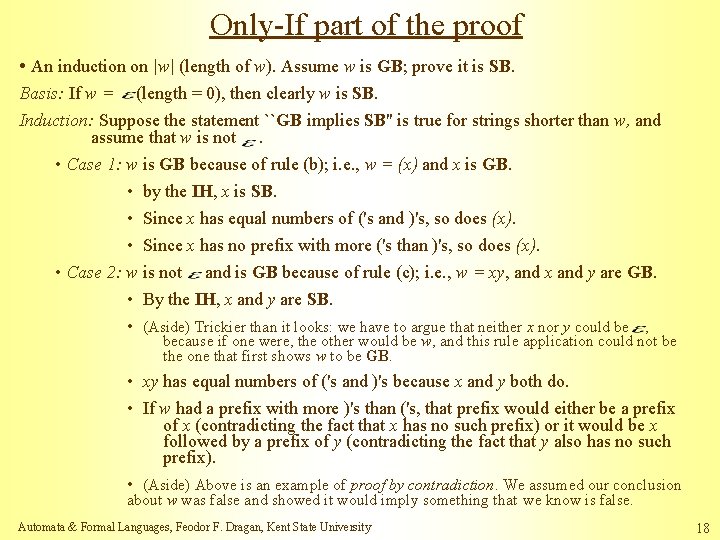
Only-If part of the proof • An induction on |w| (length of w). Assume w is GB; prove it is SB. Basis: If w = (length = 0), then clearly w is SB. Induction: Suppose the statement ``GB implies SB'' is true for strings shorter than w, and assume that w is not. • Case 1: w is GB because of rule (b); i. e. , w = (x) and x is GB. • by the IH, x is SB. • Since x has equal numbers of ('s and )'s, so does (x). • Since x has no prefix with more ('s than )'s, so does (x). • Case 2: w is not and is GB because of rule (c); i. e. , w = xy, and x and y are GB. • By the IH, x and y are SB. • (Aside) Trickier than it looks: we have to argue that neither x nor y could be , because if one were, the other would be w, and this rule application could not be the one that first shows w to be GB. • xy has equal numbers of ('s and )'s because x and y both do. • If w had a prefix with more )'s than ('s, that prefix would either be a prefix of x (contradicting the fact that x has no such prefix) or it would be x followed by a prefix of y (contradicting the fact that y also has no such prefix). • (Aside) Above is an example of proof by contradiction. We assumed our conclusion about w was false and showed it would imply something that we know is false. Automata & Formal Languages, Feodor F. Dragan, Kent State University 18
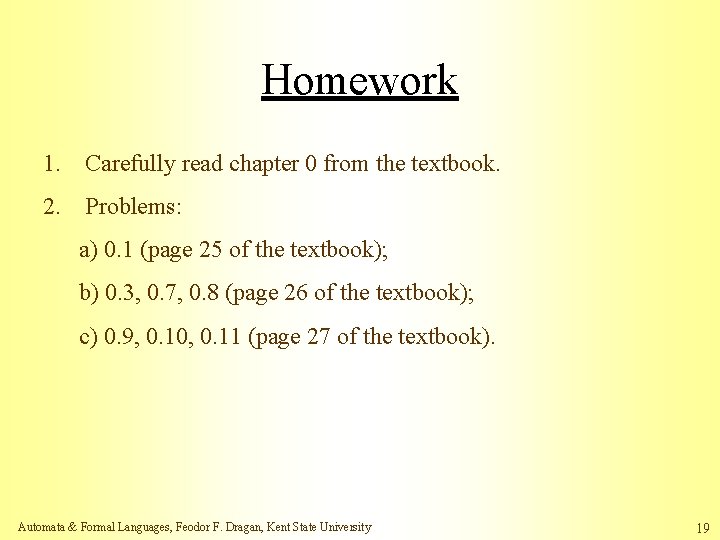
Homework 1. Carefully read chapter 0 from the textbook. 2. Problems: a) 0. 1 (page 25 of the textbook); b) 0. 3, 0. 7, 0. 8 (page 26 of the textbook); c) 0. 9, 0. 10, 0. 11 (page 27 of the textbook). Automata & Formal Languages, Feodor F. Dragan, Kent State University 19