
Introduction to Theory Its not as boring and
Introduction to Theory Its not as boring and useless as you might think
What is theory? • Not “ivory tower” BS that doesn’t apply to the “real world” • Quite to the contrary: Maahs’ cardinal rule of theory: – EVERY THEORY HAS A POLICY IMPLICATION • Corollary: Every policy implication is derived from a theory
Definition of a Theory • Set of statements that explain how and why concepts are related – In our case, what set of concepts explain crime? – Concept = abstract idea that can be measured or “operationalized”
How to recognize a good theory • Empirical Support – “Real world data” (observations) – Survey or Experiment • Other Criteria – Scope – Parsimony • A good theory explains a lot with a little

Micro and Macro • Micro level theories – Why do some individuals have a higher probability of committing crimes than others? • Biology, psychology, but also sociology • Individual differences, but also environment • Macro level theories – Why do some aggregates have a higher crime rate than others? • Mostly sociology, mostly “culture” or “social structure”
Barkan Example • Explaining Bulimia and Anorexia Disorders • Macro – Why “young women? ” Why higher rates of these disorders in certain countries? • Barbie doll culture? • Micro – Why, even in countries with high rates of the disorder, do most young women not have the disorder? • Effective parenting, high self-esteem…

Establishing Causation • X (Cause) precedes Y (effect) – Causal ordering • X statistically related to Y – Correlation (need not be perfect) • Relationship is not “spurious” – How to rule out spuriousness? • Experimental Designs • Survey Research and Statistical Control
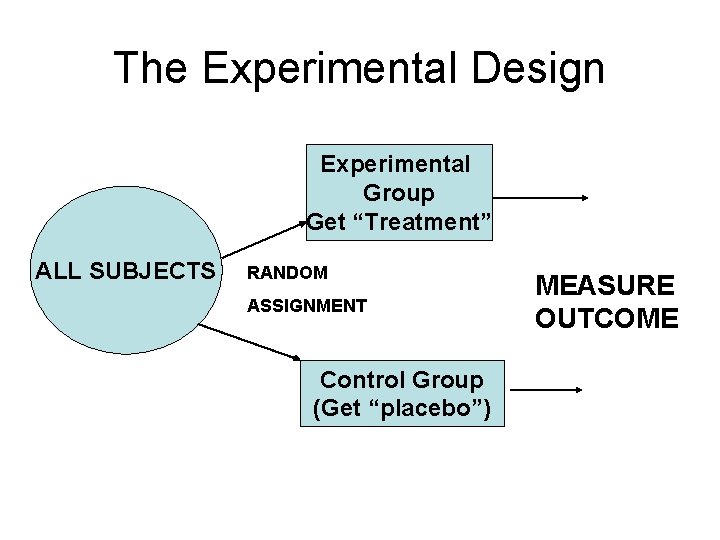
The Experimental Design Experimental Group Get “Treatment” ALL SUBJECTS RANDOM ASSIGNMENT Control Group (Get “placebo”) MEASURE OUTCOME
Statistical Control • Barkan Example: • Survey reveals that “pimple saturation” related to “time spent listening to rock music” – What would you want to control for? • “HOLDING CONSTANT” or “INDEPENDENT OF” • Similar: Survey reveals that abused children and likely to be violent when they reach adolescence

A Brief History of Criminological Theory • Prior to 1700 s, no real theory – Humans as “depraved” • Classical School (1750 s-late 1800 s) – Age of enlightenment (Locke, Rousseau) • Humans as “enlightened” (rational, hedonistic) • Utilitarian Thinkers – Beccaria (Italian Economist) On Crime and Punishment – Bentham (England): focus on English justice system
What killed the Classical School? • The percieved failure of classical school reforms – Changing legal code did not “cure” crime • Development of physical sciences – Darwin, Galileo, Newton • There are cause-effect relationships that can be deduced from observation and manipulation – August Compte • Apply this logic to the study of human behavior
The Positive School • 1900 -Present – Humans as “determined” – Determined by what? • Biology • Psychology • Sociology • Criticims of Positive School – Legal Definitions controlled by those in power – Overly “deterministic” – Criminals as “different” and “inferior”
Classical School II: Resurrection • Social Context of the 1970 s – Perceived failure of rehabilitation • “Neo-classical” theory – Deterrence theory, Rational Choice theory, Routine Activities Theory – These theories still compete with “positive” theories today.
- Slides: 13