
Introduction to the Semantic Web Jeff Heflin Lehigh
Introduction to the Semantic Web Jeff Heflin Lehigh University
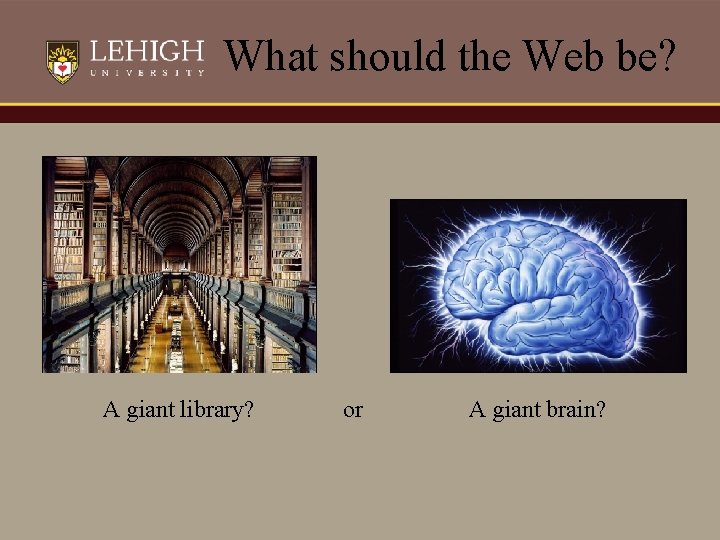
What should the Web be? A giant library? or A giant brain?
The Semantic Web u Definition – The Semantic Web is not a separate Web but an extension of the current one, in which information is given well-defined meaning, better enabling computers and people to work in cooperation. (Berners-Lee et al. , Scientific American, May 2001) u Ontology – a key component of the Semantic Web – ontologies define the semantics of the terms used in semistructured web pages » identify context, provide shared definitions » has a formal syntax and unambiguous semantics » usually includes a taxonomy, but typically much more – inference algorithms can compute what logically follows
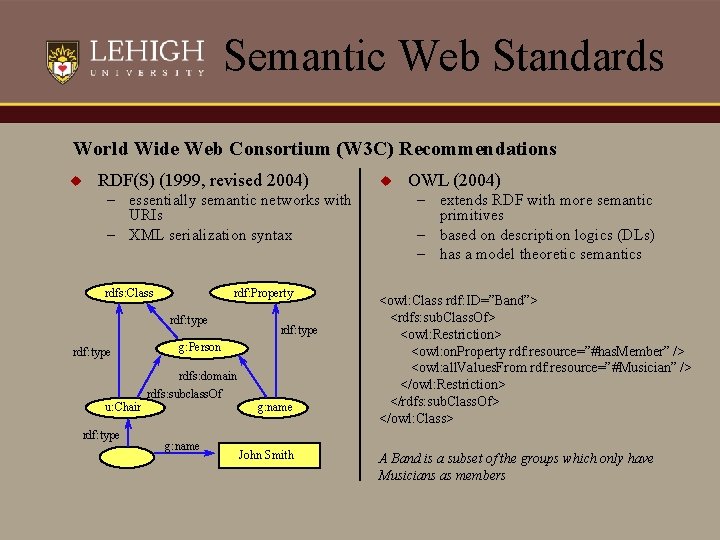
Semantic Web Standards World Wide Web Consortium (W 3 C) Recommendations u RDF(S) (1999, revised 2004) – essentially semantic networks with URIs – XML serialization syntax rdfs: Class rdf: Property rdf: type g: Person rdfs: domain rdfs: subclass. Of u: Chair rdf: type g: name John Smith u OWL (2004) – extends RDF with more semantic primitives – based on description logics (DLs) – has a model theoretic semantics <owl: Class rdf: ID=”Band”> <rdfs: sub. Class. Of> <owl: Restriction> <owl: on. Property rdf: resource=”#has. Member” /> <owl: all. Values. From rdf: resource=”#Musician” /> </owl: Restriction> </rdfs: sub. Class. Of> </owl: Class> A Band is a subset of the groups which only have Musicians as members
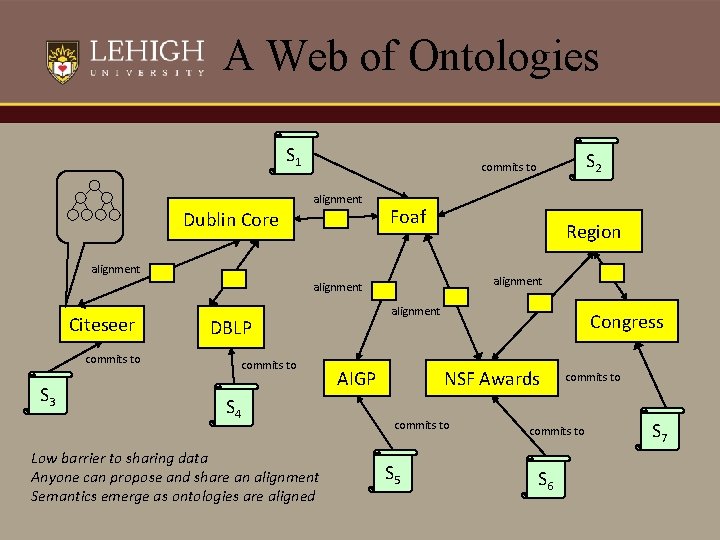
A Web of Ontologies S 1 alignment Dublin Core Foaf Region alignment Citeseer commits to S 3 S 2 commits to alignment DBLP commits to S 4 Low barrier to sharing data Anyone can propose and share an alignment Semantics emerge as ontologies are aligned AIGP Congress NSF Awards commits to S 5 commits to S 6 S 7
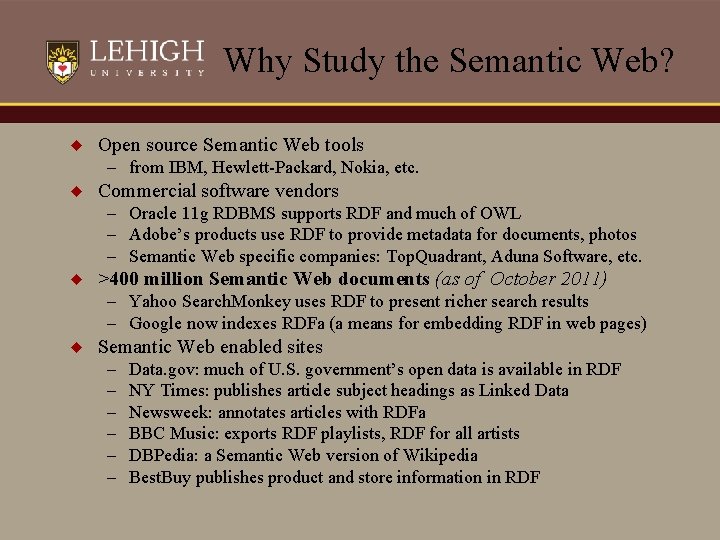
Why Study the Semantic Web? u Open source Semantic Web tools – from IBM, Hewlett-Packard, Nokia, etc. u Commercial software vendors – Oracle 11 g RDBMS supports RDF and much of OWL – Adobe’s products use RDF to provide metadata for documents, photos – Semantic Web specific companies: Top. Quadrant, Aduna Software, etc. u >400 million Semantic Web documents (as of October 2011) – Yahoo Search. Monkey uses RDF to present richer search results – Google now indexes RDFa (a means for embedding RDF in web pages) u Semantic Web enabled sites – – – Data. gov: much of U. S. government’s open data is available in RDF NY Times: publishes article subject headings as Linked Data Newsweek: annotates articles with RDFa BBC Music: exports RDF playlists, RDF for all artists DBPedia: a Semantic Web version of Wikipedia Best. Buy publishes product and store information in RDF
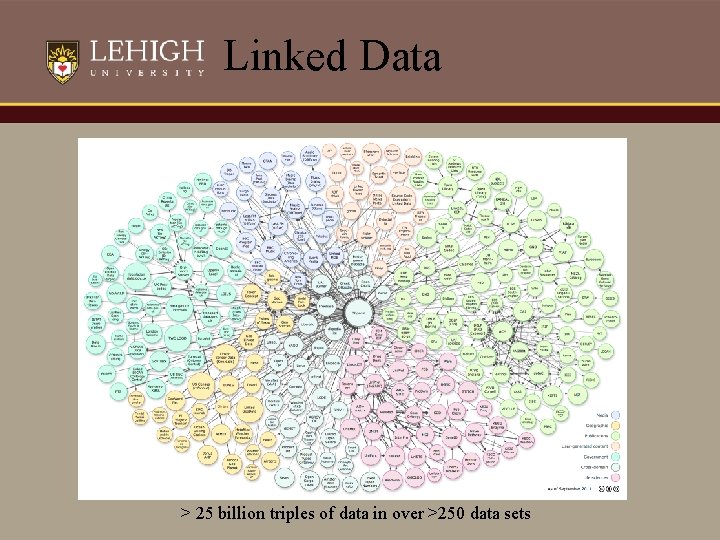
Linked Data > 25 billion triples of data in over >250 data sets

The End 8 of 30
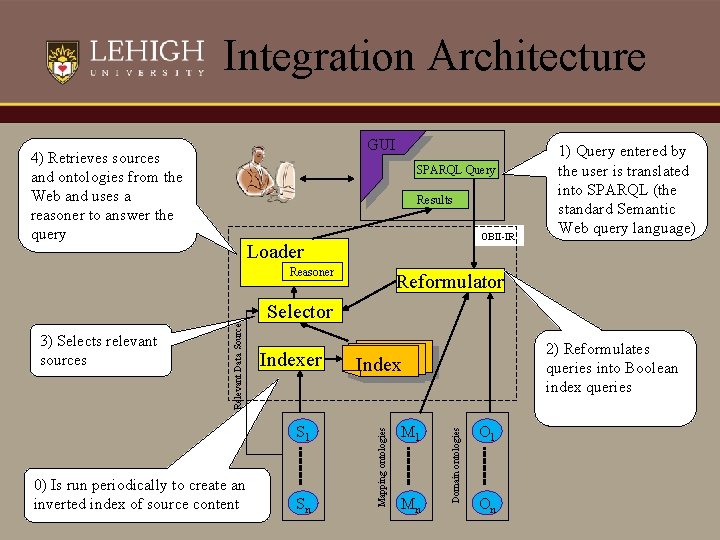
Integration Architecture GUI 4) Retrieves sources and ontologies from the Web and uses a reasoner to answer the query SPARQL Query Results OBII-IR Loader Reasoner 1) Query entered by the user is translated into SPARQL (the standard Semantic Web query language) Reformulator S 1 0) Is run periodically to create an inverted index of source content Sn 2) Reformulates queries into Boolean index queries Index M 1 Mn Domain ontologies Indexer Mapping ontologies 3) Selects relevant sources Relevant Data Source Selector O 1 On
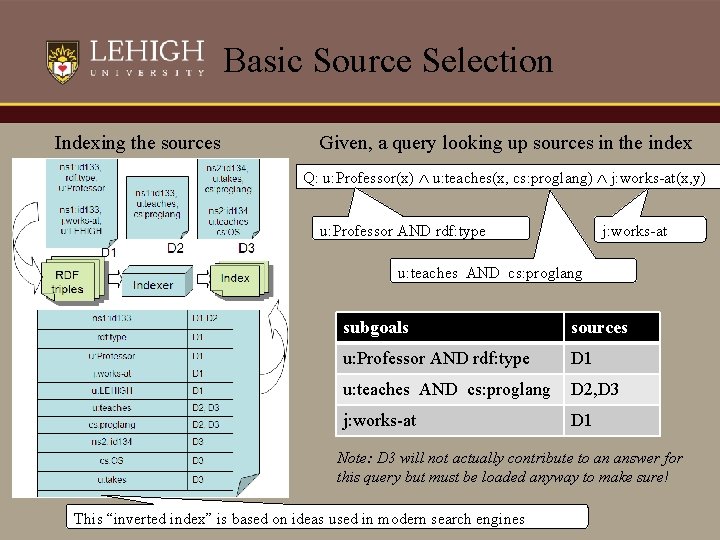
Basic Source Selection Indexing the sources Given, a query looking up sources in the index Q: u: Professor(x) u: teaches(x, cs: proglang) j: works-at(x, y) u: Professor AND rdf: type j: works-at u: teaches AND cs: proglang subgoals sources u: Professor AND rdf: type D 1 u: teaches AND cs: proglang D 2, D 3 j: works-at D 1 Note: D 3 will not actually contribute to an answer for this query but must be loaded anyway to make sure! This “inverted index” is based on ideas used in modern search engines
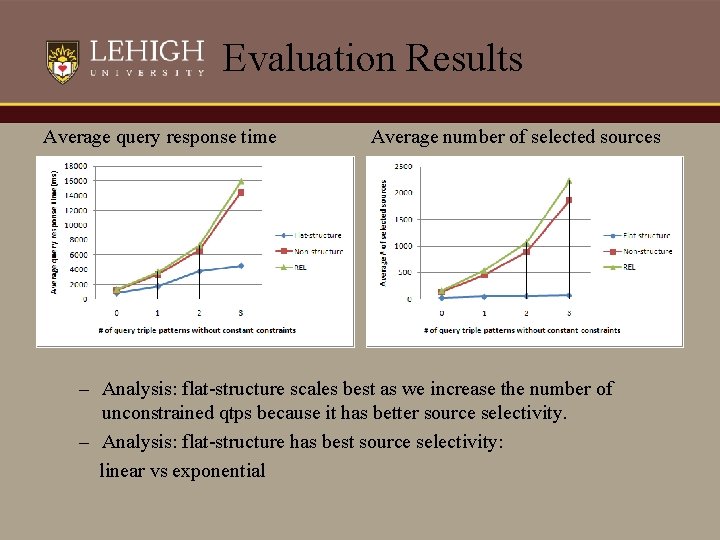
Evaluation Results Average query response time Average number of selected sources – Analysis: flat-structure scales best as we increase the number of unconstrained qtps because it has better source selectivity. – Analysis: flat-structure has best source selectivity: linear vs exponential
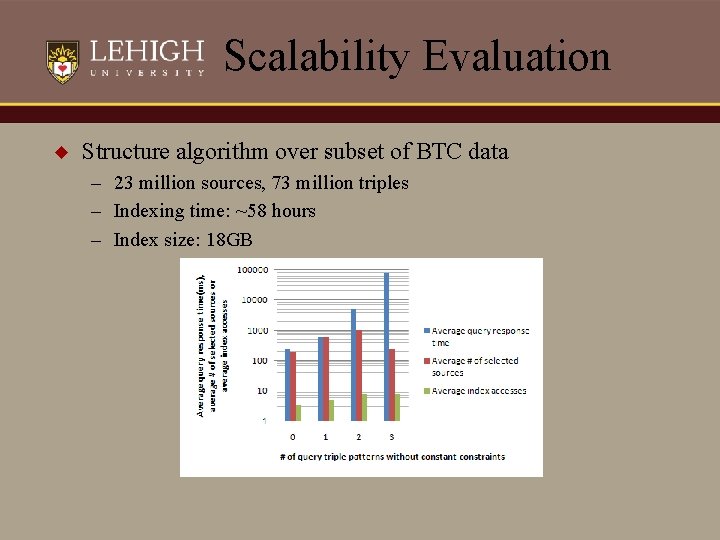
Scalability Evaluation u Structure algorithm over subset of BTC data – 23 million sources, 73 million triples – Indexing time: ~58 hours – Index size: 18 GB
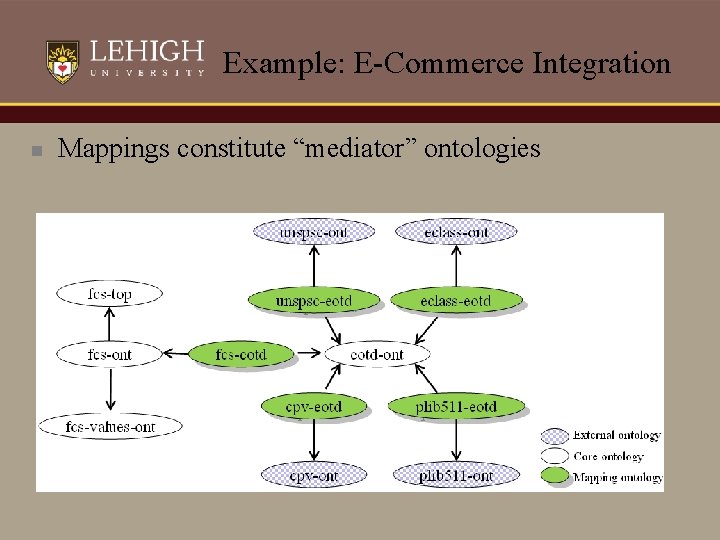
Example: E-Commerce Integration n Mappings constitute “mediator” ontologies
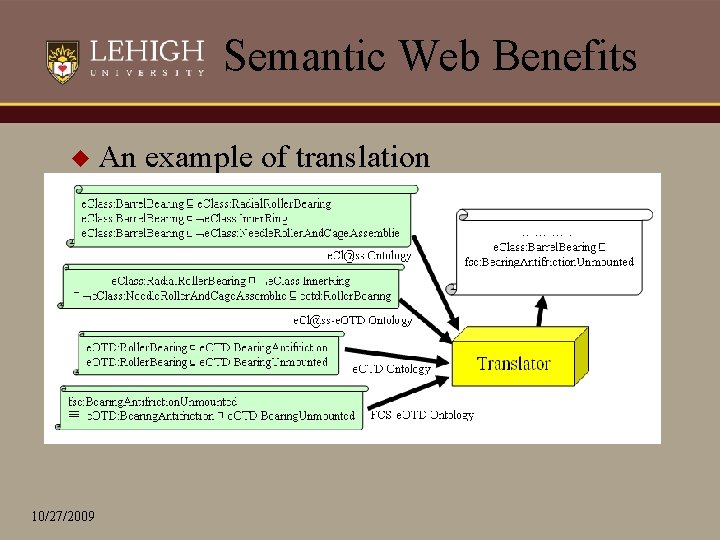
Semantic Web Benefits u 10/27/2009 An example of translation
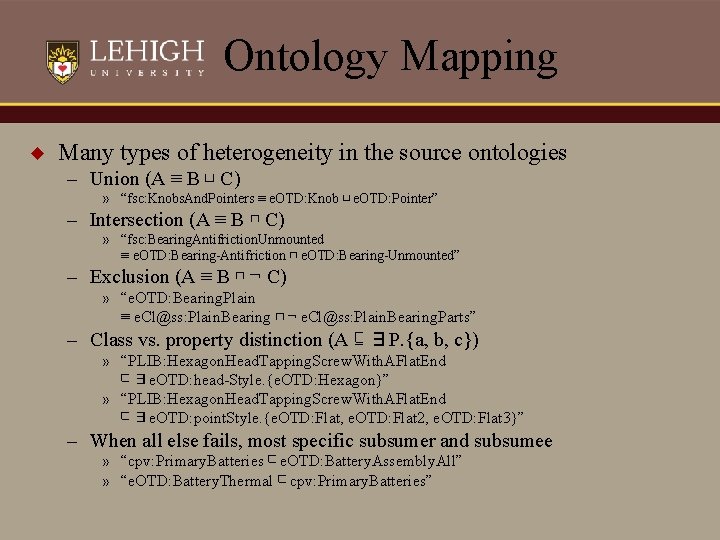
Ontology Mapping u Many types of heterogeneity in the source ontologies – Union (A ≡ B ⊔ C) » “fsc: Knobs. And. Pointers ≡ e. OTD: Knob ⊔ e. OTD: Pointer” – Intersection (A ≡ B ⊓ C) » “fsc: Bearing. Antifriction. Unmounted ≡ e. OTD: Bearing-Antifriction ⊓ e. OTD: Bearing-Unmounted” – Exclusion (A ≡ B ⊓ ¬ C) » “e. OTD: Bearing. Plain ≡ e. Cl@ss: Plain. Bearing ⊓ ¬ e. Cl@ss: Plain. Bearing. Parts” – Class vs. property distinction (A ⊑ ∃P. {a, b, c}) » “PLIB: Hexagon. Head. Tapping. Screw. With. AFlat. End ⊑ ∃e. OTD: head-Style. {e. OTD: Hexagon}” » “PLIB: Hexagon. Head. Tapping. Screw. With. AFlat. End ⊑ ∃e. OTD: point. Style. {e. OTD: Flat, e. OTD: Flat 2, e. OTD: Flat 3}” – When all else fails, most specific subsumer and subsumee » “cpv: Primary. Batteries ⊑ e. OTD: Battery. Assembly. All” » “e. OTD: Battery. Thermal ⊑ cpv: Primary. Batteries”
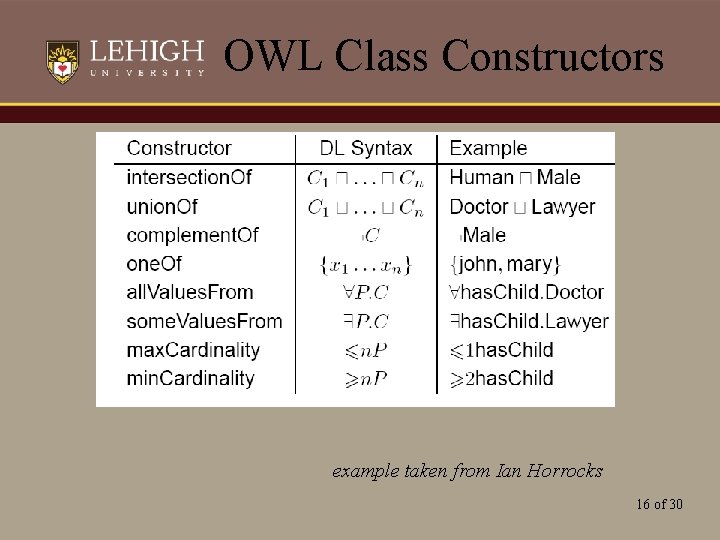
OWL Class Constructors example taken from Ian Horrocks 16 of 30
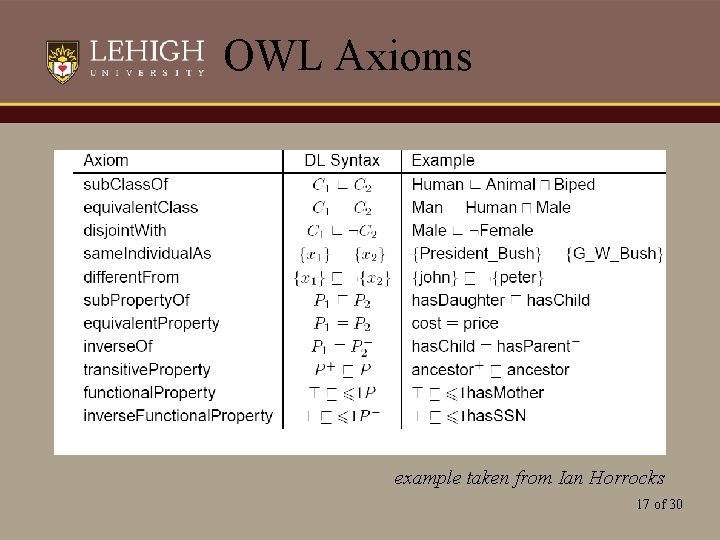
OWL Axioms example taken from Ian Horrocks 17 of 30
- Slides: 17