
INTRODUCTION TO THE RESEARCH PROCESS A Paper Presented











- Slides: 22
INTRODUCTION TO THE RESEARCH PROCESS A Paper Presented by Dr. Helen M. Byamugisha Associate Library Professor/ University Librarian Makerere University
PRESENTATION OUTLINE • Introduction • Definition of Research • The Research Process • Elements and Components of a Research Paper
INTRODUCTION • Many people who are beginning the research journey assume that it is just a ‘hard thing to do’. • They often say that research is simply a ‘difficult task to accomplish’. • After hearing ‘ugly stories’ from colleagues, beginning researchers are usually scared of the mention of the word research!! • Former graduate students may complain of how: • the defense of the dissertation or thesis was hard, • the supervisor was very bad and nearly failed the candidate, • the panel was very biased towards certain questions,
INTRODUCTION CONTIN… • the process of collecting data was not easy and • the use of the computer to analyze the data was just hell! It is these biases which scare beginners of research to label research as a very difficult venture. While research can be difficult because of internal and external factors, it is not as difficult as some researchers think. The rules are set by the researchers themselves. A student: Øselects his or her own problem of investigation, Ødesigns the research questions, Ødesigns the study, Øselects the population and determines the sample
INTRODUCTION CONTIN… Ødesigns the data collection instruments, Øcollects the data, Øanalyses the data and Ø reports the results. All these are done under the guidance of the supervisors and following the institutional guidelines.
WHAT IS RESEARCH? Research is the scientific process of collecting, organizing, analyzing and reporting data. • A continued search for new knowledge and understanding of the world around us. • An attempt to provide dependable and useful answers or solutions to questions, issues or problems. • A measure of solving a naughty problem; a way of thinking or looking at facts; problem solving by pushing back the frontiers of knowledge. • Systematic investigation designed to answer a question
WHAT IS RESEARCH? • Research simply means a search for facts or answers to the questions we ask, it means seeking solutions to the problems. • It is a purposive investigation. • It is an organized inquiry. It seeks to find explanations to unexplained phenomenon, to clarify the doubtful facts and to correct the misconceived facts. • Ordinarily, the search for answers to the questions we pose can be obtained in two main ways: 1. Arbitrary, crude or rudimentary methods. This involves imaginations, opinion, blind belief or impression. This method of gathering facts has incurable weaknesses. It is subjective, the findings will vary from one person to another depending on his or her impression
WHAT IS RESEARCH? 2. Scientific, logic, systematic methods. This involves a systematic rational approach to seeking facts and it eliminates the incurable effect of the above method. This method is objective, precise and it arrives at conclusions on the basis of verifiable facts.
REFLECTION Research is to see what everybody else has seen and to think what nobody else has thought. Albert Szent-Gyorgyi
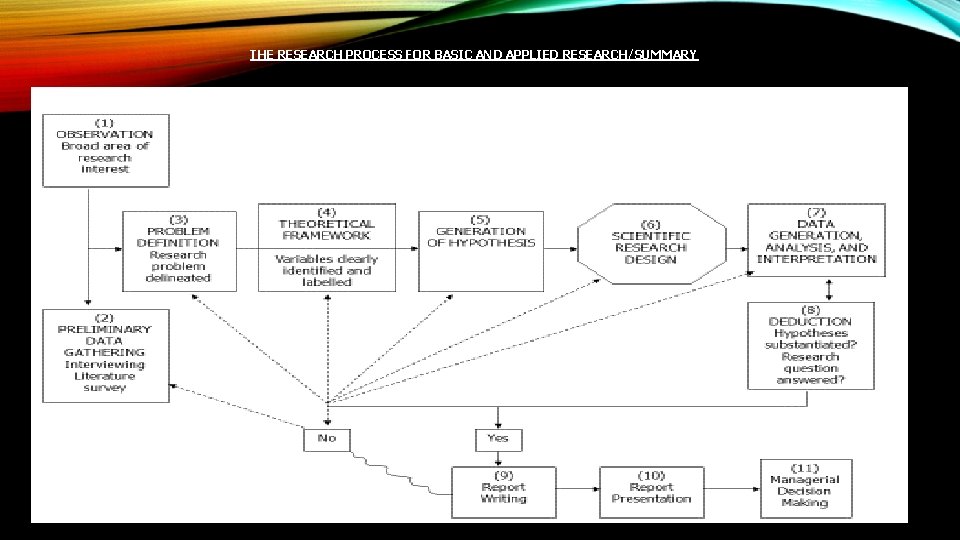
THE RESEARCH PROCESS Research is a process through which we attempt to achieve the resolution of a problem, or a greater understanding of a phenomenon. This process has eight distinct characteristics. Characteristics of a research process • It originates with a question or problem. • It requires a clear articulation of a goal. • It follows a specific plan of procedure. • It is guided by the specific research problem, question, or hypothesis. • It accepts certain critical assumptions. • Research requires the collection and Interpretation of data in attempting to resolve the problem that initiated the research.
THE RESEARCH PROCESS - CYCLIC • • Problem identification Research objectives/questions/hypotheses that further clarify the research problem. Review of related literature Methodology (research design, population, sampling methods and sample size, data collection methods and instruments. ) Data collection Data analysis (Presentation, discussion and interpretation); Writing report/Dissemination Research is, by its nature, cyclical.
THE RESEARCH PROCESS FOR BASIC AND APPLIED RESEARCH/SUMMARY
ELEMENTS OF A SUCCESSFUL RESEARCH PAPER Writing a successful research paper is not easy work • • No shortcuts to be taken as one sits down to: Øchoose a topic, Øconduct research, Ø determine methodology, Ø organize (and outline) thoughts, Øform arguments or interpretations, cite sources, write the first draft, and, finally, apply the necessary revisions. • No need to be anxious with a research paper assignment! • With a good understanding of the elements of a successful research paper, the process can be made a whole lot easier and simpler.
IDENTIFYING A RESEARCH TOPIC Researcher’s interests Relevancy to area of specialization Researcher’s competence Resource envelope Funders Topic not over-researched Importance and urgency Not reproducing other works (plagiarism)
ELEMENTS OF A SUCCESSFUL RESEARCH PAPER A Successful Research Paper is a SMART one • SMART is a good way to remember the fundamentals of research paper writing, and to help prepare an author in writing a successful research paper. • S= Specific: A research paper should be specific. It should maintain its focus on the given subject of research - answering a specific research question - and not be inconsistent or aimless as to convey information or make claims on other, unrelated topics or subjects.
ELEMENTS OF A SUCCESSFUL RESEARCH PAPER M=Measurable: must contain specific, proven research, and cites all research sources and related literature. A=Attainable: must answer the research question and should contribute to the knowledge of the given subject. It cannot propose to answer a question that does not relate to real life or is not based on an existing body of knowledge. R= Realistic: A research paper is objective and realistic. It should be based on valid evidence from reliable sources. T= Time A research paper can not be written without the researcher knowing the limits, timeframes, and focus of the required work. Without the writer / researcher stating the scope and limitations of the research paper, thesis statement will be hampered by an inability to answer the given research question or focus on the given research subject.
COMPONENTS OF A RESEARCH PAPER • There are standard components that a researcher may have to understand. Title • The title page, with the alignment of the actual title of the paper typically centered. • Should summarize the main idea of the article. Author (s) – names and institutional affiliation (s) listed. Abstract – a brief comprehensive summary of the contents of the article.
COMPONENTS OF A RESEARCH PAPER Introduction – State the reason for the research: üProvides the context and a situational analysis of the research topic at hand. üexplain why the research subject was chosen, and what the relevance or rationale is of undertaking research on the subject (show your reasons and passion, too!) ü identifies discusses findings of other scholars; üincludes a review of literature ü this is where the research question and hypothesis are stated.
COMPONENTS OF A RESEARCH PAPER Methodology (i) Describes the research design, methodology, population or study sample. (ii) Data collection methods – describe the method (s) used to gather information or data collection (iii) Measures: describe the means used for measuring or measures • This part states and explains the process by which data, results, and evidence are collected, organized, and analyzed. • If the methodology of the research paper is based on previous research literature, make sure that such literature is still valid and up-to-date. Research founded on outdated or disapproved material weakens credibility and makes proving something successfully more difficult.
COMPONENTS OF A RESEARCH PAPER Results and Discussion: • Summarizes the results and presents findings using text (quotations), charts, graphs, illustrations, tables and additional supporting evidence. • Methodology and findings are followed through; with a smooth transition to reporting, analyzing, discussing, and substantiating the results. • Write in a way that captures and sustains the attention of the reader. When using quotations, do so accurately and cite the sources of the quotations in the references section. Conclusion • This summarizes the results and major findings. • Do not include in the conclusion anything that has not been brought up in the results and discussion components.
COMPONENTS OF A RESEARCH PAPER References / Bibliography • An alphabetical listing of works that were cited and used to support the research is made. • Cites all the references made in the paper to other research studies and sources of information, be it by way of testimony, statistics, direct quotes, and paraphrased information. • Vital that every reference is recorded: doing so adds credibility and discipline to the paper. Acknowledgement Acknowledges individuals, institutions and organizations that supported the research.
THE END THANK YOU FOR LISTENING TO ME