
Introduction to the physics of the Quark Gluon
![High Energy Heavy Ion Collision Facilities Accelerator Lab. Ebeam [AGe. V] AGS (’ 80](https://slidetodoc.com/presentation_image_h/1b03b11ca84e55c4ac3ddcdbf4bbc44a/image-14.jpg "High Energy Heavy Ion Collision Facilities Accelerator Lab. Ebeam [AGe. V] AGS (’ 80")
![The Several Probes [Romatschke], [Snellings], [Beraudo] Initial Conditions Quark-Gluon Plasma Hadronization BULK (p. T~T)](https://slidetodoc.com/presentation_image_h/1b03b11ca84e55c4ac3ddcdbf4bbc44a/image-21.jpg "The Several Probes [Romatschke], [Snellings], [Beraudo] Initial Conditions Quark-Gluon Plasma Hadronization BULK (p. T~T)")
- Slides: 29
Introduction to the physics of the Quark. Gluon Plasma and the relativistic heavy-ion collisions Villa Gualino-Torino, 7 -3 -2011
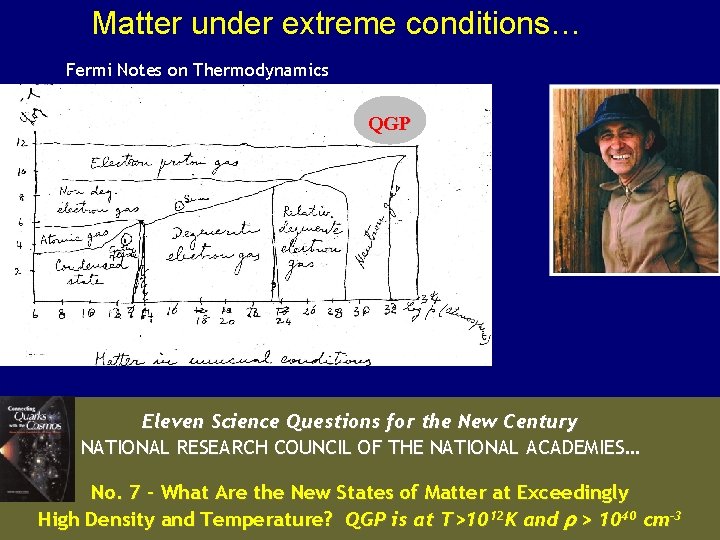
Matter under extreme conditions… Fermi Notes on Thermodynamics QGP Eleven Science Questions for the New Century NATIONAL RESEARCH COUNCIL OF THE NATIONAL ACADEMIES… No. 7 - What Are the New States of Matter at Exceedingly High Density and Temperature? QGP is at T>1012 K and r > 1040 cm-3
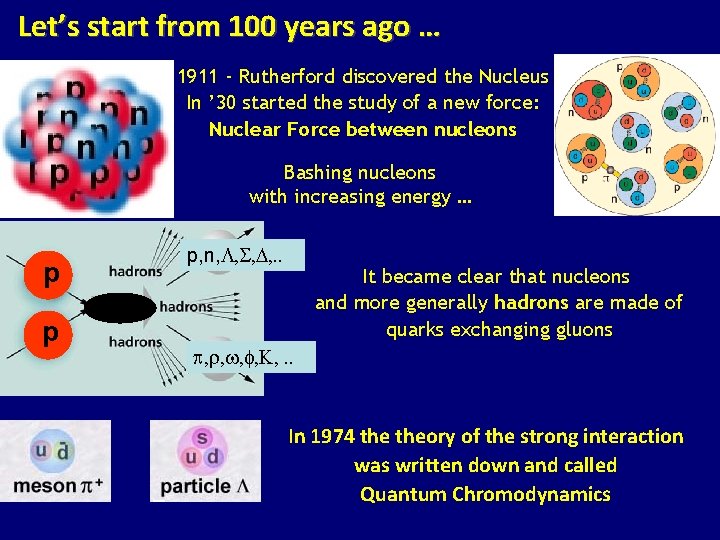
Let’s start from 100 years ago … 1911 - Rutherford discovered the Nucleus In ’ 30 started the study of a new force: Nuclear Force between nucleons Bashing nucleons with increasing energy … p p p, n, L, S, D, . . It became clear that nucleons and more generally hadrons are made of quarks exchanging gluons p, r, w, f, K, . . In 1974 theory of the strong interaction was written down and called Quantum Chromodynamics
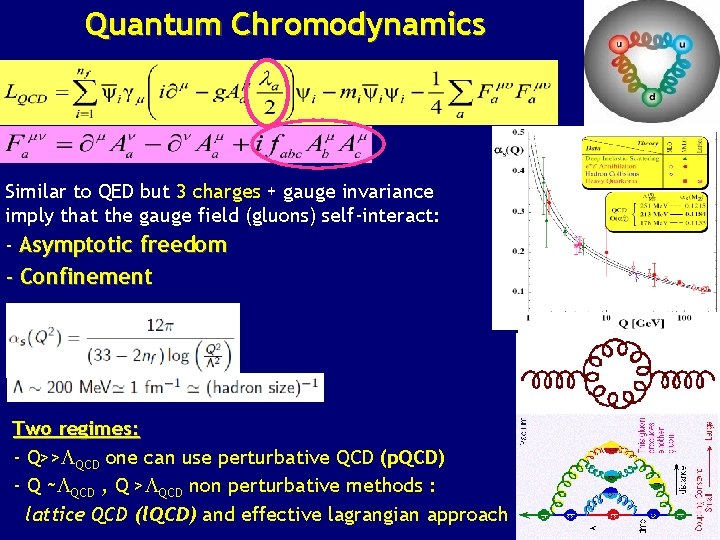
Quantum Chromodynamics electric charge Similar to QED but 3 charges + gauge invariance imply that the gauge field (gluons) self-interact: - Asymptotic freedom - Confinement colour charge Two regimes: - Q>>LQCD one can use perturbative QCD (p. QCD) - Q ~LQCD , Q >LQCD non perturbative methods : lattice QCD (l. QCD) and effective lagrangian approach
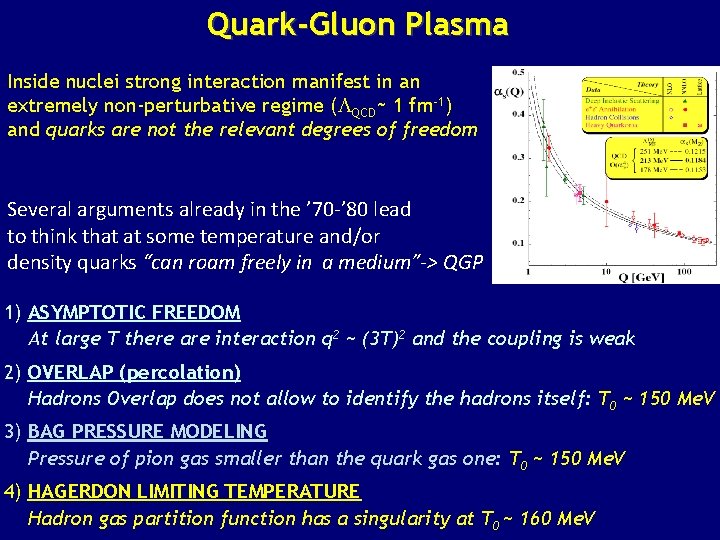
Quark-Gluon Plasma Inside nuclei strong interaction manifest in an extremely non-perturbative regime (LQCD~ 1 fm-1) and quarks are not the relevant degrees of freedom Several arguments already in the ’ 70 -’ 80 lead to think that at some temperature and/or density quarks “can roam freely in a medium”-> QGP 1) ASYMPTOTIC FREEDOM At large T there are interaction q 2 ~ (3 T)2 and the coupling is weak 2) OVERLAP (percolation) Hadrons Overlap does not allow to identify the hadrons itself: T 0 ~ 150 Me. V 3) BAG PRESSURE MODELING Pressure of pion gas smaller than the quark gas one: T 0 ~ 150 Me. V 4) HAGERDON LIMITING TEMPERATURE Hadron gas partition function has a singularity at T 0 ~ 160 Me. V
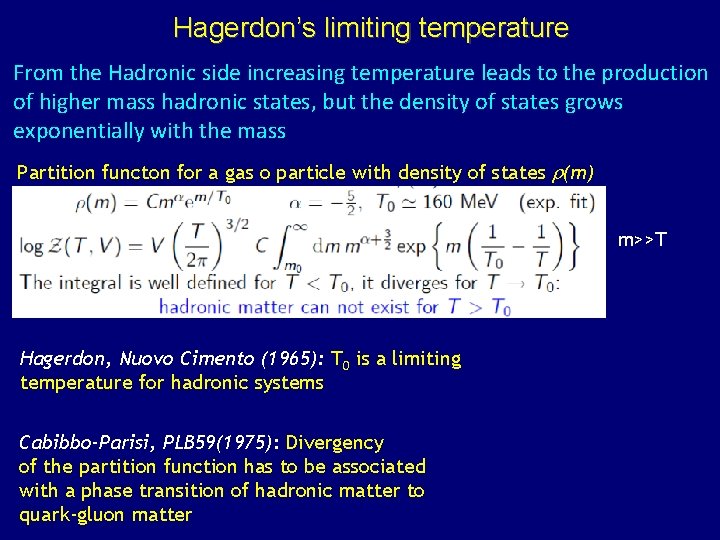
Hagerdon’s limiting temperature From the Hadronic side increasing temperature leads to the production of higher mass hadronic states, but the density of states grows exponentially with the mass Partition functon for a gas o particle with density of states r(m) m>>T Hagerdon, Nuovo Cimento (1965): T 0 is a limiting temperature for hadronic systems Cabibbo-Parisi, PLB 59(1975): Divergency of the partition function has to be associated with a phase transition of hadronic matter to quark-gluon matter
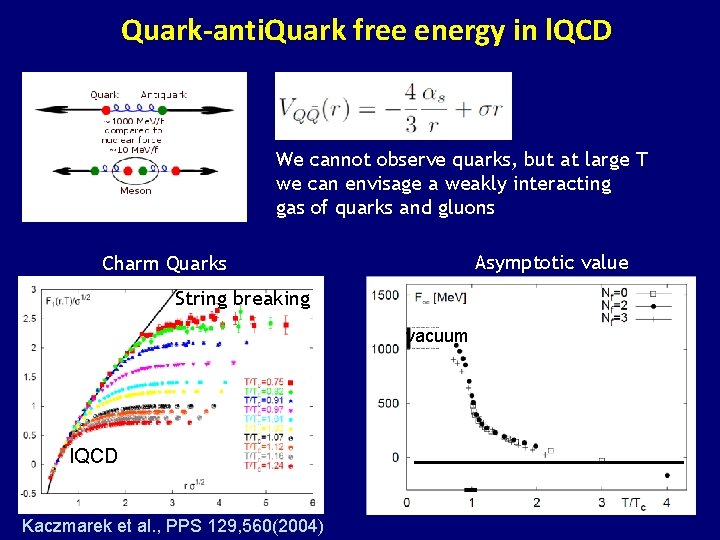
Quark-anti. Quark free energy in l. QCD We cannot observe quarks, but at large T we can envisage a weakly interacting gas of quarks and gluons Asymptotic value Charm Quarks String breaking vacuum l. QCD Kaczmarek et al. , PPS 129, 560(2004)
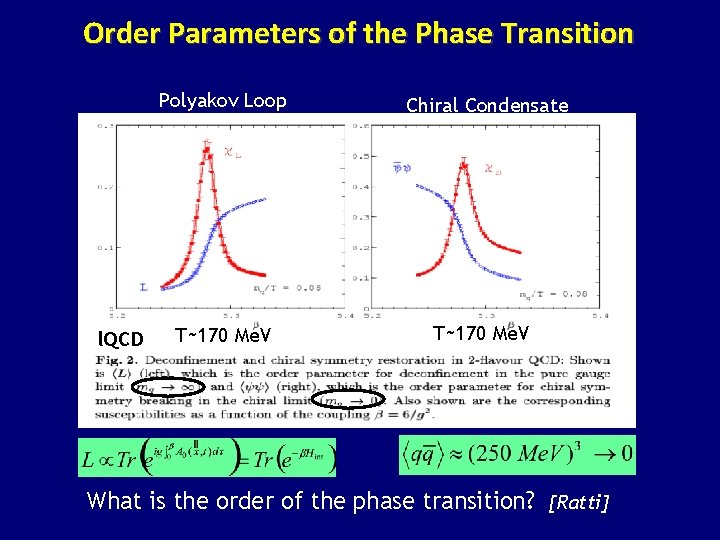
Order Parameters of the Phase Transition l. QCD Polyakov Loop Chiral Condensate T~170 Me. V What is the order of the phase transition? [Ratti]
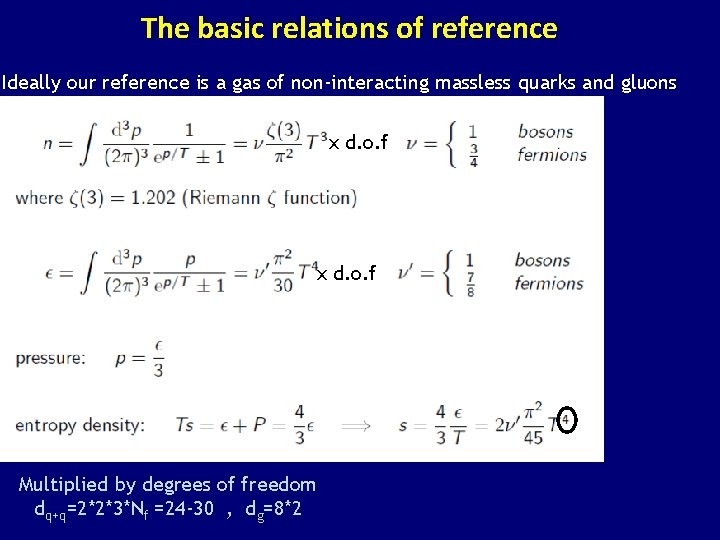
The basic relations of reference Ideally our reference is a gas of non-interacting massless quarks and gluons x d. o. f Multiplied by degrees of freedom dq+q=2*2*3*Nf =24 -30 , dg=8*2
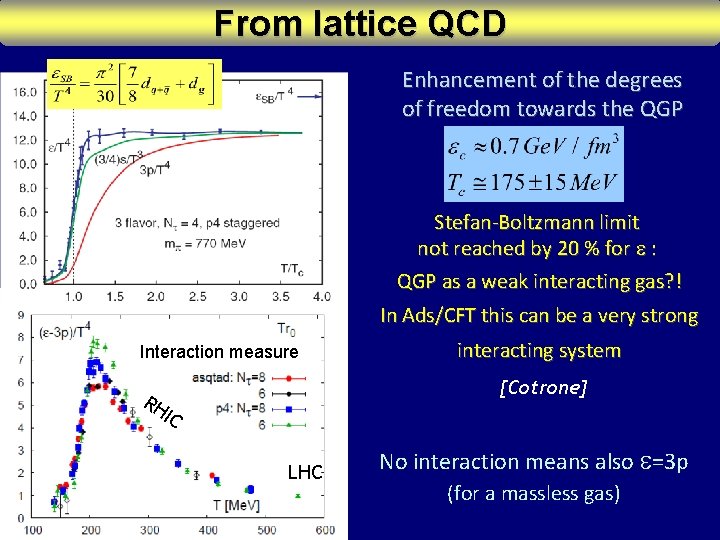
From lattice QCD Enhancement of the degrees of freedom towards the QGP RHIC Stefan-Boltzmann limit not reached by 20 % for e : QGP as a weak interacting gas? ! m. B=0 In Ads/CFT this can be a very strong Interaction measure interacting system [Cotrone] RH IC LHC No interaction means also e=3 p (for a massless gas)
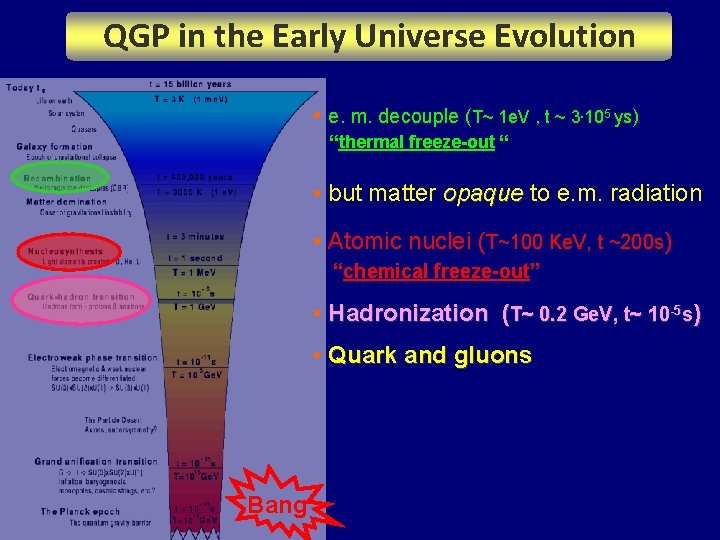
QGP in the Early Universe Evolution • e. m. decouple (T~ 1 e. V , t ~ 3. 105 ys) “thermal freeze-out “ • but matter opaque to e. m. radiation • Atomic nuclei (T~100 Ke. V, t ~200 s) “chemical freeze-out” • Hadronization (T~ 0. 2 Ge. V, t~ 10 -5 s) • Quark and gluons Bang
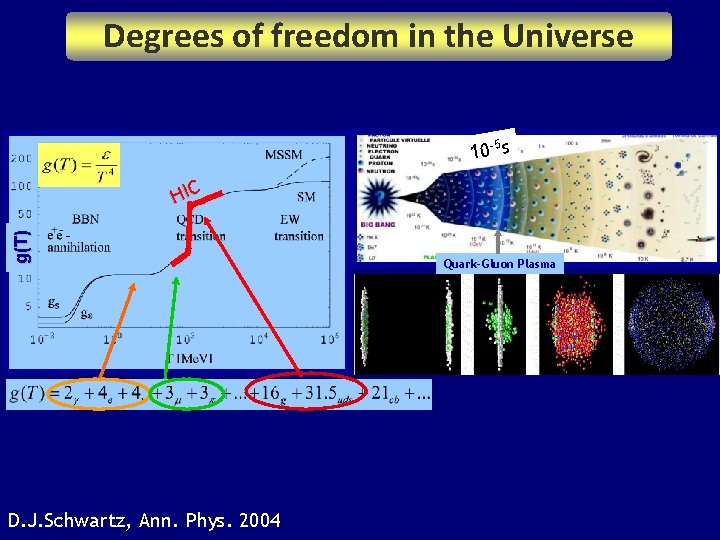
Degrees of freedom in the Universe 5 10 - s g(T) HIC D. J. Schwartz, Ann. Phys. 2004 Quark-Gluon Plasma
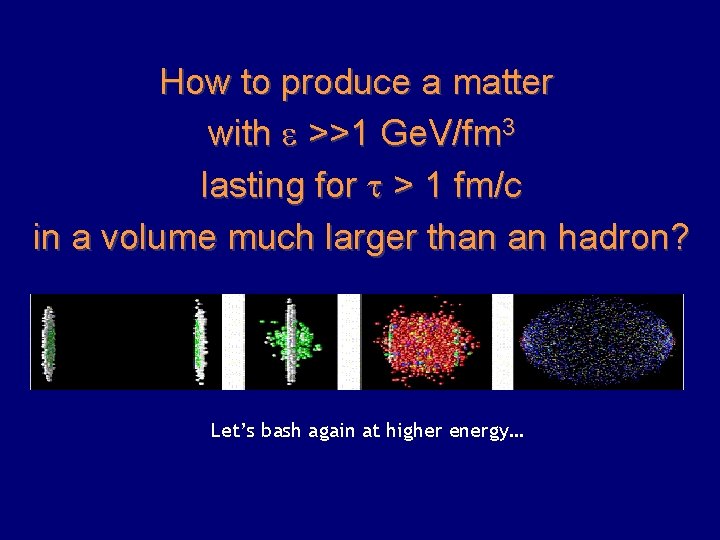
How to produce a matter with e >>1 Ge. V/fm 3 lasting for t > 1 fm/c in a volume much larger than an hadron? Let’s bash again at higher energy…
High Energy Heavy Ion Collision Facilities Accelerator Lab. Ebeam [AGe. V] AGS (’ 80 s) BNL 10 (*) 4. 5 2 SPS (94 -…) CERN 160(*) 17. 3 9 RHIC (00 -…) BNL 100 +100 200 100 LHC (09 -…) CERN 2750+2750 5500 Fixed target Contrac tion 2750 Max energy density complete stopping Collider RHIC -> emax~ 102 Ge. V/fm 3 LHC -> emax~ 3 103 Ge. V/fm 3
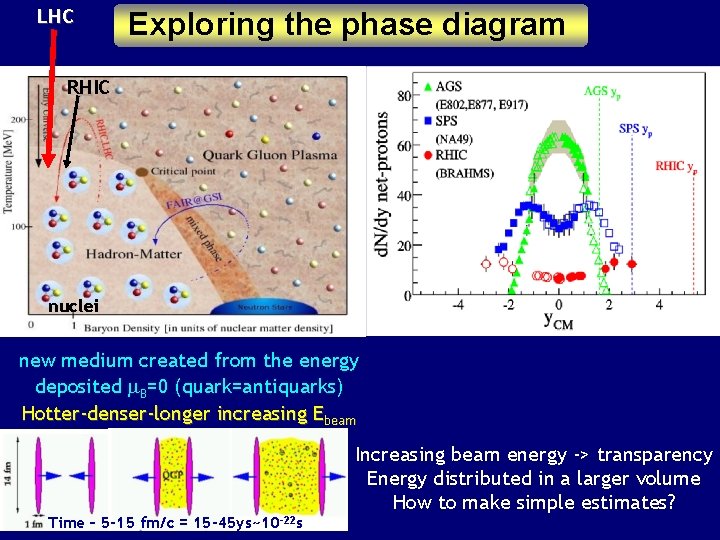
LHC Exploring the phase diagram RHIC SPS nuclei new medium created from the energy deposited m. B=0 (quark=antiquarks) Hotter-denser-longer increasing Ebeam Time – 5 -15 fm/c = 15 -45 ys~10 -22 s Increasing beam energy -> transparency Energy distributed in a larger volume How to make simple estimates?
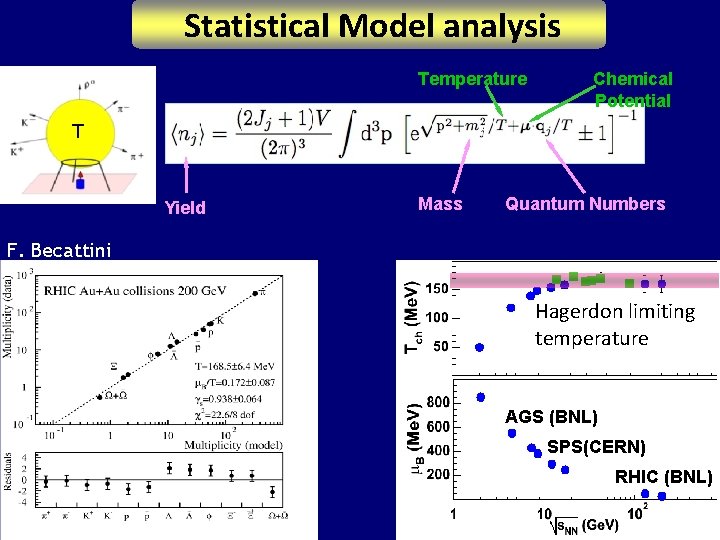
Statistical Model analysis Temperature Chemical Potential T Yield Mass Quantum Numbers F. Becattini Hagerdon limiting temperature AGS (BNL) SPS(CERN) RHIC (BNL)
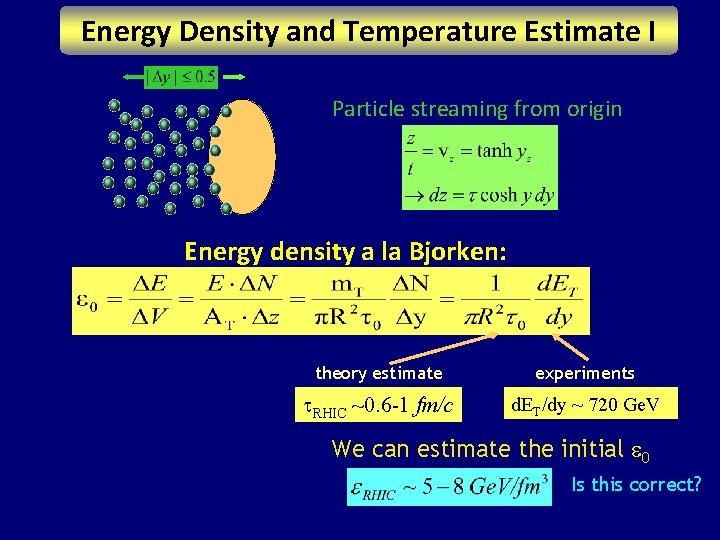
Energy Density and Temperature Estimate I Particle streaming from origin Energy density a la Bjorken: theory estimate experiments t. RHIC ~0. 6 -1 fm/c d. ET/dy ~ 720 Ge. V We can estimate the initial e 0 Is this correct?
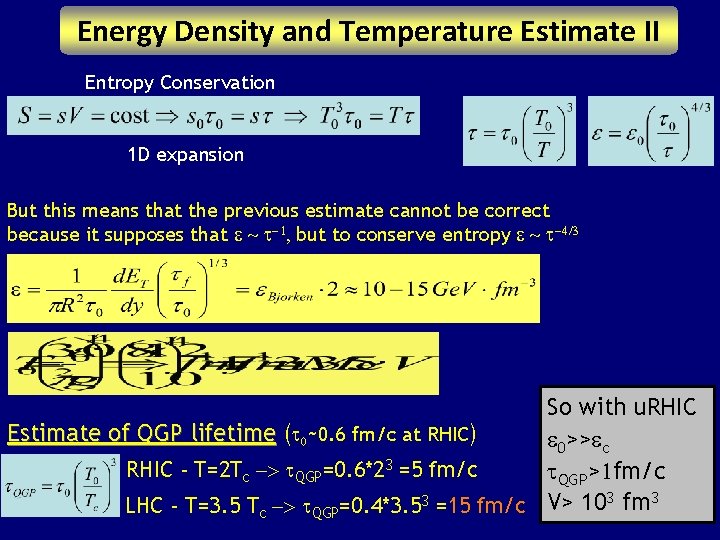
Energy Density and Temperature Estimate II Entropy Conservation 1 D expansion But this means that the previous estimate cannot be correct because it supposes that e ~ t-1, but to conserve entropy e ~ t-4/3 So with u. RHIC Estimate of QGP lifetime (t 0~0. 6 fm/c at RHIC) e 0>>ec RHIC - T=2 Tc -> t. QGP=0. 6*23 =5 fm/c t. QGP>1 fm/c LHC - T=3. 5 Tc -> t. QGP=0. 4*3. 53 =15 fm/c V> 103 fm 3
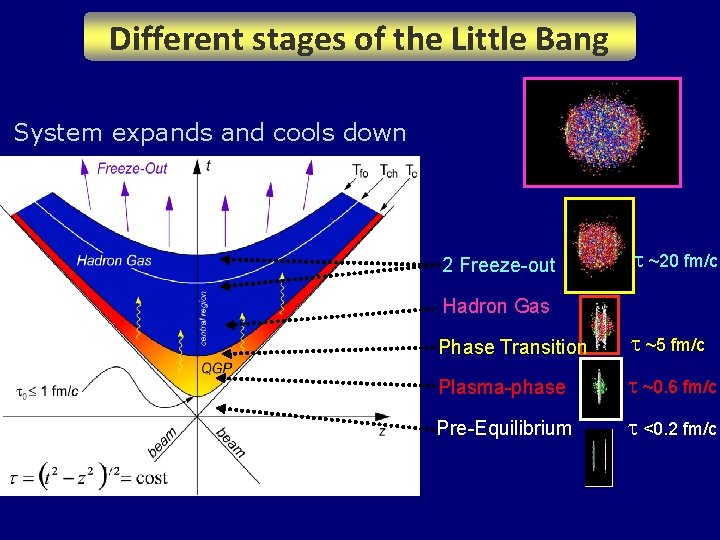
Different stages of the Little Bang System expands and cools down 2 Freeze-out t ~20 fm/c Hadron Gas Phase Transition t ~5 fm/c Plasma-phase t ~0. 6 fm/c Pre-Equilibrium t <0. 2 fm/c
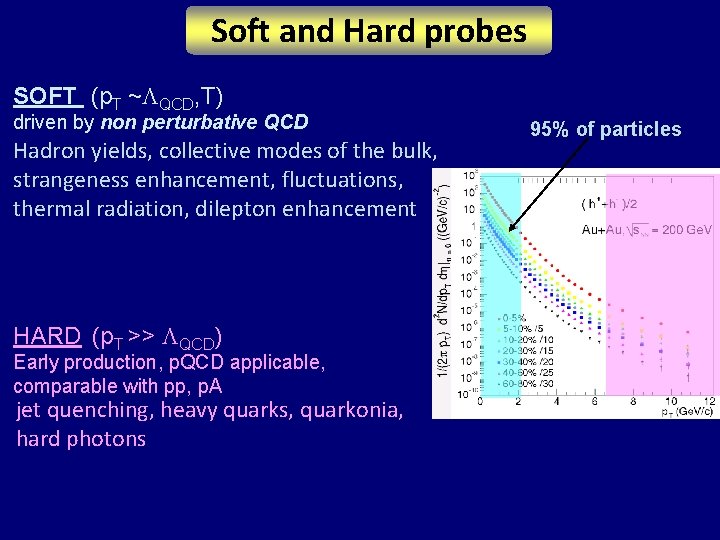
Soft and Hard probes SOFT (p. T ~LQCD, T) driven by non perturbative QCD Hadron yields, collective modes of the bulk, strangeness enhancement, fluctuations, thermal radiation, dilepton enhancement HARD (p. T >> LQCD) Early production, p. QCD applicable, comparable with pp, p. A jet quenching, heavy quarks, quarkonia, hard photons 95% of particles
The Several Probes [Romatschke], [Snellings], [Beraudo] Initial Conditions Quark-Gluon Plasma Hadronization BULK (p. T~T) CGC (x<<1) Gluon saturation [Albacete] MINIJETS (p. T>>T, LQCD) [Bruna] Heavy Quarks (mq>>T, LQCD) [Arnaldi] Microscopic Mechanism Matters! [Becattini] [Blume] § Initial Condition – “exotic” non equilibrium CGC § Bulk – Hydrodynamics BUT finite viscosities (h, z) § Minijets – perturbative QCD BUT strong Jet-Bulk “talk” § Heavy Quarks – Brownian motion (? ) BUT strongly dragged by the Bulk § Quarkonia – Are suppressed (only resonances? ) or regenerated § Hadronization – Microscopic mechanism can modify QGP observables
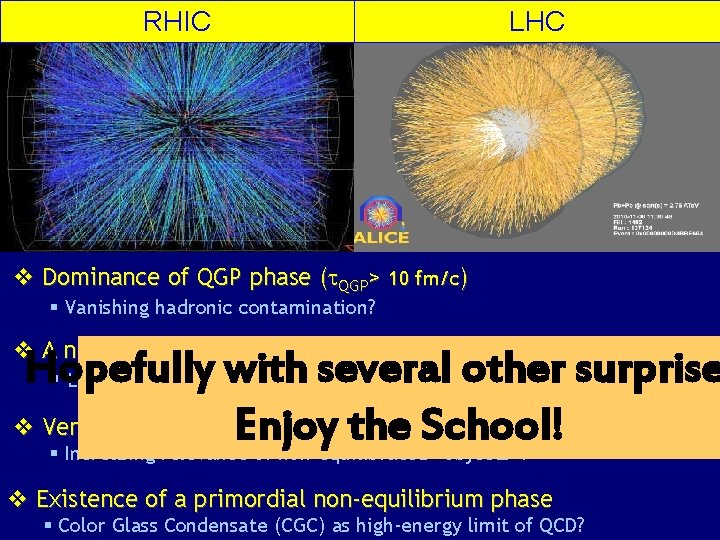
RHIC LHC v Dominance of QGP phase (t. QGP> 10 fm/c) § Vanishing hadronic contamination? v A new QGP phase: perturbative plasma? § Larger h/s we get close to the p. QCD estimates? Hopefully with several other surprise v Very large yield of. Enjoy heavy quark (m >>T ) and jets (p >>T) the School! § Increasing relevance of non-equilibrated “objects”! q v Existence of a primordial non-equilibrium phase T § Color Glass Condensate (CGC) as high-energy limit of QCD?
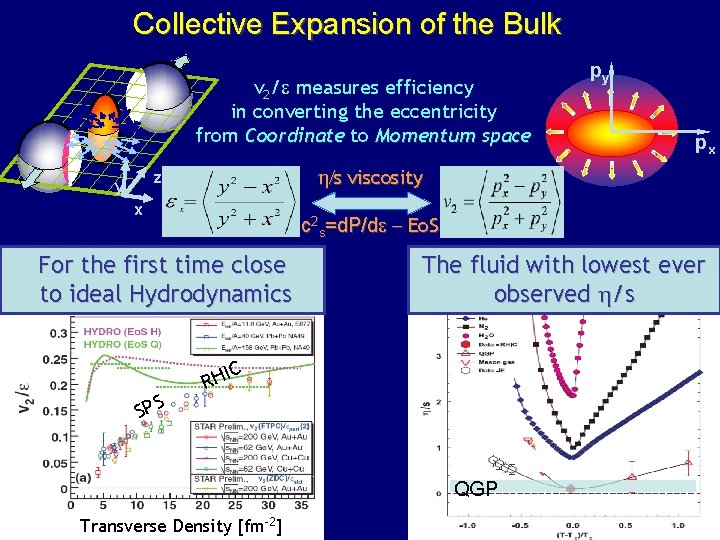
Collective Expansion of the Bulk v 2/e measures efficiency in converting the eccentricity from Coordinate to Momentum space x c 2 s=d. P/de - Eo. S The fluid with lowest ever observed h/s Viscosity h/s For the first time close to ideal Hydrodynamics IC SPS px h/s viscosity z y py RH QGP Transverse Density [fm-2]
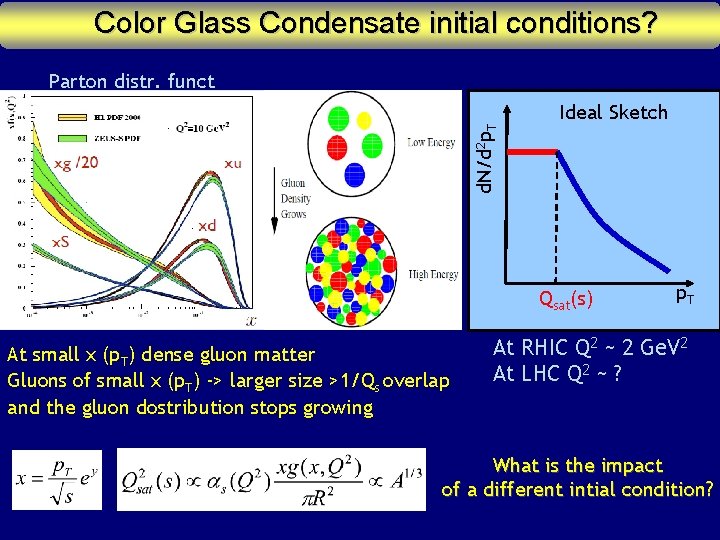
Color Glass Condensate initial conditions? d. N/d 2 p. T Parton distr. funct Ideal Sketch Qsat(s) At small x (p. T) dense gluon matter Gluons of small x (p. T) -> larger size >1/Qs overlap and the gluon dostribution stops growing p. T At RHIC Q 2 ~ 2 Ge. V 2 At LHC Q 2 ~ ? What is the impact of a different intial condition?
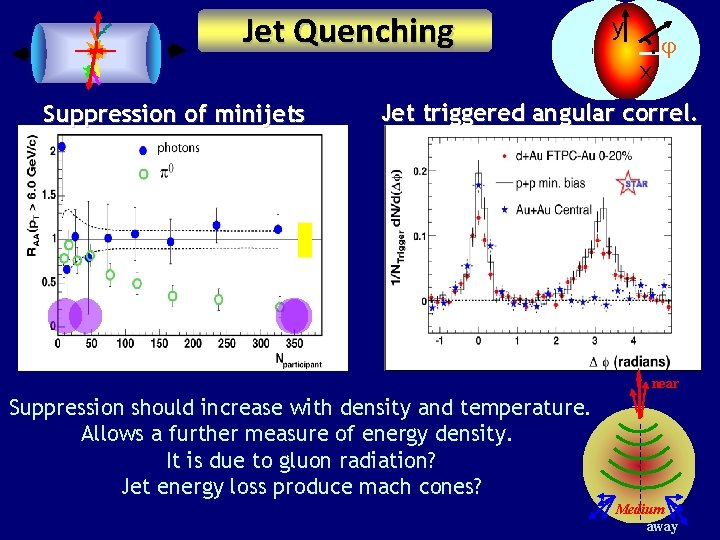
Jet Quenching y x Suppression of minijets Jet triggered angular correl. near Suppression should increase with density and temperature. Allows a further measure of energy density. It is due to gluon radiation? Jet energy loss produce mach cones? Medium away
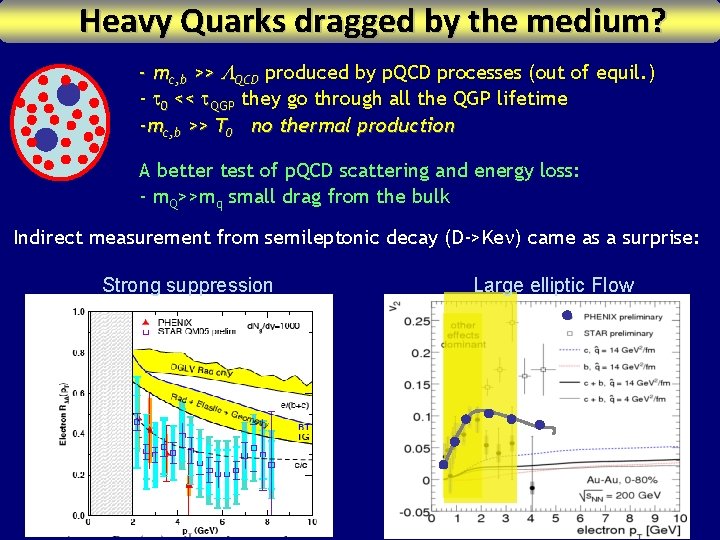
Heavy Quarks dragged by the medium? - mc, b >> LQCD produced by p. QCD processes (out of equil. ) - t 0 << t. QGP they go through all the QGP lifetime -mc, b >> T 0 no thermal production A better test of p. QCD scattering and energy loss: - m. Q>>mq small drag from the bulk Indirect measurement from semileptonic decay (D->Ken) came as a surprise: Strong suppression Large elliptic Flow
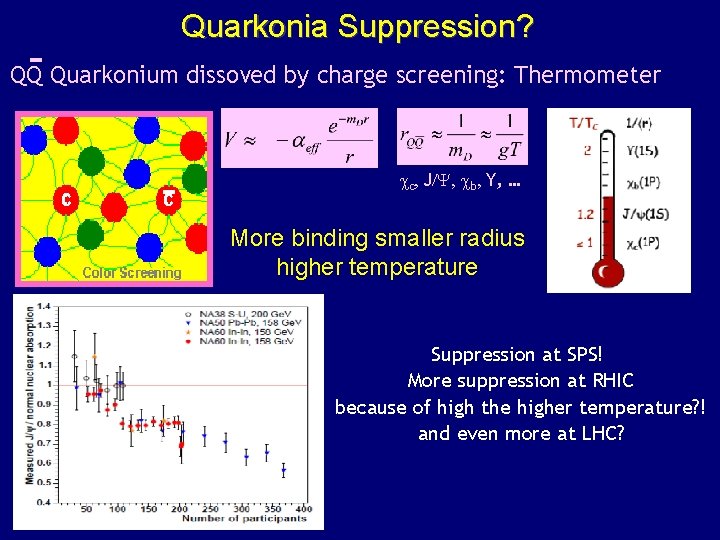
Quarkonia Suppression? QQ Quarkonium dissoved by charge screening: Thermometer cc, J/Y, cb, Y, … More binding smaller radius higher temperature Suppression at SPS! More suppression at RHIC because of high the higher temperature? ! and even more at LHC?
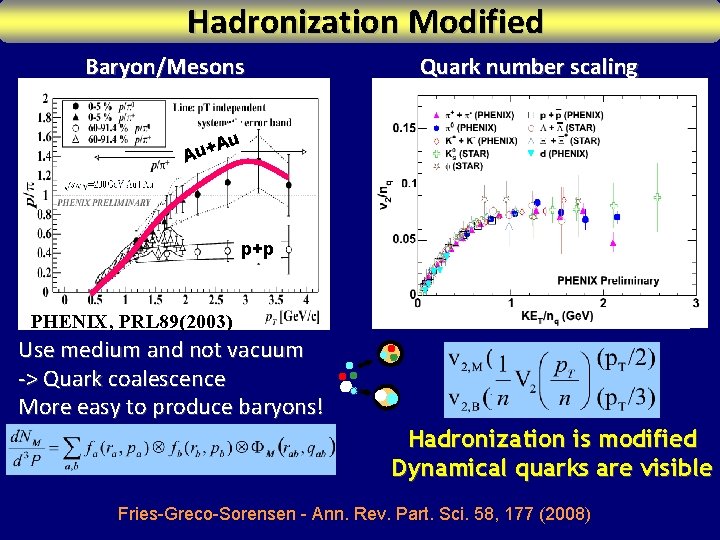
Hadronization Modified Baryon/Mesons Au + u A Quark number scaling n Ba o ry Meson p+p PHENIX, PRL 89(2003) Use medium and not vacuum -> Quark coalescence More easy to produce baryons! Hadronization is modified Dynamical quarks are visible Fries-Greco-Sorensen - Ann. Rev. Part. Sci. 58, 177 (2008)
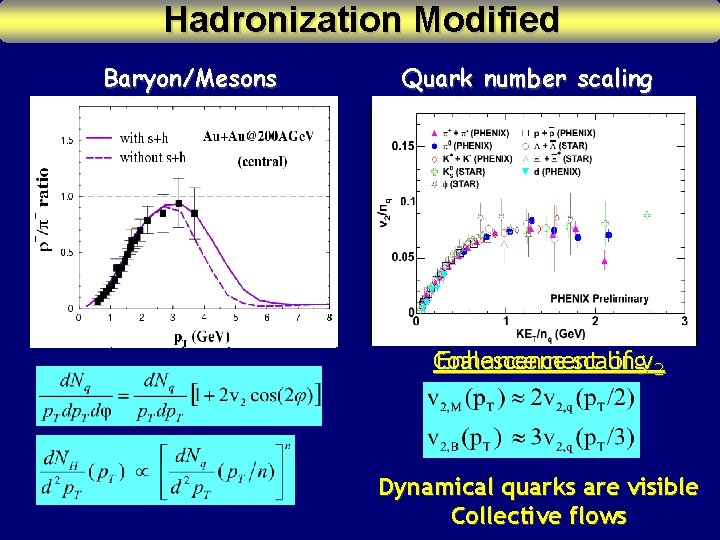
Hadronization Modified Baryon/Mesons Quark number scaling Au + u A p+p PHENIX, PRL 89(2003) v 2 q fitted from v 2 p GKL Coalescence scaling Enhancement of v 2 Dynamical quarks are visible Collective flows