
Introduction to the Periodic Table I am Dmitri
Introduction to the Periodic Table
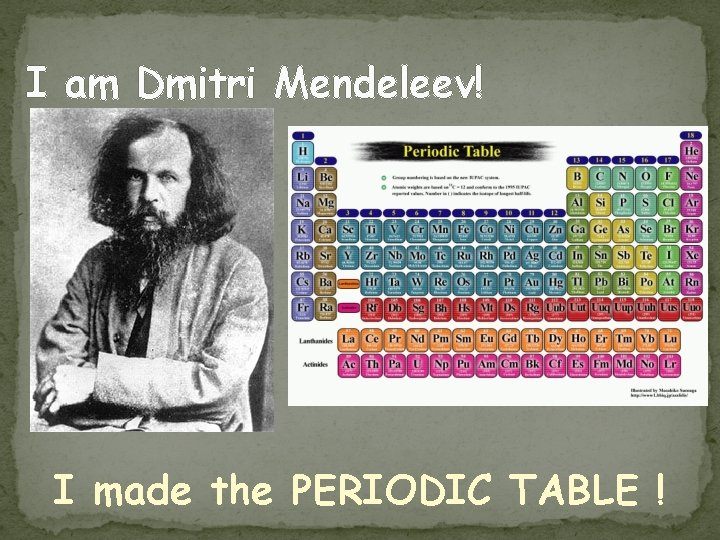
I am Dmitri Mendeleev! I made the PERIODIC TABLE !
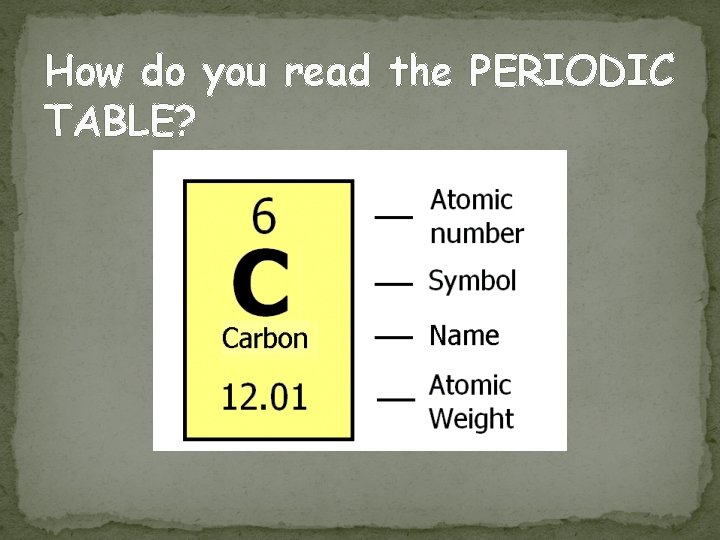
How do you read the PERIODIC TABLE?
The Periodic Table �Elements are organized according to increasing atomic mass! �Periodic law – If elements are arranged according to their atomic mass, a pattern of similar properties can be seen �Horizontal rows are called periods �Vertical columns are called groups �Elements in the same group are called a chemical family �Elements in the same group share similar properties!
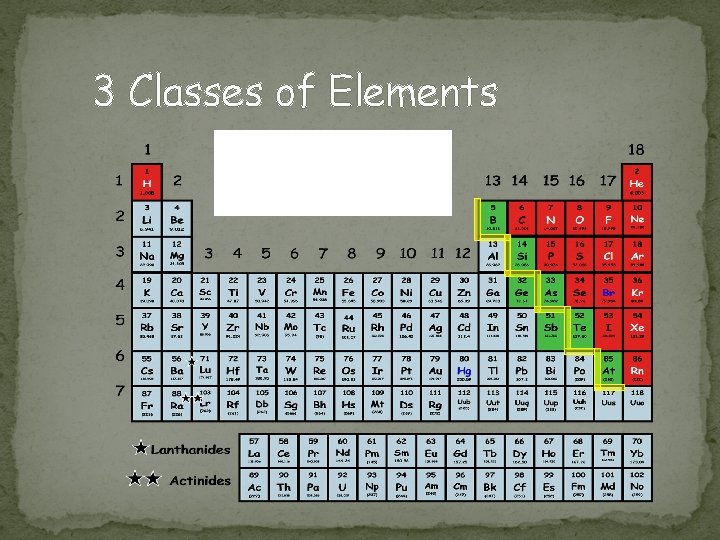
3 Classes of Elements Using this as a guide, color Class Color code your. Metal periodic table to show the Non-Metal three classes. Start by highlighting Metalloid the “zig-zag. ”
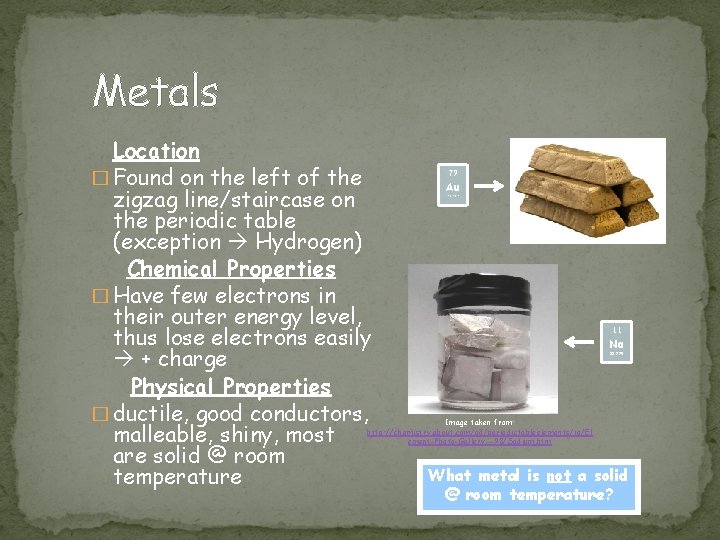
Metals Location � Found on the left of the zigzag line/staircase on the periodic table (exception Hydrogen) Chemical Properties � Have few electrons in their outer energy level, thus lose electrons easily + charge Physical Properties � ductile, good conductors, malleable, shiny, most are solid @ room temperature 79 Au 196. 967 11 Na 22. 990 Image taken from: http: //chemistry. about. com/od/periodictableelements/ig/El ement-Photo-Gallery. --98/Sodium. htm What metal is not a solid @ room temperature?
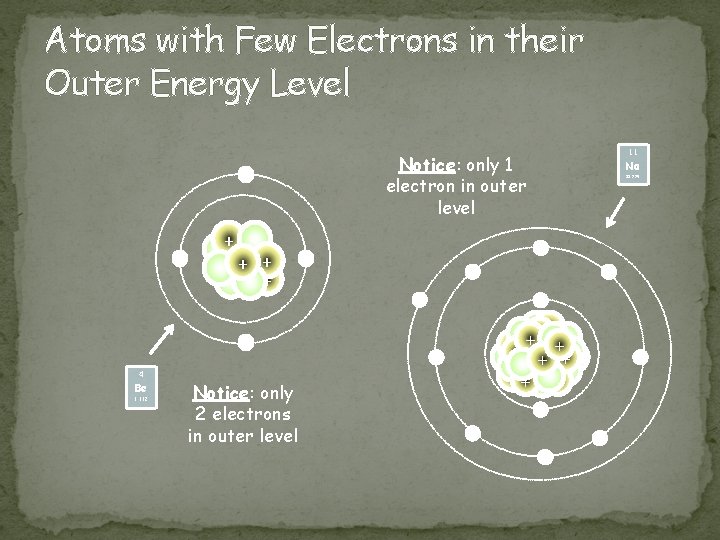
Atoms with Few Electrons in their Outer Energy Level Notice: only 1 electron in outer level - + + ++ + - Notice: only 2 electrons in outer level - - Be 22. 990 - 9. 012 Na - - + 4 11 - - -
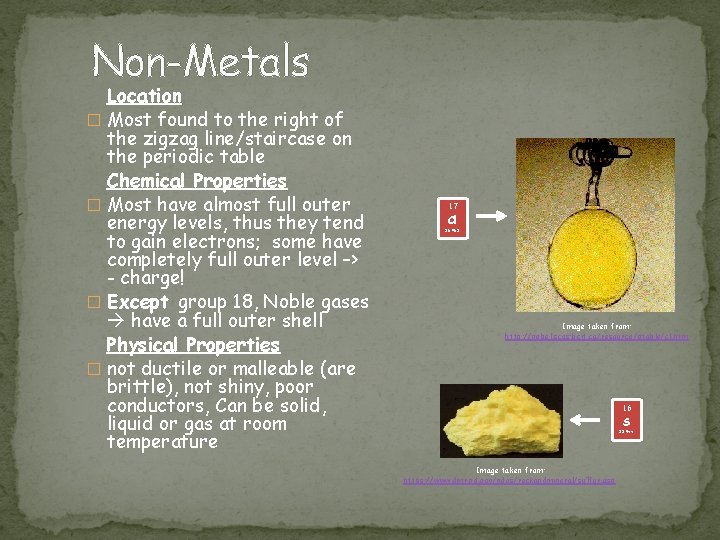
Non-Metals Location � Most found to the right of the zigzag line/staircase on the periodic table Chemical Properties � Most have almost full outer energy levels, thus they tend to gain electrons; some have completely full outer level –> - charge! � Except group 18, Noble gases have a full outer shell Physical Properties � not ductile or malleable (are brittle), not shiny, poor conductors, Can be solid, liquid or gas at room temperature 17 Cl 35. 453 Image taken from: http: //nobel. scas. bcit. ca/resource/ptable/cl. htm 16 S 32. 066 Image taken from: https: //www. dmr. nd. gov/ndgs/rockandmineral/sulfur. asp
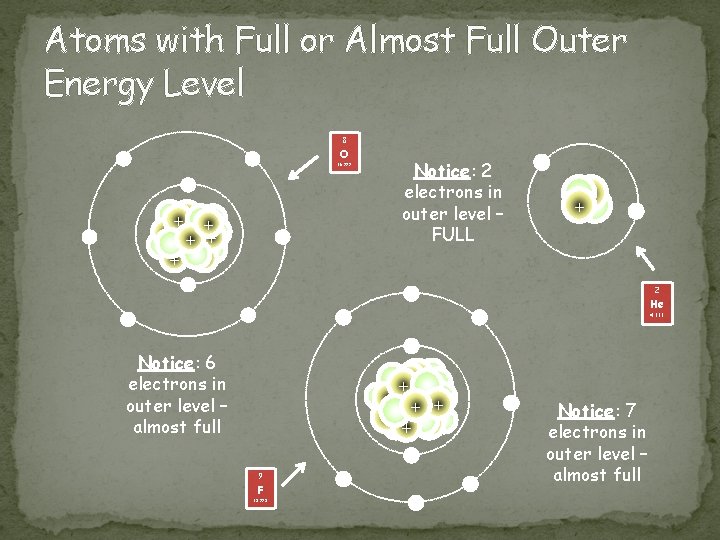
Atoms with Full or Almost Full Outer Energy Level 8 - O - 15. 999 - ++ + + + - - Notice: 2 electrons in outer level – FULL + + - 2 - - He - 4. 003 - Notice: 6 electrons in outer level – almost full +++ + + + - 9 F 18. 998 - - Notice: 7 electrons in outer level – almost full
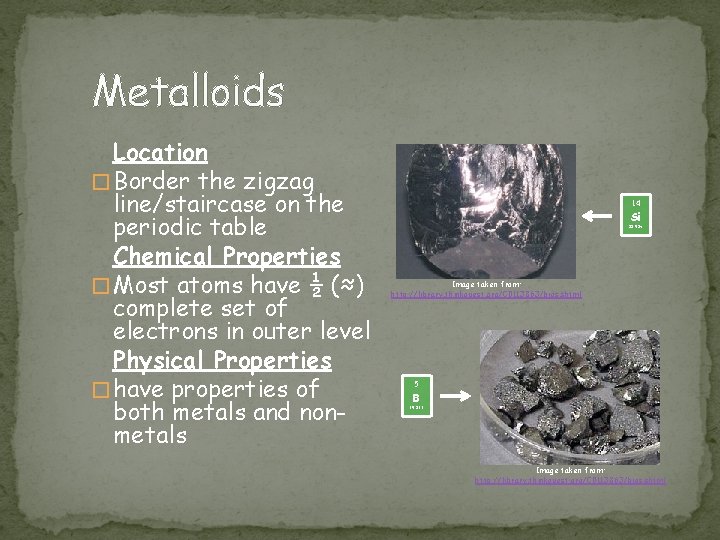
Metalloids Location � Border the zigzag line/staircase on the periodic table Chemical Properties � Most atoms have ½ (≈) complete set of electrons in outer level Physical Properties � have properties of both metals and nonmetals 14 Si 28. 086 Image taken from: http: //library. thinkquest. org/C 0113863/bios. shtml 5 B 10. 811 Image taken from: http: //library. thinkquest. org/C 0113863/bios. shtml
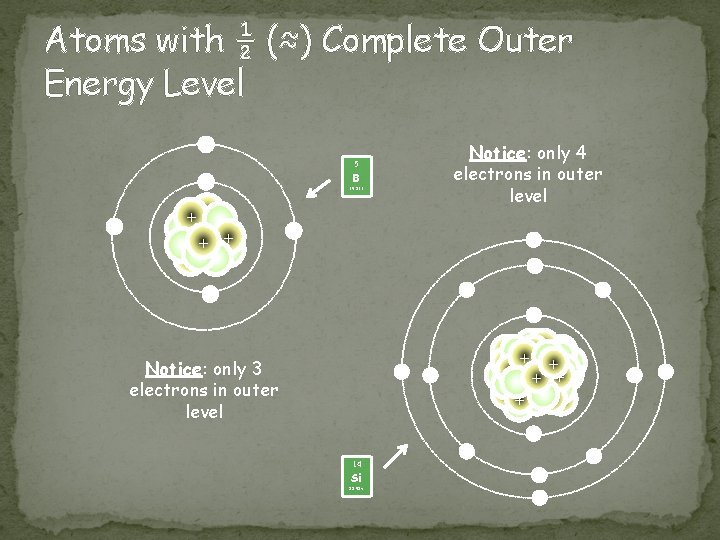
Atoms with ½ (≈) Complete Outer Energy Level - Notice: only 4 electrons in outer level 5 B - - 10. 811 ++ + - - Notice: only 3 electrons in outer level - + +++ + ++ - - 14 Si - 28. 086 - -
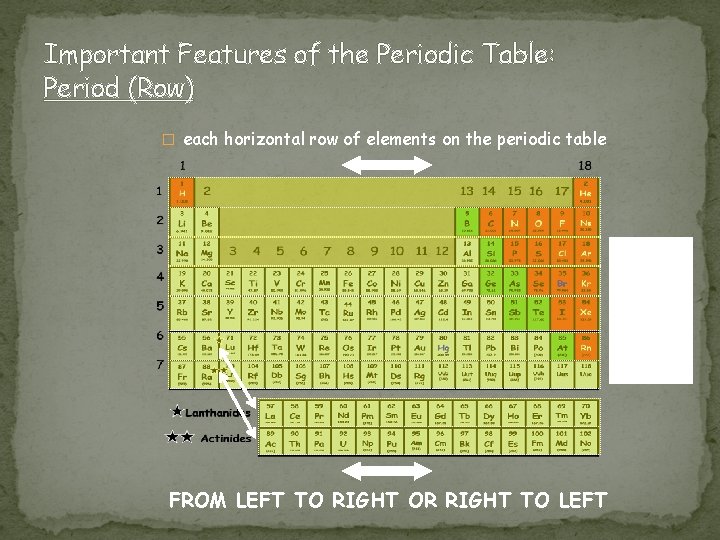
Important Features of the Periodic Table: Period (Row) � each horizontal row of elements on the periodic table How many periods (rows) are on the Periodic Table Of Elements? FROM LEFT TO RIGHT OR RIGHT TO LEFT
Period (Row) Properties �Seven periods on a periodic table (numbered from the top down) �Atomic numbers and atomic masses increase as you move from the left to the right in a period �All atoms of the elements in the same period have the same number of orbitals/shells �Example �Period 1 = 1 orbital �Period 2 = 2 orbitals �Period 3 = 3 orbitals �Etc…
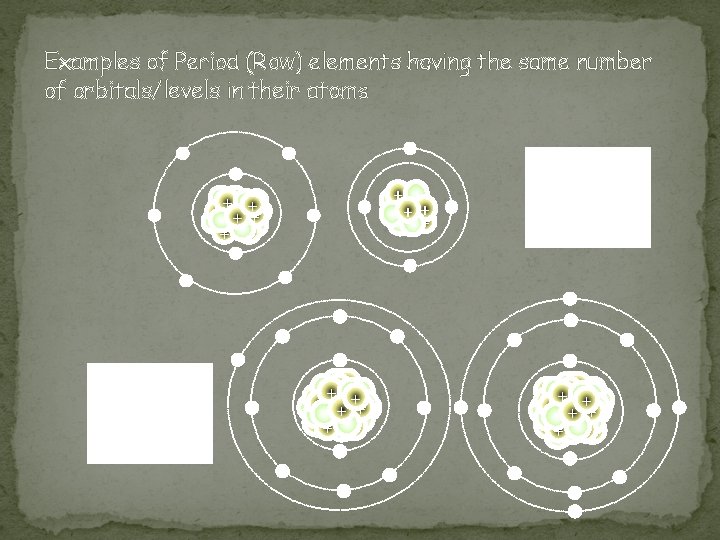
Examples of Period (Row) elements having the same number of orbitals/levels in their atoms - - - In what period (row) do you think these atoms reside? - + ++ + + - + ++ - - - - - In what period (row) do you think these atoms reside? - - - +++ + ++ + +++ ++ - - -
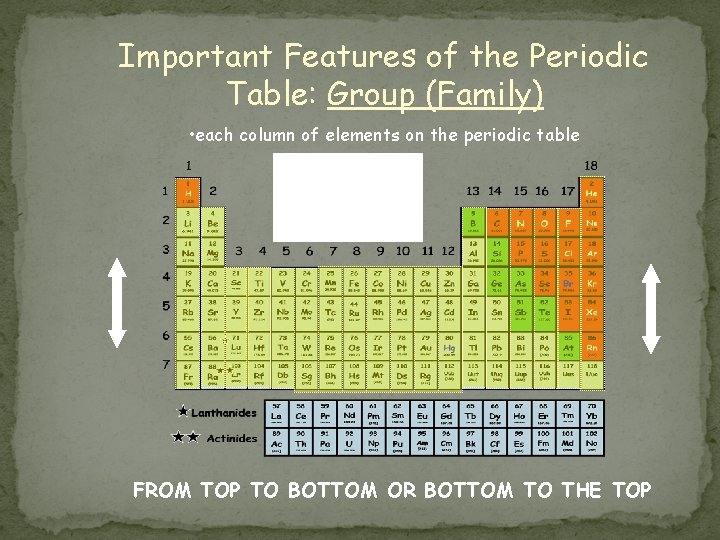
Important Features of the Periodic Table: Group (Family) • each column of elements on the periodic table How many groups (families) are on the Periodic Table Of Elements? FROM TOP TO BOTTOM OR BOTTOM TO THE TOP
Group (Family) Properties � Eighteen groups on the periodic table (numbered from left to right) � Atomic numbers and atomic masses increase as you move from the top down in a group (family) � Atoms of elements in the same group have the same number of electrons in the outer orbitals/levels of their atoms (known as valence electrons) � Exceptions: � Transition elements (3 -12) � Hydrogen (could be 1 or 17) � Helium (actually has 2 valence electrons) � Elements in groups usually have similar physical and chemical properties � Reactivity increases as you go down a group � Li < Na < K < Rb < Cs < Fr
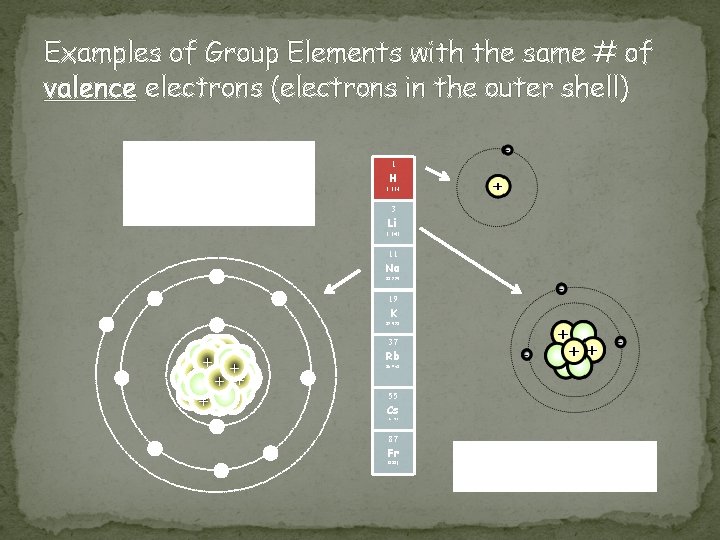
Examples of Group Elements with the same # of valence electrons (electrons in the outer shell) How many electrons do each of these atoms have in their outer orbital/level? 1 H 1. 008 3 Li 6. 941 11 Na - 22. 990 - - 19 K - 39. 098 37 ++ + + + ++ + - Rb 85. 468 55 Cs 132. 905 - 87 - - Fr (223) What group (family) do these elements reside in?
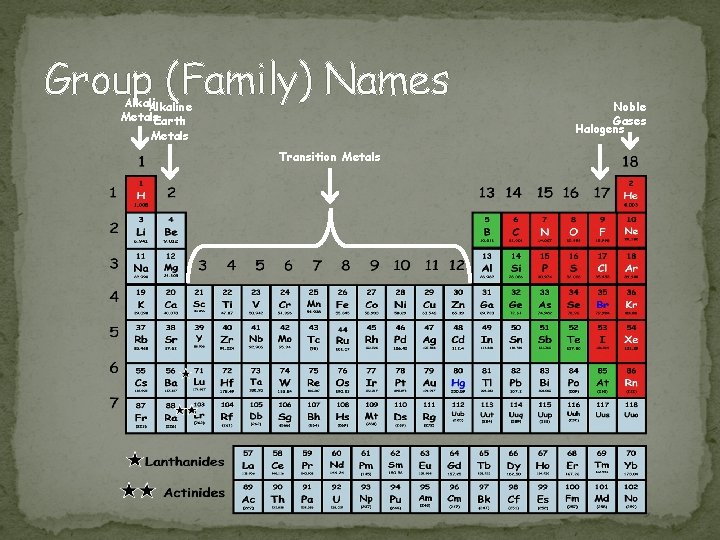
Group (Family) Names Alkaline Metals. Earth Metals Transition Metals Noble Gases Halogens
- Slides: 18