
Introduction to the Periodic Table Elements Atoms Elementa
Introduction to the Periodic Table
Elements & Atoms Element-a pure substance that has one kind of atom � The periodic table lists all the different elements that are either found in nature or prepared in the laboratory synthetically � Atom-the smallest particle of matter � Example of an element is hydrogen. It contains only hydrogen atoms.
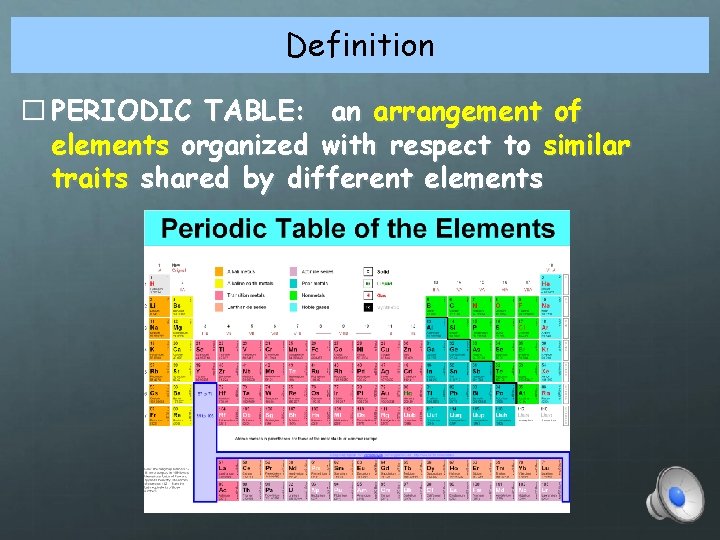
Definition � PERIODIC TABLE: an arrangement of elements organized with respect to similar traits shared by different elements
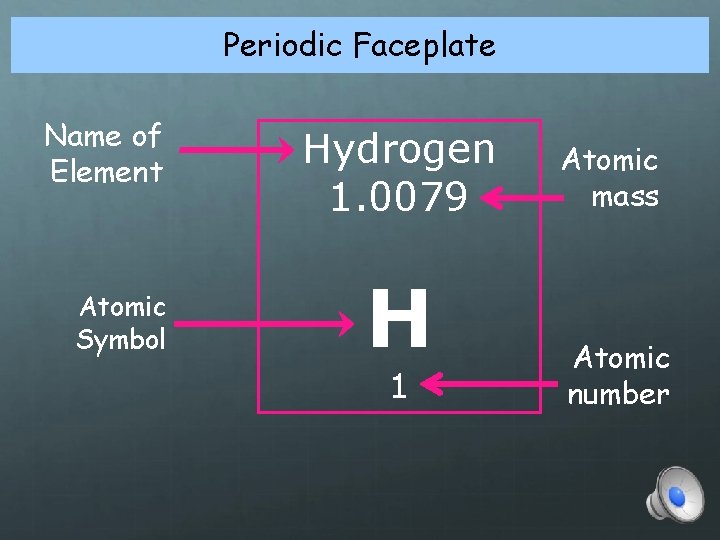
Periodic Faceplate Name of Element Atomic Symbol Hydrogen 1. 0079 H 1 Atomic mass Atomic number
Development of the PT
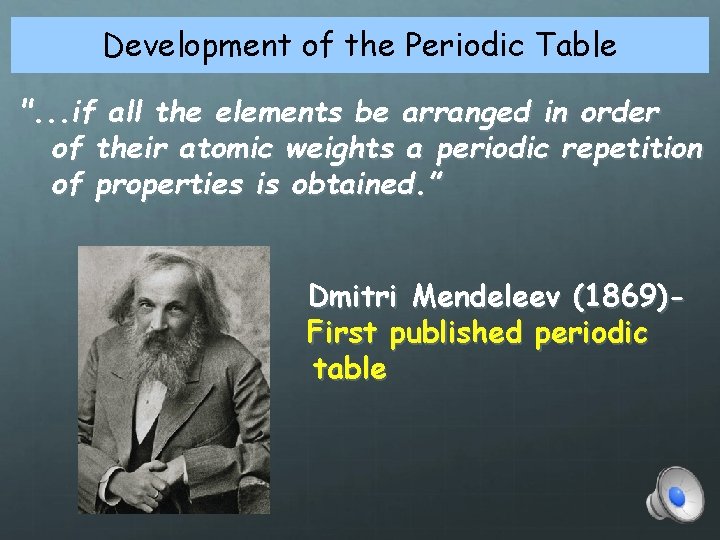
Development of the Periodic Table ". . . if all the elements be arranged in order of their atomic weights a periodic repetition of properties is obtained. ” Dmitri Mendeleev (1869)First published periodic table
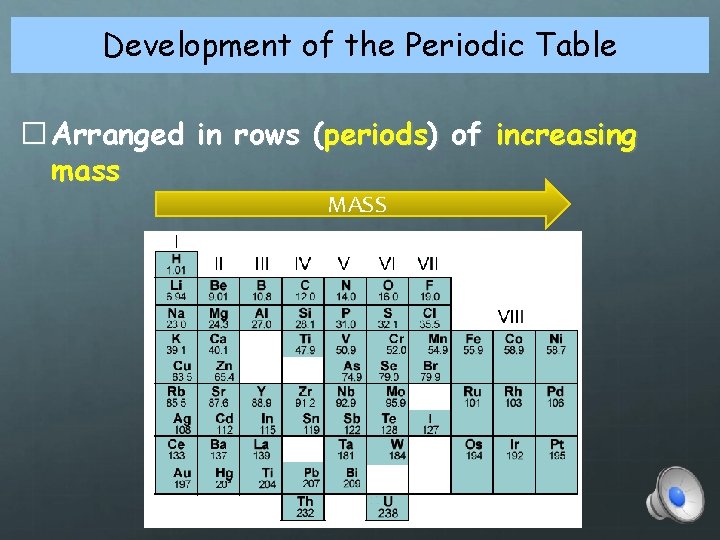
Development of the Periodic Table � Arranged in rows (periods) of increasing mass MASS
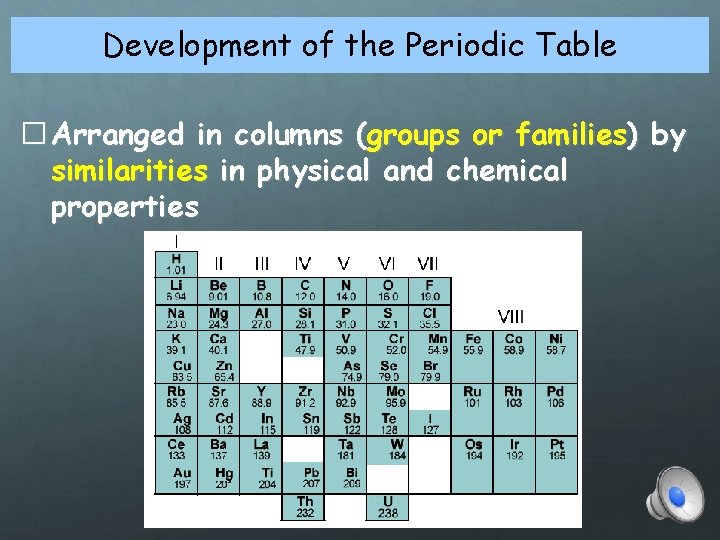
Development of the Periodic Table � Arranged in columns (groups or families) by similarities in physical and chemical properties
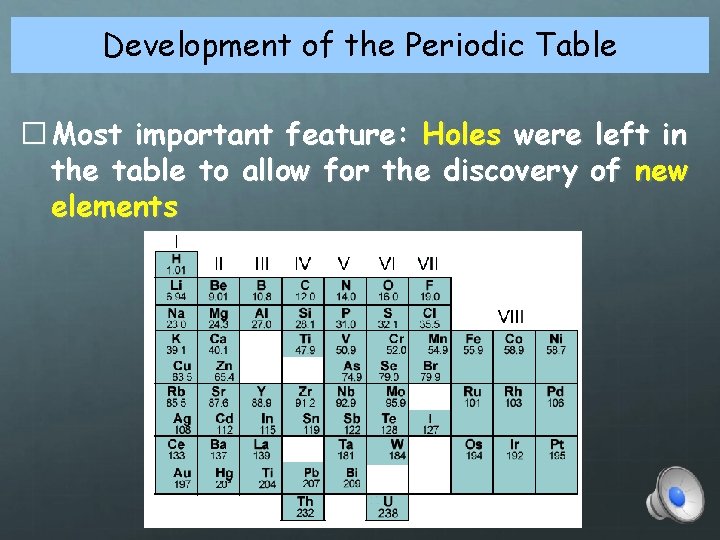
Development of the Periodic Table � Most important feature: Holes were left in the table to allow for the discovery of new elements
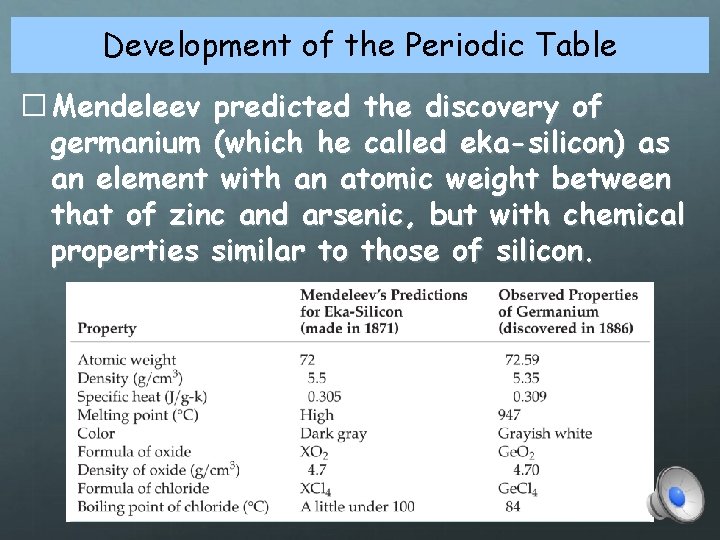
Development of the Periodic Table � Mendeleev predicted the discovery of germanium (which he called eka-silicon) as an element with an atomic weight between that of zinc and arsenic, but with chemical properties similar to those of silicon.
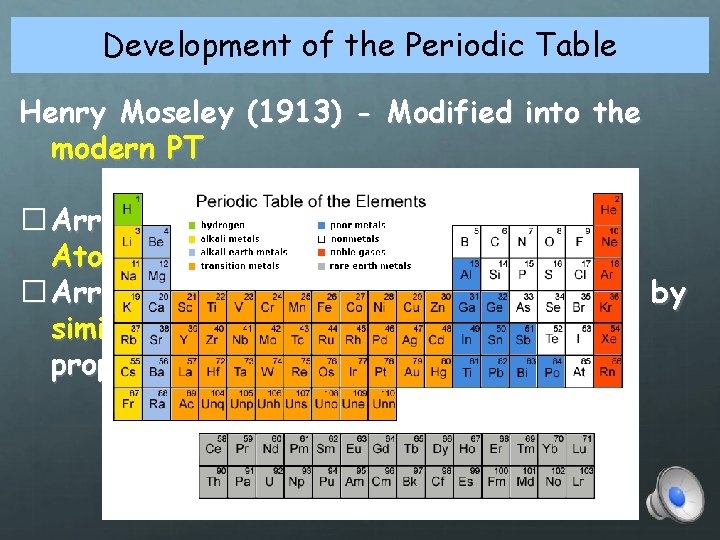
Development of the Periodic Table Henry Moseley (1913) - Modified into the modern PT � Arranged in rows (periods) of increasing Atomic Number � Arranged in columns (groups or families) by similarities of physical and chemical properties
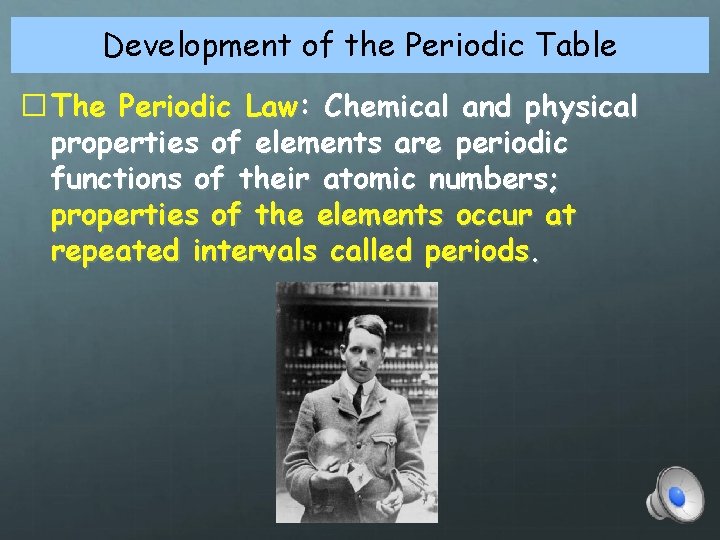
Development of the Periodic Table � The Periodic Law: Chemical and physical properties of elements are periodic functions of their atomic numbers; properties of the elements occur at repeated intervals called periods.
Organization of the PT
Organizing the Periodic Table � The PT lists each element in order of their atomic number � Elements are classified into three major categories based upon their properties: metals, nonmetals, and metalloids
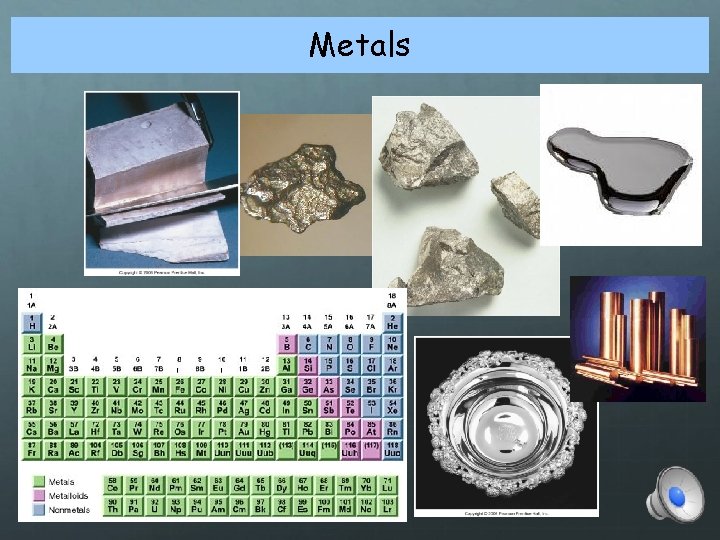
Metals
Metals METALS: located on the left side of the PT (exception of H, which is a nonmetal) � Most elements are metals (~80%) � Good conductors of heat and electricity � Lustrous (shiny) � Solids at room temperature (except Hg) � Ductile and malleable
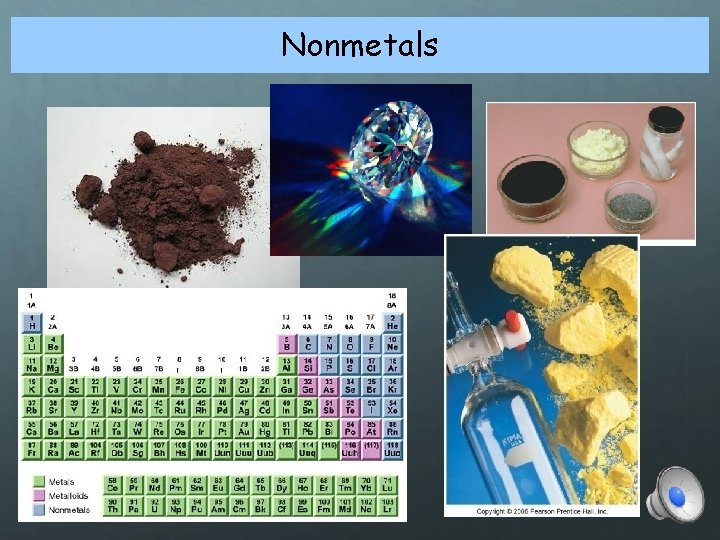
Nonmetals
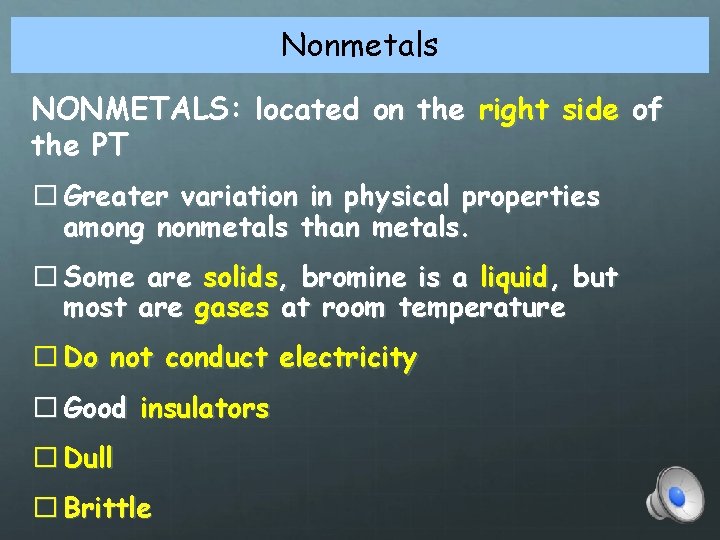
Nonmetals NONMETALS: located on the right side of the PT � Greater variation in physical properties among nonmetals than metals. � Some are solids, bromine is a liquid, but most are gases at room temperature � Do not conduct electricity � Good insulators � Dull � Brittle
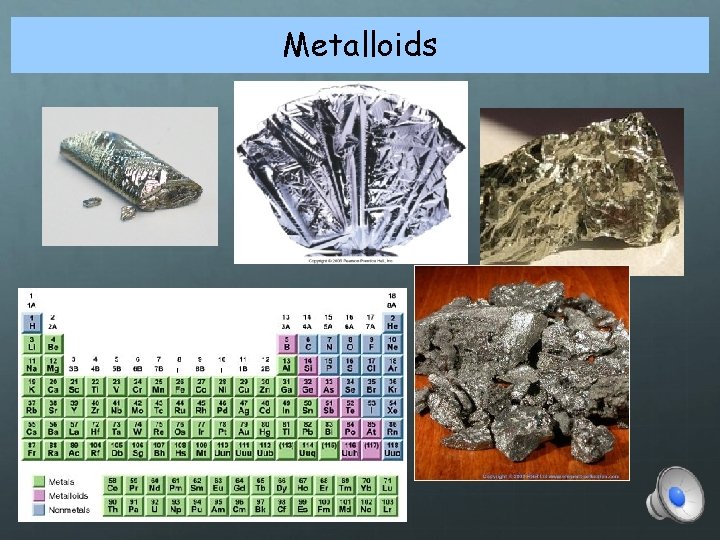
Metalloids
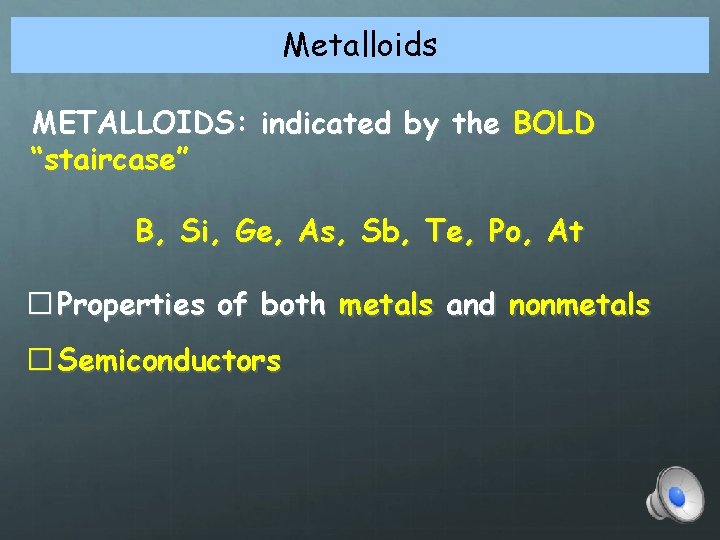
Metalloids METALLOIDS: indicated by the BOLD “staircase” B, Si, Ge, As, Sb, Te, Po, At � Properties of both metals and nonmetals � Semiconductors
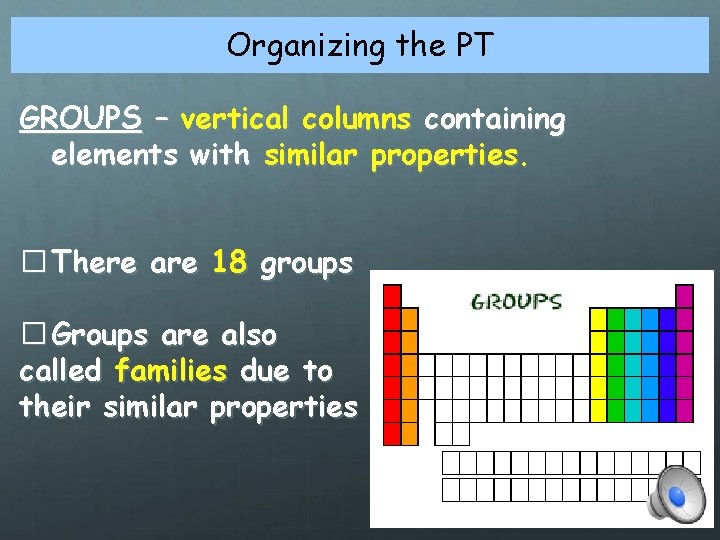
Organizing the PT GROUPS – vertical columns containing elements with similar properties. � There are 18 groups � Groups are also called families due to their similar properties
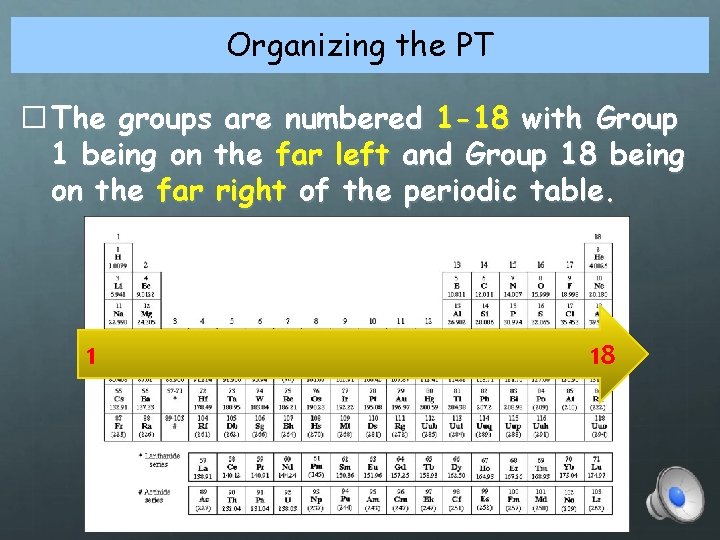
Organizing the PT � The groups are numbered 1 -18 with Group 1 being on the far left and Group 18 being on the far right of the periodic table. 1 18
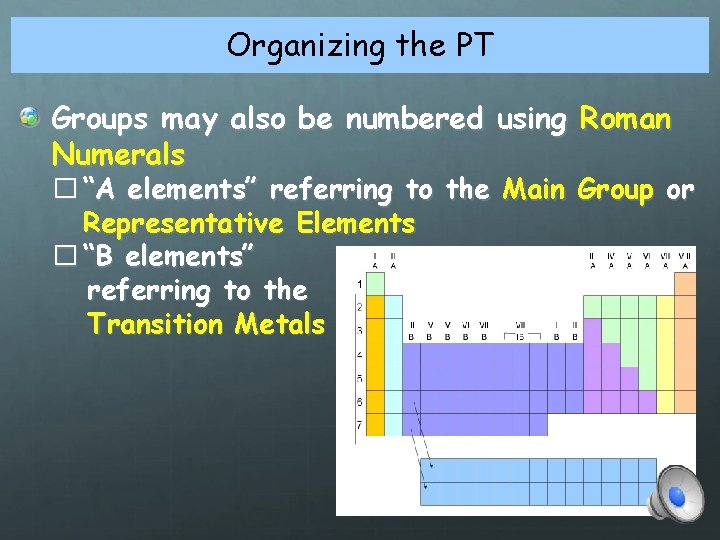
Organizing the PT Groups may also be numbered using Roman Numerals � “A elements” referring to the Main Group or Representative Elements � “B elements” referring to the Transition Metals
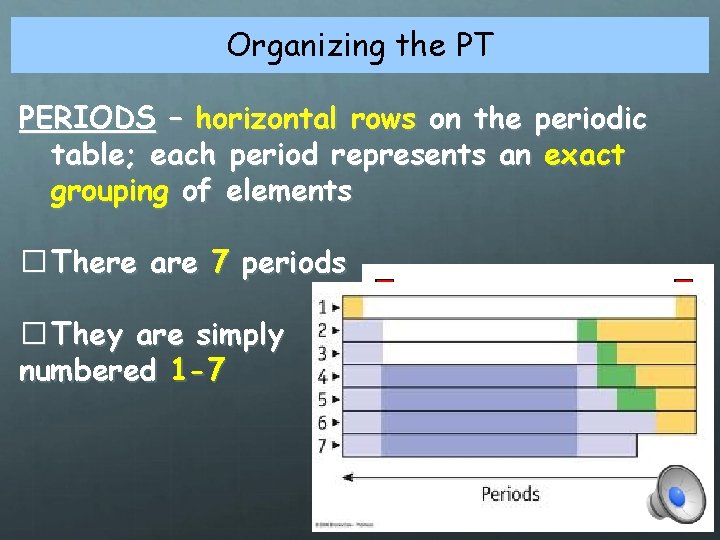
Organizing the PT PERIODS – horizontal rows on the periodic table; each period represents an exact grouping of elements � There are 7 periods � They are simply numbered 1 -7
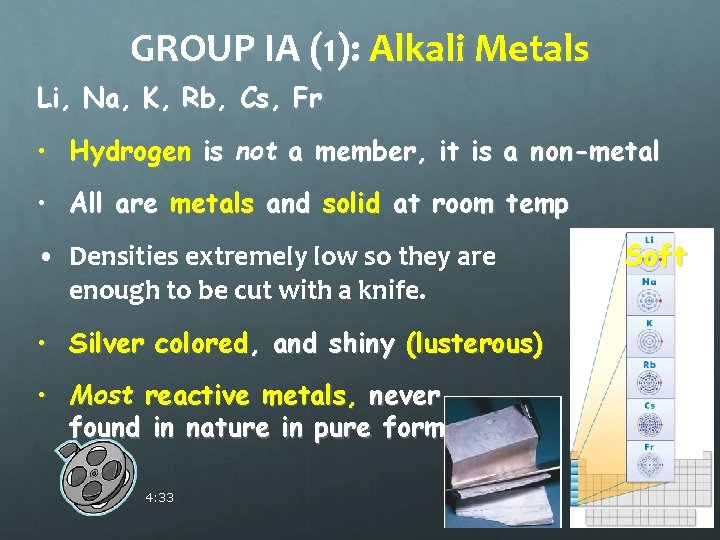
GROUP IA (1): Alkali Metals Li, Na, K, Rb, Cs, Fr • Hydrogen is not a member, it is a non-metal • All are metals and solid at room temp • Densities extremely low so they are enough to be cut with a knife. • Silver colored, and shiny (lusterous) • Most reactive metals, never found in nature in pure form 4: 33 Soft
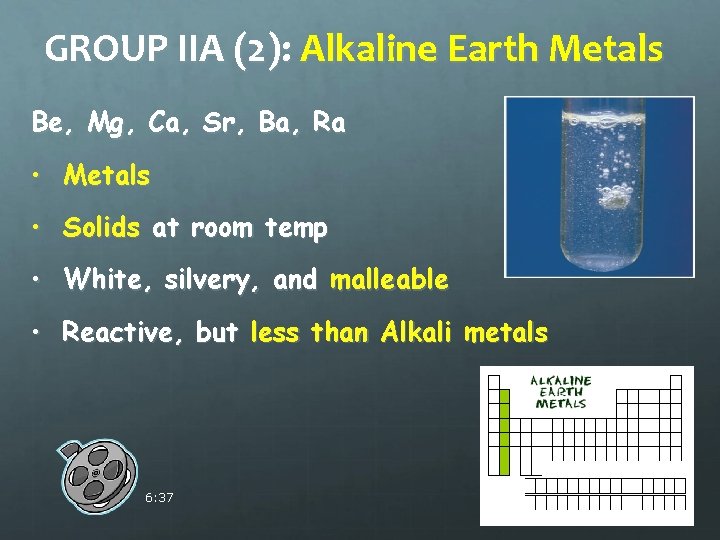
GROUP IIA (2): Alkaline Earth Metals Be, Mg, Ca, Sr, Ba, Ra • Metals • Solids at room temp • White, silvery, and malleable • Reactive, but less than Alkali metals 6: 37
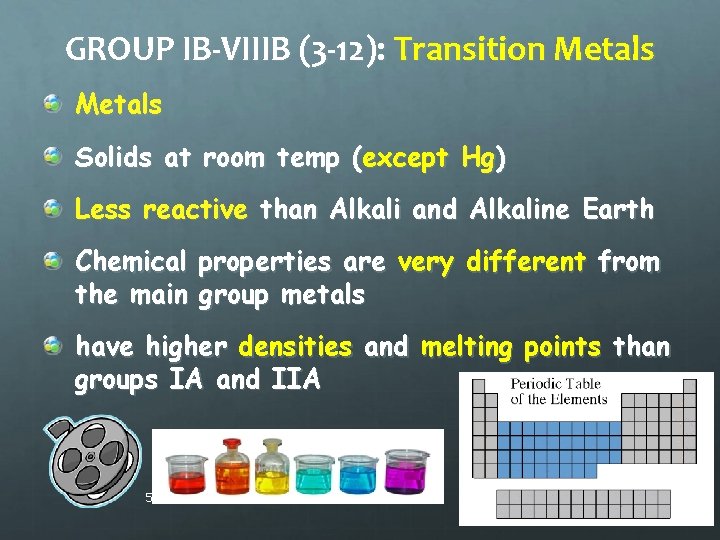
GROUP IB-VIIIB (3 -12): Transition Metals Solids at room temp (except Hg) Less reactive than Alkali and Alkaline Earth Chemical properties are very different from the main group metals have higher densities and melting points than groups IA and IIA 5: 13
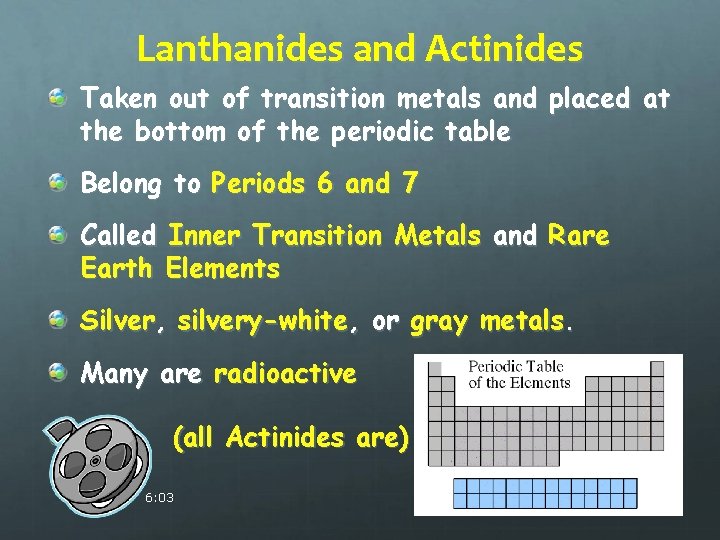
Lanthanides and Actinides Taken out of transition metals and placed at the bottom of the periodic table Belong to Periods 6 and 7 Called Inner Transition Metals and Rare Earth Elements Silver, silvery-white, or gray metals. Many are radioactive (all Actinides are) 6: 03
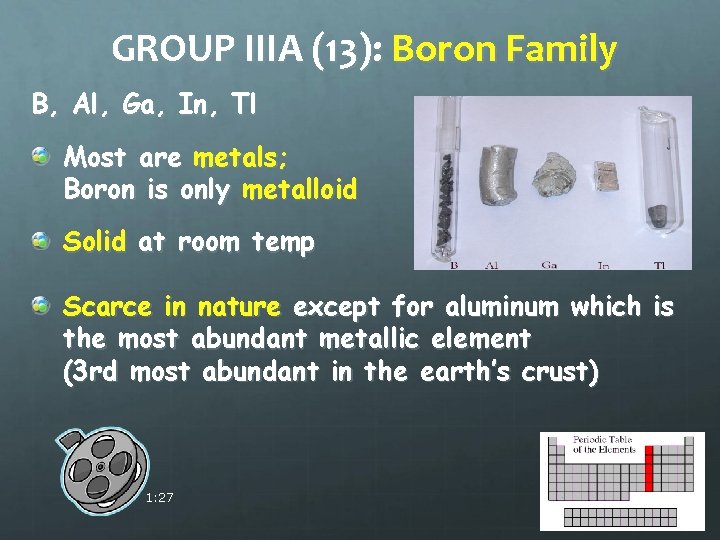
GROUP IIIA (13): Boron Family B, Al, Ga, In, Tl Most are metals; Boron is only metalloid Solid at room temp Scarce in nature except for aluminum which is the most abundant metallic element (3 rd most abundant in the earth’s crust) 1: 27
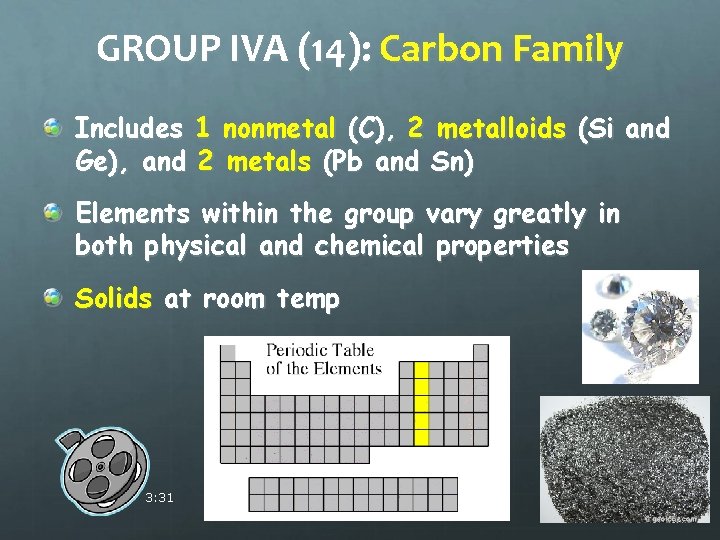
GROUP IVA (14): Carbon Family Includes 1 nonmetal (C), 2 metalloids (Si and Ge), and 2 metals (Pb and Sn) Elements within the group vary greatly in both physical and chemical properties Solids at room temp 3: 31
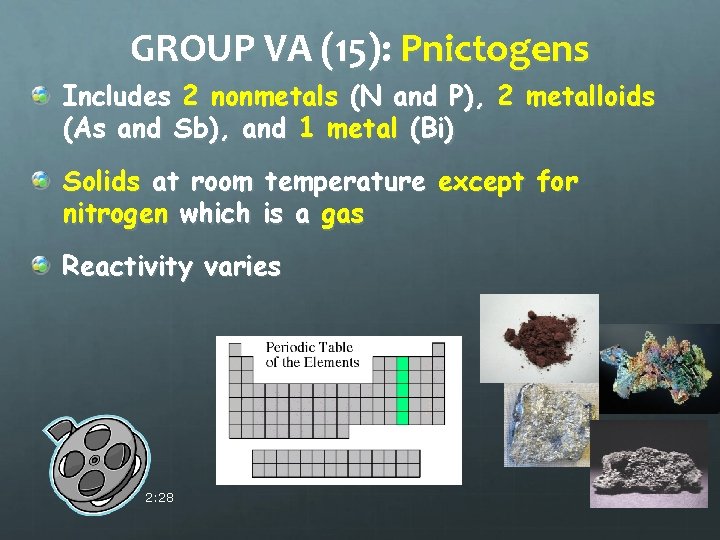
GROUP VA (15): Pnictogens Includes 2 nonmetals (N and P), 2 metalloids (As and Sb), and 1 metal (Bi) Solids at room temperature except for nitrogen which is a gas Reactivity varies 2: 28
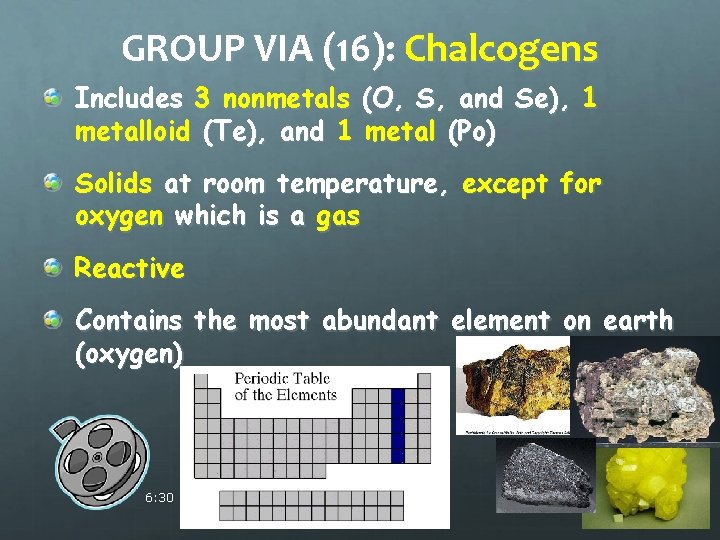
GROUP VIA (16): Chalcogens Includes 3 nonmetals (O, S, and Se), 1 metalloid (Te), and 1 metal (Po) Solids at room temperature, except for oxygen which is a gas Reactive Contains the most abundant element on earth (oxygen) 6: 30
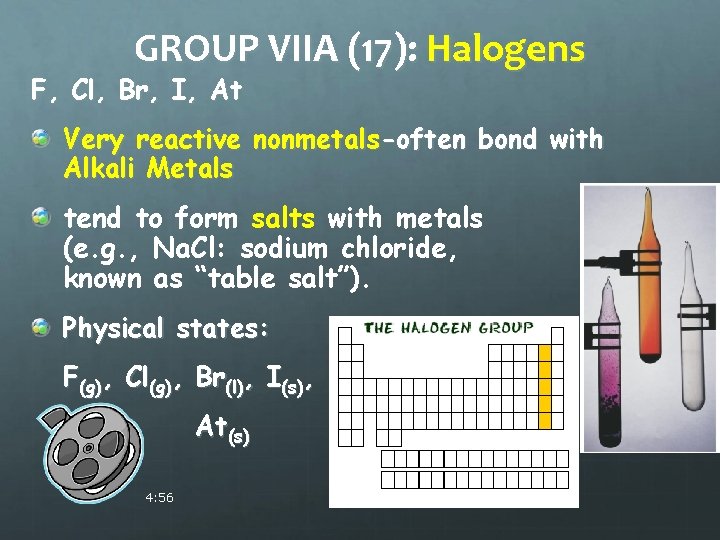
GROUP VIIA (17): Halogens F, Cl, Br, I, At Very reactive nonmetals-often bond with Alkali Metals tend to form salts with metals (e. g. , Na. Cl: sodium chloride, known as “table salt”). Physical states: F(g), Cl(g), Br(l), I(s), At(s) 4: 56 also
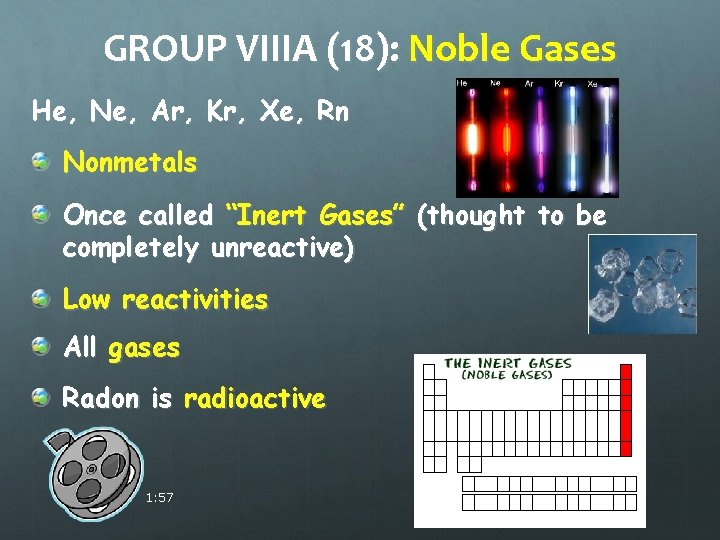
GROUP VIIIA (18): Noble Gases He, Ne, Ar, Kr, Xe, Rn Nonmetals Once called “Inert Gases” (thought to be completely unreactive) Low reactivities All gases Radon is radioactive 1: 57
- Slides: 34