
Introduction to the Passive Voice When and how
- Slides: 68
Introduction to the Passive Voice When and how to use it.
The Passive Voice l When to use it:
The Passive Voice l When to use it: ¡When the what is done is more important than who is doing it (the agent of the action).
The Passive Voice l When to use it: ¡When the what is done is more important the who is doing it.
The Passive Voice l When to use it: ¡When the what is done is more important the who is doing it. ¡When the agent (doer) is unknown.
The Passive Voice l When to use it: ¡When the what is done is more important the who is doing it. ¡When the agent is unknown. ¡When the agent is obvious.
The Passive Voice l When to use it: ¡When the what is done is more important the who is doing it. ¡When the agent is unknown. ¡When the agent is obvious.
The Passive Voice l How to use it.
The Passive Voice l How to use it. ¡In a typical sentence there is a subject (who performs the verb), a verb, and an object (who or what receives the action of the verb).
The Passive Voice l How to use it. ¡In a typical sentence there is a subject (who performs the verb), a verb, and an object (who or what receives the action of the verb). ¡Consider the following active sentence: l. John hit the ball.
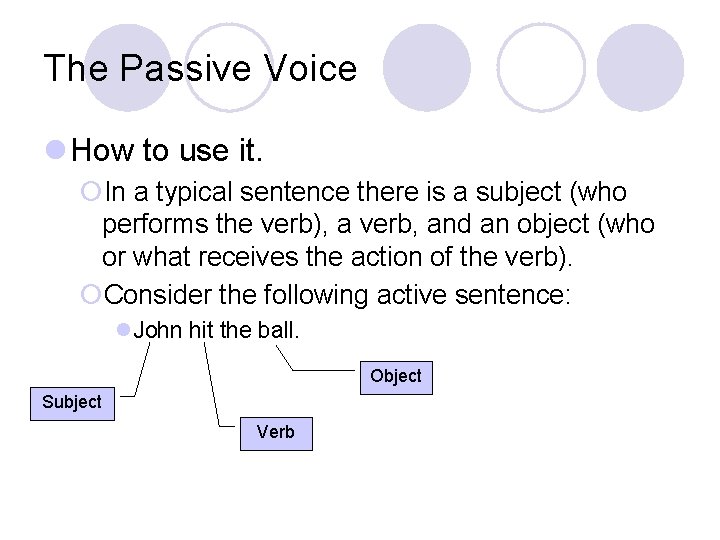
The Passive Voice l How to use it. ¡In a typical sentence there is a subject (who performs the verb), a verb, and an object (who or what receives the action of the verb). ¡Consider the following active sentence: l. John hit the ball. Object Subject Verb
The Passive Voice l How to use it. ¡In a typical sentence there is a subject (who performs the verb), a verb, and an object (who or what receives the action of the verb). ¡Consider the following active sentence: l. John hit the ball. ¡“John” is the subject, “hit” is the verb and “the ball” is the object; and they appear in that order, i. e. subject + verb + object.
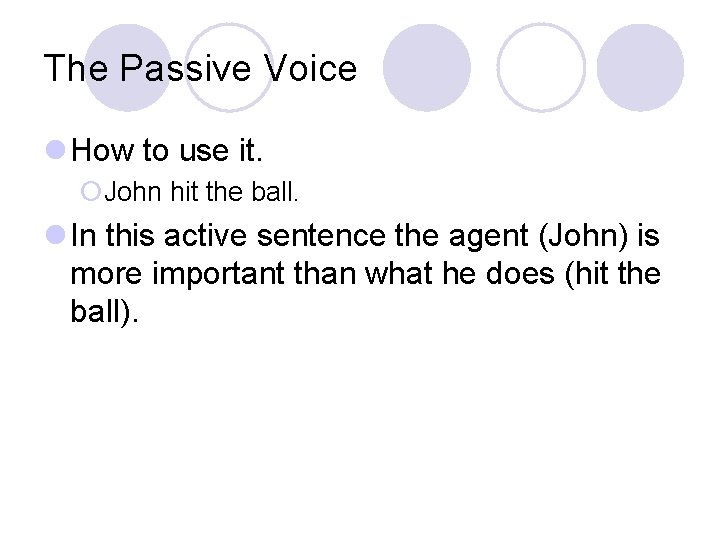
The Passive Voice l How to use it. ¡John hit the ball. l In this active sentence the agent (John) is more important than what he does (hit the ball).
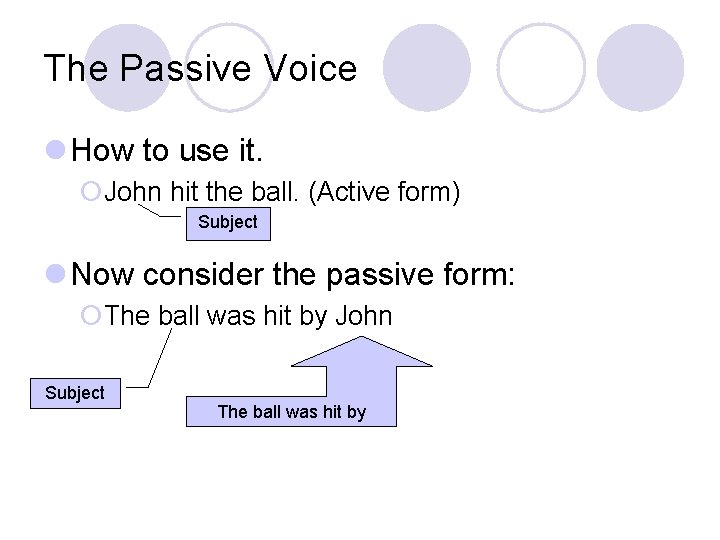
The Passive Voice l How to use it. ¡John hit the ball. (Active form) Subject l Now consider the passive form: ¡The ball was hit by John Subject The ball was hit by
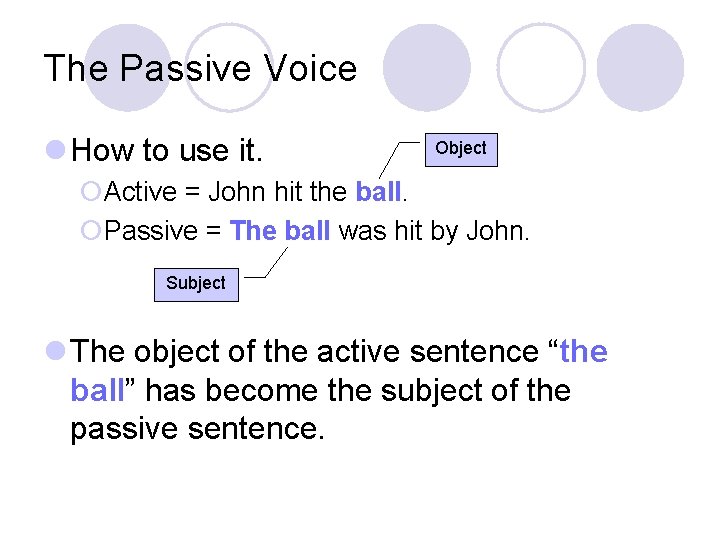
The Passive Voice l How to use it. Object ¡Active = John hit the ball. ¡Passive = The ball was hit by John. Subject l The object of the active sentence “the ball” has become the subject of the passive sentence.
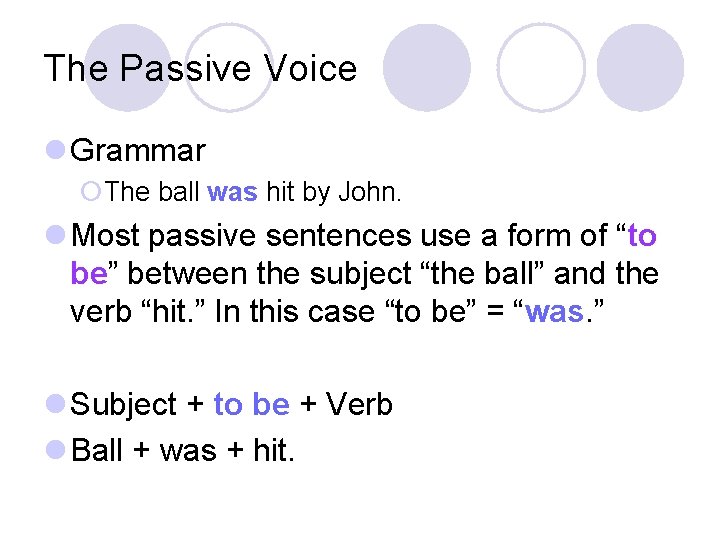
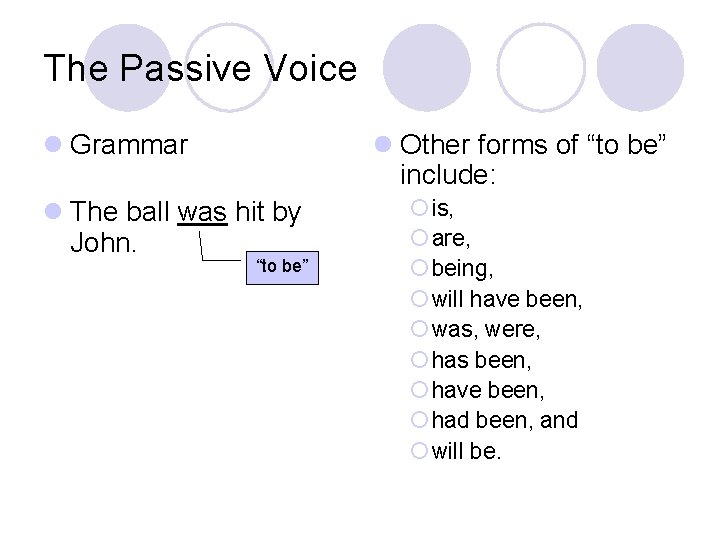
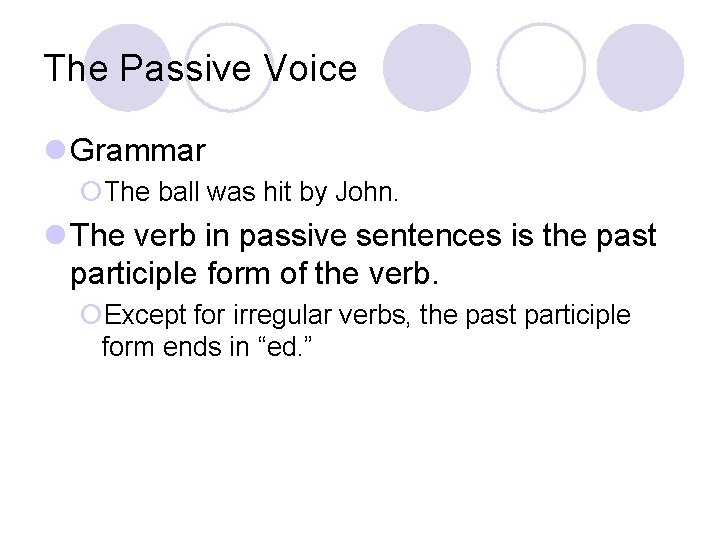
The Passive Voice l Grammar ¡The ball was hit by John. l Most passive sentences use a form of “to be” between the subject “the ball” and the verb “hit. ” In this case “to be” = “was. ” l Subject + to be + Verb l Ball + was + hit.
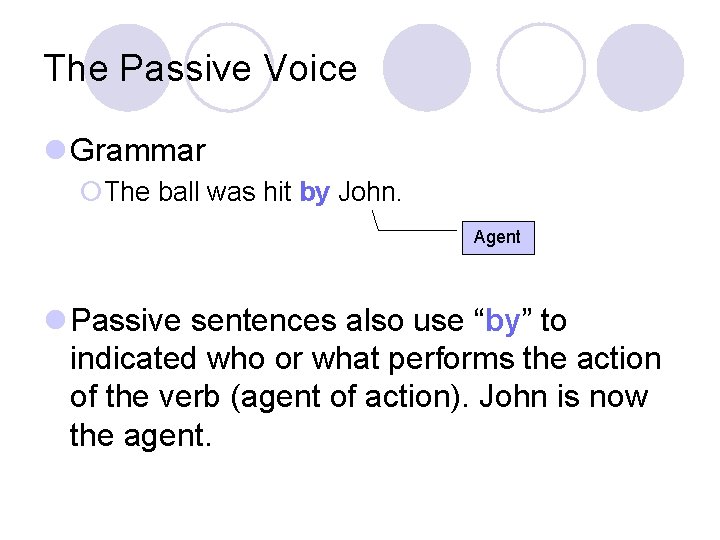
The Passive Voice l Grammar ¡The ball was hit by John. Agent l Passive sentences also use “by” to indicated who or what performs the action of the verb (agent of action). John is now the agent.
The Passive Voice l Grammar l Other forms of “to be” include: l The ball was hit by John. “to be” ¡ is, ¡ are, ¡ being, ¡ will have been, ¡ was, were, ¡ has been, ¡ have been, ¡ had been, and ¡ will be.
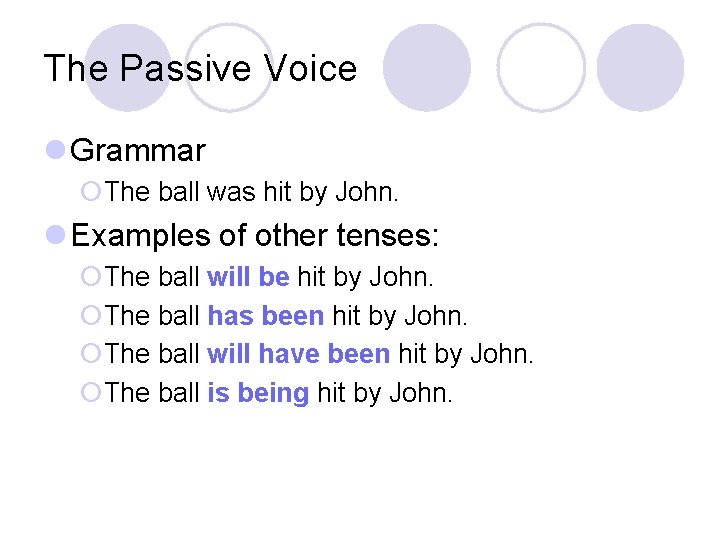
The Passive Voice l Grammar ¡The ball was hit by John. l Examples of other tenses: ¡The ball will be hit by John. ¡The ball has been hit by John. ¡The ball will have been hit by John. ¡The ball is being hit by John.
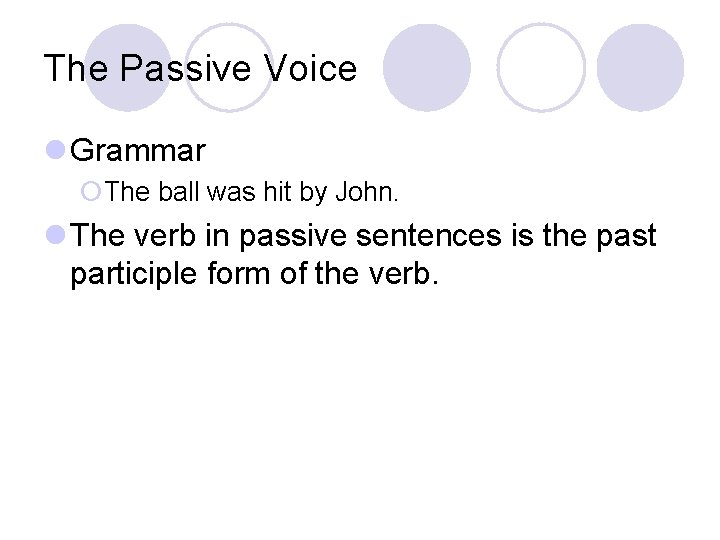
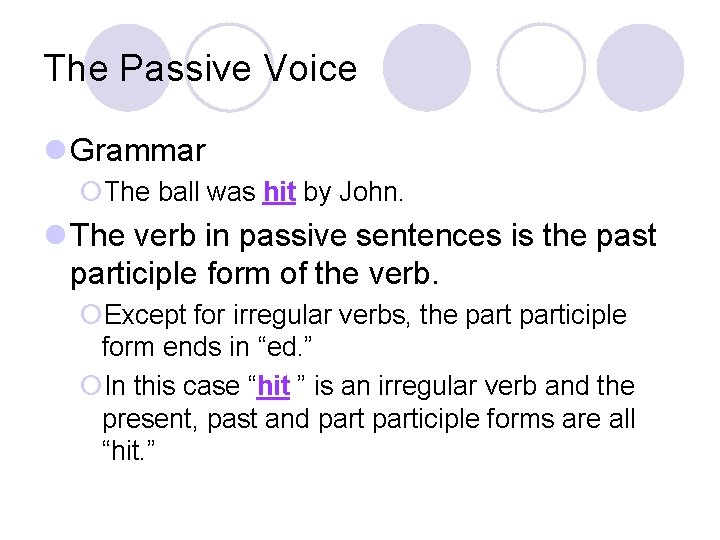
The Passive Voice l Grammar ¡The ball was hit by John. l The verb in passive sentences is the past participle form of the verb.
The Passive Voice l Grammar ¡The ball was hit by John. l The verb in passive sentences is the past participle form of the verb. ¡Except for irregular verbs, the past participle form ends in “ed. ”
The Passive Voice l Grammar ¡The ball was hit by John. l The verb in passive sentences is the past participle form of the verb. ¡Except for irregular verbs, the participle form ends in “ed. ” ¡In this case “hit ” is an irregular verb and the present, past and participle forms are all “hit. ”
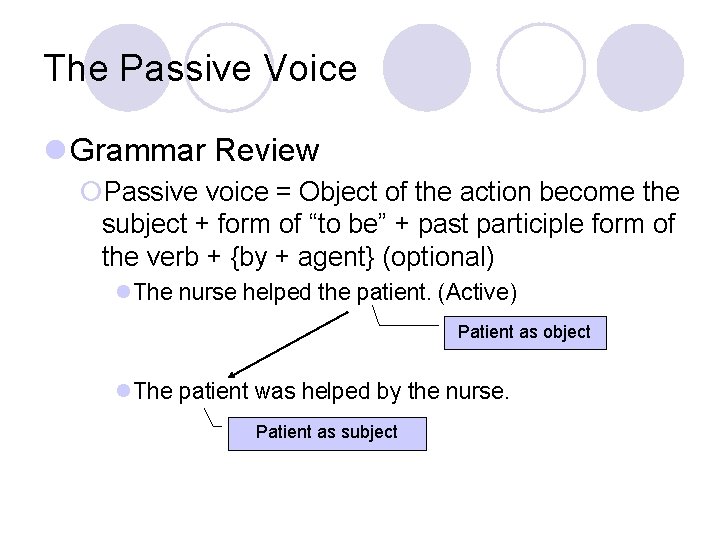
The Passive Voice l Grammar Review ¡Passive voice = Object of the action become the subject + form of “to be” + past participle form of the verb + {by + agent} (optional) l. The nurse helped the patient. (Active) Patient as object l. The patient was helped by the nurse. Patient as subject
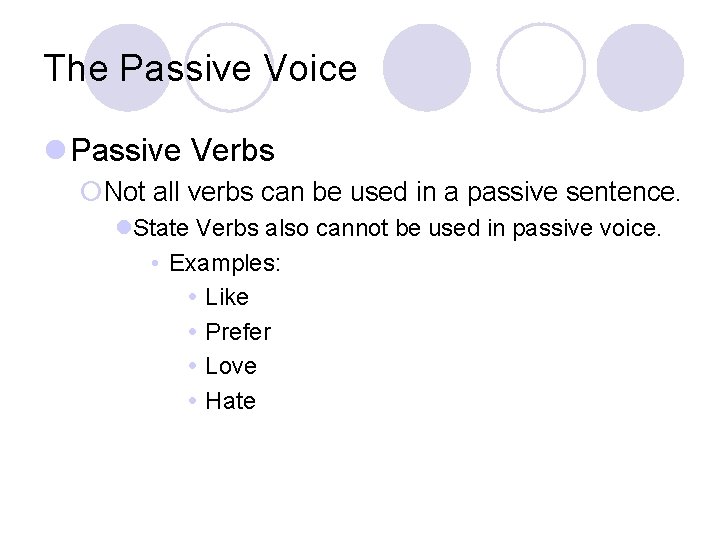
The Passive Voice l Passive Verbs ¡Not all verbs can be used in a passive sentence.
The Passive Voice l Passive Verbs ¡Not all verbs can be used in a passive sentence. l. Intransitive verbs, i. e. verbs which cannot have a direct object are not used.
The Passive Voice l Passive Verbs ¡Not all verbs can be used in a passive sentence. l. Intransitive verbs, i. e. verbs which cannot have a direct object are not used. • Examples: Sit Sleep
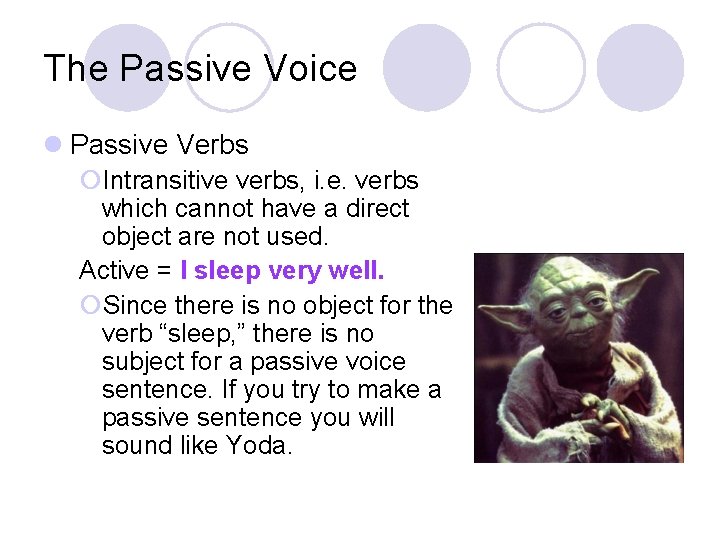
The Passive Voice l Passive Verbs ¡Intransitive verbs, i. e. verbs which cannot have a direct object are not used. Active = I sleep very well. ¡Since there is no object for the verb “sleep, ” there is no subject for a passive voice sentence. If you try to make a passive sentence you will sound like Yoda.
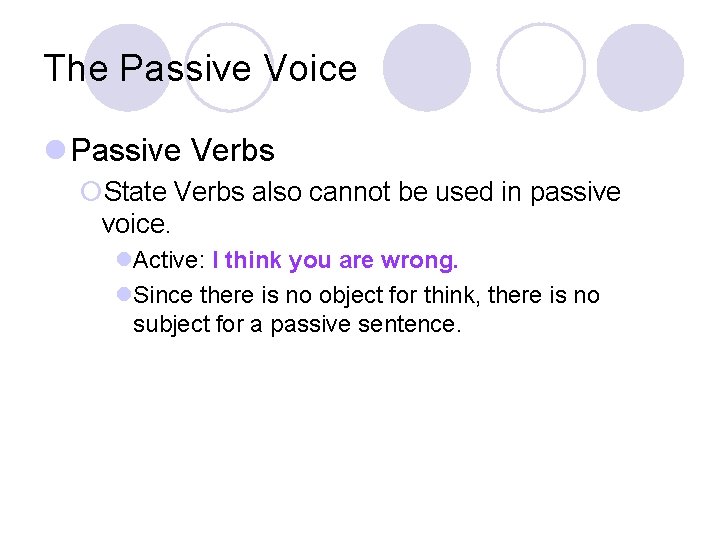
The Passive Voice l Passive Verbs ¡Not all verbs can be used in a passive sentence. l. State Verbs also cannot be used in passive voice.
The Passive Voice l Passive Verbs ¡Not all verbs can be used in a passive sentence. l. State Verbs also cannot be used in passive voice. • Examples: Like Prefer Love Hate
The Passive Voice l Passive Verbs ¡State Verbs also cannot be used in passive voice. l. Active: I think you are wrong. l. Since there is no object for think, there is no subject for a passive sentence.
The Passive Voice l What do you do if you can’t make a sentence passive? l Just leave it active.
The Passive Voice l Practice: Determine if each sentence is in active voice or passive voice.
The Passive Voice l Practice: Determine if the sentence is in active voice or passive voice. ¡The doctor wrote a prescription.
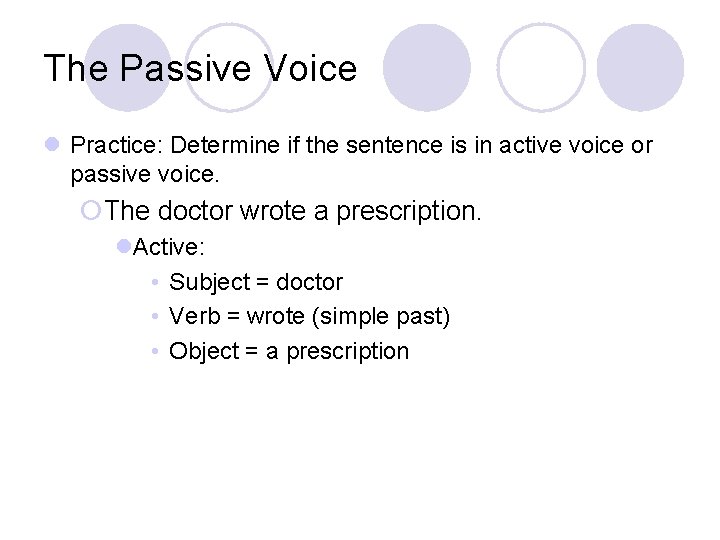
The Passive Voice l Practice: Determine if the sentence is in active voice or passive voice. ¡The doctor wrote a prescription. l. Active: • Subject = doctor • Verb = wrote (simple past) • Object = a prescription
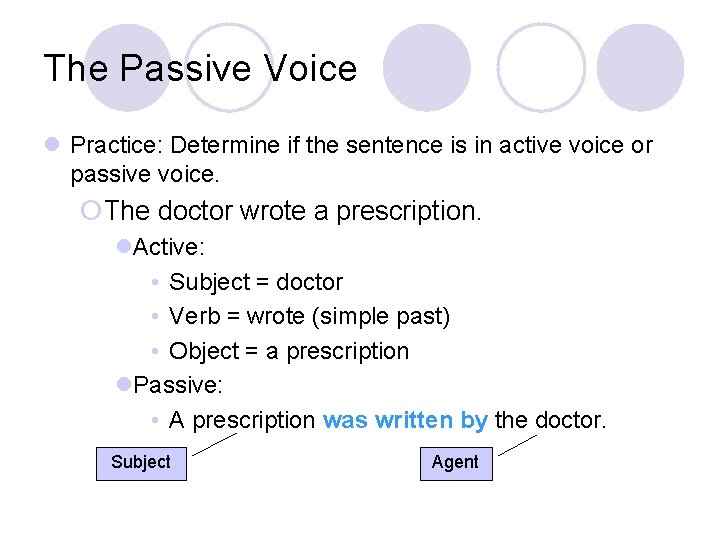
The Passive Voice l Practice: Determine if the sentence is in active voice or passive voice. ¡The doctor wrote a prescription. l. Active: • Subject = doctor • Verb = wrote (simple past) • Object = a prescription l. Passive: • A prescription was written by the doctor. Subject Agent
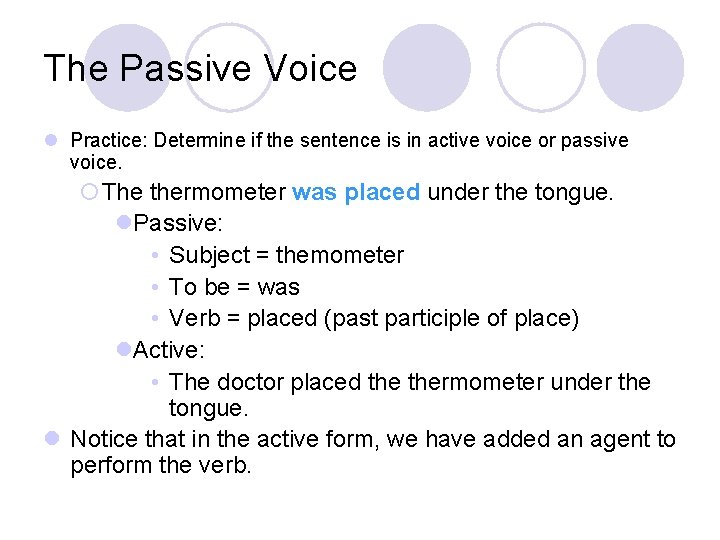
The Passive Voice l Practice: Determine if the sentence is in active voice or passive voice. ¡The thermometer was placed under the tongue.
The Passive Voice l Practice: Determine if the sentence is in active voice or passive voice. ¡The thermometer was placed under the tongue. l. Passive: • Subject = themometer • To be = was • Verb = placed (past participle of place) l. Active: • The doctor placed thermometer under the tongue. l Notice that in the active form, we have added an agent to perform the verb.
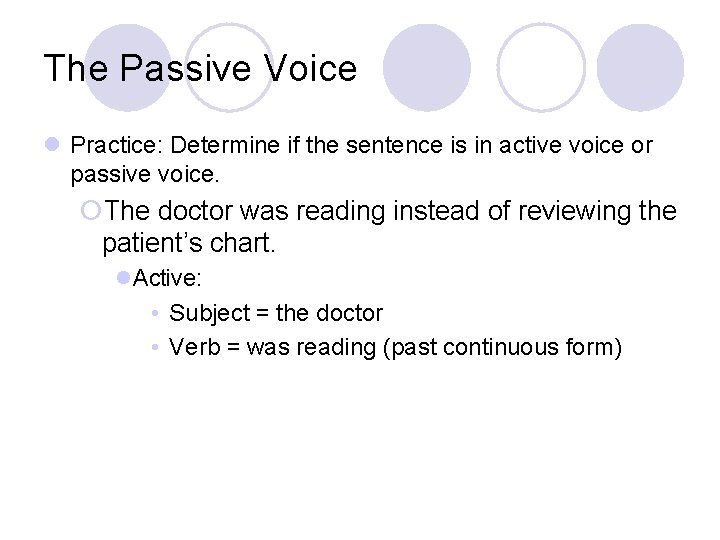
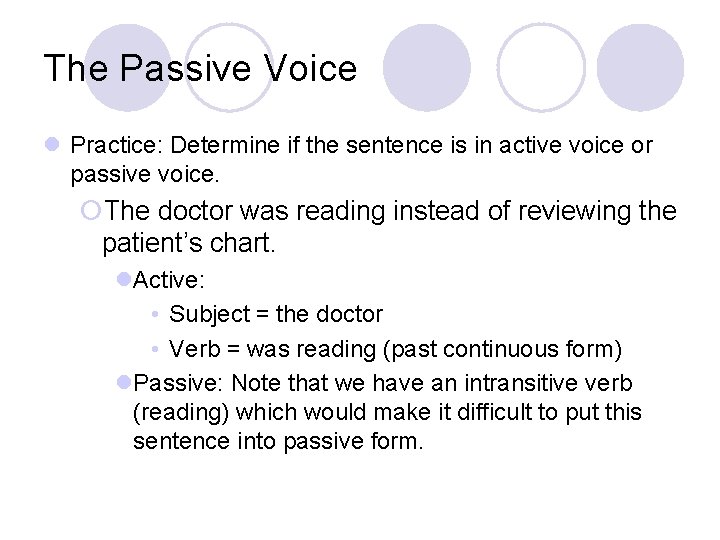
The Passive Voice l Practice: Determine if the sentence is in active voice or passive voice. ¡The doctor was reading instead of reviewing the patient’s chart.
The Passive Voice l Practice: Determine if the sentence is in active voice or passive voice. ¡The doctor was reading instead of reviewing the patient’s chart. l. Active: • Subject = the doctor • Verb = was reading (past continuous form)
The Passive Voice l Practice: Determine if the sentence is in active voice or passive voice. ¡The doctor was reading instead of reviewing the patient’s chart. l. Active: • Subject = the doctor • Verb = was reading (past continuous form) l. Passive: Note that we have an intransitive verb (reading) which would make it difficult to put this sentence into passive form.
The Passive Voice l Practice: Make passive sentences from these active ones.
The Passive Voice l Practice: Make a passive sentence from this active one. ¡The doctor gave the patient antibiotics.
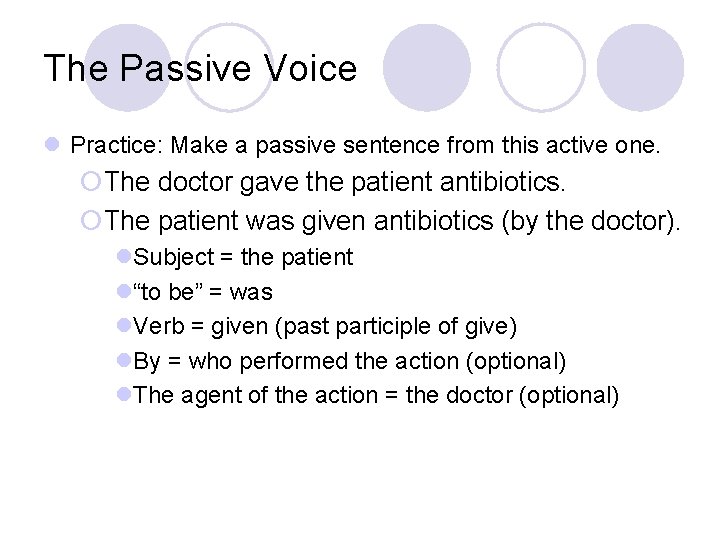
The Passive Voice l Practice: Make a passive sentence from this active one. ¡The doctor gave the patient antibiotics. ¡The patient was given antibiotics (by the doctor). l. Subject = the patient l“to be” = was l. Verb = given (past participle of give) l. By = who performed the action (optional) l. The agent of the action = the doctor (optional)
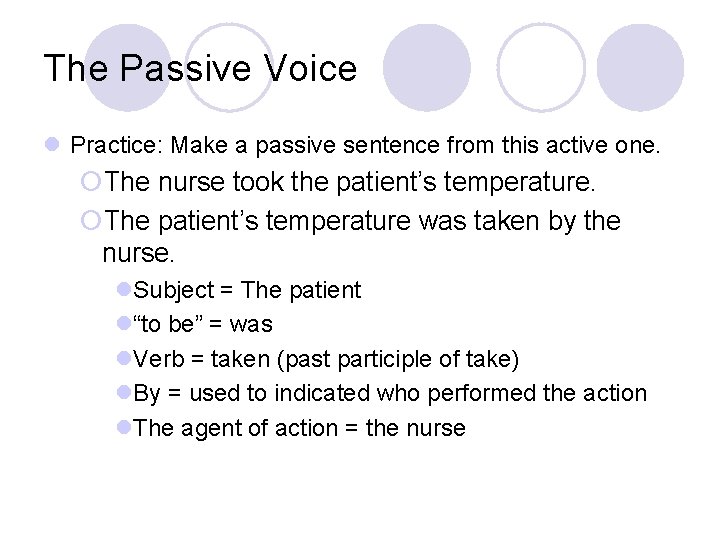
The Passive Voice l Practice: Make a passive sentence from this active one. ¡The nurse took the patient’s temperature.
The Passive Voice l Practice: Make a passive sentence from this active one. ¡The nurse took the patient’s temperature. ¡The patient’s temperature was taken by the nurse. l. Subject = The patient l“to be” = was l. Verb = taken (past participle of take) l. By = used to indicated who performed the action l. The agent of action = the nurse
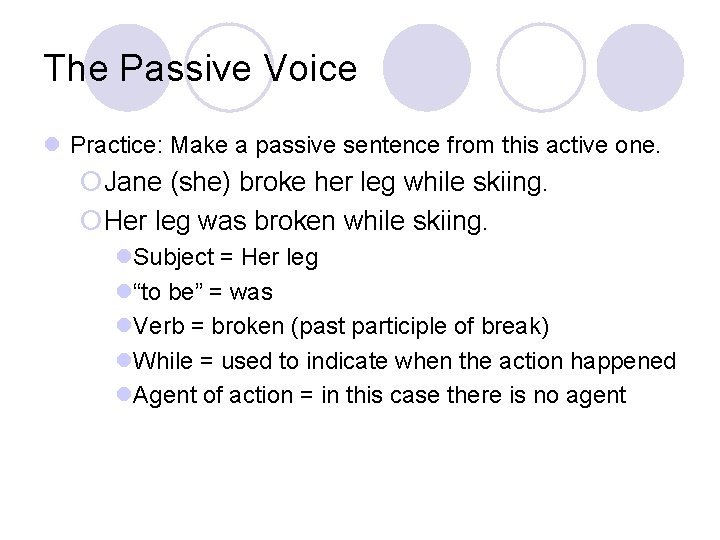
The Passive Voice l Practice: Make a passive sentence from this active one. ¡Jane broke her leg while skiing.
The Passive Voice l Practice: Make a passive sentence from this active one. ¡Jane (she) broke her leg while skiing. ¡Her leg was broken while skiing. l. Subject = Her leg l“to be” = was l. Verb = broken (past participle of break) l. While = used to indicate when the action happened l. Agent of action = in this case there is no agent
The Passive Voice l Practice: Make a passive sentence from this active one. ¡They had already discussed the operation.
The Passive Voice l Practice: Make passive sentences from these active ones. ¡They had already discussed the operation. ¡The operation had already been discussed (by the doctors). l. Subject = the operation l“to be” = had been l. Verb = discussed (participle of discuss) l. By = who performed the verb (optional) l. Agent of action = the doctors (optional)
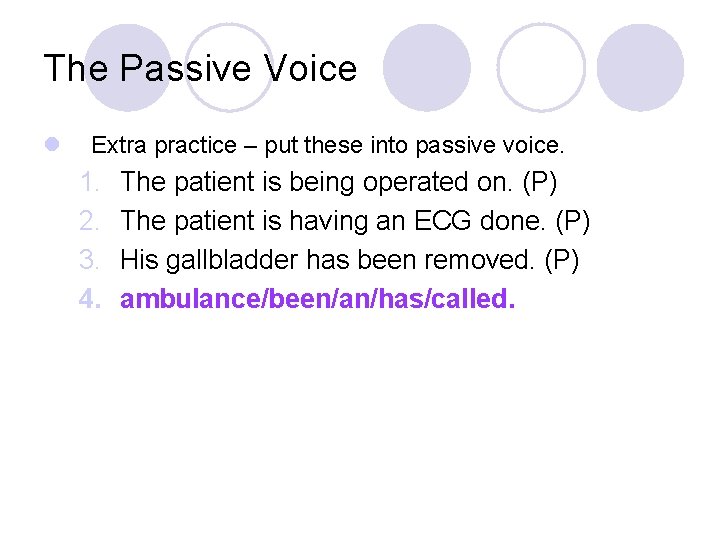
The Passive Voice l Extra practice – put these into passive voice. 1. patient/the/operated/on/being/is.
The Passive Voice l Extra practice – put these into passive voice. 1. The patient is being operated on. (P) 2. is/done/ECG/having/patient/the/an.
The Passive Voice l Extra practice – put these into passive voice. 1. The patient is being operated on. (P) 2. The patient is having an ECG done. (P) 3. right kidney/been/his/removed/has.
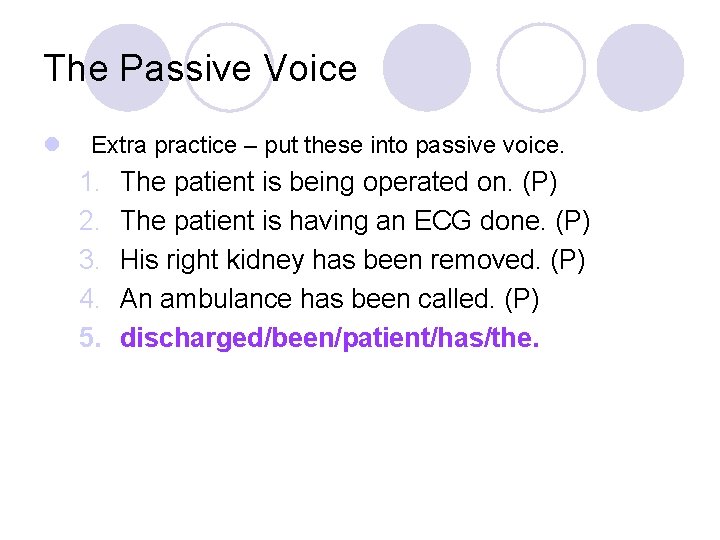
The Passive Voice l Extra practice – put these into passive voice. 1. 2. 3. 4. The patient is being operated on. (P) The patient is having an ECG done. (P) His gallbladder has been removed. (P) ambulance/been/an/has/called.
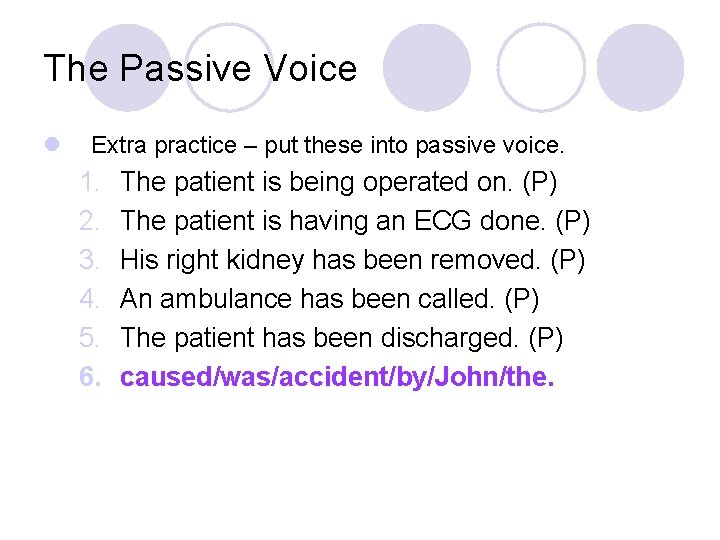
The Passive Voice l Extra practice – put these into passive voice. 1. 2. 3. 4. 5. The patient is being operated on. (P) The patient is having an ECG done. (P) His right kidney has been removed. (P) An ambulance has been called. (P) discharged/been/patient/has/the.
The Passive Voice l Extra practice – put these into passive voice. 1. 2. 3. 4. 5. 6. The patient is being operated on. (P) The patient is having an ECG done. (P) His right kidney has been removed. (P) An ambulance has been called. (P) The patient has been discharged. (P) caused/was/accident/by/John/the.
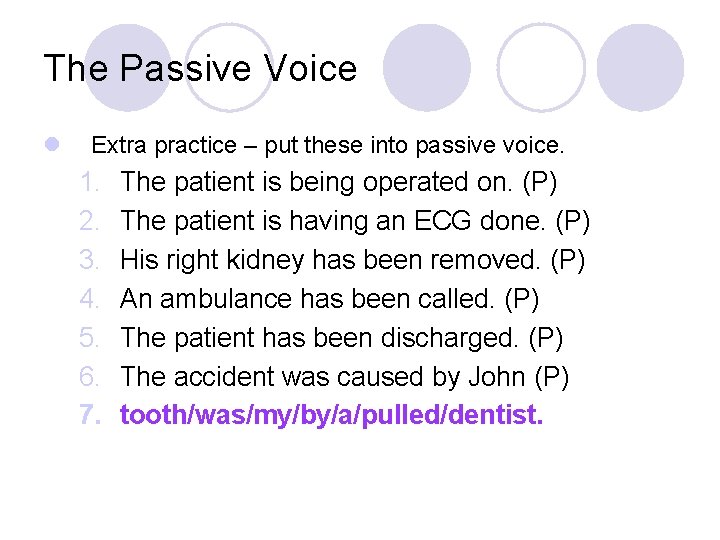
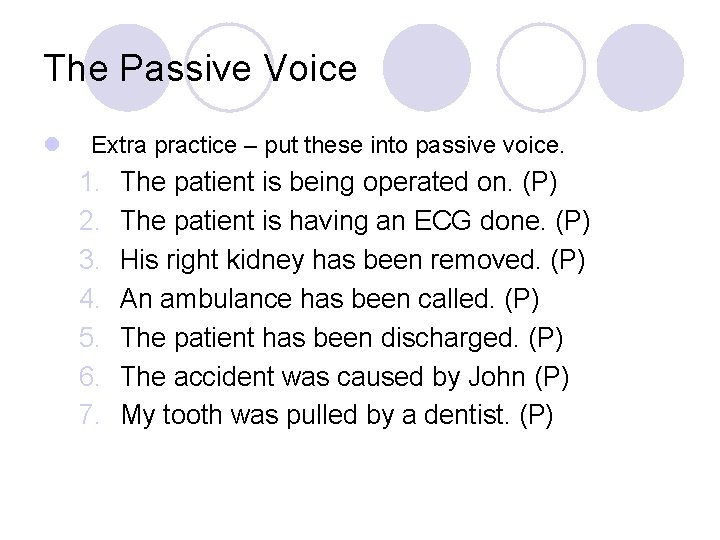
The Passive Voice l Extra practice – put these into passive voice. 1. 2. 3. 4. 5. 6. 7. The patient is being operated on. (P) The patient is having an ECG done. (P) His right kidney has been removed. (P) An ambulance has been called. (P) The patient has been discharged. (P) The accident was caused by John (P) tooth/was/my/by/a/pulled/dentist.
The Passive Voice l Extra practice – put these into passive voice. 1. 2. 3. 4. 5. 6. 7. The patient is being operated on. (P) The patient is having an ECG done. (P) His right kidney has been removed. (P) An ambulance has been called. (P) The patient has been discharged. (P) The accident was caused by John (P) My tooth was pulled by a dentist. (P)
The Passive Voice l Extra practice – put these into passive voice. 1. will/during/your/appendix/removed/operation/t he/be.
The Passive Voice l Extra practice – put these into passive voice. 1. Your appendix will be removed during the operation. 2. told/nobody/patient/happening/was/the/what.
The Passive Voice l Extra practice – put these into passive voice. 1. Your appendix will be removed during the operation. 2. Nobody told the patient what was happening. 3. shocked/jumped/rats/when/the.
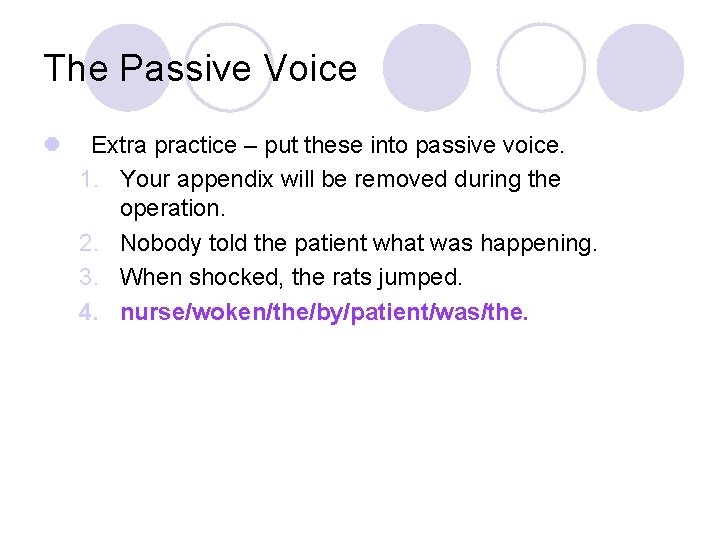
The Passive Voice l Extra practice – put these into passive voice. 1. Your appendix will be removed during the operation. 2. Nobody told the patient what was happening. 3. When shocked, the rats jumped. 4. nurse/woken/the/by/patient/was/the.
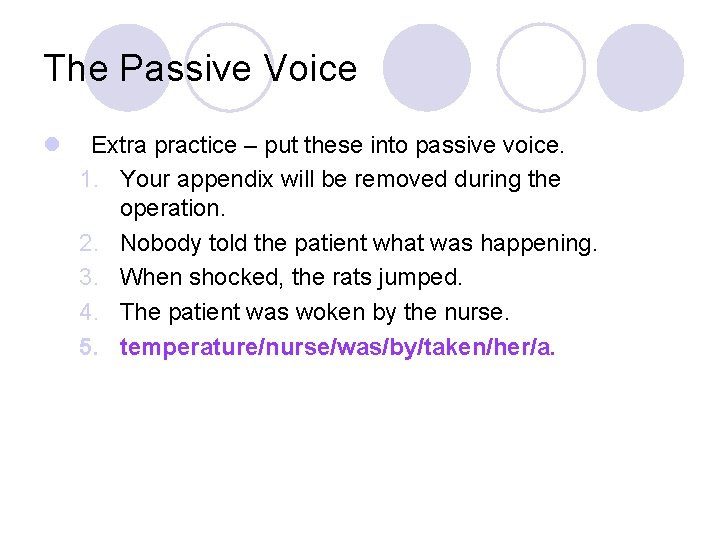
The Passive Voice l Extra practice – put these into passive voice. 1. Your appendix will be removed during the operation. 2. Nobody told the patient what was happening. 3. When shocked, the rats jumped. 4. The patient was woken by the nurse. 5. temperature/nurse/was/by/taken/her/a.
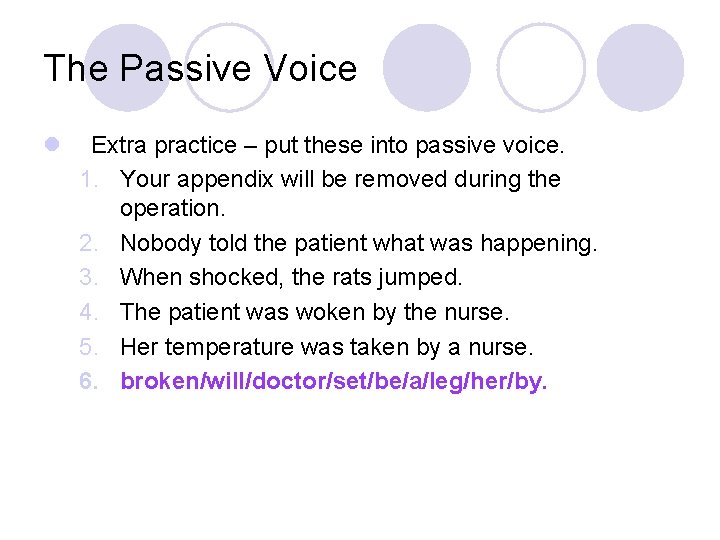
The Passive Voice l Extra practice – put these into passive voice. 1. Your appendix will be removed during the operation. 2. Nobody told the patient what was happening. 3. When shocked, the rats jumped. 4. The patient was woken by the nurse. 5. Her temperature was taken by a nurse. 6. broken/will/doctor/set/be/a/leg/her/by.
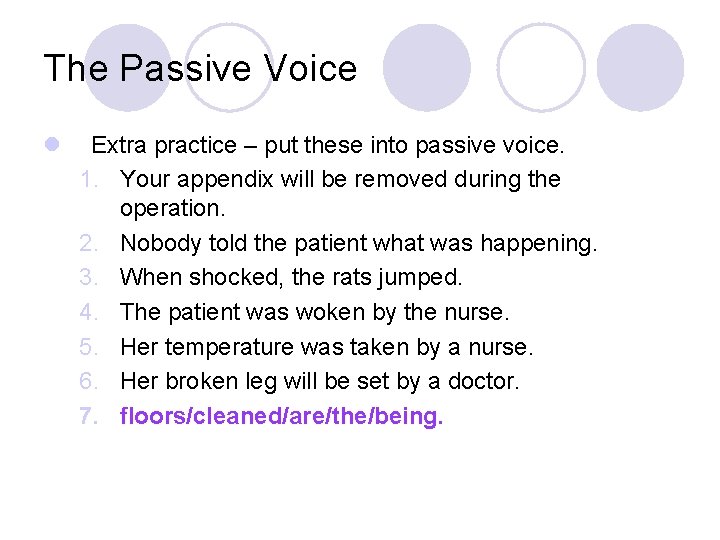
The Passive Voice l Extra practice – put these into passive voice. 1. Your appendix will be removed during the operation. 2. Nobody told the patient what was happening. 3. When shocked, the rats jumped. 4. The patient was woken by the nurse. 5. Her temperature was taken by a nurse. 6. Her broken leg will be set by a doctor. 7. floors/cleaned/are/the/being.
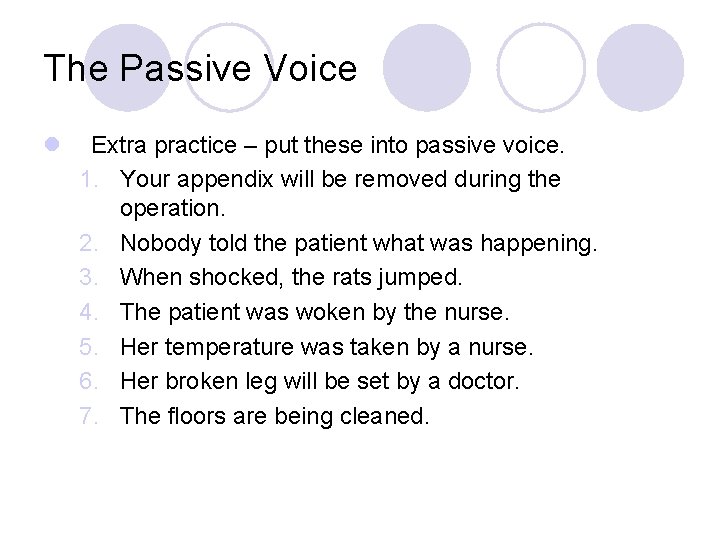
The Passive Voice l Extra practice – put these into passive voice. 1. Your appendix will be removed during the operation. 2. Nobody told the patient what was happening. 3. When shocked, the rats jumped. 4. The patient was woken by the nurse. 5. Her temperature was taken by a nurse. 6. Her broken leg will be set by a doctor. 7. The floors are being cleaned.
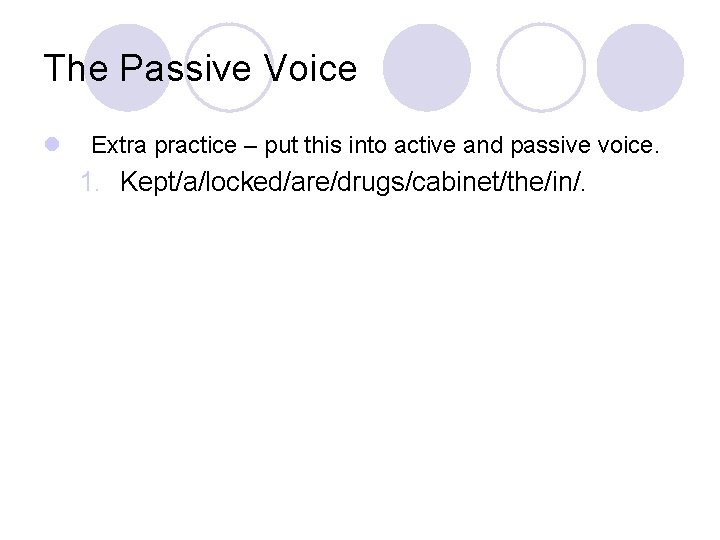
The Passive Voice l Extra practice – put this into active and passive voice. 1. Kept/a/locked/are/drugs/cabinet/the/in/.
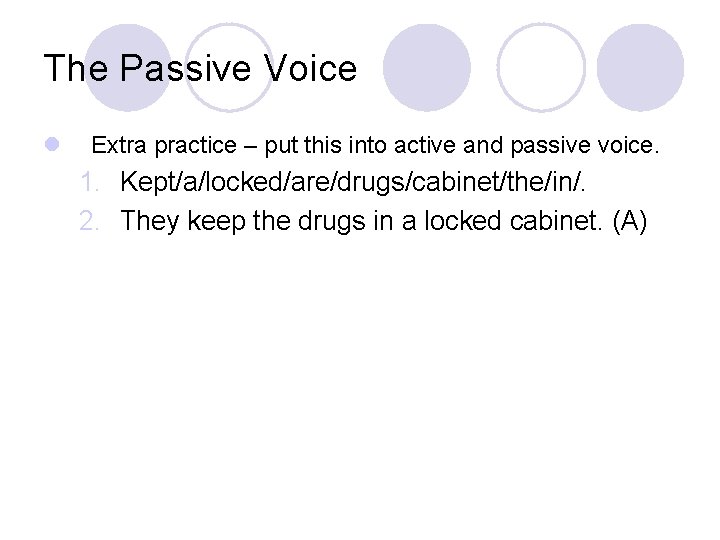
The Passive Voice l Extra practice – put this into active and passive voice. 1. Kept/a/locked/are/drugs/cabinet/the/in/. 2. They keep the drugs in a locked cabinet. (A)
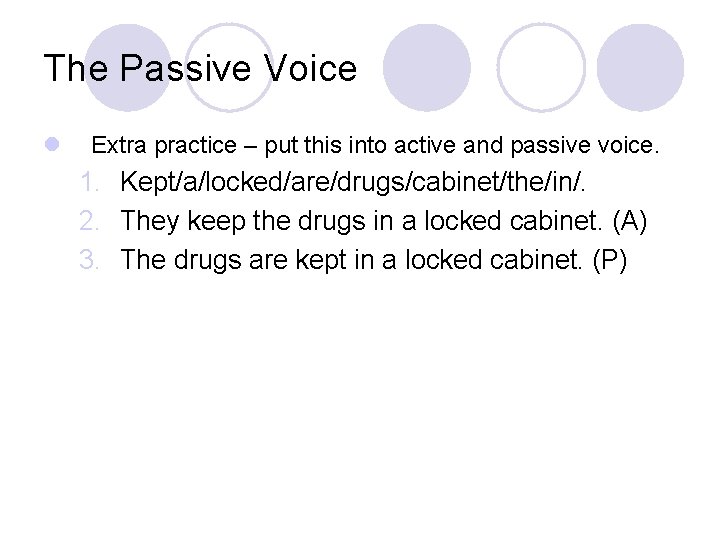
The Passive Voice l Extra practice – put this into active and passive voice. 1. Kept/a/locked/are/drugs/cabinet/the/in/. 2. They keep the drugs in a locked cabinet. (A) 3. The drugs are kept in a locked cabinet. (P)