
Introduction to the new mainframe Chapter 11 a
- Slides: 38
Introduction to the new mainframe Chapter 11 a Message Backbone for SOA Web. Sphere MQ on z/OS © Copyright IBM Corp. , 2008. All rights reserved. Contains Animation
Introduction to the new mainframe Trademarks The following are trademarks of the International Business Machines Corporation in the United States, other countries, or both. For a complete list of IBM trademarks please visit www. ibm. com/legal/copytrade. shtml CICS DB 2 E-business logo ESCON e. Server FICON IBM Logo IMS i. Series MVS OS/390 p. Series Rational RS/6000 S/390 Tivoli VM/ESA VSE/ESA Web. Sphere z/OS z. Series System z Java and all Java-based trademarks are trademarks of Sun Microsystems, Inc. in the United States, other countries, or both. Microsoft, Windows NT, and the Windows logo are trademarks of Microsoft Corporation in the United States, other countries, or both. Microsoft trademark guidelines Intel is a registeredtrademarksof Intel Corporation in the United States and other countries. UNIX is a registered trademark of The Open Group in the United States and other countries. Linux is a registered trademark of Linus Torvalds in the United States, other countries, or both. Other company, product, or service names may be trademarks or service marks of others. © Copyright IBM Corp. , 2008. All rights reserved.
Introduction to the new mainframe Chapter 11 a objectives Be able to: Explain MQ processing. List common MQ objects. Benefits of doing it on z © Copyright IBM Corp. , 2008. All rights reserved.
Introduction to the new mainframe Key terms in this chapter queues Queue manager Channels Messages security listener trigger cluster Queue sharing Pub/sub © Copyright IBM Corp. , 2008. All rights reserved.
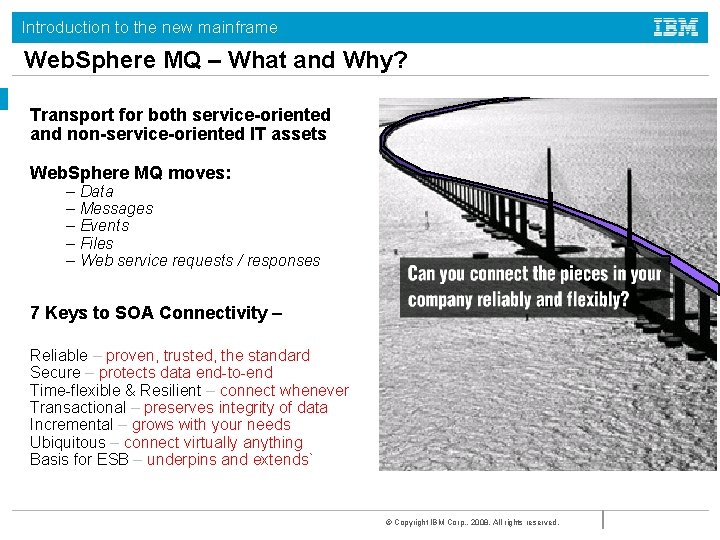
Introduction to the new mainframe Web. Sphere MQ – What and Why? Transport for both service-oriented and non-service-oriented IT assets Web. Sphere MQ moves: – Data – Messages – Events – Files – Web service requests / responses 7 Keys to SOA Connectivity – Reliable – proven, trusted, the standard Secure – protects data end-to-end Time-flexible & Resilient – connect whenever Transactional – preserves integrity of data Incremental – grows with your needs Ubiquitous – connect virtually anything Basis for ESB – underpins and extends` © Copyright IBM Corp. , 2008. All rights reserved.
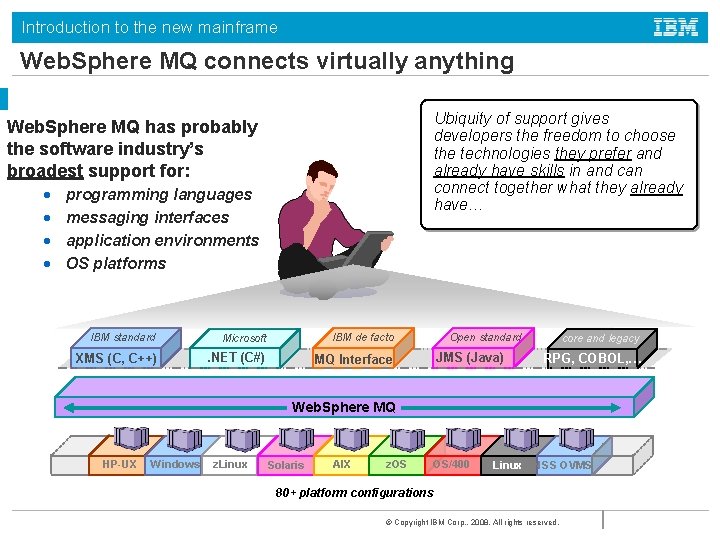
Introduction to the new mainframe Web. Sphere MQ connects virtually anything Ubiquity of support gives developers the freedom to choose the technologies they prefer and already have skills in and can connect together what they already have… Web. Sphere MQ has probably the software industry’s broadest support for: • • programming languages messaging interfaces application environments OS platforms IBM standard Microsoft IBM de facto XMS (C, C++) . NET (C#) MQ Interface Open standard JMS (Java) core and legacy RPG, COBOL, … Web. Sphere MQ HP-UX Windows z. Linux Solaris AIX z. OS OS/400 Linux NSS OVMS 80+ platform configurations © Copyright IBM Corp. , 2008. All rights reserved.
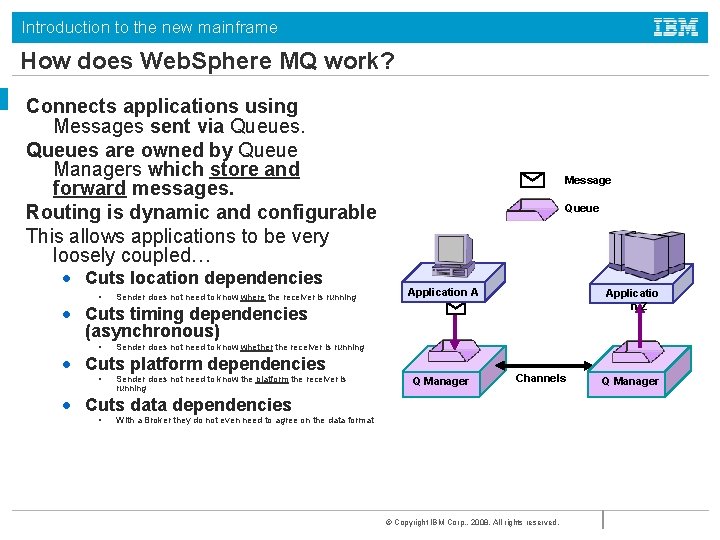
Introduction to the new mainframe How does Web. Sphere MQ work? Connects applications using Messages sent via Queues are owned by Queue Managers which store and forward messages. Routing is dynamic and configurable This allows applications to be very loosely coupled… • Cuts location dependencies • Sender does not need to know where the receiver is running • Sender does not need to know whether the receiver is running • Sender does not need to know the platform the receiver is running Message Queue Application A Applicatio n. Z • Cuts timing dependencies (asynchronous) • Cuts platform dependencies Q Manager Channels • Cuts data dependencies • With a Broker they do not even need to agree on the data format © Copyright IBM Corp. , 2008. All rights reserved. Q Manager
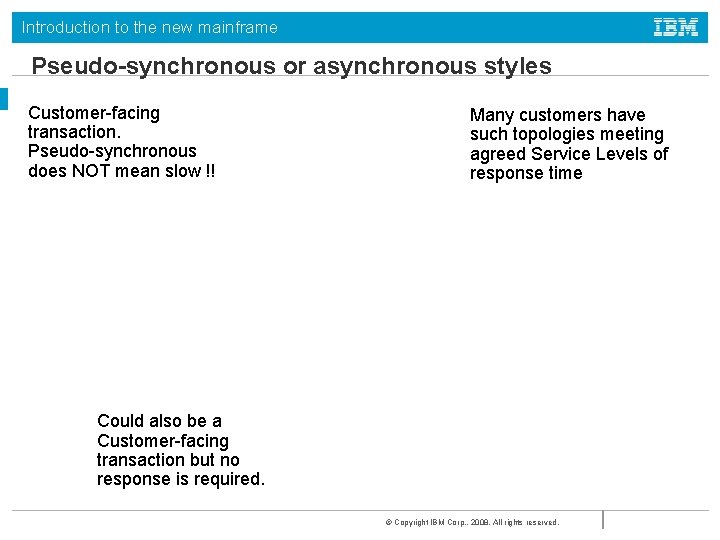
Introduction to the new mainframe Pseudo-synchronous or asynchronous styles Customer-facing transaction. Pseudo-synchronous does NOT mean slow !! Many customers have such topologies meeting agreed Service Levels of response time Could also be a Customer-facing transaction but no response is required. © Copyright IBM Corp. , 2008. All rights reserved.
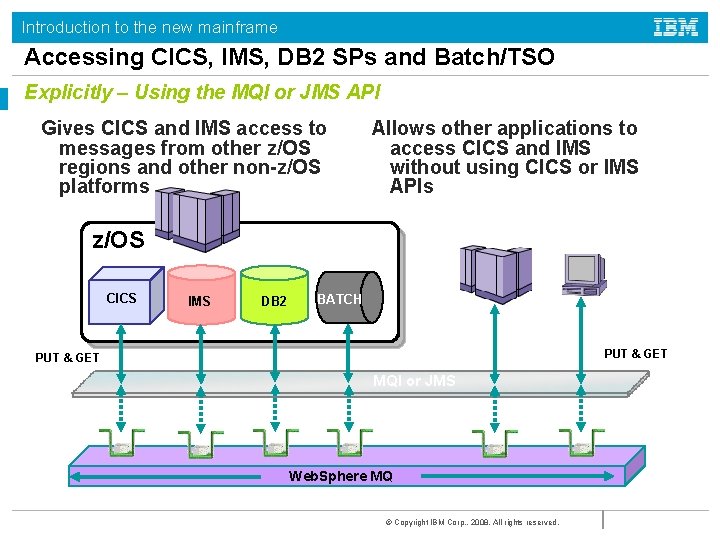
Introduction to the new mainframe Accessing CICS, IMS, DB 2 SPs and Batch/TSO Explicitly – Using the MQI or JMS API Gives CICS and IMS access to messages from other z/OS regions and other non-z/OS platforms Allows other applications to access CICS and IMS without using CICS or IMS APIs z/OS CICS IMS DB 2 BATCH PUT & GET MQI or JMS Web. Sphere MQ © Copyright IBM Corp. , 2008. All rights reserved.
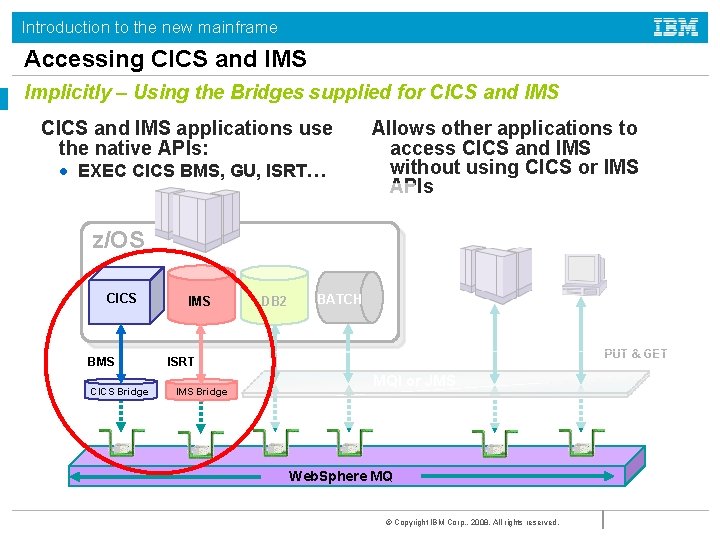
Introduction to the new mainframe Accessing CICS and IMS Implicitly – Using the Bridges supplied for CICS and IMS applications use the native APIs: • EXEC CICS BMS, GU, ISRT… Allows other applications to access CICS and IMS without using CICS or IMS APIs z/OS CICS BMS CICS Bridge IMS DB 2 BATCH PUT & GET ISRT IMS Bridge MQI or JMS Web. Sphere MQ © Copyright IBM Corp. , 2008. All rights reserved.
Introduction to the new mainframe Web. Sphere MQ Clustering MQ clustering provides 2 functions; automatic advertising of queues within a cluster to reduce MQ administration, workload balancing by spreading messages destined for a single logical queue over multiple queues of the same name on different Queue Managers © Copyright IBM Corp. , 2008. All rights reserved.
Introduction to the new mainframe Workload balancing with MQ Clustering Basic clustering provides “round-robin” spreading of message data but a workload exit can be programmed to change this. MQ V 6 provides additional facilities for more complex message spreading. © Copyright IBM Corp. , 2008. All rights reserved.
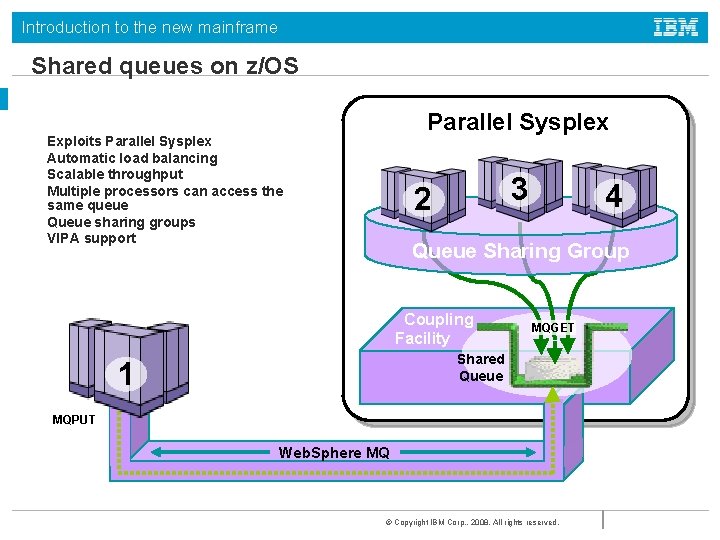
Introduction to the new mainframe Shared queues on z/OS Parallel Sysplex Exploits Parallel Sysplex Automatic load balancing Scalable throughput Multiple processors can access the same queue Queue sharing groups VIPA support 3 2 4 Queue Sharing Group Coupling Facility MQGET Shared Queue 1 MQPUT Web. Sphere MQ © Copyright IBM Corp. , 2008. All rights reserved.
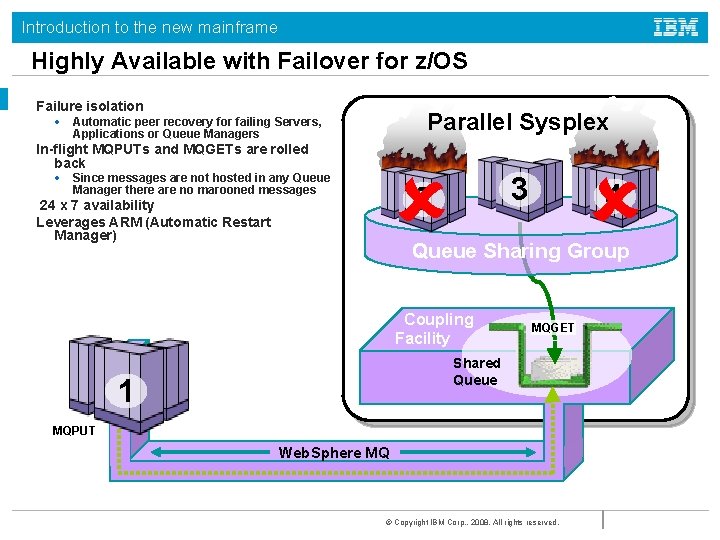
Introduction to the new mainframe Highly Available with Failover for z/OS Failure isolation Parallel Sysplex • Automatic peer recovery for failing Servers, Applications or Queue Managers In-flight MQPUTs and MQGETs are rolled back • Since messages are not hosted in any Queue Manager there are no marooned messages 3 2 24 x 7 availability Leverages ARM (Automatic Restart Manager) 4 Queue Sharing Group Coupling Facility MQGET Shared Queue 1 MQPUT Web. Sphere MQ © Copyright IBM Corp. , 2008. All rights reserved.
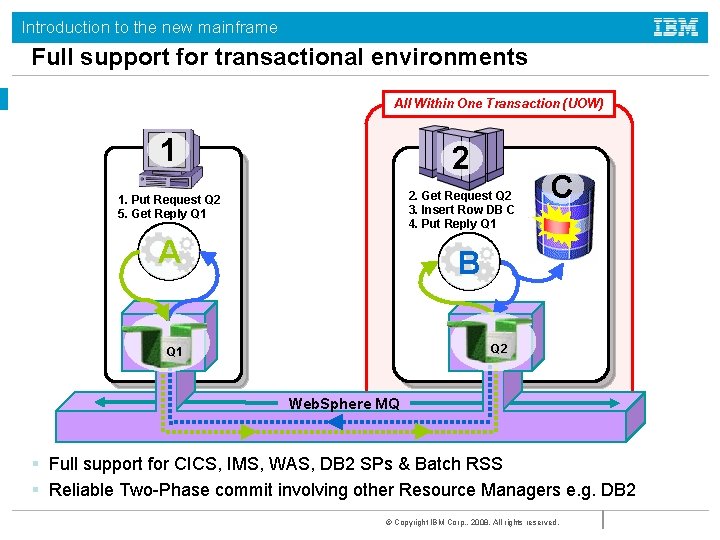
Introduction to the new mainframe Full support for transactional environments All Within One Transaction (UOW) 1 2 2. Get Request Q 2 3. Insert Row DB C 4. Put Reply Q 1 1. Put Request Q 2 5. Get Reply Q 1 A C B Q 2 Q 1 Web. Sphere MQ § Full support for CICS, IMS, WAS, DB 2 SPs & Batch RSS § Reliable Two-Phase commit involving other Resource Managers e. g. DB 2 © Copyright IBM Corp. , 2008. All rights reserved.
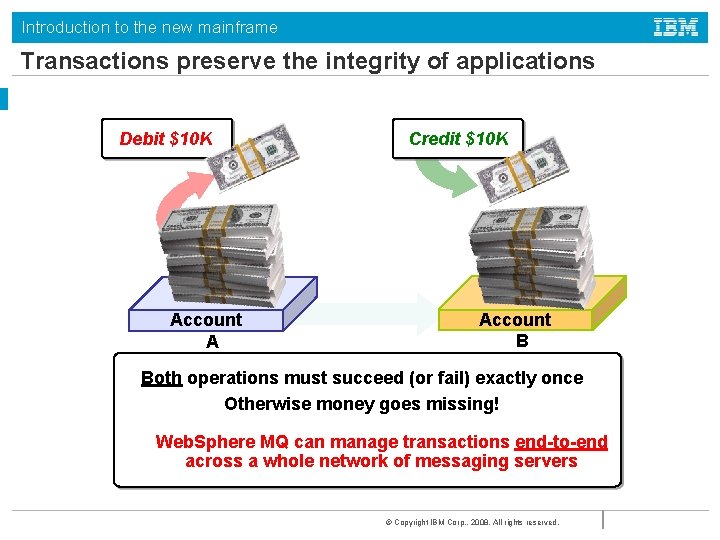
Introduction to the new mainframe Transactions preserve the integrity of applications Debit $10 K Account A Credit $10 K Account B Both operations must succeed (or fail) exactly once Otherwise money goes missing! Web. Sphere MQ can manage transactions end-to-end across a whole network of messaging servers © Copyright IBM Corp. , 2008. All rights reserved.
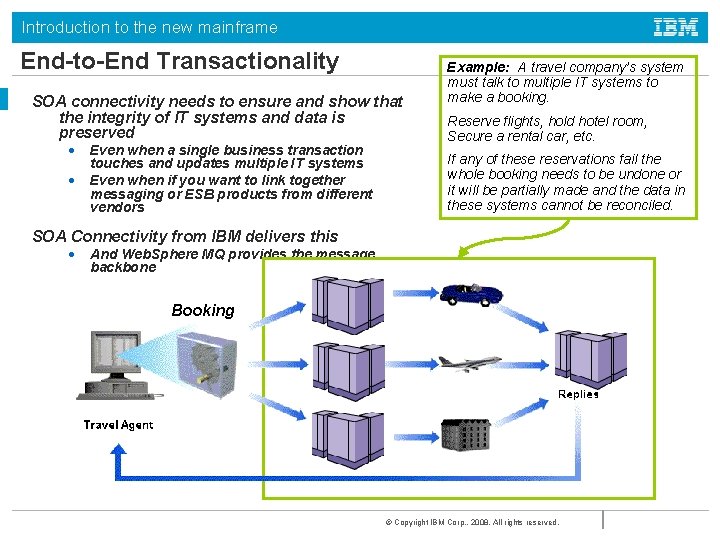
Introduction to the new mainframe End-to-End Transactionality SOA connectivity needs to ensure and show that the integrity of IT systems and data is preserved • • Even when a single business transaction touches and updates multiple IT systems Even when if you want to link together messaging or ESB products from different vendors Example: A travel company’s system must talk to multiple IT systems to make a booking. Reserve flights, hold hotel room, Secure a rental car, etc. If any of these reservations fail the whole booking needs to be undone or it will be partially made and the data in these systems cannot be reconciled. SOA Connectivity from IBM delivers this • And Web. Sphere MQ provides the message backbone Booking © Copyright IBM Corp. , 2008. All rights reserved.
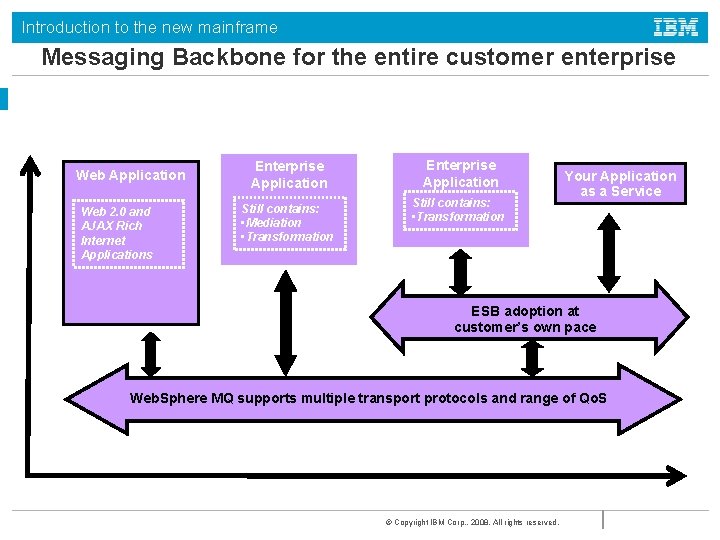
Introduction to the new mainframe Messaging Backbone for the entire customer enterprise Web Application Web 2. 0 and AJAX Rich Internet Applications Enterprise Application Still contains: • Mediation • Transformation Still contains: • Transformation Your Application as a Service ESB adoption at customer’s own pace Web. Sphere MQ supports multiple transport protocols and range of Qo. S © Copyright IBM Corp. , 2008. All rights reserved.
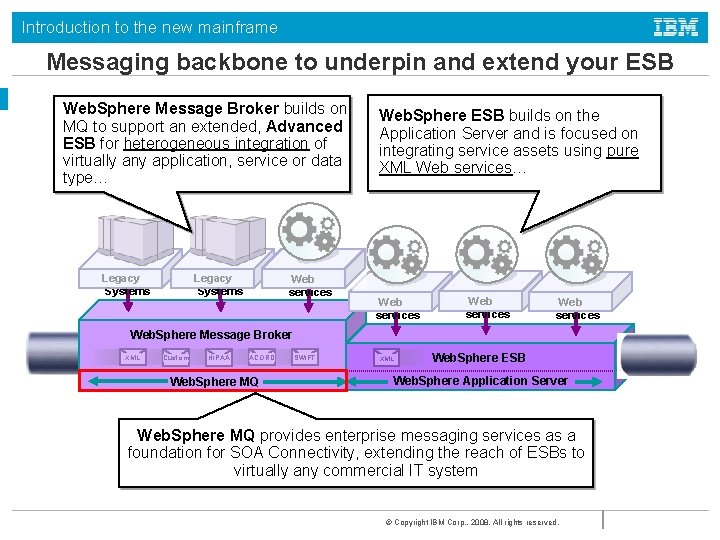
Introduction to the new mainframe Messaging backbone to underpin and extend your ESB Web. Sphere Message Broker builds on MQ to support an extended, Advanced ESB for heterogeneous integration of virtually any application, service or data type… Legacy Systems Web services Web. Sphere ESB builds on the Application Server and is focused on integrating service assets using pure XML Web services… Web services Web. Sphere Message Broker XML Custom HIPAA ACORD Web. Sphere MQ SWIFT XML Web. Sphere ESB Web. Sphere Application Server Web. Sphere MQ provides enterprise messaging services as a foundation for SOA Connectivity, extending the reach of ESBs to virtually any commercial IT system © Copyright IBM Corp. , 2008. All rights reserved.
Introduction to the new mainframe Standards - JMS 1. 1 and J 2 EE JMS 1. 1 is latest level of standard, and is required for J 2 EE compliance Joins pub/sub and point-to-point methods into a single set of methods • Backwards-compatible • JMS applications can still use the older 1. 02 APIs WMQ JMS is always supported inside WAS and now also for Web. Logic • It is not the “embedded” provider for WAS 6, but still (of course) can be used V 6 also includes MA 0 C Publish/Subscribe component on distributed platforms only • Making it easier to use full JMS function without downloading or buying extras © Copyright IBM Corp. , 2008. All rights reserved.
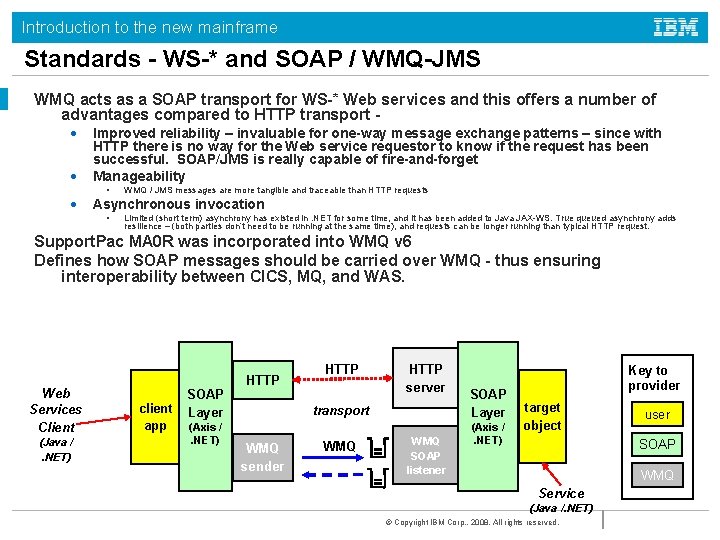
Introduction to the new mainframe Standards - WS-* and SOAP / WMQ-JMS WMQ acts as a SOAP transport for WS-* Web services and this offers a number of advantages compared to HTTP transport • • • Improved reliability – invaluable for one-way message exchange patterns – since with HTTP there is no way for the Web service requestor to know if the request has been successful. SOAP/JMS is really capable of fire-and-forget Manageability • WMQ / JMS messages are more tangible and traceable than HTTP requests Asynchronous invocation • Limited (short term) asynchrony has existed in. NET for some time, and it has been added to Java JAX-WS. True queued asynchrony adds resilience – (both parties don’t need to be running at the same time), and requests can be longer running than typical HTTP request. Support. Pac MA 0 R was incorporated into WMQ v 6 Defines how SOAP messages should be carried over WMQ - thus ensuring interoperability between CICS, MQ, and WAS. Web Services Client (Java /. NET) client app SOAP Layer (Axis /. NET) HTTP server transport WMQ sender WMQ SOAP listener SOAP Layer (Axis /. NET) Key to provider target object user SOAP WMQ Service (Java /. NET) © Copyright IBM Corp. , 2008. All rights reserved.
Introduction to the new mainframe XMS Common messaging API across IBM providers • Transport neutral - WMQ, Real-Time, and WAS V 6 Messaging • JMS-like API for other languages • Simplified Point-to-Point and Publish/Subscribe messaging Decoupled administration • XMS and JMS use the same administered Connection Factories and Destinations XMS 1. 2 for C/C++ available as Support. Pac IA 94 • Category 3 Support. Pac • Initially for Windows, Linux, Solaris XMS 1. 2 for. NET available as Support. Pac IA 9 H • Now a Category 3 Support. Pac • "Fully managed" code for WMQ, WAS Messaging and Real-Time clients • . NET support enables C#, VB. NET etc. languages Inclusion with WMQ in future Fix Pack or Version © Copyright IBM Corp. , 2008. All rights reserved.
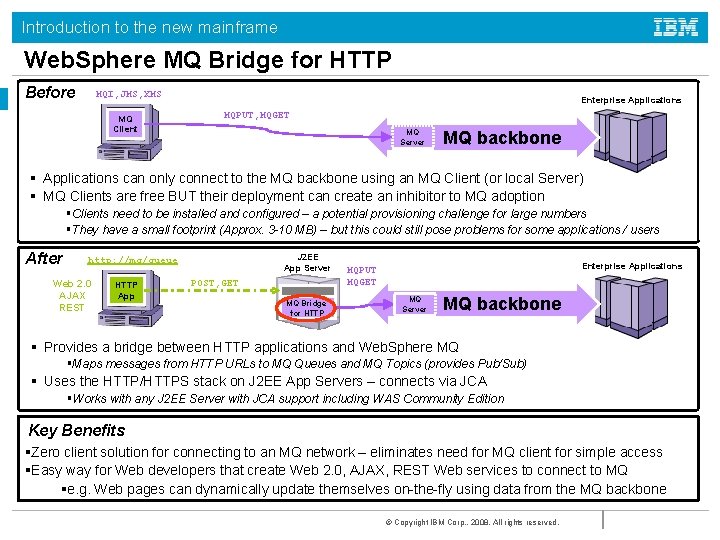
Introduction to the new mainframe Web. Sphere MQ Bridge for HTTP Before MQI, JMS, XMS MQ Client Enterprise Applications MQPUT, MQGET MQ Server MQ backbone § Applications can only connect to the MQ backbone using an MQ Client (or local Server) § MQ Clients are free BUT their deployment can create an inhibitor to MQ adoption §Clients need to be installed and configured – a potential provisioning challenge for large numbers §They have a small footprint (Approx. 3 -10 MB) – but this could still pose problems for some applications / users After J 2 EE App Server http: //mq/queue Web 2. 0 AJAX REST HTTP App POST, GET HTTP stack MQ Bridge for HTTP Enterprise Applications MQPUT MQGET MQ Server MQ backbone § Provides a bridge between HTTP applications and Web. Sphere MQ §Maps messages from HTTP URLs to MQ Queues and MQ Topics (provides Pub/Sub) § Uses the HTTP/HTTPS stack on J 2 EE App Servers – connects via JCA §Works with any J 2 EE Server with JCA support including WAS Community Edition Key Benefits §Zero client solution for connecting to an MQ network – eliminates need for MQ client for simple access §Easy way for Web developers that create Web 2. 0, AJAX, REST Web services to connect to MQ §e. g. Web pages can dynamically update themselves on-the-fly using data from the MQ backbone © Copyright IBM Corp. , 2008. All rights reserved.
Introduction to the new mainframe © Copyright IBM Corp. , 2008. All rights reserved.
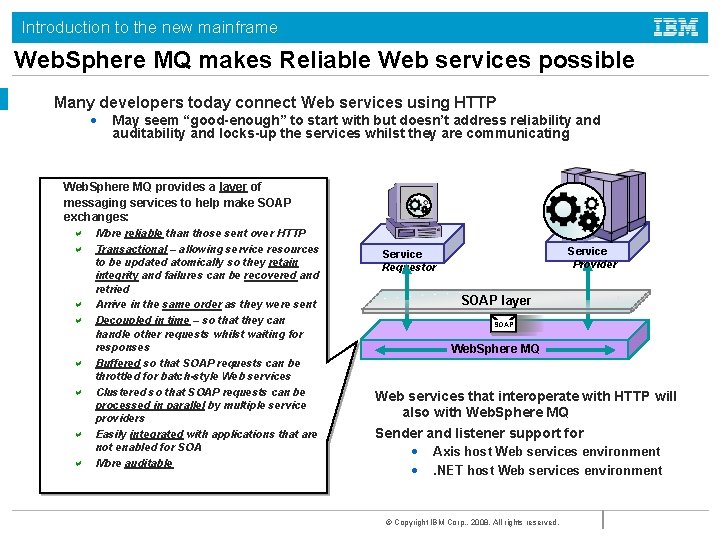
Introduction to the new mainframe Web. Sphere MQ makes Reliable Web services possible Many developers today connect Web services using HTTP • May seem “good-enough” to start with but doesn’t address reliability and auditability and locks-up the services whilst they are communicating Web. Sphere MQ provides a layer of messaging services to help make SOAP exchanges: a More reliable than those sent over HTTP a Transactional – allowing service resources a a a to be updated atomically so they retain integrity and failures can be recovered and retried Arrive in the same order as they were sent Decoupled in time – so that they can handle other requests whilst waiting for responses Buffered so that SOAP requests can be throttled for batch-style Web services Clustered so that SOAP requests can be processed in parallel by multiple service providers Easily integrated with applications that are not enabled for SOA More auditable Service Provider Service Requestor SOAP layer SOAP Web. Sphere MQ Web services that interoperate with HTTP will also with Web. Sphere MQ Sender and listener support for • Axis host Web services environment • . NET host Web services environment © Copyright IBM Corp. , 2008. All rights reserved.
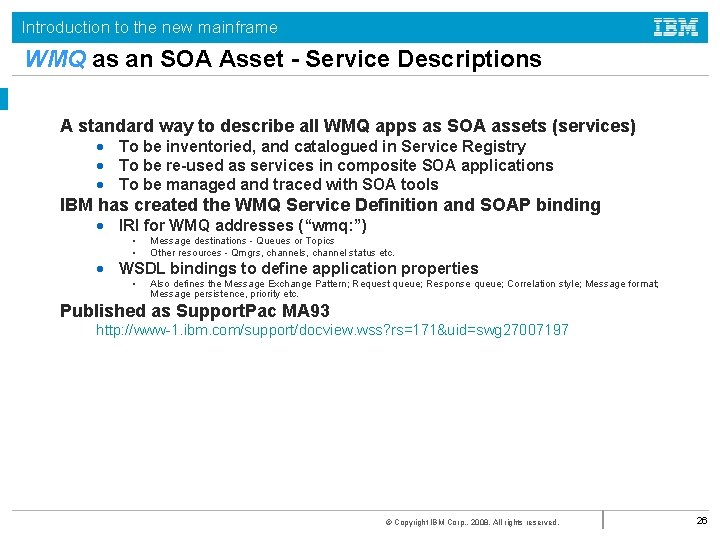
Introduction to the new mainframe WMQ as an SOA Asset - Service Descriptions A standard way to describe all WMQ apps as SOA assets (services) • To be inventoried, and catalogued in Service Registry • To be re-used as services in composite SOA applications • To be managed and traced with SOA tools IBM has created the WMQ Service Definition and SOAP binding • IRI for WMQ addresses (“wmq: ”) • • Message destinations - Queues or Topics Other resources - Qmgrs, channel status etc. • Also defines the Message Exchange Pattern; Request queue; Response queue; Correlation style; Message format; Message persistence, priority etc. • WSDL bindings to define application properties Published as Support. Pac MA 93 http: //www-1. ibm. com/support/docview. wss? rs=171&uid=swg 27007197 © Copyright IBM Corp. , 2008. All rights reserved. 26
Introduction to the new mainframe Publish/Subscribe A natural part of the JMS API • Combines both Publish/Subscribe and Point-to-Point patterns • Now also a natural part of the native MQI Point-to-point asynchronous messaging decouples applications • But still implies a one-one relationship between sender and receiver Publish/subscribe is a further stage of decoupling • Sender has no direct knowledge of how many (if any) apps will see a message • Link between applications is a Topic, not a Queue WMQ V 6 (Distributed) included a Publish/Subscribe broker (formerly MA 0 C) • Compatibility mode available in V 7 Implementation substantially improved with V 7 • And is available for the first time on z/OS © Copyright IBM Corp. , 2008. All rights reserved.
Introduction to the new mainframe Client Enhancements Client Performance • Traditional WMQ non-persistent messages more reliable than some need • "Read Ahead" for Receiving Messages/Publications • "Asynchronous Put" for Sending/Publishing Messages Client Connection Management • Shared Client Conversations • Implementation also gives us more heartbeat opportunities • Faster failure notification for clients • • Automatic workload distribution via CCDT Control number of connected clients at a queue manager • Limited number of clients permitted by V 7 license without CAF • Client Connections • Free connections to z/OS for administration programs like WMQ Explorer © Copyright IBM Corp. , 2008. All rights reserved.
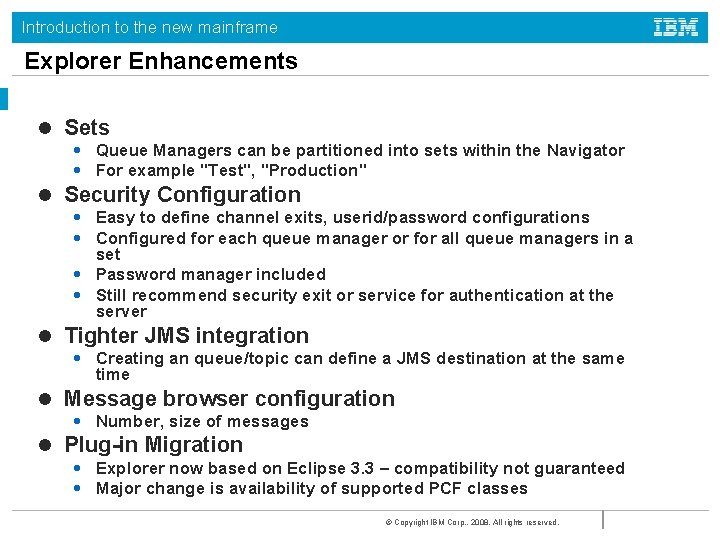
Introduction to the new mainframe Explorer Enhancements l Sets • Queue Managers can be partitioned into sets within the Navigator • For example "Test", "Production" l Security Configuration • Easy to define channel exits, userid/password configurations • Configured for each queue manager or for all queue managers in a set • Password manager included • Still recommend security exit or service for authentication at the server l Tighter JMS integration • Creating an queue/topic can define a JMS destination at the same time l Message browser configuration • Number, size of messages l Plug-in Migration • Explorer now based on Eclipse 3. 3 – compatibility not guaranteed • Major change is availability of supported PCF classes © Copyright IBM Corp. , 2008. All rights reserved.
Introduction to the new mainframe Security is #1 concern of CIOs l Secure Sockets Layer (SSL) • Provides channel-level security • Web. Sphere MQ V 5. 3 introduced SSL support • Uses the z/OS Cryptographic Services System SSL function l Web. Sphere MQ Extended Security Edition for z/OS • Provides advanced security capabilities leveraging encryption technology l Security Server on z/OS (previously RACF) • Web. Sphere MQ for z/OS has always provided close integration with RACF and 3 rd-party alternatives • Security Server (RACF) can protect the resources that Web. Sphere MQ for z/OS owns and manages from access by unauthorized users © Copyright IBM Corp. , 2008. All rights reserved.
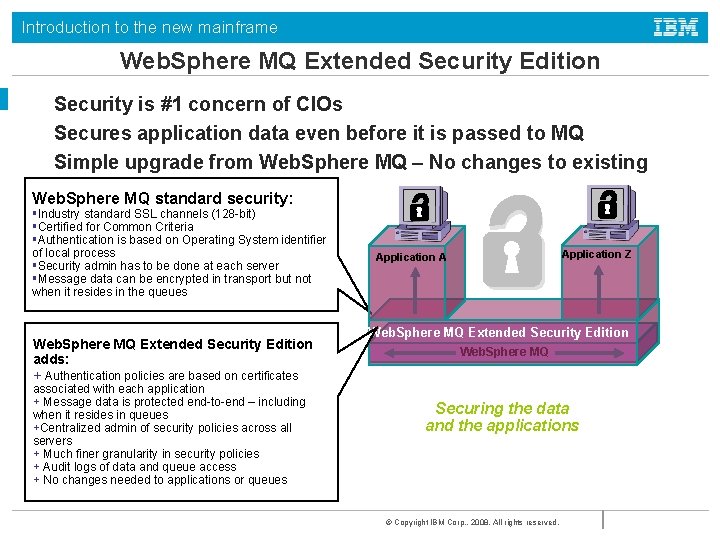
Introduction to the new mainframe Web. Sphere MQ Extended Security Edition Security is #1 concern of CIOs Secures application data even before it is passed to MQ Simple upgrade from Web. Sphere MQ – No changes to existing network required Web. Sphere MQ standard security: §Industry standard SSL channels (128 -bit) §Certified for Common Criteria §Authentication is based on Operating System identifier of local process §Security admin has to be done at each server §Message data can be encrypted in transport but not when it resides in the queues Web. Sphere MQ Extended Security Edition adds: + Authentication policies are based on certificates associated with each application + Message data is protected end-to-end – including when it resides in queues +Centralized admin of security policies across all servers + Much finer granularity in security policies + Audit logs of data and queue access + No changes needed to applications or queues Application Z Application A Web. Sphere MQ Extended Security Edition Web. Sphere MQ Securing the data and the applications © Copyright IBM Corp. , 2008. All rights reserved.
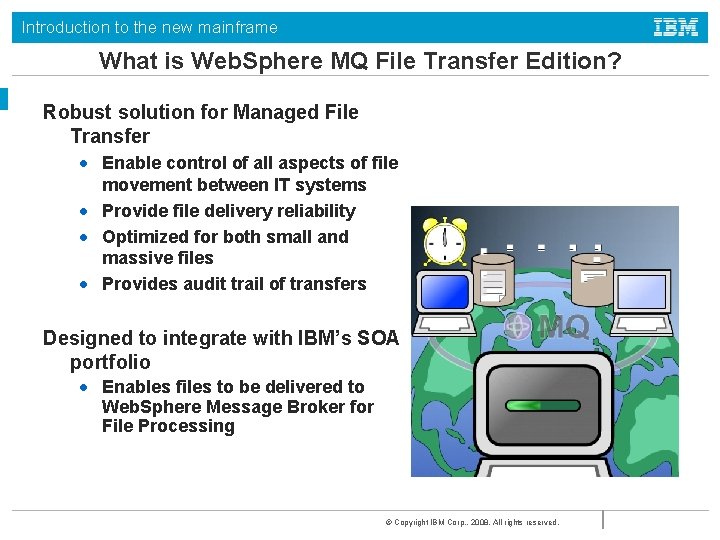
Introduction to the new mainframe What is Web. Sphere MQ File Transfer Edition? Robust solution for Managed File Transfer • Enable control of all aspects of file movement between IT systems • Provide file delivery reliability • Optimized for both small and massive files • Provides audit trail of transfers Designed to integrate with IBM’s SOA portfolio • Enables files to be delivered to Web. Sphere Message Broker for File Processing © Copyright IBM Corp. , 2008. All rights reserved.
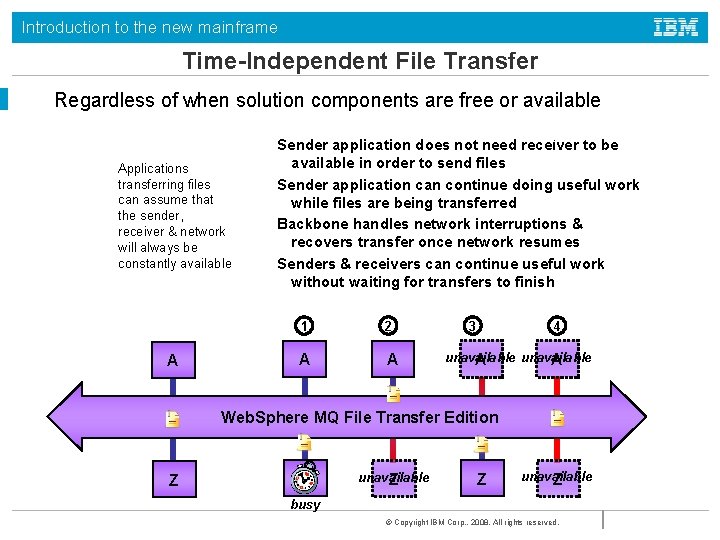
Introduction to the new mainframe Time-Independent File Transfer Regardless of when solution components are free or available Seems like this… Applications transferring files can assume that the sender, receiver & network will always be constantly available A …Even when this might be happening! Sender application does not need receiver to be available in order to send files Sender application can continue doing useful work while files are being transferred Backbone handles network interruptions & recovers transfer once network resumes Senders & receivers can continue useful work without waiting for transfers to finish 1 2 A A 3 4 unavailable A A Web. Sphere MQ File Transfer Edition Z Z unavailable Z busy © Copyright IBM Corp. , 2008. All rights reserved.
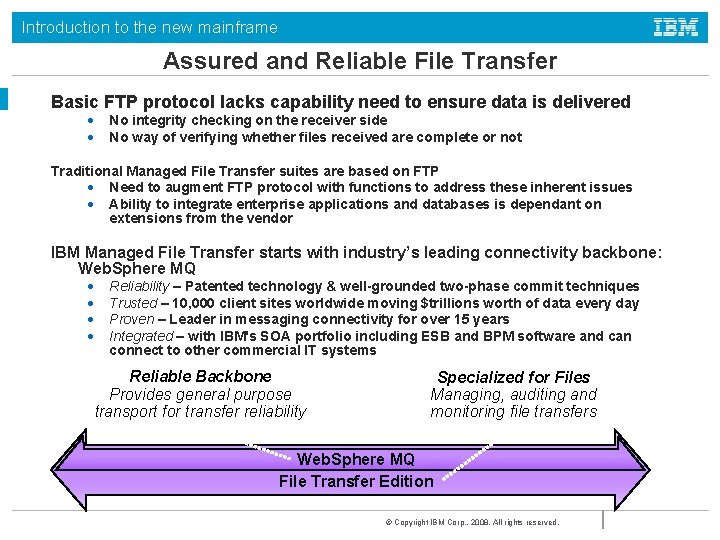
Introduction to the new mainframe Assured and Reliable File Transfer Basic FTP protocol lacks capability need to ensure data is delivered • • No integrity checking on the receiver side No way of verifying whether files received are complete or not Traditional Managed File Transfer suites are based on FTP • Need to augment FTP protocol with functions to address these inherent issues • Ability to integrate enterprise applications and databases is dependant on extensions from the vendor IBM Managed File Transfer starts with industry’s leading connectivity backbone: Web. Sphere MQ • • Reliability – Patented technology & well-grounded two-phase commit techniques Trusted – 10, 000 client sites worldwide moving $trillions worth of data every day Proven – Leader in messaging connectivity for over 15 years Integrated – with IBM's SOA portfolio including ESB and BPM software and can connect to other commercial IT systems Reliable Backbone Provides general purpose transport for transfer reliability Specialized for Files Managing, auditing and monitoring file transfers Web. Sphere MQ File Transfer Edition © Copyright IBM Corp. , 2008. All rights reserved.
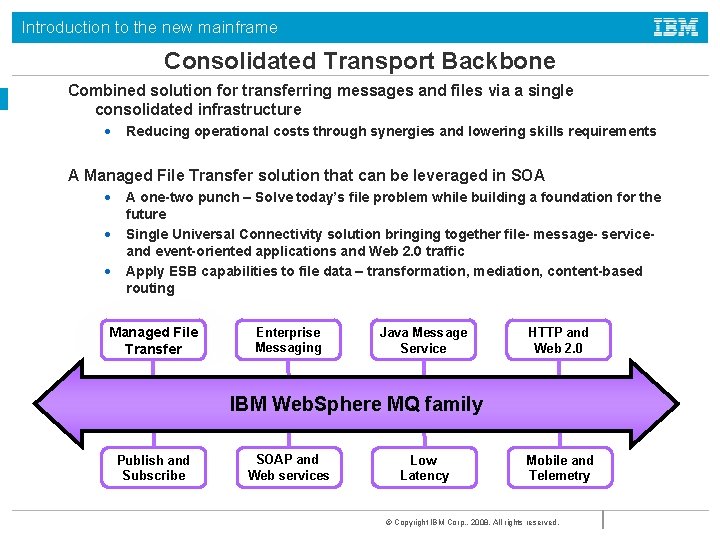
Introduction to the new mainframe Consolidated Transport Backbone Combined solution for transferring messages and files via a single consolidated infrastructure • Reducing operational costs through synergies and lowering skills requirements A Managed File Transfer solution that can be leveraged in SOA • • • A one-two punch – Solve today’s file problem while building a foundation for the future Single Universal Connectivity solution bringing together file- message- serviceand event-oriented applications and Web 2. 0 traffic Apply ESB capabilities to file data – transformation, mediation, content-based routing Managed File Transfer Enterprise Messaging Java Message Service HTTP and Web 2. 0 IBM Web. Sphere MQ family Publish and Subscribe SOAP and Web services Low Latency Mobile and Telemetry © Copyright IBM Corp. , 2008. All rights reserved.
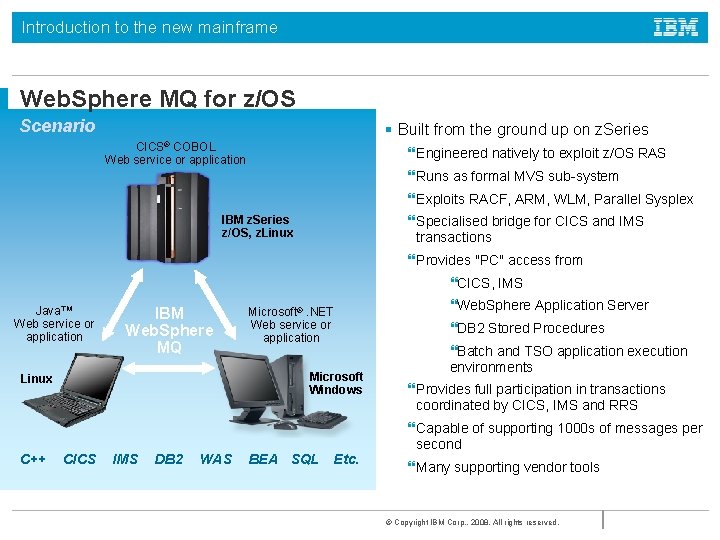
Introduction to the new mainframe Web. Sphere MQ for z/OS Scenario § Built from the ground up on z. Series CICS® COBOL Web service or application } Engineered natively to exploit z/OS RAS } Runs as formal MVS sub-system } Exploits RACF, ARM, WLM, Parallel Sysplex IBM z. Series z/OS, z. Linux } Specialised bridge for CICS and IMS transactions } Provides "PC" access from }CICS, IMS Java™ Web service or application IBM Web. Sphere MQ Microsoft Windows Linux C++ Microsoft®. NET Web service or application CICS IMS DB 2 WAS BEA SQL Etc. }Web. Sphere Application Server }DB 2 Stored Procedures }Batch and TSO application execution environments } Provides full participation in transactions coordinated by CICS, IMS and RRS } Capable of supporting 1000 s of messages per second } Many supporting vendor tools © Copyright IBM Corp. , 2008. All rights reserved.
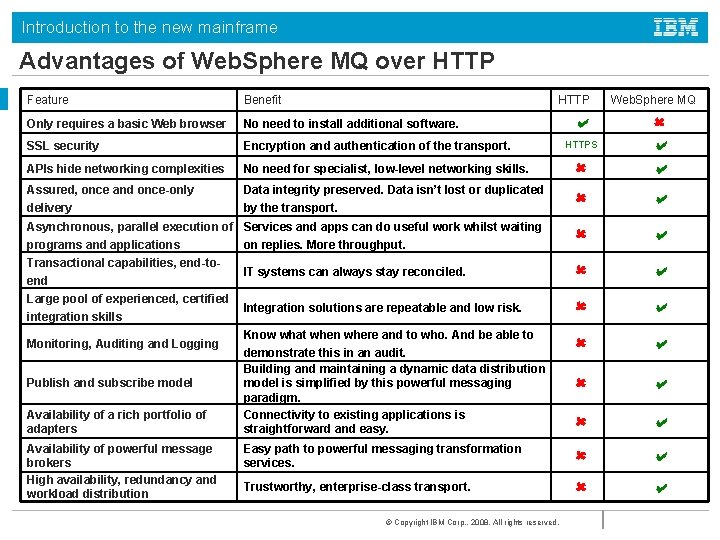
Introduction to the new mainframe Advantages of Web. Sphere MQ over HTTP Feature Benefit HTTP Only requires a basic Web browser No need to install additional software. SSL security Encryption and authentication of the transport. APIs hide networking complexities No need for specialist, low-level networking skills. Assured, once and once-only delivery Web. Sphere MQ HTTPS Data integrity preserved. Data isn’t lost or duplicated by the transport. Asynchronous, parallel execution of Services and apps can do useful work whilst waiting programs and applications on replies. More throughput. Transactional capabilities, end-toend IT systems can always stay reconciled. Large pool of experienced, certified integration skills Integration solutions are repeatable and low risk. Know what when where and to who. And be able to demonstrate this in an audit. Building and maintaining a dynamic data distribution model is simplified by this powerful messaging paradigm. Connectivity to existing applications is straightforward and easy. Easy path to powerful messaging transformation services. Trustworthy, enterprise-class transport. Monitoring, Auditing and Logging Publish and subscribe model Availability of a rich portfolio of adapters Availability of powerful message brokers High availability, redundancy and workload distribution © Copyright IBM Corp. , 2008. All rights reserved.
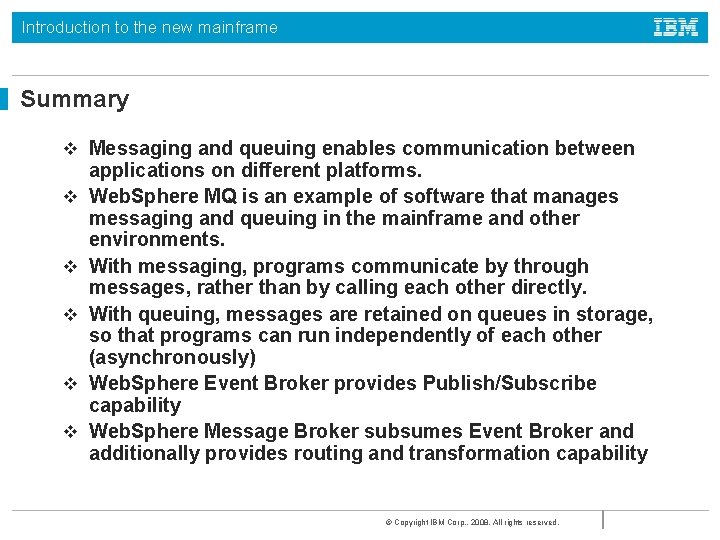
Introduction to the new mainframe Summary v Messaging and queuing enables communication between v v v applications on different platforms. Web. Sphere MQ is an example of software that manages messaging and queuing in the mainframe and other environments. With messaging, programs communicate by through messages, rather than by calling each other directly. With queuing, messages are retained on queues in storage, so that programs can run independently of each other (asynchronously) Web. Sphere Event Broker provides Publish/Subscribe capability Web. Sphere Message Broker subsumes Event Broker and additionally provides routing and transformation capability © Copyright IBM Corp. , 2008. All rights reserved.