
Introduction to The National Centers for Environmental Prediction
- Slides: 18
Introduction to The National Centers for Environmental Prediction (NCEP)
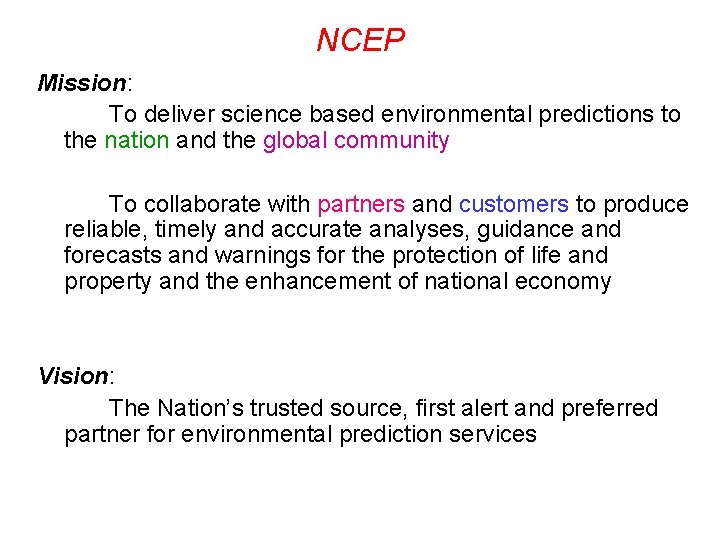
NCEP Mission: To deliver science based environmental predictions to the nation and the global community To collaborate with partners and customers to produce reliable, timely and accurate analyses, guidance and forecasts and warnings for the protection of life and property and the enhancement of national economy Vision: The Nation’s trusted source, first alert and preferred partner for environmental prediction services
3
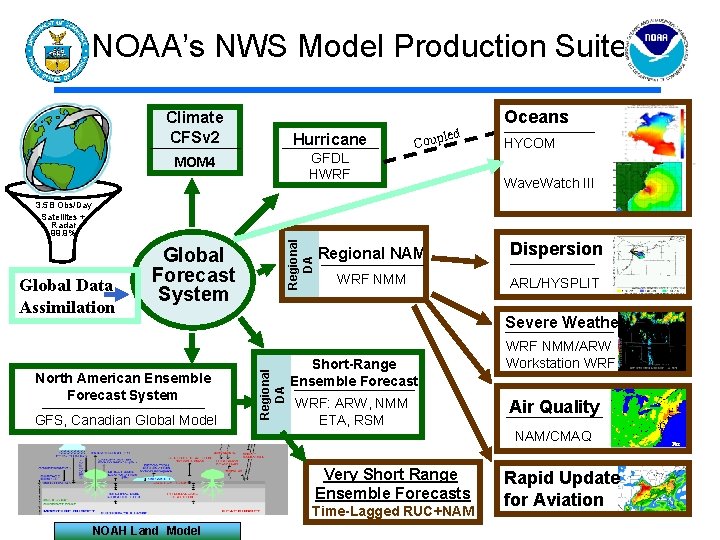
NOAA’s NWS Model Production Suite Climate CFSv 2 Hurricane GFDL HWRF MOM 4 led Coup Oceans HYCOM Wave. Watch III Global Forecast System North American Ensemble Forecast System GFS, Canadian Global Model Regional NAM Dispersion WRF NMM ARL/HYSPLIT Severe Weather Regional DA Global Data Assimilation Regional DA 3. 5 B Obs/Day Satellites + Radar 99. 9% Short-Range Ensemble Forecast WRF: ARW, NMM ETA, RSM WRF NMM/ARW Workstation WRF Air Quality NAM/CMAQ Very Short Range Ensemble Forecasts Time-Lagged RUC+NAM NOAH Land Model Rapid Update for Aviation For eca st 5
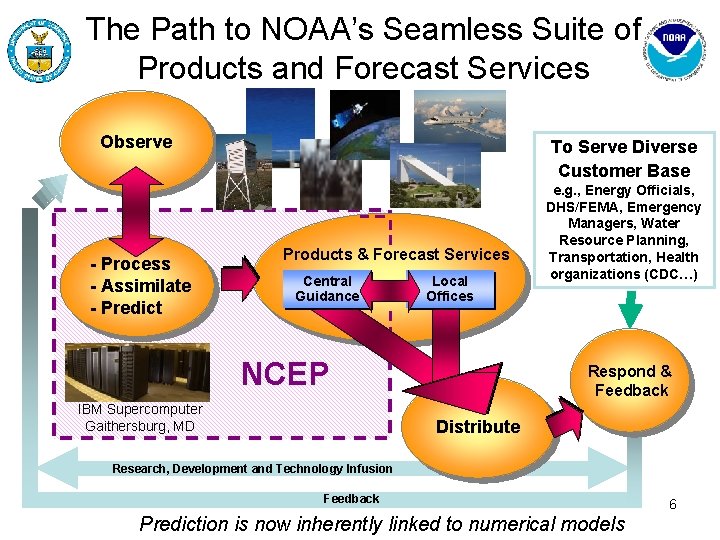
The Path to NOAA’s Seamless Suite of Products and Forecast Services Observe - Process - Assimilate - Predict To Serve Diverse Customer Base Products & Forecast Services Central Guidance Local Offices NCEP IBM Supercomputer Gaithersburg, MD e. g. , Energy Officials, DHS/FEMA, Emergency Managers, Water Resource Planning, Transportation, Health organizations (CDC…) Respond & Feedback Distribute Research, Development and Technology Infusion Feedback Prediction is now inherently linked to numerical models 6
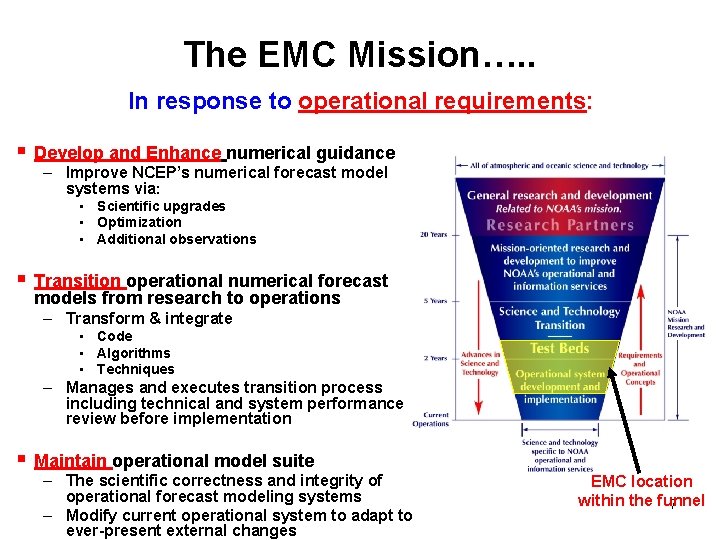
The EMC Mission…. . In response to operational requirements: § Develop and Enhance numerical guidance – Improve NCEP’s numerical forecast model systems via: • Scientific upgrades • Optimization • Additional observations § Transition operational numerical forecast models from research to operations – Transform & integrate • Code • Algorithms • Techniques – Manages and executes transition process including technical and system performance review before implementation § Maintain operational model suite – The scientific correctness and integrity of operational forecast modeling systems – Modify current operational system to adapt to ever-present external changes EMC location within the funnel 7
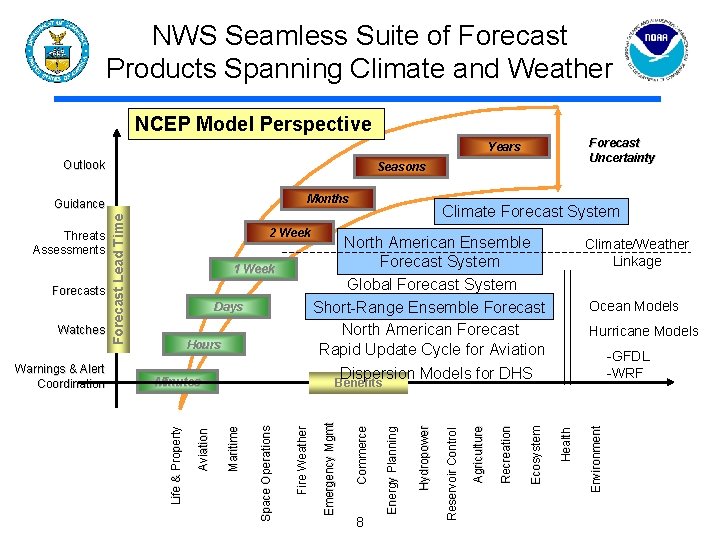
NWS Seamless Suite of Forecast Products Spanning Climate and Weather NCEP Model Perspective Forecast Uncertainty Years Outlook Seasons Months Hours Minutes Climate Forecast System North American Ensemble Forecast System Global Forecast System Short-Range Ensemble Forecast North American Forecast Rapid Update Cycle for Aviation Dispersion Models for DHS Climate/Weather Linkage Ocean Models Hurricane Models -GFDL -WRF Environment Health Ecosystem Recreation Agriculture Hydropower Reservoir Control 8 Energy Planning Commerce Emergency Mgmt Fire Weather Benefits Space Operations Warnings & Alert Coordination Days Maritime Watches 1 Week Aviation Forecasts 2 Week Life & Property Threats Assessments Forecast Lead Time Guidance
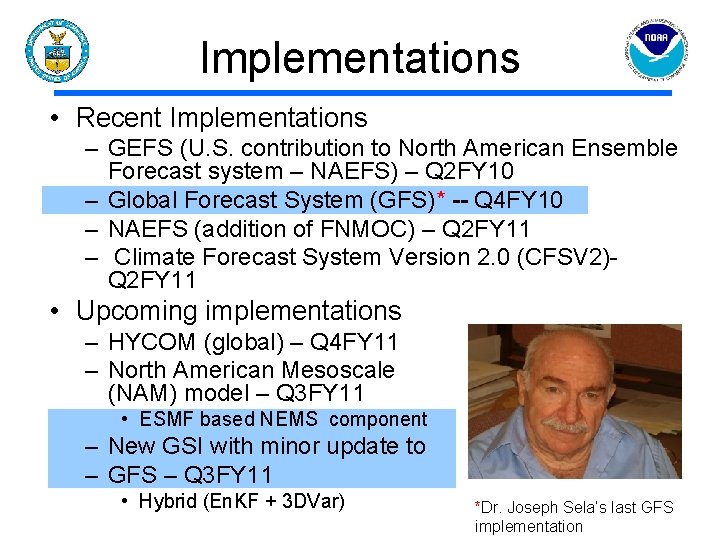
Implementations • Recent Implementations – GEFS (U. S. contribution to North American Ensemble Forecast system – NAEFS) – Q 2 FY 10 – Global Forecast System (GFS)* -- Q 4 FY 10 – NAEFS (addition of FNMOC) – Q 2 FY 11 – Climate Forecast System Version 2. 0 (CFSV 2)Q 2 FY 11 • Upcoming implementations – HYCOM (global) – Q 4 FY 11 – North American Mesoscale (NAM) model – Q 3 FY 11 • ESMF based NEMS component – New GSI with minor update to – GFS – Q 3 FY 11 • Hybrid (En. KF + 3 DVar) *Dr. Joseph Sela’s last GFS 9 implementation
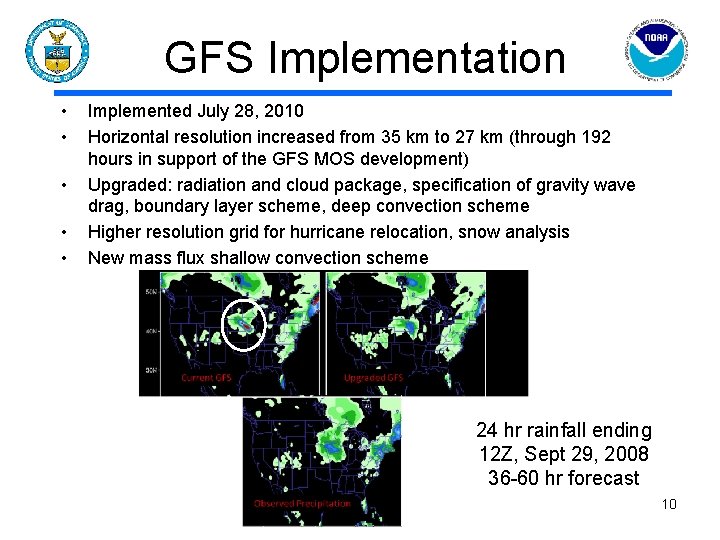
GFS Implementation • • • Implemented July 28, 2010 Horizontal resolution increased from 35 km to 27 km (through 192 hours in support of the GFS MOS development) Upgraded: radiation and cloud package, specification of gravity wave drag, boundary layer scheme, deep convection scheme Higher resolution grid for hurricane relocation, snow analysis New mass flux shallow convection scheme 24 hr rainfall ending 12 Z, Sept 29, 2008 36 -60 hr forecast 10
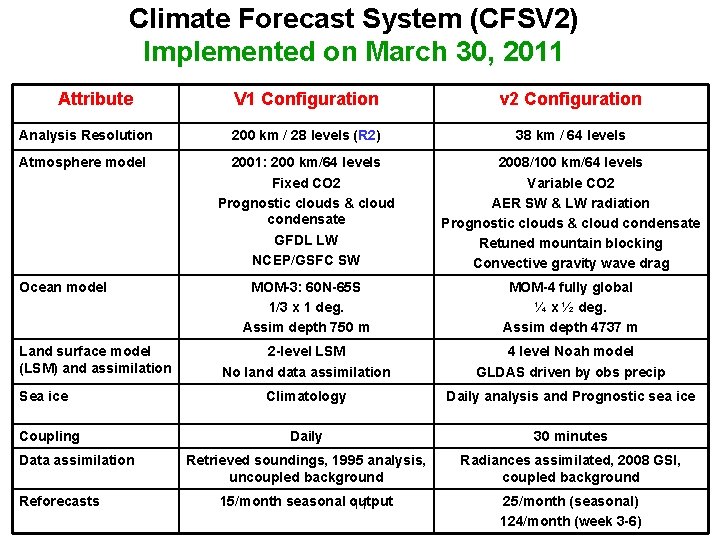
Climate Forecast System (CFSV 2) Implemented on March 30, 2011 Attribute V 1 Configuration v 2 Configuration Analysis Resolution 200 km / 28 levels (R 2) 38 km / 64 levels Atmosphere model 2001: 200 km/64 levels Fixed CO 2 Prognostic clouds & cloud condensate GFDL LW NCEP/GSFC SW 2008/100 km/64 levels Variable CO 2 AER SW & LW radiation Prognostic clouds & cloud condensate Retuned mountain blocking Convective gravity wave drag MOM-3: 60 N-65 S 1/3 x 1 deg. Assim depth 750 m MOM-4 fully global ¼ x ½ deg. Assim depth 4737 m 2 -level LSM No land data assimilation 4 level Noah model GLDAS driven by obs precip Climatology Daily analysis and Prognostic sea ice Daily 30 minutes Retrieved soundings, 1995 analysis, uncoupled background Radiances assimilated, 2008 GSI, coupled background 15/month seasonal output 11 25/month (seasonal) 124/month (week 3 -6) Ocean model Land surface model (LSM) and assimilation Sea ice Coupling Data assimilation Reforecasts
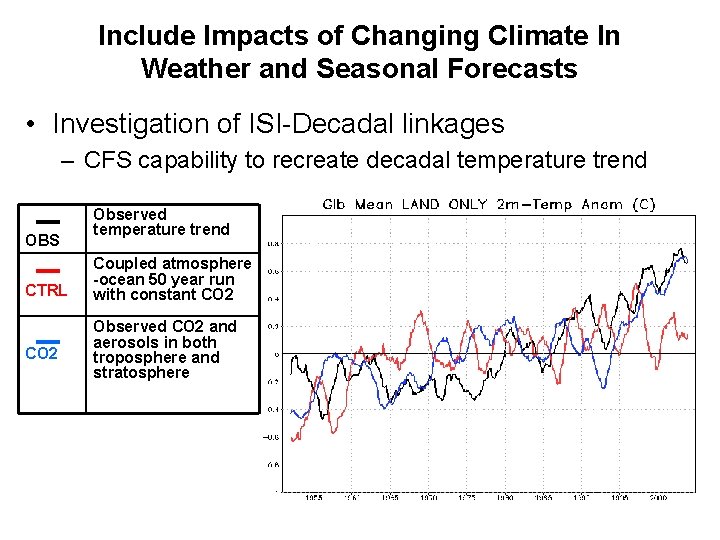
Include Impacts of Changing Climate In Weather and Seasonal Forecasts • Investigation of ISI-Decadal linkages – CFS capability to recreate decadal temperature trend OBS CTRL CO 2 Observed temperature trend Coupled atmosphere -ocean 50 year run with constant CO 2 Observed CO 2 and aerosols in both troposphere and stratosphere 12
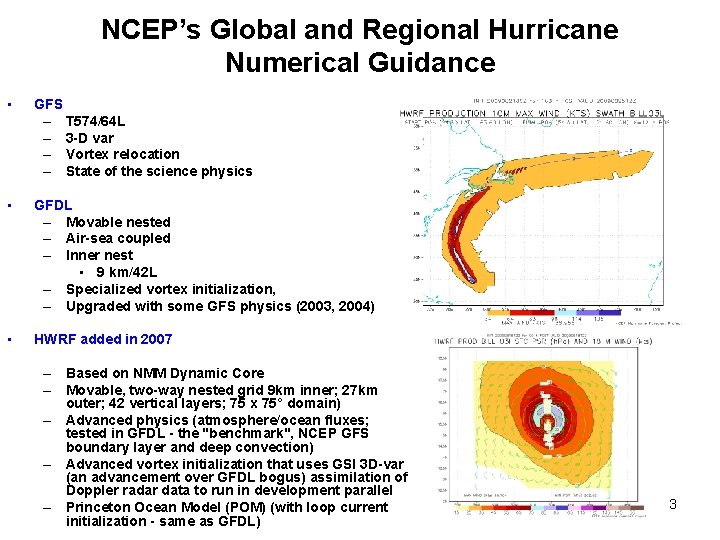
NCEP’s Global and Regional Hurricane Numerical Guidance • GFS – T 574/64 L – 3 -D var – Vortex relocation – State of the science physics • GFDL – Movable nested – Air-sea coupled – Inner nest • 9 km/42 L – Specialized vortex initialization, – Upgraded with some GFS physics (2003, 2004) • HWRF added in 2007 – Based on NMM Dynamic Core – Movable, two-way nested grid 9 km inner; 27 km outer; 42 vertical layers; 75 x 75° domain) – Advanced physics (atmosphere/ocean fluxes; tested in GFDL - the "benchmark", NCEP GFS boundary layer and deep convection) – Advanced vortex initialization that uses GSI 3 D-var (an advancement over GFDL bogus) assimilation of Doppler radar data to run in development parallel – Princeton Ocean Model (POM) (with loop current initialization - same as GFDL) 13
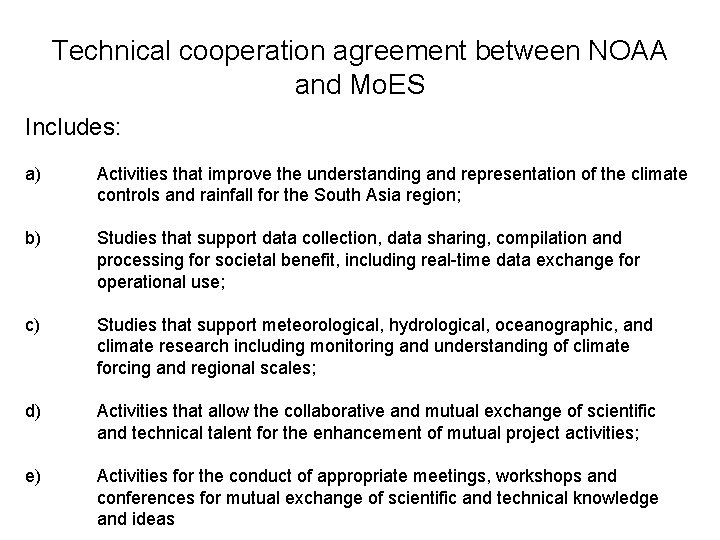
Technical cooperation agreement between NOAA and Mo. ES Includes: a) Activities that improve the understanding and representation of the climate controls and rainfall for the South Asia region; b) Studies that support data collection, data sharing, compilation and processing for societal benefit, including real-time data exchange for operational use; c) Studies that support meteorological, hydrological, oceanographic, and climate research including monitoring and understanding of climate forcing and regional scales; d) Activities that allow the collaborative and mutual exchange of scientific and technical talent for the enhancement of mutual project activities; e) Activities for the conduct of appropriate meetings, workshops and conferences for mutual exchange of scientific and technical knowledge and ideas
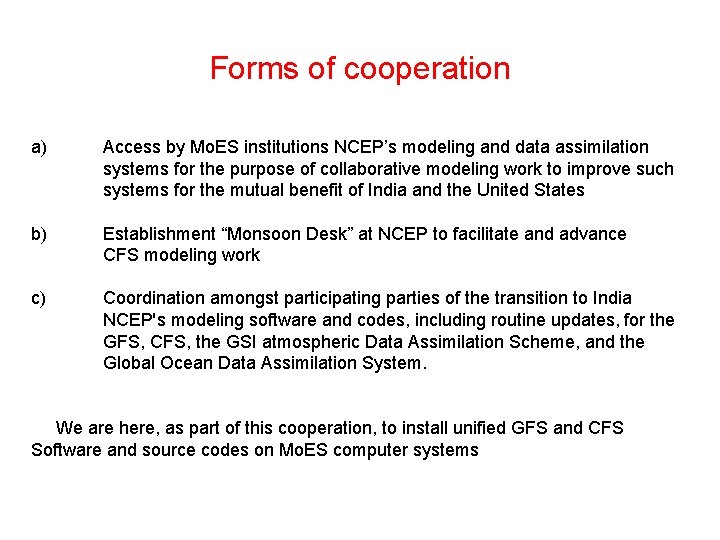
Forms of cooperation a) Access by Mo. ES institutions NCEP’s modeling and data assimilation systems for the purpose of collaborative modeling work to improve such systems for the mutual benefit of India and the United States b) Establishment “Monsoon Desk” at NCEP to facilitate and advance CFS modeling work c) Coordination amongst participating parties of the transition to India NCEP's modeling software and codes, including routine updates, for the GFS, CFS, the GSI atmospheric Data Assimilation Scheme, and the Global Ocean Data Assimilation System. We are here, as part of this cooperation, to install unified GFS and CFS Software and source codes on Mo. ES computer systems
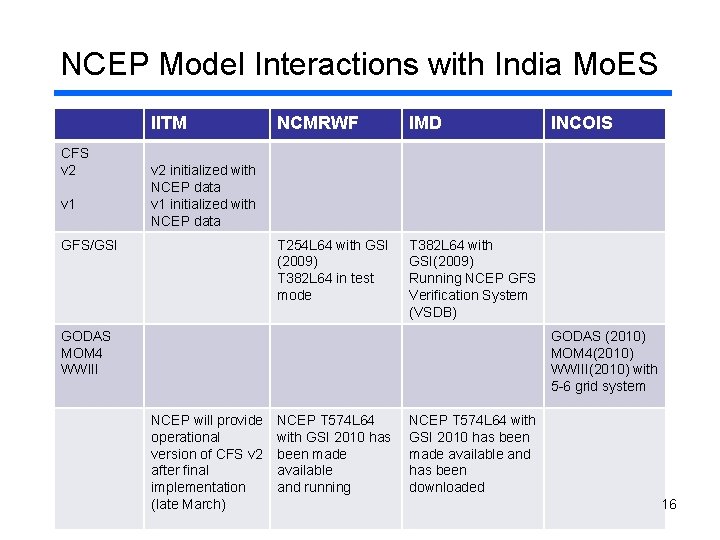
NCEP Model Interactions with India Mo. ES IITM CFS v 2 v 1 NCMRWF IMD T 254 L 64 with GSI (2009) T 382 L 64 in test mode T 382 L 64 with GSI(2009) Running NCEP GFS Verification System (VSDB) INCOIS v 2 initialized with NCEP data v 1 initialized with NCEP data GFS/GSI GODAS MOM 4 WWIII GODAS (2010) MOM 4(2010) WWIII(2010) with 5 -6 grid system NCEP will provide operational version of CFS v 2 after final implementation (late March) NCEP T 574 L 64 with GSI 2010 has been made available and running NCEP T 574 L 64 with GSI 2010 has been made available and has been downloaded 16
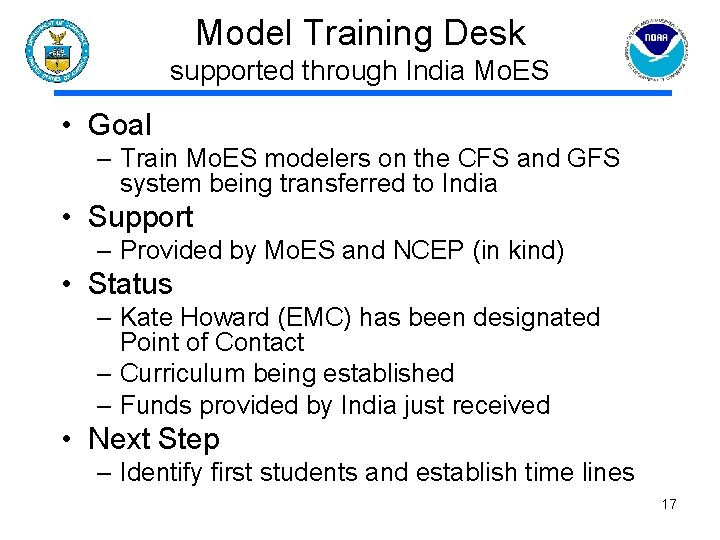
Model Training Desk supported through India Mo. ES • Goal – Train Mo. ES modelers on the CFS and GFS system being transferred to India • Support – Provided by Mo. ES and NCEP (in kind) • Status – Kate Howard (EMC) has been designated Point of Contact – Curriculum being established – Funds provided by India just received • Next Step – Identify first students and establish time lines 17
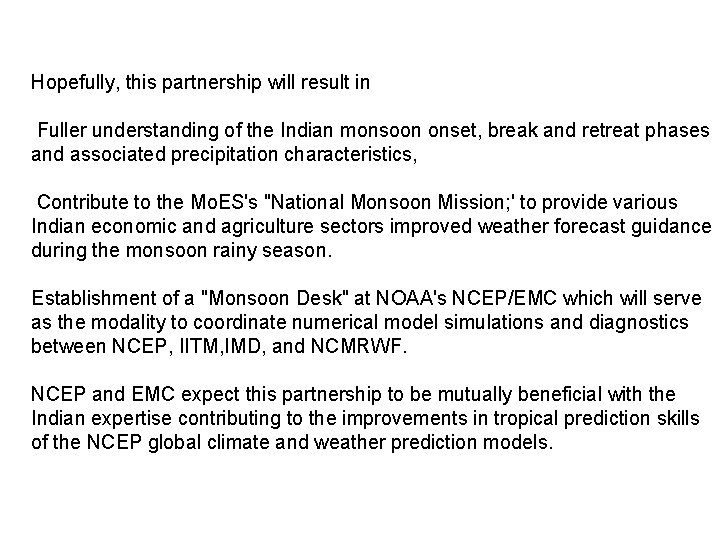
Hopefully, this partnership will result in Fuller understanding of the Indian monsoon onset, break and retreat phases and associated precipitation characteristics, Contribute to the Mo. ES's "National Monsoon Mission; ' to provide various Indian economic and agriculture sectors improved weather forecast guidance during the monsoon rainy season. Establishment of a "Monsoon Desk" at NOAA's NCEP/EMC which will serve as the modality to coordinate numerical model simulations and diagnostics between NCEP, IITM, IMD, and NCMRWF. NCEP and EMC expect this partnership to be mutually beneficial with the Indian expertise contributing to the improvements in tropical prediction skills of the NCEP global climate and weather prediction models.