
Introduction To The Middle School Data Team This
- Slides: 23
Introduction To The Middle School Data Team This Demo Uses Fictional Data For Purposes of Example The Ultimate Goal is to Answer Your Questions with Your Data. Team. Consulting. Com 1
Middle School Data Team Purpose of the Data Team The purpose of the Middle School data team is to use quantitative and qualitative data, as much as possible, to improve teaching and learning. Members of the Data Team The purpose of this presentation is to invite you to become a member of the data team. To provide a taste of the possibilities, we will present one line of inquiry of interest to the current members. The current members: Roberto da Costa Samuel Guthrie Xi’an Coy Manh Danielle Moonstar Sean Parker (consultant) Rahne Sinclair Data. Team. Consulting. Com 2
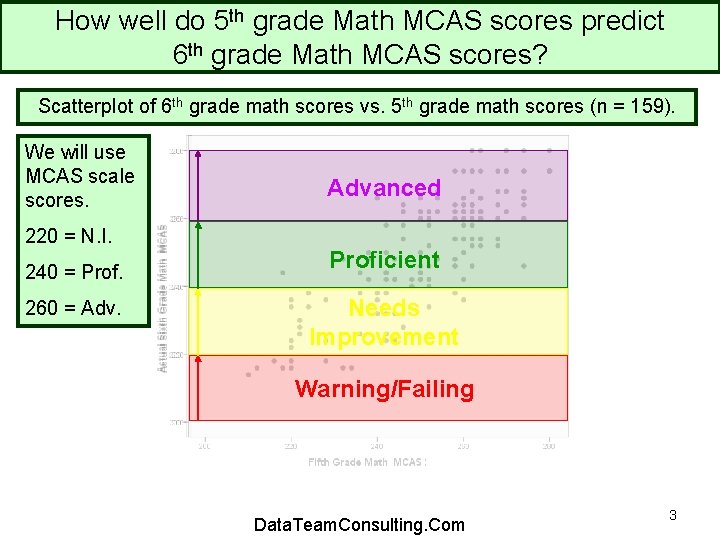
How well do 5 th grade Math MCAS scores predict 6 th grade Math MCAS scores? Scatterplot of 6 th grade math scores vs. 5 th grade math scores (n = 159). We will use MCAS scale scores. 220 = N. I. 240 = Prof. 260 = Advanced Proficient Needs Improvement Warning/Failing Data. Team. Consulting. Com 3
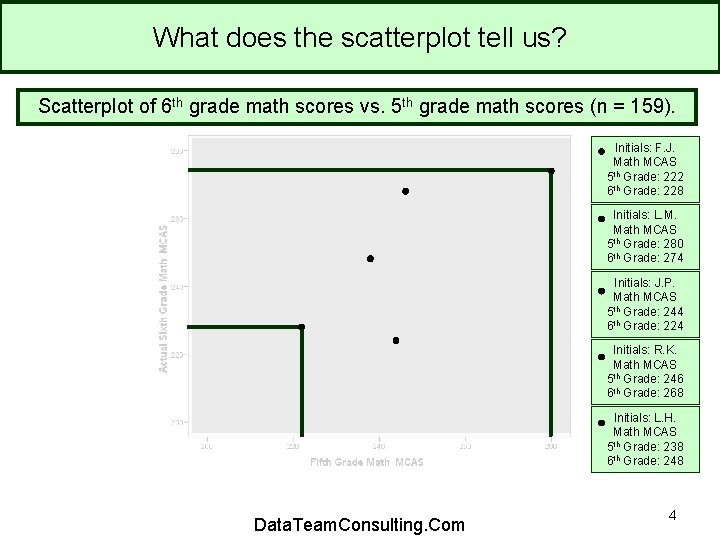
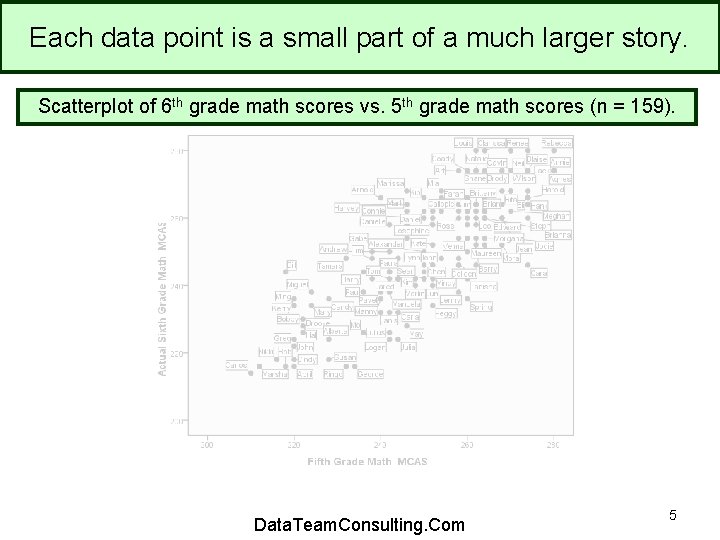
What does the scatterplot tell us? Scatterplot of 6 th grade math scores vs. 5 th grade math scores (n = 159). Initials: F. J. Math MCAS 5 th Grade: 222 6 th Grade: 228 Initials: L. M. Math MCAS 5 th Grade: 280 6 th Grade: 274 Initials: J. P. Math MCAS 5 th Grade: 244 6 th Grade: 224 Initials: R. K. Math MCAS 5 th Grade: 246 6 th Grade: 268 Initials: L. H. Math MCAS 5 th Grade: 238 6 th Grade: 248 Data. Team. Consulting. Com 4
Each data point is a small part of a much larger story. Scatterplot of 6 th grade math scores vs. 5 th grade math scores (n = 159). Data. Team. Consulting. Com 5
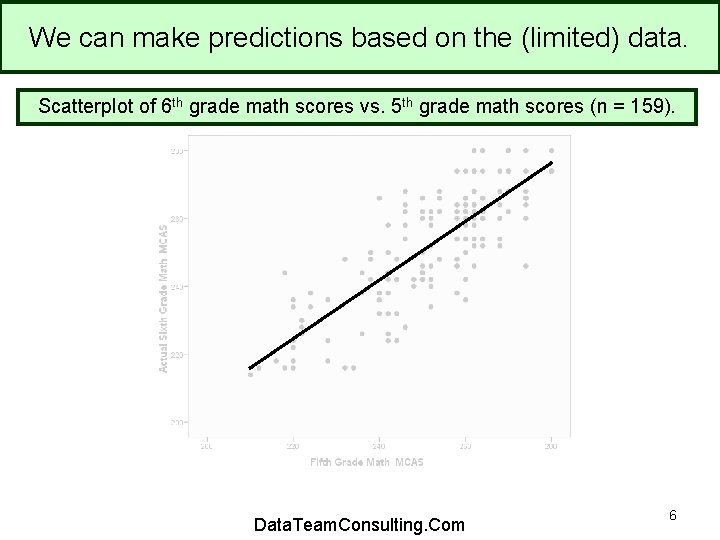
We can make predictions based on the (limited) data. Scatterplot of 6 th grade math scores vs. 5 th grade math scores (n = 159). Data. Team. Consulting. Com 6
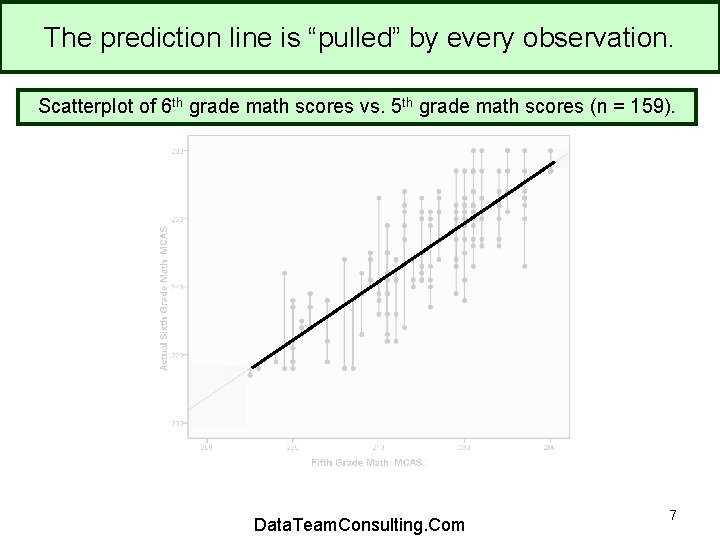
The prediction line is “pulled” by every observation. Scatterplot of 6 th grade math scores vs. 5 th grade math scores (n = 159). Data. Team. Consulting. Com 7
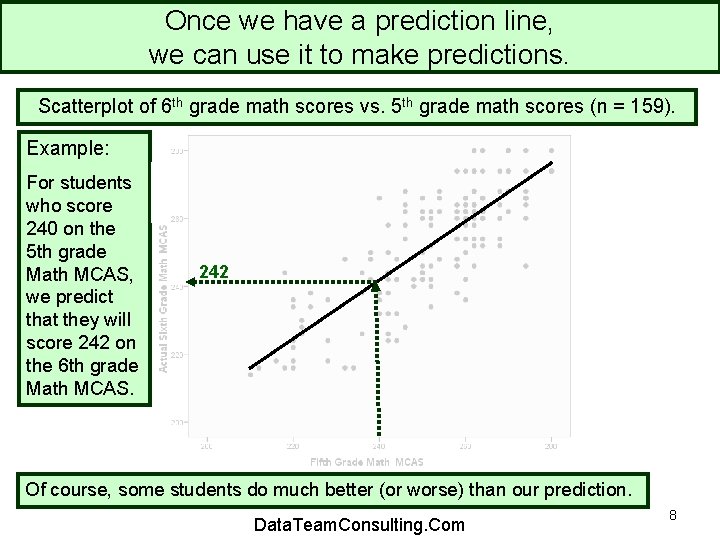
Once we have a prediction line, we can use it to make predictions. Scatterplot of 6 th grade math scores vs. 5 th grade math scores (n = 159). Example: For students who score 240 on the 5 th grade Math MCAS, we predict that they will score 242 on the 6 th grade Math MCAS. 242 Of course, some students do much better (or worse) than our prediction. Data. Team. Consulting. Com 8
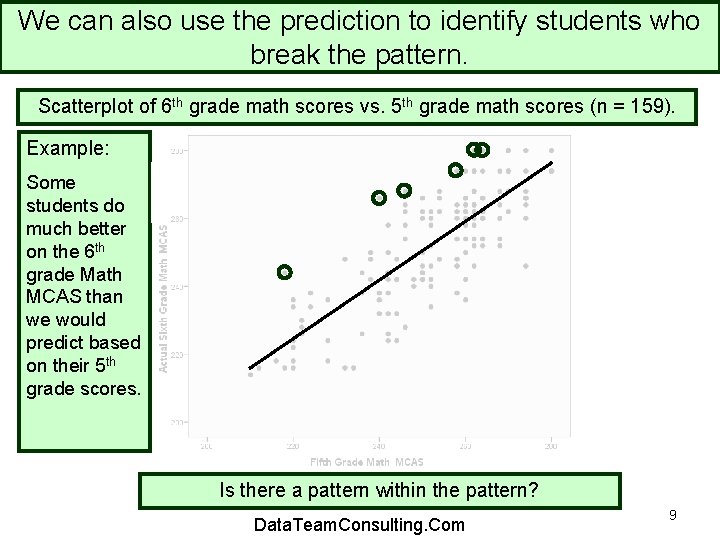
We can also use the prediction to identify students who break the pattern. Scatterplot of 6 th grade math scores vs. 5 th grade math scores (n = 159). Example: Some students do much better on the 6 th grade Math MCAS than we would predict based on their 5 th grade scores. Is there a pattern within the pattern? Data. Team. Consulting. Com 9
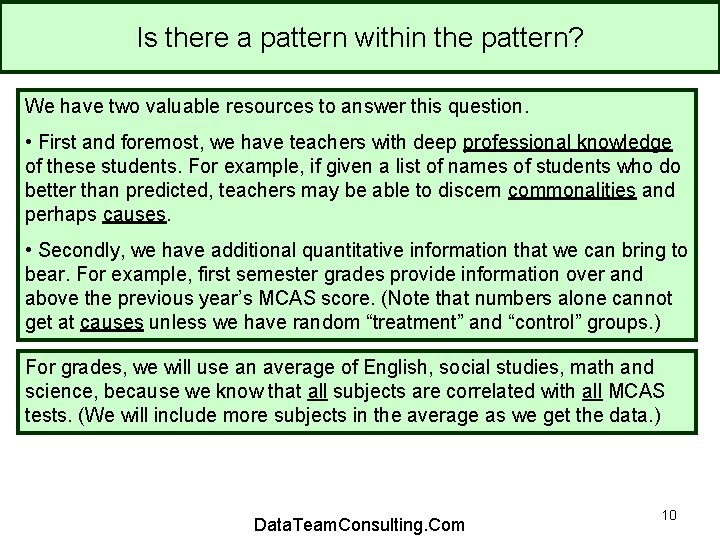
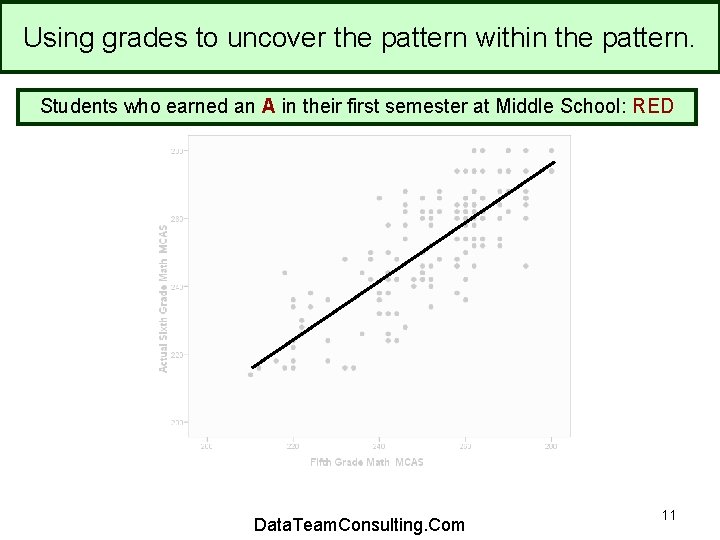
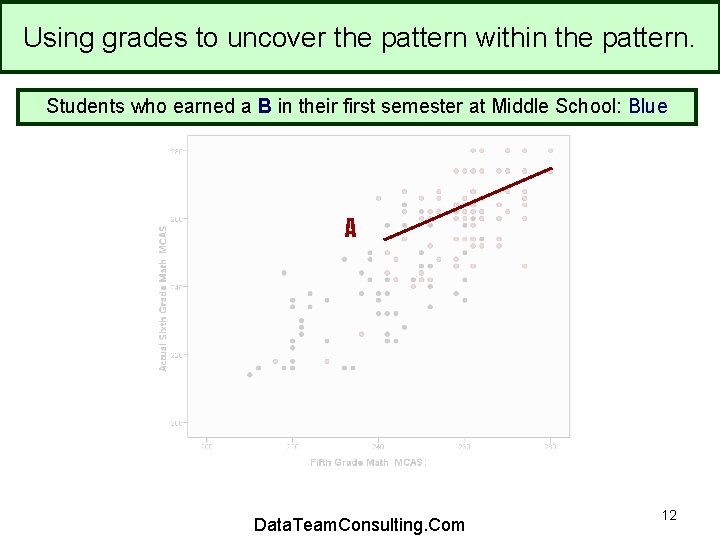
Is there a pattern within the pattern? We have two valuable resources to answer this question. • First and foremost, we have teachers with deep professional knowledge of these students. For example, if given a list of names of students who do better than predicted, teachers may be able to discern commonalities and perhaps causes. • Secondly, we have additional quantitative information that we can bring to bear. For example, first semester grades provide information over and above the previous year’s MCAS score. (Note that numbers alone cannot get at causes unless we have random “treatment” and “control” groups. ) For grades, we will use an average of English, social studies, math and science, because we know that all subjects are correlated with all MCAS tests. (We will include more subjects in the average as we get the data. ) Data. Team. Consulting. Com 10
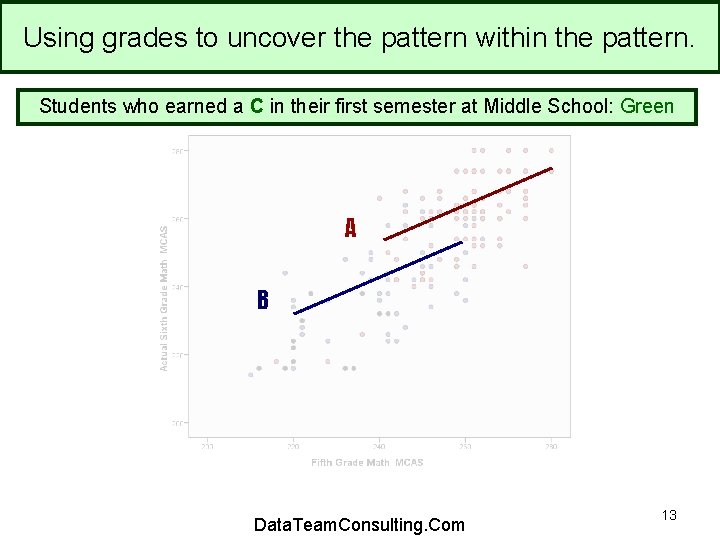
Using grades to uncover the pattern within the pattern. Students who earned an A in their first semester at Middle School: RED Data. Team. Consulting. Com 11
Using grades to uncover the pattern within the pattern. Studentswho whoearnedan a BA in in their first semester at at Middle School: Blue RED A Data. Team. Consulting. Com 12
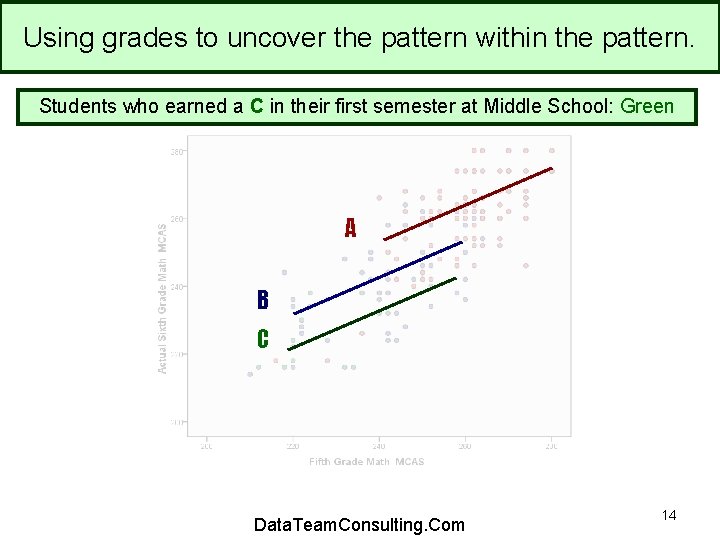
Using grades to uncover the pattern within the pattern. Studentswho whoearnedaa. CBinintheirfirstsemesteratat. Middle. School: Green Blue A B Data. Team. Consulting. Com 13
Using grades to uncover the pattern within the pattern. Students who earned a C in their first semester at Middle School: Green A B C Data. Team. Consulting. Com 14
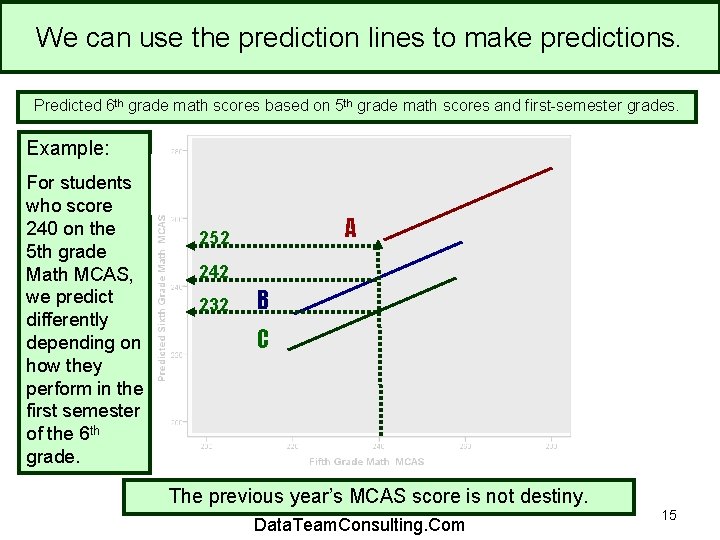
We can use the prediction lines to make predictions. Predicted 6 th grade math scores based on 5 th grade math scores and first-semester grades. Example: For students who score 240 on the 5 th grade Math MCAS, we predict differently depending on how they perform in the first semester of the 6 th grade. A 252 242 232 B C The previous year’s MCAS score is not destiny. Data. Team. Consulting. Com 15
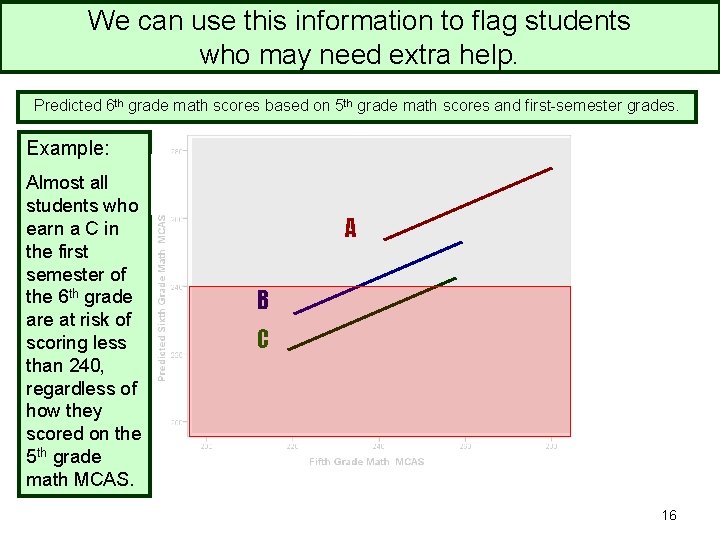
We can use this information to flag students who may need extra help. Predicted 6 th grade math scores based on 5 th grade math scores and first-semester grades. Example: Almost all students who earn a C in the first semester of the 6 th grade are at risk of scoring less than 240, regardless of how they scored on the 5 th grade math MCAS. A B C 16
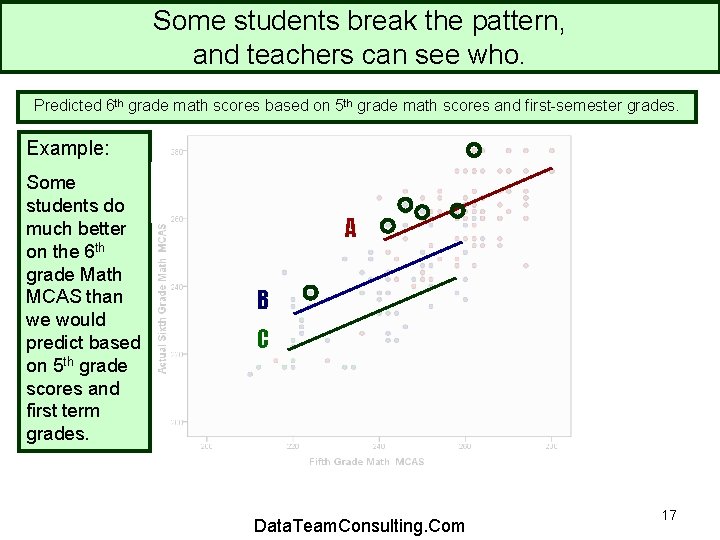
Some students break the pattern, and teachers can see who. Predicted 6 th grade math scores based on 5 th grade math scores and first-semester grades. Example: Some students do much better on the 6 th grade Math MCAS than we would predict based on 5 th grade scores and first term grades. A B C Data. Team. Consulting. Com 17
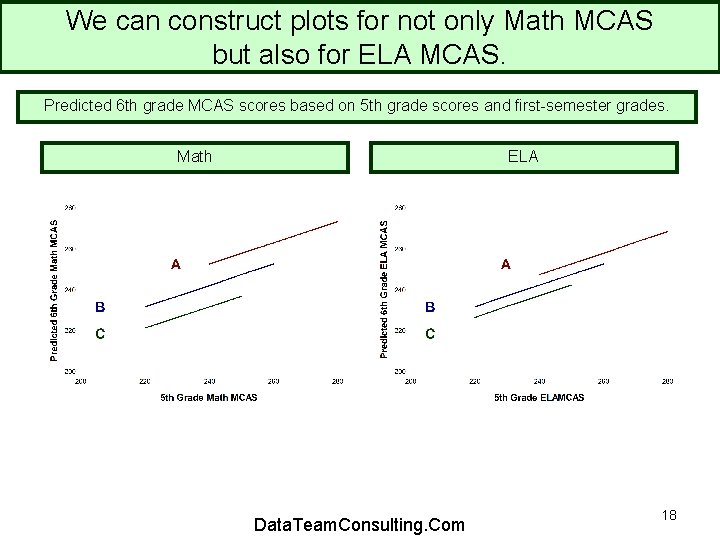
We can construct plots for not only Math MCAS but also for ELA MCAS. Predicted 6 th grade MCAS scores based on 5 th grade scores and first-semester grades. Math ELA Data. Team. Consulting. Com 18
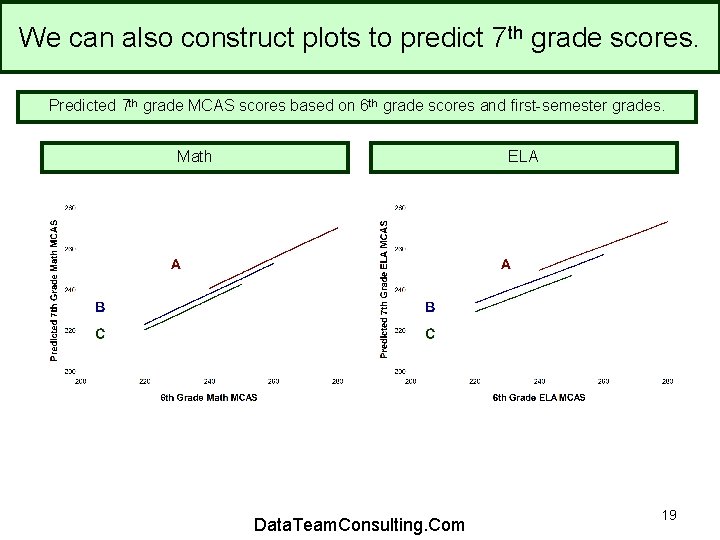
We can also construct plots to predict 7 th grade scores. Predicted 7 th grade MCAS scores based on 6 th grade scores and first-semester grades. Math ELA Data. Team. Consulting. Com 19
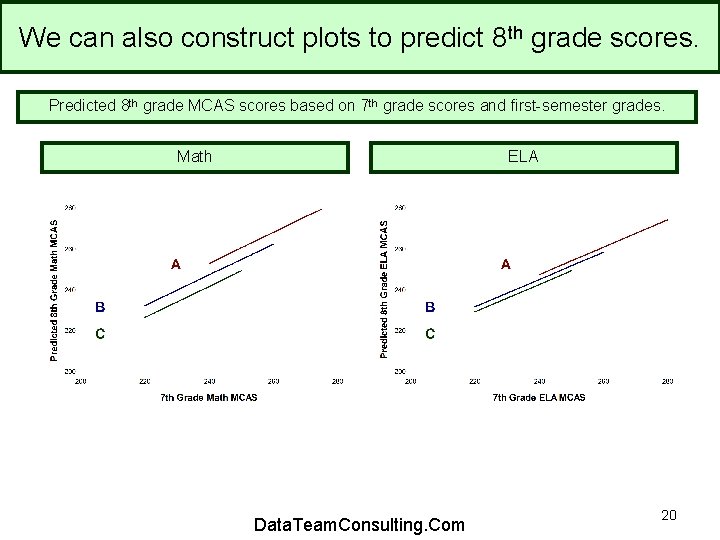
We can also construct plots to predict 8 th grade scores. Predicted 8 th grade MCAS scores based on 7 th grade scores and first-semester grades. Math ELA Data. Team. Consulting. Com 20
Future Lines of Inquiry Future lines of inquiry for the data team: • Does the MCAS/grades pattern hold up across the years? (The current patterns are based on one cohort. ) • What other factors do we need to consider? E. g. , special education status, free lunch eligibility, classroom conduct as assessed by teachers. • Based on professional experience and knowledge, what are the potential causes? How can we dig deeper into the causes using qualitative and quantitative data? Future lines of inquiry for an action team: What policies and interventions do the data suggest? (The data team and the action teams should be separate. The purpose of the data team should be informative. ) Data. Team. Consulting. Com 21
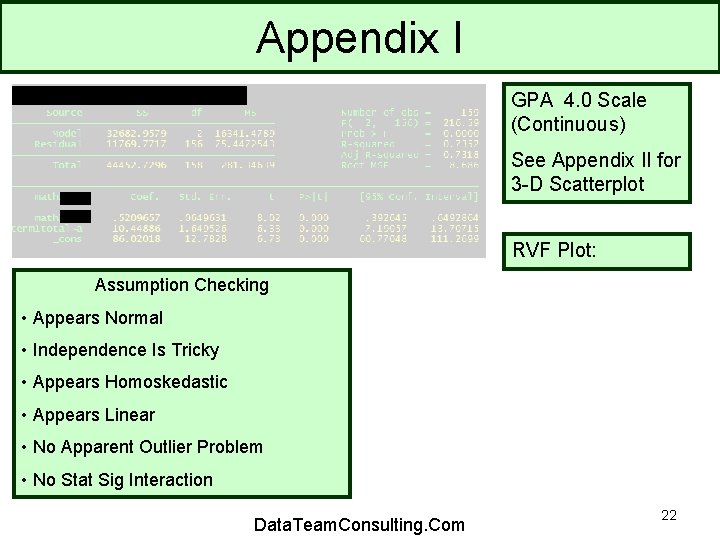
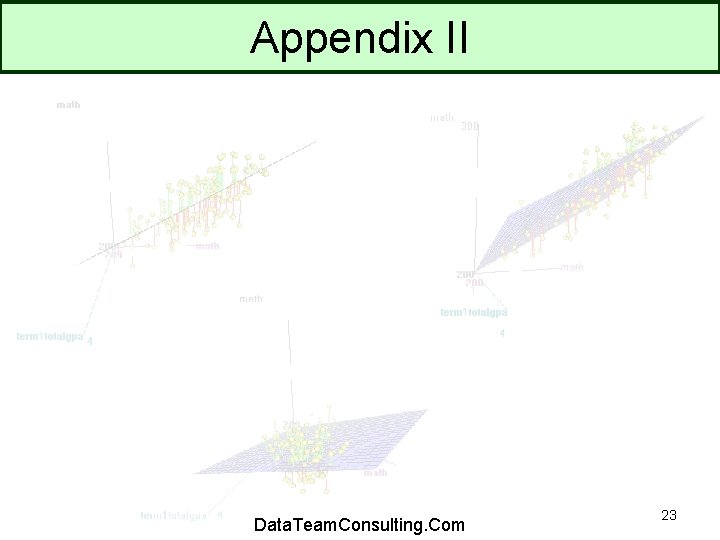
Appendix I GPA 4. 0 Scale (Continuous) See Appendix II for 3 -D Scatterplot RVF Plot: Assumption Checking • Appears Normal • Independence Is Tricky • Appears Homoskedastic • Appears Linear • No Apparent Outlier Problem • No Stat Sig Interaction Data. Team. Consulting. Com 22
Appendix II Data. Team. Consulting. Com 23