
Introduction to the Math Shifts of the Common
- Slides: 45
Introduction to the Math Shifts of the Common Core State Standards
https: //vimeo. com/92784226 achievethecore. org 2
The Background of the Common Core Initiated by the National Governors Association (NGA) and Council of Chief State School Officers (CCSSO) with the following design principles: • Result in College and Career Readiness • Based on solid research and practice evidence • fewer, higher, and clearer achievethecore. org 3
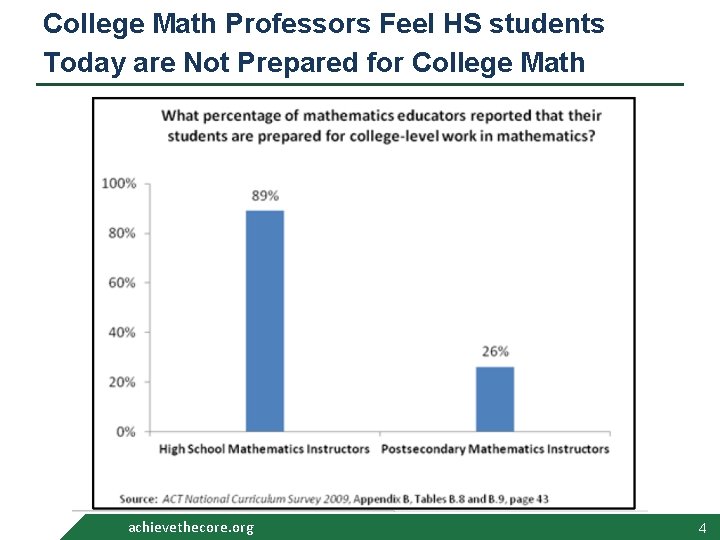
College Math Professors Feel HS students Today are Not Prepared for College Math achievethecore. org 4
What The Disconnect Means for Students • Nationwide, many students in two-year and four-year colleges need remediation in math. • Remedial classes lower the odds of finishing the degree or program. • We need to set the agenda in high school math to prepare more students for postsecondary education and training. achievethecore. org 5
The CCSS Requires Three Shifts in Mathematics 1. Focus: Focus strongly where the Standards focus. 2. Coherence: Think across grades and link to major topics within grades. 3. Rigor: In major topics, pursue conceptual understanding, procedural skill and fluency, and application. achievethecore. org https: //vimeo. com/92784227 6
Shift #1: Focus Strongly Where the Standards Focus • Significantly narrow the scope of content and deepen how time and energy is spent in the math classroom. • Focus deeply on what is emphasized in the standards, so that students gain strong foundations. achievethecore. org 7
https: //vimeo. com/92784228 achievethecore. org 8
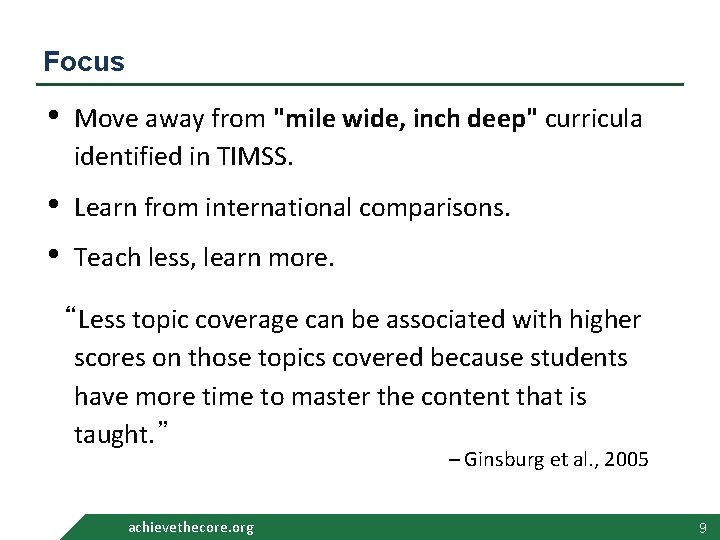
Focus • Move away from "mile wide, inch deep" curricula identified in TIMSS. • • Learn from international comparisons. Teach less, learn more. “Less topic coverage can be associated with higher scores on those topics covered because students have more time to master the content that is taught. ” – Ginsburg et al. , 2005 achievethecore. org 9
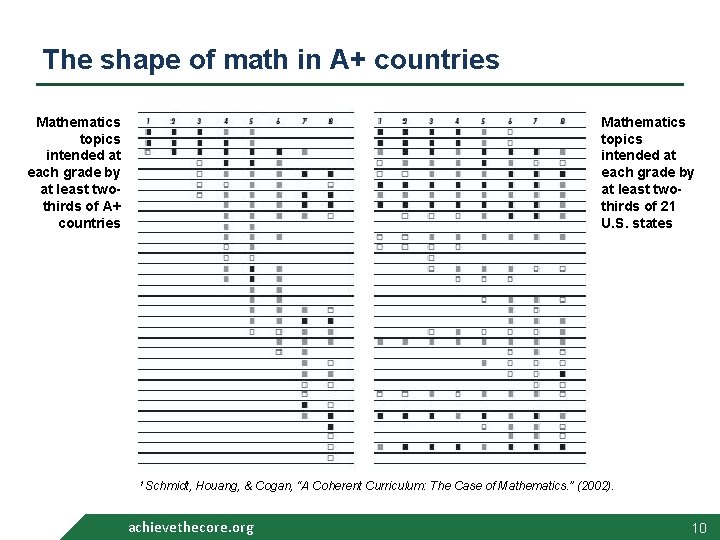
The shape of math in A+ countries Mathematics topics intended at each grade by at least twothirds of 21 U. S. states 1 Schmidt, Houang, & Cogan, “A Coherent Curriculum: The Case of Mathematics. ” (2002). achievethecore. org 10
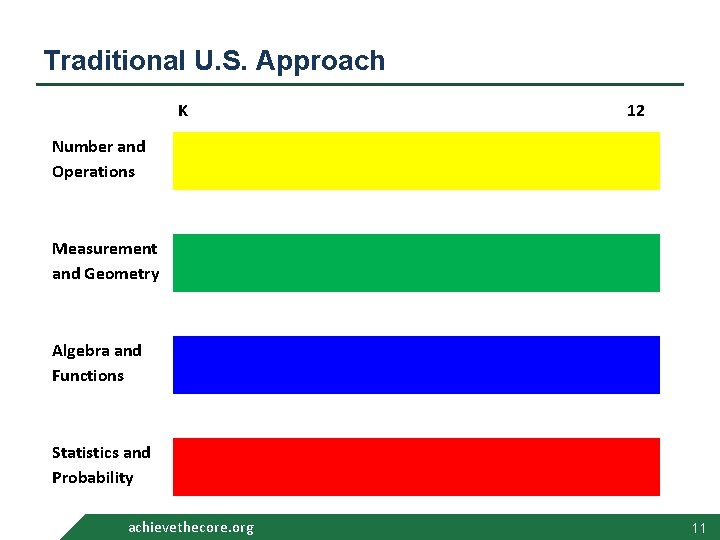
Traditional U. S. Approach K 12 Number and Operations Measurement and Geometry Algebra and Functions Statistics and Probability achievethecore. org 11
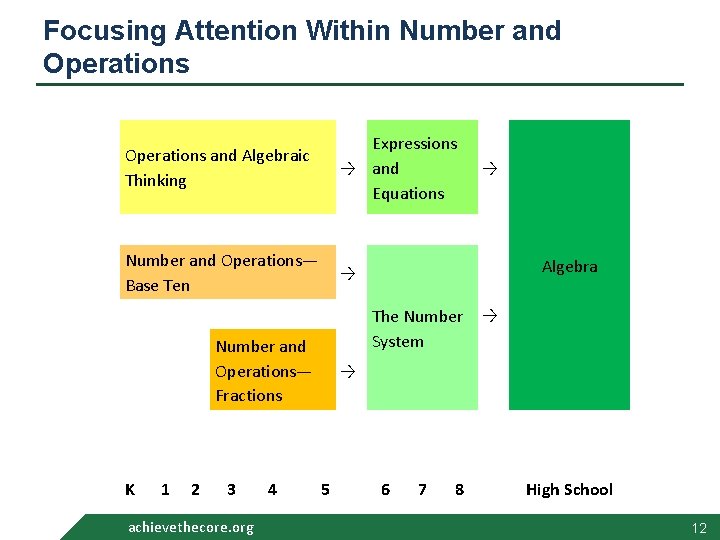
Focusing Attention Within Number and Operations and Algebraic Thinking Expressions → and Equations Number and Operations— Base Ten → K 1 2 3 achievethecore. org 4 Algebra The Number System Number and Operations— Fractions → → → 5 6 7 8 High School 12
https: //vimeo. com/92784229 achievethecore. org 13
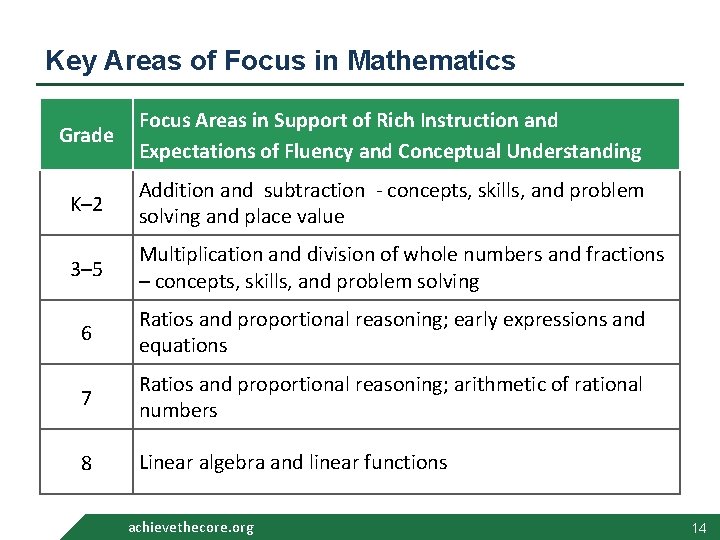
Key Areas of Focus in Mathematics Grade Focus Areas in Support of Rich Instruction and Expectations of Fluency and Conceptual Understanding K– 2 Addition and subtraction - concepts, skills, and problem solving and place value 3– 5 Multiplication and division of whole numbers and fractions – concepts, skills, and problem solving 6 Ratios and proportional reasoning; early expressions and equations 7 Ratios and proportional reasoning; arithmetic of rational numbers 8 Linear algebra and linear functions achievethecore. org 14
Group Discussion Shift #1: Focus strongly where the Standards focus. In your groups, discuss ways to respond to the following question, “Why focus? There’s so much math that students could be learning, why limit them to just a few things? ” achievethecore. org 15
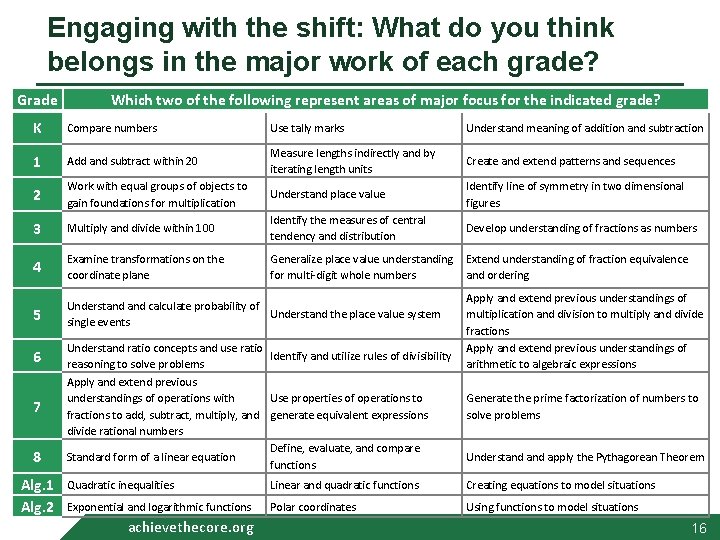
Engaging with the shift: What do you think belongs in the major work of each grade? Grade Which two of the following represent areas of major focus for the indicated grade? K Compare numbers Use tally marks Understand meaning of addition and subtraction 1 Add and subtract within 20 Measure lengths indirectly and by iterating length units Create and extend patterns and sequences 2 Work with equal groups of objects to gain foundations for multiplication Understand place value Identify line of symmetry in two dimensional figures 3 Multiply and divide within 100 Identify the measures of central tendency and distribution Develop understanding of fractions as numbers 4 Examine transformations on the coordinate plane Generalize place value understanding for multi-digit whole numbers Extend understanding of fraction equivalence and ordering 5 Understand calculate probability of Understand the place value system single events 6 7 8 Alg. 1 Alg. 2 Understand ratio concepts and use ratio Identify and utilize rules of divisibility reasoning to solve problems Apply and extend previous Use properties of operations to understandings of operations with fractions to add, subtract, multiply, and generate equivalent expressions divide rational numbers Define, evaluate, and compare Standard form of a linear equation functions Apply and extend previous understandings of multiplication and division to multiply and divide fractions Apply and extend previous understandings of arithmetic to algebraic expressions Generate the prime factorization of numbers to solve problems Understand apply the Pythagorean Theorem Quadratic inequalities Linear and quadratic functions Creating equations to model situations Exponential and logarithmic functions Polar coordinates Using functions to model situations achievethecore. org 16
Shift #2: Coherence: Think Across Grades, and Link to Major Topics Within Grades • Carefully connect the learning within and across grades so that students can build new understanding on foundations built in previous years. • Begin to count on solid conceptual understanding of core content and build on it. Each standard is not a new event, but an extension of previous learning. achievethecore. org 17
https: //vimeo. com/92784230 achievethecore. org 18
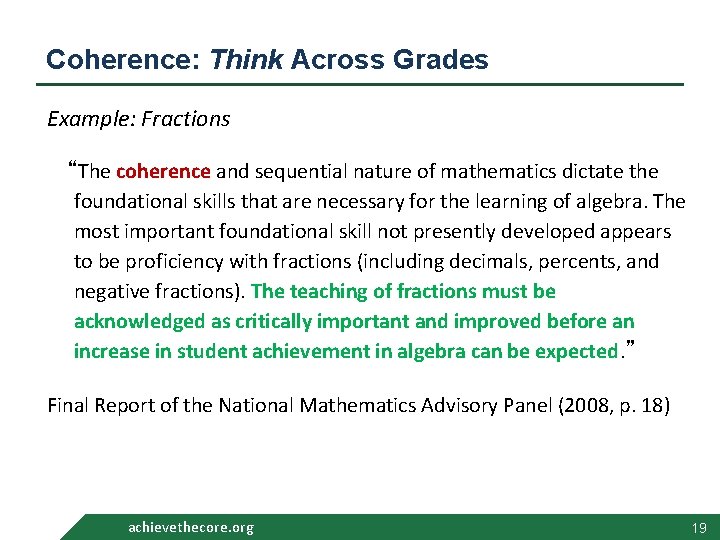
Coherence: Think Across Grades Example: Fractions “The coherence and sequential nature of mathematics dictate the foundational skills that are necessary for the learning of algebra. The most important foundational skill not presently developed appears to be proficiency with fractions (including decimals, percents, and negative fractions). The teaching of fractions must be acknowledged as critically important and improved before an increase in student achievement in algebra can be expected. ” Final Report of the National Mathematics Advisory Panel (2008, p. 18) achievethecore. org 19
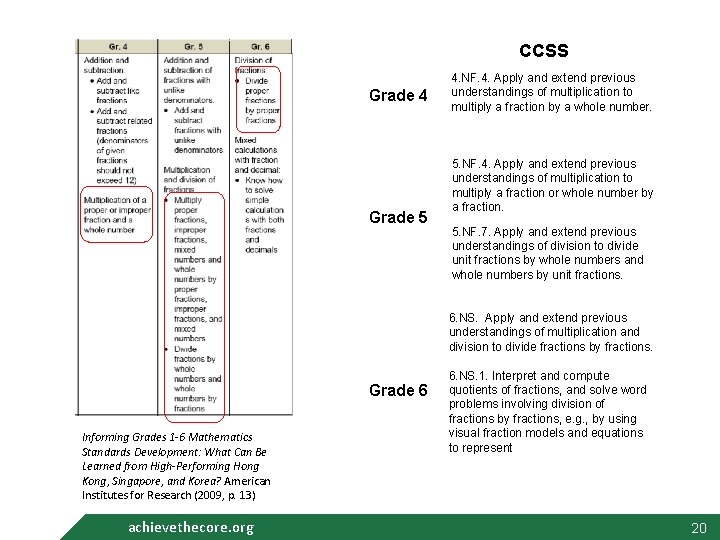
CCSS Grade 4 Grade 5 4. NF. 4. Apply and extend previous understandings of multiplication to multiply a fraction by a whole number. 5. NF. 4. Apply and extend previous understandings of multiplication to multiply a fraction or whole number by a fraction. 5. NF. 7. Apply and extend previous understandings of division to divide unit fractions by whole numbers and whole numbers by unit fractions. 6. NS. Apply and extend previous understandings of multiplication and division to divide fractions by fractions. Grade 6 Informing Grades 1 -6 Mathematics Standards Development: What Can Be Learned from High-Performing Hong Kong, Singapore, and Korea? American Institutes for Research (2009, p. 13) achievethecore. org 6. NS. 1. Interpret and compute quotients of fractions, and solve word problems involving division of fractions by fractions, e. g. , by using visual fraction models and equations to represent the problem. 20
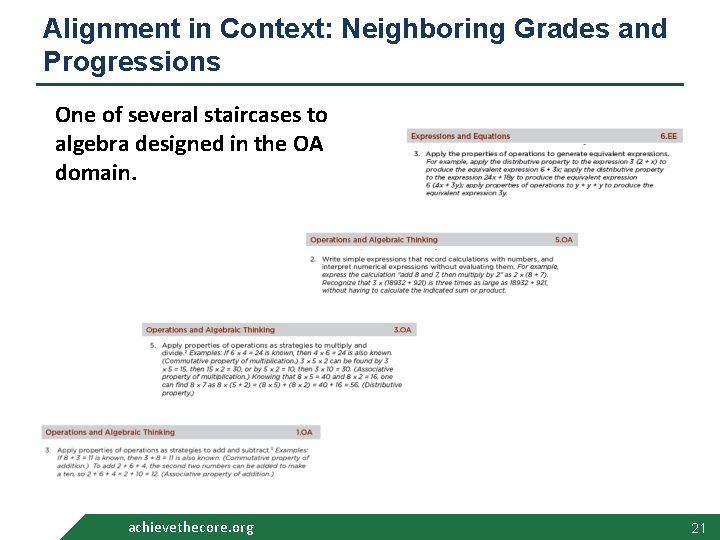
Alignment in Context: Neighboring Grades and Progressions One of several staircases to algebra designed in the OA domain. achievethecore. org 21
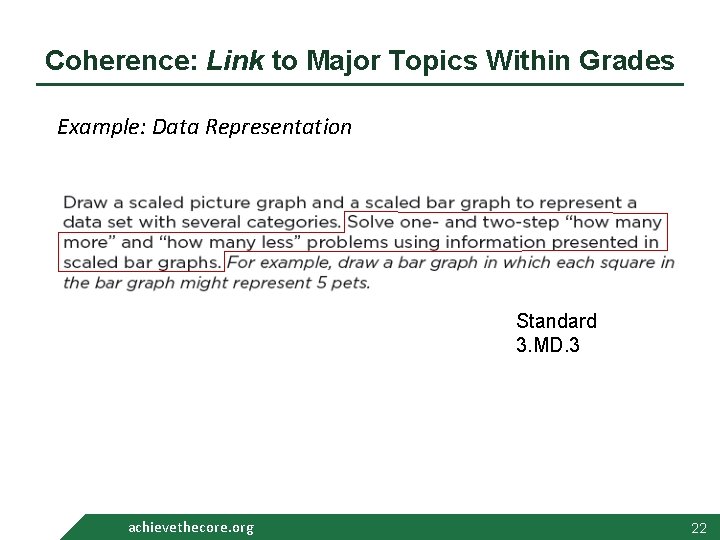
Coherence: Link to Major Topics Within Grades Example: Data Representation Standard 3. MD. 3 achievethecore. org 22
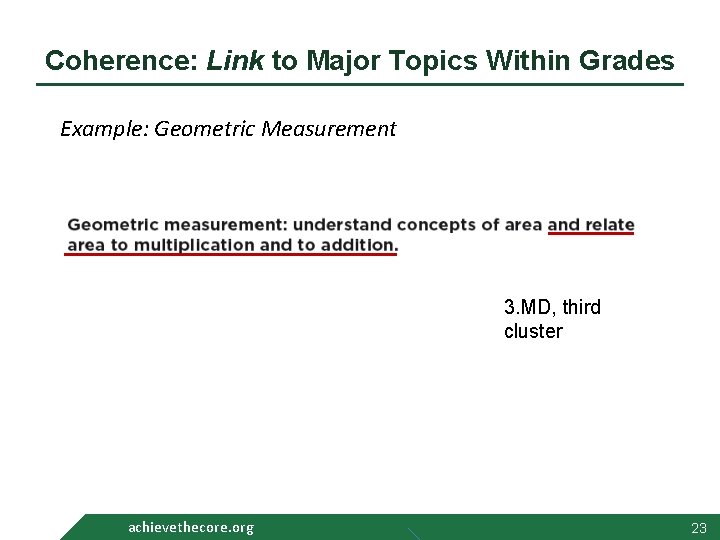
Coherence: Link to Major Topics Within Grades Example: Geometric Measurement 3. MD, third cluster achievethecore. org 23
Group Discussion Shift #2: Coherence: Think across grades, link to major topics within grades In your groups, discuss what coherence in the math curriculum means to you. Be sure to address both elements—coherence within the grade and coherence across grades. Cite specific examples. achievethecore. org 24
Engaging with the Shift: Investigate Coherence in the Standards with Respect to Fractions In the space below, copy all of the standards related to multiplication and division of fractions and note how coherence is evident in these standards. Note also standards that are outside of the Number and Operations—Fractions domain but are related to, or in support of, fractions. achievethecore. org 25
Shift #3: Rigor: In Major Topics, Pursue Conceptual Understanding, Procedural Skill and Fluency, and Application https: //vimeo. com/92830168 achievethecore. org 26
Rigor • The CCSSM require a balance of: § Solid conceptual understanding § Procedural skill and fluency § Application of skills in problem solving situations • Pursuit of all three requires equal intensity in time, activities, and resources. achievethecore. org 27
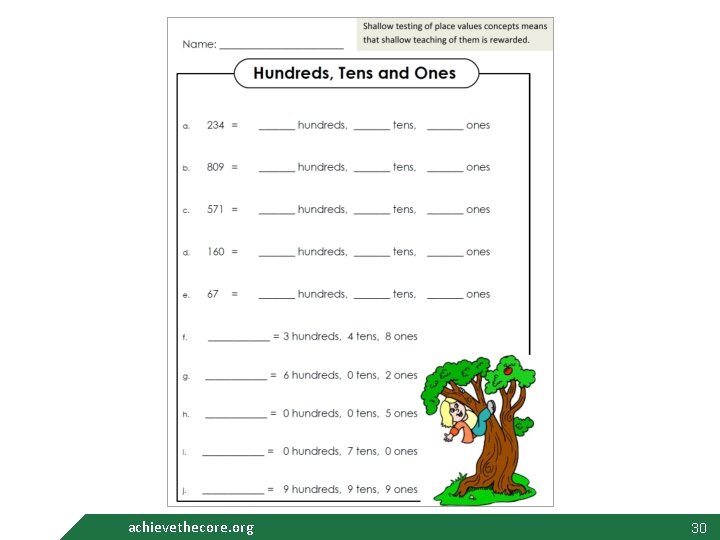
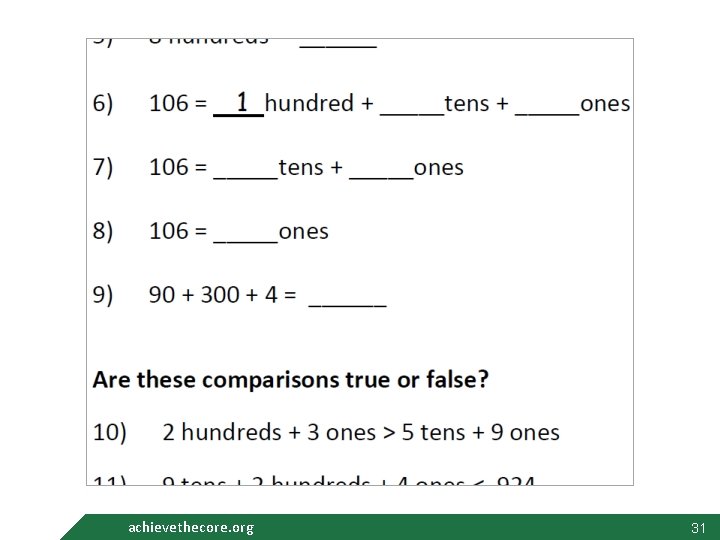
Solid Conceptual Understanding • Teach more than “how to get the answer” and instead support students’ ability to access concepts from a number of perspectives • Students are able to see math as more than a set of mnemonics or discrete procedures • Conceptual understanding supports the other aspects of rigor (fluency and application) achievethecore. org 28
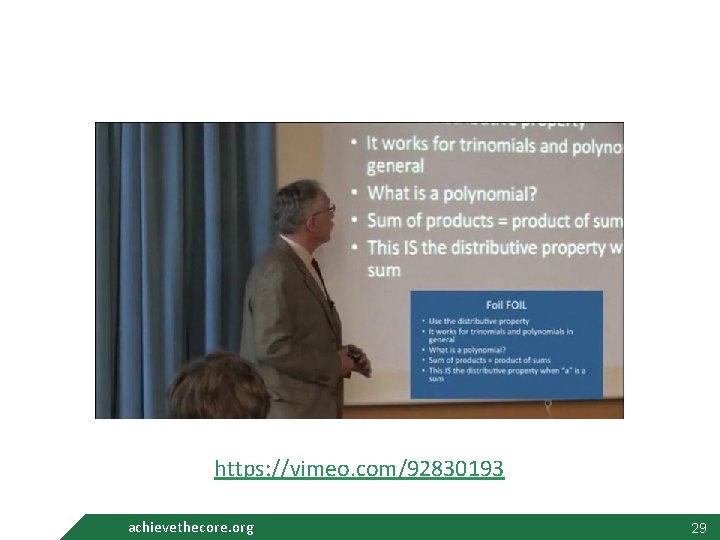
https: //vimeo. com/92830193 achievethecore. org 29
achievethecore. org 30
achievethecore. org 31
Fluency • The standards require speed and accuracy in calculation. • Teachers structure class time and/or homework time for students to practice core functions such as singledigit multiplication so that they are more able to understand manipulate more complex concepts achievethecore. org 32
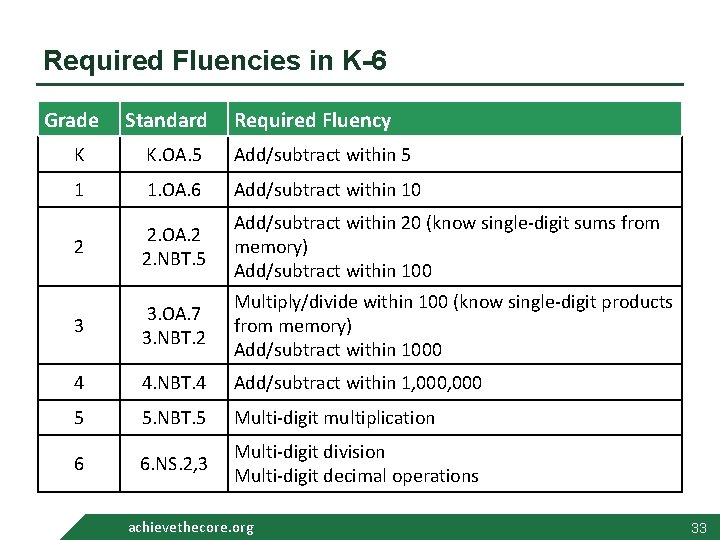
Required Fluencies in K-6 Grade Standard Required Fluency K K. OA. 5 Add/subtract within 5 1 1. OA. 6 Add/subtract within 10 2 2. OA. 2 2. NBT. 5 Add/subtract within 20 (know single-digit sums from memory) Add/subtract within 100 3 3. OA. 7 3. NBT. 2 Multiply/divide within 100 (know single-digit products from memory) Add/subtract within 1000 4 4. NBT. 4 Add/subtract within 1, 000 5 5. NBT. 5 Multi-digit multiplication 6 6. NS. 2, 3 Multi-digit division Multi-digit decimal operations achievethecore. org 33
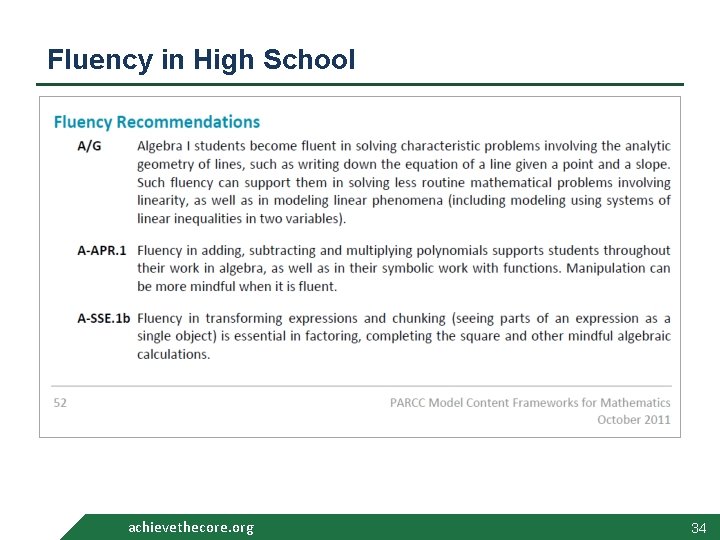
Fluency in High School achievethecore. org 34
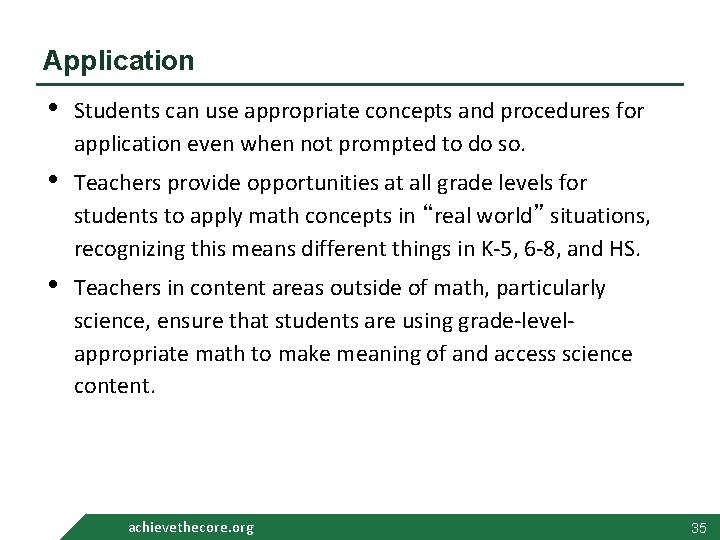
Application • Students can use appropriate concepts and procedures for application even when not prompted to do so. • Teachers provide opportunities at all grade levels for students to apply math concepts in “real world” situations, recognizing this means different things in K-5, 6 -8, and HS. • Teachers in content areas outside of math, particularly science, ensure that students are using grade-levelappropriate math to make meaning of and access science content. achievethecore. org 35
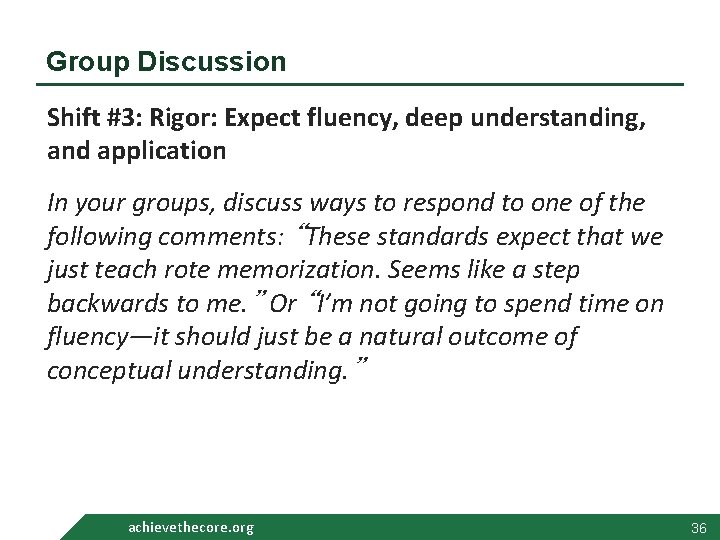
Group Discussion Shift #3: Rigor: Expect fluency, deep understanding, and application In your groups, discuss ways to respond to one of the following comments: “These standards expect that we just teach rote memorization. Seems like a step backwards to me. ” Or “I’m not going to spend time on fluency—it should just be a natural outcome of conceptual understanding. ” achievethecore. org 36
Engaging with the Shift: Making a True Statement Rigor = ______ + _______ This shift requires a balance of three discrete components in math instruction. This is not a pedagogical option, but is required by the Standards. Using grade __ as a sample, find and copy the standards which specifically set expectations for each component. achievethecore. org 37
It Starts with Focus • The current U. S. curriculum is "a mile wide and an inch deep. " • Focus is necessary in order to achieve the rigor set forth in the standards. • Remember Hong Kong example: more in-depth mastery of a smaller set of things pays off. achievethecore. org 38
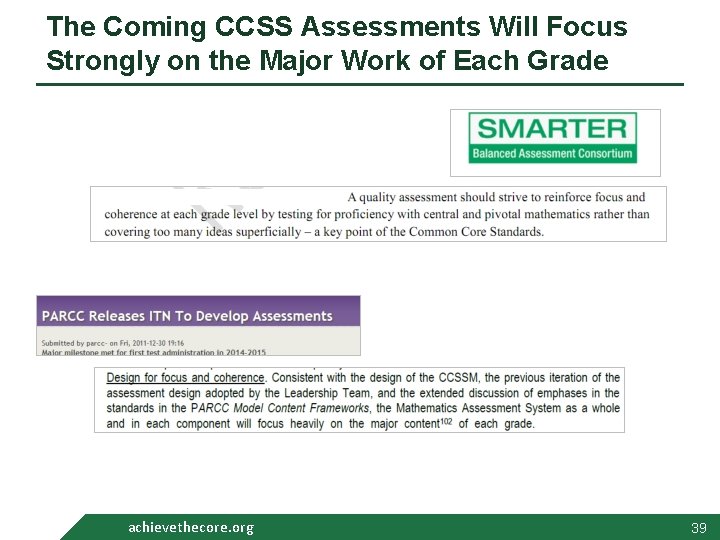
The Coming CCSS Assessments Will Focus Strongly on the Major Work of Each Grade achievethecore. org 39
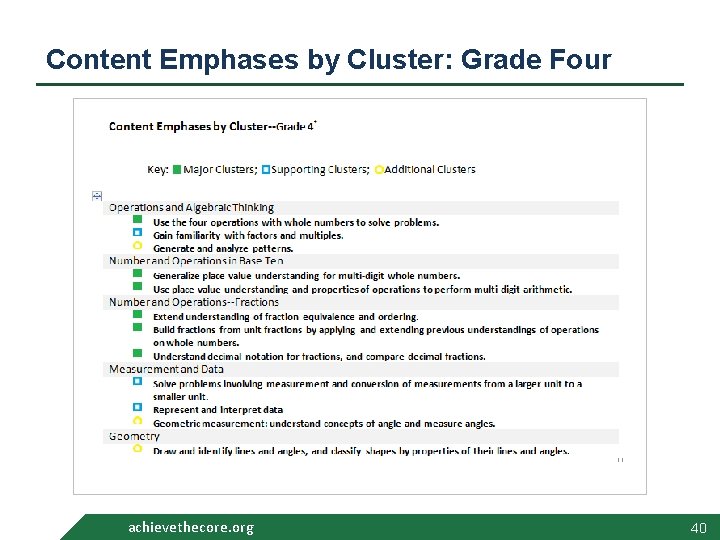
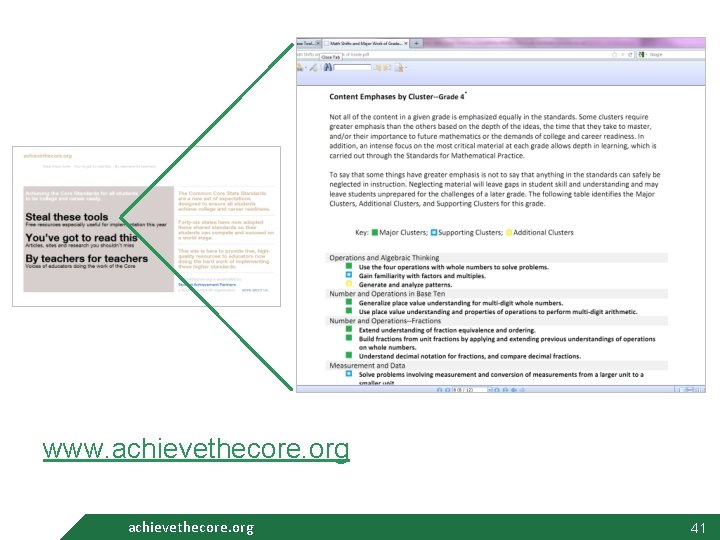
Content Emphases by Cluster: Grade Four Key: Major Clusters; Clusters achievethecore. org Supporting Clusters; Additional 40
www. achievethecore. org 41
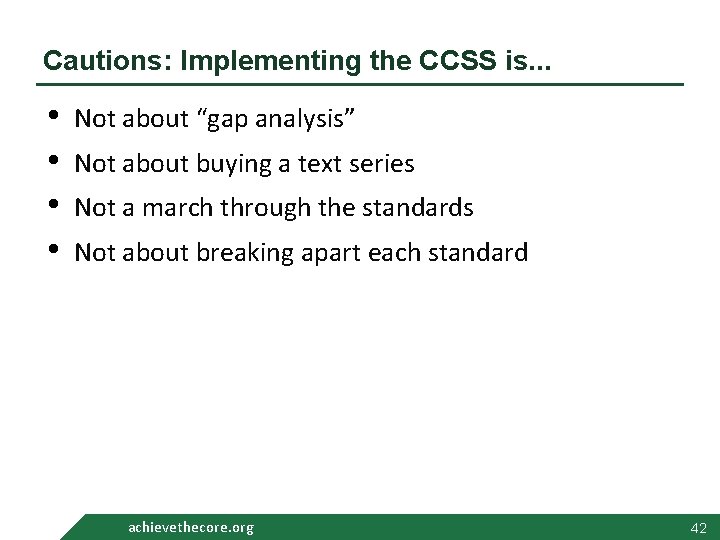
Cautions: Implementing the CCSS is. . . • • Not about “gap analysis” Not about buying a text series Not a march through the standards Not about breaking apart each standard achievethecore. org 42
https: //vimeo. com/92830194 achievethecore. org 43
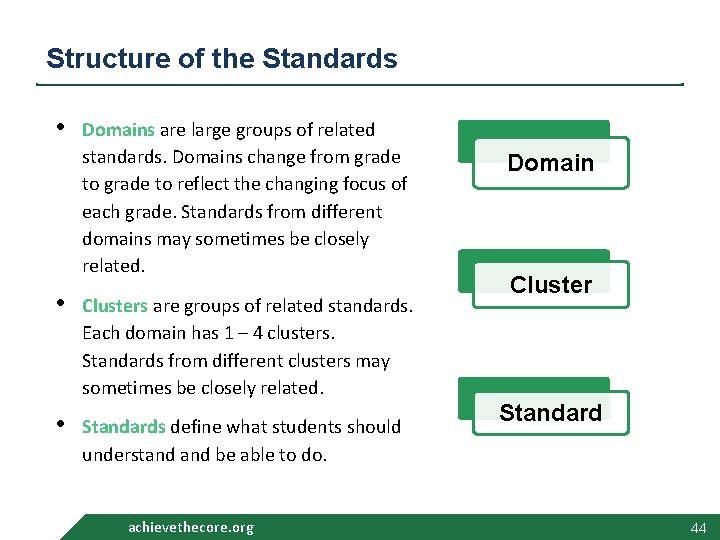
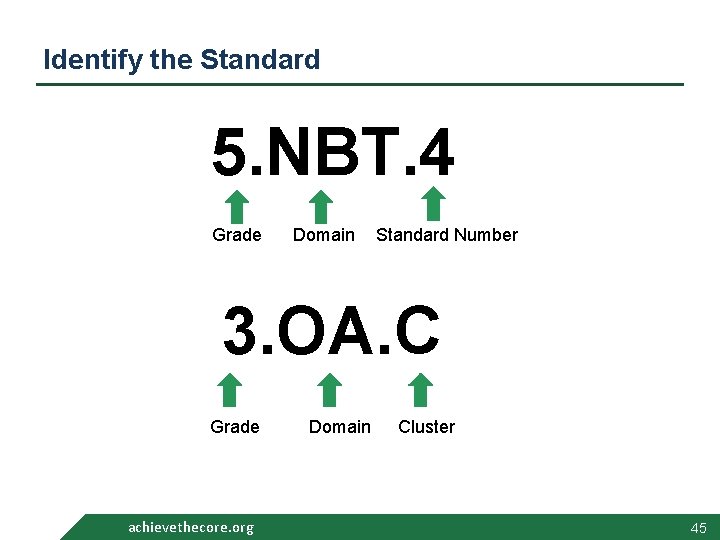
Structure of the Standards • Domains are large groups of related standards. Domains change from grade to reflect the changing focus of each grade. Standards from different domains may sometimes be closely related. • Clusters are groups of related standards. Each domain has 1 – 4 clusters. Standards from different clusters may sometimes be closely related. • Standards define what students should understand be able to do. achievethecore. org Domain Cluster Standard 44
Identify the Standard 5. NBT. 4 Grade Domain Standard Number 3. OA. C Grade achievethecore. org Domain Cluster 45