
INTRODUCTION TO THE MARZANO TEACHER EVALUATION MODEL FOR



- Slides: 35
INTRODUCTION TO THE MARZANO TEACHER EVALUATION MODEL FOR USD 259
The Big Picture The evaluation process was jointly developed by USD 259 Administration and UTW. The Marzano Model was chosen by committee that had Administrators, Teachers, and UTW representation to replace the Danielson Model. We will be using an electronic tool called i. Observation to conduct observations, provide feedback and to finalize evaluations. Administrators are going through training and certification now. Teachers will be trained next fall.
Teacher Categories Currently Five Categories of Teachers � Category A: Probationary Teachers in 1 st or 2 nd year of teaching. � Category A with Peer Consultant: Same as Category A, but one evaluation done by Peer Consultant. � Category B: Probationary Teachers in final year of probation. � Category B-Plan of Assistance: Non-probationary teachers on a Plan of Assistance (POA). � Category C: Non-Probationary teachers in years 4+.
Future Option Category D Teachers: Undefined at this point, but held in reserve for future use with exemplary or “All Star” experienced teachers.
Evaluation Critical definitions
Types of Observations Formal Observation � An announced observation that is at least 30 minutes in length. � The teacher will be required to submit his or her lesson plan in a district approved format (see negotiated agreement) at least 24 hours in advance of the observation. �A post observation conference would be held within five school days of the observation.
Types of Observations Informal Observation: � An observation that can be announced or unannounced, but is at least 15 minutes in length. � The teacher is not required to submit a lesson plan ahead of time. �A post observation conference would be held within five school days of the observation.
Types of Observations Walkthrough Observations � An unannounced quick observation of at least three minutes in length. � No lesson plan is required ahead of time. � No post observation conference is required.
Types of Observations Targeted Observations � Announced observations at least ten minutes in length that focus on a specific Lesson Segment, Design Question, and/or Element. �A pre-conference would be held at least 24 hours in advance and a post conference would be held within five school days of the observation.
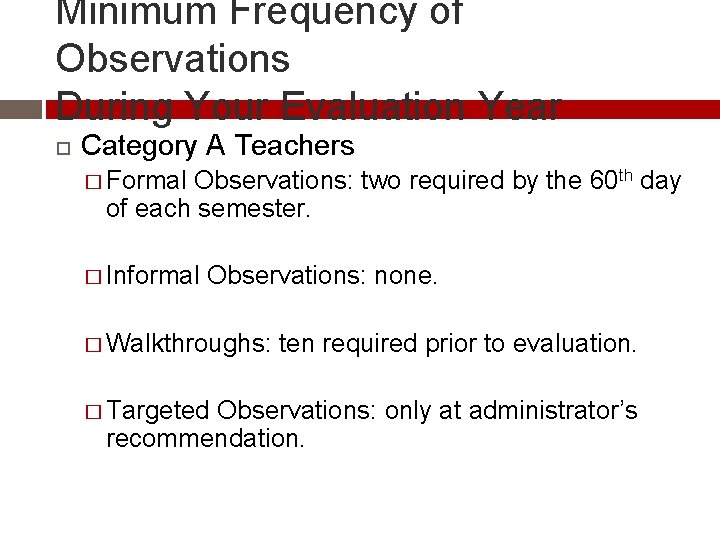
Minimum Frequency of Observations During Your Evaluation Year Category A Teachers � Formal Observations: two required by the 60 th day of each semester. � Informal Observations: none. � Walkthroughs: � Targeted ten required prior to evaluation. Observations: only at administrator’s recommendation.
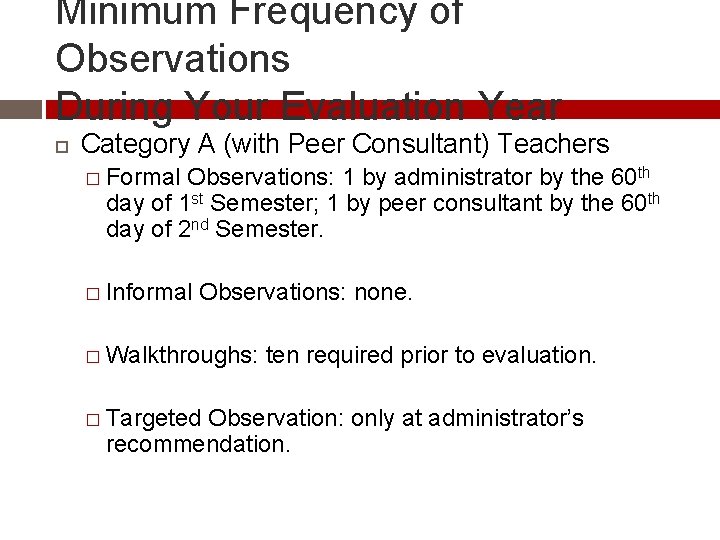
Minimum Frequency of Observations During Your Evaluation Year Category A (with Peer Consultant) Teachers � Formal Observations: 1 by administrator by the 60 th day of 1 st Semester; 1 by peer consultant by the 60 th day of 2 nd Semester. � Informal Observations: none. � Walkthroughs: � Targeted ten required prior to evaluation. Observation: only at administrator’s recommendation.
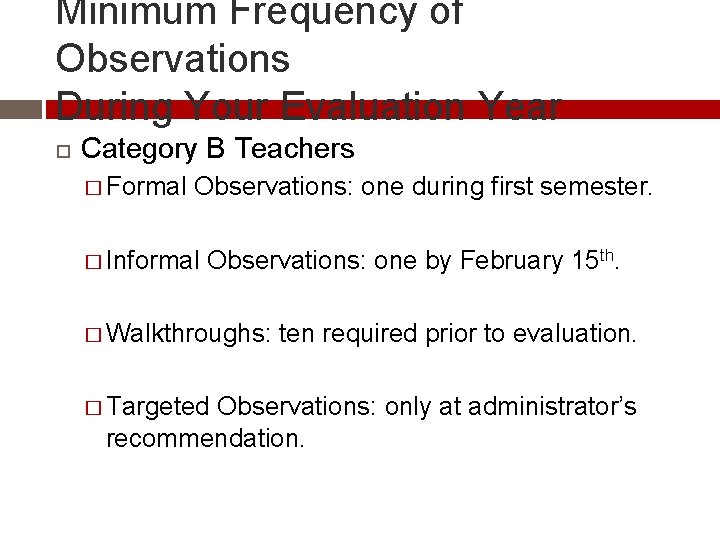
Minimum Frequency of Observations During Your Evaluation Year Category B Teachers � Formal Observations: one during first semester. � Informal Observations: one by February 15 th. � Walkthroughs: � Targeted ten required prior to evaluation. Observations: only at administrator’s recommendation.
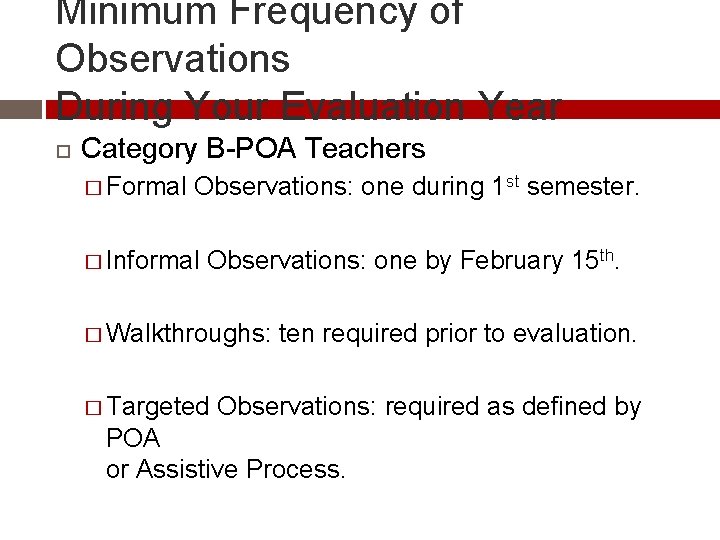
Minimum Frequency of Observations During Your Evaluation Year Category B-POA Teachers � Formal Observations: one during 1 st semester. � Informal Observations: one by February 15 th. � Walkthroughs: � Targeted ten required prior to evaluation. Observations: required as defined by POA or Assistive Process.
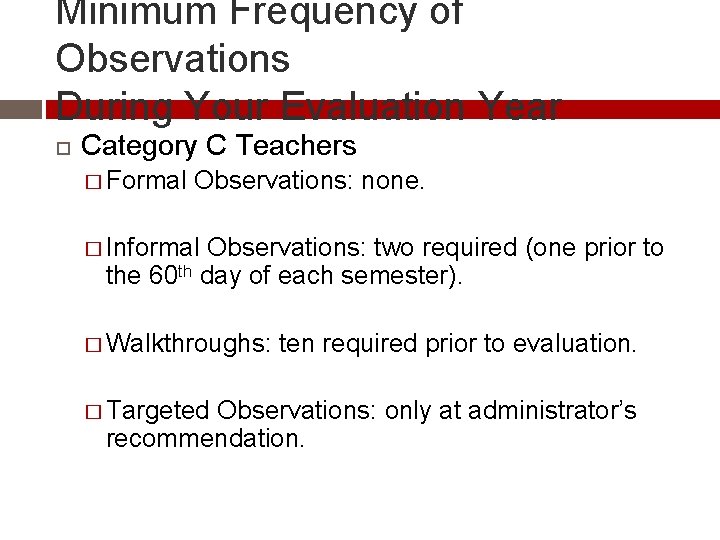
Minimum Frequency of Observations During Your Evaluation Year Category C Teachers � Formal Observations: none. � Informal Observations: two required (one prior to the 60 th day of each semester). � Walkthroughs: � Targeted ten required prior to evaluation. Observations: only at administrator’s recommendation.
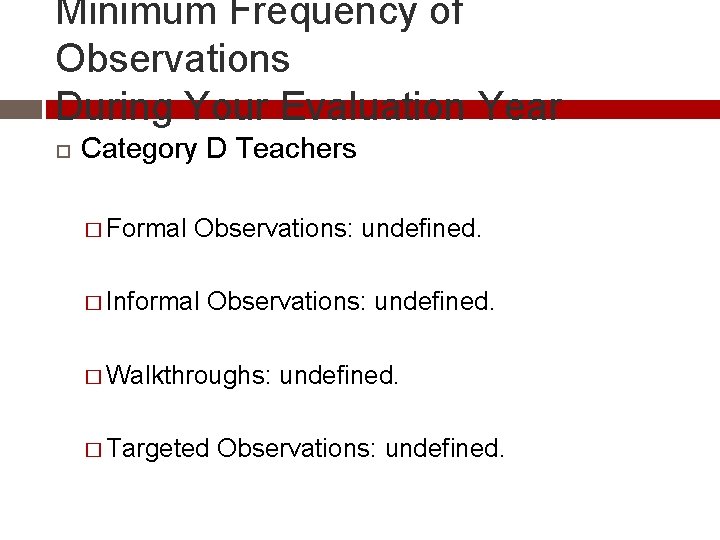
Minimum Frequency of Observations During Your Evaluation Year Category D Teachers � Formal Observations: undefined. � Informal Observations: undefined. � Walkthroughs: � Targeted undefined. Observations: undefined.
Evaluation The Roll Out Cycles
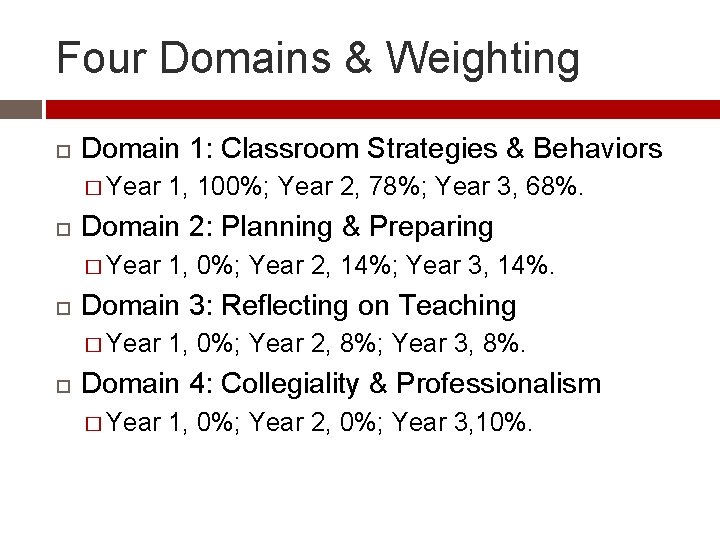
Four Domains & Weighting Domain 1: Classroom Strategies & Behaviors � Year Domain 2: Planning & Preparing � Year 1, 0%; Year 2, 14%; Year 3, 14%. Domain 3: Reflecting on Teaching � Year 1, 100%; Year 2, 78%; Year 3, 68%. 1, 0%; Year 2, 8%; Year 3, 8%. Domain 4: Collegiality & Professionalism � Year 1, 0%; Year 2, 0%; Year 3, 10%.
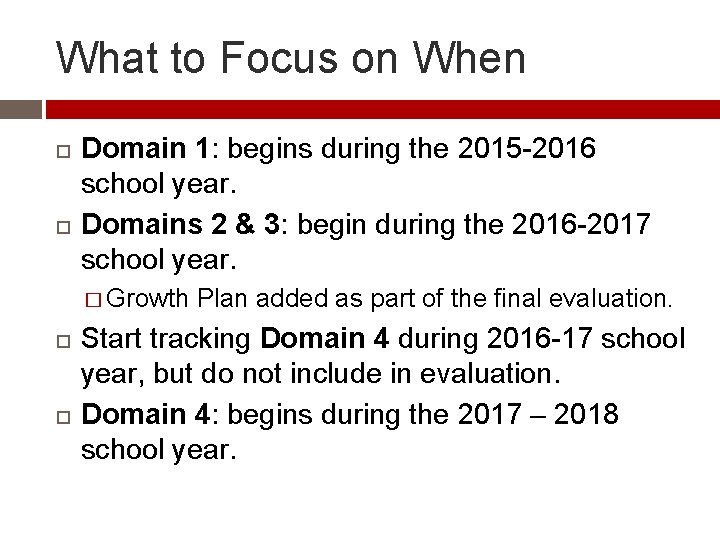
What to Focus on When Domain 1: begins during the 2015 -2016 school year. Domains 2 & 3: begin during the 2016 -2017 school year. � Growth Plan added as part of the final evaluation. Start tracking Domain 4 during 2016 -17 school year, but do not include in evaluation. Domain 4: begins during the 2017 – 2018 school year.
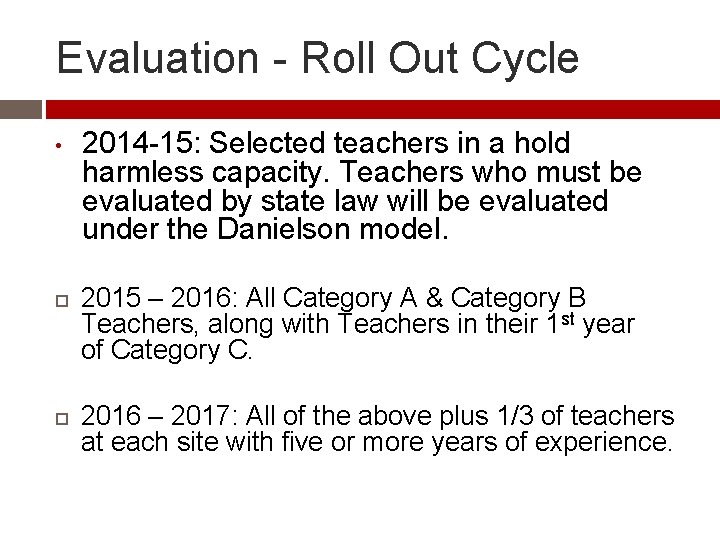
Evaluation - Roll Out Cycle • 2014 -15: Selected teachers in a hold harmless capacity. Teachers who must be evaluated by state law will be evaluated under the Danielson model. 2015 – 2016: All Category A & Category B Teachers, along with Teachers in their 1 st year of Category C. 2016 – 2017: All of the above plus 1/3 of teachers at each site with five or more years of experience.
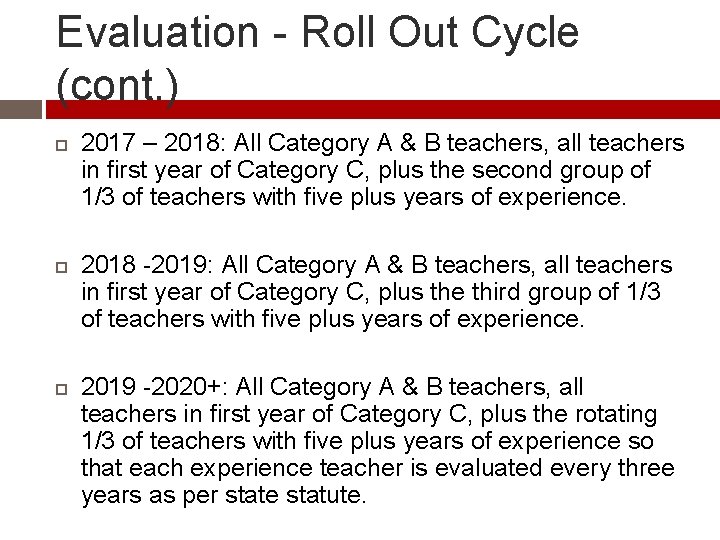
Evaluation - Roll Out Cycle (cont. ) 2017 – 2018: All Category A & B teachers, all teachers in first year of Category C, plus the second group of 1/3 of teachers with five plus years of experience. 2018 -2019: All Category A & B teachers, all teachers in first year of Category C, plus the third group of 1/3 of teachers with five plus years of experience. 2019 -2020+: All Category A & B teachers, all teachers in first year of Category C, plus the rotating 1/3 of teachers with five plus years of experience so that each experience teacher is evaluated every three years as per state statute.
Evaluation What is the difference between an observation and an evaluation?
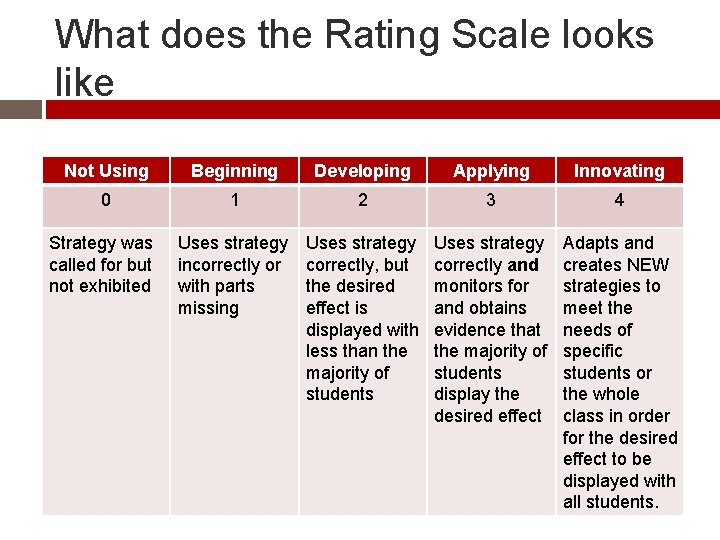
Evaluation Score vs Observation Rating Observation is a Rating Scale which includes � Not using (0) � Beginning (1) � Developing (2) � Applying (3) � Innovating (4) Evaluation Scoring is a 4 point scale that includes � Highly Effective � Developing � Unsatisfactory
What does the Rating Scale looks like Not Using Beginning Developing Applying Innovating 0 1 2 3 4 Strategy was called for but not exhibited Uses strategy incorrectly or with parts missing Uses strategy correctly, but the desired effect is displayed with less than the majority of students Uses strategy correctly and monitors for and obtains evidence that the majority of students display the desired effect Adapts and creates NEW strategies to meet the needs of specific students or the whole class in order for the desired effect to be displayed with all students.
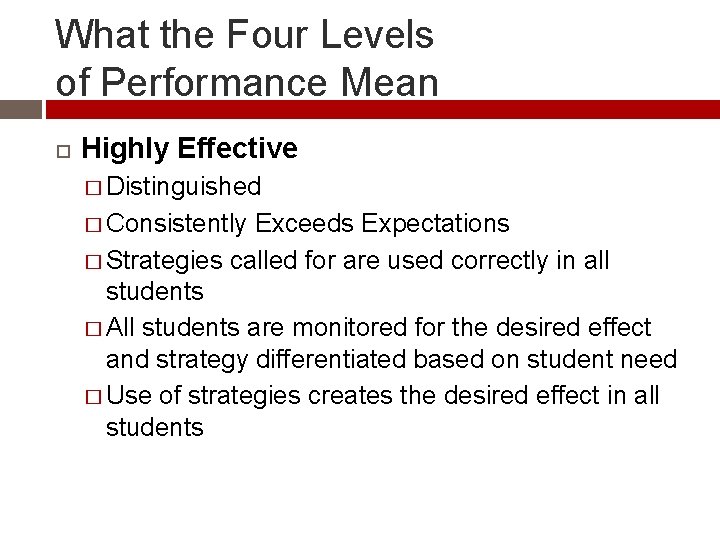
What the Four Levels of Performance Mean Highly Effective � Distinguished � Consistently Exceeds Expectations � Strategies called for are used correctly in all students � All students are monitored for the desired effect and strategy differentiated based on student need � Use of strategies creates the desired effect in all students
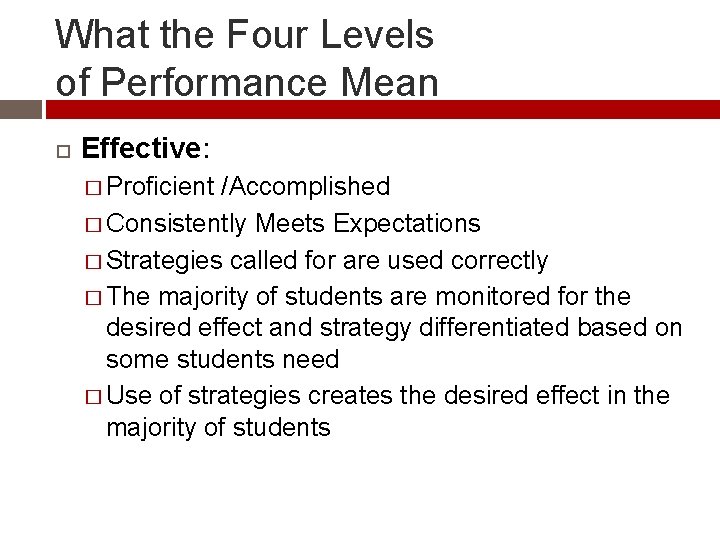
What the Four Levels of Performance Mean Effective: � Proficient /Accomplished � Consistently Meets Expectations � Strategies called for are used correctly � The majority of students are monitored for the desired effect and strategy differentiated based on some students need � Use of strategies creates the desired effect in the majority of students
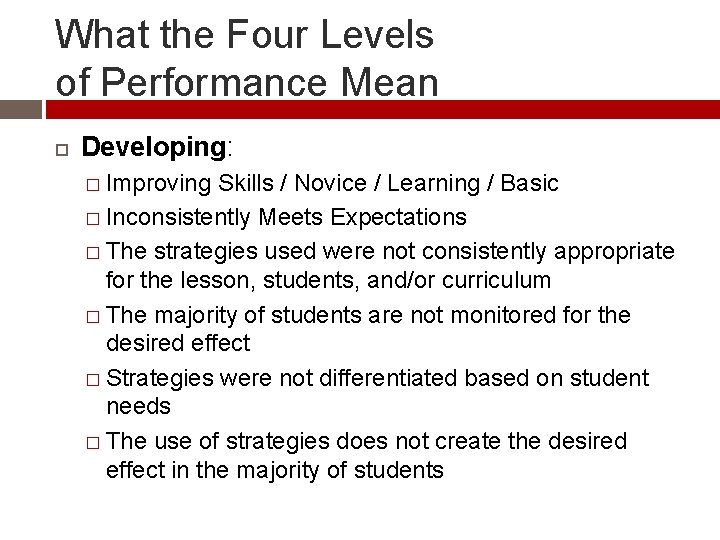
What the Four Levels of Performance Mean Developing: � Improving Skills / Novice / Learning / Basic � Inconsistently Meets Expectations � The strategies used were not consistently appropriate for the lesson, students, and/or curriculum � The majority of students are not monitored for the desired effect � Strategies were not differentiated based on student needs � The use of strategies does not create the desired effect in the majority of students
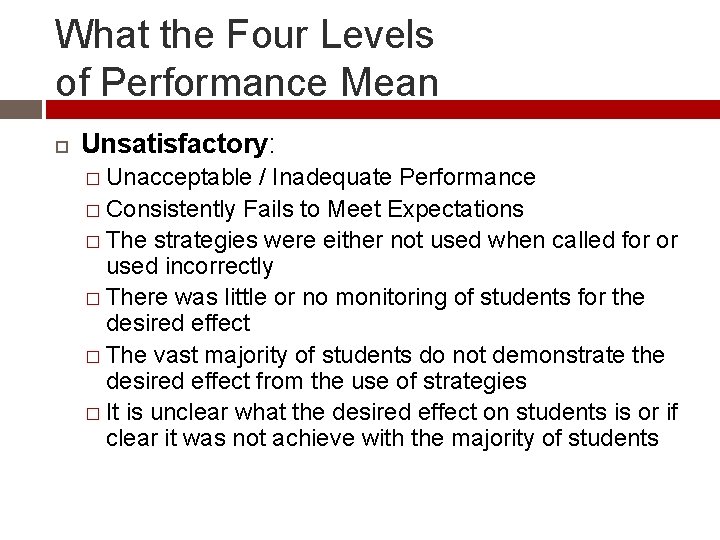
What the Four Levels of Performance Mean Unsatisfactory: � Unacceptable / Inadequate Performance � Consistently Fails to Meet Expectations � The strategies were either not used when called for or used incorrectly � There was little or no monitoring of students for the desired effect � The vast majority of students do not demonstrate the desired effect from the use of strategies � It is unclear what the desired effect on students is or if clear it was not achieve with the majority of students
Evaluation How is the Evaluation Score Determined?
How You Will be Scored 2015 -16, Category A & B teachers � Domain 1 only. � Highly Effective: at least 55% at level 4 with 0% at level 0. � Effective: at least 55% at level 3 or higher. � Developing: Less than 55% at level 3 or higher and less than 50% at level 1 or 0. � Unsatisfactory: Greater than or equal to 50% at level 1 or 0.
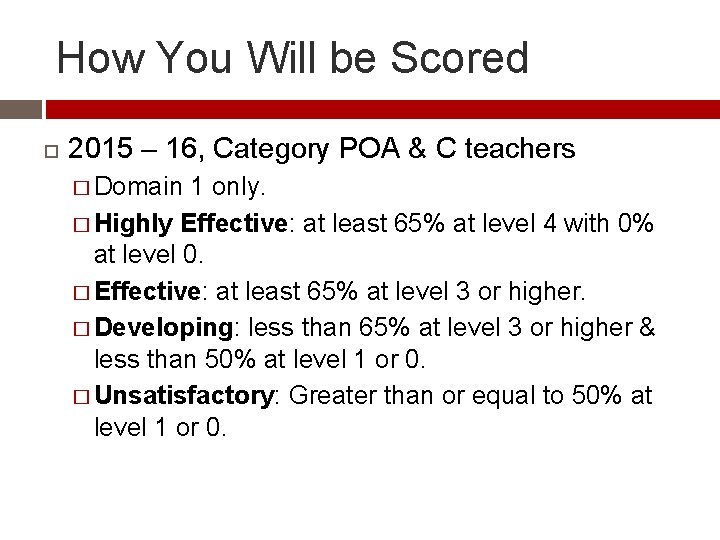
How You Will be Scored 2015 – 16, Category POA & C teachers � Domain 1 only. � Highly Effective: at least 65% at level 4 with 0% at level 0. � Effective: at least 65% at level 3 or higher. � Developing: less than 65% at level 3 or higher & less than 50% at level 1 or 0. � Unsatisfactory: Greater than or equal to 50% at level 1 or 0.
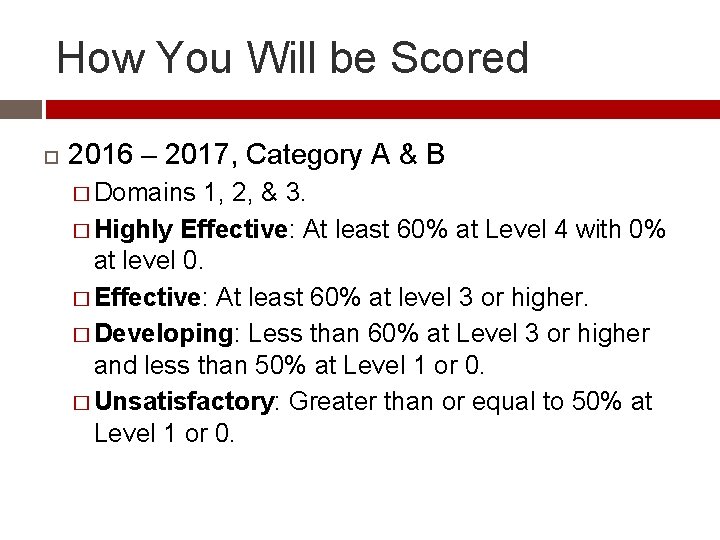
How You Will be Scored 2016 – 2017, Category A & B � Domains 1, 2, & 3. � Highly Effective: At least 60% at Level 4 with 0% at level 0. � Effective: At least 60% at level 3 or higher. � Developing: Less than 60% at Level 3 or higher and less than 50% at Level 1 or 0. � Unsatisfactory: Greater than or equal to 50% at Level 1 or 0.
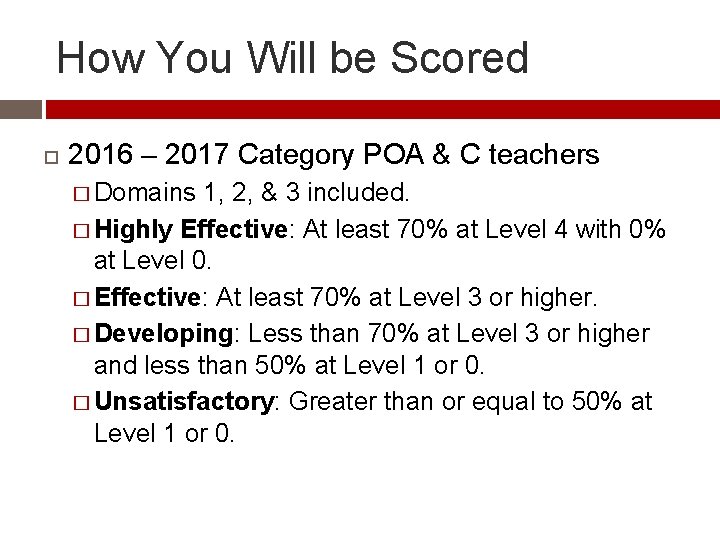
How You Will be Scored 2016 – 2017 Category POA & C teachers � Domains 1, 2, & 3 included. � Highly Effective: At least 70% at Level 4 with 0% at Level 0. � Effective: At least 70% at Level 3 or higher. � Developing: Less than 70% at Level 3 or higher and less than 50% at Level 1 or 0. � Unsatisfactory: Greater than or equal to 50% at Level 1 or 0.
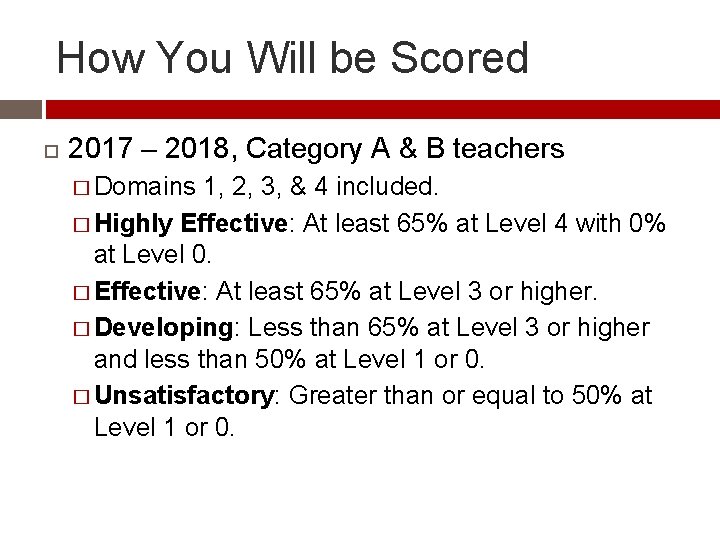
How You Will be Scored 2017 – 2018, Category A & B teachers � Domains 1, 2, 3, & 4 included. � Highly Effective: At least 65% at Level 4 with 0% at Level 0. � Effective: At least 65% at Level 3 or higher. � Developing: Less than 65% at Level 3 or higher and less than 50% at Level 1 or 0. � Unsatisfactory: Greater than or equal to 50% at Level 1 or 0.
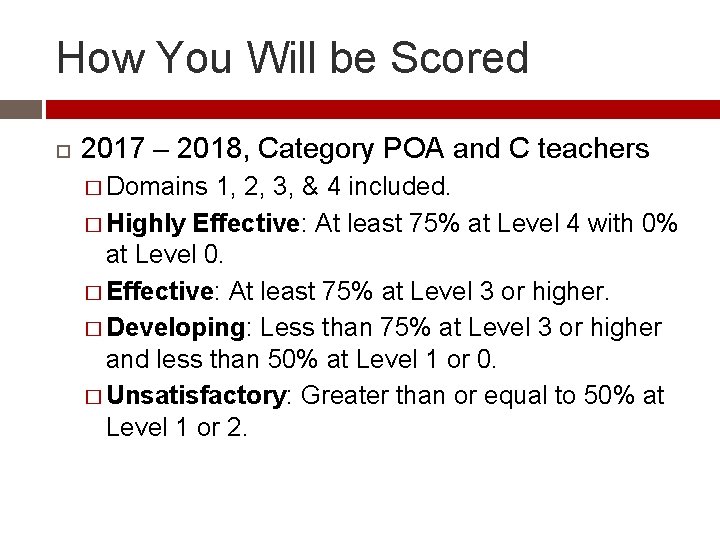
How You Will be Scored 2017 – 2018, Category POA and C teachers � Domains 1, 2, 3, & 4 included. � Highly Effective: At least 75% at Level 4 with 0% at Level 0. � Effective: At least 75% at Level 3 or higher. � Developing: Less than 75% at Level 3 or higher and less than 50% at Level 1 or 0. � Unsatisfactory: Greater than or equal to 50% at Level 1 or 2.
Next Steps August Training on Marzano October Training on i. Observation Continued Training on Domain 1 over 15 -16 school year