
Introduction to the Learning Sciences Bilingual 16 th
Introduction to the Learning Sciences (Bilingual ) 学习科学导论 (双语) 16 th Class, June. 12, 2016, Sunday Focus:The Future of Learning: Grounding Educational Innovation in the Learning Sciences Instructor: Prof. Baohui Zhang 张宝辉教授 Teaching Assistant: Ms. Shasha Zhang 张莎莎; Research Assistant: Ms. Nan Li 李楠 School of Education, Shaanxi Normal University, China
Presentation Plan 本次课计划 n Lesson objectives n Course Content n Break n n Discussion Leader & discussion questions Assignment
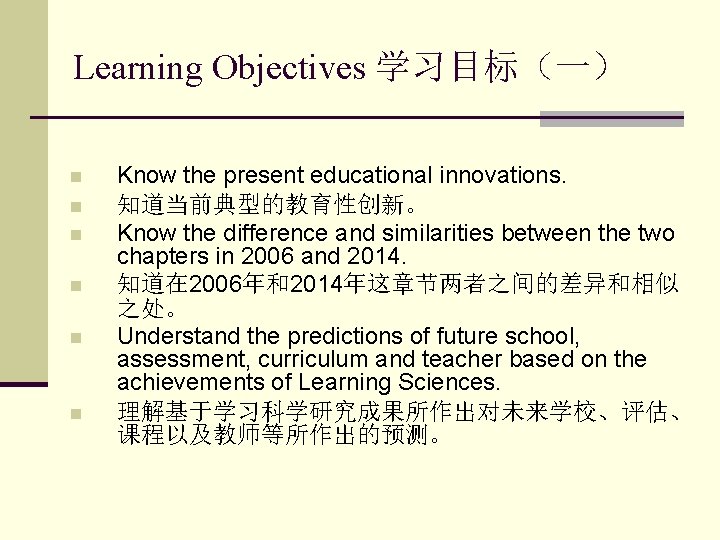
Learning Objectives 学习目标(一) n n n Know the present educational innovations. 知道当前典型的教育性创新。 Know the difference and similarities between the two chapters in 2006 and 2014. 知道在 2006年和2014年这章节两者之间的差异和相似 之处。 Understand the predictions of future school, assessment, curriculum and teacher based on the achievements of Learning Sciences. 理解基于学习科学研究成果所作出对未来学校、评估、 课程以及教师等所作出的预测。
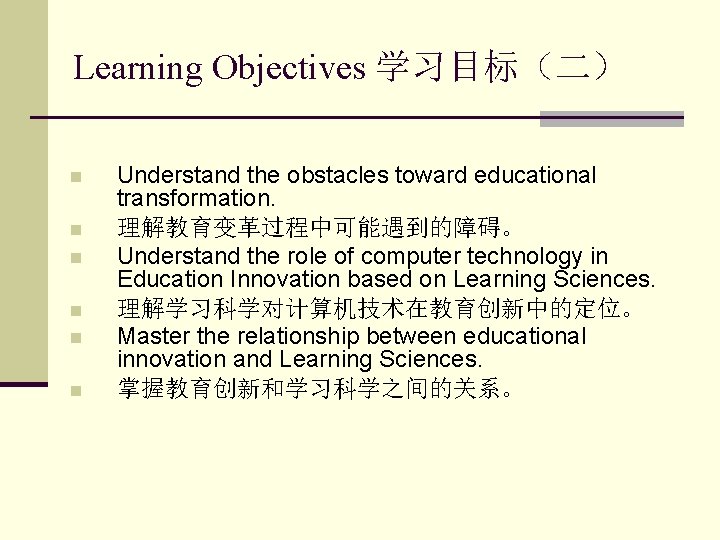
Learning Objectives 学习目标(二) n n n Understand the obstacles toward educational transformation. 理解教育变革过程中可能遇到的障碍。 Understand the role of computer technology in Education Innovation based on Learning Sciences. 理解学习科学对计算机技术在教育创新中的定位。 Master the relationship between educational innovation and Learning Sciences. 掌握教育创新和学习科学之间的关系。
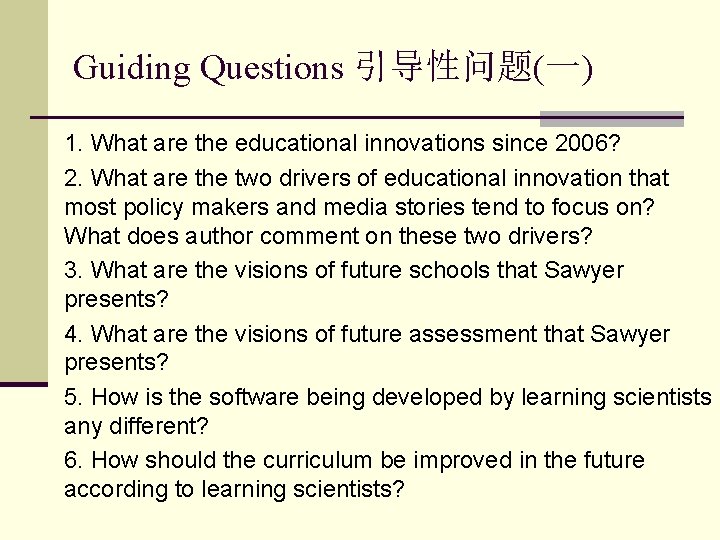
Guiding Questions 引导性问题(一) 1. What are the educational innovations since 2006? 2. What are the two drivers of educational innovation that most policy makers and media stories tend to focus on? What does author comment on these two drivers? 3. What are the visions of future schools that Sawyer presents? 4. What are the visions of future assessment that Sawyer presents? 5. How is the software being developed by learning scientists any different? 6. How should the curriculum be improved in the future according to learning scientists?
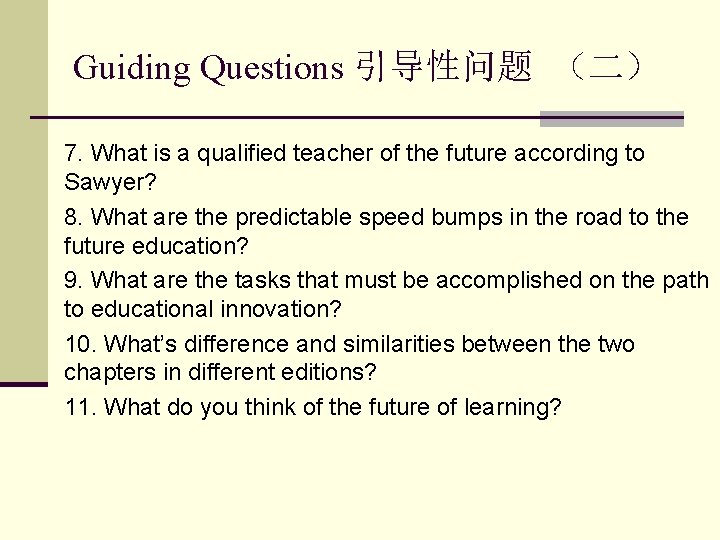
Guiding Questions 引导性问题 (二) 7. What is a qualified teacher of the future according to Sawyer? 8. What are the predictable speed bumps in the road to the future education? 9. What are the tasks that must be accomplished on the path to educational innovation? 10. What’s difference and similarities between the two chapters in different editions? 11. What do you think of the future of learning?

The Cambridge Handbook of the Learning Sciences
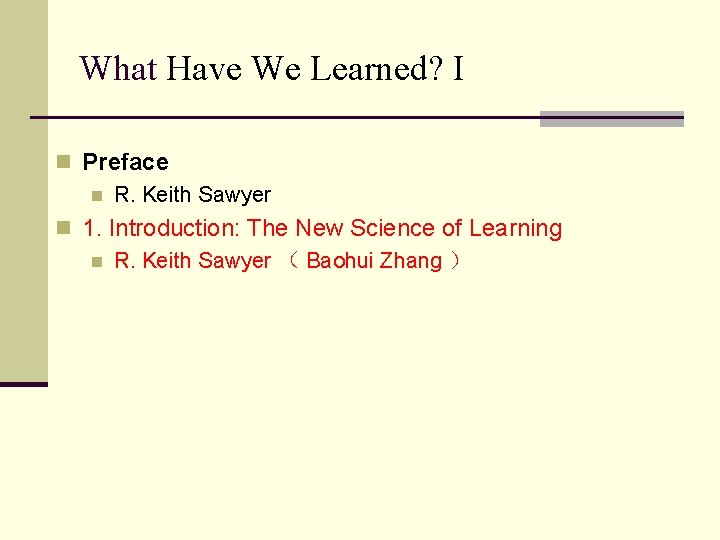
What Have We Learned? I n Preface n R. Keith Sawyer n 1. Introduction: The New Science of Learning n R. Keith Sawyer ( Baohui Zhang )
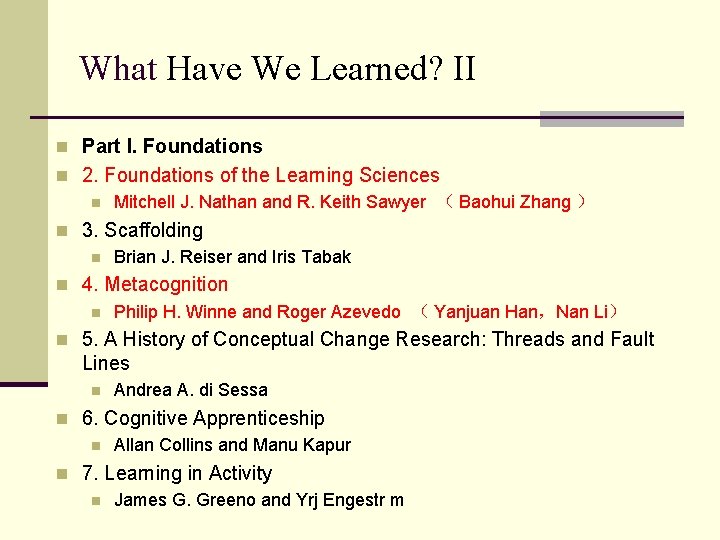
What Have We Learned? II n Part I. Foundations n 2. Foundations of the Learning Sciences n Mitchell J. Nathan and R. Keith Sawyer ( Baohui Zhang ) n 3. Scaffolding n Brian J. Reiser and Iris Tabak n 4. Metacognition n Philip H. Winne and Roger Azevedo ( Yanjuan Han,Nan Li) n 5. A History of Conceptual Change Research: Threads and Fault Lines n Andrea A. di Sessa n 6. Cognitive Apprenticeship n Allan Collins and Manu Kapur n 7. Learning in Activity n James G. Greeno and Yrj Engestr m
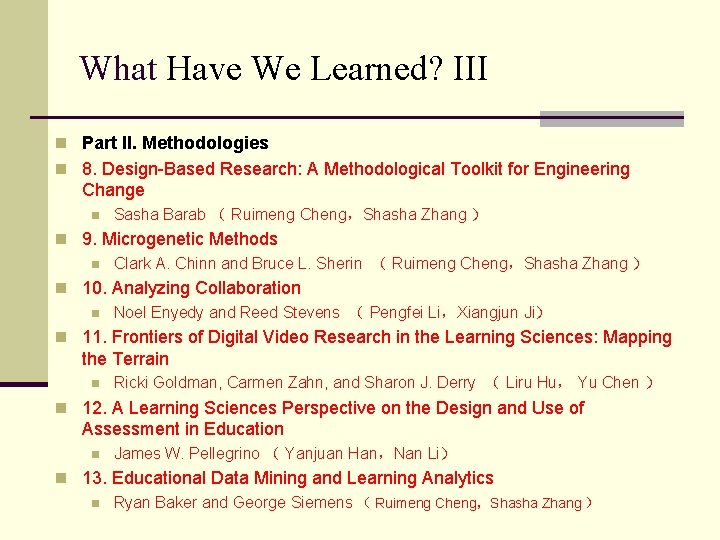
What Have We Learned? III n Part II. Methodologies n 8. Design-Based Research: A Methodological Toolkit for Engineering Change n Sasha Barab ( Ruimeng Cheng,Shasha Zhang ) n 9. Microgenetic Methods n Clark A. Chinn and Bruce L. Sherin ( Ruimeng Cheng,Shasha Zhang ) n 10. Analyzing Collaboration n Noel Enyedy and Reed Stevens ( Pengfei Li,Xiangjun Ji) n 11. Frontiers of Digital Video Research in the Learning Sciences: Mapping the Terrain n Ricki Goldman, Carmen Zahn, and Sharon J. Derry ( Liru Hu, Yu Chen ) n 12. A Learning Sciences Perspective on the Design and Use of Assessment in Education n James W. Pellegrino ( Yanjuan Han,Nan Li) n 13. Educational Data Mining and Learning Analytics n Ryan Baker and George Siemens ( Ruimeng Cheng,Shasha Zhang )
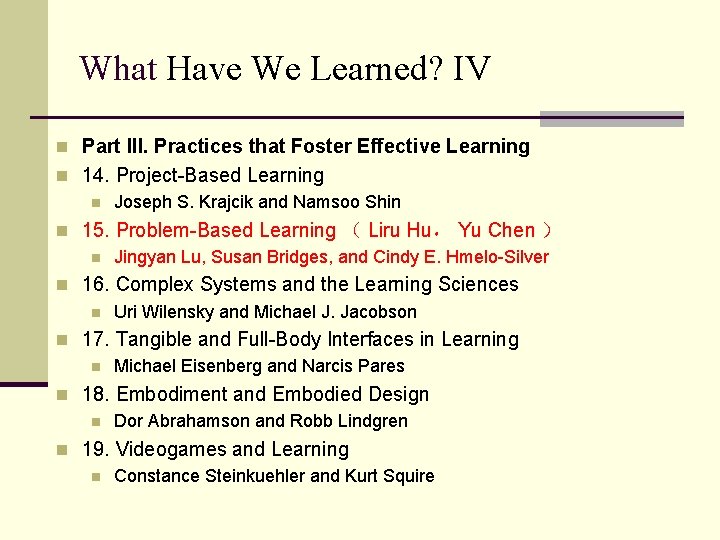
What Have We Learned? IV n Part III. Practices that Foster Effective Learning n 14. Project-Based Learning n Joseph S. Krajcik and Namsoo Shin n 15. Problem-Based Learning ( Liru Hu, Yu Chen ) n Jingyan Lu, Susan Bridges, and Cindy E. Hmelo-Silver n 16. Complex Systems and the Learning Sciences n Uri Wilensky and Michael J. Jacobson n 17. Tangible and Full-Body Interfaces in Learning n Michael Eisenberg and Narcis Pares n 18. Embodiment and Embodied Design n Dor Abrahamson and Robb Lindgren n 19. Videogames and Learning n Constance Steinkuehler and Kurt Squire

What Have We Learned? V n Part IV. Learning Together n 20. Knowledge Building and Knowledge Creation: Theory, Pedagogy, and. Technology n Marlene Scardamalia and Carl Bereiter n 21. The Social and Interactive Dimensions of Collaborative Learning n Naomi Miyake and Paul A. Kirschner n 22. Arguing to Learn n Jerry Andriessen and Michael Baker n 23. Informal Learning in Museums n Kevin Crowley, Palmyre Pierroux, and Karen Knutson n 24. Computer-Supported Collaborative Learning n Gerry Stahl, Timothy Koschmann, and Daniel Suthers n 25. Mobile Learning n Mike Sharples and Roy Pea n 26. Learning in Virtual Worlds n Yasmin B. Kafai and Chris Dede
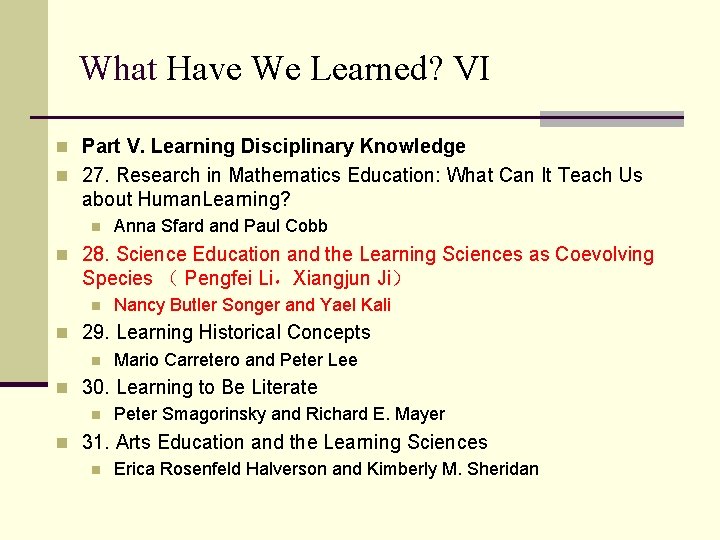
What Have We Learned? VI n Part V. Learning Disciplinary Knowledge n 27. Research in Mathematics Education: What Can It Teach Us about Human. Learning? n Anna Sfard and Paul Cobb n 28. Science Education and the Learning Sciences as Coevolving Species ( Pengfei Li,Xiangjun Ji) n Nancy Butler Songer and Yael Kali n 29. Learning Historical Concepts n Mario Carretero and Peter Lee n 30. Learning to Be Literate n Peter Smagorinsky and Richard E. Mayer n 31. Arts Education and the Learning Sciences n Erica Rosenfeld Halverson and Kimberly M. Sheridan
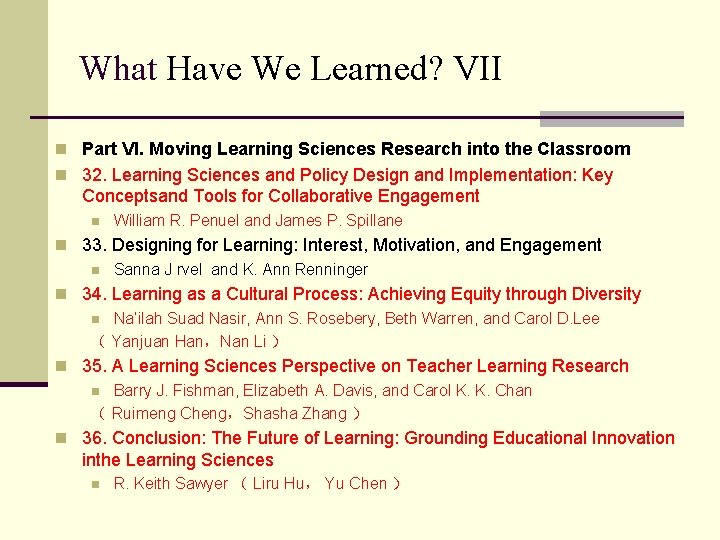
What Have We Learned? VII n Part VI. Moving Learning Sciences Research into the Classroom n 32. Learning Sciences and Policy Design and Implementation: Key Conceptsand Tools for Collaborative Engagement n William R. Penuel and James P. Spillane n 33. Designing for Learning: Interest, Motivation, and Engagement n Sanna J rvel and K. Ann Renninger n 34. Learning as a Cultural Process: Achieving Equity through Diversity n Na’ilah Suad Nasir, Ann S. Rosebery, Beth Warren, and Carol D. Lee ( Yanjuan Han,Nan Li ) n 35. A Learning Sciences Perspective on Teacher Learning Research n Barry J. Fishman, Elizabeth A. Davis, and Carol K. K. Chan ( Ruimeng Cheng,Shasha Zhang ) n 36. Conclusion: The Future of Learning: Grounding Educational Innovation inthe Learning Sciences n R. Keith Sawyer ( Liru Hu, Yu Chen )
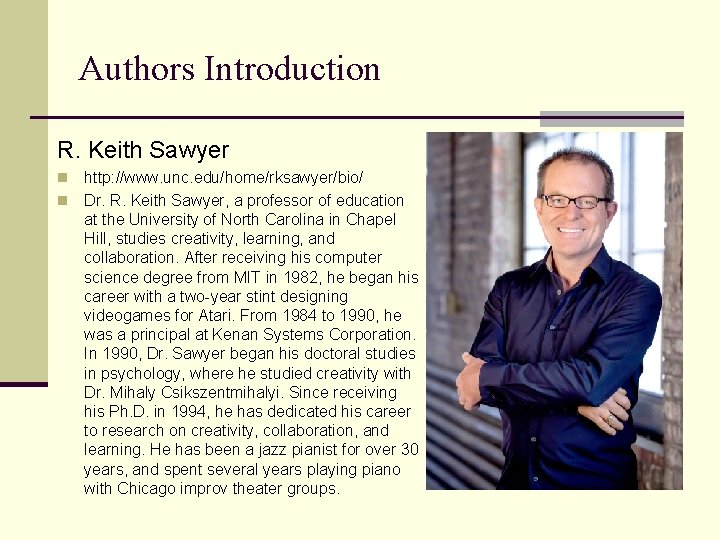
Authors Introduction R. Keith Sawyer http: //www. unc. edu/home/rksawyer/bio/ n Dr. R. Keith Sawyer, a professor of education at the University of North Carolina in Chapel Hill, studies creativity, learning, and collaboration. After receiving his computer science degree from MIT in 1982, he began his career with a two-year stint designing videogames for Atari. From 1984 to 1990, he was a principal at Kenan Systems Corporation. In 1990, Dr. Sawyer began his doctoral studies in psychology, where he studied creativity with Dr. Mihaly Csikszentmihalyi. Since receiving his Ph. D. in 1994, he has dedicated his career to research on creativity, collaboration, and learning. He has been a jazz pianist for over 30 years, and spent several years playing piano with Chicago improv theater groups. n
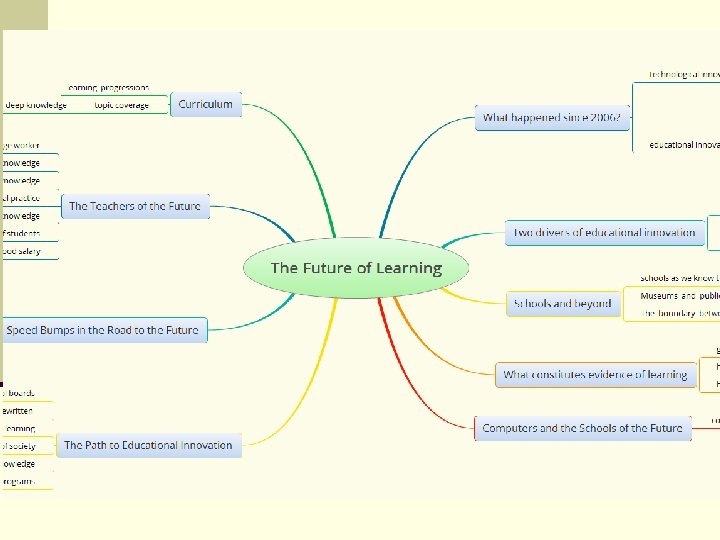
Overview of the Chapter
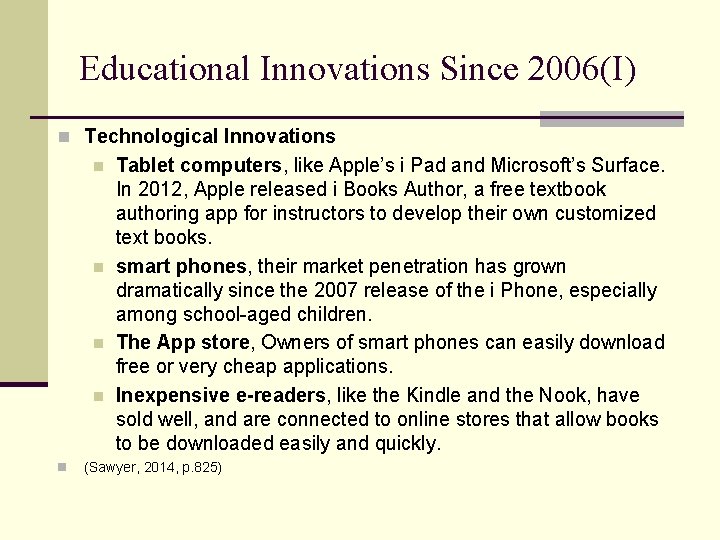
Educational Innovations Since 2006(I) n Technological Innovations n n n Tablet computers, like Apple’s i Pad and Microsoft’s Surface. In 2012, Apple released i Books Author, a free textbook authoring app for instructors to develop their own customized text books. smart phones, their market penetration has grown dramatically since the 2007 release of the i Phone, especially among school-aged children. The App store, Owners of smart phones can easily download free or very cheap applications. Inexpensive e-readers, like the Kindle and the Nook, have sold well, and are connected to online stores that allow books to be downloaded easily and quickly. (Sawyer, 2014, p. 825)

Educational Innovations Since 2006(II) n Educational innovations: n Massive open online courses (MOOCs). MOOCs have gained legitimacy because America’s top research universities are involved. In 2014, Google and ed. X released MOOC. org, an open-source platform that any university can use. n Learning Management Systems (LMS). LMS are now used by most colleges to support their on-campus courses with full-time students. The market leader is Blackboard; others include Moodle and Sakai. Newcomers like Piazza and Classroom Salon are increasingly integrating social networking features long associated with sites like Facebook n The flipped classroom. The Khan Academy popularized the notion of the “flipped classroom”. n Online college degrees. The University of North Carolina at Chapel Hillbegan offering an online MBA degree in 2011, MBA@UNC. In May 2013, Georgia Tech announced the first online master’s degree in computer science n (Sawyer, 2014, p. 826)
Two Drivers of Educational Innovation(I) n The application of market models to the education sector. n n introducing competition and increasing customer choice will drive innovation monopolies reduce effectiveness and innovation n The increasing involvement of the private sector in education. n n n Two of the most influential recent education reforms in the United States had strong private sector involvement: the Common Core standards and the 21 st-century skills movement Many of these successful business leaders have also funded the push toward market reforms in schools (Sawyer, 2014, pp. 826 -827)

Two Drivers of Educational Innovation(II) n But to date, these potential drivers of educational innovation have not resulted in schools that are more solidly grounded in the learning sciences – the participatory, project-based, constructivist, and collaborative pedagogies. n A reversion to instructionist pedagogy n n High-stakes assessments MOOCs :a transmission model A growing number of techno-skeptics (Sawyer, 2014, pp. 827 -828)
Two Drivers of Educational Innovation(III) n If we are to succeed in creating the schools of the future, educational innovation and technology must be grounded in the learning sciences. n n n U. S. National Research Council’s How People Learn (Bransford, Brown, & Cocking, 2000) Innovative Learning Environments (2013) , OECD The Nature of Learning: Using Research to Inspire Practice (2010) , OECD Innovating to Learn, Learning to Innovate (2008), OECD (Sawyer, 2014, p. 828)

Schools and Beyond(I) n Two notes: n “Learning environments” rather than “schools” or “classrooms” n A more profound question that learning scientists ask: n n Are today’s schools really the right schools for the knowledge society? (Sawyer, 2014, p. 830)
Schools and Beyond(II) n Roger Schank (1999) and Seymour Papert (1980), argued that computer technology is so radically transformative that schools as we know them will have to fade away before the full benefits can be realized. n (Sawyer, 2014, p. 830)

Schools and Beyond(III) n The recent technological developments I described earlier seem to finally make this possible. Everything is subject to change: n Schools may not be physical locations where everyone goes, students may not be grouped by age or grade, students could learn anywhere at anytime. n I made this same statement in my conclusion to the 2006 edition, when it may have seemed shocking; now, in 2014, such visions have become the conventional wisdom. n (Sawyer, 2014, p. 830)

Schools and Beyond(III) n Imagine a nation of online home-based activities organized around small neighborhood learning clubs, all connected through highbandwidth Internet software. There would be no textbooks, few lectures, and no curriculum as we know it today. “Teachers” would operate as independent consultants who work from home most of the time, and occasionally meet with ad hoc groups of students at a learning club. Each meeting would be radically different in nature, depending on the project-based and self-directed learning that those students were engaged in. In fact, each type of learning session might involve a different learning specialist. The teaching profession could become multitiered, with master teachers developing curriculum in collaboration with software developers and acting as consultants to schools, and learning centers staffed by a variety of independent contractors whose job no longer involves lesson preparation or grading, but instead involves mostly assisting students as they work at the computer or gather data in the field (Stallard & Cocker, 2001). (Sawyer, 2014, pp. 830 -831)
Schools and Beyond(IV) Other Trends: n Full-time and part-time online schools n Well-designed software fulfill individualized learning by using learning analytics. n Conservative critics of public schools: for-profit tutoring centers n Museums and public libraries: evolution to learning resource centers n The boundary between formal schooling and continuing education will increasingly blur n (Sawyer, 2014, pp. 830 -831) (Sawyer, 2014, p. 832)

Evidence of Learning n “Credit hour” model and a nine-month calendar n Culminating examination One of the most prominent alternatives to the credit hour model is the proposal to use badges as the fundamental unit of learning. n A second prominent alternative is the idea of instituting an “exit exam” for universities as a replacement for the school transcript and the grade point average (GPA). n Challenge: design badges and other assessments grounded in learning sciences and accurately reflecting 21 st-century skills n n (Sawyer, 2014, p. 833)

Computers and the Schools of the Future(I) n 1950 s, when B. F. Skinner claimed that his “teaching machines” made the teacher “out of date” (1954/1968, p. 22). n Papert’s 1980 book Mindstorms argued that giving every child a computer would allow students to actively construct their own learning, leaving teachers with an uncertain role: “schools as we know them today will have no place in the future” n Larry Cuban famously documented the failure of computers and the Internet to improve U. S. schools in his 2001 book Over- sold and Under-used. n (Sawyer, 2014, pp. 834 -835)
Computers and the Schools of the Future(II) n How is the software being developed by learning scientists any different? n n n Learning scientists’ computer software is designed with the participation of practicing teachers and is grounded in how people learn. computers will never realize their full potential if they are merely add-ons to the existing instructionist classroom; that’s why they are engaged in the hard work of designing entire learning environments – not just stand-alone computer applications, as previous generations of educational software designers did. (Sawyer, 2014, pp. 834 -835)
Curriculum n Identifying the specific sequences of activities and concepts that are most effective in each subject sometimes referred to as “learning trajectories” or “learning progressions” n Topic coverage: n n Focus on breadth is misguided: “a mile wide and an inch deep” Students learn better when they learn deep knowledge that allows them to think and to solve problems with the content that they are learning. n A near-term task: identify the content of the curriculum for each subject and each grade, and then to design an integrated, coherent, unified curriculum to replace existing textbooks. n (Sawyer, 2014, pp. 835 -836)

The Teachers of the Future n knowledge worker n pedagogical knowledge n learning knowledge n faimiliar with authentic professional practice n teach deep knowledge n leader of students n good salary n (Sawyer, 2014, pp. 834 -835)
Speed Bumps in the Road to the Future I Three things now seem certain: First, that learning environments will eventually have to change to meet the needs of the modern knowledge society Second, that schools are complex institutions that have proven quite resistant to change Third, that alternative learning environments, many enabled by new technologies, are rapidly emerging to challenge schools ( Sawyer, 2014,p 837)
Speed Bumps in the Road to the Future II Incompatibilities between Schools and the Learning Sciences. Connecting Elemental and Systemic Approaches. Assessment and Accountability New Methodologies Building the Community (Sawyer, 2014,pp 837 -842).
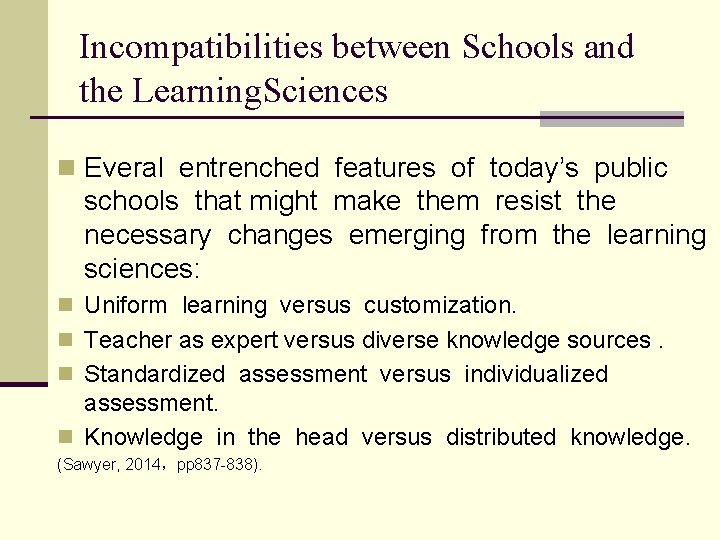
Incompatibilities between Schools and the Learning. Sciences n Everal entrenched features of today’s public schools that might make them resist the necessary changes emerging from the learning sciences: n Uniform learning versus customization. n Teacher as expert versus diverse knowledge sources. n Standardized assessment versus individualized assessment. n Knowledge in the head versus distributed knowledge. (Sawyer, 2014,pp 837 -838).
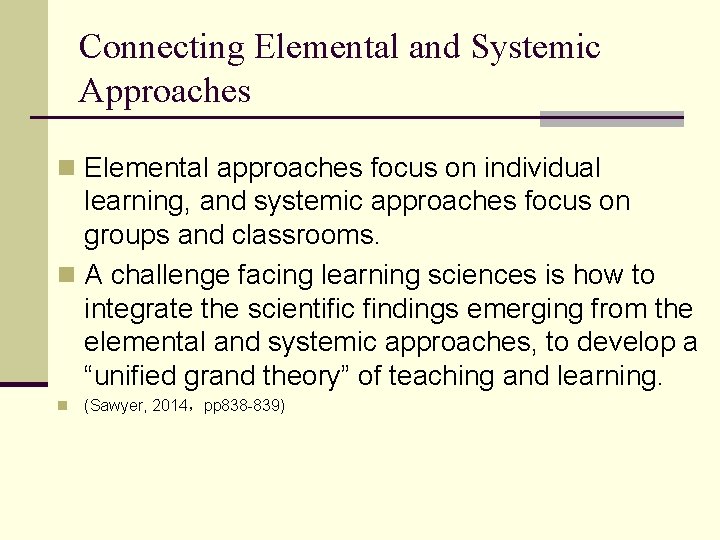
Connecting Elemental and Systemic Approaches n Elemental approaches focus on individual learning, and systemic approaches focus on groups and classrooms. n A challenge facing learning sciences is how to integrate the scientific findings emerging from the elemental and systemic approaches, to develop a “unified grand theory” of teaching and learning. n (Sawyer, 2014,pp 838 -839)
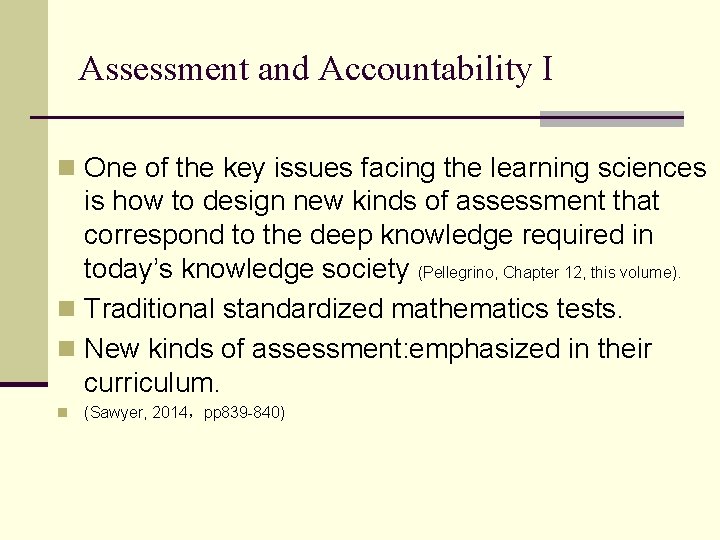
Assessment and Accountability I n One of the key issues facing the learning sciences is how to design new kinds of assessment that correspond to the deep knowledge required in today’s knowledge society (Pellegrino, Chapter 12, this volume). n Traditional standardized mathematics tests. n New kinds of assessment: emphasized in their curriculum. n (Sawyer, 2014,pp 839 -840)
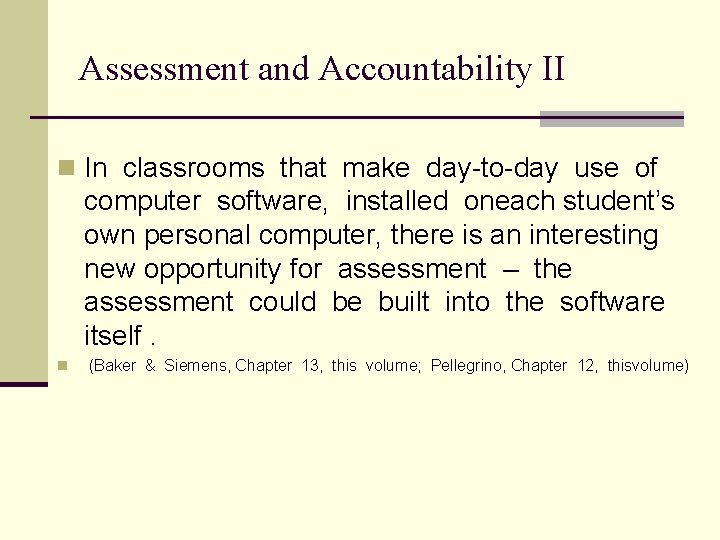
Assessment and Accountability II n In classrooms that make day-to-day use of computer software, installed oneach student’s own personal computer, there is an interesting new opportunity for assessment – the assessment could be built into the software itself. n (Baker & Siemens, Chapter 13, this volume; Pellegrino, Chapter 12, thisvolume)
New Methodologies n Experimental studies that randomly assign students to either a new educational intervention or a traditional classroom remain the gold standard for evaluating what works best to improve learning. n This method is known as the randomized controlled trial (RCT) and is commonly used in medicine to evaluate new drugs and treatments. n (Sawyer, 2014,pp 840 -842)
Building the Community n The large community of cognitive psychologists and cognitiveneuroscientists who are studying basic brain functions that are related tolearning. n The task facing society today is to design the schools of the future, and that is a massive under taking that will involve many different communities of practice. n n (Sawyer, 2014,p 842)
The Path to Educational Innovation n Parents, politicians, and school boards must be convinced that change isnecessary. n Textbooks must be rewritten. n The shift to customized. n The relationship between the institution of school and the rest of societymay need to change. n Standardized tests must be rewritten. n (Sawyer, 2014,pp 843 -844)

Discussion (I) n. What’s difference and similarities between the two chapters in different editions? n. And why?
Discussion (II) n. Some questions from our reading summary n. I don't know how to develop these abilities. How to train enough qualified teachers in the future?How to structure a school of future?(Chen Yu) n. Sawyer comments “high-stakes testing” strengthens instructionism (Sawyer, 2014, p. 828). However, he also takes this as prominent alternatives of assessment(Sawyer, 2014, p. 833). Therefore, I am confusing about this. I also doubt it a good idea to replace credit hour with high-stakes exit exams. (Hu Liru)
Discussion (I) n. What’s difference and similarities between the two chapters in different editions? n. And why?
Discussion n. What do you think of the future of learning? n. Use 10 minutes to: n. A: Please draw your imagination of learning in the future, including the future school, teacher, curriculum, how to show the evidence of learning and so on. n. B: Imagine you were a headmaster of a school. Draw your school and how you would cultivate your students. n. Share your ideas.
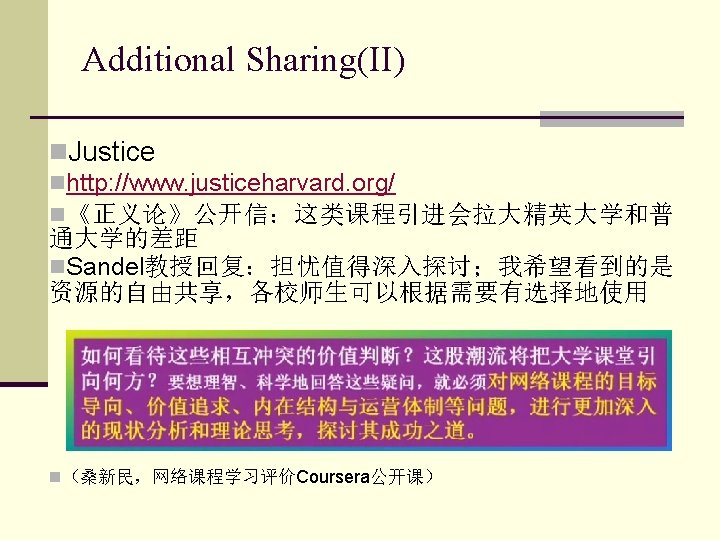
Additional Sharing(I) n乔布斯之问 n 20年来IT如何改变了几乎所有领域?为什么IT对 教育的影响小得令人吃惊? n schools are complex institutions that have proven to be amazingly resistant to change. (sawyer, 2014) n n 《美国 2010年国家教育技术计划》(NETP)指出信 息技术在教育领域的应用成效甚微在于其并未触及教 育系统的结构性变革 What do you think?
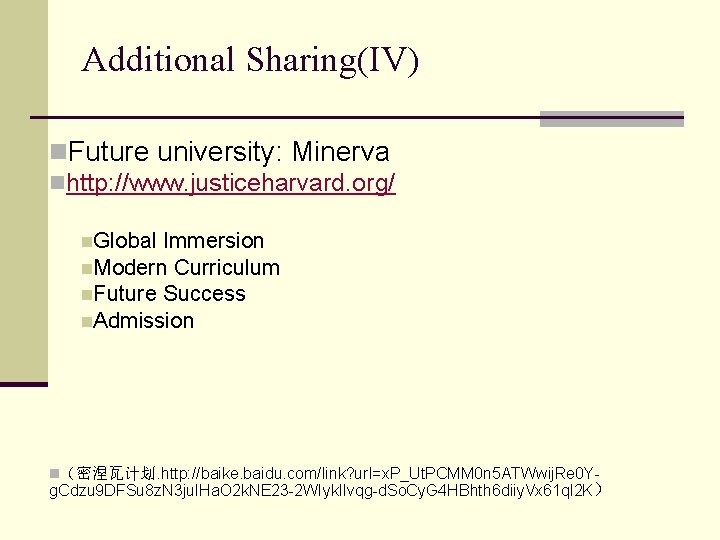
Additional Sharing(IV) n. Future university: Minerva nhttp: //www. justiceharvard. org/ n. Global Immersion n. Modern Curriculum n. Future Success n. Admission n(密涅瓦计划. http: //baike. baidu. com/link? url=x. P_Ut. PCMM 0 n 5 ATWwij. Re 0 Y- g. Cdzu 9 DFSu 8 z. N 3 ju. IHa. O 2 k. NE 23 -2 WIyk. Ilvqg-d. So. Cy. G 4 HBhth 6 diiy. Vx 61 ql 2 K)
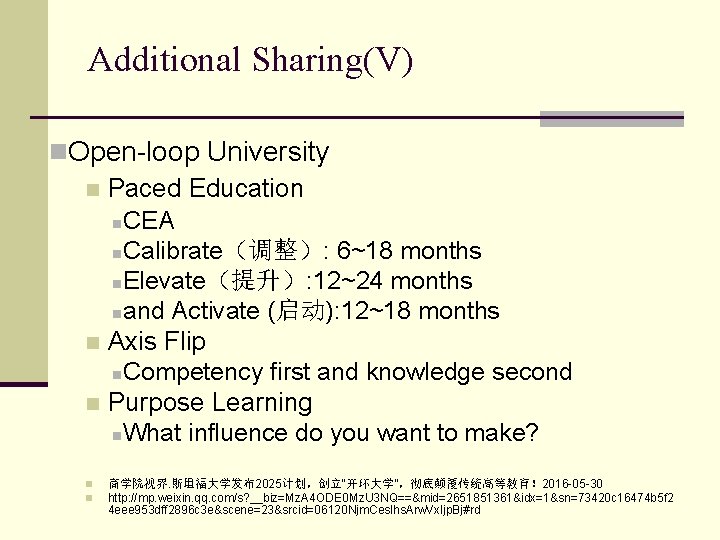
Additional Sharing(V) n. Open-loop University n Paced Education n. CEA n. Calibrate(调整): 6~18 months n. Elevate(提升): 12~24 months nand Activate (启动): 12~18 months n Axis Flip n. Competency first and knowledge second n Purpose Learning n. What influence do you want to make? n n 商学院视界. 斯坦福大学发布2025计划,创立“开环大学”,彻底颠覆传统高等教育!2016 -05 -30 http: //mp. weixin. qq. com/s? __biz=Mz. A 4 ODE 0 Mz. U 3 NQ==&mid=2651851361&idx=1&sn=73420 c 16474 b 5 f 2 4 eee 953 dff 2896 c 3 e&scene=23&srcid=06120 Njm. Ceslhs. Arw. Vxljp. Bj#rd
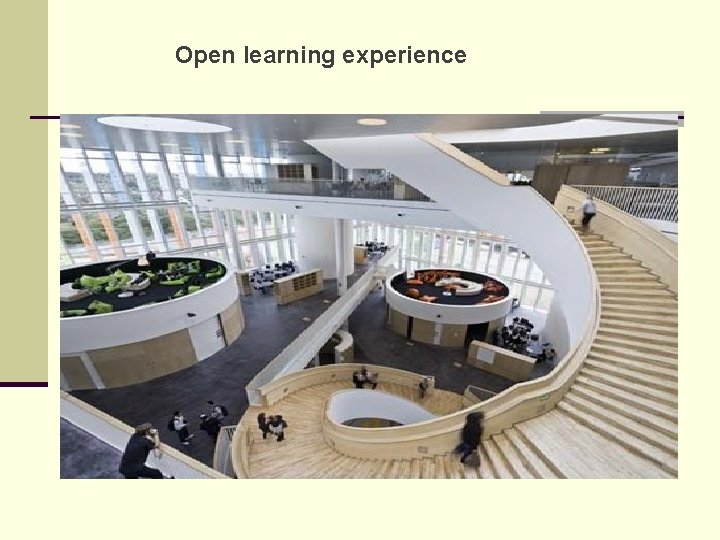
Open learning experience
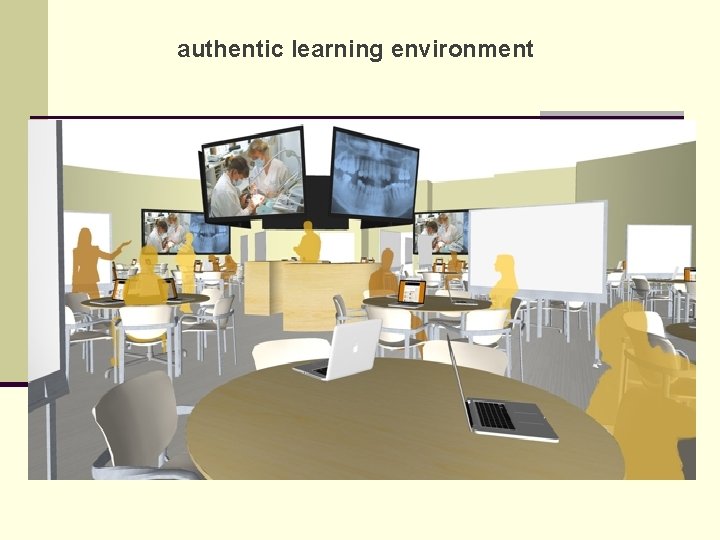
authentic learning environment
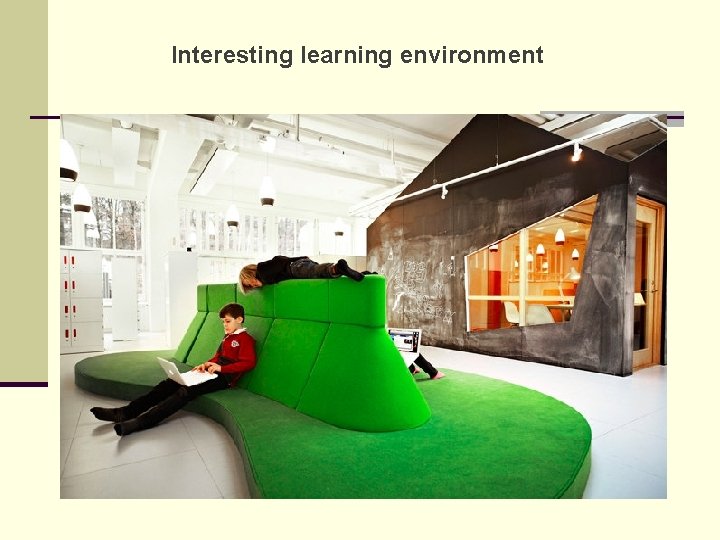
Interesting learning environment
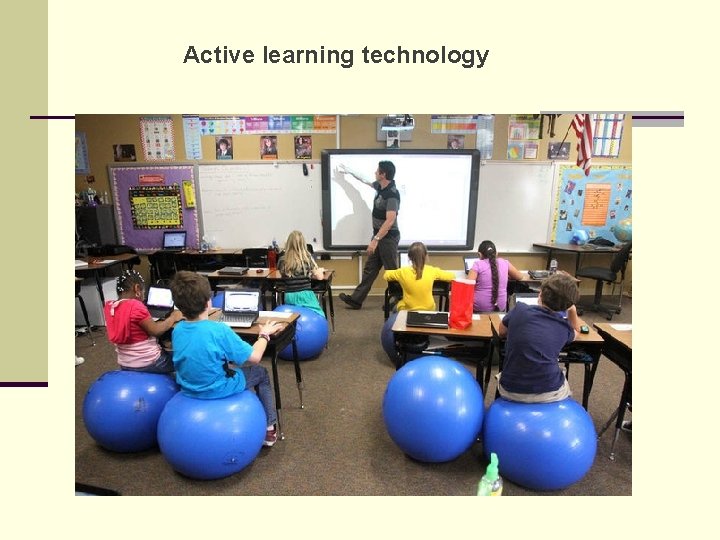
Active learning technology
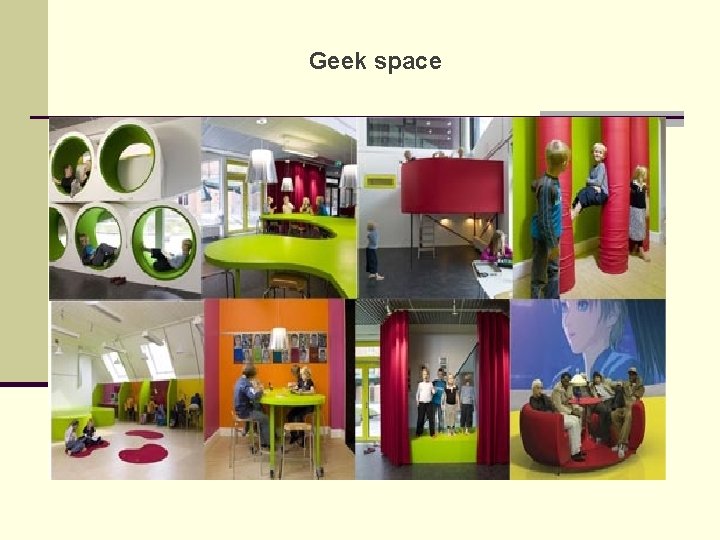
Geek space
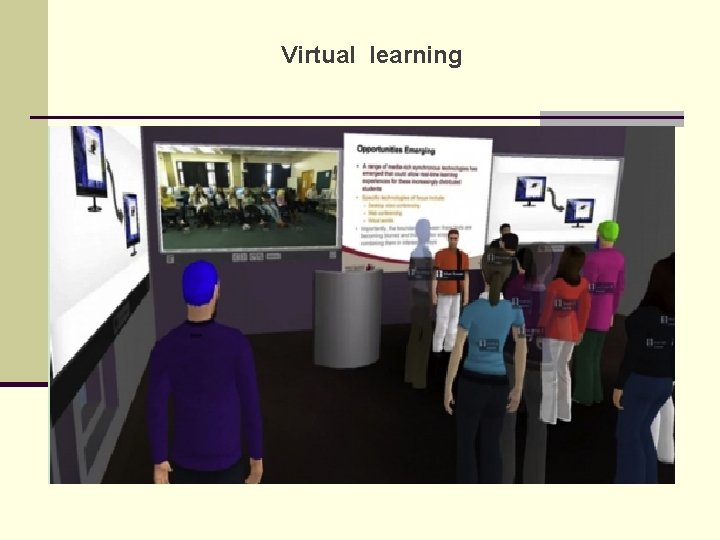
Virtual learning
![References [1]Sawyer R K. The Cambridge handbook of the learning sciences /[M]. Cambridge University](http://slidetodoc.com/presentation_image_h2/a4fe5fbf62f1b35ff145912a12f22c29/image-58.jpg "References [1]Sawyer R K. The Cambridge handbook of the learning sciences /[M]. Cambridge University")
References [1]Sawyer R K. The Cambridge handbook of the learning sciences /[M]. Cambridge University Press, 2006. [2]Sawyer R K. The Cambridge handbook of the learning sciences /[M]. Cambridge University Press, 2014. [3]桑新民,网络课程学习评价Coursera公开课. https: //www. coursera. org/learn/wangluo-kecheng-xuexi-pingjia/ [4]百度百科. 密涅瓦计划 [DB/OL]. http: //baike. baidu. com/link? url=x. P_Ut. PCMM 0 n 5 ATWwij. Re 0 Yg. Cdzu 9 DFSu 8 z. N 3 ju. IHa. O 2 k. NE 23 -2 WIyk. Ilvqg-d. So. Cy. G 4 HBhth 6 diiy. Vx 61 ql 2 K [5]商学院视界. 斯坦福大学发布2025计划,创立“开环大学”,彻底颠覆传统高等 教育! [DB/OL]. 2016050. http: //mp. weixin. qq. com/s? __biz=Mz. A 4 ODE 0 Mz. U 3 NQ==&mid=26518513 61&idx=1&sn=73420 c 16474 b 5 f 24 eee 953 dff 2896 c 3 e&scene=23&srcid=06120 Njm. Ceslhs. Arw. Vxljp. Bj#rd [6]赵建华, 蒋银健, 姚鹏阁, 李百惠. 为未来做准备的学习: 重塑技术在教育中的角色 ——美国国家教育技术规划(NETP 2016)解读[J]. 现代远程教育研究, 2016, 02: 317.
Homework n. Reading summary of chapter 36 Demand: n n n Using English Due date: 12 am, June. 12, 2016 Please post your reading summary to Dr. Zhang n. Reflection journal Demand: n n n Using English Due date: 5 am, June. 13, 2016 Please post your reflection journal in QQ group and try to respond to others’ posts

Contact: QQ group-- 320585188 Baohui. zhang@snnu. edu. cn; 18291856988 (HP)
- Slides: 60