
Introduction to the Independent Living for Older Individuals


- Slides: 42
Introduction to the Independent Living for Older Individuals who are Blind Program Julie Brock and Rita Houston
Purpose The purpose of this module is to acquaint Program Managers with an overview of the Older Blind Program and the impact it has on the aging population with vision loss and the implications for the general population. www. oib-tac. org
Learning Objectives On completion of this course the student will be able to: § Outline and discuss the history of the Older Blind Program § Summarize Title VII Chapter 2 regulations and define the intent of the law § Appraise basic points comprising the scope of the problem § Compare and contrast various service delivery models § Identify and describe basic program components § Distinguish between and define program outputs and outcomes www. oib-tac. org
History of Older Blind Program § Efforts to establish services for persons who are older and blind date back to the late sixties, early seventies. § Dr. Douglas Mc. Farland Father Thomas Carroll began the campaign intending for either the aging network or the vision rehabilitation field to claim responsibility for serving older individuals who are blind. § Advocates had worked for years to convince the aging network to be involved in serving the older blind population. However, their budgets were inadequate. § It was the vision rehabilitation field that assumed responsibility for serving the older blind population. www. oib-tac. org
History of Older Blind Program § Senator Jennings Randolph introduced a bill to fund Research and Demonstration projects within the Rehabilitation Act of 1973. § Three-year pilot projects were funded in four states from 1975 -1978 to develop service delivery mechanisms. § By the 1980’s 24 other states, including Florida, Alabama, Texas, Pennsylvania, Mississippi, New York, Michigan, Montana, and New Jersey, used a variety of funding sources to serve older individuals who are blind. § Initial champions were successful in adding Part C to Title VII of the 1978 Amendments of the Rehabilitation Act. However, no funding was appropriated until 1986. www. oib-tac. org
History of Older Blind Program § Congressman Edward Roybal and Senator Mark Hatfield were successful in achieving funding at the $5 million dollar level in 1986, creating the first discretionary funding. § All states competed for funding, and appropriations were adequate to fund only 25 states for one year. § In the next competition, only 15 states were successful in maintaining their funding, decreasing the number of individuals receiving services (Herndon, 1993). § In 1992 Raymond Melhoff was instrumental in convincing leading organizations to change the law, making Part C a formula funded grant. www. oib-tac. org
History of Older Blind Program § In 1992, reauthorization of the Rehab Act changed Title VII Part C to Title VII Chapter 2. § A collective of vision rehabilitation organizations campaigned for additional funds to establish a base for each state at $225, 000 per year. § $15 million was distributed to all states based on the formula funding. § Efforts continue to increase funding and quality of services for this program. www. oib-tac. org
The Law Full text of Title VII Chapter 2 Regulations - Independent Living Services for Older Individuals Who are Blind is available in course handouts. www. oib-tac. org
Intent of the Law § Definition of law - Section 751 - The Chapter 2 Program is for individuals who are 55 and older who have significant vision loss who do not necessarily want to go to work but do want to live independently. § Program of Grants - Section 752 - The RSA Commissioner has the authority to make grants to a Designated State Agency. The law provides for the competitive grant process when appropriations are under the $13 million dollar level and for the formula grant process when it is greater than $13 million. § Purpose - Section 752 - Funds can only be expended for these purposes: providing independent living services, conducting activities that will improve or expand services for such individuals, and conducting activities to help improve public understanding of the problems of such individuals. www. oib-tac. org
Intent of the Law § Services - Section 752 - All the services listed in the law under subsection (D)(1) are allowed to be provided but all are not necessarily required. § Financial Requirements - Section 752 & 753 - All programs must have matching funds. In section 753, funds were appropriated until 2003. The proposed changes in WIOA provide funding to the year 2020. www. oib-tac. org
Changes to the Law with Enactment of WIOA § The Chapter 2 Program will remain in the Department of Education with the Vocational Rehabilitation Program. § That not less than 1. 8% nor more than 2. 0% be reserved to provide training and technical assistance to the Designated State Agencies and other providers of independent living services. § Services to facilitate the transition of individuals from nursing homes and other institutions to home and community based residence with requisite supports and services are core independent living services and as such may be provided by the older independent living blind program. www. oib-tac. org
Changes to the Law with Enactment of WIOA § Grantees may also provide services to older individuals who are blind and who are at risk of entering institutions, so that they may remain in the community. § The WIOA statue no longer requires the older blind program to be included in the State’s Plan for Independent Living. § WIOA requires that an OIB grantee inform the Secretary 45 days before the end of the fiscal year that funds will be available for re-allotment. www. oib-tac. org
Scope of the Problem Growing Population of Older Individuals who are Blind § “Vision impairment is defined as having less than 20/40 vision in the better eye even with eyeglasses. ” www. visionproblemsus. org § The severity of vision loss can vary widely and may result in equally varying degrees of functional impairment. § States differ in their visual eligibility criteria and the method for determining eligibility. § Almost everyone with blindness or visual impairment can benefit from vision rehabilitation which can help make the most of whatever vision remains. www. oib-tac. org
Scope of the Problem Growing Population of Older Individuals who are Blind “Visually impaired older Americans, excluding those who are totally blind, total nearly 2. 9 million. The prevalence of vision impairment increases rapidly in the later years, particularly after age 75. ” www. visionproblemsus. org www. oib-tac. org
The Definition of Legal Blindness § “‘Legal blindness’ represents an artificial distinction and has little value for rehabilitation, but it is significant in that it determines eligibility for certain disability benefits from the federal government. § In the United States, it is typically defined as visual acuity with best correction in the better eye worse than or equal to 20/200 or a visual field of less than 20 degrees in diameter. ” www. visionproblemsus. org www. oib-tac. org
Projections of vision loss by the CDC § “During the next three decades, the population of adults with vision impairment and age related eye disease is estimated to double because of the rapidly aging US population. § The number of people who experience diabetic retinopathy is expected to triple between 2005 to 2050 from 5. 5 million to 16 million people. ” www. cdc. gov “Vision Health Initiative Basics of Vision and Eye Health” www. oib-tac. org
Failure of Medicare and Medicaid to Cover Specialized Services § “The primary health programs serving older Americans, Medicare and Medicaid, do not cover technology and specialized services for older Americans who are blind or visually impaired. ” www. afb. org § Although it is true that traditional blind rehabilitation professionals cannot bill Medicare for their services, since 2002, occupational therapists are permitted to bill for low vision rehabilitation services. www. oib-tac. org
Lack of Coordination of Agencies Providing Aging Services § “Service delivery systems addressing the needs of older Americans are fragmented and poorly coordinated. § Older American Program should be required to demonstrate and report on ongoing collaboration especially the Chapter 2 Program. § The Chapter 2 Programs should be required to document collaboration with the Older Americans Act programs. ” www. afb. org www. oib-tac. org
Shortage of Qualified Personnel § “The number of qualified professionals providing support for the growing population of older Americans with vision loss is vastly inadequate to meet service delivery needs. § Targeted funds are needed to support training and employment of vision professionals as well as to provide pre-service and in-service training for service providers, caregivers, and healthcare workers who provide in-home, community-based and residential services. ” www. afb. org www. oib-tac. org
Supporting Certification § Program Managers should be at the forefront in advocating for university training programs as well as in recruiting individuals in high school and undergraduate programs to these training programs. § Additionally, supporting policies which provide incentives and benefits to obtaining and maintaining certification are suggested to help increase the number of qualified professionals. § To view a list of current certificants visit: www. acvrep. org or www. nbpcb. org www. oib-tac. org
Service Delivery Models § Various types of service delivery models exist. § States may use one or a combination of these service models. § Service models may be influenced by factors such as geography, lack of qualified personnel, finances, and volunteerism. § The most prevalent service models are center based, itinerant, contract, and peer support. www. oib-tac. org
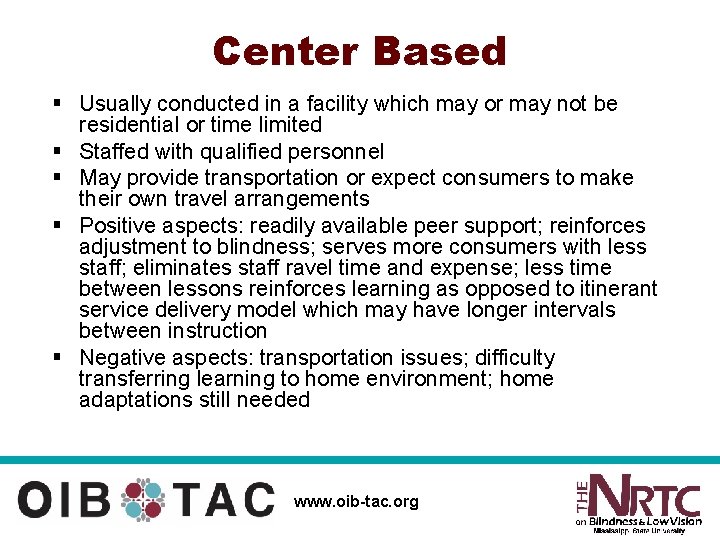
Center Based § Usually conducted in a facility which may or may not be residential or time limited § Staffed with qualified personnel § May provide transportation or expect consumers to make their own travel arrangements § Positive aspects: readily available peer support; reinforces adjustment to blindness; serves more consumers with less staff; eliminates staff ravel time and expense; less time between lessons reinforces learning as opposed to itinerant service delivery model which may have longer intervals between instruction § Negative aspects: transportation issues; difficulty transferring learning to home environment; home adaptations still needed www. oib-tac. org
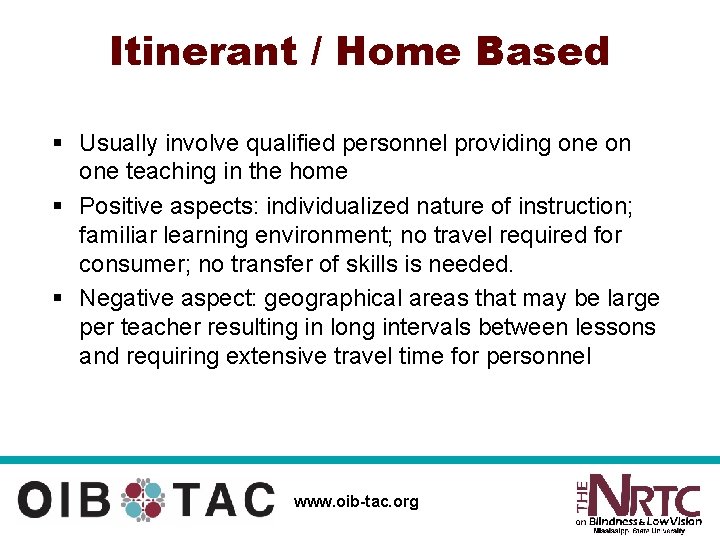
Itinerant / Home Based § Usually involve qualified personnel providing one on one teaching in the home § Positive aspects: individualized nature of instruction; familiar learning environment; no travel required for consumer; no transfer of skills is needed. § Negative aspect: geographical areas that may be large per teacher resulting in long intervals between lessons and requiring extensive travel time for personnel www. oib-tac. org
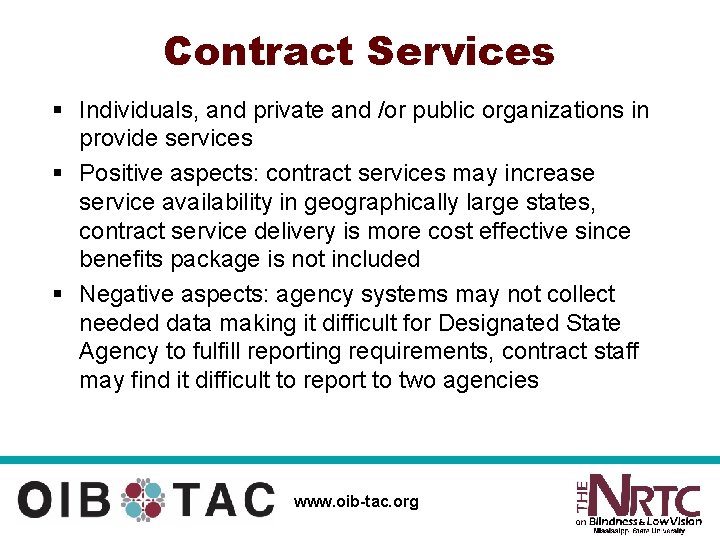
Contract Services § Individuals, and private and /or public organizations in provide services § Positive aspects: contract services may increase service availability in geographically large states, contract service delivery is more cost effective since benefits package is not included § Negative aspects: agency systems may not collect needed data making it difficult for Designated State Agency to fulfill reporting requirements, contract staff may find it difficult to report to two agencies www. oib-tac. org
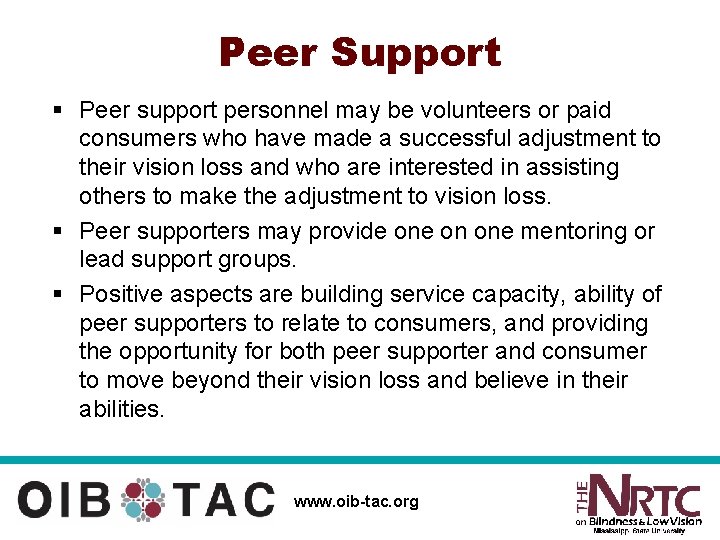
Peer Support § Peer support personnel may be volunteers or paid consumers who have made a successful adjustment to their vision loss and who are interested in assisting others to make the adjustment to vision loss. § Peer supporters may provide on one mentoring or lead support groups. § Positive aspects are building service capacity, ability of peer supporters to relate to consumers, and providing the opportunity for both peer supporter and consumer to move beyond their vision loss and believe in their abilities. www. oib-tac. org
Basic Program Components § All programs should encompass the following components: • Administrative • Direct Service • Evaluation www. oib-tac. org
Administrative § Designated State Agency (DSA) is ultimately responsible for ensuring the program is administered solely by the agency described in their grant submitted for funding. § Program Manager assumes responsibility of statewide coordination of program activities, personnel and fiscal management, and reporting to the DSA and RSA. § Advisory Council facilitates meaningful input for program direction and improvement. www. oib-tac. org
Direct Service § Referrals take in basic demographic data and the referral process should be publicized. § Functional Assessment should be conducted with each consumer by certified personnel to determine functional ability. May be performance based or self report to establish baseline data. Measures should be established to reach mastery of learning objectives. www. oib-tac. org
Direct Service § Each professional discipline should have a functional assessment specific to their discipline. § For a list of topics covered by a VRT, O&M, or LVT assessment, please see the course handouts. www. oib-tac. org
Allowable Services may include the areas in the functional assessment. The law provides for other services such as visual screening, surgical or therapeutic treatment and hospitalization related to eye conditions, provision of eye glasses and other visual aids, and transportation services and any other appropriate service designated to help an older individual who is blind to cope with independent living. The Designated State Agency and the Program Manager will determine which services may be provided. www. oib-tac. org
Measurement of Functional Gains Equally important as baseline data with regard to level of functioning at the beginning of the program is data on level of functioning after instruction is provided. Program Managers should develop a way to measure the progress of the consumer as a result of the instruction or to document regression if health deficits impair the ability to meet goals. This may be a pretest/posttest, goal attainment scale, retrospective reporting or some type of measure to reach mastery of learning objectives. www. oib-tac. org
Closure Activities It is recommended to have a beginning and end to the instructional program with documented results of progress or regression. This information would be invaluable to the individual as well as the Program. The Program should not become solely a place for socialization for the older person who is blind. Staff should ensure the inclusion of consumers in community programs for all individuals and establish peer support groups, etc. to combat the feelings of isolation. www. oib-tac. org
Qualified Personnel § It is recommended that OIB programs hire direct service personnel qualified to sit for certification exam through the Academy for Certification of Rehabilitation and Education Professionals (ACVREP) and/or the National Blindness Professional Certification Board (NCPCB). § Qualified personnel are Certified Vision Rehabilitation Therapists, Certified Orientation & Mobility Specialists, Licensed Occupational Therapists, Certified Assistive Technology Instructional Specialists, and Certified Low Vision Therapists. www. oib-tac. org
Program Manager Qualification Program Managers should have a Bachelor’s degree in any field, combined with a graduate degree in vision studies with a minimum two to five years of experience working in the blind rehabilitation field. www. oib-tac. org
Program Outputs/Outcomes Data collection is the process of gathering and measuring information on targeted variables in an established systematic fashion which then enables one to answer relevant questions and evaluate outcomes. Program Managers should develop a standardized data collection system for all direct service providers whether they are inhouse or contract service workers. If possible, the system should be electronic and fully accessible to in-house and contract staff. Minimum data collection components should include all the federally required elements of the 7 -OB Report. www. oib-tac. org
Quality Assurance Survey At a minimum, some type of quality assurance/consumer satisfaction survey performed a by a third party is advisable to insure that the program is meeting requirements, for program improvement, and to capture the views of consumers on the overall effects of the program on their lives. www. oib-tac. org
Conclusion The older blind program has provided services to tens of thousands of consumers throughout the United States and its territories over the last 30 years. The improvement gained by older people in their independence and quality of life should not be underestimated. www. oib-tac. org
“Losing one’s sight is not the end of one’s existence. One simply needs to learn how to do basic tasks with a few adaptations. Without the assistance of staff and their fine program I would still be in that nursing home. I am grateful to be in my own home again. Yet I wonder how many other elderly people with a vision loss are trapped within the walls of a nursing home when they too could be in their own home living a full and independent life. ” www. oib-tac. org
OIB-TAC is developed by the National Research & Training Center on Blindness and Low Vision (NRTC) at Mississippi State University to provide training and technical assistance to designated state agencies and others serving older individuals who are blind or visually impaired. Funded by the Rehabilitation Services Administration (RSA) under the Department of Education, grant no. H 177 Z 150003 receives project support from the following:
References § Herndon, 1993 § Select Committee on Aging Hearing, Ninety-ninth Congress in 1985 § the Law which was enacted in 1978 § Changes to the Law with the Enactment of WIOA § Prevent Blindness America www. preventblindness. org § CDC www. cdc. gov § White House Conference on Aging 2015, www. afb. org § Academy for Certification of vision Rehabilitation and Education Professionals (ACVREP) www. acvrep. org § National Blindness Professional Certification Board (NBPCB) www. nbpcb. orgg www. oib-tac. org
For more information, please contact: OIB-TAC: www. oib-tac. org NRTC: blind. msstate. edu ntac. blind. msstate. edu www. facebook. com/msu. nrtc www. twitter. com/msu_nrtc P. O. Box 6189 Room 150, Industrial Ed Bldg 108 Herbert – South Mississippi State, MS 39762 P. 662. 325. 2001 F. 662. 325. 8989
Take the Online Quiz § To take the online quiz associated with this course, click the “Take Our Online Quiz” button on the course page, or follow this link, https: //www. classmarker. com/onlinetest/start/? quiz=agm 590 b 82 b 07 fb 66. www. oib-tac. org