
Introduction to the HLLHC Circuits and Report from

- Slides: 31
Introduction to the HL-LHC Circuits and Report from Previous Review Felix Rodriguez Mateos logo area International Review of HL-LHC Magnet Circuits, 9 th - 10 th September 2019
Outline § Introduction to the HL-LHC Circuits § Hollow Electron Lenses’ Circuits - brief description § Follow up of the Internal Review in March 2017 § The Magnet Circuit Forum § Structure of the Review logo area Felix Rodriguez Mateos 2
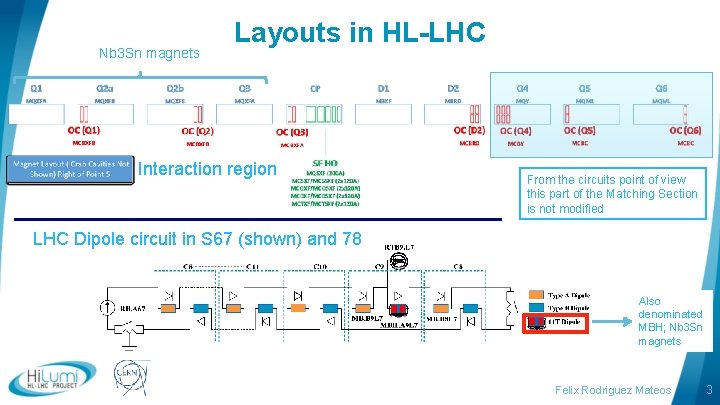
Nb 3 Sn magnets Layouts in HL-LHC Interaction region From the circuits point of view this part of the Matching Section is not modified LHC Dipole circuit in S 67 (shown) and 78 Also denominated MBH; Nb 3 Sn magnets logo area Felix Rodriguez Mateos 3
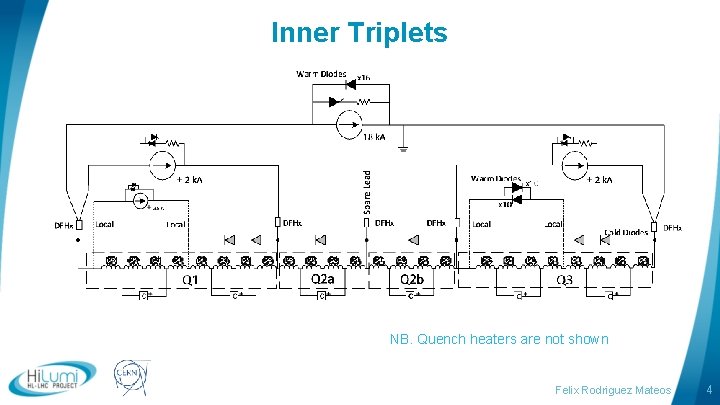
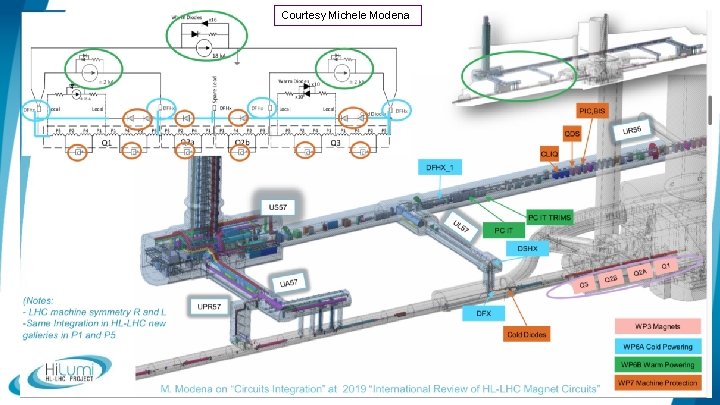
Inner Triplets NB. Quench heaters are not shown logo area Felix Rodriguez Mateos 4
Inner Triplets logo area Felix Rodriguez Mateos 5
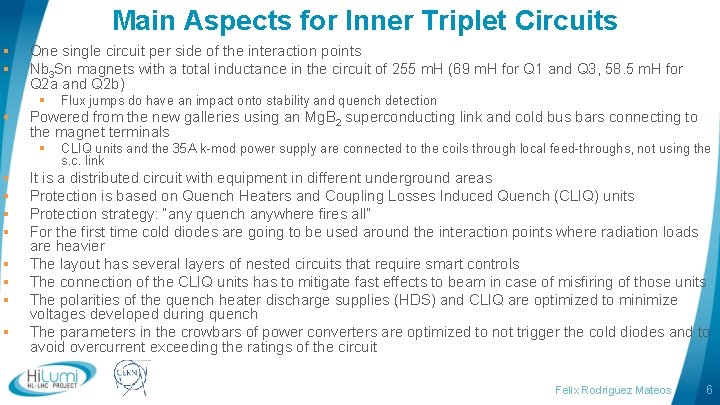
Main Aspects for Inner Triplet Circuits § § One single circuit per side of the interaction points Nb 3 Sn magnets with a total inductance in the circuit of 255 m. H (69 m. H for Q 1 and Q 3, 58. 5 m. H for Q 2 a and Q 2 b) § § Powered from the new galleries using an Mg. B 2 superconducting link and cold bus bars connecting to the magnet terminals § § § § § Flux jumps do have an impact onto stability and quench detection CLIQ units and the 35 A k-mod power supply are connected to the coils through local feed-throughs, not using the s. c. link It is a distributed circuit with equipment in different underground areas Protection is based on Quench Heaters and Coupling Losses Induced Quench (CLIQ) units Protection strategy: “any quench anywhere fires all” For the first time cold diodes are going to be used around the interaction points where radiation loads are heavier The layout has several layers of nested circuits that require smart controls The connection of the CLIQ units has to mitigate fast effects to beam in case of misfiring of those units The polarities of the quench heater discharge supplies (HDS) and CLIQ are optimized to minimize voltages developed during quench The parameters in the crowbars of power converters are optimized to not trigger the cold diodes and to avoid overcurrent exceeding the ratings of the circuit logo area Felix Rodriguez Mateos 6
Courtesy Michele Modena logo area Felix Rodriguez Mateos 7
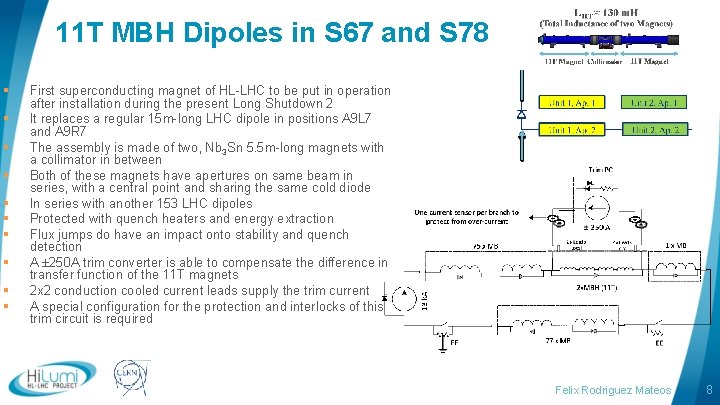
11 T MBH Dipoles in S 67 and S 78 § § § § § First superconducting magnet of HL-LHC to be put in operation after installation during the present Long Shutdown 2 It replaces a regular 15 m-long LHC dipole in positions A 9 L 7 and A 9 R 7 The assembly is made of two, Nb 3 Sn 5. 5 m-long magnets with a collimator in between Both of these magnets have apertures on same beam in series, with a central point and sharing the same cold diode In series with another 153 LHC dipoles Protected with quench heaters and energy extraction Flux jumps do have an impact onto stability and quench detection A ± 250 A trim converter is able to compensate the difference in transfer function of the 11 T magnets 2 x 2 conduction cooled current leads supply the trim current A special configuration for the protection and interlocks of this trim circuit is required logo area Felix Rodriguez Mateos 8
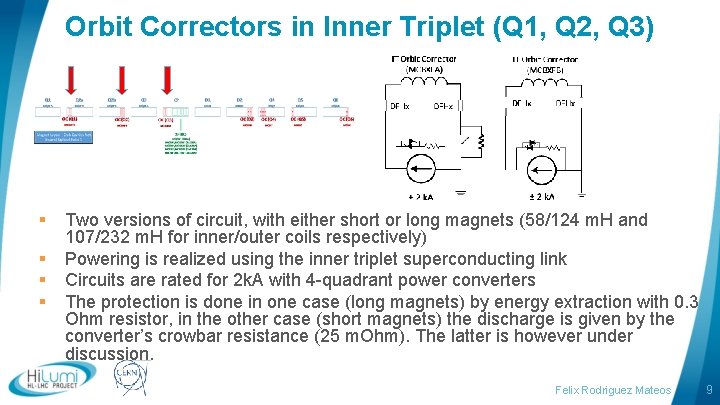
Orbit Correctors in Inner Triplet (Q 1, Q 2, Q 3) § § Two versions of circuit, with either short or long magnets (58/124 m. H and 107/232 m. H for inner/outer coils respectively) Powering is realized using the inner triplet superconducting link Circuits are rated for 2 k. A with 4 -quadrant power converters The protection is done in one case (long magnets) by energy extraction with 0. 3 Ohm resistor, in the other case (short magnets) the discharge is given by the converter’s crowbar resistance (25 m. Ohm). The latter is however under discussion. logo area Felix Rodriguez Mateos 9
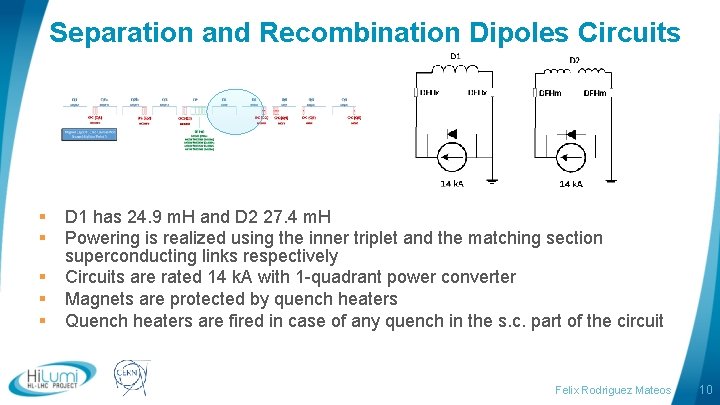
Separation and Recombination Dipoles Circuits § § § D 1 has 24. 9 m. H and D 2 27. 4 m. H Powering is realized using the inner triplet and the matching section superconducting links respectively Circuits are rated 14 k. A with 1 -quadrant power converter Magnets are protected by quench heaters Quench heaters are fired in case of any quench in the s. c. part of the circuit logo area Felix Rodriguez Mateos 10
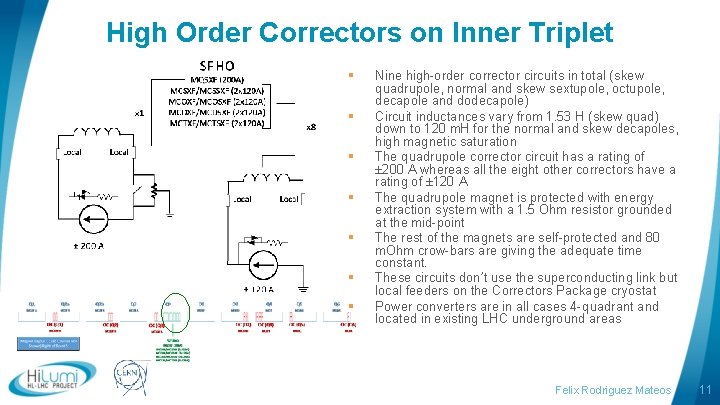
High Order Correctors on Inner Triplet § § § § logo area Nine high-order corrector circuits in total (skew quadrupole, normal and skew sextupole, octupole, decapole and dodecapole) Circuit inductances vary from 1. 53 H (skew quad) down to 120 m. H for the normal and skew decapoles, high magnetic saturation The quadrupole corrector circuit has a rating of ± 200 A whereas all the eight other correctors have a rating of ± 120 A The quadrupole magnet is protected with energy extraction system with a 1. 5 Ohm resistor grounded at the mid-point The rest of the magnets are self-protected and 80 m. Ohm crow-bars are giving the adequate time constant. These circuits don’t use the superconducting link but local feeders on the Correctors Package cryostat Power converters are in all cases 4 -quadrant and located in existing LHC underground areas Felix Rodriguez Mateos 11
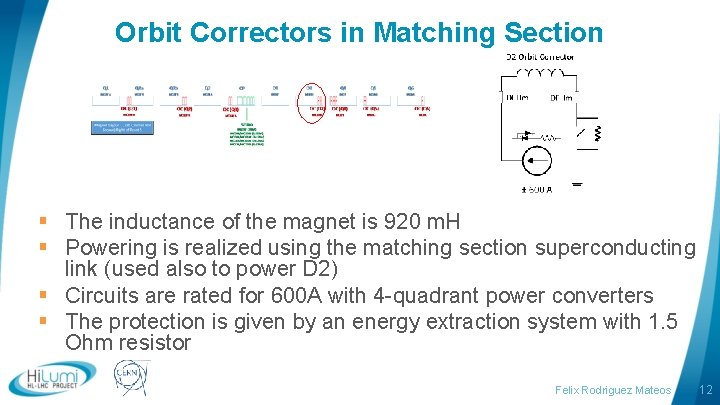
Orbit Correctors in Matching Section § The inductance of the magnet is 920 m. H § Powering is realized using the matching section superconducting link (used also to power D 2) § Circuits are rated for 600 A with 4 -quadrant power converters § The protection is given by an energy extraction system with 1. 5 Ohm resistor logo area Felix Rodriguez Mateos 12
Q 10 … for completeness § The orbit correctors in Q 10 of interaction points 1 and 5 will be changed from 120 A to 60 A (LHC versions) § There will be two new 600 A lattice sextupoles in series with the rest of the arc families (D and F) logo area Felix Rodriguez Mateos 13
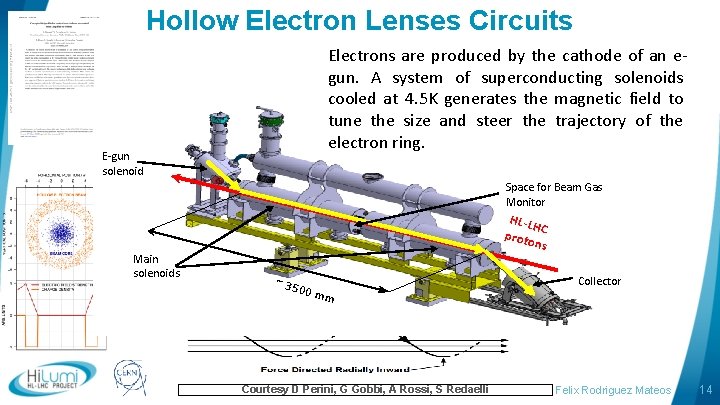
Hollow Electron Lenses Circuits n tro ec El ng ri Electrons are produced by the cathode of an egun. A system of superconducting solenoids cooled at 4. 5 K generates the magnetic field to tune the size and steer the trajectory of the electron ring. E-gun solenoid Space for Beam Gas Monitor Main solenoids HL-L H prot C ons ~ 350 0 mm logo area Courtesy D Perini, G Gobbi, A Rossi, S Redaelli Collector Felix Rodriguez Mateos 14
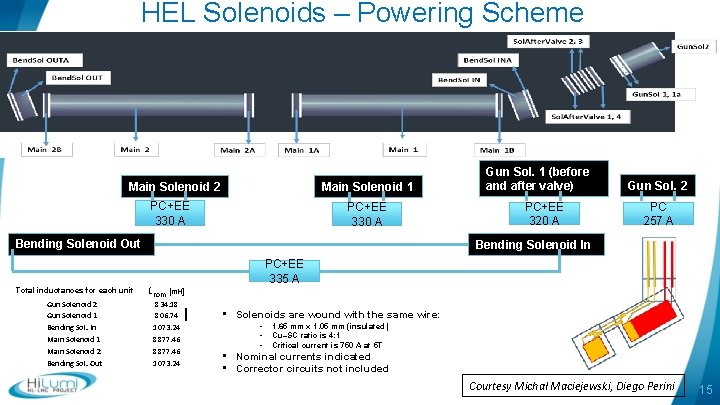
HEL Solenoids – Powering Scheme Main Solenoid 2 Main Solenoid 1 PC+EE 330 A Bending Solenoid Out Gun Sol. 1 (before and after valve) PC+EE 320 A Gun Sol. 2 PC 257 A Bending Solenoid In Total inductances for each unit Lnom [m. H] Gun Solenoid 2 Gun Solenoid 1 Bending Sol. In Main Solenoid 1 Main Solenoid 2 Bending Sol. Out 834. 18 806. 74 1073. 24 8877. 46 1073. 24 PC+EE 335 A • Solenoids are wound with the same wire: • • • 1. 65 mm x 1. 05 mm (insulated) Cu–SC ratio is 4: 1 Critical current is 750 A at 5 T • Nominal currents indicated • Corrector circuits not included Courtesy Michał Maciejewski, Diego Perini 15
The HL-LHC Circuits Internal Review took place at CERN on March 17 th 2017 Review Panel § § § § Lucio Rossi (Chair) Luca Bottura Rudiger Schmidt Andrzej Siemko Thomas Taylor Davide Tommasini Akira Yamamoto § Scientific Secretary: Felix Rodriguez Mateos logo area https: //indico. cern. ch/event/611018/ Felix Rodriguez Mateos 16
Background for the last (Internal) Review § § After months of common work together with the relevant work packages at the Magnet Circuit Forum (MCF, first meeting July 2016, 15 meetings until then, plus several other topical meetings), some points remained open at a conceptual level by the end of 2016. It was considered as required to call for an Internal Review at CERN in order to get advice on how to close those open points and take appropriate decisions. The review was hence organized in a focused way (clear questions were asked that speakers should try to document and close with the help of the Panel) The Review remained at a conceptual level as technical developments of hardware were going to have proper review processes on their side Felix Rodriguez Mateos 17
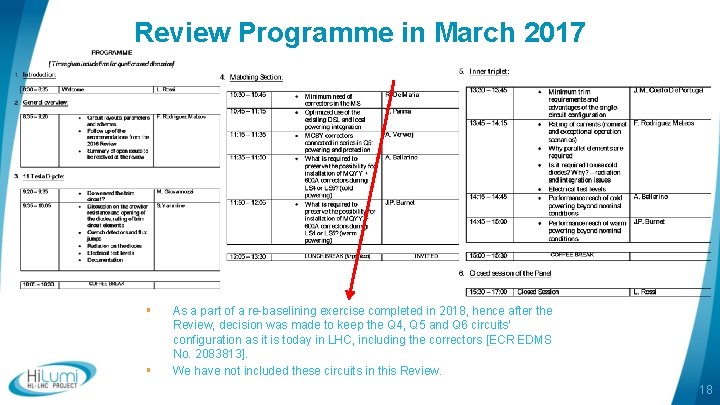
Review Programme in March 2017 § § As a part of a re-baselining exercise completed in 2018, hence after the Review, decision was made to keep the Q 4, Q 5 and Q 6 circuits’ configuration as it is today in LHC, including the correctors [ECR EDMS No. 2083813]. We have not included these circuits in this Review. 18
Follow up of recommendations on 11 T Dipole (1/2) • Panel recommends to keep the trim PC, it provides a viable complement to the use of the orbit correctors, reducing their load and adding a degree of redundancy • The trim PC is part of the baseline; studies have been completed which led to decisions with respect to interlocks that will be presented during this Review • A high trim crowbar resistance is required; 250 A to be taken as a nominal design value for the trim current leads • Initially it was thought that a high resistance crowbar would be needed, but detailed studies came to the conclusion that the definition of the resistance is a trade off between limiting the currents in the circuit and not opening the cold diode of the magnet. • The panel remarks that the impact of the trim PC on the QDS in case of powering abort on the 11 T and neighbouring MB magnets must be further investigated by simulations and if possible by tests in SM 18 • Studies have been done at the simulation level and with tests in SM 18 (on an LHC dipole with a diode), proving that the design is sound Felix Rodriguez Mateos 19
Follow up of recommendations on 11 T Dipole (2/2) • The panel recommends to qualify the current leads by applying the same criteria for the voltage withstand levels as it is done with the similar elements in the circuit. • Tests on prototype current leads for the trim circuit have undergone tests at warm well above the required levels • The panel endorses the fact that the trim power converter and the warm circuit should follow the 2 x (Worst Case Voltage) + 500 V design rule (2 x Full Energy Extraction Voltage + 500 V, therefore around 2. 3 k. V) • The decision is to qualify the power converter and the warm part of the circuit to 1. 3 k. V. This is found to be sufficient due to the fact that the maximum voltage seen by the warm part of the circuit to ground is ½ of the full extraction voltage at nominal current (i. e. 415 V). Therefore with the 1. 3 k. V the criteria above is respected. Felix Rodriguez Mateos 20
Follow up of recommendations on Inner Triplet (1/3) • The panel considers that the presented powering circuit is a robust solution, provided the 2 k. A and 120 A SC trim cables in the superconducting link can be upgraded to a rating of about 5 -6 k. A and 5 MIITs • This has been done and is part of the baseline for the cold powering equipment. • The panel recommends the removal of the Q 2 a 120 A trim power converter from the baseline. The need for local K-modulation will, however, require an additional small trim of about 30 A for Q 1 • Removal of Q 2 a trim has been endorsed by the Project. The same as for the design of the 35 A k-modulation circuit. Both are part of an Eng. Change Request (ECR) on the complete inner triplet circuit that has been presented to the Technical Committee. • The panel is strongly in favour of the crowbar of 30 V proposed (possibly 50 V) for the main power converter that reduces the current ramp down time from 1750 s to less than 500 s • The difficulties to bring the voltage to a value larger than 10 V are due to technological limits and the margin to deal with transients. The baseline today is to stay at 10 V. An agreement within the Circuit Forum has been found. Included in ECR. Felix Rodriguez Mateos 21
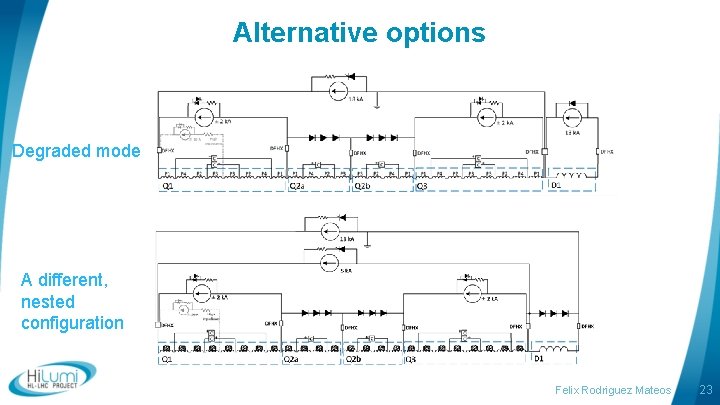
Follow up of recommendations on Inner Triplet (2/3) • The panel recommends continuing studies on a possible further optimization for the circuit operation. An example is the introduction of cold diodes. The panel recommends to develop and test diodes capable of conducting up to 18 k. A and which are qualified for the expected radiation levels and liquid helium operation • Cold diodes are today part of the baseline. Important results were obtained as to qualify diodes which were specially developed for the purpose, under the dose and neutron fluence expected at their final position. • Another alternative is to connect the D 1 magnet to the IT main circuit. A study should be done on the application of this topology as a mitigation during machine operation in case of failure of 1 of the 18 k. A conductors • Study was done. It is feasible but certainly complicated. The two different circuits would share the same ground. Any problem on one circuit impacts the next one. Difficult for diagnostics. Difficult connections of water cooled cables. • Finally, a scheme for powering the IT and D 1 with a single 13 k. A PC, supplemented with a nested 5 k. A PC, was also briefly discussed. • A basic analysis was done by WP 6 b. The coupling between circuits complicates the regulation and controls. Very difficult to reach precision with a 4 -layer nested configuration. Felix Rodriguez Mateos 22
Alternative options Degraded mode A different, nested configuration Felix Rodriguez Mateos 23
Follow up of recommendations on Inner Triplet (3/3) • Changes are required to the present link cable cross-section. In the discussion, a few members of the panel suggested to reconsider the need for spare 18 k. A cables within the link. This suggestion may mitigate possible issues (if any) due to the increase of size of the trim cable within the link envelope • The baseline for the s. c. link does not include any spare 18 k. A conductor • The panel agrees that one can be confident in the simulations, but experience with magnet testing is sparse, making it difficult to benchmark. The team is therefore encouraged to complete the optimization over the next few months, integrating information from magnet testing. The panel reiterates the importance of the string test for comprehensive validation. • Teams working on simulations and testing magnets do work together, exchanging information. String is on the baseline. • The panel recommends that WP 3 devote appropriate attention to the design and integration of the busbars in the inner triplet circuits and the cables and feedthroughs for CLIQ. Special attention should be devoted to design and implementation of interconnects and splices • Today feedthroughs, feeders, bus bars, etc receive the required attention, and are common subjects of discussion in between work packages. Design effort on-going. • The panel recommends that a technically competent CERN staffer be designated to take full responsibility for the required studies, including benchmarking • Done Felix Rodriguez Mateos 24
Additional recommendation • For the purpose of El. QA activities, there is a request that switches or similar quick disconnect equipment (separators) be installed between the power converters and the current leads, to facilitate the relevant high voltage testing at the end of shutdowns. Such equipment is quite cumbersome, especially for the 13 and 18 k. A circuits, and it would be inconvenient to install it directly at the current lead or power converter terminals of the warm bus-bars/cables joining the two. They will therefore have to be located somewhere in between (preferably close to the current leads due to leakage current limitations to preserve the sensitivity of the El. QA measurements), and space allocated for their installation. • The HL-LHC Project has agreed to include the disconnectors provided that some budget reduction is applied. WP 6 b (Warm Powering) in collaboration with WP 15 (Integration) and Cold powering (WP 6 a) have initiated since a while the studies to do so. It is widely accepted today that the added value of the disconnectors in terms of safety is high. They also help in the manoeuvres of connecting/disconnecting the superconducting parts of the circuit from converters and cables for insulation verifications at relatively high voltage. Felix Rodriguez Mateos 25
The Mandate to the MCF Magnet Circuit Forum One of the recommendations of the March 2016 review on HL-LHC Magnet Circuits was: “… to realize close and regular interaction (communication) between the involved experts and workpackages. This could be possibly done by setting-up of a dedicated working group or by using existing structures to discuss circuit integration and protection on a regular basis and to identify the optimum scheme for each magnet circuit system. ” Mandate § § § § The Magnet Circuit Forum (MCF) is the meeting where all aspects related to powering and protection of the HL-LHC circuits are discussed, in particular the ones pertaining to the optimization of circuit layouts and definition of protection means. Subjects in the agenda are defined in close collaboration with the relevant WPs. Interface aspects between systems are clarified through meetings at the forum. To this end, a documentation plan has to be developed and completed. The aim is to prepare a set of functional interface specifications that can be used as input for the design (technical specifications) of the different systems. Assessment on realistic failure scenarios and required mitigation strategies on a global basis is part of the activities of the MCF. The MCF is the meeting where aspects related to high voltage withstand levels are discussed and harmonized. The MCF reports regularly to TCC and takes up any relevant discussion within the domain of cold/warm powering and protection of the HL-LHC circuits in logo collaboration with the relevant WPs. area Felix Rodriguez Mateos 26
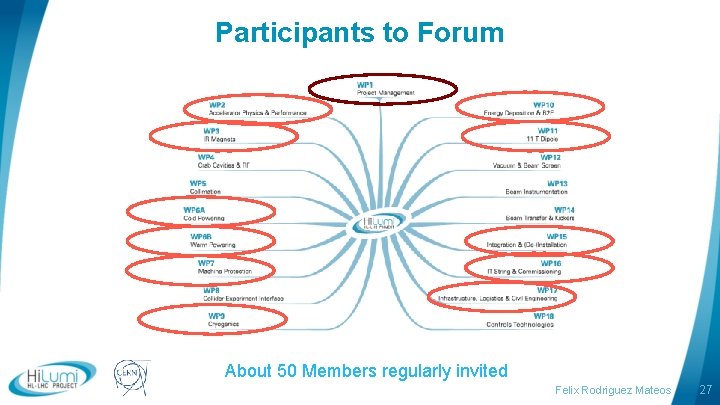
Participants to Forum logo area About 50 Members regularly invited Felix Rodriguez Mateos 27
Activities and Topics of the Forum § MCF has the responsibility to keep up to date the circuit configurations and parameters. This is done through updates of the Circuit Table and the electrical schemes (see MCF Sharepoint) § So far 54 meetings, properly documented with minutes, list of actions, etc § MCF is also organizing topical meetings with reduced attendance, 27 meetings have taken place so far § The Forum has taken the lead in the preparation of some Engineering Change Requests related to circuit aspects § More information in S. Yammine’s presentation tomorrow on Document Plan and Change Management logo area Felix Rodriguez Mateos 28
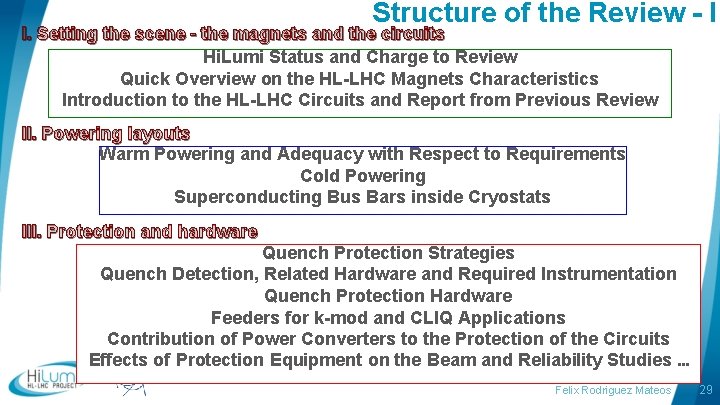
Structure of the Review - I I. Setting the scene – the magnets and the circuits Hi. Lumi Status and Charge to Review Quick Overview on the HL-LHC Magnets Characteristics Introduction to the HL-LHC Circuits and Report from Previous Review II. Powering layouts Warm Powering and Adequacy with Respect to Requirements Cold Powering Superconducting Bus Bars inside Cryostats III. Protection and hardware Quench Protection Strategies Quench Detection, Related Hardware and Required Instrumentation Quench Protection Hardware Feeders for k-mod and CLIQ Applications Contribution of Power Converters to the Protection of the Circuits Effects of Protection Equipment on the Beam and Reliability Studies … logo area Felix Rodriguez Mateos 29
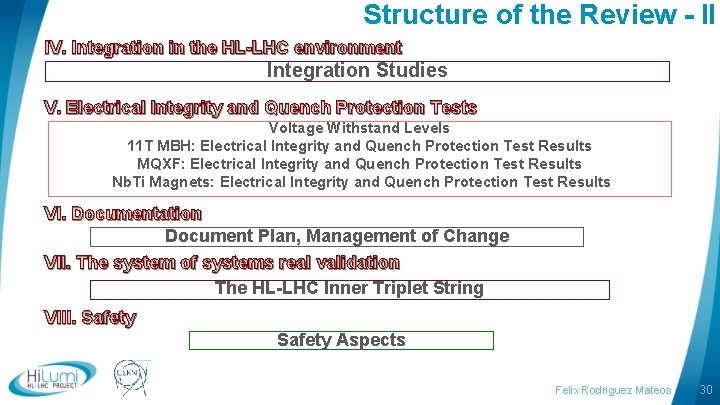
Structure of the Review - II IV. Integration in the HL-LHC environment Integration Studies V. Electrical Integrity and Quench Protection Tests Voltage Withstand Levels 11 T MBH: Electrical Integrity and Quench Protection Test Results MQXF: Electrical Integrity and Quench Protection Test Results Nb. Ti Magnets: Electrical Integrity and Quench Protection Test Results VI. Documentation Document Plan, Management of Change VII. The system of systems real validation The HL-LHC Inner Triplet String VIII. Safety Aspects logo area Felix Rodriguez Mateos 30
Many thanks, enjoy the Review logo area Felix Rodriguez Mateos 31