
Introduction to the Guidelines for Uniform Performance Standards
- Slides: 24
Introduction to the Guidelines for Uniform Performance Standards and Evaluation Criteria for Teachers May 2011 0
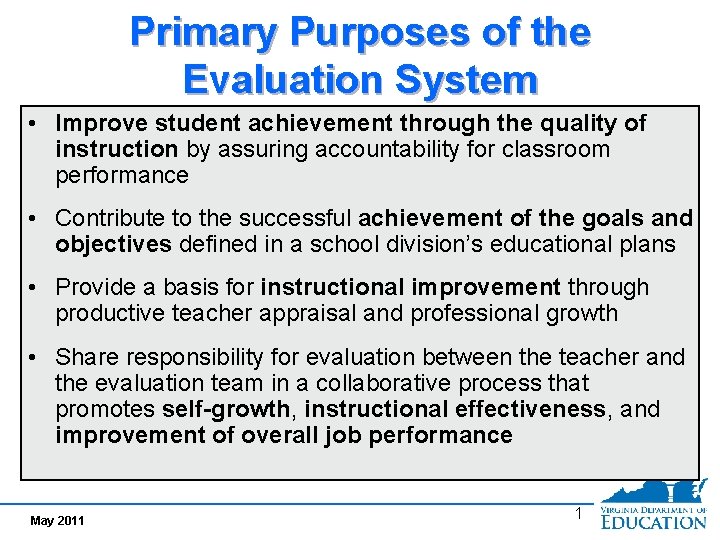
Primary Purposes of the Evaluation System • Improve student achievement through the quality of instruction by assuring accountability for classroom performance • Contribute to the successful achievement of the goals and objectives defined in a school division’s educational plans • Provide a basis for instructional improvement through productive teacher appraisal and professional growth • Share responsibility for evaluation between the teacher and the evaluation team in a collaborative process that promotes self-growth, instructional effectiveness, and improvement of overall job performance May 2011 1
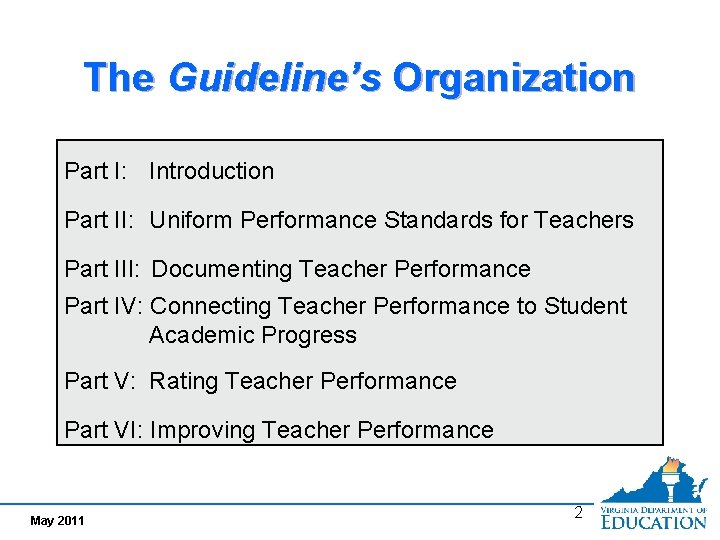
The Guideline’s Organization Part I: Introduction Part II: Uniform Performance Standards for Teachers Part III: Documenting Teacher Performance Part IV: Connecting Teacher Performance to Student Academic Progress Part V: Rating Teacher Performance Part VI: Improving Teacher Performance May 2011 2
Question 1 What is the basis of the teachers’ evaluation? May 2011 3
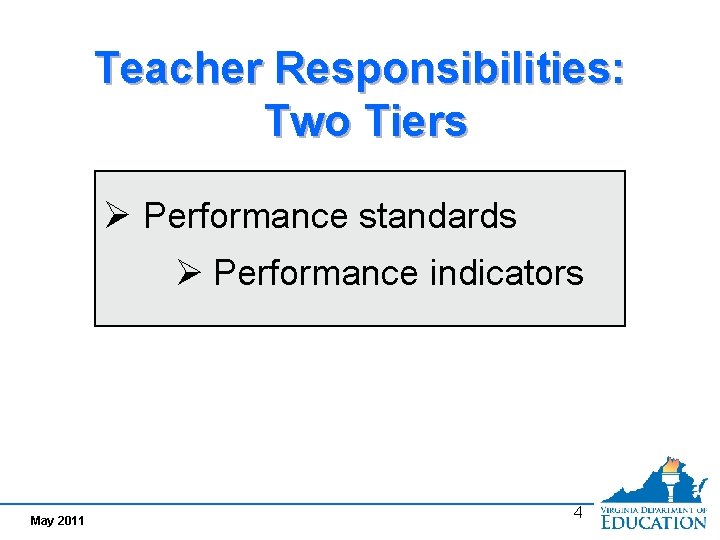
Teacher Responsibilities: Two Tiers Ø Performance standards Ø Performance indicators May 2011 4
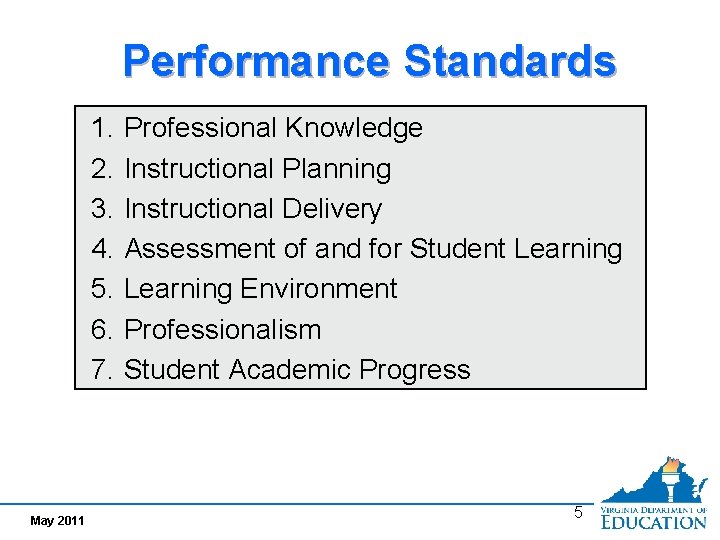
Performance Standards 1. 2. 3. 4. 5. 6. 7. May 2011 Professional Knowledge Instructional Planning Instructional Delivery Assessment of and for Student Learning Environment Professionalism Student Academic Progress 5
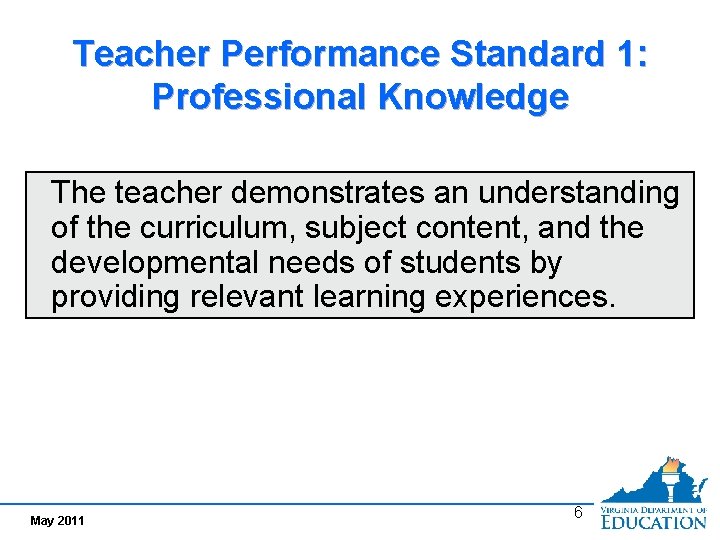
Teacher Performance Standard 1: Professional Knowledge The teacher demonstrates an understanding of the curriculum, subject content, and the developmental needs of students by providing relevant learning experiences. May 2011 6
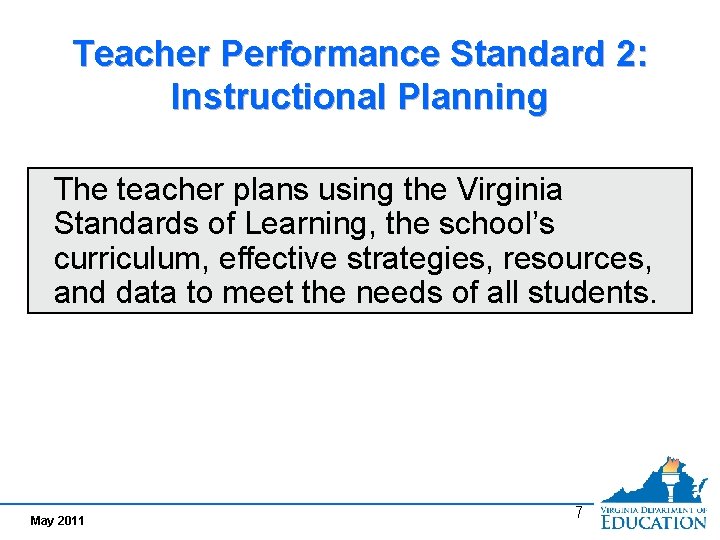
Teacher Performance Standard 2: Instructional Planning The teacher plans using the Virginia Standards of Learning, the school’s curriculum, effective strategies, resources, and data to meet the needs of all students. May 2011 7
Teacher Performance Standard 3: Instructional Delivery The teacher effectively engages students in learning by using a variety of instructional strategies in order to meet individual learning needs. May 2011 8
Teacher Performance Standard 4: Assessment of and for Student Learning The teacher systematically gathers, analyzes, and uses all relevant data to measure student academic progress, guide instructional content and delivery methods, and provide timely feedback to both students and parents throughout the school year. May 2011 9
Teacher Performance Standard 5: Learning Environment The teacher uses resources, routines, and procedures to provide a respectful, positive, safe, student-centered environment that is conducive to learning. May 2011 10
Teacher Performance Standard 6: Professionalism The teacher maintains a commitment to professional ethics, communicates effectively, and takes responsibility for and participates in professional growth that results in enhanced student learning. May 2011 11
Teacher Performance Standard 7: Student Academic Progress The work of the teacher results in acceptable, measurable, and appropriate student academic progress. May 2011 12
Performance Indicators Examples for Standard 7: Student Academic Progress § Sets acceptable, measurable, and appropriate achievement goals for student learning progress based on baseline data. § Documents the progress of each student throughout the year. § Provides evidence that achievement goals have been met, including the state-provided growth measure when available as well as other multiple measures of student growth. § Uses available performance outcome data to continually document and communicate student academic progress and develop interim learning targets. Note: Only Samples! May 2011 13
Question 2 How will teacher performance be documented? May 2011 14
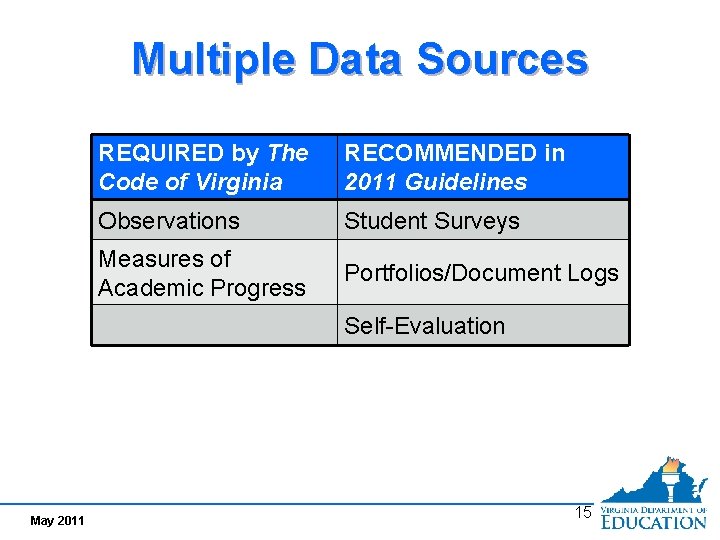
Multiple Data Sources REQUIRED by The Code of Virginia RECOMMENDED in 2011 Guidelines Observations Student Surveys Measures of Academic Progress Portfolios/Document Logs Self-Evaluation May 2011 15
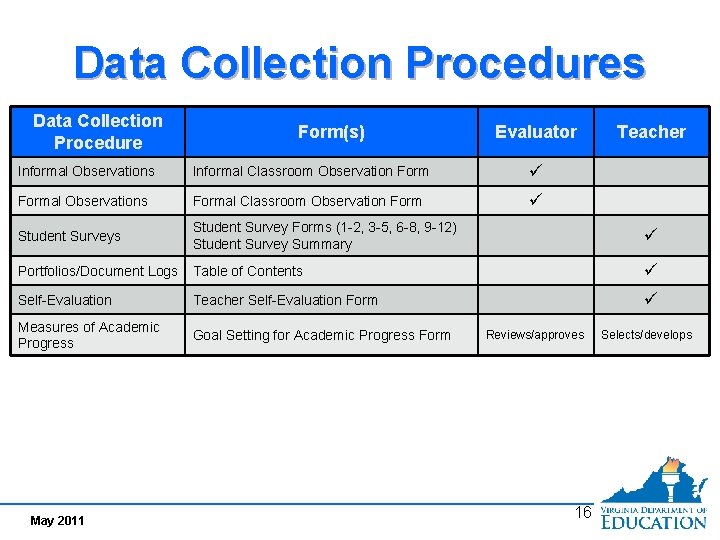
Data Collection Procedures Data Collection Procedure Form(s) Evaluator Teacher Informal Observations Informal Classroom Observation Formal Observations Formal Classroom Observation Form Student Surveys Student Survey Forms (1 -2, 3 -5, 6 -8, 9 -12) Student Survey Summary Portfolios/Document Logs Table of Contents Self-Evaluation Teacher Self-Evaluation Form Measures of Academic Progress Goal Setting for Academic Progress Form May 2011 Reviews/approves 16 Selects/develops
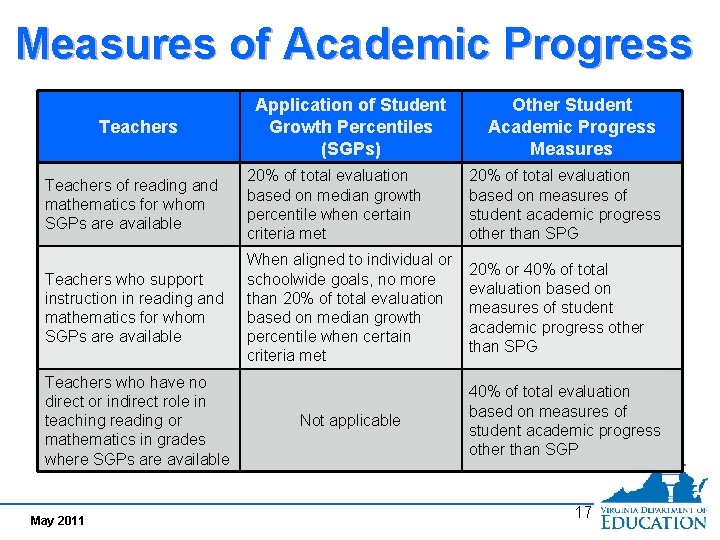
Measures of Academic Progress Teachers Application of Student Growth Percentiles (SGPs) Other Student Academic Progress Measures Teachers of reading and mathematics for whom SGPs are available 20% of total evaluation based on median growth percentile when certain criteria met 20% of total evaluation based on measures of student academic progress other than SPG Teachers who support instruction in reading and mathematics for whom SGPs are available When aligned to individual or schoolwide goals, no more than 20% of total evaluation based on median growth percentile when certain criteria met 20% or 40% of total evaluation based on measures of student academic progress other than SPG Teachers who have no direct or indirect role in teaching reading or mathematics in grades where SGPs are available May 2011 Not applicable 40% of total evaluation based on measures of student academic progress other than SGP 17
Question 3 How will teacher performance be rated? May 2011 18
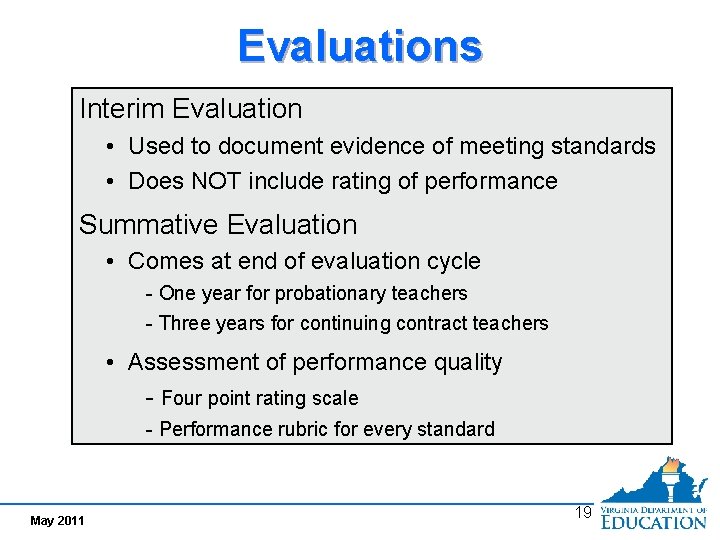
Evaluations Interim Evaluation • Used to document evidence of meeting standards • Does NOT include rating of performance Summative Evaluation • Comes at end of evaluation cycle - One year for probationary teachers - Three years for continuing contract teachers • Assessment of performance quality - Four point rating scale - Performance rubric for every standard May 2011 19
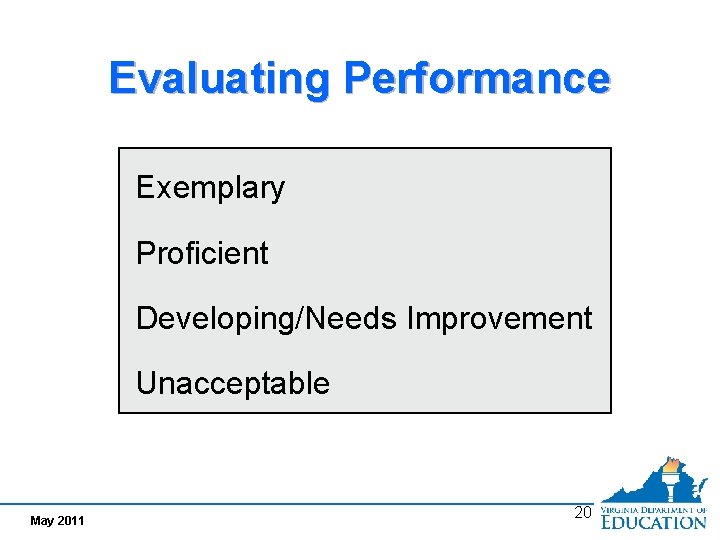
Evaluating Performance Exemplary Proficient Developing/Needs Improvement Unacceptable May 2011 20
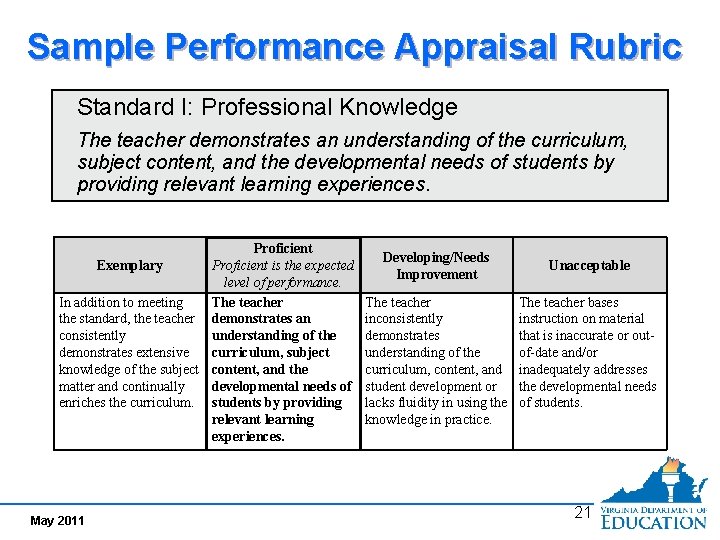
Sample Performance Appraisal Rubric Standard I: Professional Knowledge The teacher demonstrates an understanding of the curriculum, subject content, and the developmental needs of students by providing relevant learning experiences. Proficient is the expected Exemplary level of performance. In addition to meeting The teacher the standard, the teacher demonstrates an consistently understanding of the demonstrates extensive curriculum, subject knowledge of the subject content, and the matter and continually developmental needs of enriches the curriculum. students by providing relevant learning experiences. May 2011 Developing/Needs Improvement The teacher inconsistently demonstrates understanding of the curriculum, content, and student development or lacks fluidity in using the knowledge in practice. Unacceptable The teacher bases instruction on material that is inaccurate or outof-date and/or inadequately addresses the developmental needs of students. 21
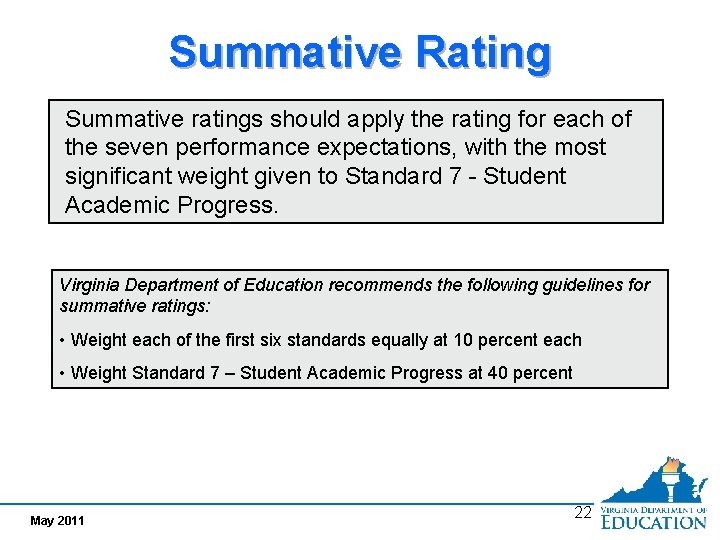
Summative Rating Summative ratings should apply the rating for each of the seven performance expectations, with the most significant weight given to Standard 7 - Student Academic Progress. Virginia Department of Education recommends the following guidelines for summative ratings: • Weight each of the first six standards equally at 10 percent each • Weight Standard 7 – Student Academic Progress at 40 percent May 2011 22
Improving Performance Outstanding Teachers = Student Results May 2011 23