
Introduction to the GTL Mentoring and Induction Toolkit
![Introduction to the GTL Mentoring and Induction Toolkit [Facilitator] [Date] Copyright © 2018 American](https://slidetodoc.com/presentation_image_h2/f66e0187f1be405a0817aec11805e142/image-1.jpg "Introduction to the GTL Mentoring and Induction Toolkit [Facilitator] [Date] Copyright © 2018 American")

- Slides: 42
Introduction to the GTL Mentoring and Induction Toolkit [Facilitator] [Date] Copyright © 2018 American Institutes for Research. All rights reserved.
Mission The mission of the Center on Great Teachers and Leaders (GTL Center) is to foster the capacity of vibrant networks of practitioners, researchers, innovators, and experts to build and sustain a seamless system of support for great teachers and leaders for every school in every state in the nation. 2
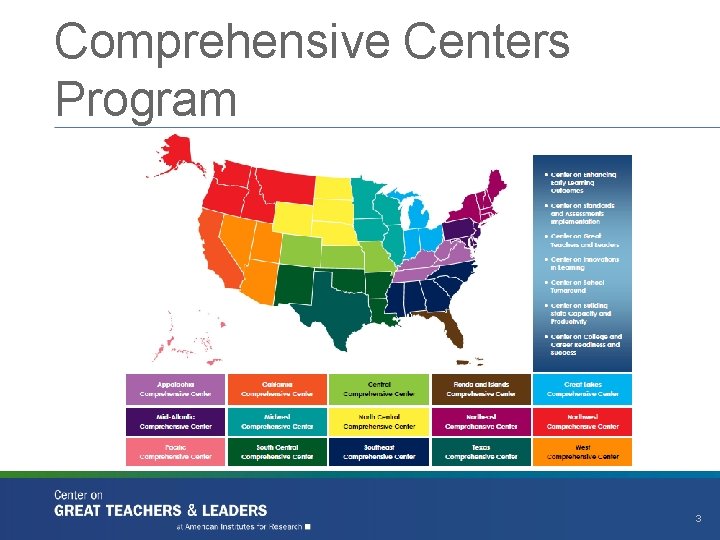
Comprehensive Centers Program 3
Mentoring and Induction Toolkit § The purpose of the GTL Center’s Mentoring and Induction Toolkit is to give regional comprehensive centers (RCCs) and state education agencies (SEAs) tools, resources, and support to facilitate meaningful conversations with local education agencies (LEAs) to design and implement effective, high-quality mentoring and induction programs. 4
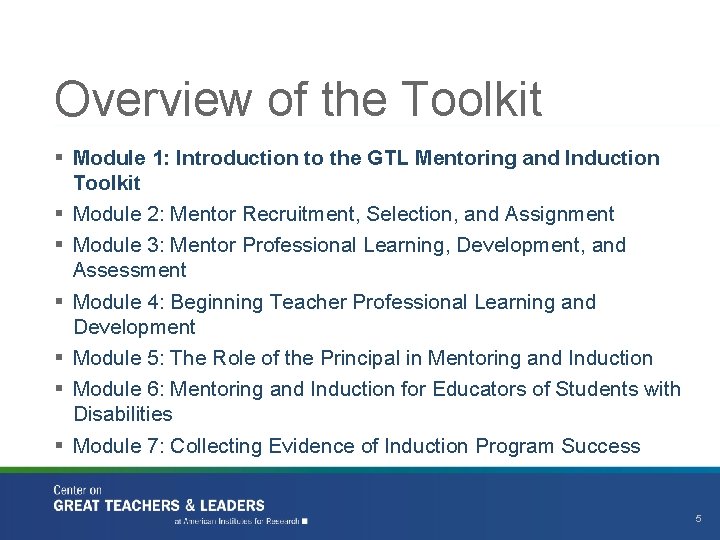
Overview of the Toolkit § Module 1: Introduction to the GTL Mentoring and Induction Toolkit § Module 2: Mentor Recruitment, Selection, and Assignment § Module 3: Mentor Professional Learning, Development, and Assessment § Module 4: Beginning Teacher Professional Learning and Development § Module 5: The Role of the Principal in Mentoring and Induction § Module 6: Mentoring and Induction for Educators of Students with Disabilities § Module 7: Collecting Evidence of Induction Program Success 5
Module Components § Anchor Presentation: Summarizes research and best practices related to the topic. § Handouts: Provide information to supplement the anchor presentation. § Team Tools: Help teams plan, design, and implement the components of a comprehensive mentoring and induction program. 6
Access to Toolkit Materials § Anchor presentations, handouts, and team tools are available on the GTL Center website. § RCC and SEA personnel may request consultation from GTL experts to learn more about customizing the toolkit materials. 7
Module 1 Objectives Participants will: § Build a shared understanding of the definition and critical features of a comprehensive mentoring and induction program. § Identify GTL Center tools that can help teams design and implement a comprehensive system of mentoring and induction supports. 8
What is Induction? § Induction is a system of coordinated and aligned supports designed to provide new educators with a supportive pathway into the profession. 9
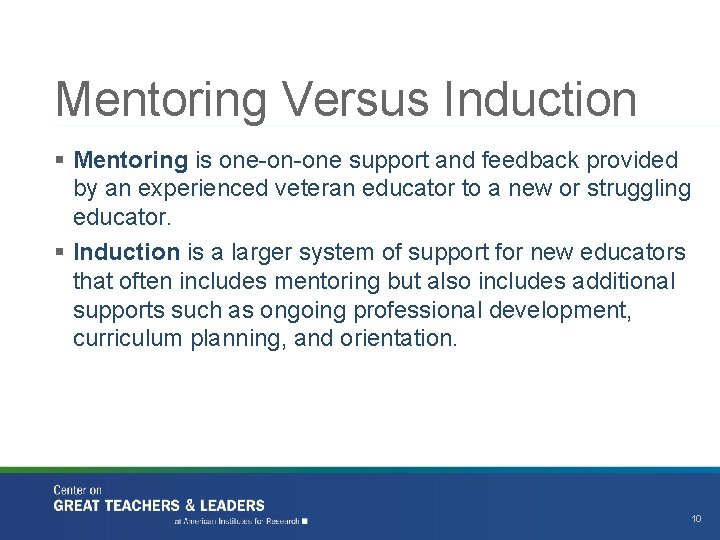
Mentoring Versus Induction § Mentoring is one-on-one support and feedback provided by an experienced veteran educator to a new or struggling educator. § Induction is a larger system of support for new educators that often includes mentoring but also includes additional supports such as ongoing professional development, curriculum planning, and orientation. 10
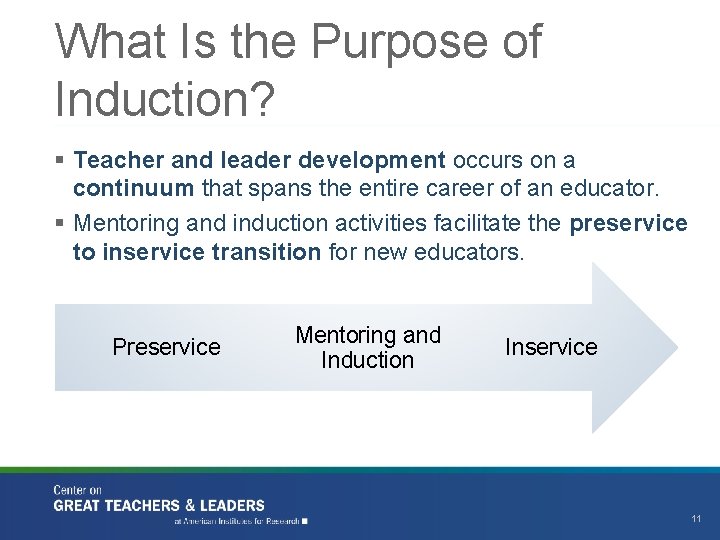
What Is the Purpose of Induction? § Teacher and leader development occurs on a continuum that spans the entire career of an educator. § Mentoring and induction activities facilitate the preservice to inservice transition for new educators. Preservice Mentoring and Induction Inservice 11
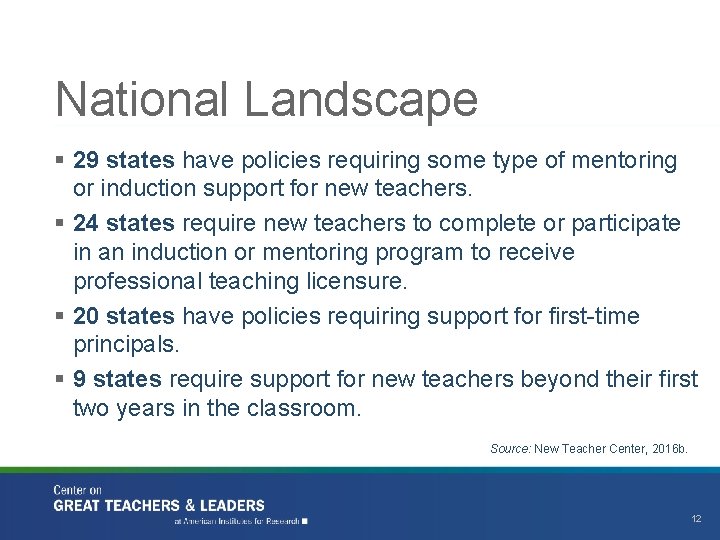
National Landscape § 29 states have policies requiring some type of mentoring or induction support for new teachers. § 24 states require new teachers to complete or participate in an induction or mentoring program to receive professional teaching licensure. § 20 states have policies requiring support for first-time principals. § 9 states require support for new teachers beyond their first two years in the classroom. Source: New Teacher Center, 2016 b. 12
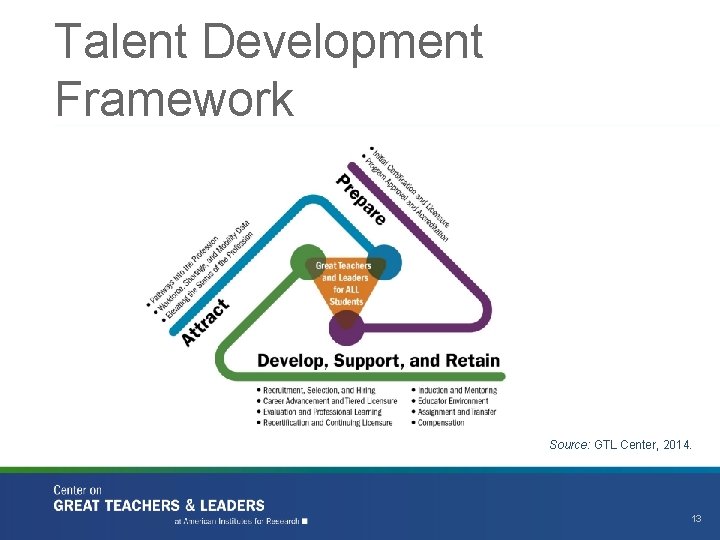
Talent Development Framework Source: GTL Center, 2014. 13
Connecting Efforts When part of a coordinated talent development strategy, mentoring and induction can connect with and support many state- and district-driven initiatives, such as: § Improving equitable access to excellent educators. § Alleviating teacher shortages. § Addressing school turnaround. 14
Mentoring and Induction in Every Student Succeeds Act Plans § Mentoring and/or induction is: • Included in 45 state Every Student Succeeds Act (ESSA) plans. • Identified as a strategy for promoting educator retention in 12 states. • Identified as a strategy for promoting equity in 13 states. § 27 states provide detailed plans for mentoring and induction. § 25 states plan to use funding from Title II, Part A, to support mentoring and induction. 15
Equitable Access § Improvements in equitable access are achieved by focusing on schools with the most severe and persistent equity gaps. § Investing in mentoring and induction supports in high-need schools can help address gaps between preservice preparation and inservice expectations. § Unfortunately, research suggests that teachers in highneed schools are less likely to receive mentoring and induction supports (Kardos & Johnson, 2010). 16
How Can Effective Mentoring and Induction Close Equity Gaps? Mentoring and induction can: § Attract effective teachers by offering better supports and working environment in hard-to-staff schools. § Improve teacher effectiveness in high-need schools by strengthening preparation. § Increase teacher retention in high-need schools by offering ongoing support and opportunities for growth. 17
Alleviating Teacher Shortages § New teachers are less likely to leave the profession if they are provided with a mentor in their content area and if they participate in formal planning and collaboration with other teachers (Ingersoll & Smith, 2004; Ingersoll & Strong, 2011). § Mentoring aligned with job roles and responsibilities is especially important for teachers in critical shortage areas such as special education (Billingsley, Griffin, Smith, Kamman, & Israel, 2009). 18
Addressing School Turnaround Mentoring and induction supports should target the specific needs of educators in turnaround settings: § Turnaround Leadership § Talent Development § Instructional Transformation § Culture Shift Source: Four Domains for Rapid School Improvement: A Systems Framework, Center on School Turnaround, 2017. 19
Toolkit Connection: School Turnaround Does your team need help designing mentoring and induction in a turnaround setting? Try these toolkit resources! § Mentoring and Induction in Turnaround Schools Self. Assessment: Helps teams assess, reflect, and monitor progress on district- and school-level implementation of M&I in turnaround settings. § Mentoring and Induction in Turnaround Schools Crosswalk and Reflection: Outlines an integrated model for M&I in turnaround settings and helps teams reflect on implementation at the school, district, and state levels. 20
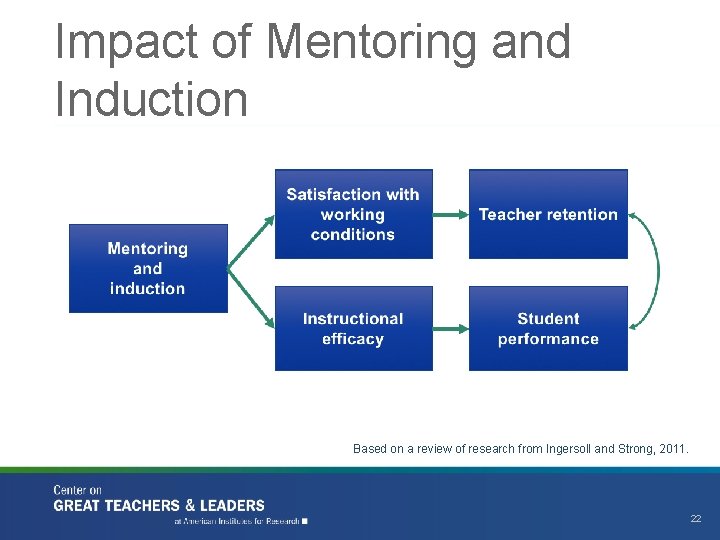
Why Does Induction Matter? 1. 2. 3. 4. 5. Improves teacher retention Increases teacher effectiveness Improves student achievement Expands pathways into teacher leadership Improves school climate and working conditions 21
Impact of Mentoring and Induction Based on a review of research from Ingersoll and Strong, 2011. 22
Toolkit Connection: Data Does your team need help analyzing data? Try these toolkit resources! § Mentoring and Induction Data Protocol: Gives teams an inquiry-based structure to examine outcomes related to mentoring and induction, including teacher retention, teacher performance, and student achievement data. § Root Cause Analysis Workbook: Guides teams through a process to explore root causes to identify context-specific strategies for strengthening induction programs. 23
Other Tools to Explore Data § GTL Center’s Equitable Access & Diversifying the Educator Workforce Project includes a data tool for practitioners and a companion guidebook that can: • Reveal insights about the diversity of the educator workforce at the state, district, school, or preparation program level. • Identify the main drivers behind the existing disparities within the educator workforce. • Pinpoint crucial points across the educator career continuum where implementing carefully selected strategies can help diversify the educator workforce and improve equitable access. 24
Components of Induction The components of a comprehensive induction program vary by district but usually include the following: § Orientation activities § New teacher mentoring § Professional development and learning communities for beginning teachers and mentors § Professional supports for principals and program leadership § Programmatic supports 25
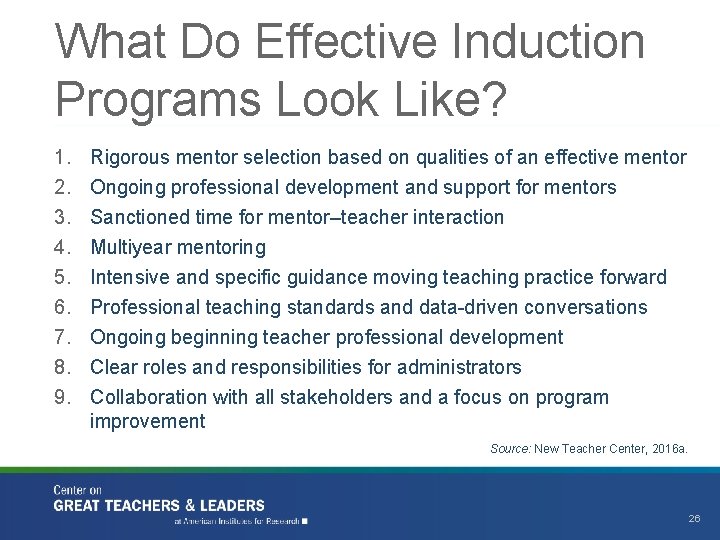
What Do Effective Induction Programs Look Like? 1. 2. 3. 4. 5. 6. 7. 8. 9. Rigorous mentor selection based on qualities of an effective mentor Ongoing professional development and support for mentors Sanctioned time for mentor–teacher interaction Multiyear mentoring Intensive and specific guidance moving teaching practice forward Professional teaching standards and data-driven conversations Ongoing beginning teacher professional development Clear roles and responsibilities for administrators Collaboration with all stakeholders and a focus on program improvement Source: New Teacher Center, 2016 a. 26
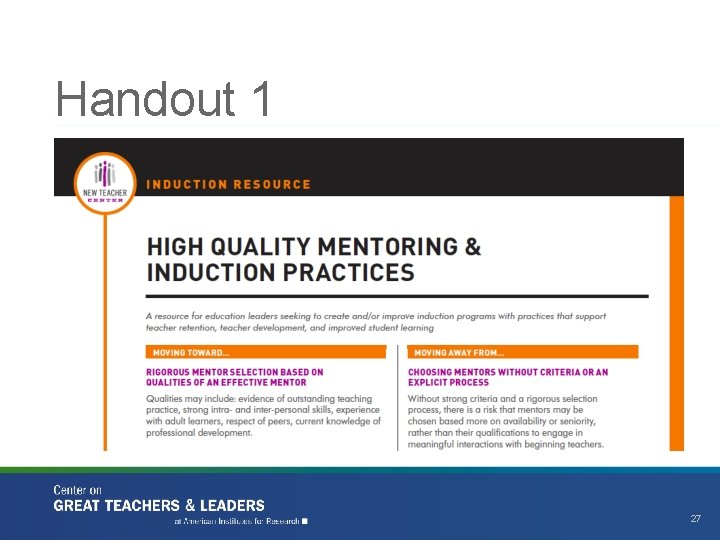
Handout 1 27
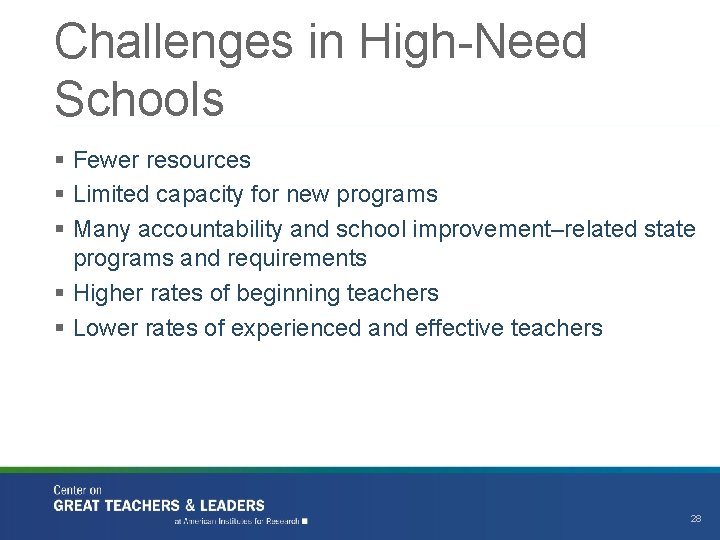
Challenges in High-Need Schools § Fewer resources § Limited capacity for new programs § Many accountability and school improvement–related state programs and requirements § Higher rates of beginning teachers § Lower rates of experienced and effective teachers 28
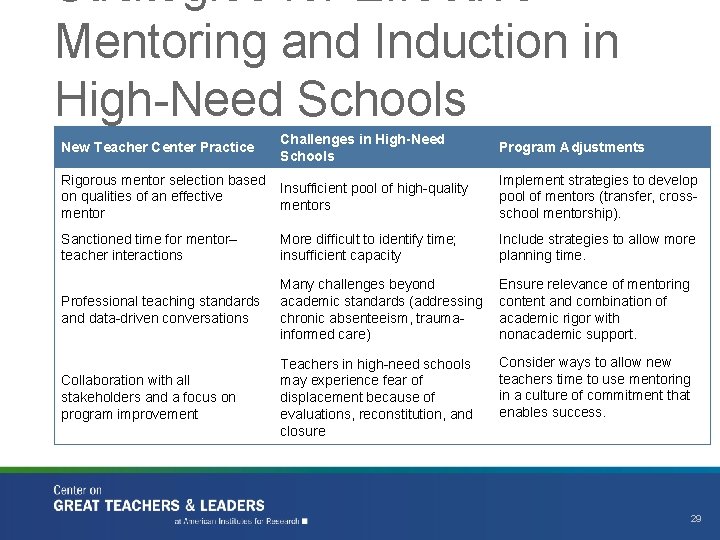
Strategies for Effective Mentoring and Induction in High-Need Schools New Teacher Center Practice Challenges in High-Need Schools Program Adjustments Rigorous mentor selection based on qualities of an effective mentor Insufficient pool of high-quality mentors Implement strategies to develop pool of mentors (transfer, crossschool mentorship). Sanctioned time for mentor– teacher interactions More difficult to identify time; insufficient capacity Include strategies to allow more planning time. Professional teaching standards and data-driven conversations Many challenges beyond academic standards (addressing chronic absenteeism, traumainformed care) Ensure relevance of mentoring content and combination of academic rigor with nonacademic support. Collaboration with all stakeholders and a focus on program improvement Teachers in high-need schools may experience fear of displacement because of evaluations, reconstitution, and closure Consider ways to allow new teachers time to use mentoring in a culture of commitment that enables success. 29
Toolkit Connection: Induction Does your team need help thinking through the structural pieces of an induction program? Try this toolkit resource! § Induction Program Inventory: Helps teams plan for the building blocks of a comprehensive induction program, including structures to support beginning teachers, mentors, principals, and district leaders. 30
Induction in Practice § There is wide variation in the ways in which mentoring and induction activities and programs are implemented at schools and in districts (De. Cesare, Workman, & Mc. Clelland, 2016; New Teacher Center, 2016 b; Strong, 2009). § Districts cite lack of funding, lack of time, and lack of stipends as a barrier to implementing adequate mentoring programs (De. Cesare, Workman, & Mc. Clelland, 2016). 31
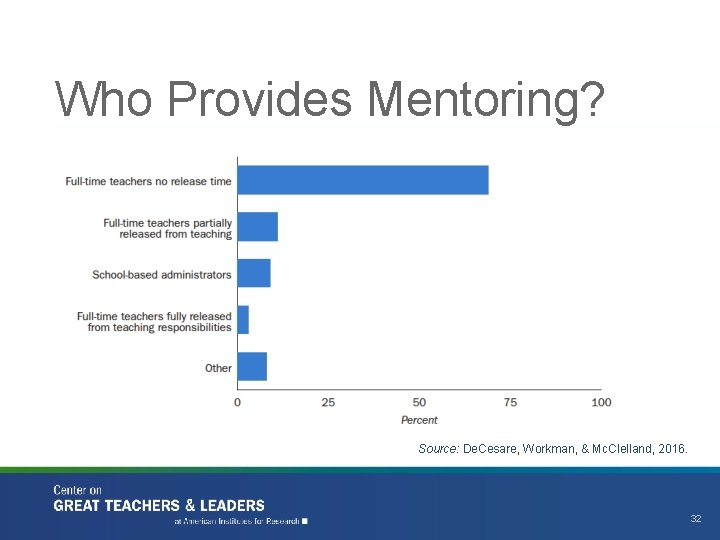
Who Provides Mentoring? Source: De. Cesare, Workman, & Mc. Clelland, 2016. 32
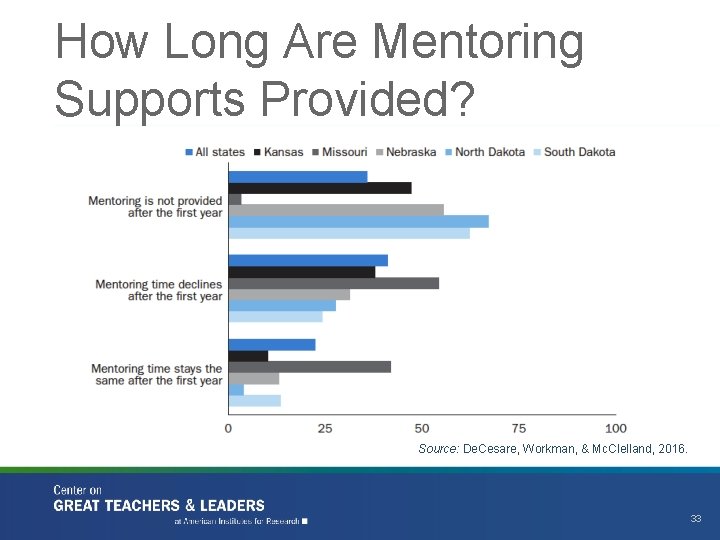
How Long Are Mentoring Supports Provided? Source: De. Cesare, Workman, & Mc. Clelland, 2016. 33
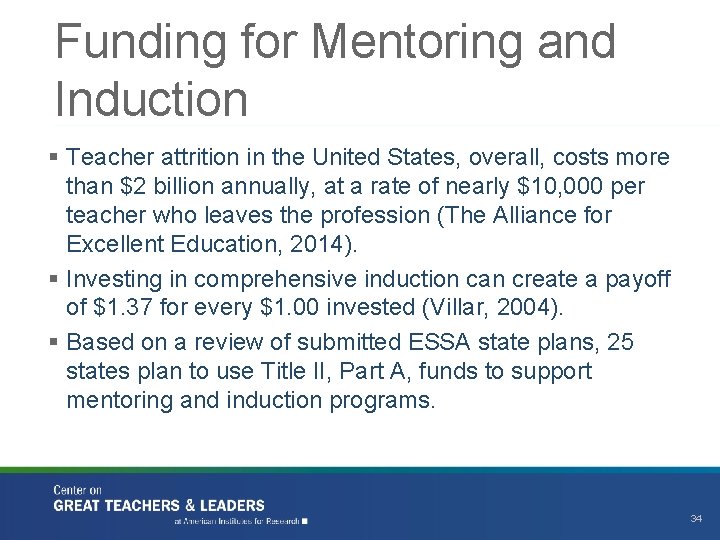
Funding for Mentoring and Induction § Teacher attrition in the United States, overall, costs more than $2 billion annually, at a rate of nearly $10, 000 per teacher who leaves the profession (The Alliance for Excellent Education, 2014). § Investing in comprehensive induction can create a payoff of $1. 37 for every $1. 00 invested (Villar, 2004). § Based on a review of submitted ESSA state plans, 25 states plan to use Title II, Part A, funds to support mentoring and induction programs. 34
References Alliance for Excellent Education. (2014). On the path to equity: Improving the effectiveness of beginning teachers. Washington, DC: Author. Retrieved from https: //all 4 ed. org/wpcontent/uploads/2014/07/Path. To. Equity. pdf Behrstock-Sherratt, E. , Bassett, K. , Olson, D. , & Jacques, C. (2014). From good to great: Exemplary teachers share perspectives on increasing teacher effectiveness across the career continuum. Washington, DC: Center on Great Teachers and Leaders. Retrieved from https: //files. eric. ed. gov/fulltext/ED 555657. pdf 35
References (continued) Billingsley, B. S. , Griffin, C. C. , Smith, S. J. , Kamman, M. , & Israel, M. (2009). A review of teacher induction in special education: Research, practice, and technology solutions. National Center to Inform Policy and Practice in Special Education Professional Development. (NCIPP Doc. No. RS-1). Retrieved from http: //ncipp. education. ufl. edu/files_6/NCIPP_Induc_010310. pdf Center on Great Teachers and Leaders. (2014). Talent development framework for 21 st century educators: Moving toward state policy alignment and coherence. Washington, DC: American Institutes for Research. Retrieved from http: //www. gtlcenter. org/sites/default/files/142591_GTL_Talent_Dev_Framework-ed_110714. pdf 36
References (continued) Center on School Turnaround. (2017). Four domains for rapid school improvement: A systems framework [The Center for School Turnaround at West. Ed]. San Francisco, CA: West. Ed. Retrieved from https: //centeronschoolturnaround. org/wpcontent/uploads/2018/04/CST_Four-Domains-Framework-Final. pdf De. Cesare, D. , Workman, S. , & Mc. Clelland, A. (2016, April). How do school districts mentor new teachers? (REL 2016 -125). Washington, DC: U. S. Department of Education, Institute of Education Sciences, National Center for Education Evaluation and Regional Assistance, Regional Educational Laboratory Central. 37
References (continued) Ingersoll, R. M. , & Smith, T. M. (2004). Do teacher induction and mentoring matter? NASSP Bulletin, 88(638), 28– 40. Ingersoll, R. M. , & Strong, M. (2011). The impact of induction and mentoring programs for beginning teachers: A critical review of the research. Review of Educational Research, 81(2), 201– 233. Kardos, S. M. , & Johnson, S. M. (2010). New teachers’ experiences of mentoring: The good, the bad, and the inequity. Journal of Educational Change, 11(1), 23– 44. New Teacher Center. (2016 a). High-quality mentoring and induction practices. Santa Cruz, CA: Author. Retrieved from https: //newteachercenter. org/wpcontent/uploads/high-quality-mentoring_induction-resource. pdf 38
References (continued) New Teacher Center. (2016 b). Support from the start: A 50 -state review of policies on new educator induction and mentoring. Santa Cruz, CA: Author. Retrieved from https: //newteachercenter. org/wpcontent/uploads/state-teacher-induction-2016 -exec-summ-only-finalversion-v 3. pdff Schmidt, R. , Young, V. , Cassidy, L. , Wang, H. , & Laguarda, K. (2017). Impact of the New Teacher Center’s new teacher induction model on teachers and students. Menlo Park, CA: SRI Education. Retrieved from https: //newteachercenter. org/wp-content/uploads/NTC_i 3 Validation-eval-brief_062017_final. pdf 39
References (continued) Strong, M. (2006). Does new teacher support affect student achievement? (Research Brief). Santa Cruz, CA: New Teacher Center. Retrieved from http: //www. newteachercenter. org/sites/default/files/ntc/main/ resources/BRF_Does. New. Teacher. Support. Affect. Student. Achieve ment. pdf Strong, M. (2009). Effective teacher induction and mentoring: Assessing the evidence. New York, NY: Teachers College Press. 40
References (continued) Villar, A. (2004). Measuring the benefits and costs of mentor-based induction: A value-added assessment of new teacher effectiveness linked to student achievement. Santa Cruz, CA: New Teacher Center. 41
More questions? Contact the GTL Center! 1000 Thomas Jefferson Street NW Washington, DC 20007 -3835 877 -322 -8700 gtlcenter@air. org www. gtlcenter. org | www. air. org www. facebook. com/gtlcenter www. twitter. com/gtlcenter Advancing state efforts to grow, respect, and retain great teachers and leaders for all students 42