
Introduction to the FAA Center of Excellence for
- Slides: 9
Introduction to the FAA Center of Excellence for Commercial Space Transportation Ken Davidian COE CST Overview Presentation Director of Research FAA Office of Commercial Space Transportation Federal Aviation Administration
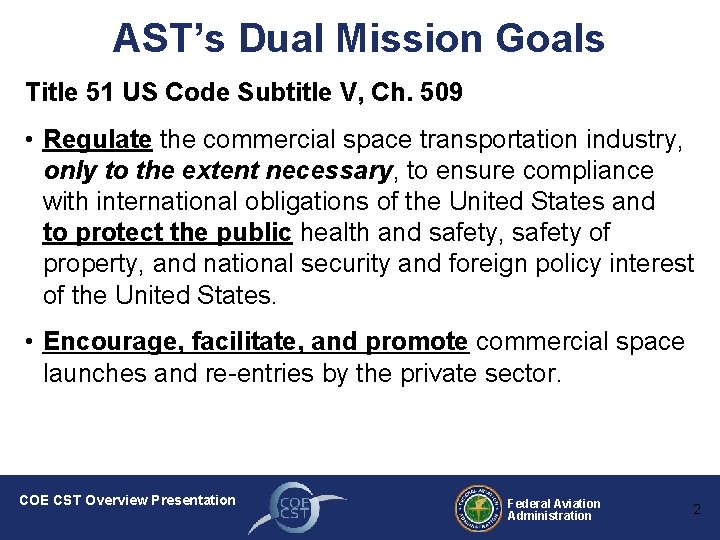
AST’s Dual Mission Goals Title 51 US Code Subtitle V, Ch. 509 • Regulate the commercial space transportation industry, only to the extent necessary, to ensure compliance with international obligations of the United States and to protect the public health and safety, safety of property, and national security and foreign policy interest of the United States. • Encourage, facilitate, and promote commercial space launches and re-entries by the private sector. COE CST Overview Presentation Federal Aviation Administration 2
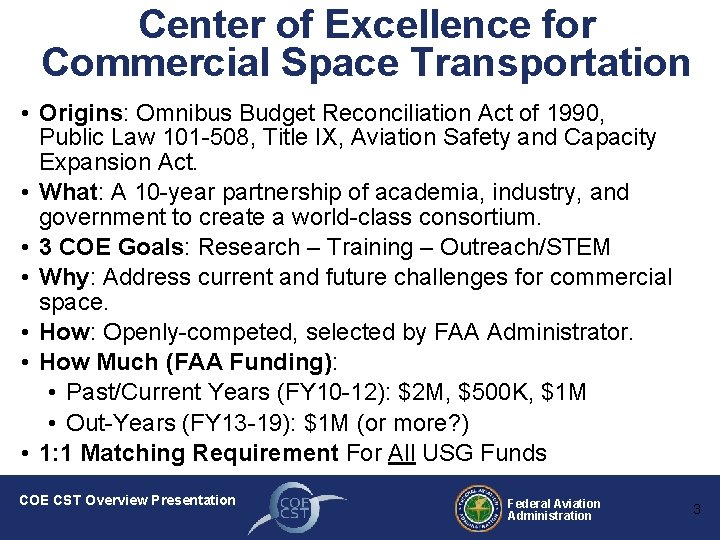
Center of Excellence for Commercial Space Transportation • Origins: Omnibus Budget Reconciliation Act of 1990, Public Law 101 -508, Title IX, Aviation Safety and Capacity Expansion Act. • What: A 10 -year partnership of academia, industry, and government to create a world-class consortium. • 3 COE Goals: Research – Training – Outreach/STEM • Why: Address current and future challenges for commercial space. • How: Openly-competed, selected by FAA Administrator. • How Much (FAA Funding): • Past/Current Years (FY 10 -12): $2 M, $500 K, $1 M • Out-Years (FY 13 -19): $1 M (or more? ) • 1: 1 Matching Requirement For All USG Funds COE CST Overview Presentation Federal Aviation Administration 3
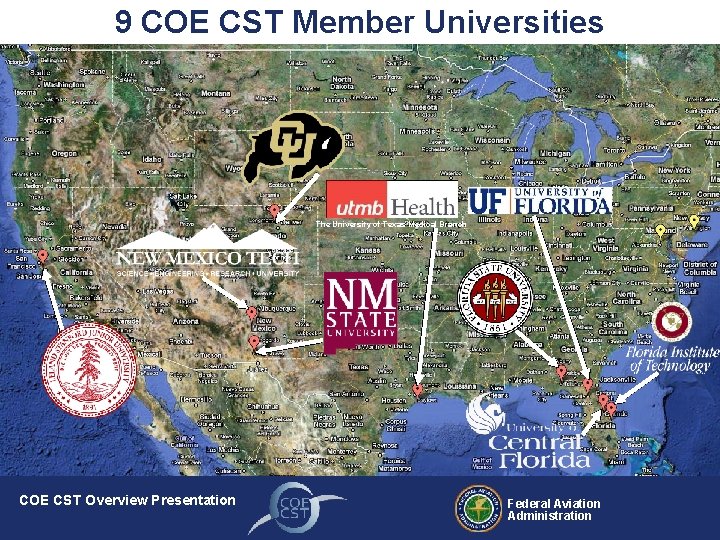
9 COE CST Member Universities The University of Texas Medical Branch COE CST Overview Presentation Federal Aviation Administration
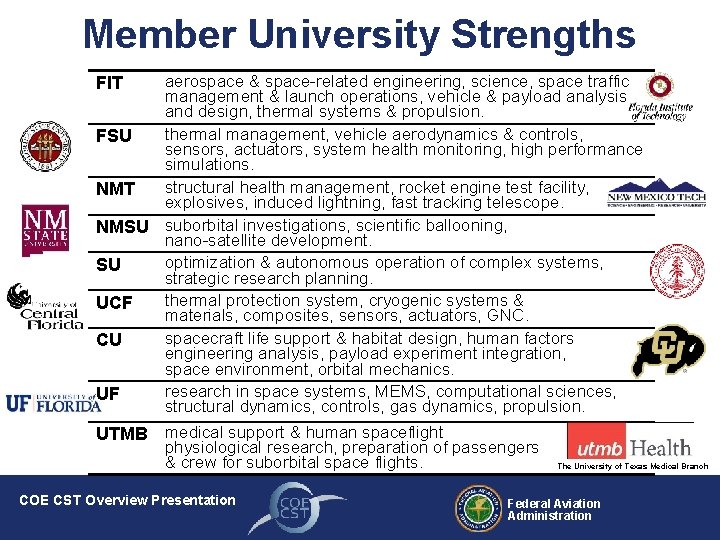
Member University Strengths aerospace & space-related engineering, science, space traffic management & launch operations, vehicle & payload analysis and design, thermal systems & propulsion. thermal management, vehicle aerodynamics & controls, FSU sensors, actuators, system health monitoring, high performance simulations. structural health management, rocket engine test facility, NMT explosives, induced lightning, fast tracking telescope. NMSU suborbital investigations, scientific ballooning, nano-satellite development. optimization & autonomous operation of complex systems, SU strategic research planning. thermal protection system, cryogenic systems & UCF materials, composites, sensors, actuators, GNC. spacecraft life support & habitat design, human factors CU engineering analysis, payload experiment integration, space environment, orbital mechanics. research in space systems, MEMS, computational sciences, UF structural dynamics, controls, gas dynamics, propulsion. UTMB medical support & human spaceflight physiological research, preparation of passengers & crew for suborbital space flights. The University of Texas Medical Branch FIT COE CST Overview Presentation Federal Aviation Administration
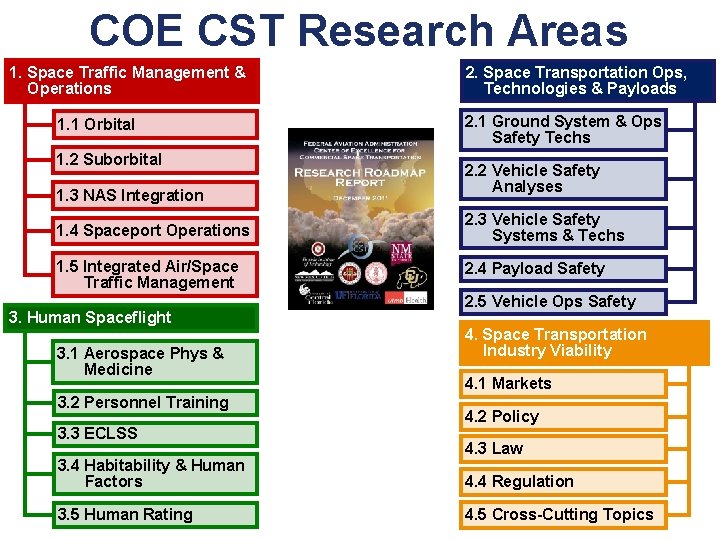
COE CST Research Areas 1. Space Traffic Management & Operations 1. 1 Orbital 1. 2 Suborbital 1. 3 NAS Integration 2. Space Transportation Ops, Technologies & Payloads 2. 1 Ground System & Ops Safety Techs 2. 2 Vehicle Safety Analyses 1. 4 Spaceport Operations 2. 3 Vehicle Safety Systems & Techs 1. 5 Integrated Air/Space Traffic Management 2. 4 Payload Safety 3. Human Spaceflight 3. 1 Aerospace Phys & Medicine 3. 2 Personnel Training 3. 3 ECLSS 3. 4 Habitability & Human Factors COE CST Overview Presentation 3. 5 Human Rating 2. 5 Vehicle Ops Safety 4. Space Transportation Industry Viability 4. 1 Markets 4. 2 Policy 4. 3 Law 4. 4 Regulation 4. 5 Federal Aviation Cross-Cutting Administration Topics
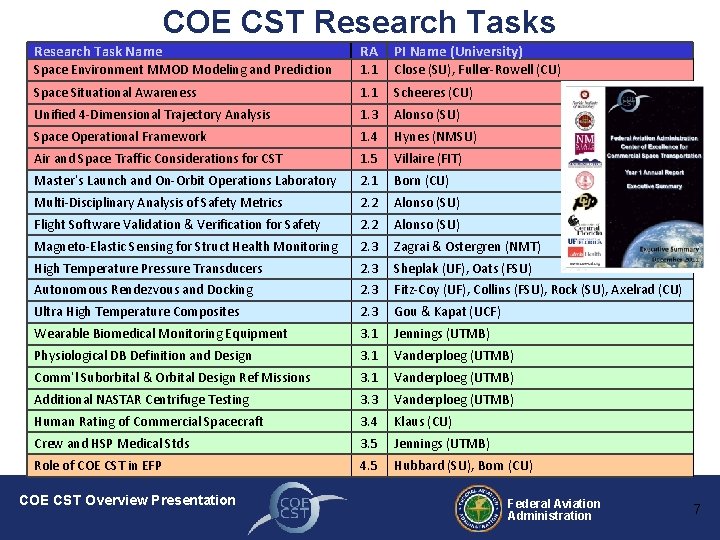
COE CST Research Tasks Research Task Name RA PI Name (University) Space Environment MMOD Modeling and Prediction 1. 1 Close (SU), Fuller-Rowell (CU) Space Situational Awareness 1. 1 Scheeres (CU) Unified 4 -Dimensional Trajectory Analysis 1. 3 Alonso (SU) Space Operational Framework 1. 4 Hynes (NMSU) Air and Space Traffic Considerations for CST 1. 5 Villaire (FIT) Master’s Launch and On-Orbit Operations Laboratory 2. 1 Born (CU) Multi-Disciplinary Analysis of Safety Metrics 2. 2 Alonso (SU) Flight Software Validation & Verification for Safety 2. 2 Alonso (SU) Magneto-Elastic Sensing for Struct Health Monitoring 2. 3 Zagrai & Ostergren (NMT) High Temperature Pressure Transducers 2. 3 Sheplak (UF), Oats (FSU) Autonomous Rendezvous and Docking 2. 3 Fitz-Coy (UF), Collins (FSU), Rock (SU), Axelrad (CU) Ultra High Temperature Composites 2. 3 Gou & Kapat (UCF) Wearable Biomedical Monitoring Equipment 3. 1 Jennings (UTMB) Physiological DB Definition and Design 3. 1 Vanderploeg (UTMB) Comm’l Suborbital & Orbital Design Ref Missions 3. 1 Vanderploeg (UTMB) Additional NASTAR Centrifuge Testing 3. 3 Vanderploeg (UTMB) Human Rating of Commercial Spacecraft 3. 4 Klaus (CU) Crew and HSP Medical Stds 3. 5 Jennings (UTMB) Role of COE CST in EFP 4. 5 Hubbard (SU), Born (CU) COE CST Overview Presentation Federal Aviation Administration 7
The COE CST is made possible with generous support from… COE CST Overview Presentation Federal Aviation Administration 8
For More Information… www. coe-cst. org COE CST Overview Presentation Contact Info for Ken Davidian COE CST Program Manager Federal Aviation Administration 9