
Introduction to the ERICA Tool ERICA project objective
Introduction to the ERICA Tool
ERICA project objective “to provide and apply an integrated approach of addressing scientific, managerial and societal issues surrounding environmental effects of ionising contamination, at a community level, with emphasis on biota and ecosystems” The ERICA Tool is the freely available software which implements the ERICA integrated approach. To download Tool: http: //www. project. facilia. se/erica/download. html Well documented: https: //wiki. ceh. ac. uk/display/rpemain/ERICA+reports Considers terrestrial, freshwater and marine ecosystems
ERICA flow chart www. ceh. ac. uk/PROTECT
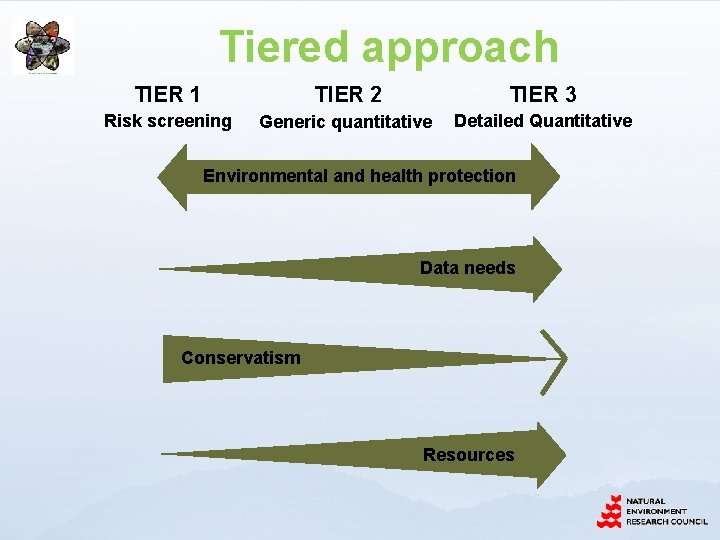
Tiered approach TIER 1 TIER 2 TIER 3 Risk screening Generic quantitative Detailed Quantitative Environmental and health protection Data needs Conservatism Resources
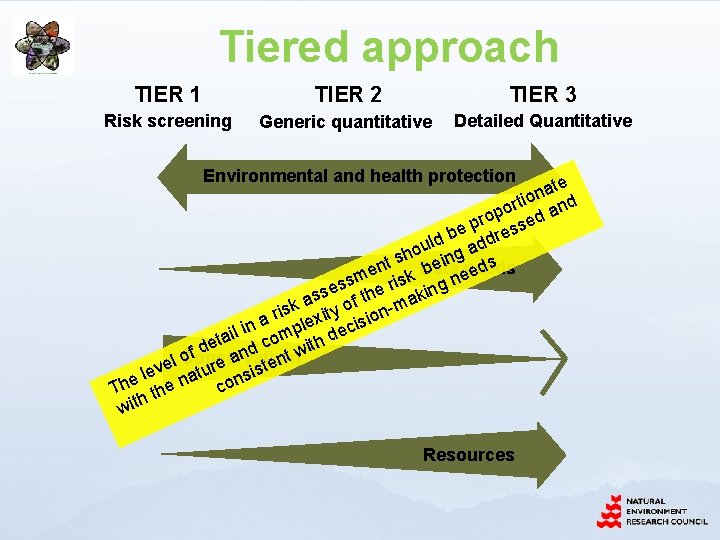
Tiered approach TIER 1 TIER 2 TIER 3 Risk screening Generic quantitative Detailed Quantitative Environmental and health protection te a n rtio and o p ro sed p s e e b r d d ul g ad o h ein needs nt s Data ds b e e e k m ss e ris ing n e s as of th -mak k ris exity sion a in mpl deci l i a et d co with d f o e an ent Conservatism l e lev natur nsist e co Th the h wit Resources
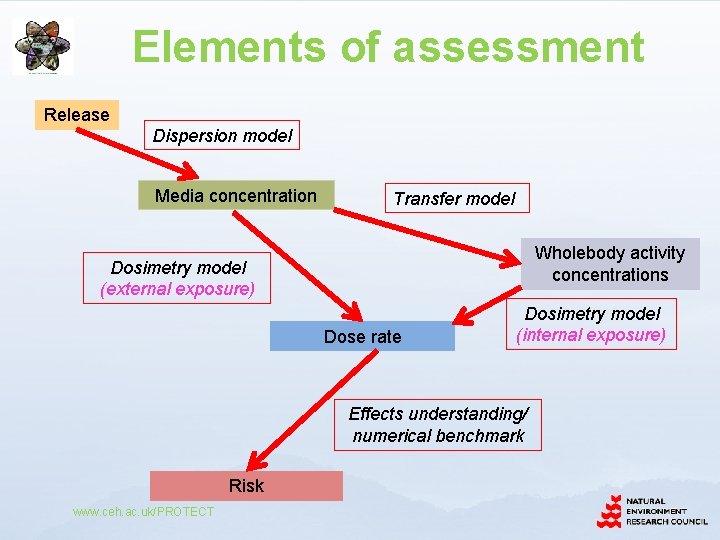
Elements of assessment Release Dispersion model Media concentration Transfer model Wholebody activity concentrations Dosimetry model (external exposure) Dose rate Dosimetry model (internal exposure) Effects understanding/ numerical benchmark Risk www. ceh. ac. uk/PROTECT
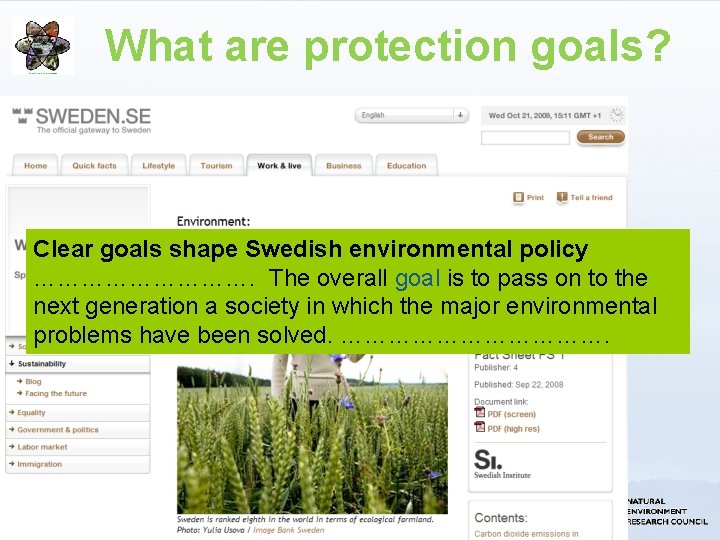
What are protection goals? Clear goals shape Swedish environmental policy ……………. The overall goal is to pass on to the next generation a society in which the major environmental problems have been solved. ……………….
What are protection goals? A condition or state desired to be brought about through a course of action program. They are usually qualitative statements that provide direction for plans and GOAL projects. Goals are not specific numerical limitations, but conditions or states which can be obtained through careful planning and implementation. The water use goal for the fishery, established by the Hamilton Harbour Stakeholder Group, is "that water quality and fish habitat should be improved to permit an edible, naturally-reproducing fishery for warm water species, and water and habitat conditions in Hamilton Harbour should not limit natural reproduction and the edibility of cold water species. "
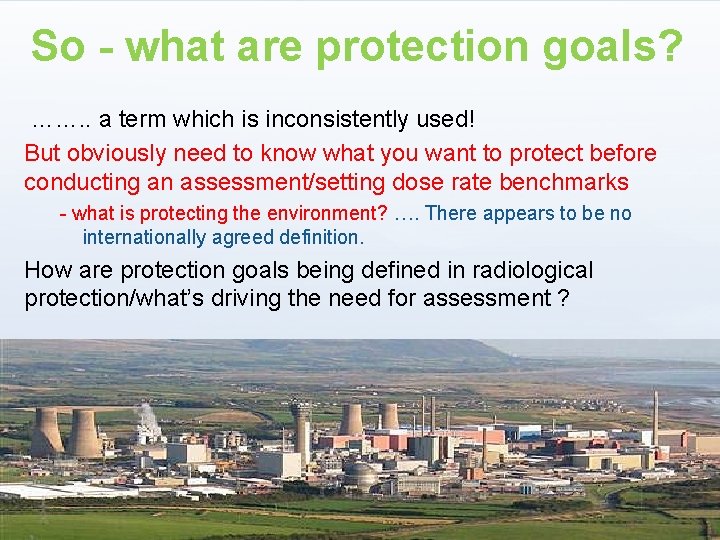
So - what are protection goals? ……. . a term which is inconsistently used! But obviously need to know what you want to protect before conducting an assessment/setting dose rate benchmarks - what is protecting the environment? …. There appears to be no internationally agreed definition. How are protection goals being defined in radiological protection/what’s driving the need for assessment ?
Typical radiological protection goal definition ¥ For ¥ instance (from EC PROTECT project): To protect the sustainability of populations of the vast majority of all species and thus ensure ecosystem function now and in the future. Special attention should be given to keystone, sentinel, rare, protected or culturally significant species
Stakeholder involvement: what do we mean by stakeholders? ¥ Term ¥ stakeholders here means: any person or organisation that could either be affected by, or interested in, the outcome of a decision ¥ Consequently Will vary with the objective of the assessment ¥ May include a wide range of people (experts, lay people, elected people, volunteers, etc) ¥
What is Problem Formulation? ¥ Identifies the: source (of radionuclides) ¥ receiving media ¥ any key receptor species ¥ assessment criteria to use ¥ uncertainties (either knowledge or data) ¥ ¥ Considers the need for, and takes into account, stakeholder involvement ¥ legislation and/or any regulatory requirements ¥
Problem formulation. . . ¥ Should be documented ¥ ¥ Commonly, by conceptual model ¥ ¥ in a transparent & understandable way describing what is known about the site Level of detail required ¥ will be influenced by a number of factors
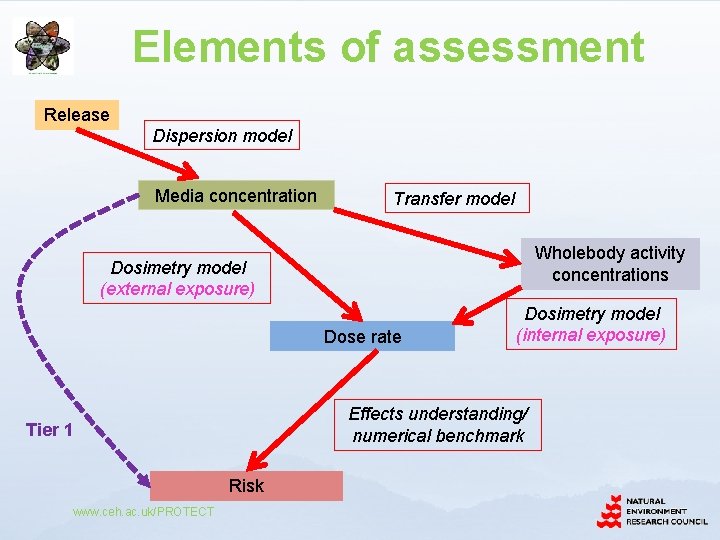
Elements of assessment Release Dispersion model Media concentration Transfer model Wholebody activity concentrations Dosimetry model (external exposure) Dose rate Effects understanding/ numerical benchmark Tier 1 Risk www. ceh. ac. uk/PROTECT Dosimetry model (internal exposure)
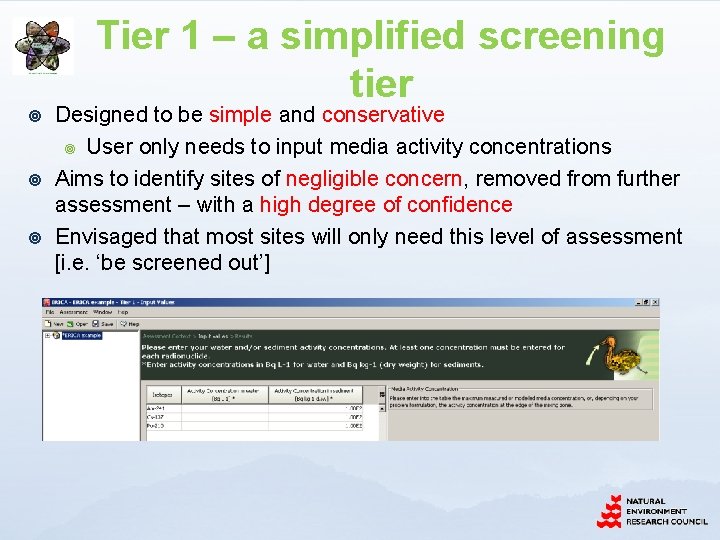
Tier 1 – a simplified screening tier ¥ ¥ ¥ Designed to be simple and conservative ¥ User only needs to input media activity concentrations Aims to identify sites of negligible concern, removed from further assessment – with a high degree of confidence Envisaged that most sites will only need this level of assessment [i. e. ‘be screened out’]
Dose rate screening value ¥ Dose rate below which it is agreed (for the purposes of an assessment) that there is no requirement for further evaluation ¥ In ERICA Tier 1 input media (soil, water, sediment) activity concentrations are compared to precalculated concentrations estimated to give rise to the screening dose rate for the most exposed organism ¥ These are termed ‘Environmental Media Concentration Limits’ (EMCL) www. ceh. ac. uk/PROTECT
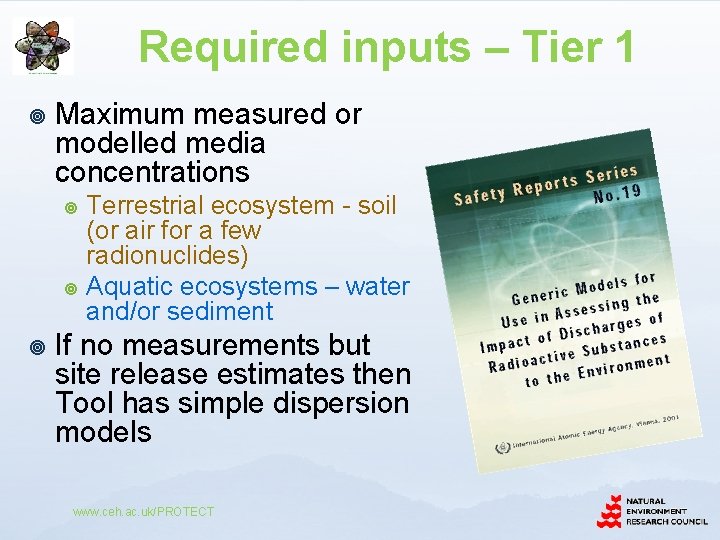
Required inputs – Tier 1 ¥ Maximum measured or modelled media concentrations ¥ ¥ ¥ Terrestrial ecosystem - soil (or air for a few radionuclides) Aquatic ecosystems – water and/or sediment If no measurements but site release estimates then Tool has simple dispersion models www. ceh. ac. uk/PROTECT
Reference organism? ¥ Vast number of potential organisms to simplify a set of organisms have been selected to represent different tropic levels, organisms likely to be exposed, radiosensitive organisms, encompass all European protected species, incorporate ICRP RAPs ¥ ¥ These are the ‘Reference Organisms’ 12 freshwater, 13 terrestrial, 13 marine organisms www. ceh. ac. uk/PROTECT Terrestrial Amphibian Bird egg Detritivorous invertebrate Flying insects Gastropod Grasses and herbs Lichen and bryophytes Mammal Reptile Shrub Soil invertebrate Tree
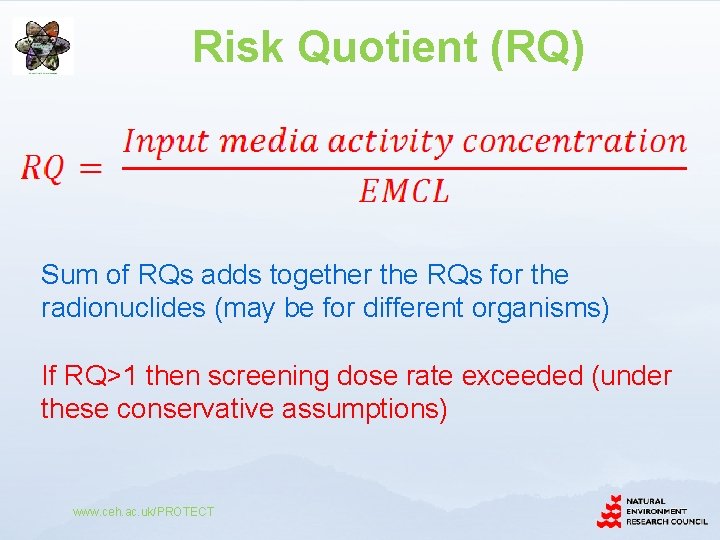
Risk Quotient (RQ) Sum of RQs adds together the RQs for the radionuclides (may be for different organisms) If RQ>1 then screening dose rate exceeded (under these conservative assumptions) www. ceh. ac. uk/PROTECT
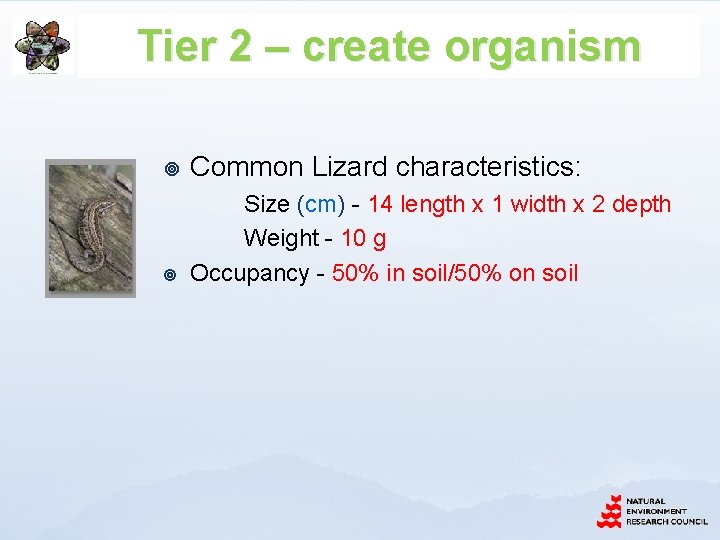
Tier 2 – create organism ¥ Common Lizard characteristics: ¥ Size (cm) - 14 length x 1 width x 2 depth Weight - 10 g Occupancy - 50% in soil/50% on soil
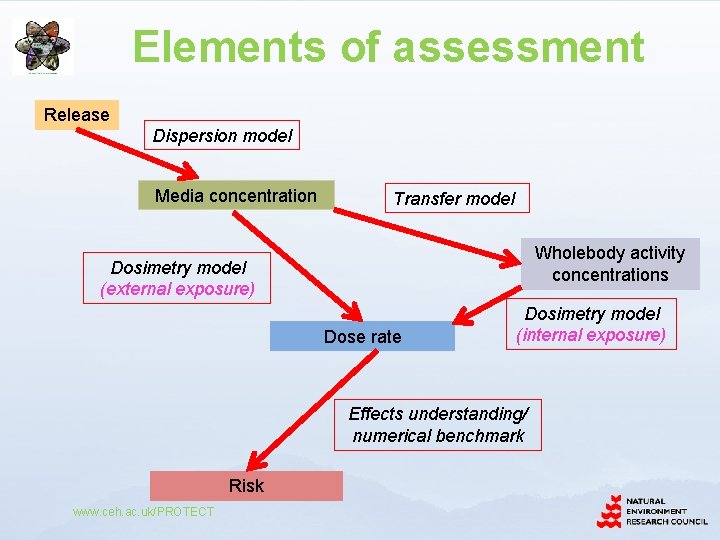
Elements of assessment Release Dispersion model Media concentration Transfer model Wholebody activity concentrations Dosimetry model (external exposure) Dose rate Dosimetry model (internal exposure) Effects understanding/ numerical benchmark Risk www. ceh. ac. uk/PROTECT
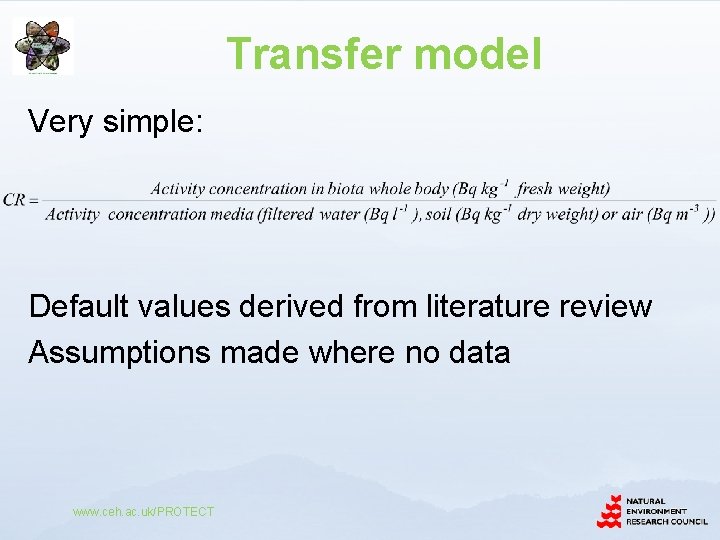
Transfer model Very simple: Default values derived from literature review Assumptions made where no data www. ceh. ac. uk/PROTECT
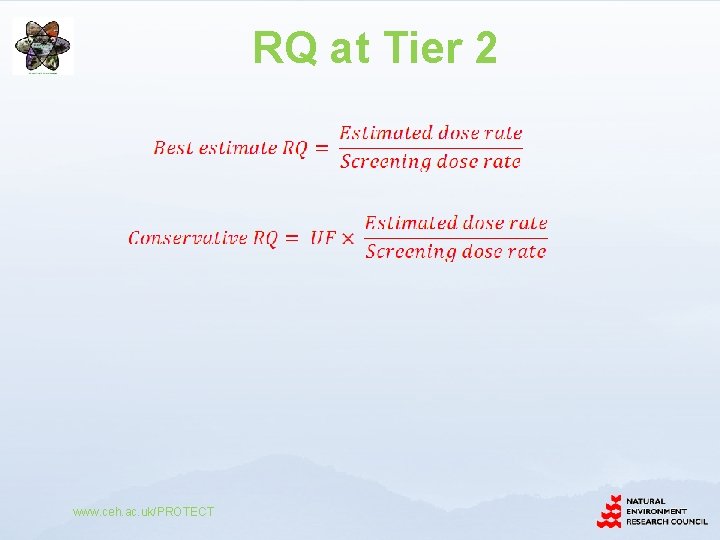
RQ at Tier 2 www. ceh. ac. uk/PROTECT
Tier 3 distribution ¥ Assume lognormal for all ¥ Soil Am-241 300± 50 Bq/kg ¥ Cs-137 9500± 5000 Bq/kg ¥ ¥ Deer Am-241 1± 0. 5 Bq/kg ¥ Cs-137 5000± 400 Bq/kg ¥ www. ceh. ac. uk/PROTECT
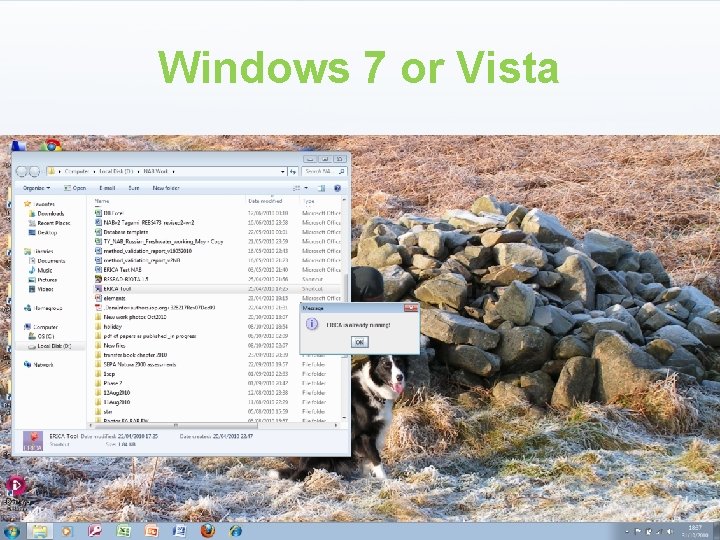
Windows 7 or Vista

Run as administrator
- Slides: 26