
Introduction to the ERALEARN 2020 platform manual for
- Slides: 15
Introduction to the ERA-LEARN 2020 platform & manual for call implementation Roland Brandenburg, FFG Implementing Joint Calls Brussels, 24 -25 September 2015
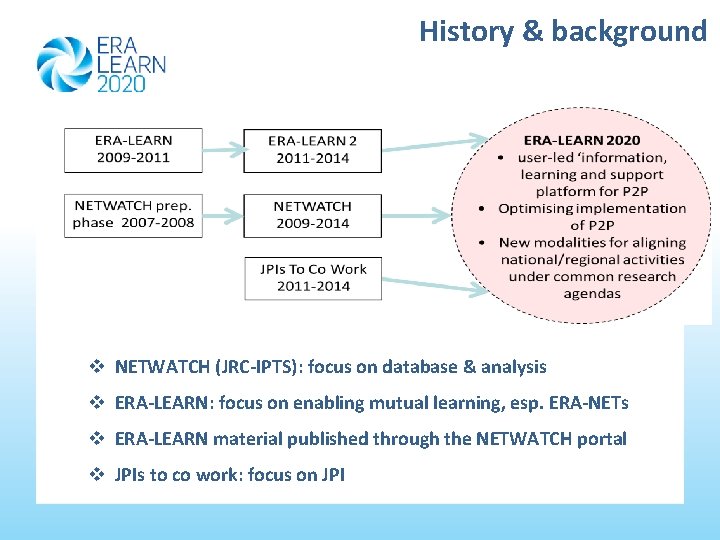
History & background v NETWATCH (JRC-IPTS): focus on database & analysis v ERA-LEARN: focus on enabling mutual learning, esp. ERA-NETs v ERA-LEARN material published through the NETWATCH portal v JPIs to co work: focus on JPI
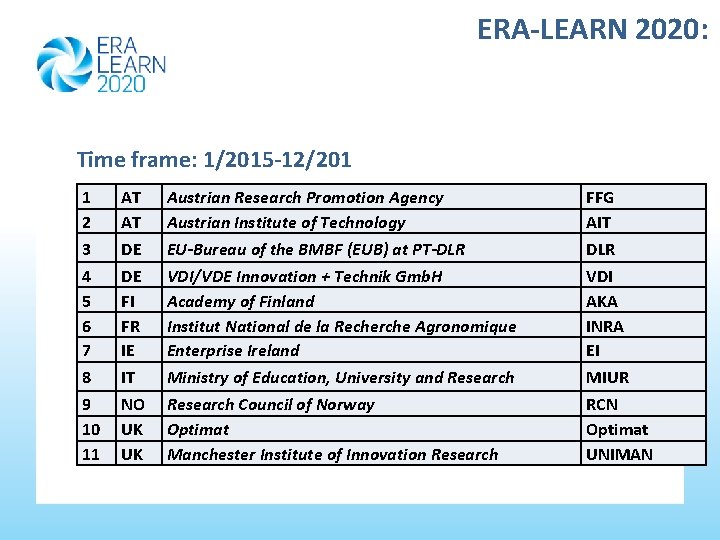
ERA-LEARN 2020: Time frame: 1/2015 -12/201 1 2 3 4 5 6 7 8 9 10 11 AT AT DE DE FI FR IE IT NO UK UK Austrian Research Promotion Agency Austrian Institute of Technology EU-Bureau of the BMBF (EUB) at PT-DLR VDI/VDE Innovation + Technik Gmb. H Academy of Finland Institut National de la Recherche Agronomique Enterprise Ireland Ministry of Education, University and Research Council of Norway Optimat Manchester Institute of Innovation Research FFG AIT DLR VDI AKA INRA EI MIUR RCN Optimat UNIMAN
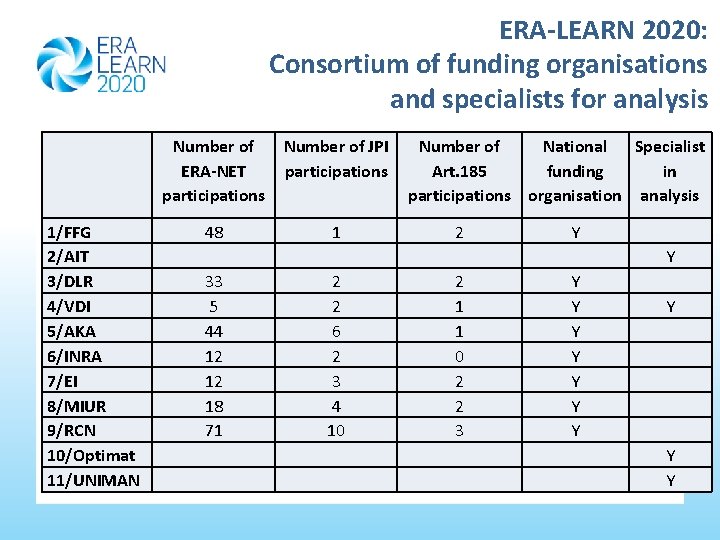
ERA-LEARN 2020: Consortium of funding organisations and specialists for analysis 1/FFG 2/AIT 3/DLR 4/VDI 5/AKA 6/INRA 7/EI 8/MIUR 9/RCN 10/Optimat 11/UNIMAN Number of ERA-NET participations Number of JPI participations 48 1 Number of National Specialist Art. 185 funding in participations organisation analysis 2 Y Y 33 5 44 12 12 18 71 2 2 6 2 3 4 10 2 1 1 0 2 2 3 Y Y Y Y Y
ERA-LEARN 2020: Objectives • provide a web-based information, learning and support platform for P 2 P; • support the ongoing optimisation of P 2 P networks by expanding the ERALEARN toolbox to include the wider activities of joint programming, particularly the ERA-NET Cofund, Art. 185, JPIs • implement a systematic process for monitoring & impact assessment of P 2 P networks, including their impacts at both the policy, programme and cofunded RTD project-level; • assess and benchmark current approaches to alignment and explore options for new modalities that will better align national and/or regional activities under common research agendas; • implement an annual cycle of knowledge exchange aimed at increasing the impact of investment in P 2 P activities and exploring options to support less research intensive countries.
ERA-LEARN 2020: Impact • Increased efficiency of public administration & policy learning • Increased awareness of joint programming and establishment of added value • Improved understanding of the joint programming approach to policy making and • implementation and development of common approaches • Higher standards and increased effectiveness of joint programming activities
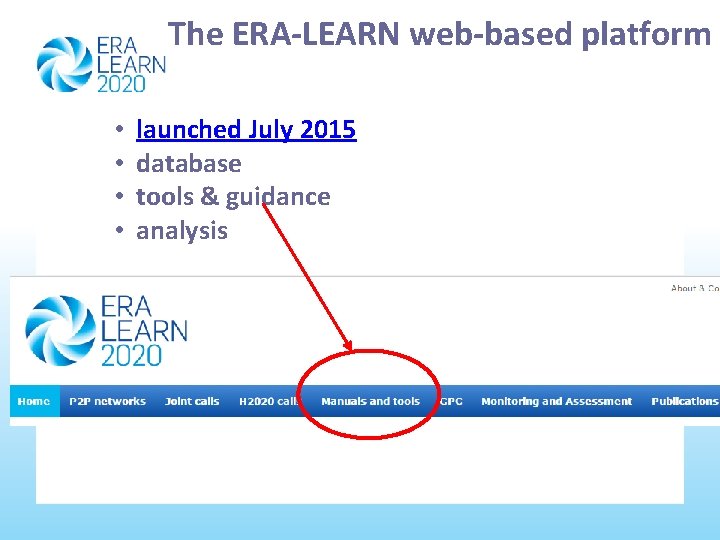
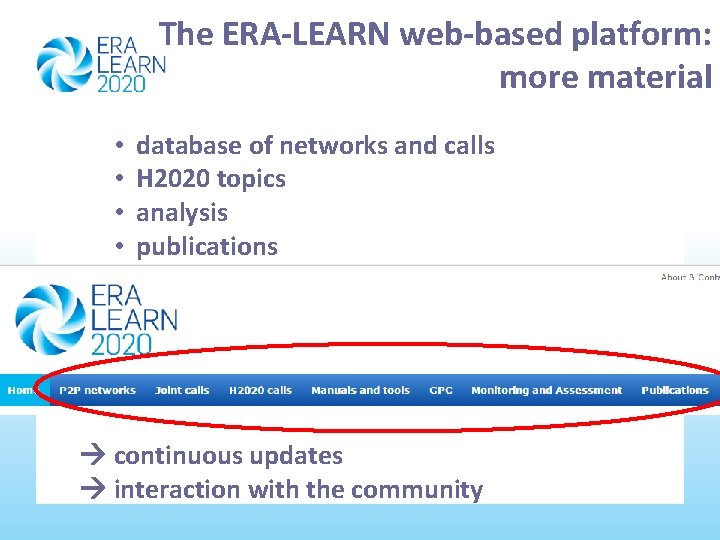
The ERA-LEARN web-based platform • • launched July 2015 database tools & guidance analysis
The ERA-LEARN toolbox: P 2 P in H 2020 • Horizon 2020 calls for P 2 Ps – WP 2014 & 2015: ERA-NET Cofund & CSA – WP 2016 & 2017: ERA-NET Cofund & CSA –to come soon incl partner search tool • ERA-NET Cofund under Horizon 2020: background information practical documentation • financial details, model GA, model CA, …. • Practical documentation: support for proposal preparation, consortium management
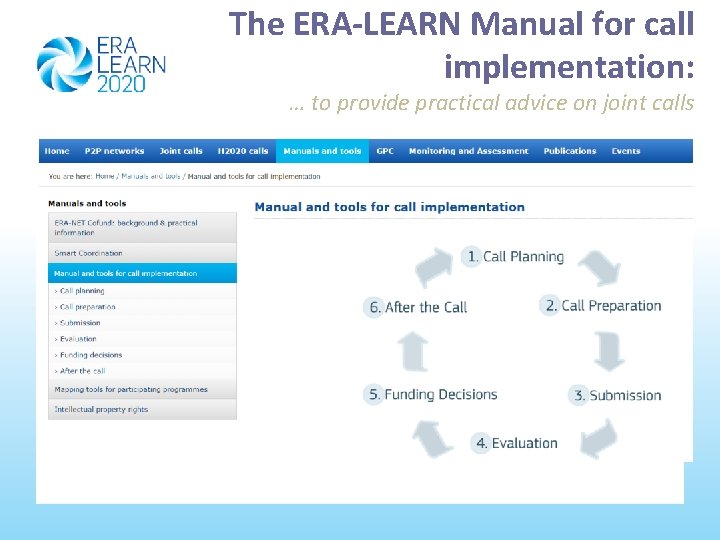
The ERA-LEARN Manual for call implementation: … to provide practical advice on joint calls
The ERA-LEARN Manual for call implementation • Top priority: easy to use -not another large pdf document • Call implementation requires thinking ahead and corresponding planning in advance many crosslinks between the elements of the call cycle • Module structure is suitable for quick updates and extensions Interactive online manual is a convenient solution
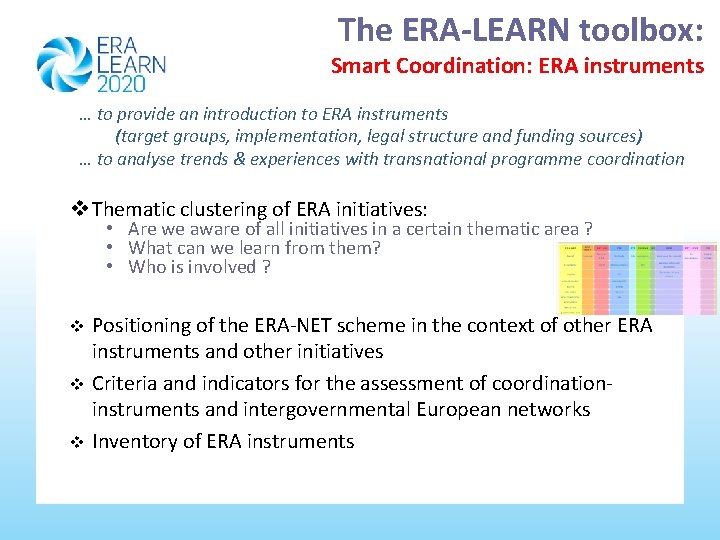
The ERA-LEARN toolbox: Smart Coordination: ERA instruments … to provide an introduction to ERA instruments (target groups, implementation, legal structure and funding sources) … to analyse trends & experiences with transnational programme coordination v Thematic clustering of ERA initiatives: • Are we aware of all initiatives in a certain thematic area ? • What can we learn from them? • Who is involved ? v v v Positioning of the ERA-NET scheme in the context of other ERA instruments and other initiatives Criteria and indicators for the assessment of coordinationinstruments and intergovernmental European networks Inventory of ERA instruments
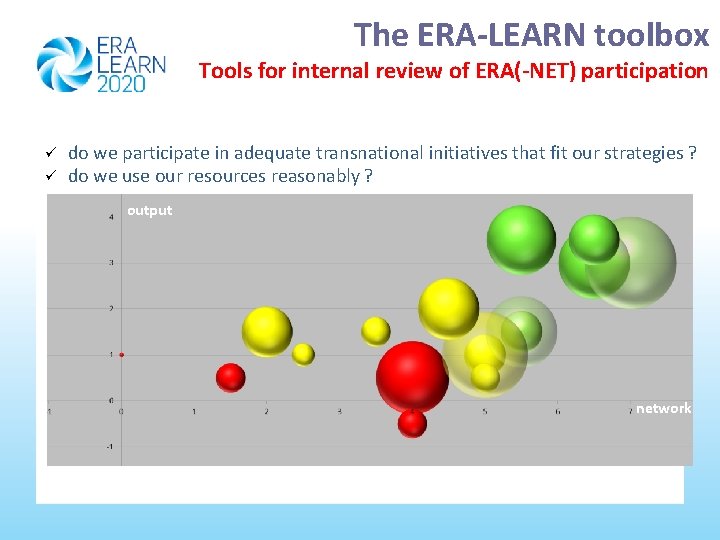
The ERA-LEARN toolbox Tools for internal review of ERA(-NET) participation ü ü do we participate in adequate transnational initiatives that fit our strategies ? do we use our resources reasonably ? output network
The ERA-LEARN web-based platform: more material • • database of networks and calls H 2020 topics analysis publications continuous updates interaction with the community
Dissemination and Exploitation: past and future events & publications • to involve the whole (ERA-NET) community • to facilitate communication, information sharing and best practice exchange v Annual ERA-NET event «ERA-NETs on stage» , Brussels, 2008, 2009, 2010 v ERA-LEARN workshop «Implementing Joint Calls» , Berlin, March 2010 v EC / ERA-LEARN Strategy Workshop «Innovation Union - Joint Programming and its instruments» , Brussels, Apr 2011 v Annual Joint Programming Event, Brussels, Nov 2011 v ERA-LEARN workshop «Implementing Joint Calls» , Brussels, Nov 2011 v EC / ERA-LEARN Workshop “The future ERA-NET instrument under H 2020» , Brussels, June 2012 v ERA-LEARN Workshop «Addressing the needs of the mature trans-national coordination community» , Dublin, Feb 2013 v ERA-LEARN workshop «Implementing Joint Calls» , Brussels, Sep 2013, Jan 2014, Sep 2015 v Annual Joint Programming Conference, Brussels, Nov 2015 v Newsletters since 2011
Contact Roland Brandenburg FFG Austrian Research Promotion Agency office@era-learn. eu www. era-learn. eu