
Introduction to the English education system Professor Chris
- Slides: 19
Introduction to the English education system Professor Chris Wilkins SUP 4 PCL University of Leicester 10 -11 October 2017
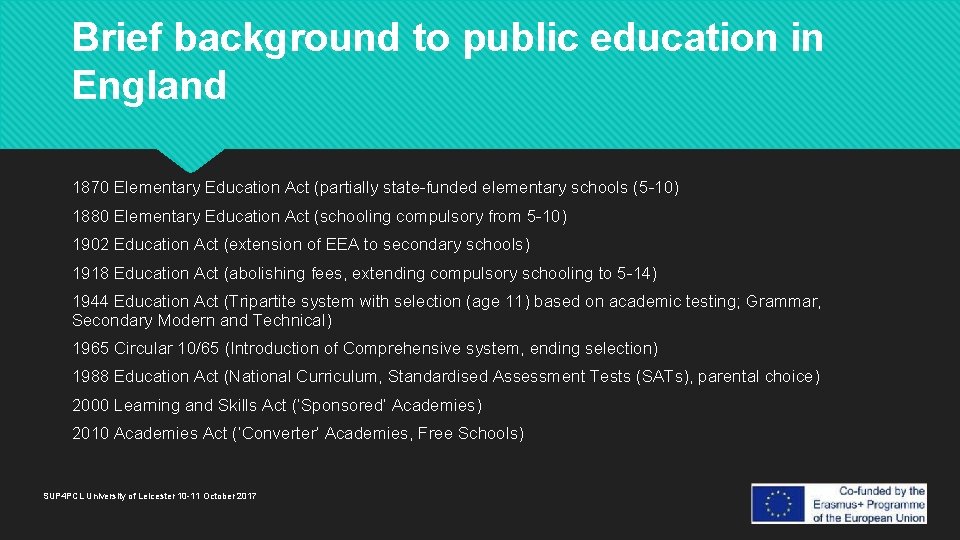
Brief background to public education in England 1870 Elementary Education Act (partially state-funded elementary schools (5 -10) 1880 Elementary Education Act (schooling compulsory from 5 -10) 1902 Education Act (extension of EEA to secondary schools) 1918 Education Act (abolishing fees, extending compulsory schooling to 5 -14) 1944 Education Act (Tripartite system with selection (age 11) based on academic testing; Grammar, Secondary Modern and Technical) 1965 Circular 10/65 (Introduction of Comprehensive system, ending selection) 1988 Education Act (National Curriculum, Standardised Assessment Tests (SATs), parental choice) 2000 Learning and Skills Act (‘Sponsored’ Academies) 2010 Academies Act (‘Converter’ Academies, Free Schools) SUP 4 PCL University of Leicester 10 -11 October 2017
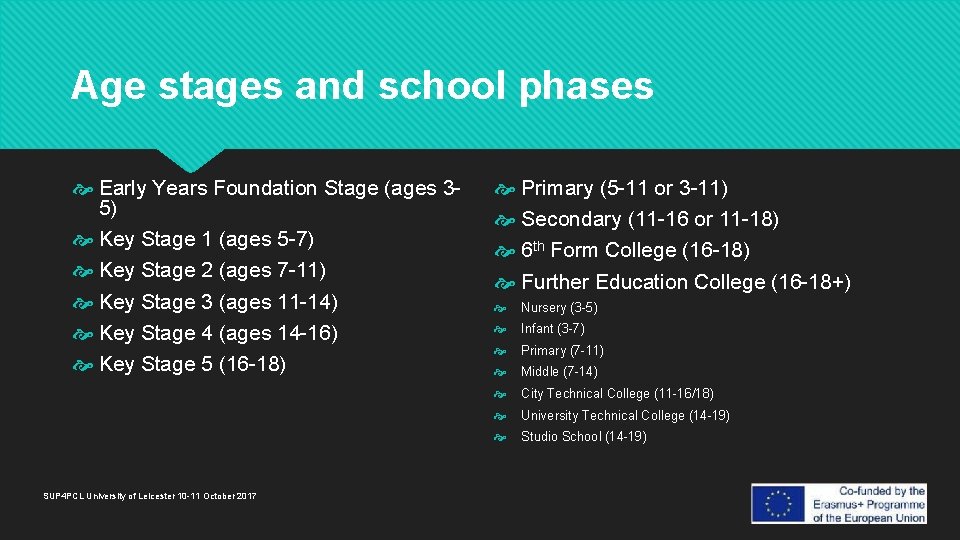
Age stages and school phases Early Years Foundation Stage (ages 35) Key Stage 1 (ages 5 -7) Key Stage 2 (ages 7 -11) Key Stage 3 (ages 11 -14) Key Stage 4 (ages 14 -16) Key Stage 5 (16 -18) SUP 4 PCL University of Leicester 10 -11 October 2017 Primary (5 -11 or 3 -11) Secondary (11 -16 or 11 -18) 6 th Form College (16 -18) Further Education College (16 -18+) Nursery (3 -5) Infant (3 -7) Primary (7 -11) Middle (7 -14) City Technical College (11 -16/18) University Technical College (14 -19) Studio School (14 -19)
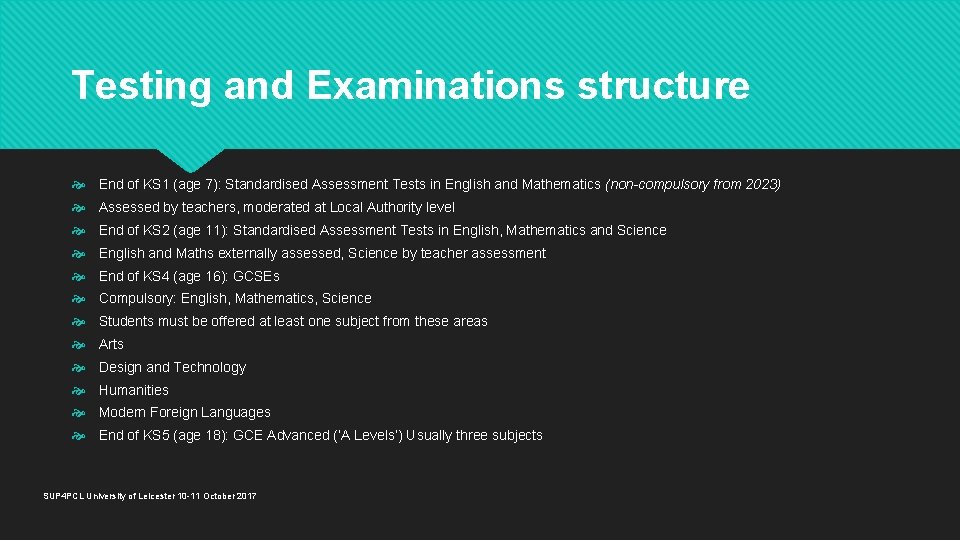
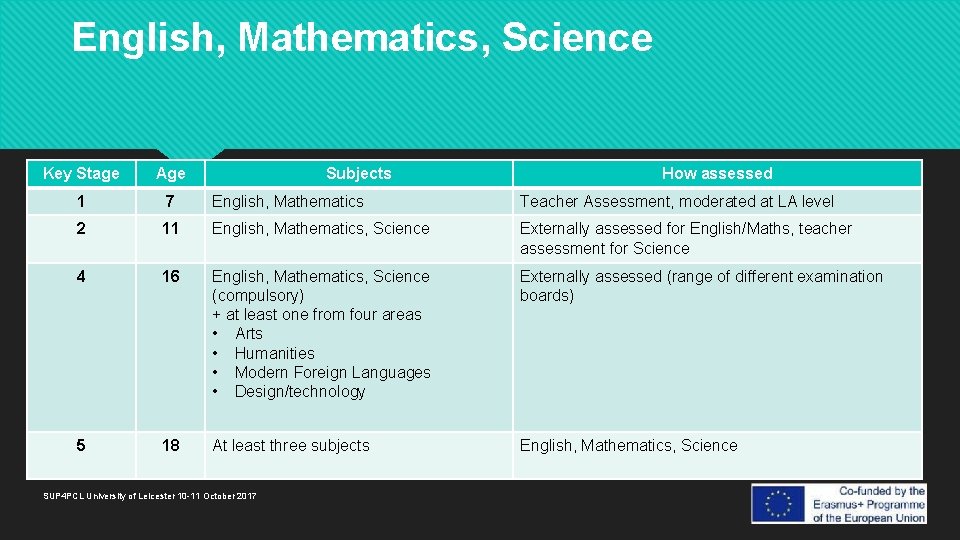
Testing and Examinations structure End of KS 1 (age 7): Standardised Assessment Tests in English and Mathematics (non-compulsory from 2023) Assessed by teachers, moderated at Local Authority level End of KS 2 (age 11): Standardised Assessment Tests in English, Mathematics and Science English and Maths externally assessed, Science by teacher assessment End of KS 4 (age 16): GCSEs Compulsory: English, Mathematics, Science Students must be offered at least one subject from these areas Arts Design and Technology Humanities Modern Foreign Languages End of KS 5 (age 18): GCE Advanced (‘A Levels’) Usually three subjects SUP 4 PCL University of Leicester 10 -11 October 2017
English, Mathematics, Science Key Stage Age Subjects 1 7 English, Mathematics Teacher Assessment, moderated at LA level 2 11 English, Mathematics, Science Externally assessed for English/Maths, teacher assessment for Science 4 16 English, Mathematics, Science (compulsory) + at least one from four areas • Arts • Humanities • Modern Foreign Languages • Design/technology Externally assessed (range of different examination boards) 5 18 At least three subjects English, Mathematics, Science SUP 4 PCL University of Leicester 10 -11 October 2017 How assessed
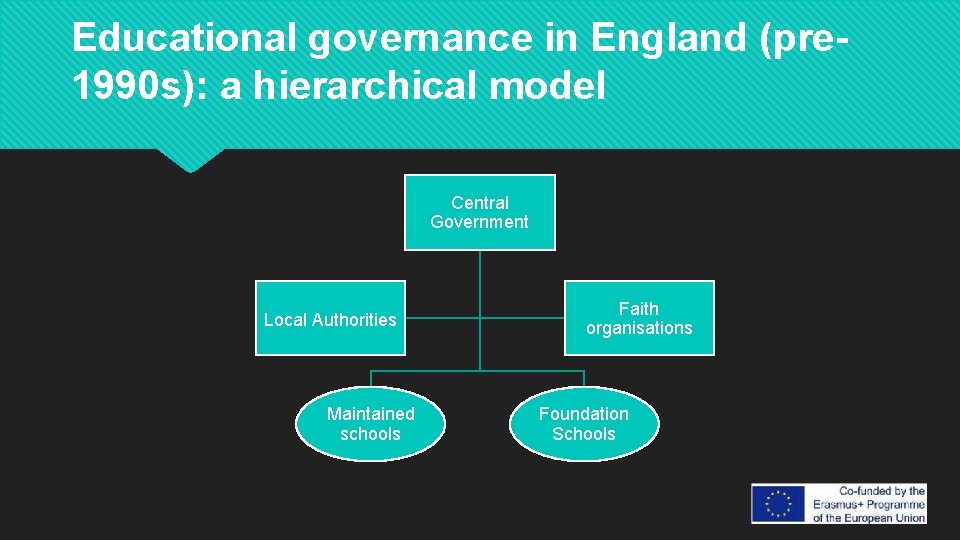
Educational governance in England (pre 1990 s): a hierarchical model Central Government Local Authorities Maintained schools Faith organisations Foundation Schools
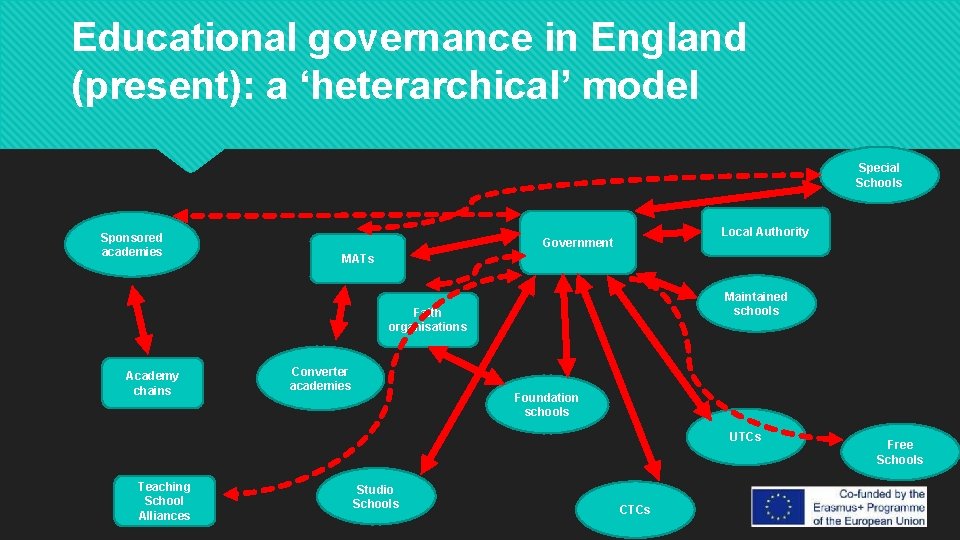
Educational governance in England (present): a ‘heterarchical’ model Special Schools Sponsored academies Local Authority Government MATs Maintained schools Faith organisations Academy chains Converter academies Foundation schools UTCs Teaching School Alliances Studio Schools CTCs Free Schools
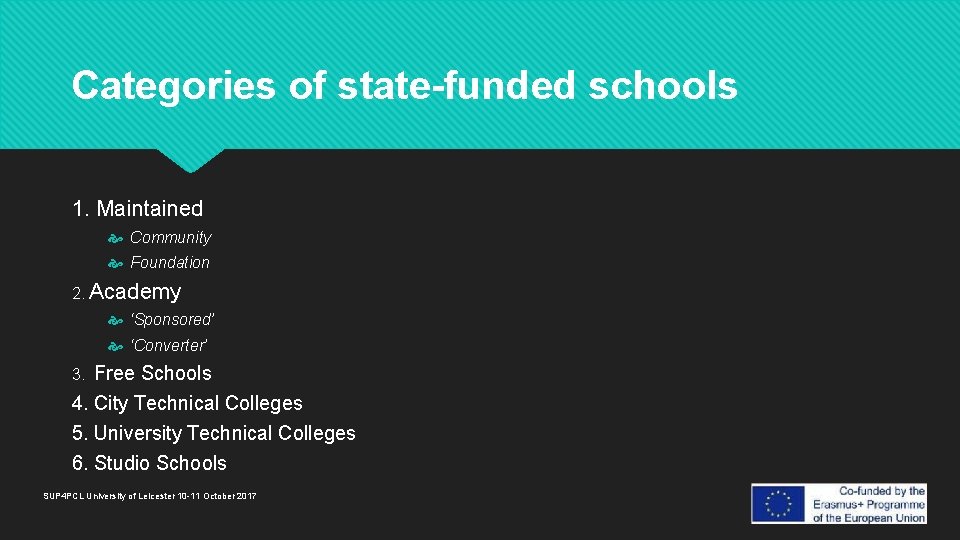
Categories of state-funded schools 1. Maintained Community Foundation 2. Academy ‘Sponsored’ ‘Converter’ Free Schools 4. City Technical Colleges 5. University Technical Colleges 6. Studio Schools 3. SUP 4 PCL University of Leicester 10 -11 October 2017
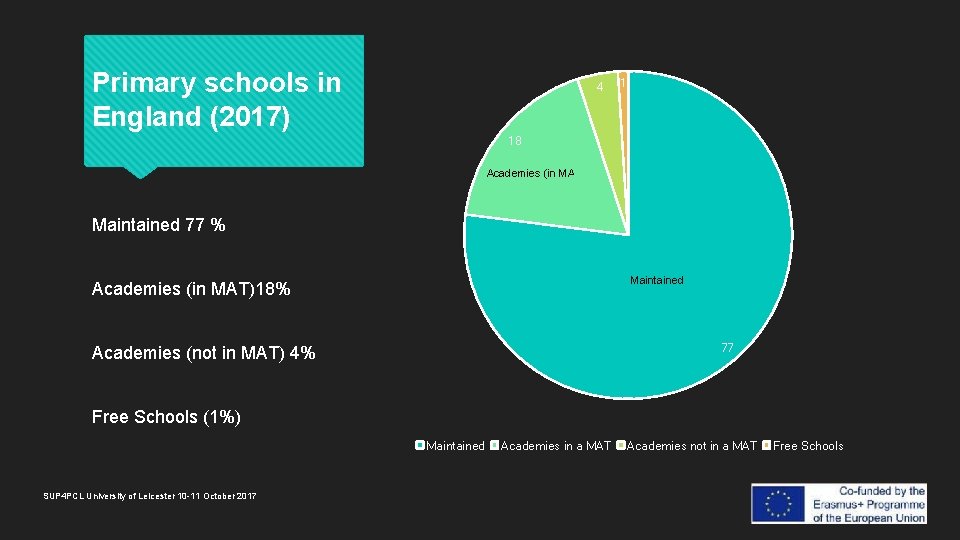
Primary schools in England (2017) 4 1 18 Academies (in MAT) Maintained 77 % Maintained Academies (in MAT)18% 77 Academies (not in MAT) 4% Free Schools (1%) Maintained SUP 4 PCL University of Leicester 10 -11 October 2017 Academies in a MAT Academies not in a MAT Free Schools
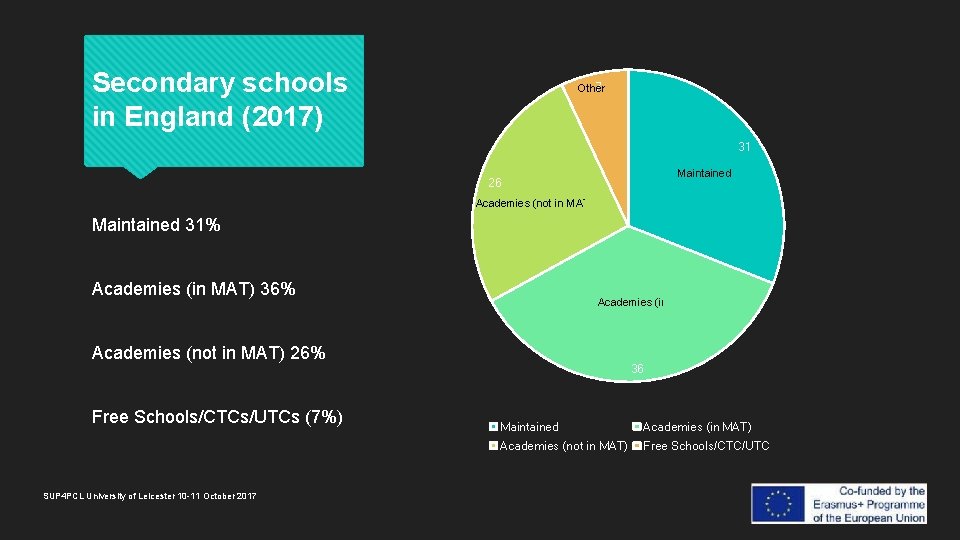
Secondary schools in England (2017) 7 Other 31 Maintained 26 Academies (not in MAT) Maintained 31% Academies (in MAT) 36% Academies (in MAT) Academies (not in MAT) 26% Free Schools/CTCs/UTCs (7%) SUP 4 PCL University of Leicester 10 -11 October 2017 36 Maintained Academies (in MAT) Academies (not in MAT) Free Schools/CTC/UTC
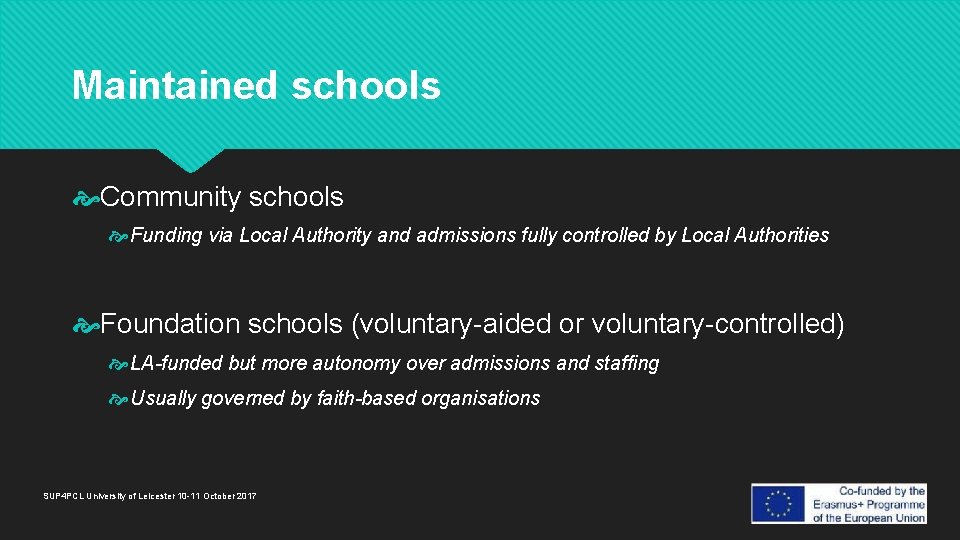
Maintained schools Community schools Funding via Local Authority and admissions fully controlled by Local Authorities Foundation schools (voluntary-aided or voluntary-controlled) LA-funded but more autonomy over admissions and staffing Usually governed by faith-based organisations SUP 4 PCL University of Leicester 10 -11 October 2017
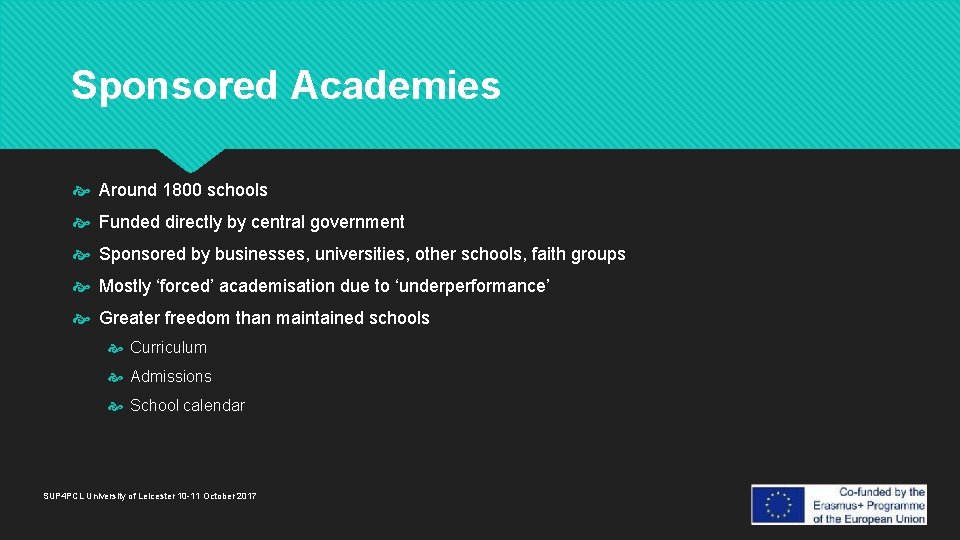
Sponsored Academies Around 1800 schools Funded directly by central government Sponsored by businesses, universities, other schools, faith groups Mostly ‘forced’ academisation due to ‘underperformance’ Greater freedom than maintained schools Curriculum Admissions School calendar SUP 4 PCL University of Leicester 10 -11 October 2017
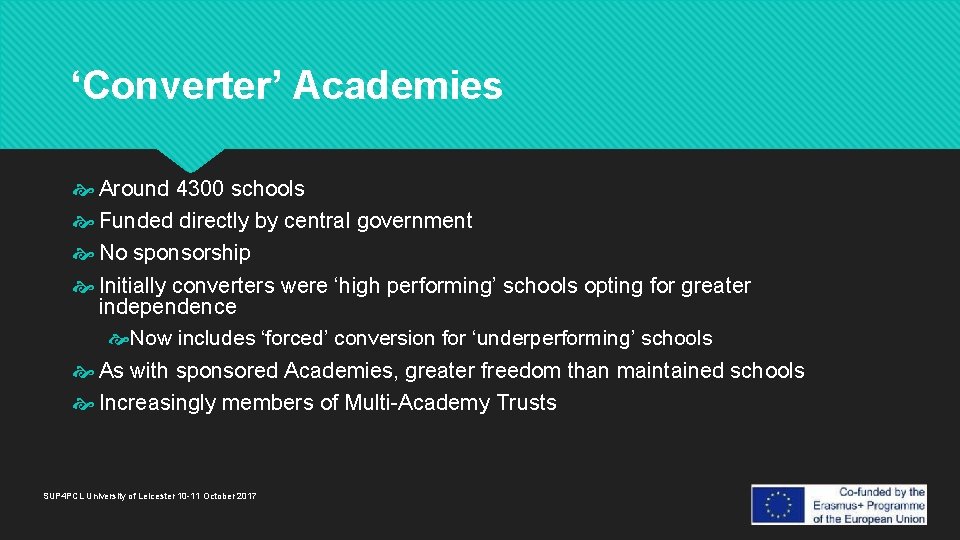
‘Converter’ Academies Around 4300 schools Funded directly by central government No sponsorship Initially converters were ‘high performing’ schools opting for greater independence Now includes ‘forced’ conversion for ‘underperforming’ schools As with sponsored Academies, greater freedom than maintained schools Increasingly members of Multi-Academy Trusts SUP 4 PCL University of Leicester 10 -11 October 2017
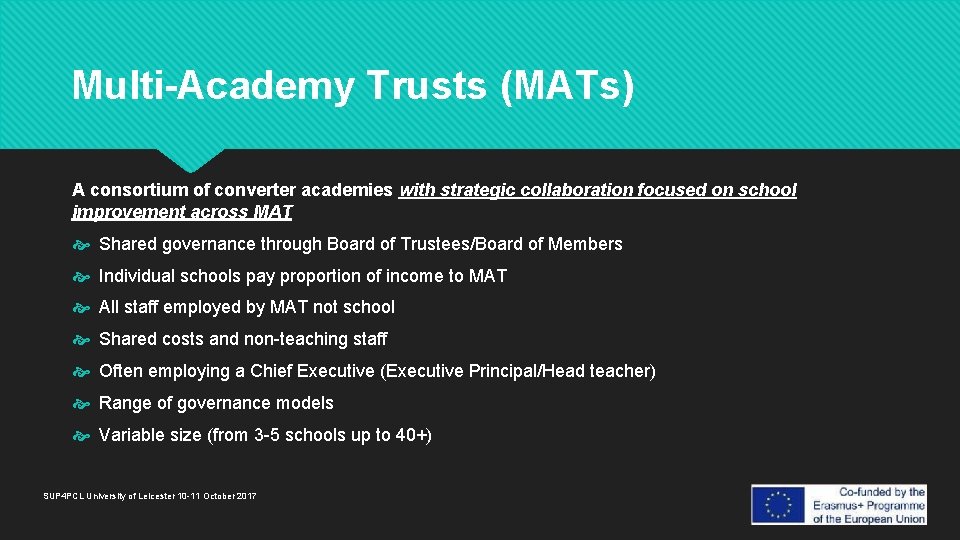
Multi-Academy Trusts (MATs) A consortium of converter academies with strategic collaboration focused on school improvement across MAT Shared governance through Board of Trustees/Board of Members Individual schools pay proportion of income to MAT All staff employed by MAT not school Shared costs and non-teaching staff Often employing a Chief Executive (Executive Principal/Head teacher) Range of governance models Variable size (from 3 -5 schools up to 40+) SUP 4 PCL University of Leicester 10 -11 October 2017
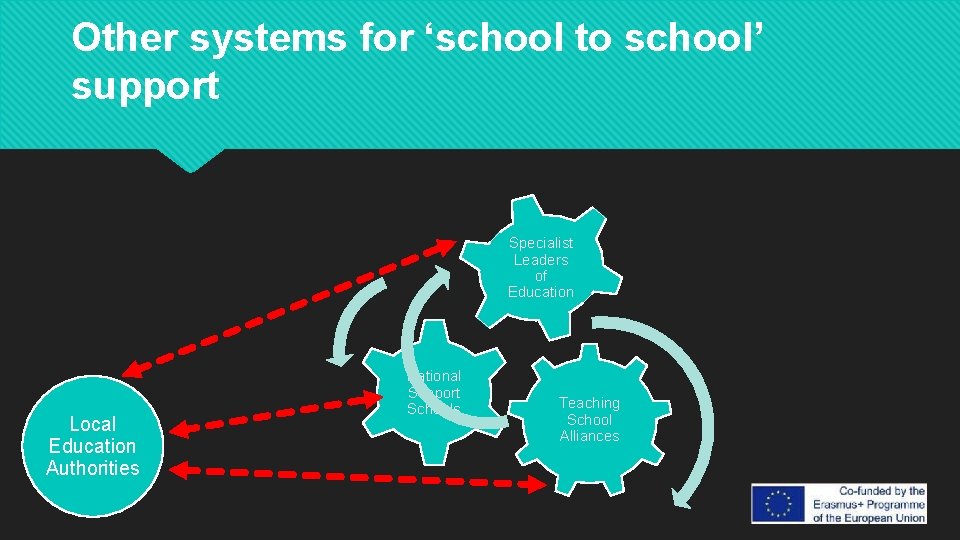
Other systems for ‘school to school’ support Specialist Leaders of Education Local Education Authorities National Support Schools Teaching School Alliances
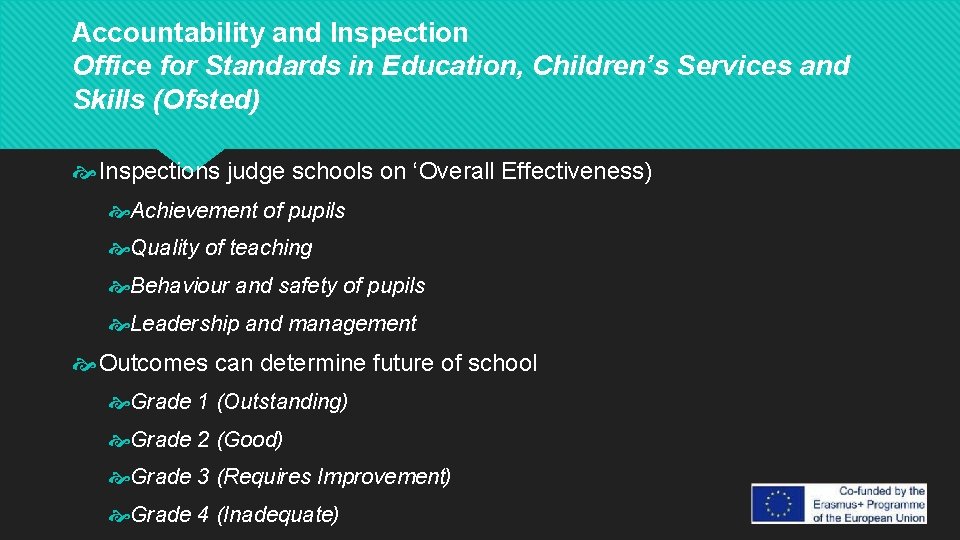
Accountability and Inspection Office for Standards in Education, Children’s Services and Skills (Ofsted) Inspections judge schools on ‘Overall Effectiveness) Achievement of pupils Quality of teaching Behaviour and safety of pupils Leadership and management Outcomes can determine future of school Grade 1 (Outstanding) Grade 2 (Good) Grade 3 (Requires Improvement) Grade 4 (Inadequate)
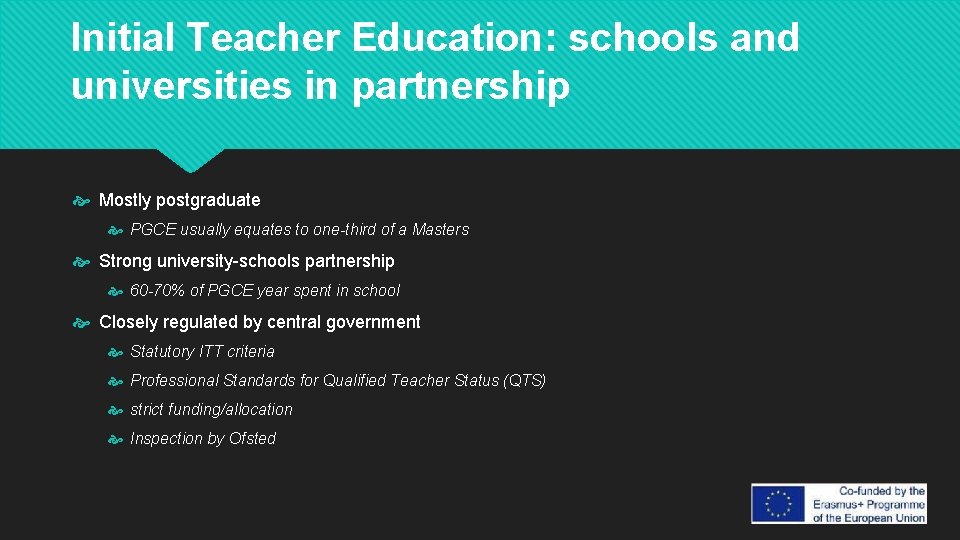
Initial Teacher Education: schools and universities in partnership Mostly postgraduate PGCE usually equates to one-third of a Masters Strong university-schools partnership 60 -70% of PGCE year spent in school Closely regulated by central government Statutory ITT criteria Professional Standards for Qualified Teacher Status (QTS) strict funding/allocation Inspection by Ofsted
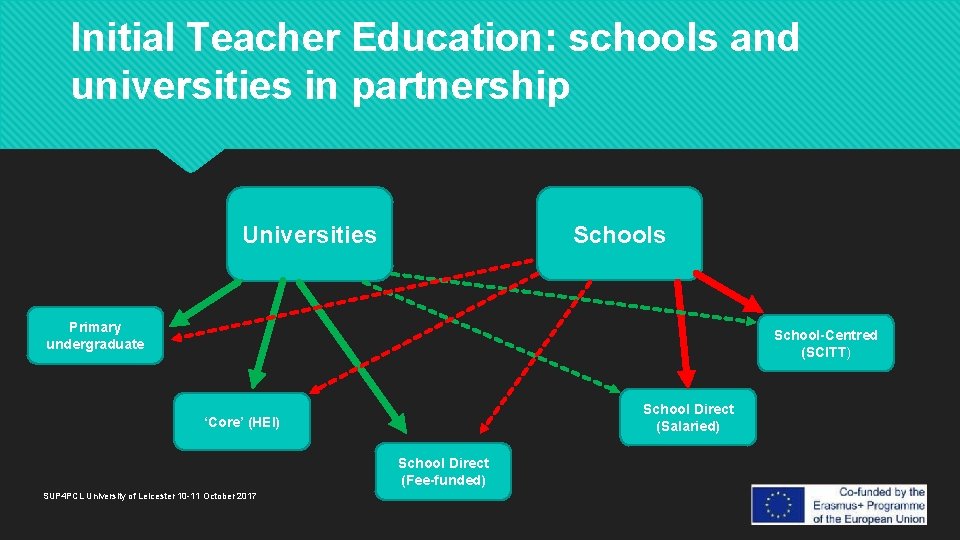
Initial Teacher Education: schools and universities in partnership Schools Universities Primary undergraduate School-Centred (SCITT) School Direct (Salaried) ‘Core’ (HEI) School Direct (Fee-funded) SUP 4 PCL University of Leicester 10 -11 October 2017
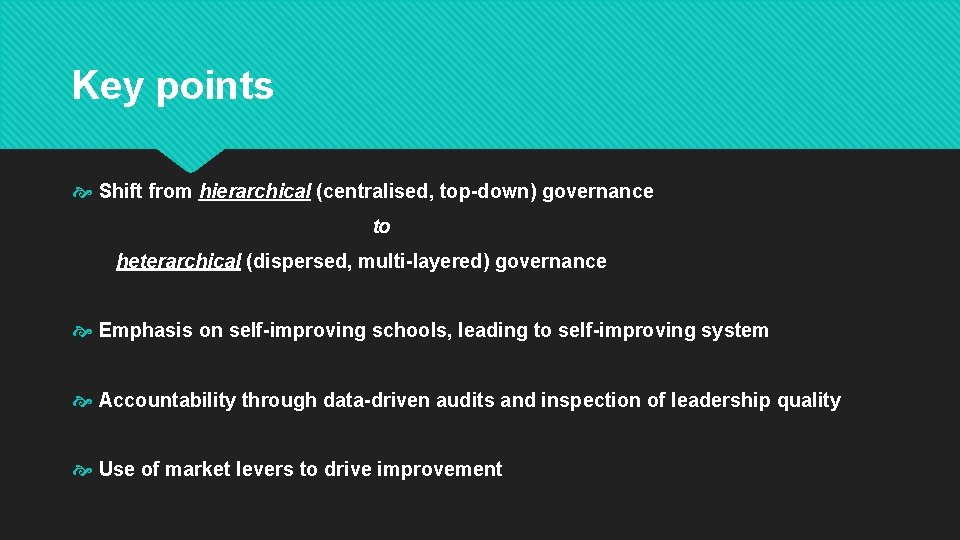
Key points Shift from hierarchical (centralised, top-down) governance to heterarchical (dispersed, multi-layered) governance Emphasis on self-improving schools, leading to self-improving system Accountability through data-driven audits and inspection of leadership quality Use of market levers to drive improvement