
Introduction to the Engineering Design Process Brenda Capobianco
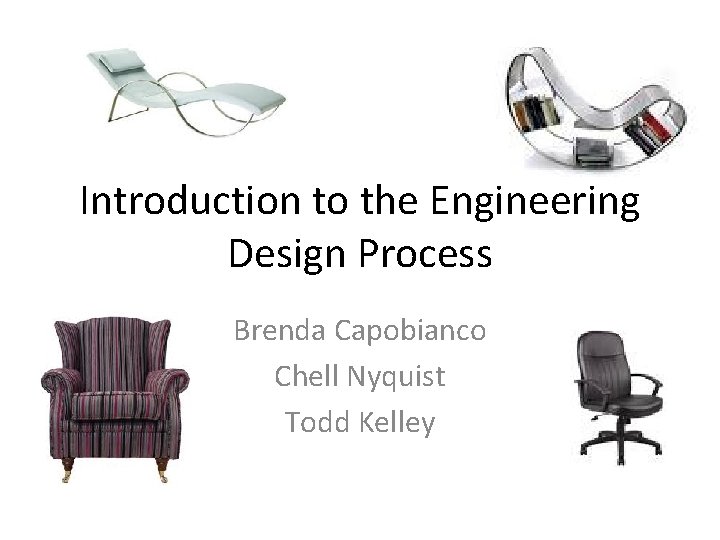
Introduction to the Engineering Design Process Brenda Capobianco Chell Nyquist Todd Kelley
Engineers • Engineers are responsible for designing many different things in the human-made world. • What might this include? • Engineers are also responsible for designing the less obvious products. • How about chairs?
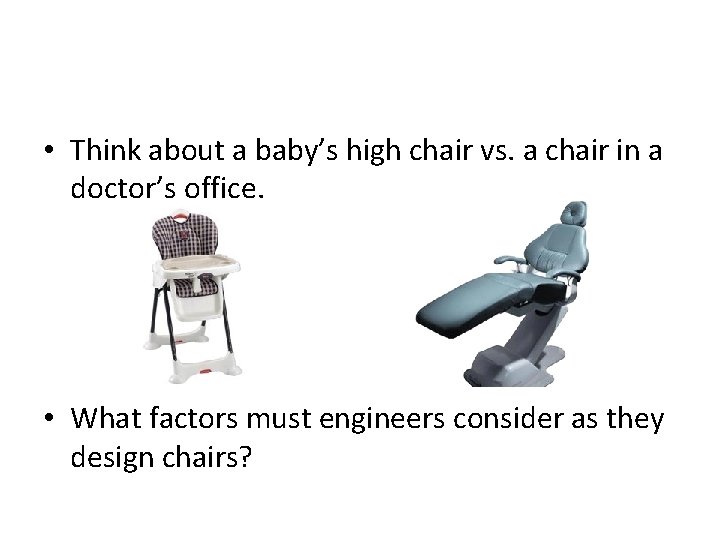
• Think about a baby’s high chair vs. a chair in a doctor’s office. • What factors must engineers consider as they design chairs?
Design a Lifeguard Chair Local authorities have recently decided to open a privately owned swimming pool to the public. A grand-opening ceremony is currently being planned and the Town Safety Inspector has ordered that lifeguard chairs be constructed so the swimming pool is up to public safety code. These new lifeguard chairs must be completed before the pool can be opened to the public. You have just been hired by the Safe Stands Company to design and construct lifeguard chair models in time for the grandopening ceremony. The chairs must be sturdy enough for the lifeguards to sit on and must be tall enough for them to patrol everyone at the pool.
Design a Lifeguard Chair Criteria • Chair must be at least 35 cm tall • Cards can be folded but not torn • No piece of tape can be longer than 5 cm • Chair cannot be taped to the floor or any other object or surface • Chair must be in one piece • Chair must support the ‘lifeguard’ for 20 seconds in an upright position Constraints • Only use the materials provided (note cards & tape)

Problem Scoping Identifying the problem • What is the problem? – Need lifeguard chairs be constructed so the swimming pool is up to public safety code. • What is the goal? – To design and construct lifeguard chair models in time for the grand-opening ceremony. • Who is the client? – Safe Stands Company • Who is the end user? – lifeguard

Problem Scoping Identifying the problem • What are the design criteria (desired features)? – – – Chair must be at least 35 cm tall Cards can be folded but not torn No piece of tape can be longer than 5 cm Chair cannot be taped to the floor or any other object or surface Chair must be in one piece Chair must support the ‘lifeguard’ for 20 seconds in an upright position • What are the design constraints? – Materials provided – Time
Idea Generation Individual Plan • Do you have enough information? • What questions do you still have? • In your design notebook, label “Individual Design” on one page • Draw a sketch of your design Include labels, perspective, scale
Questions to consider: • What are examples of chairs that come to mind? • Tables and chairs have supports to keep their legs from tilting or twisting. Look at the furniture in this room. How would you describe the supports you see? • What kinds of forces act on a chair or table? • How will these forces play a role in your design?
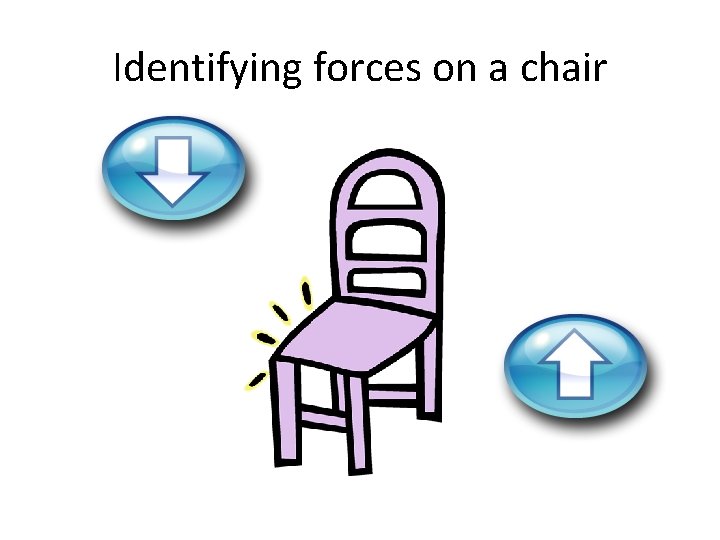
Identifying forces on a chair
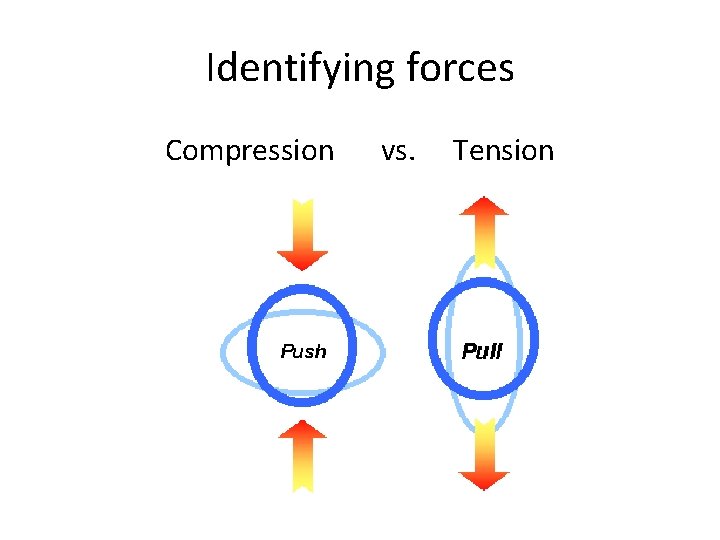
Identifying forces Compression vs. Tension
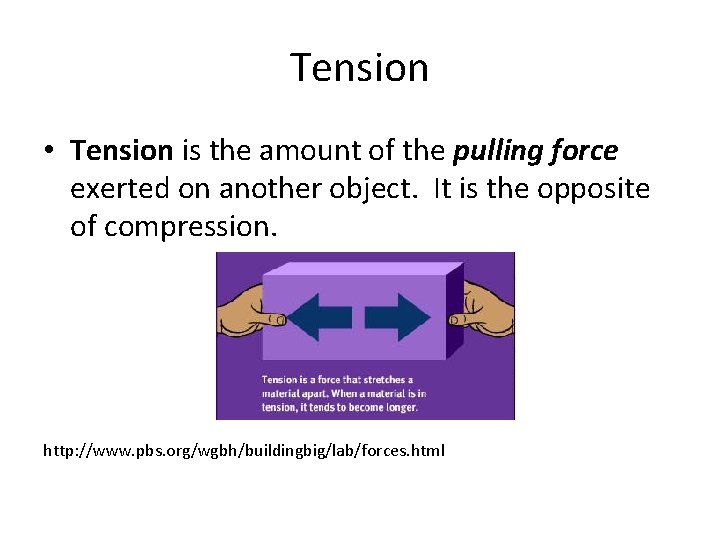
Tension • Tension is the amount of the pulling force exerted on another object. It is the opposite of compression. http: //www. pbs. org/wgbh/buildingbig/lab/forces. html

Compression is the amount of the pushing force exerted on another object. http: //www. pbs. org/wgbh/buildingbig/lab/forces. html
Questions to consider: • Looking at the materials, how can you use these materials to make a chair that is at least 35 cm (12 in) tall and strong enough to hold a lifeguard (stuffed animal)? • What can you do to prevent your chair from: – Tilting and twisting – Wobbling – Collapsing
Idea Generation Team Design • In your design notebook, label “Team Design” on next page. • Share your plan with members of your design team. • Agree on one design. Draw a sketch of your team design and create a list of materials you will need (and cost).
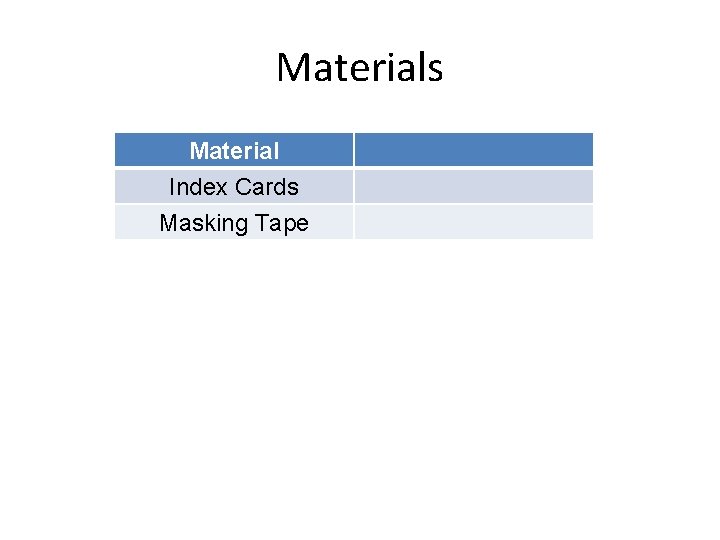
Materials Material Index Cards Masking Tape
Solution Production and Performance Construct and Test • You will have 15 minutes to construct • Keep in mind: – You must follow your team design – Use only the materials provided – Note any modifications you wish to make to your design
Solution Production and Performance Construct and Test • How are we going to test our designs? Test Conditions • Place Lifeguard (stuffed animal) on the chair. • Let go and time for 30 seconds. • Record results.
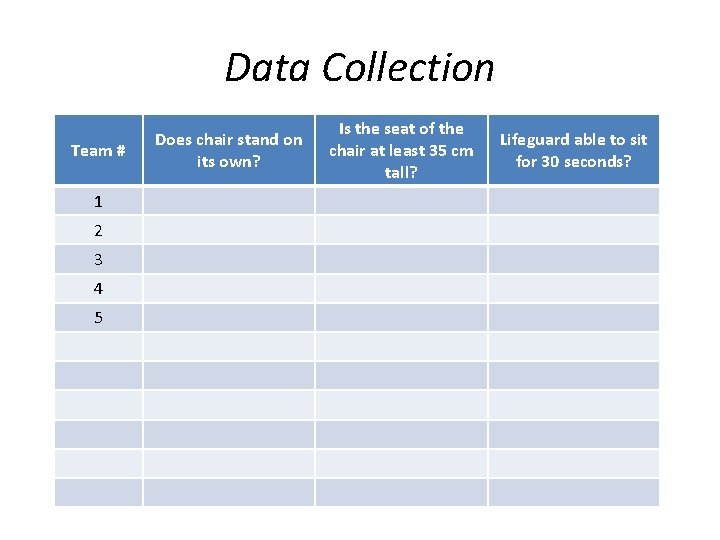
Data Collection Team # 1 2 3 4 5 Does chair stand on its own? Is the seat of the chair at least 35 cm tall? Lifeguard able to sit for 30 seconds?
Communication Share Results • What were your results? – What was the actual weight the bag could hold and the estimated volume of the bag? • Did your team’s design meet the client’s needs? • In what ways did your team use what you know about forces to inform your design?
Optimization Improve and Re-design • In what ways could you improve your design? • What is one feature you could re-design? • To what extent could your re-design improve your results?
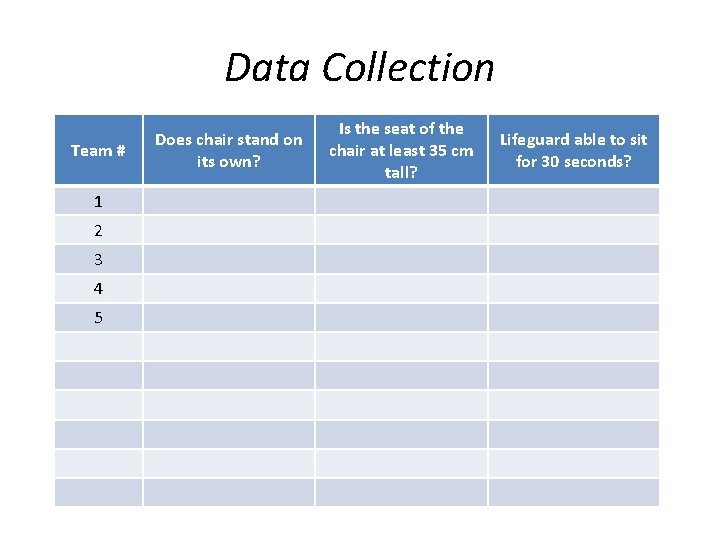
Data Collection Team # 1 2 3 4 5 Does chair stand on its own? Is the seat of the chair at least 35 cm tall? Lifeguard able to sit for 30 seconds?
Student Work
Literacy • Books – Toy Boat
Assessment
- Slides: 25