
Introduction to the Endowment Spending Policy September 2020
Introduction to the Endowment Spending Policy September 2020
Introduction – Endowment Spending Policy Spending from the Yale Endowment Ø Each year a portion of accumulated Endowment investment returns is allocated to support the University’s activities. This important source of revenue represents 33. 6% of total operating revenue this year, and it remains the largest source of operating revenue for the University. Endowment income provides essential support for financial aid, professorships, and other costs of teaching and research. Ø The level of spending is determined by using an Endowment spending policy that smooths year-to-year market swings. In 2020 the Endowment investment returns allocated to operating activities was $1, 437 million, an increase of 6. 2% over the previous year. What is the objective of the Yale Endowment spending policy? Ø The University adopted a policy specifically designed to stabilize annual spending levels and to achieve intergenerational neutrality by preserving the real value of the endowment portfolio over time. Ø To achieve these two objectives the spending policy uses a long-term targeted spending rate combined with a smoothing rule. The smoothing rule adjusts spending gradually when there are changes in the endowment market value. 2
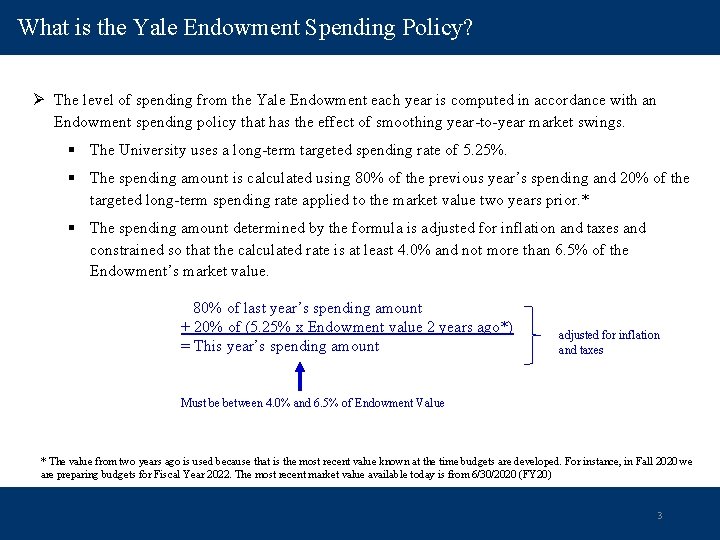
What is the Yale Endowment Spending Policy? Ø The level of spending from the Yale Endowment each year is computed in accordance with an Endowment spending policy that has the effect of smoothing year-to-year market swings. § The University uses a long-term targeted spending rate of 5. 25%. § The spending amount is calculated using 80% of the previous year’s spending and 20% of the targeted long-term spending rate applied to the market value two years prior. * § The spending amount determined by the formula is adjusted for inflation and taxes and constrained so that the calculated rate is at least 4. 0% and not more than 6. 5% of the Endowment’s market value. 80% of last year’s spending amount + 20% of (5. 25% x Endowment value 2 years ago*) = This year’s spending amount adjusted for inflation and taxes Must be between 4. 0% and 6. 5% of Endowment Value * The value from two years ago is used because that is the most recent value known at the time budgets are developed. For instance, in Fall 2020 we are preparing budgets for Fiscal Year 2022. The most recent market value available today is from 6/30/2020 (FY 20) 3
The Endowment Provides the Largest Source of Revenue for Yale § In Fiscal Year 2020 (academic year 2019 -20) the Endowment contributed $1. 4 billion of income or 33. 6% of total operating revenues. § Over the past five years Yale has spent more than $5 billion from the Endowment or approximately one-quarter of its market value, and in the next five years Yale expects to spend a similar portion of the Endowment once again – and continue to do so into the future. § Even with this significant level of spending, the Yale Endowment has more than maintained its value, allowing Yale to continue to grow support for financial aid, research, and education programs. § That means the Yale Investments Office must generate investment returns each year that allow for this level of spending (over $1 billion of spending per year currently) while also keeping pace with inflation. 4

The Endowment Spending Policy - Overview Additional background on the Yale spending policy Ø The twin objectives: § Intergenerational neutrality (slide 6), including how much the Endowment needs to earn to maintain the same level of support for the operating budget from year to year (slide 7) § Smoothing (slide 8), including what happens if the Endowment has a higher or lower investment return than expected (slide 9) Ø Endowment math: how the calculation works (slide 10) Ø What has happened to the market value of the Yale Endowment over time (slide 11) Ø How much has been spent from the Yale Endowment over time and for what purpose (slide 12) 5

The Endowment Spending Policy (1): Intergenerational Neutrality What is intergenerational neutrality? Ø The benefits of the Endowment should be spread equally across all generations (neither over- nor under-spend on the current and future generations of students and scholars). Ø We are the stewards for all future generations. Intergenerational neutrality in practice: the target spending rate. Ø Each year we target to spend 5. 25%. An Implication: maintaining the status quo requires significant annual returns Ø Since we spend 5. 25% each year and inflation (HEPI) is about 3% each year, we need annual endowment returns of approximately 8. 25% per cent just to stand still. 6
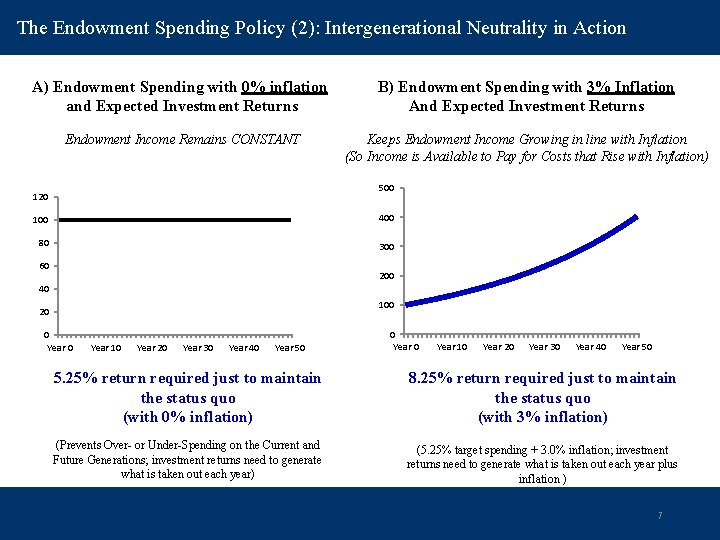
The Endowment Spending Policy (2): Intergenerational Neutrality in Action A) Endowment Spending with 0% inflation and Expected Investment Returns B) Endowment Spending with 3% Inflation And Expected Investment Returns Endowment Income Remains CONSTANT Keeps Endowment Income Growing in line with Inflation (So Income is Available to Pay for Costs that Rise with Inflation) 500 120 100 400 80 300 60 200 40 100 20 0 Year 10 Year 20 Year 30 Year 40 Year 50 5. 25% return required just to maintain the status quo (with 0% inflation) 8. 25% return required just to maintain the status quo (with 3% inflation) (Prevents Over- or Under-Spending on the Current and Future Generations; investment returns need to generate what is taken out each year) (5. 25% target spending + 3. 0% inflation; investment returns need to generate what is taken out each year plus inflation ) 7
The Endowment Spending Policy (3): Smoothing Why do we smooth the spending? Ø Endowment returns are volatile. Ø University spending is difficult to change. Smoothing in practice: the Smoothing Rule Ø What we actually spend is: [80% of last year’s spending] + [20% of the updated* target] (all adjusted for inflation and taxes) Ø *The target for 2021 -22 is based on the endowment market value on 6/30/20. 8
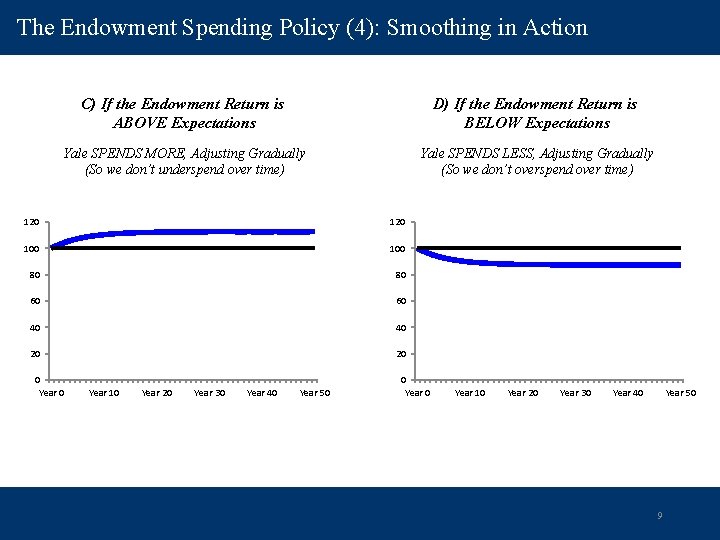
The Endowment Spending Policy (4): Smoothing in Action C) If the Endowment Return is ABOVE Expectations D) If the Endowment Return is BELOW Expectations Yale SPENDS MORE, Adjusting Gradually (So we don’t underspend over time) Yale SPENDS LESS, Adjusting Gradually (So we don’t overspend over time) 120 100 80 80 60 60 40 40 20 20 0 Year 10 Year 20 Year 30 Year 40 Year 50 9
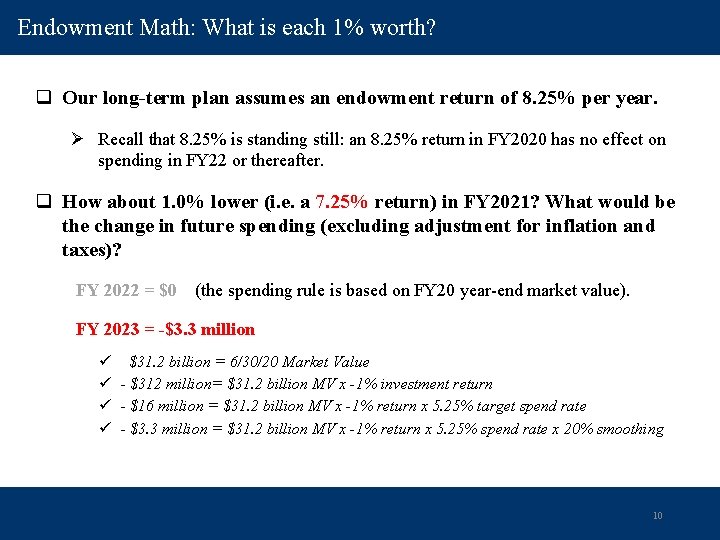
Endowment Math: What is each 1% worth? q Our long-term plan assumes an endowment return of 8. 25% per year. Ø Recall that 8. 25% is standing still: an 8. 25% return in FY 2020 has no effect on spending in FY 22 or thereafter. q How about 1. 0% lower (i. e. a 7. 25% return) in FY 2021? What would be the change in future spending (excluding adjustment for inflation and taxes)? FY 2022 = $0 (the spending rule is based on FY 20 year-end market value). FY 2023 = -$3. 3 million ü $31. 2 billion = 6/30/20 Market Value ü - $312 million= $31. 2 billion MV x -1% investment return ü - $16 million = $31. 2 billion MV x -1% return x 5. 25% target spend rate ü - $3. 3 million = $31. 2 billion MV x -1% return x 5. 25% spend rate x 20% smoothing 10
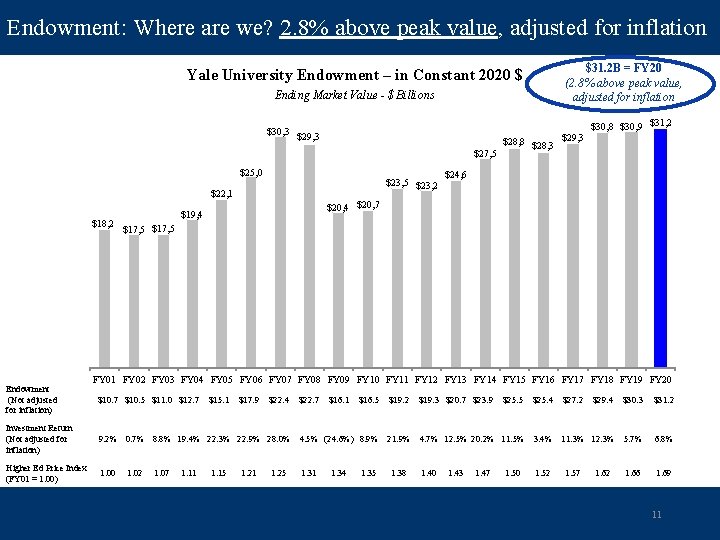
Endowment: Where are we? 2. 8% above peak value, adjusted for inflation $31. 2 B = FY 20 (2. 8% above peak value, adjusted for inflation Yale University Endowment – in Constant 2020 $ Ending Market Value - $ Billions $30, 8 $30, 9 $31, 2 $30, 3 $29, 3 $27, 5 $25, 0 $23, 5 $23, 2 $22, 1 $18, 2 Endowment (Not adjusted for inflation) $28, 8 $28, 3 $29, 3 $24, 6 $20, 4 $20, 7 $19, 4 $17, 5 FY 01 FY 02 FY 03 FY 04 FY 05 FY 06 FY 07 FY 08 FY 09 FY 10 FY 11 FY 12 FY 13 FY 14 FY 15 FY 16 FY 17 FY 18 FY 19 FY 20 $10. 7 $10. 5 $11. 0 $12. 7 $15. 1 $17. 9 $22. 4 $22. 7 $16. 1 $16. 5 $19. 2 $19. 3 $20. 7 $23. 9 $25. 5 $25. 4 $27. 2 $29. 4 $30. 3 $31. 2 21. 9% 4. 7% 12. 5% 20. 2% 11. 5% 3. 4% 11. 3% 12. 3% 5. 7% 6. 8% 1. 40 1. 52 1. 66 1. 69 Investment Return (Not adjusted for inflation) 9. 2% 0. 7% 8. 8% 19. 4% 22. 3% 22. 9% 28. 0% 4. 5% (24. 6%) 8. 9% Higher Ed Price Index (FY 01 = 1. 00) 1. 00 1. 31 1. 02 1. 07 1. 11 1. 15 1. 21 1. 25 1. 34 1. 35 1. 38 1. 43 1. 47 1. 50 1. 57 1. 62 11
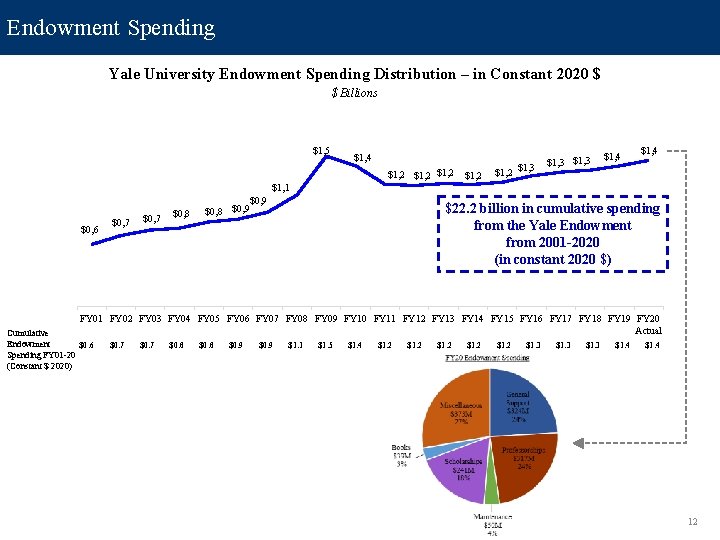
Endowment Spending Yale University Endowment Spending Distribution – in Constant 2020 $ $ Billions $1, 5 $1, 4 $1, 2 $1, 2 $1, 3 $1, 4 $1, 1 $0, 6 $0, 7 $0, 8 $0, 9 $22. 2 billion in cumulative spending from the Yale Endowment from 2001 -2020 (in constant 2020 $) FY 01 FY 02 FY 03 FY 04 FY 05 FY 06 FY 07 FY 08 FY 09 FY 10 FY 11 FY 12 FY 13 FY 14 FY 15 FY 16 FY 17 FY 18 FY 19 FY 20 Actual Cumulative Endowment $0. 6 Spending FY 01 -20 (Constant $ 2020) $0. 7 $0. 8 $0. 9 $1. 1 $1. 5 $1. 4 $1. 2 $1. 3 $1. 4 12

For questions, please contact the Office of Financial Planning and Analysis at budget@yale. edu. 13
- Slides: 13