
Introduction to the ELALiteracy Shifts of the Common
- Slides: 120
Introduction to the ELA/Literacy Shifts of the Common Core State Standards Grades 6 -8 Leadership
Grades 6 -8 Leadership Introduction: Who I am
“I tell my students, 'When you get these jobs that you have been so brilliantly trained for, just remember that your real job is that if you are free, you need to free somebody else. If you have some power, then your job is to empower somebody else. This is not just a grab-bag candy game. ” -Toni Morrison
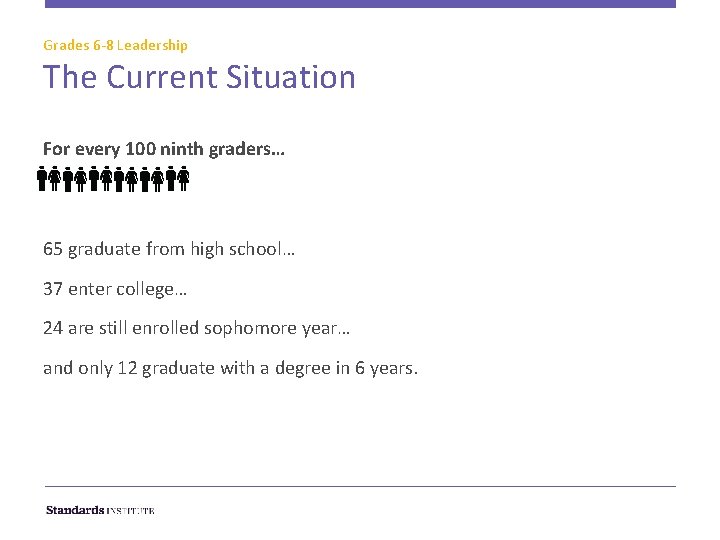
Grades 6 -8 Leadership The Current Situation For every 100 ninth graders… 65 graduate from high school… 37 enter college… 24 are still enrolled sophomore year… and only 12 graduate with a degree in 6 years.
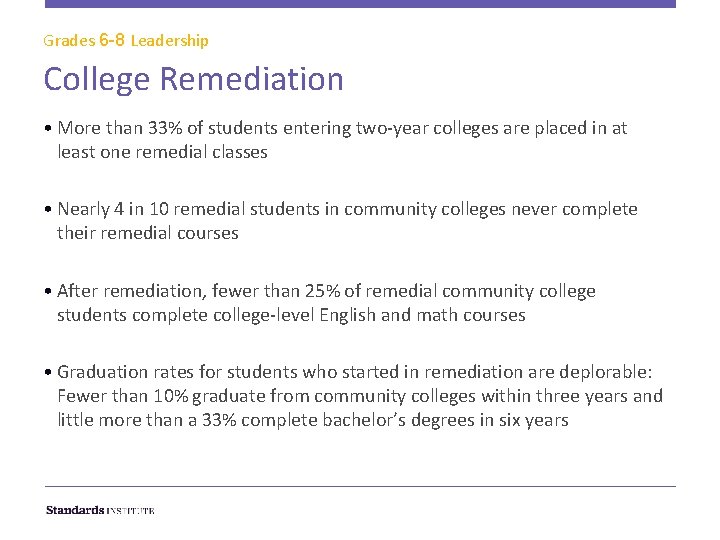
Grades 6 -8 Leadership College Remediation • More than 33% of students entering two-year colleges are placed in at least one remedial classes • Nearly 4 in 10 remedial students in community colleges never complete their remedial courses • After remediation, fewer than 25% of remedial community college students complete college-level English and math courses • Graduation rates for students who started in remediation are deplorable: Fewer than 10% graduate from community colleges within three years and little more than a 33% complete bachelor’s degrees in six years
Grades 6 -8 Leadership Common Core Previously standards, assessments and instruction were not: • Rigorous enough to prepare students for success in college and careers • Aligned to the skills professors and employers say are needed to thrive in a global economy Common Core standards are fewer, clearer, and more rigorous. • Aligned to requirements for college and career preparedness • Based on evidence 6
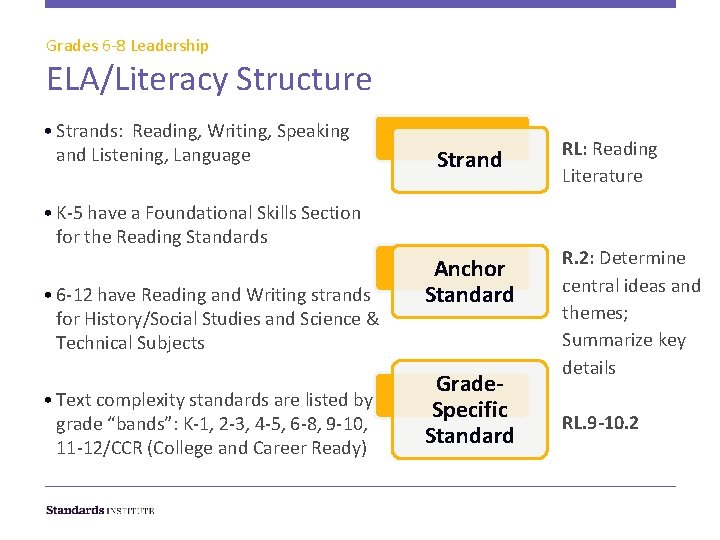
Grades 6 -8 Leadership ELA/Literacy Structure • Strands: Reading, Writing, Speaking and Listening, Language Strand • K-5 have a Foundational Skills Section for the Reading Standards • 6 -12 have Reading and Writing strands for History/Social Studies and Science & Technical Subjects • Text complexity standards are listed by grade “bands”: K-1, 2 -3, 4 -5, 6 -8, 9 -10, 11 -12/CCR (College and Career Ready) Anchor Standard Grade. Specific Standard RL: Reading Literature R. 2: Determine central ideas and themes; Summarize key details RL. 9 -10. 2 7
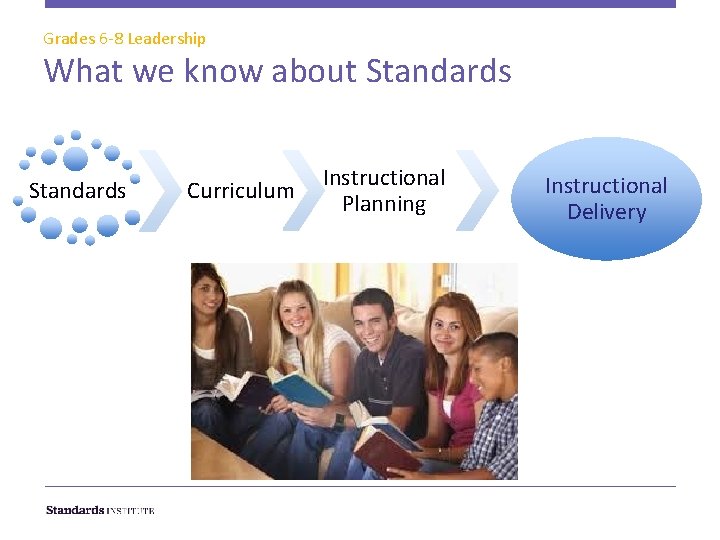
Grades 6 -8 Leadership What we know about Standards Curriculum Instructional Planning Instructional Delivery 8
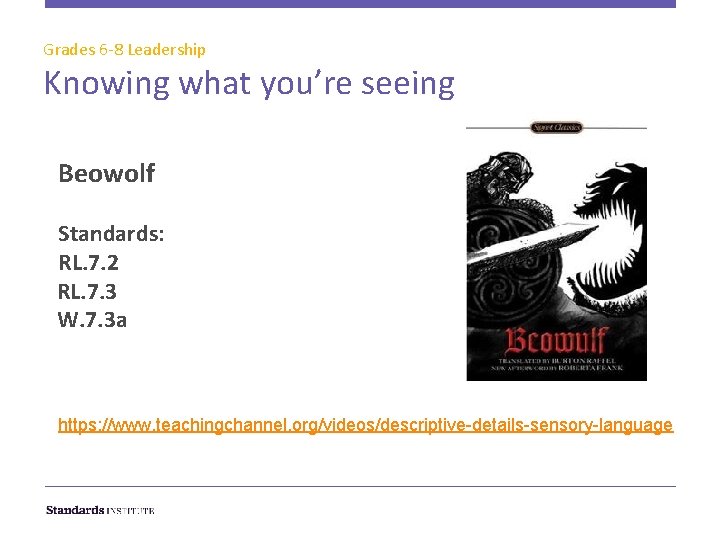
Grades 6 -8 Leadership Knowing what you’re seeing Beowolf Standards: RL. 7. 2 RL. 7. 3 W. 7. 3 a https: //www. teachingchannel. org/videos/descriptive-details-sensory-language
Grades 9 -12 Leadership In what ways is this task designed for students to meet the entirety of each Standard? Think about your “look-fors” and cite evidence from the video. RL 7. 2 Determine a theme or central idea of a text and analyze its development over the course of the text; provide an objective summary of the text. RL 7. 3 Analyze how particular elements of a story or drama interact (e. g. , how setting shapes the characters or plot). W 7. 3 a Engage and orient the reader by establishing a context and point of view and introducing a narrator and/or characters; organize an event sequence that unfolds naturally and logically.
Common Core State Standards for ELA/Literacy Key Shifts 11
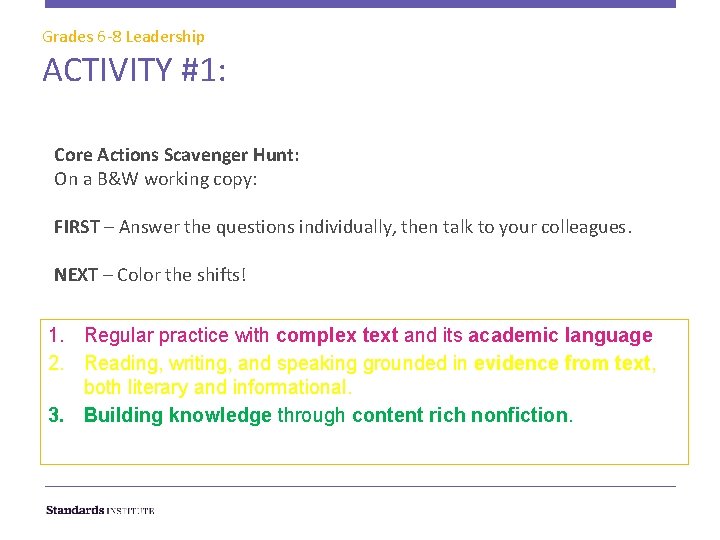
Grades 6 -8 Leadership The CCSS Requires Three Shifts in ELA/Literacy • Regular practice with complex text and its academic language • Reading, writing and speaking grounded in evidence from text, both literary and informational • Building knowledge through content-rich nonfiction 12
Shift #1: Regular practice with complex text and its academic language 13
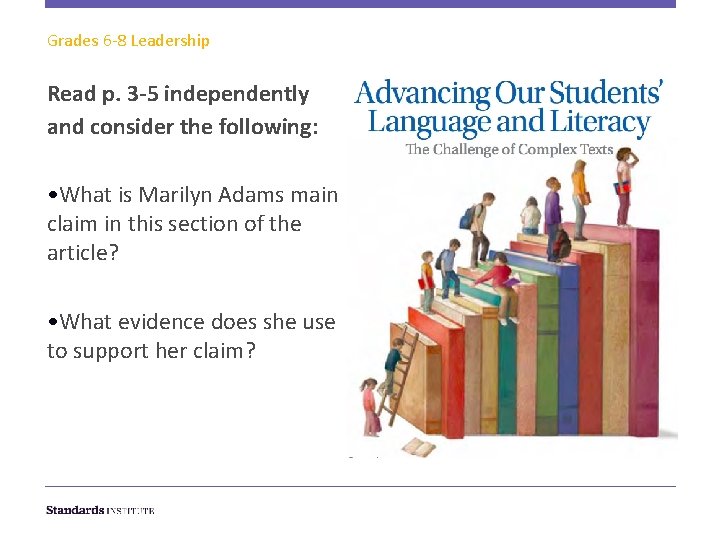
Grades 6 -8 Leadership Read p. 3 -5 independently and consider the following: • What is Marilyn Adams main claim in this section of the article? • What evidence does she use to support her claim? 14
Grades 6 -8 Leadership Regular Practice With Complex Text and its Academic Language: Why? • Gap between complexity of college and high school texts • What students can read, in terms of complexity is the greatest predictor of success in college (ACT study) • Too many students are reading at too low a level. (<50% of graduates can read sufficiently complex texts) Solutions: • Standards include a staircase of increasing text complexity from elementary through high school backwards-mapped from requirements for college texts • Standards also focus on building general academic vocabulary, which is so critical to comprehension 15
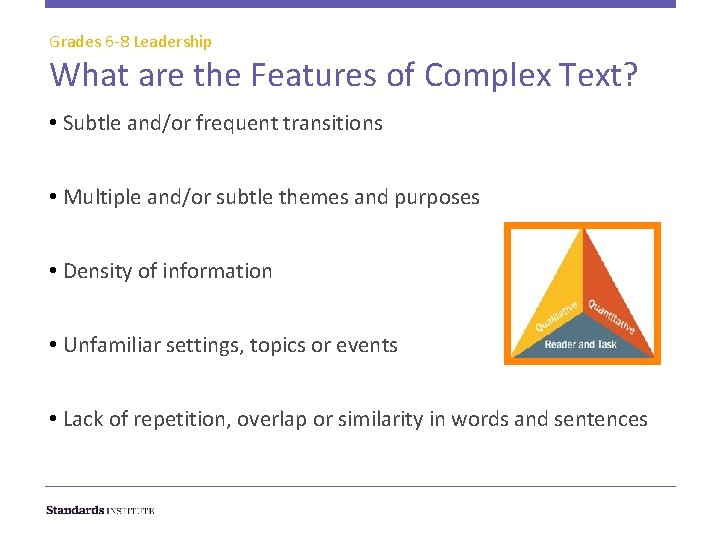
Grades 6 -8 Leadership What are the Features of Complex Text? • Subtle and/or frequent transitions • Multiple and/or subtle themes and purposes • Density of information • Unfamiliar settings, topics or events • Lack of repetition, overlap or similarity in words and sentences • Complex sentences • Uncommon vocabulary • Lack of words, sentences or paragraphs that review or pull things together for the student • Longer paragraphs • Any text structure which is less narrative and/or mixes structures 16
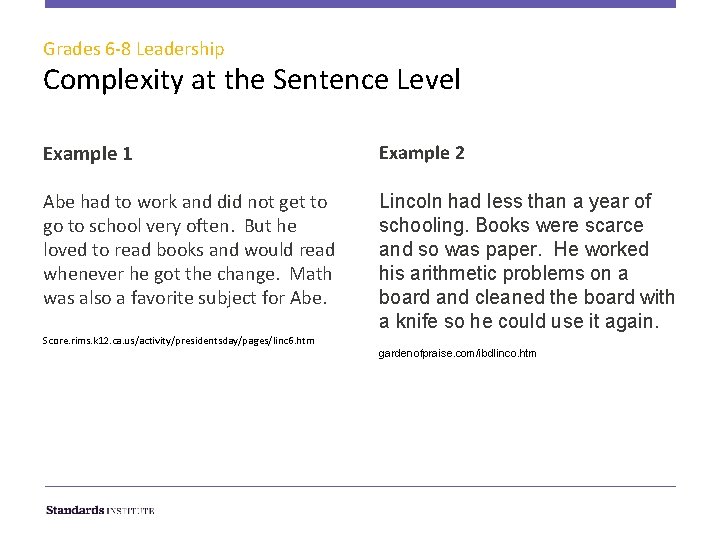
Grades 6 -8 Leadership Complexity at the Sentence Level Example 1 Example 2 Abe had to work and did not get to go to school very often. But he loved to read books and would read whenever he got the change. Math was also a favorite subject for Abe. Lincoln had less than a year of schooling. Books were scarce and so was paper. He worked his arithmetic problems on a board and cleaned the board with a knife so he could use it again. Score. rims. k 12. ca. us/activity/presidentsday/pages/linc 6. htm gardenofpraise. com/ibdlinco. htm
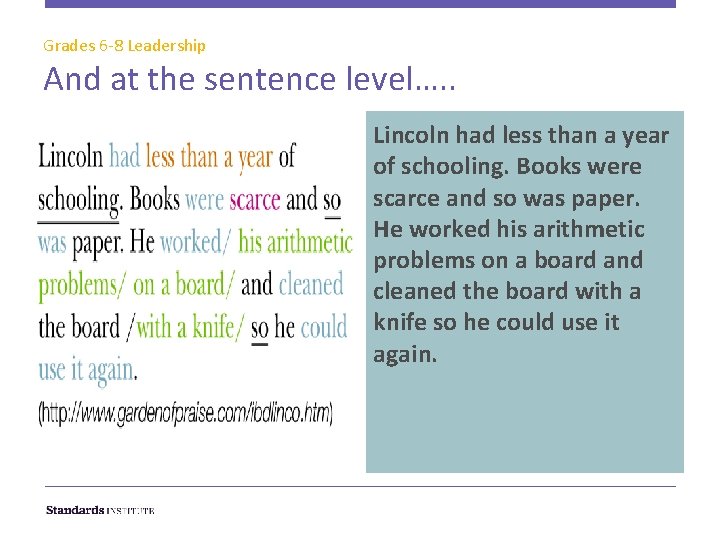
Grades 6 -8 Leadership And at the sentence level…. . Lincoln had less than a year of schooling. Books were scarce and so was paper. He worked his arithmetic problems on a board and cleaned the board with a knife so he could use it again.
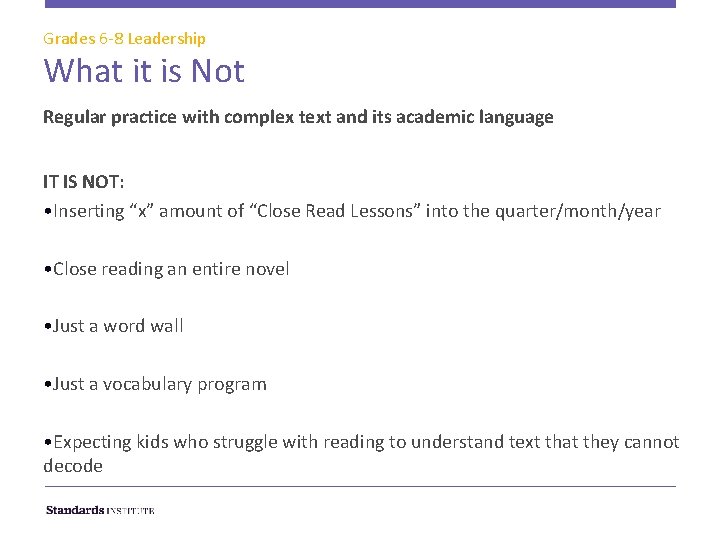
Grades 6 -8 Leadership What it is Not Regular practice with complex text and its academic language IT IS NOT: • Inserting “x” amount of “Close Read Lessons” into the quarter/month/year • Close reading an entire novel • Just a word wall • Just a vocabulary program • Expecting kids who struggle with reading to understand text that they cannot decode
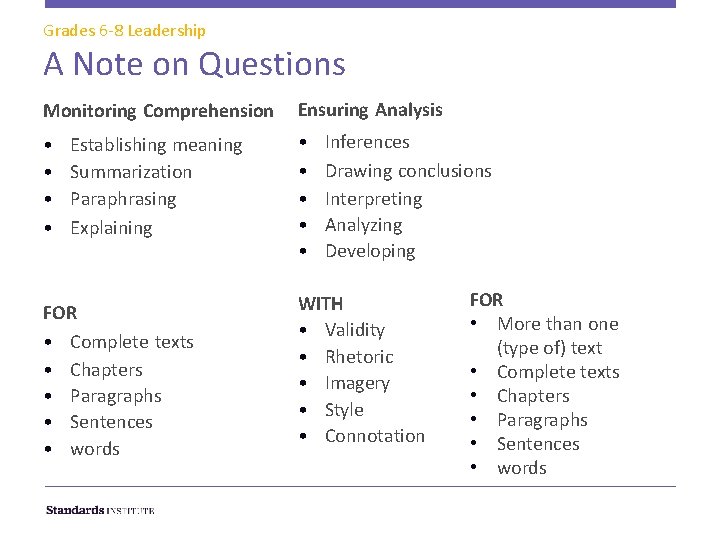
Grades 6 -8 Leadership A Note on Questions Monitoring Comprehension Ensuring Analysis • • Establishing meaning Summarization Paraphrasing Explaining FOR • Complete texts • Chapters • Paragraphs • Sentences • words • • • Inferences Drawing conclusions Interpreting Analyzing Developing WITH • Validity • Rhetoric • Imagery • Style • Connotation FOR • More than one (type of) text • Complete texts • Chapters • Paragraphs • Sentences • words
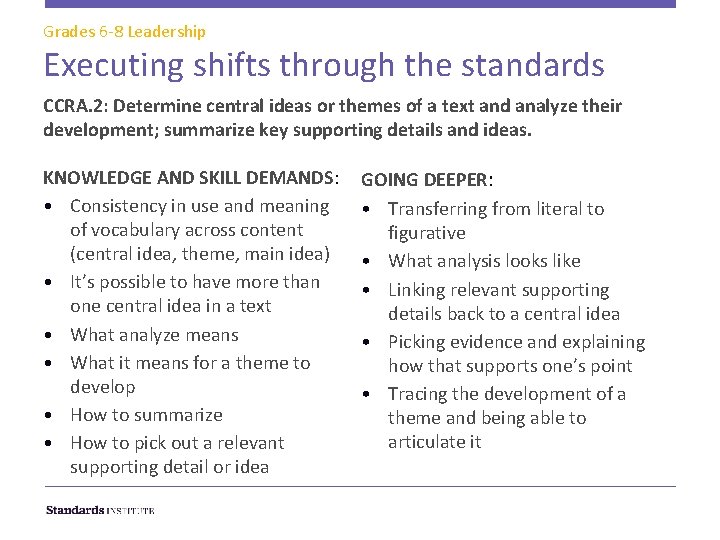
Grades 6 -8 Leadership Executing shifts through the standards CCRA. 2: Determine central ideas or themes of a text and analyze their development; summarize key supporting details and ideas. KNOWLEDGE AND SKILL DEMANDS: • Consistency in use and meaning of vocabulary across content (central idea, theme, main idea) • It’s possible to have more than one central idea in a text • What analyze means • What it means for a theme to develop • How to summarize • How to pick out a relevant supporting detail or idea GOING DEEPER: • Transferring from literal to figurative • What analysis looks like • Linking relevant supporting details back to a central idea • Picking evidence and explaining how that supports one’s point • Tracing the development of a theme and being able to articulate it
Shift #2: Reading, Writing, and Speaking Grounded in Evidence From Text, Both Literary and Informational 22
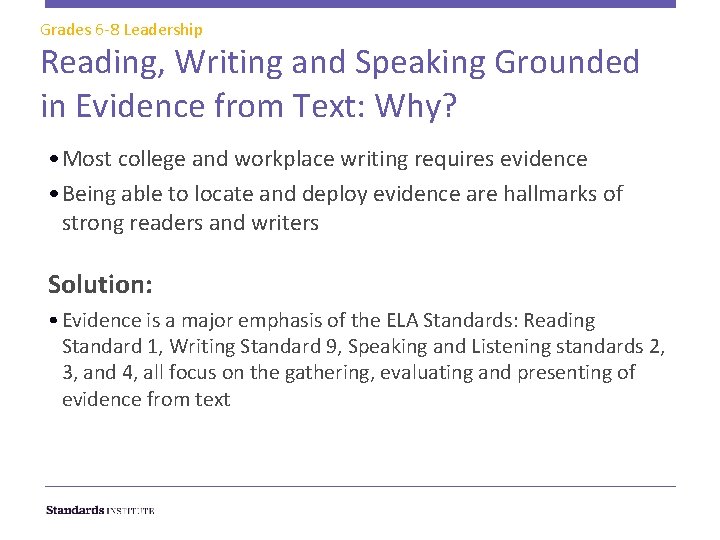
Grades 6 -8 Leadership Reading, Writing and Speaking Grounded in Evidence from Text: Why? • Most college and workplace writing requires evidence • Being able to locate and deploy evidence are hallmarks of strong readers and writers Solution: • Evidence is a major emphasis of the ELA Standards: Reading Standard 1, Writing Standard 9, Speaking and Listening standards 2, 3, and 4, all focus on the gathering, evaluating and presenting of evidence from text 23
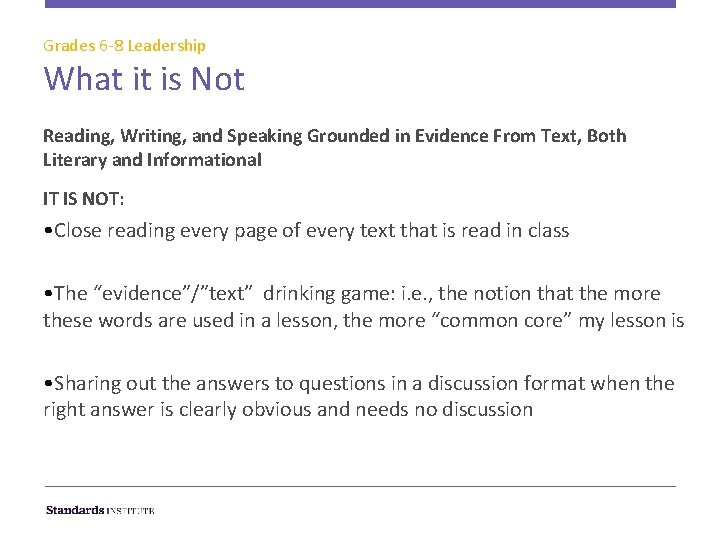
Grades 6 -8 Leadership What it is Not Reading, Writing, and Speaking Grounded in Evidence From Text, Both Literary and Informational IT IS NOT: • Close reading every page of every text that is read in class • The “evidence”/”text” drinking game: i. e. , the notion that the more these words are used in a lesson, the more “common core” my lesson is • Sharing out the answers to questions in a discussion format when the right answer is clearly obvious and needs no discussion
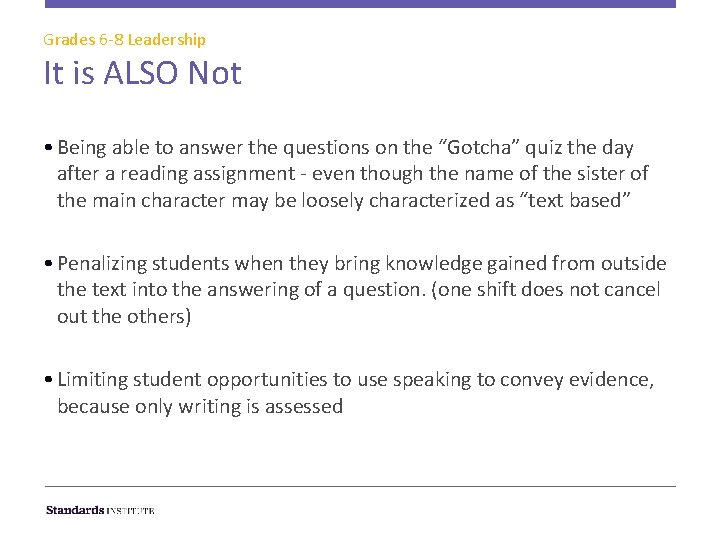
Grades 6 -8 Leadership It is ALSO Not • Being able to answer the questions on the “Gotcha” quiz the day after a reading assignment - even though the name of the sister of the main character may be loosely characterized as “text based” • Penalizing students when they bring knowledge gained from outside the text into the answering of a question. (one shift does not cancel out the others) • Limiting student opportunities to use speaking to convey evidence, because only writing is assessed
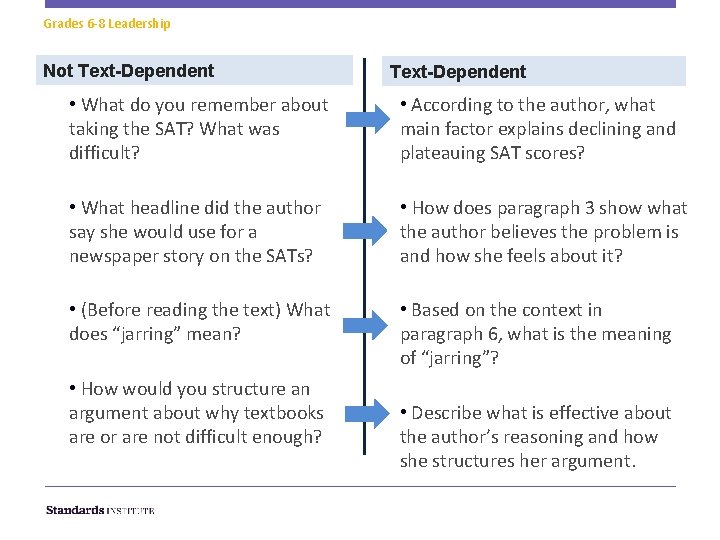
Grades 6 -8 Leadership Not Text-Dependent • What do you remember about taking the SAT? What was difficult? • According to the author, what main factor explains declining and plateauing SAT scores? • What headline did the author say she would use for a newspaper story on the SATs? • How does paragraph 3 show what • (Before reading the text) What does “jarring” mean? • Based on the context in paragraph 6, what is the meaning of “jarring”? • How would you structure an argument about why textbooks are or are not difficult enough? the author believes the problem is and how she feels about it? • Describe what is effective about the author’s reasoning and how she structures her argument.
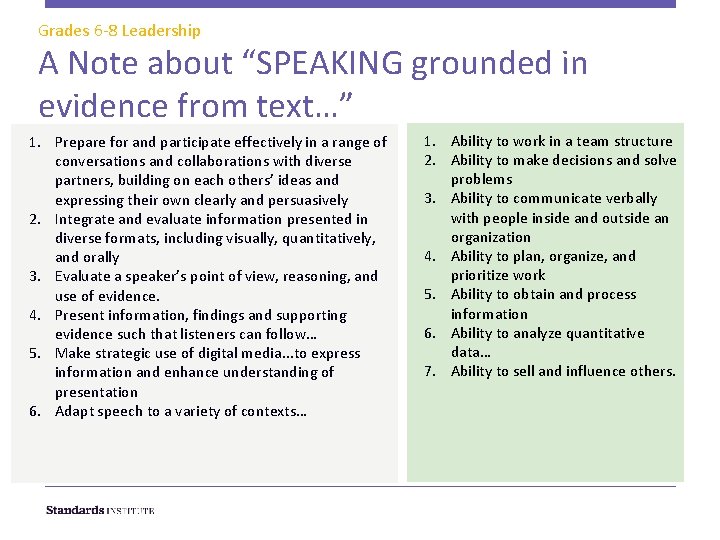
Grades 6 -8 Leadership A Note about “SPEAKING grounded in evidence from text…” 1. Prepare for and participate effectively in a range of conversations and collaborations with diverse partners, building on each others’ ideas and expressing their own clearly and persuasively 2. Integrate and evaluate information presented in diverse formats, including visually, quantitatively, and orally 3. Evaluate a speaker’s point of view, reasoning, and use of evidence. 4. Present information, findings and supporting evidence such that listeners can follow… 5. Make strategic use of digital media. . . to express information and enhance understanding of presentation 6. Adapt speech to a variety of contexts… 1. Ability to work in a team structure 2. Ability to make decisions and solve problems 3. Ability to communicate verbally with people inside and outside an organization 4. Ability to plan, organize, and prioritize work 5. Ability to obtain and process information 6. Ability to analyze quantitative data… 7. Ability to sell and influence others.
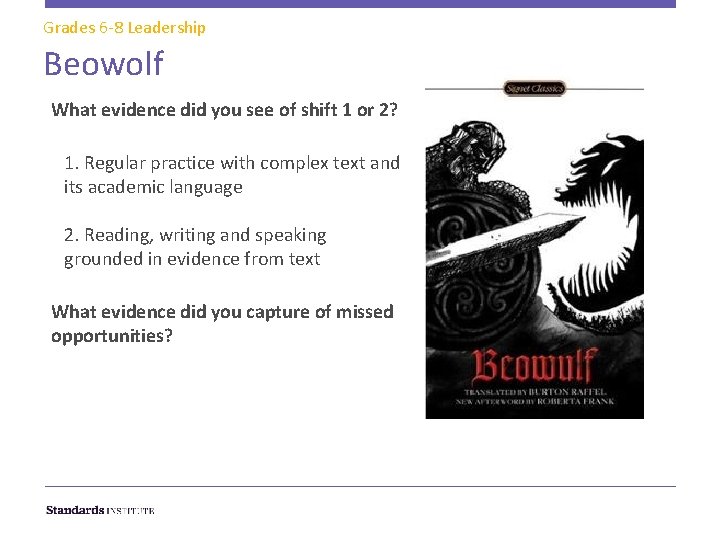
Grades 6 -8 Leadership Beowolf What evidence did you see of shift 1 or 2? 1. Regular practice with complex text and its academic language 2. Reading, writing and speaking grounded in evidence from text What evidence did you capture of missed opportunities?
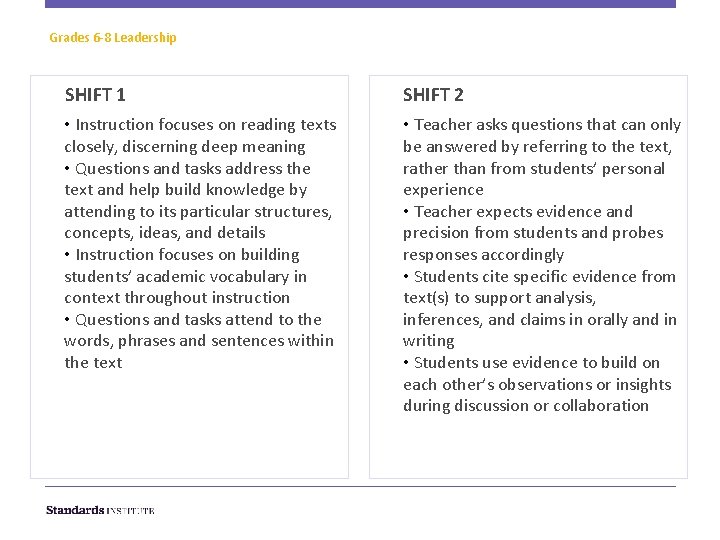
Grades 6 -8 Leadership SHIFT 1 SHIFT 2 • Instruction focuses on reading texts closely, discerning deep meaning • Questions and tasks address the text and help build knowledge by attending to its particular structures, concepts, ideas, and details • Instruction focuses on building students’ academic vocabulary in context throughout instruction • Questions and tasks attend to the words, phrases and sentences within the text • Teacher asks questions that can only be answered by referring to the text, rather than from students’ personal experience • Teacher expects evidence and precision from students and probes responses accordingly • Students cite specific evidence from text(s) to support analysis, inferences, and claims in orally and in writing • Students use evidence to build on each other’s observations or insights during discussion or collaboration
Grades 6 -8 Leadership Reflect and Write: • What would be your long-term development work with Ms. Novak? • Short-term? • Post-observation feedback?
Shift #3: Building knowledge through content-rich nonfiction 31
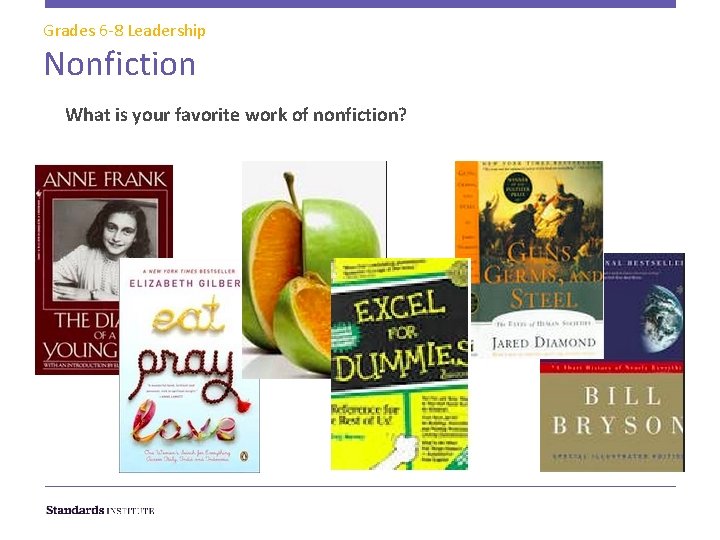
Grades 6 -8 Leadership Nonfiction What is your favorite work of nonfiction?
Grades 6 -8 Leadership Content Shift #3 • Content-Rich Nonfiction • 50/50 balance K-5 • 55/45 split in 6 -8 • 70/30 in grades 9 -12, across all courses (not just in ELA) 33
Grades 6 -8 Leadership Building Knowledge Through Content-Rich Nonfiction: Why? • Students have been required to read little informational text in elementary and middle school • Builds the vocabulary and knowledge that students are going to need for success in school • Non-fiction makes up the vast majority of required reading in college/workplace • Informational text often has to be read differently than narrative text 34
Grades 6 -8 Leadership What it is not • Research assignments, as in “research (animal, place, etc) and write a paper, due on XXX (with no direct instruction/connection to topic/explicit process) • Random/unconnected reading about a lot of different topics • Social Studies class (only) • Science class (only) • Only happening through complex text and close reading • Performing” a favorite text
Grades 6 -8 Leadership Content Shift #3 • Sequencing Texts and Topics to Build Knowledge • Not random reading • Literacy in social studies/history, science, technical subjects, and the arts is embedded 36
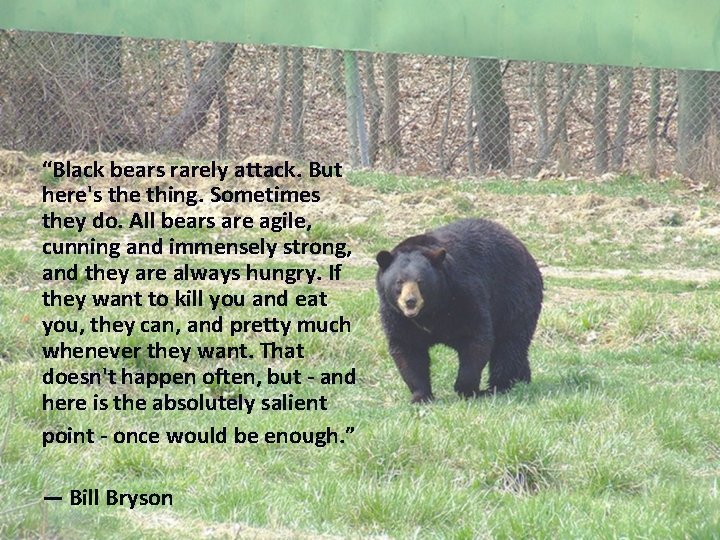
“Black bears rarely attack. But here's the thing. Sometimes they do. All bears are agile, cunning and immensely strong, and they are always hungry. If they want to kill you and eat you, they can, and pretty much whenever they want. That doesn't happen often, but - and here is the absolutely salient point - once would be enough. ” ― Bill Bryson
Grades 6 -8 Leadership References Slide # Source 4 Conley, David. 2012, “The Complexities of College and Career Readiness. ” https: //epiconline. org/files/pdf/07102012_Keene_NH. pdf 9 https: //www. teachingchannel. org/videos/descriptive-details-sensorylanguage
IPG’s and Text Complexity Grades 6 -8 Leadership
Grades 6 -8 Leadership Today’s Sessions • Session 1: ELA/Literacy Standards and Shifts: Knowing What You're Seeing • Session 2: IPGs and Text Complexity • Session 3: Knowledge Building and Text Sets
Grades 6 -8 Leadership Agenda 1. Use the Instructional Practice Guide: Coaching tool to observe a lesson using multiple complex texts 2. What is text complexity and why is it important? i. Quantitative Measures ii. Qualitative Measures iii. Reader and Task 3. What are the characteristics of complex text? 4. Ways to determine if a text is sufficiently complex 5. Group examination of texts and determination of complexity 1. 6. What to do about text complexity
Grades 6 -8 Leadership Introduction & Session objectives • Participants will learn how to use the Instructional Practice Guide as an observation and coaching tool • Participants will understand the three components of text complexity • Participants will understand the characteristics of complex text? • Participants will learn about Ways to determine if a text is sufficiently complex
Teaching the Core: The ELA & Literacy Instructional Practice Guides: Coaching Tools www. achievethecore. org
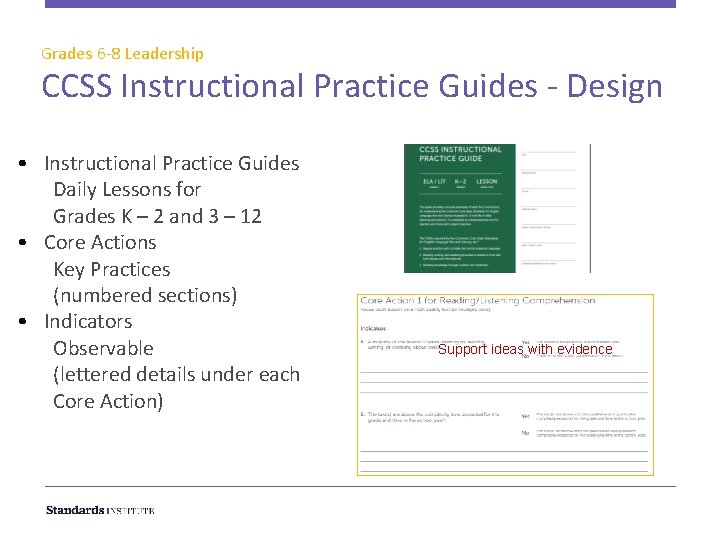
Grades 6 -8 Leadership CCSS Instructional Practice Guides– Design & Structure CCSS Instructional Practice Guides: Coaching • ELA/literacy (K-2 and 3 – 12) • Mathematics (K-8, HS) Each CCSS Instructional Practice Guide: Coaching • is a tool for a single lesson • describes 3 – 4 Core Actions • each Core Action includes 3 -6 indicators The focus today will primarily be on the Daily Lesson Guide.
Grades 6 -8 Leadership CCSS Instructional Practice Guides - Design • Instructional Practice Guides Daily Lessons for Grades K – 2 and 3 – 12 • Core Actions Key Practices (numbered sections) • Indicators Observable (lettered details under each Core Action) Support ideas with evidence
Grades 6 -8 Leadership ACTIVITY #1: Core Actions Scavenger Hunt: On a B&W working copy: FIRST – Answer the questions individually, then talk to your colleagues. NEXT – Color the shifts! 1. Regular practice with complex text and its academic language 2. Reading, writing, and speaking grounded in evidence from text, both literary and informational. 3. Building knowledge through content rich nonfiction.
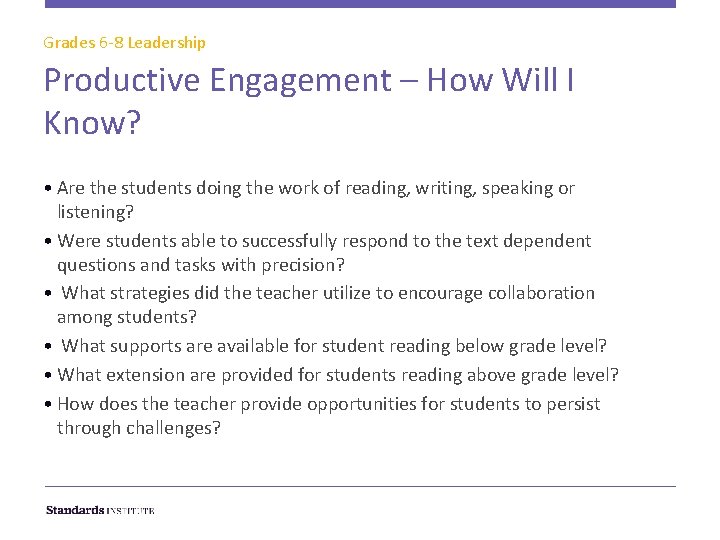
Grades 6 -8 Leadership Productive Engagement – How Will I Know? • Are the students doing the work of reading, writing, speaking or listening? • Were students able to successfully respond to the text dependent questions and tasks with precision? • What strategies did the teacher utilize to encourage collaboration among students? • What supports are available for student reading below grade level? • What extension are provided for students reading above grade level? • How does the teacher provide opportunities for students to persist through challenges?
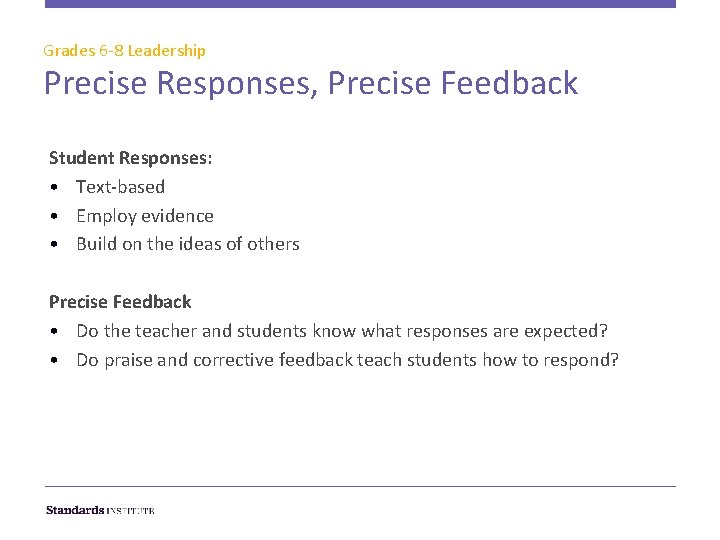
Grades 6 -8 Leadership Precise Responses, Precise Feedback Student Responses: • Text-based • Employ evidence • Build on the ideas of others Precise Feedback • Do the teacher and students know what responses are expected? • Do praise and corrective feedback teach students how to respond?
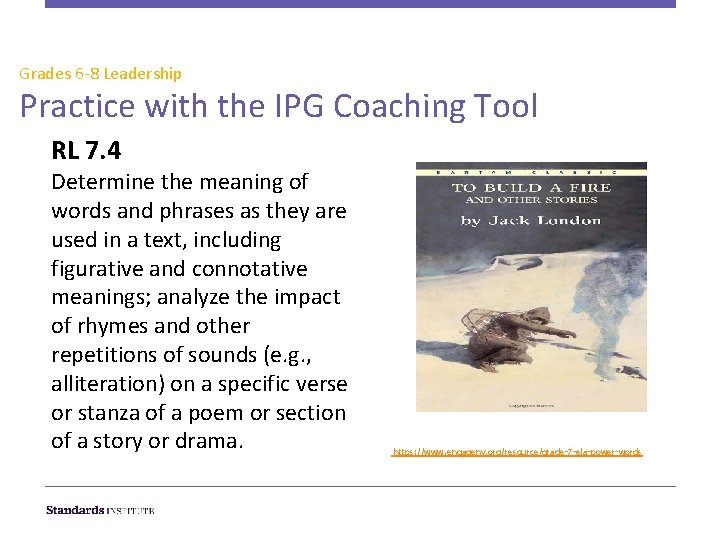
Grades 6 -8 Leadership Practice with the IPG Coaching Tool RL 7. 4 Determine the meaning of words and phrases as they are used in a text, including figurative and connotative meanings; analyze the impact of rhymes and other repetitions of sounds (e. g. , alliteration) on a specific verse or stanza of a poem or section of a story or drama. https: //www. engageny. org/resource/grade-7 -ela-power-words
Grades 6 -8 Leadership What Makes a Text Complex? “Although it was winter, the nearest ocean four hundred miles away, and the Tribal Weatherman asleep because of boredom, a hurricane dropped from the sky in 1976 and fell so hard on the Spokane Indian Reservation that it knocked Victor from bed and his latest nightmare. ” “Every Little Hurricane” from The Lone Ranger and Tonto Fistfight in Heaven by Sherman Alexie
Grades 6 -8 Leadership What Makes a Text Complex? In this example… • Long sentence(s) and complex syntax • Multiple and/or subtle themes and purposes • Lack of words, sentences or paragraphs that review or pull things together for the student • Unfamiliar settings, topics or events
Grades 6 -8 Leadership What Makes a Text Complex? “Society in every state is a blessing, but Government, even in its best state, is but a necessary evil; in its worst state an intolerable one: for when we suffer, or are exposed to the same miseries BY A GOVERNMENT, which we might expect in a country WITHOUT GOVERNMENT, our calamity is heightened by reflecting that we furnish the means by which we suffer. ” --Thomas Paine, Common Sense
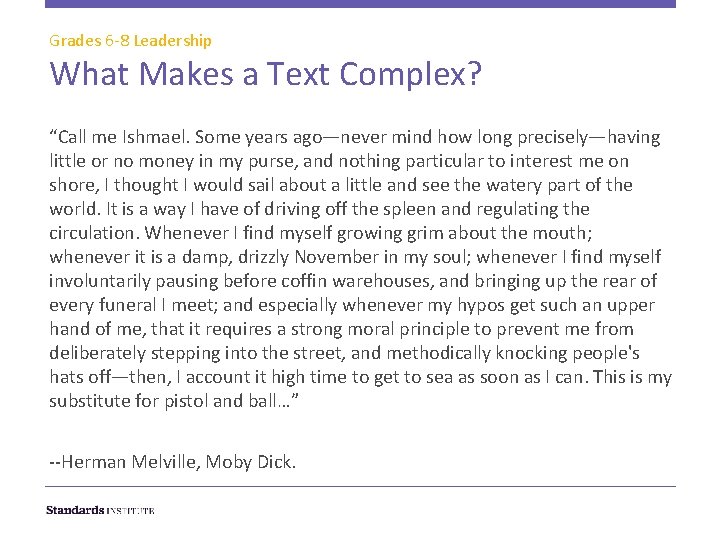
Grades 6 -8 Leadership What Makes a Text Complex? “Call me Ishmael. Some years ago—never mind how long precisely—having little or no money in my purse, and nothing particular to interest me on shore, I thought I would sail about a little and see the watery part of the world. It is a way I have of driving off the spleen and regulating the circulation. Whenever I find myself growing grim about the mouth; whenever it is a damp, drizzly November in my soul; whenever I find myself involuntarily pausing before coffin warehouses, and bringing up the rear of every funeral I meet; and especially whenever my hypos get such an upper hand of me, that it requires a strong moral principle to prevent me from deliberately stepping into the street, and methodically knocking people's hats off—then, I account it high time to get to sea as soon as I can. This is my substitute for pistol and ball…” --Herman Melville, Moby Dick.
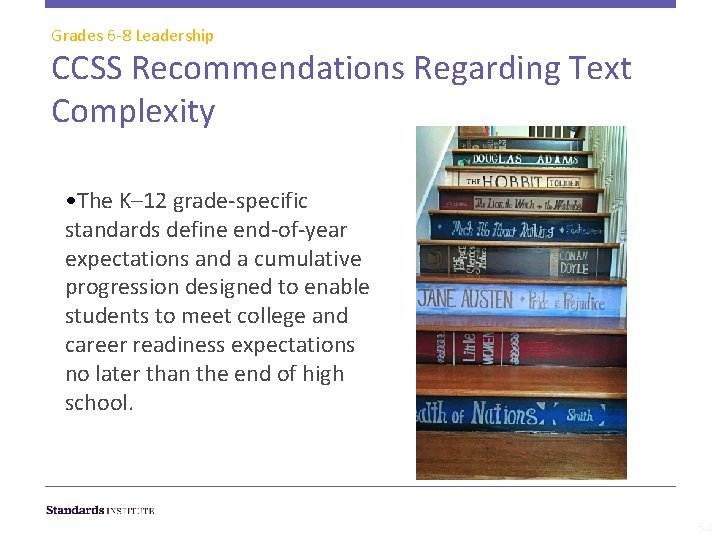
Grades 6 -8 Leadership CCSS Recommendations Regarding Text Complexity • The K– 12 grade-specific standards define end-of-year expectations and a cumulative progression designed to enable students to meet college and career readiness expectations no later than the end of high school. 54
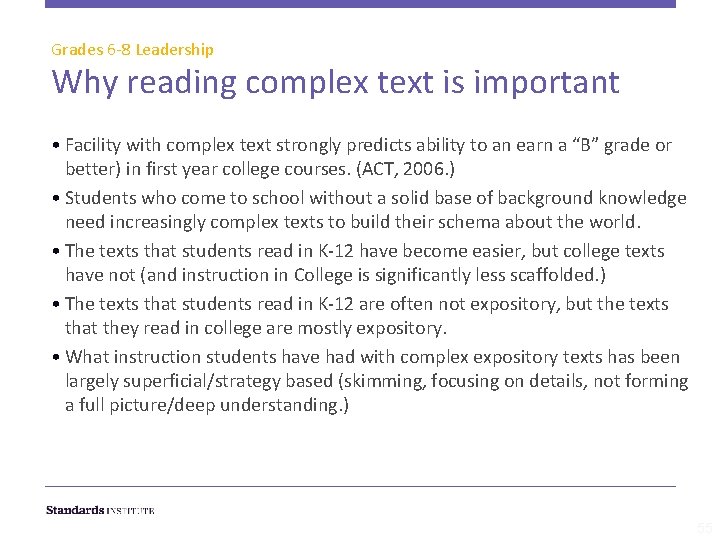
Grades 6 -8 Leadership Why reading complex text is important • Facility with complex text strongly predicts ability to an earn a “B” grade or better) in first year college courses. (ACT, 2006. ) • Students who come to school without a solid base of background knowledge need increasingly complex texts to build their schema about the world. • The texts that students read in K-12 have become easier, but college texts have not (and instruction in College is significantly less scaffolded. ) • The texts that students read in K-12 are often not expository, but the texts that they read in college are mostly expository. • What instruction students have had with complex expository texts has been largely superficial/strategy based (skimming, focusing on details, not forming a full picture/deep understanding. ) 55
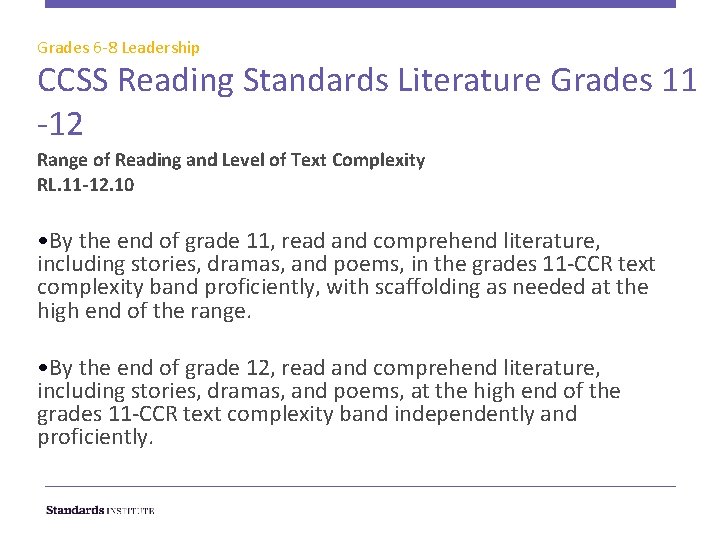
Grades 6 -8 Leadership CCSS Reading Standards Literature Grades 11 -12 Range of Reading and Level of Text Complexity RL. 11 -12. 10 • By the end of grade 11, read and comprehend literature, including stories, dramas, and poems, in the grades 11 -CCR text complexity band proficiently, with scaffolding as needed at the high end of the range. • By the end of grade 12, read and comprehend literature, including stories, dramas, and poems, at the high end of the grades 11 -CCR text complexity band independently and proficiently.
Grades 6 -8 Leadership CCSS Reading Standards Literature Grades 11 -12 Range of Reading and Level of Text Complexity RI. 11 -12. 10 • By the end of grade 11, read and comprehend literary nonfiction in the grades 11–CCR text complexity band proficiently, with scaffolding as needed at the high end of the range. • By the end of grade 12, read and comprehend literary nonfiction at the high end of the grades 11–CCR text complexity band independently and proficiently.
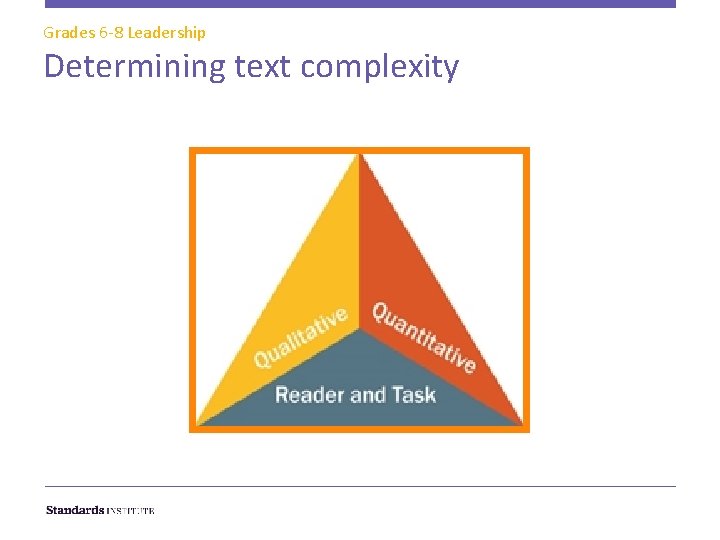
Grades 6 -8 Leadership Determining text complexity
Grades 6 -8 Leadership Explanation of the Text Complexity Factors Quantitative evaluation of the text • Readability measures and other scores of text complexity Qualitative evaluation of the text • Levels of meaning, structure, language conventionality and clarity, and knowledge demands Matching reader to text and task • Reader variables (such as motivation, knowledge, and experiences) and task variables (such as purpose and the complexity generated by the task assigned and the questions posed)
Grades 6 -8 Leadership Is there one way to determine text complexity? No, determining text complexity is a complex act! Text complexity does not reside in the text, rather it is the product of the interaction between the text, the reader, and the purpose for reading. The What, the Who, the Why and the Where and When. • What—the characteristics of the text—qualitative/quantitative evaluation • Who—the characteristics of the reader (reading ability/age/experience/ motivation) • Why—the purpose for the reading (assignment/analysis of writer’s craft/ research/pleasure) • Where and When—the conditions of the reading—teacher/parent guided, group discussion/literary circle, independent (classroom/home/library/computer), instruction vs. assessment, etc.
Grades 6 -8 Leadership What are the Features of Complex Text? • Subtle and/or frequent transitions • Multiple and/or subtle themes and purposes • Density of information • Unfamiliar settings, topics or events • Lack of repetition, overlap or similarity in words and sentences 61
Grades 6 -8 Leadership What are the Features of Complex Text? • Complex sentences • Uncommon vocabulary • Lack of words, sentences or paragraphs that review or pull things together for the student • Longer paragraphs • Any text structure which is less narrative and/or mixes structures 62
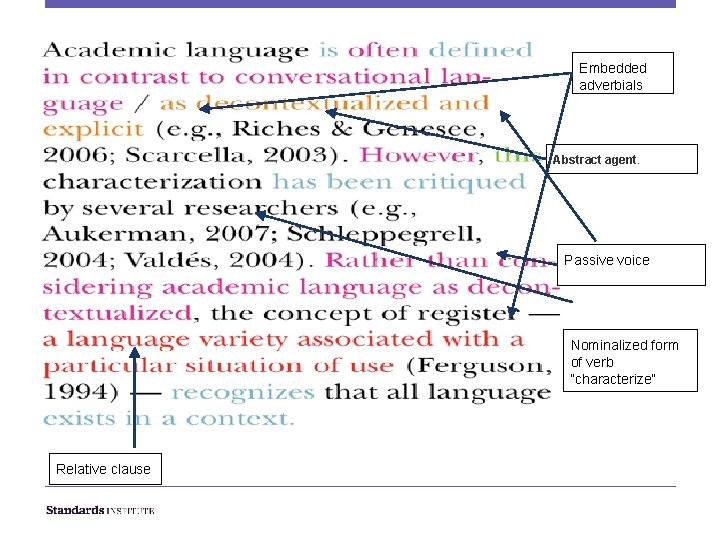
Grades 6 -8 Leadership What are the Grammatical and Rhetorical Features of Complex Text? • informational density through embedded dependent clauses and phrases within sentences in which the author is able to pack important and additional information; • the use of nominalizations; • passive voice; • a combination of complex and simple sentences; • the use of adverbial clauses and phrases to situate events; • ellipses; • the use of abstract agents as subjects; and • the use of devices for background and foreground information
Embedded adverbials Abstract agent. Passive voice Nominalized form of verb “characterize” Relative clause
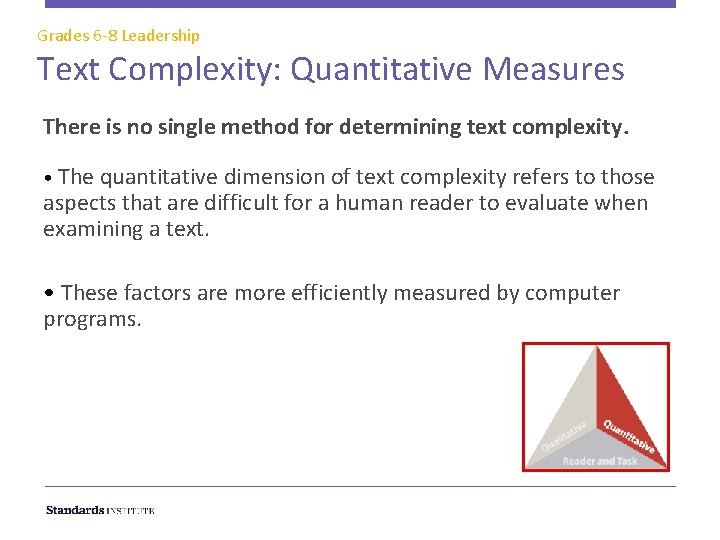
Grades 6 -8 Leadership Text Complexity: Quantitative Measures There is no single method for determining text complexity. • The quantitative dimension of text complexity refers to those aspects that are difficult for a human reader to evaluate when examining a text. • These factors are more efficiently measured by computer programs.
Grades 6 -8 Leadership Text Complexity: Quantitative Measures • Quantitative measures of text complexity generally measures of word difficulty (frequency, length) and sentence length. • Some metrics add other features of words, sentence syntax, and text cohesion, creating a broader range of text and linguistic measures.
Grades 6 -8 Leadership Free Quantitative Measures of Text Complexity • ATOS Analyzer from Renaissance Learning: http: //www/renlearn. com/ar/overview/atos/ • Degrees of Reading Power from Questar: http: //www/questarai. com • The Lexile Framework from Metamatrix: http: //www. lexile. com/analyzer • Coh-Metrix Easability Tool from University of Memphis: http: //141. 225. 42. 101/cohmetrixgates/Home • Reading Maturity from Pearson Knowledge Technologies: http: //www. readingmaturity. com (Beta site) • Source. Rater from Educators Testing Service: http: //naeptba. ets. org/Source. Rater 3/ (Beta site) • Flesch-Kincaid (part of your Microsoft Word)
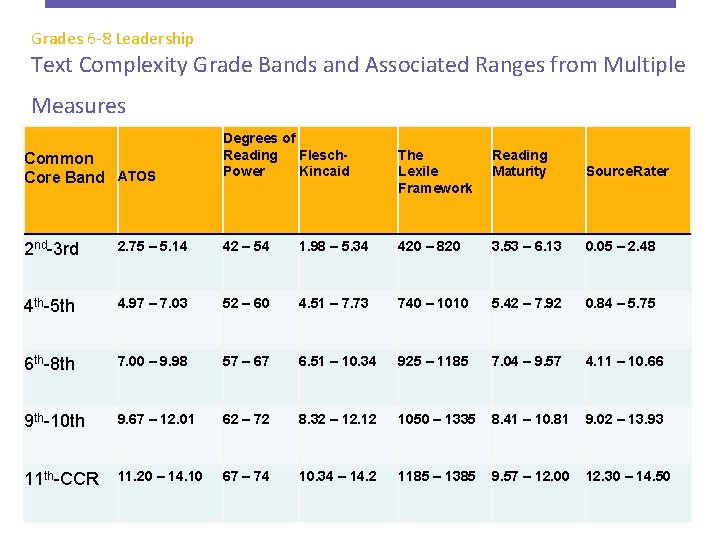
Grades 6 -8 Leadership Text Complexity Grade Bands and Associated Ranges from Multiple Measures Common Core Band ATOS Degrees of Reading Flesch. Power Kincaid The Lexile Framework Reading Maturity Source. Rater 2 nd-3 rd 2. 75 – 5. 14 42 – 54 1. 98 – 5. 34 420 – 820 3. 53 – 6. 13 0. 05 – 2. 48 4 th-5 th 4. 97 – 7. 03 52 – 60 4. 51 – 7. 73 740 – 1010 5. 42 – 7. 92 0. 84 – 5. 75 6 th-8 th 7. 00 – 9. 98 57 – 67 6. 51 – 10. 34 925 – 1185 7. 04 – 9. 57 4. 11 – 10. 66 9 th-10 th 9. 67 – 12. 01 62 – 72 8. 32 – 12. 12 1050 – 1335 8. 41 – 10. 81 9. 02 – 13. 93 11 th-CCR 11. 20 – 14. 10 67 – 74 10. 34 – 14. 2 1185 – 1385 9. 57 – 12. 00 12. 30 – 14. 50
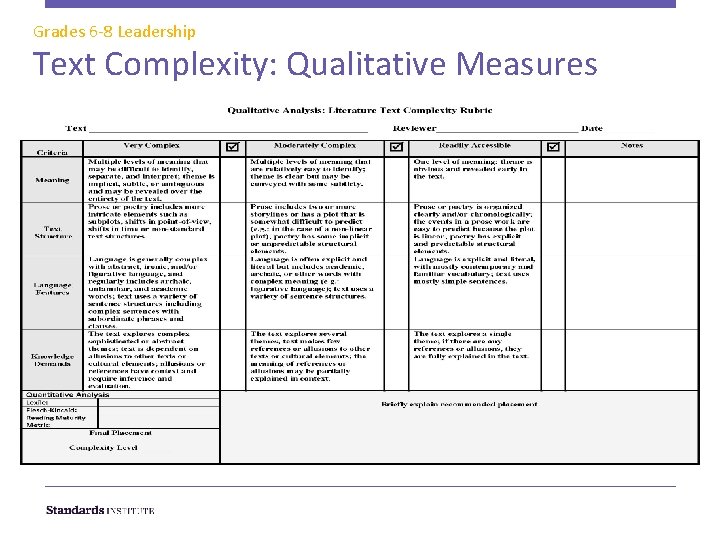
Grades 6 -8 Leadership Text Complexity: Qualitative Measures
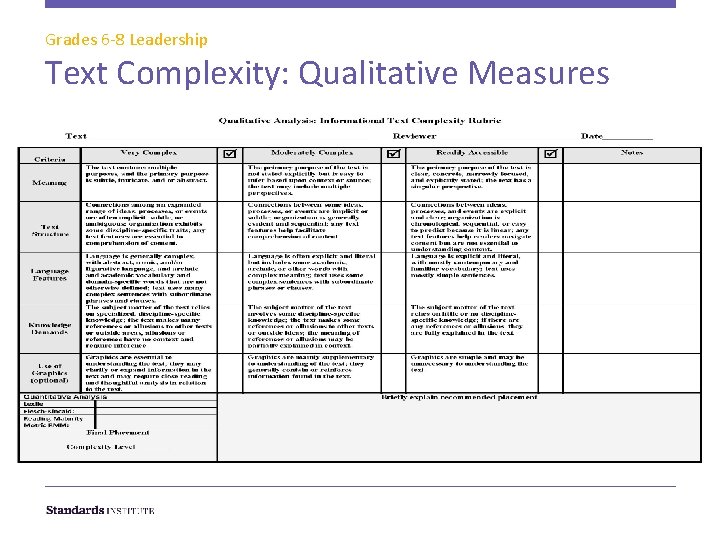
Grades 6 -8 Leadership Text Complexity: Qualitative Measures
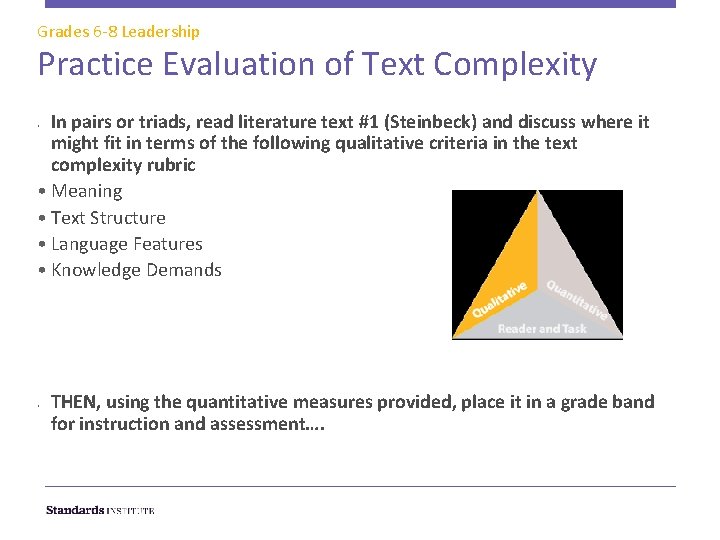
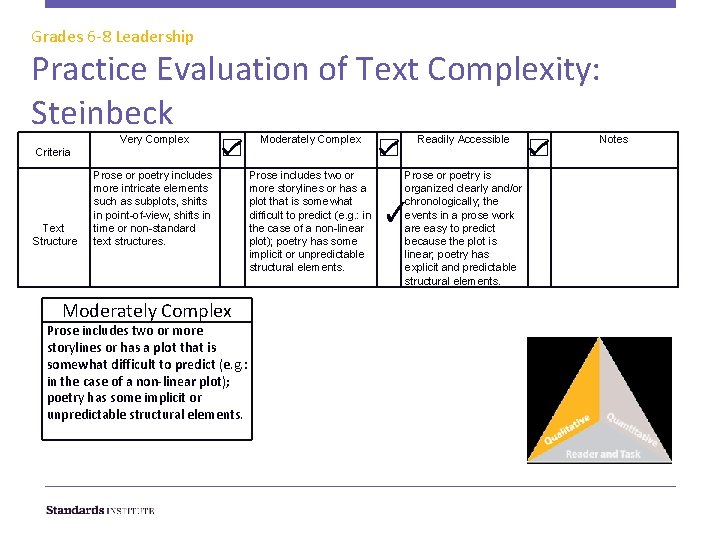
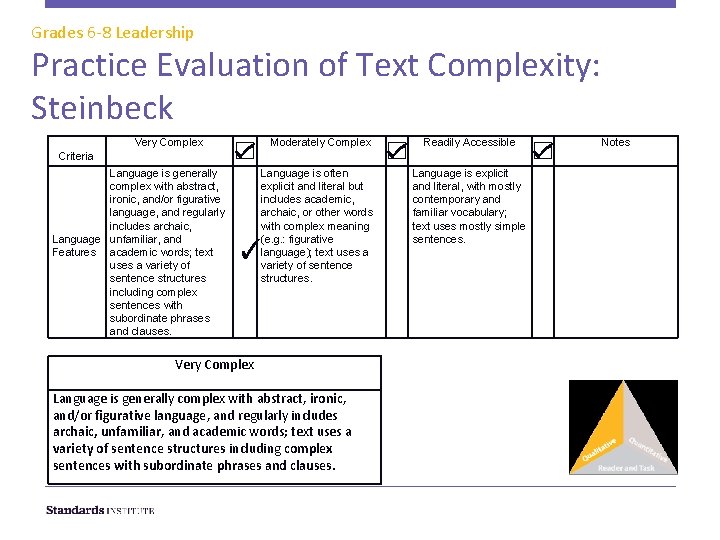
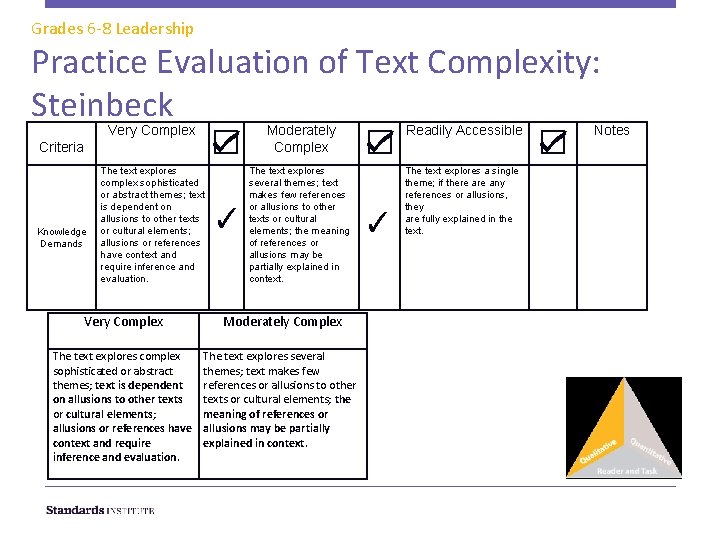
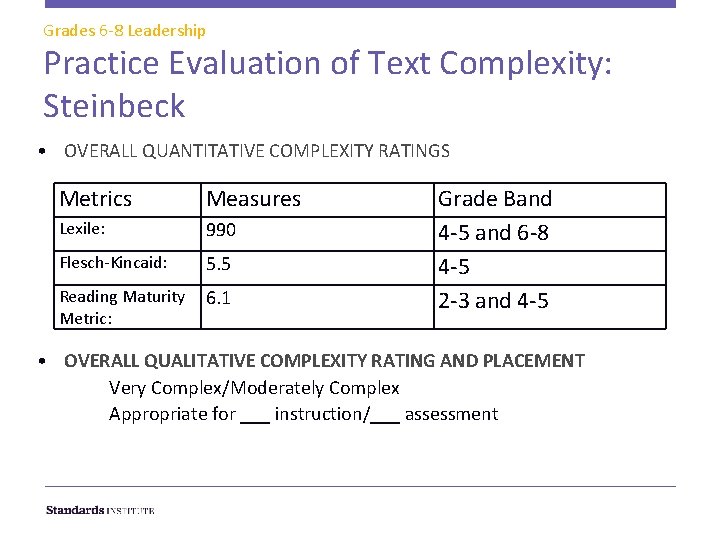
Grades 6 -8 Leadership Practice Evaluation of Text Complexity In pairs or triads, read literature text #1 (Steinbeck) and discuss where it might fit in terms of the following qualitative criteria in the text complexity rubric • Meaning • Text Structure • Language Features • Knowledge Demands • • THEN, using the quantitative measures provided, place it in a grade band for instruction and assessment….
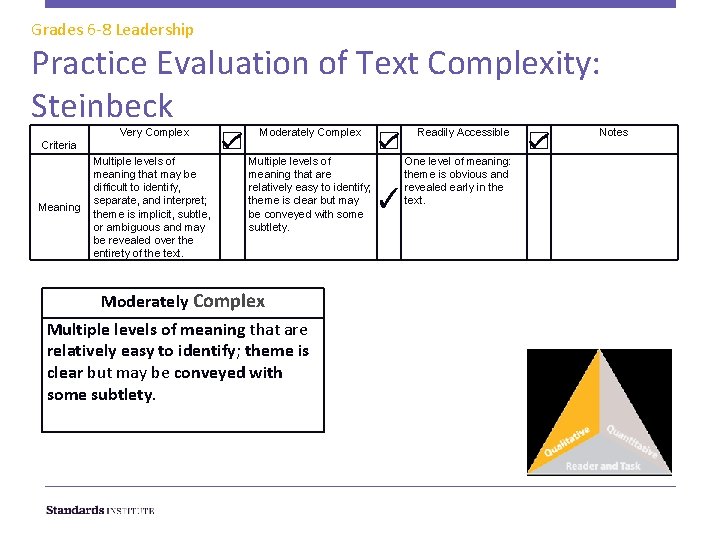
Grades 6 -8 Leadership Practice Evaluation of Text Complexity: Steinbeck Criteria Meaning Very Complex ☑ Multiple levels of meaning that may be difficult to identify, separate, and interpret; theme is implicit, subtle, or ambiguous and may be revealed over the entirety of the text. Moderately Complex ☑ Multiple levels of meaning that are relatively easy to identify; theme is clear but may be conveyed with some subtlety. Moderately Complex Multiple levels of meaning that are relatively easy to identify; theme is clear but may be conveyed with some subtlety. ✓ Readily Accessible One level of meaning: theme is obvious and revealed early in the text. ☑ Notes
Grades 6 -8 Leadership Practice Evaluation of Text Complexity: Steinbeck Criteria Text Structure Very Complex Moderately Complex ☑ Prose or poetry includes more intricate elements such as subplots, shifts in point-of-view, shifts in time or non-standard text structures. Moderately Complex Prose includes two or more storylines or has a plot that is somewhat difficult to predict (e. g. : in the case of a non-linear plot); poetry has some implicit or unpredictable structural elements. Prose includes two or more storylines or has a plot that is somewhat difficult to predict (e. g. : in the case of a non-linear plot); poetry has some implicit or unpredictable structural elements. Readily Accessible ☑ Prose or poetry is organized clearly and/or chronologically; the events in a prose work are easy to predict because the plot is linear; poetry has explicit and predictable structural elements. ☑ ✓ Notes
Grades 6 -8 Leadership Practice Evaluation of Text Complexity: Steinbeck Criteria Very Complex Language is generally complex with abstract, ironic, and/or figurative language, and regularly includes archaic, Language unfamiliar, and Features academic words; text uses a variety of sentence structures including complex sentences with subordinate phrases and clauses. Moderately Complex ☑ Language is often explicit and literal but includes academic, archaic, or other words with complex meaning (e. g. : figurative language); text uses a variety of sentence structures. ✓ Very Complex Language is generally complex with abstract, ironic, and/or figurative language, and regularly includes archaic, unfamiliar, and academic words; text uses a variety of sentence structures including complex sentences with subordinate phrases and clauses. ☑ Readily Accessible ☑ Language is explicit and literal, with mostly contemporary and familiar vocabulary; text uses mostly simple sentences. Notes
Grades 6 -8 Leadership Practice Evaluation of Text Complexity: Steinbeck Criteria Very Complex Knowledge Demands ☑ The text explores complex sophisticated or abstract themes; text is dependent on allusions to other texts or cultural elements; allusions or references have context and require inference and evaluation. ✓ Moderately Complex The text explores several themes; text makes few references or allusions to other texts or cultural elements; the meaning of references or allusions may be partially explained in context. Very Complex Moderately Complex The text explores complex sophisticated or abstract themes; text is dependent on allusions to other texts or cultural elements; allusions or references have context and require inference and evaluation. The text explores several themes; text makes few references or allusions to other texts or cultural elements; the meaning of references or allusions may be partially explained in context. ☑ Readily Accessible ☑ The text explores a single theme; if there any references or allusions, they are fully explained in the text. ✓ Notes
Grades 6 -8 Leadership Practice Evaluation of Text Complexity: Steinbeck • OVERALL QUANTITATIVE COMPLEXITY RATINGS Metrics Measures Lexile: 990 Flesch-Kincaid: 5. 5 Reading Maturity 6. 1 Metric: Grade Band 4 -5 and 6 -8 4 -5 2 -3 and 4 -5 • OVERALL QUALITATIVE COMPLEXITY RATING AND PLACEMENT Very Complex/Moderately Complex Appropriate for ___ instruction/___ assessment
Grades 6 -8 Leadership Poe “The margin of the river, and of the many dazzling rivulets that glided through devious ways into its channel, as well as the spaces that extended from the margins away down into the depths of the streams until they reached the bed of pebbles at the bottom, these spots, not less than the whole surface of the valley, from the river to the mountains that girdled it in, were carpeted all by a soft green grass, thick, short, perfectly even, and vanilla-perfumed, but so besprinkled throughout with the yellow buttercup, the white daisy, the purple violet, and the ruby -red asphodel, that its exceeding beauty spoke to our hearts in loud tones of the love and of the glory of God. ”
Grades 6 -8 Leadership Reflect and Write What is the gap between where you need to be and where you are? What do you need to lead and support this work? • Systems and structures • People • Resources Who needs to learn what by when? • You • Leadership team • Staff
Grades 6 -8 Leadership WHAT NEXT? What are your key take-aways about complex text? What are the best ways to prepare students for reading complex text? • Lots of reading • Students must build their academic vocabulary • Students must build their knowledge about the world Text Sets and Expert Packs can be a good way to get at all three of these…. (next session!)
Grades 6 -8 Leadership References Slide # Source 12 https: //www. engageny. org/resource/grade-7 -ela-power-words 24 Snow & Uccelli, 2008; Schleppegrell, 2010, 2007; Wong Fillmore & Fillmore, 2012 25 Alvarez, L. (2012). “Reconsidering academic language in practice: The demands of Spanish expository reading and students’ bilingual resources. ” Bilingual Research Journal, 35, 1, 32 -52.
Knowledge Building and Text Sets Grades 6 -8 Leadership
Grades 6 -8 Leadership Today’s Sessions • Session 1: ELA/Literacy Standards and Shifts: Knowing What You're Seeing • Session 2: IPGs and Text Complexity • Session 3: Knowledge Building and Text Sets
Grades 6 -8 Leadership Knowledge Building and Text Sets Session objectives • Participants will understand the value of building knowledge and vocabulary to support reading • Participants will understand the process of building text sets and expert packs designed to build knowledge about a topic (NOT A THEME) • Participants will engage in the process of evaluating completed and in-process text sets and expert packs against specific criteria
Grades 6 -8 Leadership Part 1: Why Build Knowledge and Vocabulary ? https: //www. youtube. com/watch? v=Ri. P-ijdxq. Ec
Grades 6 -8 Leadership Part 1: Why Build Knowledge and Vocabulary ? The Matthew Effect • Extensive research supports the necessity for reading on grade level in early elementary grades, with the consequences being directly related to HS graduation rates • The achievement gap grows the longer students are in school • Knowledge and vocabulary are directly related to reading
Grades 6 -8 Leadership Five Essential Studies • Hernandez 2011, “Double Jeopardy” • Lesnick et al 2010, “Reading on Grade Level in Third Grade: How Is it Related to High School Performance and College Enrollment? ” • Fletcher and Lyon 1998, 74% of 3 rd graders who read poorly will still be struggling in 9 th grade. • Snow et al 1998, “A person who is not at least a modestly skilled reader by the end of third grade is quite unlikely to graduate from high school. ” • Juel 1988, 1 st grade reading scores are a “reliable predictor of later reading scores. ”
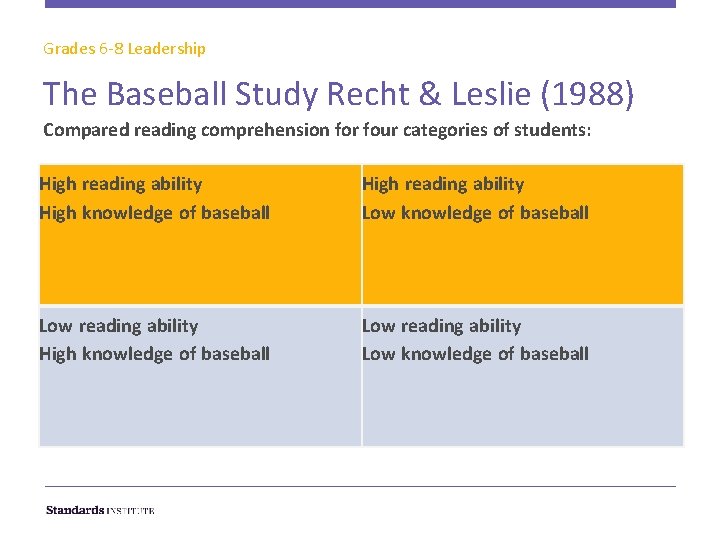
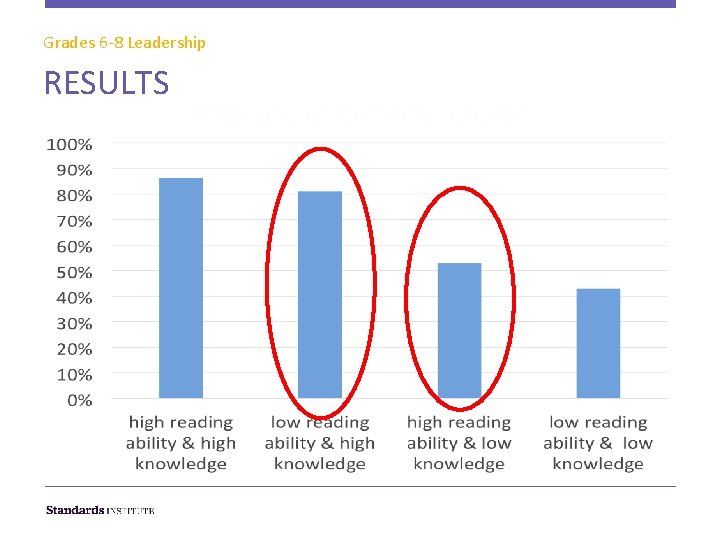
Grades 6 -8 Leadership The Baseball Study Recht & Leslie (1988) Compared reading comprehension for four categories of students: High reading ability High knowledge of baseball High reading ability Low knowledge of baseball Low reading ability High knowledge of baseball Low reading ability Low knowledge of baseball
Grades 6 -8 Leadership RESULTS
Grades 6 -8 Leadership Findings • Knowledge of the topic had a MUCH bigger impact on comprehension than generalized reading ability did (pg. 18) • With sufficient prior knowledge “low ability” students performed similarly to higher ability students. (pg. 19) The difference in their performance was not statistically significant.
Grades 6 -8 Leadership The Causes What they are NOT What they ARE • Lack of critical thinking • Failure to know or use comprehension strategies • Failure to master the standards • Vocabulary: Failure to grow sufficient vocabulary • Knowledge: Failure to develop wide knowledge • Fluency: Failure to become a fluent reader WHAT THIS MEANS: High school students have an extremely small window to graduate high school with the knowledge, vocabulary, and skills necessary to navigate successfully in college and/or career. They need to have it built for them all along the way.
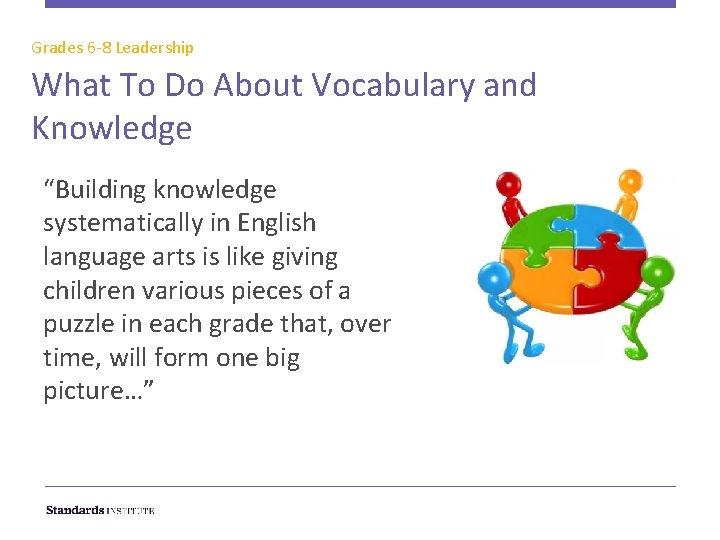
Grades 6 -8 Leadership What To Do About Vocabulary and Knowledge “Building knowledge systematically in English language arts is like giving children various pieces of a puzzle in each grade that, over time, will form one big picture…”
Importance of Knowledge “It's true that knowledge gives students something to think about, but a reading of the research literature from cognitive science shows that knowledge does much more than just help students hone their thinking skills: It actually makes learning easier. Knowledge is not only cumulative, it grows exponentially. Those with a rich base of factual knowledge find it easier to learn more…” --Daniel Willingham, “How Knowledge Helps, ” American Educator
Importance of Vocabulary “In four years, an average child in a professional family would accumulate experience with almost 45 million words, an average child in a working-class family 26 million words, and an average child in a welfare family 13 million words. ” “The Early Catastrophe: the 30 Million Word Gap by age 3”, Hart and Riley
Grades 6 -8 Leadership Topics on the ACT • The history and legal precedent for acquittal by reason of insanity • A response to feminist reappraisal of women poets • The development of the brain in a newborn infant • Two accounts of the media coverage of the Apollo moon landing
Grades 6 -8 Leadership Topics on the SAT • Burgess Shale • Controversy surrounding question of earliest North American settlements • Self Discovery via Early 20 th Century Shakespearean Theatre Tour • Integrity of Modern Film Remakes • Sleep Research • Role of Chinese American Women during WWII • Honore de Balzac • Controversy Surrounding the Architecture of the Getty Museum • The Politics of Environmental Reporting
Grades 6 -8 Leadership Topics on 10 th-11 th Grade PARCC • Tinker v. Des Moines U. S. Supreme Court : majority opinion, dissenting opinion, analysis by Law professor • Post WW II speech by Churchill about Soviet Russia • The creation of art from plastic debris found on a Northern California beach • Re-examination of the public health message about antibiotics • The declaration of independence, and spectral imaging technology findings about changes made to the language of the text • Patrick Henry Speech to the Second Virginia Convention
Grades 6 -8 Leadership The HS ELA standards are built off a foundation in the preceding grades This foundation includes reading of grade-level complex literary and informational texts independently and proficiently. But the HS students in front of us right now do NOT have this. So what do we do?
Grades 6 -8 Leadership What To Do About Vocabulary and Knowledge In the HS grades, addressing vocabulary and knowledge gaps is akin to emergency triage—but it is still necessary and worthwhile! • Building habits of mind, exposing students to a volume of nonfiction texts, making interdisciplinary connections • Enhancing understanding of Literary texts, including contemporary relevance • Creating opportunities for engagement, and to explore in appropriate depth topics of interest to students
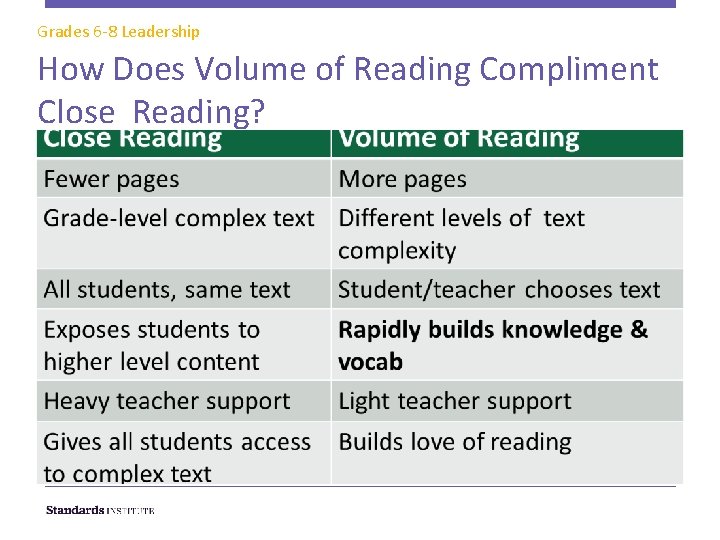
Grades 6 -8 Leadership Connection between Volume of Reading, Knowledge, and Vocabulary • Research by Landauer and Dumais into vocabulary acquisition shows that students acquire vocabulary up to four times faster when they read a series of related texts. • Reading a number of texts within a topic grows knowledge and vocabulary far faster than any other approach
Grades 6 -8 Leadership How Does Volume of Reading Compliment Close Reading?
Grades 6 -8 Leadership Reflect and Write What is the gap between where you need to be and where you are? What do you need to lead and support this work? • Systems and structures • People • Resources Who needs to learn what by when? • You • Leadership team • Staff
Part 2: Text Sets and Expert Packs
Grades 6 -8 Leadership Volume of Reading and Texts Sets Text sets focus on: • Volume of reading • Gaining knowledge about a topic through reading a range of complexities • Light teacher support • Student-driven/ independence • Clear and repetitive practice for accountability from preexisting choice
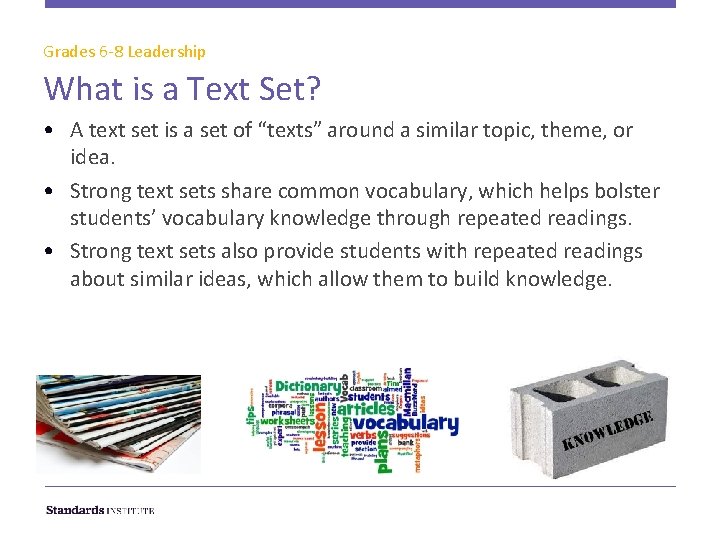
Grades 6 -8 Leadership What is a Text Set? • A text set is a set of “texts” around a similar topic, theme, or idea. • Strong text sets share common vocabulary, which helps bolster students’ vocabulary knowledge through repeated readings. • Strong text sets also provide students with repeated readings about similar ideas, which allow them to build knowledge.
Grades 6 -8 Leadership Strong Whole-Class Text Set, Grade 7 Includes: • Frederick Douglass, Narrative of the Life of Frederick Douglass, an American Slave Related Texts: • “The Slave Trade, ” “Abolition, ” and “Frederick Douglass” (texts) from Freedom: A History of US, Webisode 5 (PBS, 2002) • Scott Kirkwood, “Renaissance Man, ” National Parks, Spring 2013 v 87 i 2 p 1(3). • Claude Mc. Kay, “If We Must Die” • Langston Hughes, “The Negro Speaks of Rivers” (Poem) • Georgia Douglass Johnson, “Black Woman” • Lucille Clifton, “slaveships” • Eloise Greenfield, “Harriet Tubman” • Paul Laurence Dunbar, “We Wear the Mask”
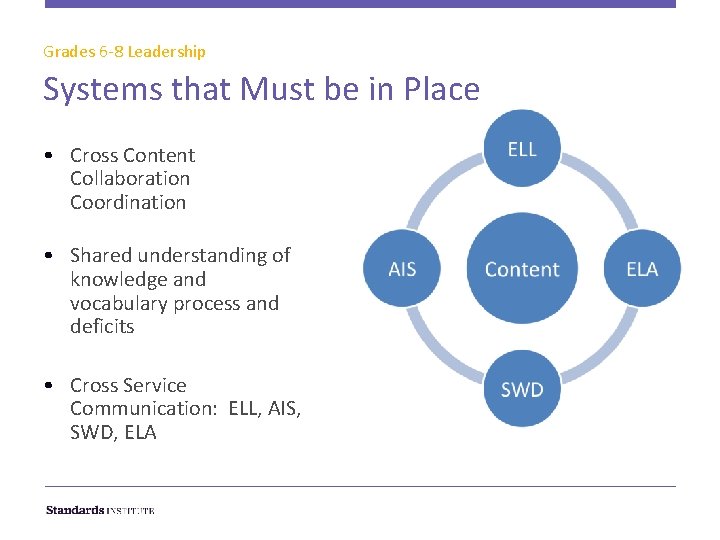
Grades 6 -8 Leadership Systems that Must be in Place • Cross Content Collaboration Coordination • Shared understanding of knowledge and vocabulary process and deficits • Cross Service Communication: ELL, AIS, SWD, ELA
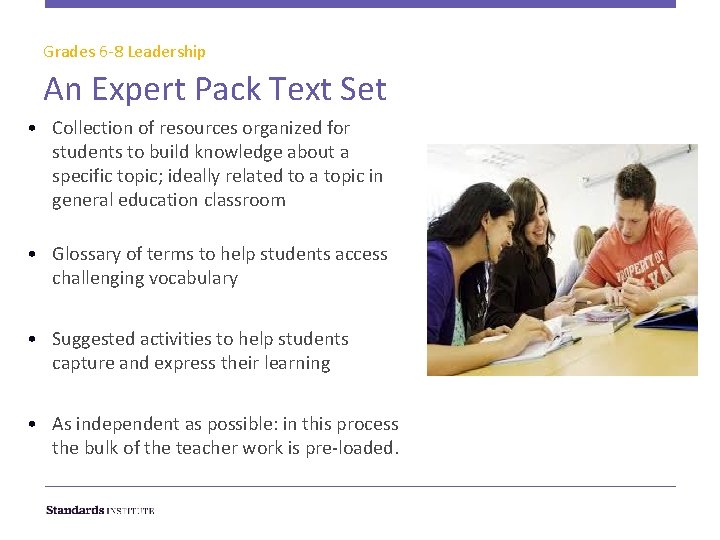
Grades 6 -8 Leadership An Expert Pack Text Set • Collection of resources organized for students to build knowledge about a specific topic; ideally related to a topic in general education classroom • Glossary of terms to help students access challenging vocabulary • Suggested activities to help students capture and express their learning • As independent as possible: in this process the bulk of the teacher work is pre-loaded.
Grades 6 -8 Leadership Expert Pack Guidelines • Text broadly defined: text, graphic novel/text, free articles (readworks), art, infographic, interactive graphics and text, interviews, audio, etc. • Text sequenced generally beginning with lower reading levels (quantitative and qualitative) and moving to more complex levels. • Support students’ ability to read the next selection (mostly) independently or in pairs. • Students develop expertise on the topic. • Topics ideally connected in some way to a content area curriculum.
Grades 6 -8 Leadership Expert Pack Development of Steps • Text Selection (between 8 and 10 texts) • Vocabulary Selection (teacher identifies anticipated vocabulary within each text) • Suggested Activities: Learning worth remembering for specific texts and developing conversation across text • Summary: table where students record text, their central learning, and how this learning builds on/adds to learning from previous text • Vocabulary “sensational six: ” students select vocabulary that they think is critical to understanding text, locate definition, and use it in a sentence specifically about the text
Grades 6 -8 Leadership Learning Worth Remembering • Student accountability – is this work worth doing • “Light touch approach” for teachers and students. Can this be done easily and mostly independently • Picture of knowledge (students record something they read that was interesting, taught you something new, made you want to learn more, and is still confusing) • Quizmaker – students develop questions for other students for reading of text, that require the text to develop the answer • Wonderings: I am still confused about/ This made me wonder • Using vocabulary in discussion of text
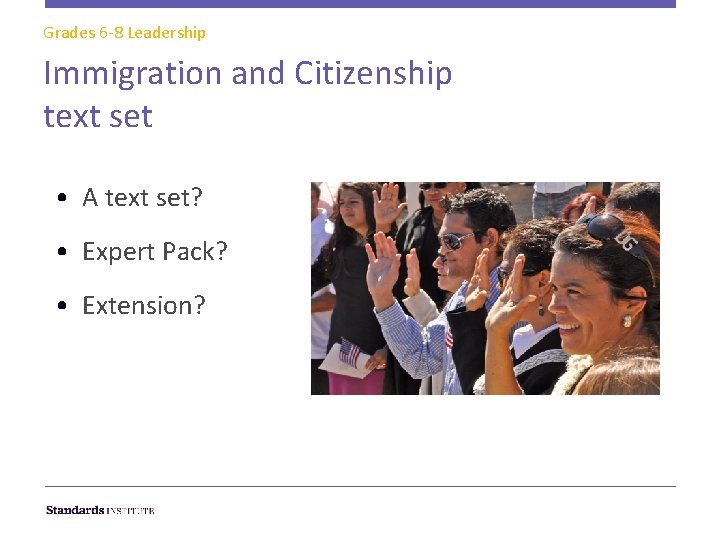
Grades 6 -8 Leadership Immigration and Citizenship text set • A text set? • Expert Pack? • Extension?
Grades 6 -8 Leadership Immigration and Citizenship text set What topic could I concentrate on that would: • support student understanding of the central text • provide background that does not give students answers to the central questions that we will be exploring in the module (e. g. , character development, author’s craft) • provide a foundation that may benefit students in knowledge and vocabulary as they tackle the text?
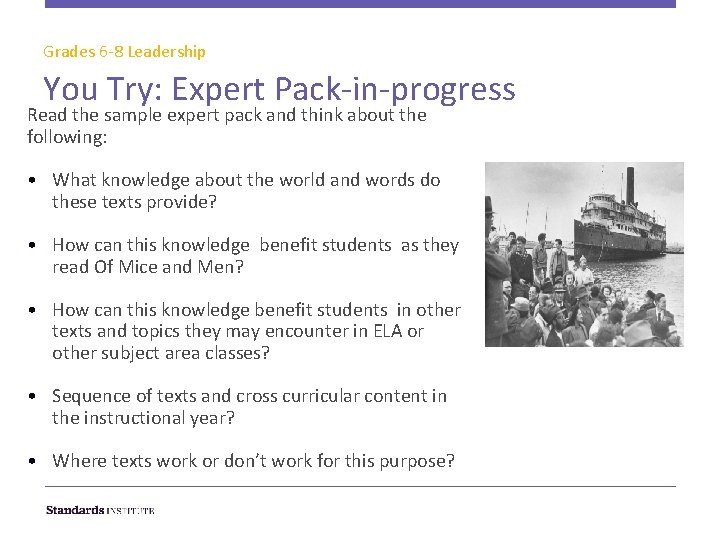
Grades 6 -8 Leadership You Try: Expert Pack-in-progress Read the sample expert pack and think about the following: • What knowledge about the world and words do these texts provide? • How can this knowledge benefit students as they read Of Mice and Men? • How can this knowledge benefit students in other texts and topics they may encounter in ELA or other subject area classes? • Sequence of texts and cross curricular content in the instructional year? • Where texts work or don’t work for this purpose?
Grades 6 -8 Leadership You Try: Expert Pack-in-progress Work in groups to determine qualitative text complexity for the resources THEN: assemble your expert pack, considering: • What knowledge about the world and words do these texts provide? • How can this knowledge benefit students as they read Of Mice and Men? • How can this knowledge benefit students in other texts and topics they may encounter in ELA or other subject area classes? • Sequence of texts • Where texts work or don’t work for this purpose
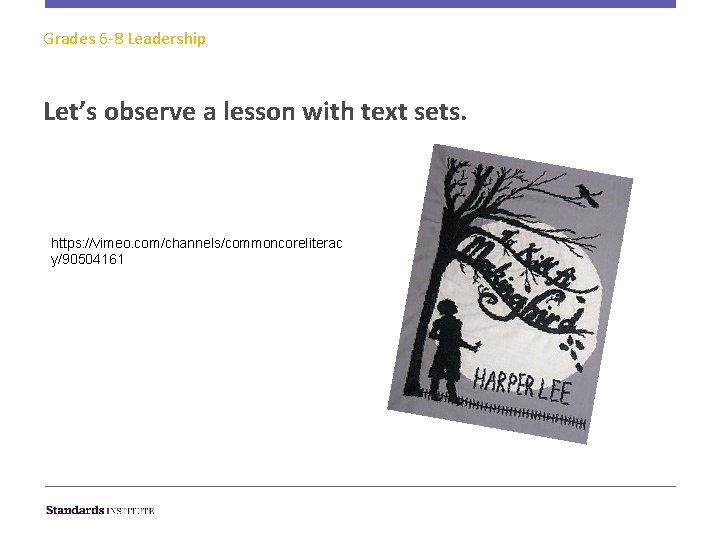
Grades 6 -8 Leadership Let’s observe a lesson with text sets. https: //vimeo. com/channels/commoncoreliterac y/90504161
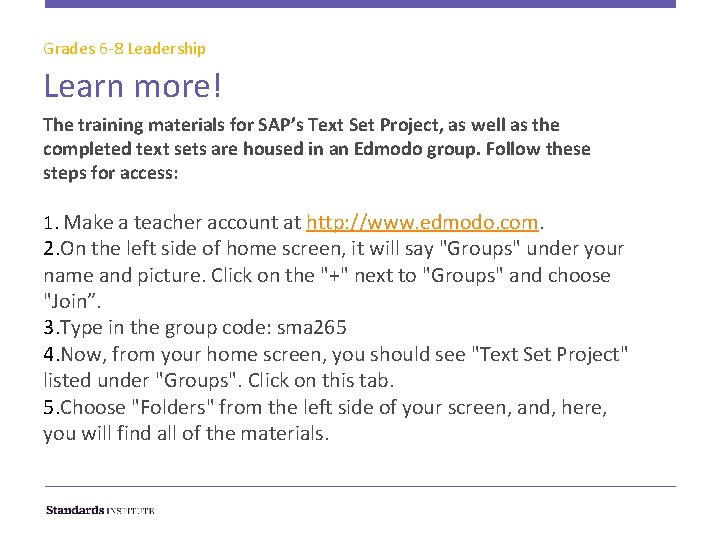
Grades 6 -8 Leadership Learn more! The training materials for SAP’s Text Set Project, as well as the completed text sets are housed in an Edmodo group. Follow these steps for access: 1. Make a teacher account at http: //www. edmodo. com. 2. On the left side of home screen, it will say "Groups" under your name and picture. Click on the "+" next to "Groups" and choose "Join”. 3. Type in the group code: sma 265 4. Now, from your home screen, you should see "Text Set Project" listed under "Groups". Click on this tab. 5. Choose "Folders" from the left side of your screen, and, here, you will find all of the materials.
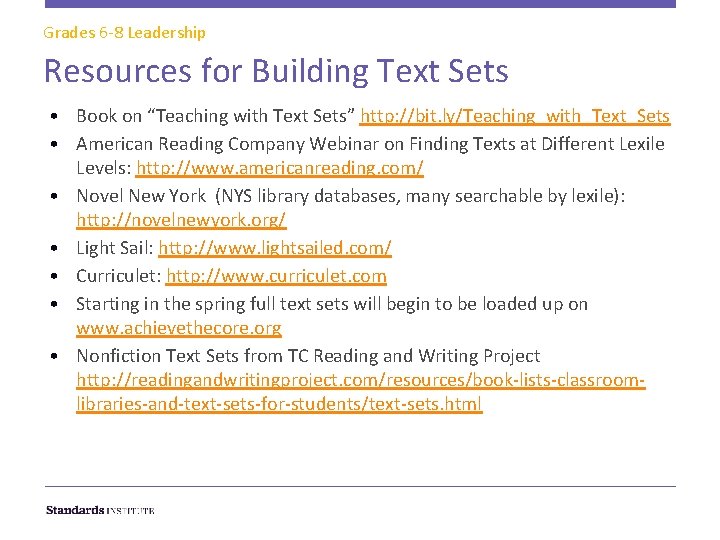
Grades 6 -8 Leadership Resources for Building Text Sets • Book on “Teaching with Text Sets” http: //bit. ly/Teaching_with_Text_Sets • American Reading Company Webinar on Finding Texts at Different Lexile Levels: http: //www. americanreading. com/ • Novel New York (NYS library databases, many searchable by lexile): http: //novelnewyork. org/ • Light Sail: http: //www. lightsailed. com/ • Curriculet: http: //www. curriculet. com • Starting in the spring full text sets will begin to be loaded up on www. achievethecore. org • Nonfiction Text Sets from TC Reading and Writing Project http: //readingandwritingproject. com/resources/book-lists-classroomlibraries-and-text-sets-for-students/text-sets. html
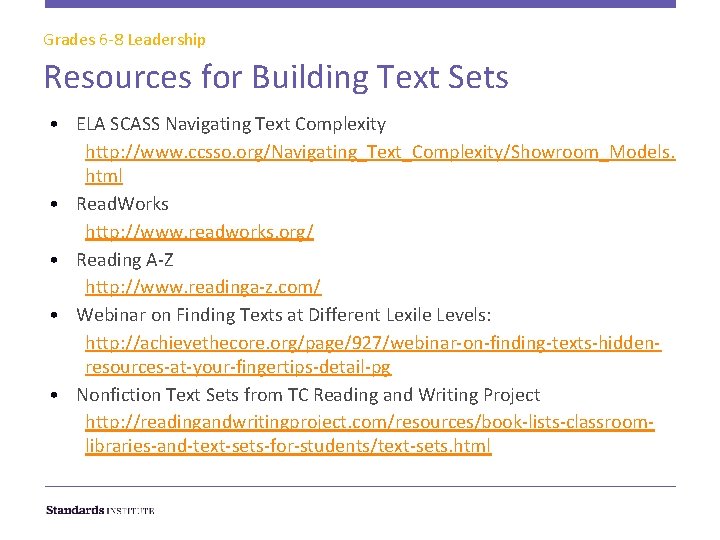
Grades 6 -8 Leadership Resources for Building Text Sets • ELA SCASS Navigating Text Complexity http: //www. ccsso. org/Navigating_Text_Complexity/Showroom_Models. html • Read. Works http: //www. readworks. org/ • Reading A-Z http: //www. readinga-z. com/ • Webinar on Finding Texts at Different Lexile Levels: http: //achievethecore. org/page/927/webinar-on-finding-texts-hiddenresources-at-your-fingertips-detail-pg • Nonfiction Text Sets from TC Reading and Writing Project http: //readingandwritingproject. com/resources/book-lists-classroomlibraries-and-text-sets-for-students/text-sets. html
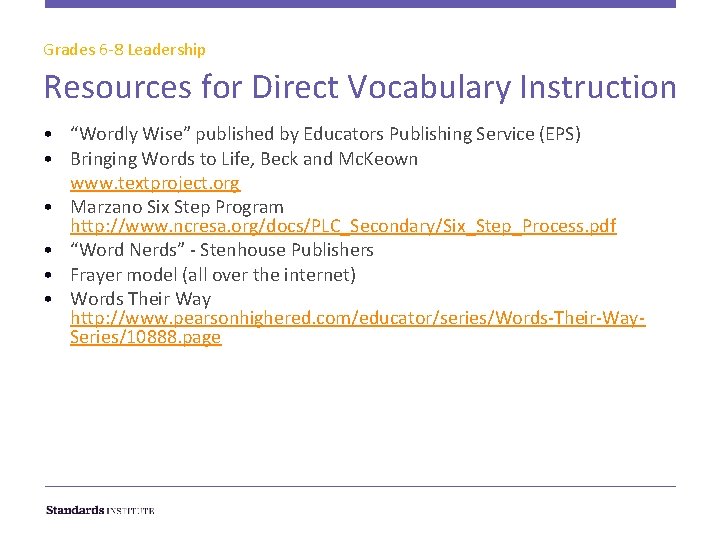
Grades 6 -8 Leadership Resources for Direct Vocabulary Instruction • “Wordly Wise” published by Educators Publishing Service (EPS) • Bringing Words to Life, Beck and Mc. Keown www. textproject. org • Marzano Six Step Program http: //www. ncresa. org/docs/PLC_Secondary/Six_Step_Process. pdf • “Word Nerds” - Stenhouse Publishers • Frayer model (all over the internet) • Words Their Way http: //www. pearsonhighered. com/educator/series/Words-Their-Way. Series/10888. page