
Introduction to the Economic Way of Thinking Acknowledgments
- Slides: 23
Introduction to the Economic Way of Thinking
Acknowledgments This Power. Point presentation is based on and includes content derived from the following OER resource: Principles of Microeconomics An Open. Stax book used for this course may be downloaded for free at: https: //openstax. org/details/books/principles-microeconomics-2 e 2
Key Questions • What is economics? • What are three basic questions economies must answer? • What are the primary economic systems? • What is an economic theory and an economic model? 3
What is Economics? • Economics is the study of how people allocate limited resources to meet unlimited wants. • Limited resources means the same thing as scarcity so another way of defining economics is to say it’s a study of how people make decisions under the condition of scarcity. • Here’s a short video introduction. https: //www. youtube. com/watch? v=yo. Vc_S_gd_0 4
Scarcity, Choice and Opportunity Cost • Facing scarcity means having to choose among alternatives. • We choose by assessing the costs and benefits of alternatives. • The cost we incur in making our choice is called opportunity cost. • Opportunity cost is the value of next-best alternative that is sacrificed when we make our choice. 5
The Three Questions All Economies Must Answer • What should we produce? • The mix of goods and services to make • How should we produce it? • The mix of resources and technology to use to produce those goods and services. • For whom should we produce? • How is income determined and how is it distributed. 6
An Overview of Economic Systems • The answers to the three questions depend on the economic system under which the economy operates. • We’ll define three different economic systems. • Traditional economy • Command economy • Market economy 7
The Traditional Economy • The traditional economy is the oldest type of economic system. • It is often agrarian and production techniques are timehonored. • Markets are primitive, institutions are weak, and exchange is often made with barter rather than money. • Families pursue the same occupation over generations. • Individuals and households tend to be self-sufficient: what they produce themselves is what they consume. 8
The Command Economy • A command economy, sometimes called a centrallyplanned economy, is characterized by top-down economic decisions made by government. • Government owns most of the resources. • Government decides what goods and services will be produced, how to produce them, and what prices to charge and wages to pay. • Government often provides services like healthcare and education. 9
The Market Economy • A market economy is an economy where decisionmaking is decentralized, where most resources are privately owned and where market forces provide answers. • What is produced depends on consumer preferences. • Profit-maximizing firms determine how best to produce. • Payments to factors of production, like labor, are determined by their productivity. • Demand interacts with supply in markets where prices signal the most efficient allocation of resources. 10
The “Mixed” Economy • Most economies operate with a mix of markets and government provision of goods and services. • Government also intervenes in market economies through regulation and antitrust legislation. • They impose regulations on businesses to protect the interests of consumers, workers and the environment. • They enact legislation to prevent businesses from engaging in anticompetitive behavior. 11
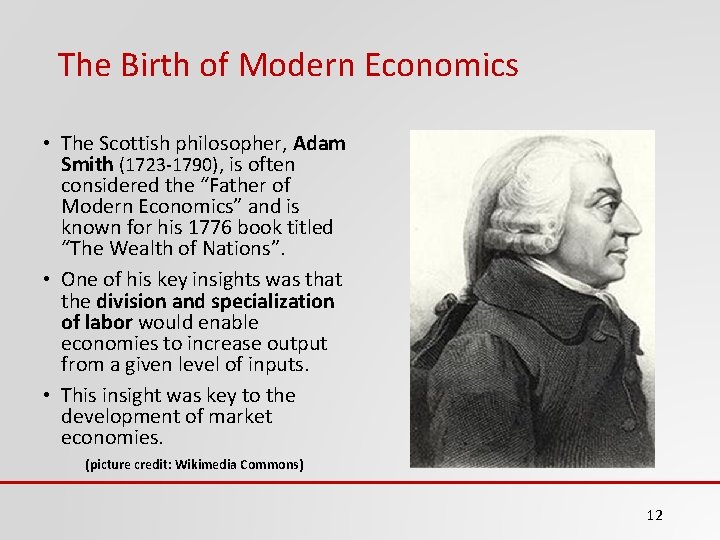
The Birth of Modern Economics • The Scottish philosopher, Adam Smith (1723 -1790), is often considered the “Father of Modern Economics” and is known for his 1776 book titled “The Wealth of Nations”. • One of his key insights was that the division and specialization of labor would enable economies to increase output from a given level of inputs. • This insight was key to the development of market economies. (picture credit: Wikimedia Commons) 12
The Division and Specialization of Labor • The division of labor refers to the way in which workers divide the tasks required to produce a good or service. • Specialization of labor happens when workers focus on particular tasks within the overall production process. • Specialization leads to greater productivity and encourages economies of scale, which means that the average cost of production falls as the quantity of output increases. 13
Economic Theories and Economic Models (1 of 2) • A economic theory is an idea or set of ideas that help us understand an observed phenomenon. • An economic model is a representation of reality that allows us to test the validity of a theory. • In economics, the words theory and model and often used interchangeably…so don’t sweat it! 14
Economic Theories and Economic Models (2 of 2) • Theories and models in economics are necessarily simplifications of reality. • Here’s a short video about economic models and why simplification is justified. https: //www. youtube. com/watch? v=l. YHy 2 XLa 4 u 0&feature=youtu. be 15
The Ceteris Paribus Assumption • Ceteris paribus is a Latin phrase that means while certain variables change, “all others remain unchanged. ” • Assume that variable A is affected by variable B and other variables C, D and E. When you’re trying to determine the effect of a change in variable B on variable A, you must hold constant the values of variables C, D, E. • It is critical to invoke the ceteris paribus assumption in economic models. 16
The Fallacy of False Cause • The fallacy of false cause refers to logical mistake of believing that two events have a causal relationship just because they occur at the same time. • For example, there’s the old belief that if an NFC team wins the Super Bowl, the stock market will rise but if an AFC team wins, it will fall. • There may indeed be a statistical correlation but you’d be foolish to bet your savings on it! 17
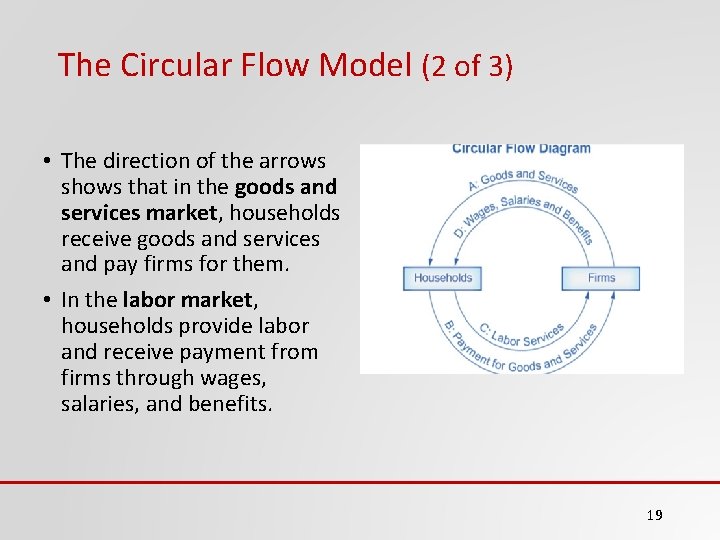
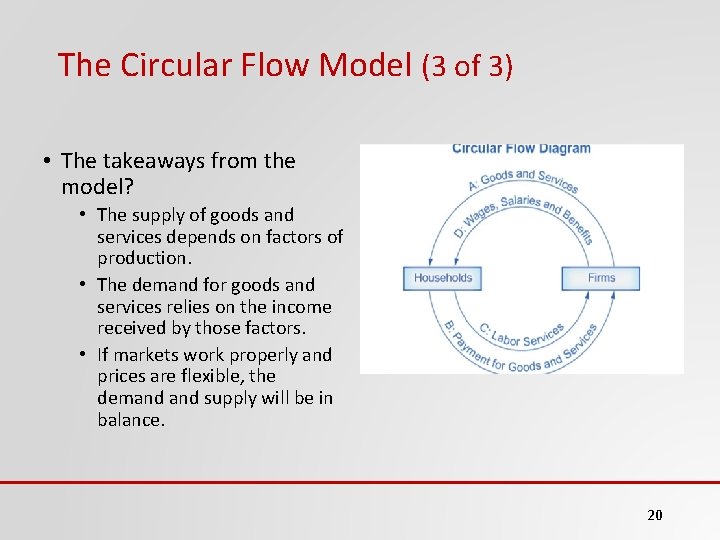
The Circular Flow Model (1 of 3) • The Circular flow model is an example of a simple economic model. • As presented on the next slide, the model shows the interaction between households and businesses in the markets for goods and services, and labor. • It shows a simplified economy that has no government sector, no financial markets and no foreign trade. 18
The Circular Flow Model (2 of 3) • The direction of the arrows shows that in the goods and services market, households receive goods and services and pay firms for them. • In the labor market, households provide labor and receive payment from firms through wages, salaries, and benefits. 19
The Circular Flow Model (3 of 3) • The takeaways from the model? • The supply of goods and services depends on factors of production. • The demand for goods and services relies on the income received by those factors. • If markets work properly and prices are flexible, the demand supply will be in balance. 20
In Conclusion, Two More Bits of Useful Information • What is the difference between microeconomics and macroeconomics? • What is the difference between positive and normative economics? 21
Microeconomics vs. Macroeconomics • There are two major branches of economics microeconomics and macroeconomics. • Microeconomics, which you’re about to study, focuses on the behavior and actions of individual units within the economy, like consumers and businesses and of individual markets. • Macroeconomics focuses on the overall economy and covers topics such as aggregate output, unemployment, inflation, and economic growth. 22
Positive vs. Normative Economics • Positive economics – refers to economic analyses that are confined to verifiable statements. • An example would be a statement that raising the minimum wage would result in fewer jobs for unskilled workers. • Economists may still disagree on the correctness of positive economic statements. • Normative economics – refers to economic analyses that are based on value judgment. • An example would be a statement that a full-time minimum wage job should pay enough to support a family. • There’s always disagreement and debate on normative statements. 23