
Introduction to the course Some NLP Applications Magic
- Slides: 57
Introduction to the course Some NLP Applications ◄ Magic? Instructor: Nick Cercone - 3050 CSEB - nick@cse. yorku. ca
Some NLP Applications Natural language interfaces to databases Natural language interfaces to search engines Generate and Repair Machine Translation (GRMT) Instructor: Nick Cercone - 3050 CSEB - nick@cse. yorku. ca 2
Natural Language Interfaces - System. X In the 1990’s Simon Fraser University researchers were engaged in a long-term project entitled Assessing Information with Ordinary Language which was realized in several versions of System. X. Initial System. X NL interface prototypes were modularly designed utilizing proven technologies, e. g. , augmented transition network grammars. System. X served as an umbrella project for new ideas and technologies, as a testbed for various techniques espoused by students and for experimenting with incompletely specified theories, HPSG’s. Instructor: Nick Cercone - 3050 CSEB - nick@cse. yorku. ca 3
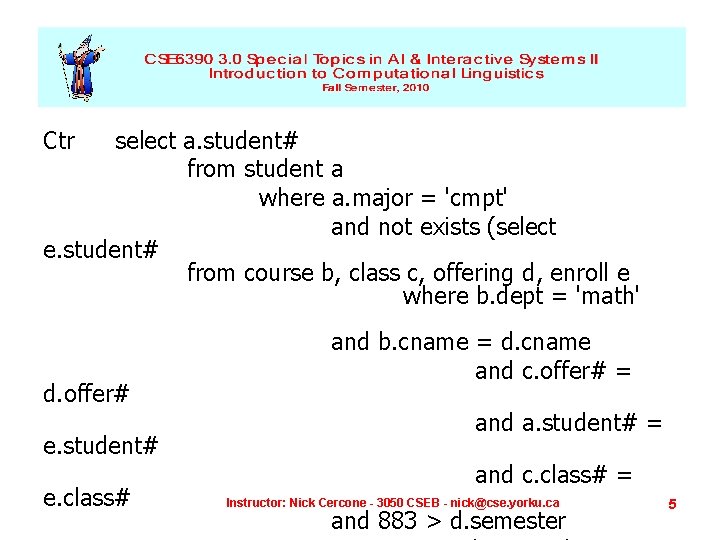
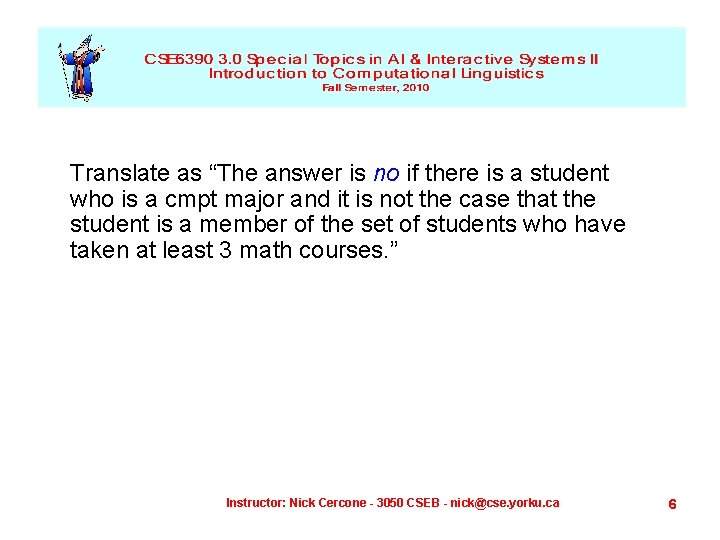
Early System. X handled quantifiers, which were problematic because SQL was not able to express queries with quantification in an obvious fashion. Thus, Has every cmpt major taken at least 3 math courses? , combined the problem of quantification with that of data organization and calculation. Instructor: Nick Cercone - 3050 CSEB - nick@cse. yorku. ca 4
Ctr select a. student# from student a where a. major = 'cmpt' and not exists (select e. student# from course b, class c, offering d, enroll e where b. dept = 'math' d. offer# e. student# e. class# and b. cname = d. cname and c. offer# = and a. student# = and c. class# = Instructor: Nick Cercone - 3050 CSEB - nick@cse. yorku. ca and 883 > d. semester 5
Translate as “The answer is no if there is a student who is a cmpt major and it is not the case that the student is a member of the set of students who have taken at least 3 math courses. ” Instructor: Nick Cercone - 3050 CSEB - nick@cse. yorku. ca 6
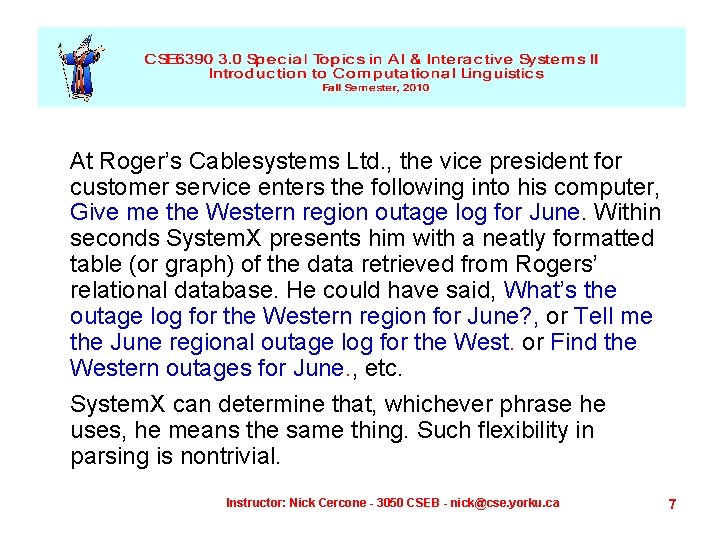
At Roger’s Cablesystems Ltd. , the vice president for customer service enters the following into his computer, Give me the Western region outage log for June. Within seconds System. X presents him with a neatly formatted table (or graph) of the data retrieved from Rogers’ relational database. He could have said, What’s the outage log for the Western region for June? , or Tell me the June regional outage log for the West. or Find the Western outages for June. , etc. System. X can determine that, whichever phrase he uses, he means the same thing. Such flexibility in parsing is nontrivial. Instructor: Nick Cercone - 3050 CSEB - nick@cse. yorku. ca 7
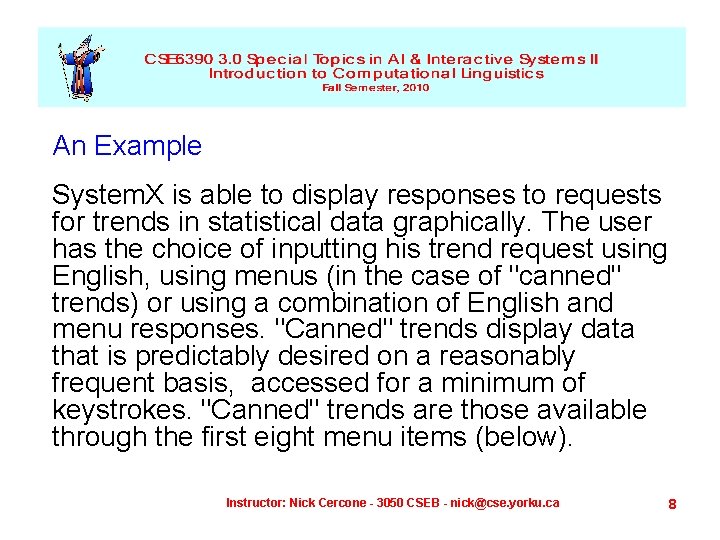
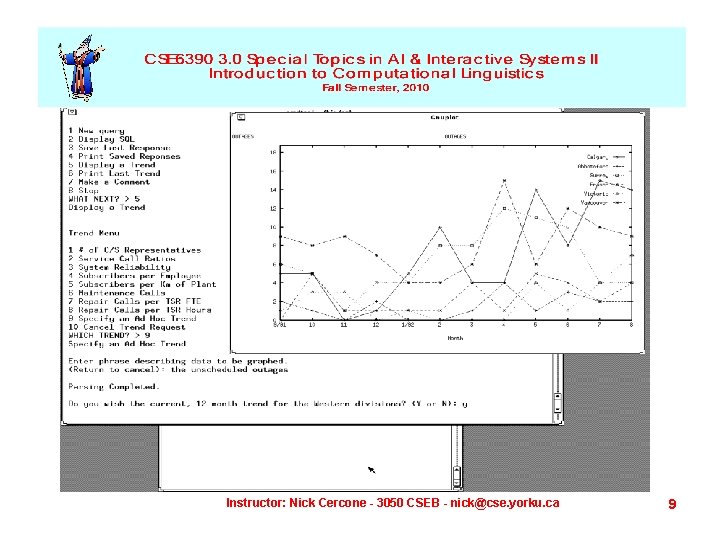
An Example System. X is able to display responses to requests for trends in statistical data graphically. The user has the choice of inputting his trend request using English, using menus (in the case of "canned" trends) or using a combination of English and menu responses. "Canned" trends display data that is predictably desired on a reasonably frequent basis, accessed for a minimum of keystrokes. "Canned" trends are those available through the first eight menu items (below). Instructor: Nick Cercone - 3050 CSEB - nick@cse. yorku. ca 8
Instructor: Nick Cercone - 3050 CSEB - nick@cse. yorku. ca 9
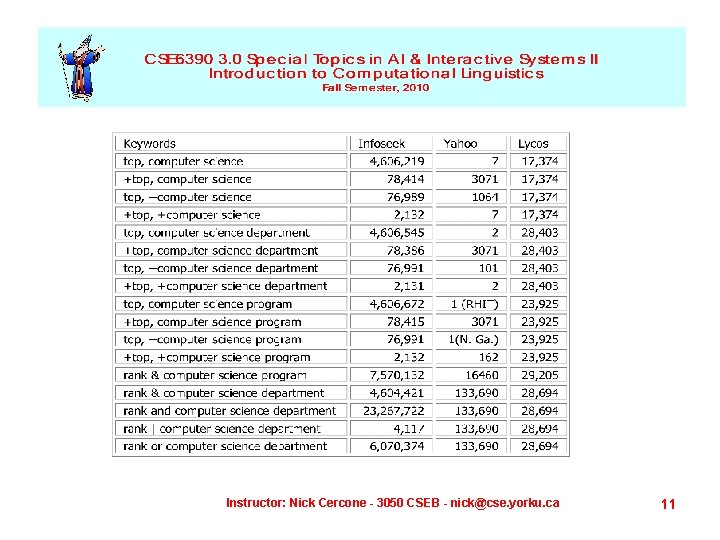
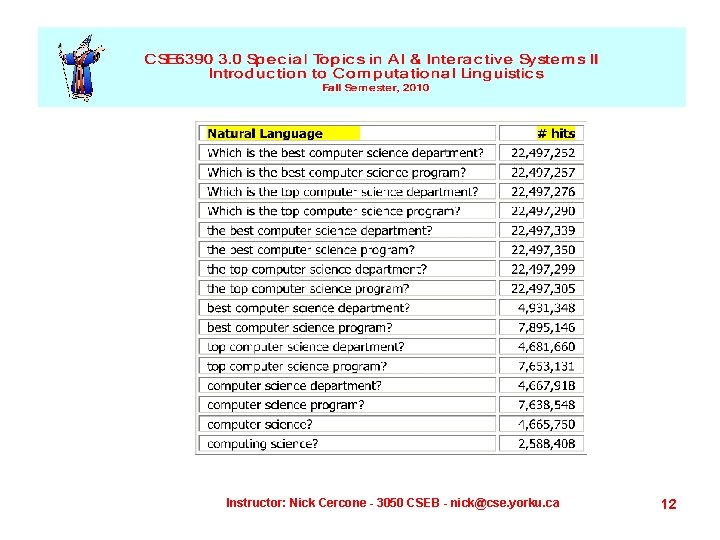
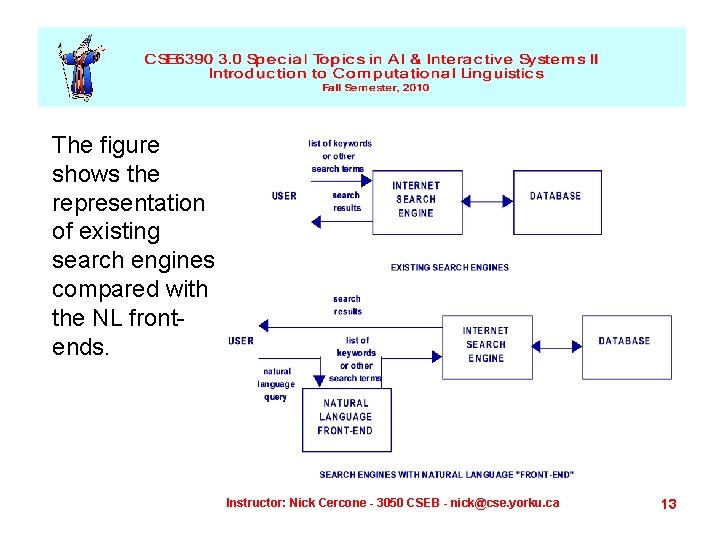
Natural language interfaces to internet search engines NLAISE and MATISE Despite the many search engines available, searching for a relevant site remains difficult. One major reason for this difficulty is that search engines do not analyze queries semantically; in contrast, most search engines perform keyword matching. How can use of NL semantics improve internet searching? Instructor: Nick Cercone - 3050 CSEB - nick@cse. yorku. ca 10
Instructor: Nick Cercone - 3050 CSEB - nick@cse. yorku. ca 11
Instructor: Nick Cercone - 3050 CSEB - nick@cse. yorku. ca 12
The figure shows the representation of existing search engines compared with the NL frontends. Instructor: Nick Cercone - 3050 CSEB - nick@cse. yorku. ca 13
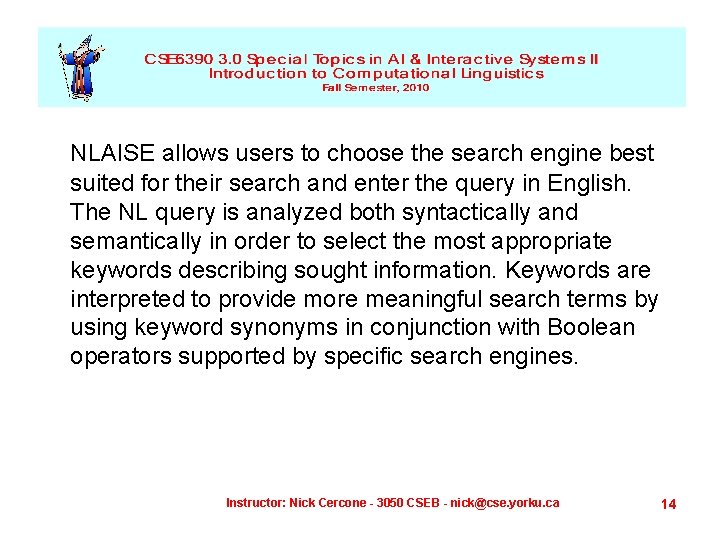
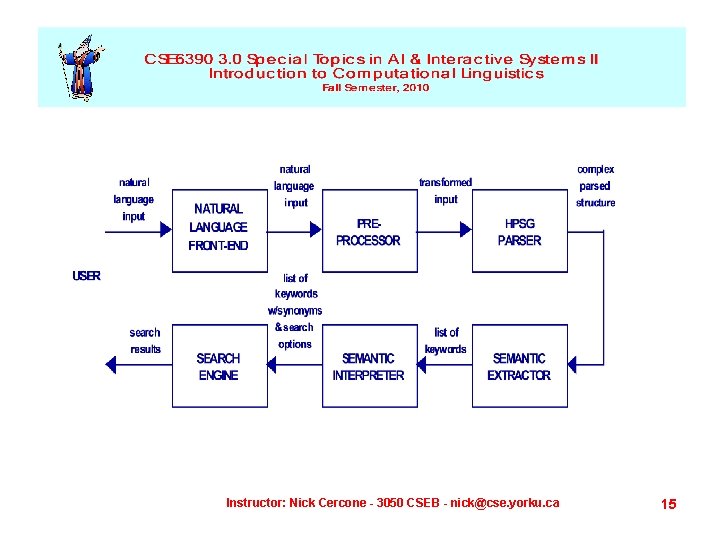
NLAISE allows users to choose the search engine best suited for their search and enter the query in English. The NL query is analyzed both syntactically and semantically in order to select the most appropriate keywords describing sought information. Keywords are interpreted to provide more meaningful search terms by using keyword synonyms in conjunction with Boolean operators supported by specific search engines. Instructor: Nick Cercone - 3050 CSEB - nick@cse. yorku. ca 14
Instructor: Nick Cercone - 3050 CSEB - nick@cse. yorku. ca 15
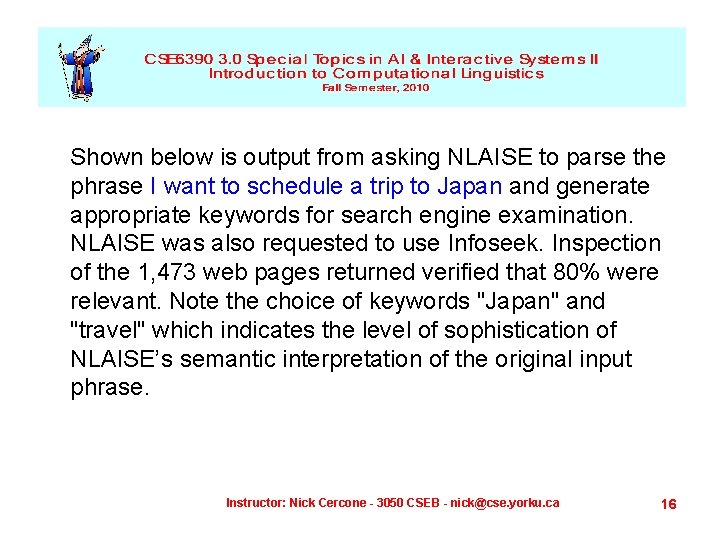
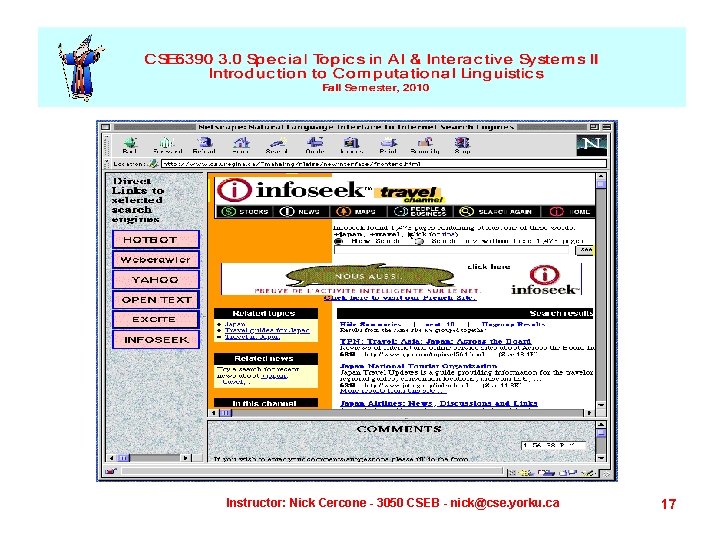
Shown below is output from asking NLAISE to parse the phrase I want to schedule a trip to Japan and generate appropriate keywords for search engine examination. NLAISE was also requested to use Infoseek. Inspection of the 1, 473 web pages returned verified that 80% were relevant. Note the choice of keywords "Japan" and "travel" which indicates the level of sophistication of NLAISE’s semantic interpretation of the original input phrase. Instructor: Nick Cercone - 3050 CSEB - nick@cse. yorku. ca 16
Instructor: Nick Cercone - 3050 CSEB - nick@cse. yorku. ca 17
EMATISE extended NLAISE in 3 user-oriented ways: (1) enhanced semantic interpretation eliminating much ambiguity over multiple domains; (2) sent out term expanded queries to multiple search engines in parallel, reranked results and returned a single relevant high precision list for the user; and (3) a higher level of abstraction above conventional search services presented the user with a single, central and natural search interface with which to interact. For example: Instructor: Nick Cercone - 3050 CSEB - nick@cse. yorku. ca 18
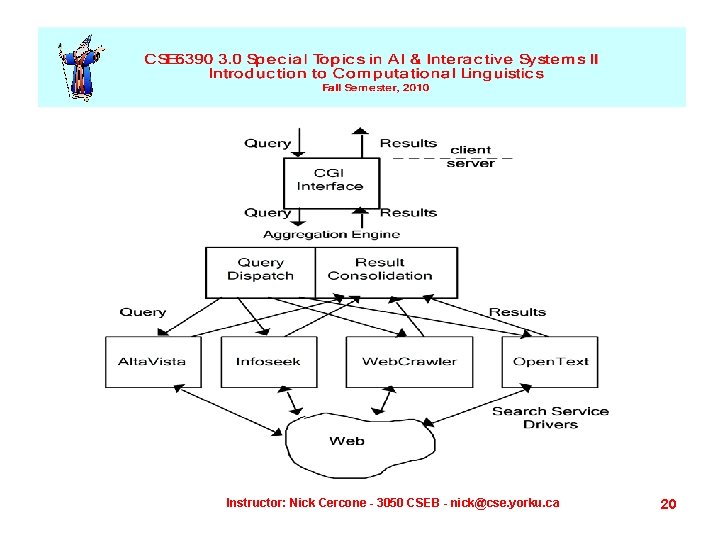
Ematise’s modular design, depicted in the next slide, consists of a CGI interface, aggregation engine, and search service drivers. The CGI interface passes a user's query option in a logical format, search service neural from Web client, to the meta search engine server. The logical query is passed to the aggregation engine, responsible for concurrently dispatching the query to selected search services, obtaining initial results from each service, eliminating duplicate results, re-ranking and consolidating the results, and finally creating HTML pages from the results, to be properly displayed back at the Web client. Instructor: Nick Cercone - 3050 CSEB - nick@cse. yorku. ca 19
Instructor: Nick Cercone - 3050 CSEB - nick@cse. yorku. ca 20
Ematise provides a layer of abstraction above traditional services and incorporates several desirable features. As the Web grows and changes, search services become volatile. Interfaces of existing search services change often due to enhancements which impact query input and output format. Also a number of services are retired or replaced. Ematise’s modular design, especially the search service driver classes, provides a wrapper around this service specific information, effectively encapsulately them, and allows for services to be added, modified, and removed easily. Instructor: Nick Cercone - 3050 CSEB - nick@cse. yorku. ca 21
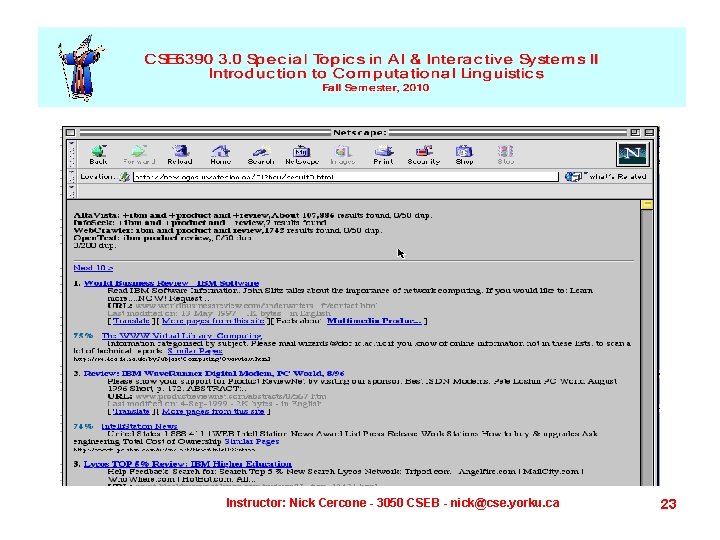
Ematise has a meta search engine that does not require large databases or large amounts of memory. Since both the server and client side of the meta search engine are implemented in Java, they are easily portable to different platforms without the extra effort of changing the code. The figure below shows EMATISE results after a simple translation of the sentence “I want to visit the homepage of IBM product review” into search engine neutral search terms, term expanded by the drivers for particular search engines. Figure 6 illustrates the results of this query after the aggregation engine assembles the results. Instructor: Nick Cercone - 3050 CSEB - nick@cse. yorku. ca 22
Instructor: Nick Cercone - 3050 CSEB - nick@cse. yorku. ca 23
Machine Translation Generate and Repair Machine Translation (GRMT) Imagine picking up the phone in Toronto, dialing your Japanese friend in Tokyo. You speak English; she hears Japanese. Fortunately it is 2020 and your English is automatically translated into Japanese in the time it takes to transfer your words. Impossible you say? ? !!! Instructor: Nick Cercone - 3050 CSEB - nick@cse. yorku. ca 24
Machine translation has fascinated and frustrated researchers for over 50 years. Recent success in statistical, nonlinguistic and hybrid systems provides hope that we will not be confined to traditional direct, transfer and intralingual approaches. We provide an approach following from CS methodology: generate and repair machine translation. (GRMT). Instructor: Nick Cercone - 3050 CSEB - nick@cse. yorku. ca 25
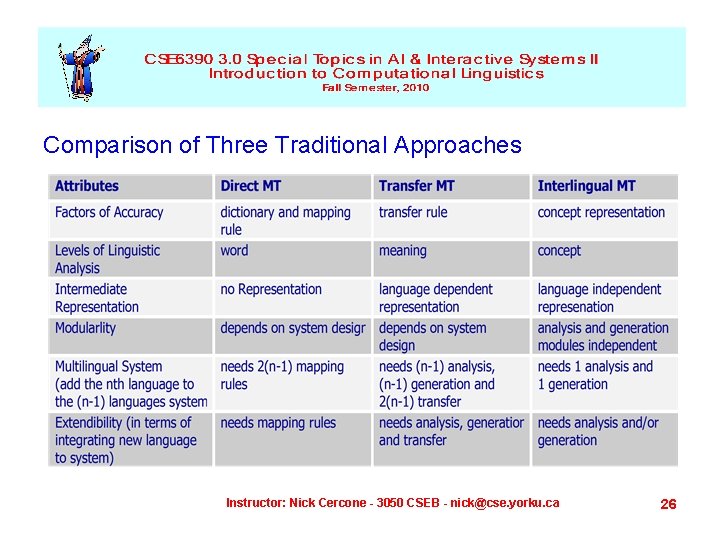
Comparison of Three Traditional Approaches Instructor: Nick Cercone - 3050 CSEB - nick@cse. yorku. ca 26
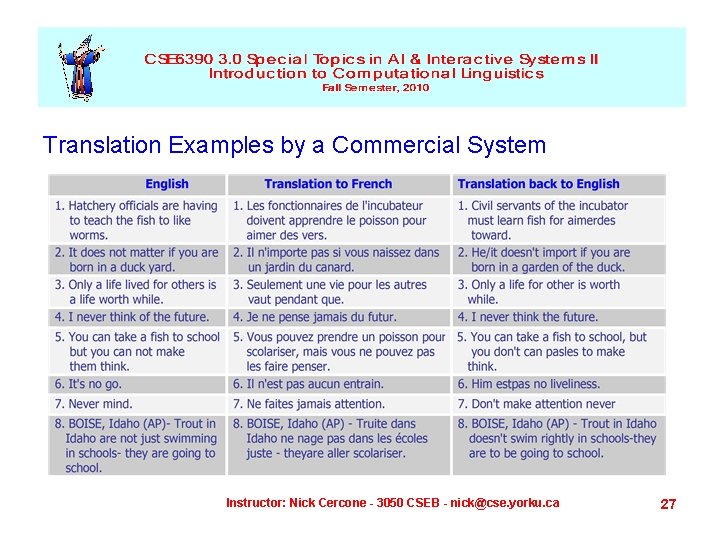
Translation Examples by a Commercial System Instructor: Nick Cercone - 3050 CSEB - nick@cse. yorku. ca 27
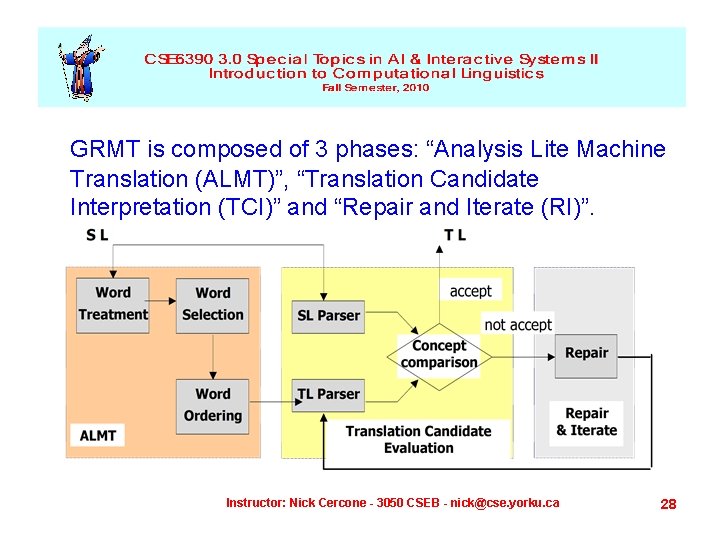
GRMT is composed of 3 phases: “Analysis Lite Machine Translation (ALMT)”, “Translation Candidate Interpretation (TCI)” and “Repair and Iterate (RI)”. Instructor: Nick Cercone - 3050 CSEB - nick@cse. yorku. ca 28
The 3 Phases ALMT generates translation candidates (TC) by considering syntactic and semantic differences between language pairs without any sophisticated analysis. This ensures the TC is generated quickly and efficiently. Next, the system interprets the TC to see if it retains the meaning of the SL. If so, that TC will be considered a translation. If not, that TC will be repaired based on the diagnosis indicated in the TCI phase. Instructor: Nick Cercone - 3050 CSEB - nick@cse. yorku. ca 29
The repaired TC will be re-interpreted to determine if it still has a different meaning from the SL. These two processes iterate until the TC conveys the same meaning as the SL. The TCI and RI stages ensure the accuracy of the translation result. Instructor: Nick Cercone - 3050 CSEB - nick@cse. yorku. ca 30
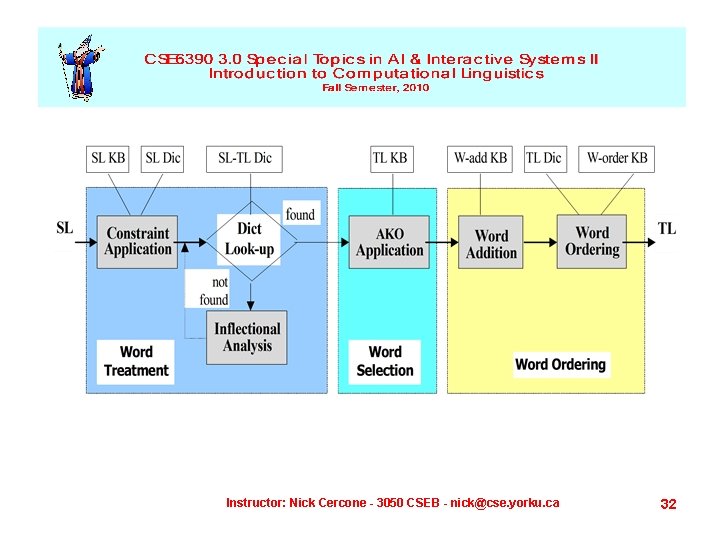
ALMT Architecture ALMT was designed around two simple notions: first, the more accurately ALMT generates a TC, the less work is required in the latter phases; and second, generating the TC must be done quickly. Therefore, ALMT generates a TC by considering the difference between language pairs in terms of syntax and semantics without performing any sophisticated analysis. ALMT performs its task by judiciously selecting a few simple heuristics, constraints, and semantic principles, to apply when appropriate, into a simple direct framework for translation. Instructor: Nick Cercone - 3050 CSEB - nick@cse. yorku. ca 31
Instructor: Nick Cercone - 3050 CSEB - nick@cse. yorku. ca 32
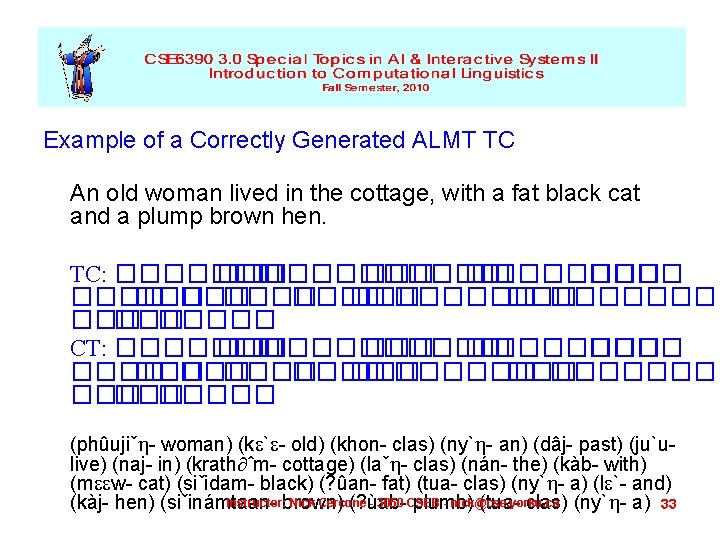
Example of a Correctly Generated ALMT TC An old woman lived in the cottage, with a fat black cat and a plump brown hen. TC: ������� ��� ������� ���� ��� ��� ����� CT: ������� ��� ������� ���� ��� ��� ����� (phûujiˇ - woman) (k ` - old) (khon- clas) (ny` - an) (dâj- past) (ju`ulive) (naj- in) (krath ˆm- cottage) (laˇ - clas) (nán- the) (kàb- with) (m w- cat) (siˇidam- black) (? ûan- fat) (tua- clas) (ny` - a) (l `- and) Instructor: brown) Nick Cercone - 3050 CSEB - nick@cse. yorku. ca (kàj- hen) (siˇinámtaan(? ùabplumb) (tua- clas) (ny` - a) 33
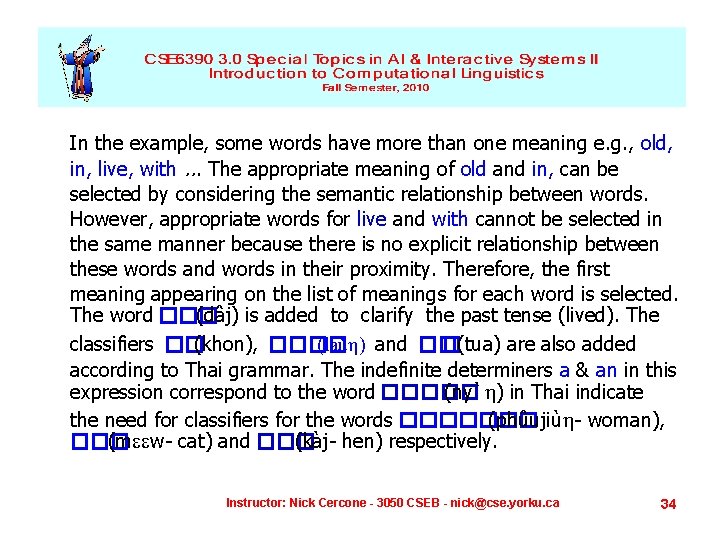
In the example, some words have more than one meaning e. g. , old, in, live, with. . . The appropriate meaning of old and in, can be selected by considering the semantic relationship between words. However, appropriate words for live and with cannot be selected in the same manner because there is no explicit relationship between these words and words in their proximity. Therefore, the first meaning appearing on the list of meanings for each word is selected. The word ��� (dâj) is added to clarify the past tense (lived). The classifiers �� (khon), ���� (laùη) and �� �(tua) are also added according to Thai grammar. The indefinite determiners a & an in this expression correspond to the word ����� (ny` ) in Thai indicate the need for classifiers for the words ������� (phûujiù - woman), ��� (m w- cat) and ��� (kàj- hen) respectively. Instructor: Nick Cercone - 3050 CSEB - nick@cse. yorku. ca 34
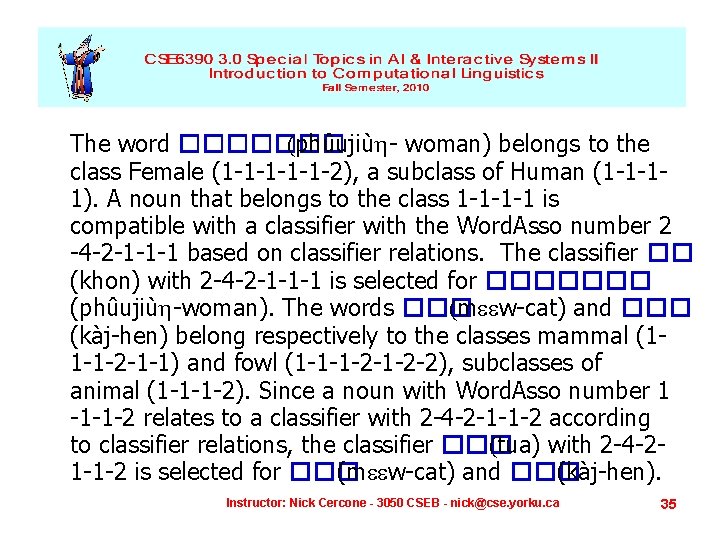
The word ������� (phûujiù - woman) belongs to the class Female (1 -1 -1 -2), a subclass of Human (1 -1 -11). A noun that belongs to the class 1 -1 -1 -1 is compatible with a classifier with the Word. Asso number 2 -4 -2 -1 -1 -1 based on classifier relations. The classifier �� (khon) with 2 -4 -2 -1 -1 -1 is selected for ������� (phûujiù -woman). The words ��� (m w-cat) and ��� (kàj-hen) belong respectively to the classes mammal (11 -1 -2 -1 -1) and fowl (1 -1 -1 -2 -2), subclasses of animal (1 -1 -1 -2). Since a noun with Word. Asso number 1 -1 -1 -2 relates to a classifier with 2 -4 -2 -1 -1 -2 according to classifier relations, the classifier ��� (tua) with 2 -4 -21 -1 -2 is selected for ��� (m w-cat) and ��� (kàj-hen). Instructor: Nick Cercone - 3050 CSEB - nick@cse. yorku. ca 35
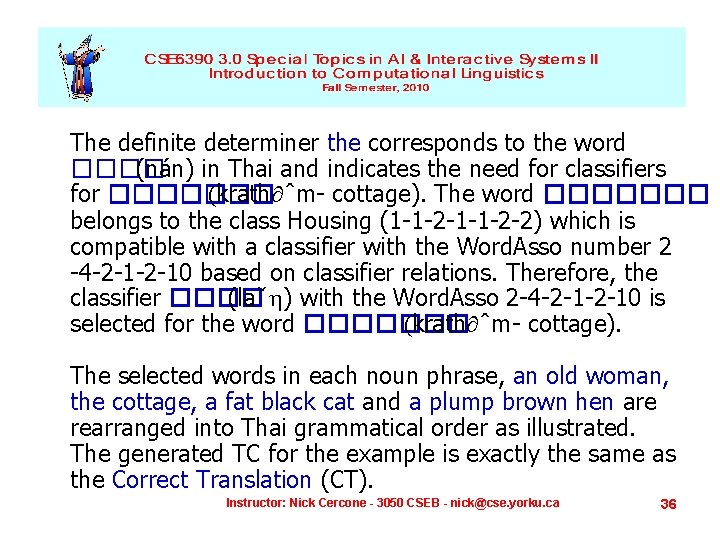
The definite determiner the corresponds to the word ���� (nán) in Thai and indicates the need for classifiers for ������� (krath ˆm- cottage). The word ������� belongs to the class Housing (1 -1 -2 -2) which is compatible with a classifier with the Word. Asso number 2 -4 -2 -10 based on classifier relations. Therefore, the classifier ���� (laˇ ) with the Word. Asso 2 -4 -2 -10 is selected for the word ������� (krath ˆm- cottage). The selected words in each noun phrase, an old woman, the cottage, a fat black cat and a plump brown hen are rearranged into Thai grammatical order as illustrated. The generated TC for the example is exactly the same as the Correct Translation (CT). Instructor: Nick Cercone - 3050 CSEB - nick@cse. yorku. ca 36
The required GRMT knowledge bases include: Constraints, Dictionaries, Grammar & Lexicon Constraints SL constraints are the characteristics of the SL which are different from those of the TL. They are used to simplify the structure of the SL and to narrow the scope of possible TL words that correspond to each SL word. TL constraints are the characteristics of the TL that are different from those of the SL. They are required, not only to retain the meaning of SL but also to make them grammatically correct. Instructor: Nick Cercone - 3050 CSEB - nick@cse. yorku. ca 37
Dictionaries GRMT uses 3 types of dictionaries, the SL dictionary, TL dictionary and a bilingual dictionary. Entries in the SL and TL dictionaries can be single word, some inflected and derived forms which cannot be easily handled by rules. Compound words are also included. Each entry has morphological, syntactic and semantic information. The Thai dictionary entry contains word form and word subcategory. The English dictionary contains the category used in the inflectional analysis step. The Bilingual dictionary contains the English entry and all corresponding Thai words and AKO number for each Thai word, e. g. , the word “dream” in English has 3 Thai words which express differences in meaning and usage. Instructor: Nick Cercone - 3050 CSEB - nick@cse. yorku. ca 38
All Thai words which correspond to each English entry are ordered based on usage frequency. The first meaning is selected once constraint and AKO fail. The SL dictionary is used by ALMT in the constraint application and inflectional analysis steps. The SL and the TL are put into correspondence via the SL-TL dictionary. The SL-TL dictionary contains the SL entry and its all possible corresponding words in the TL. Instructor: Nick Cercone - 3050 CSEB - nick@cse. yorku. ca 39
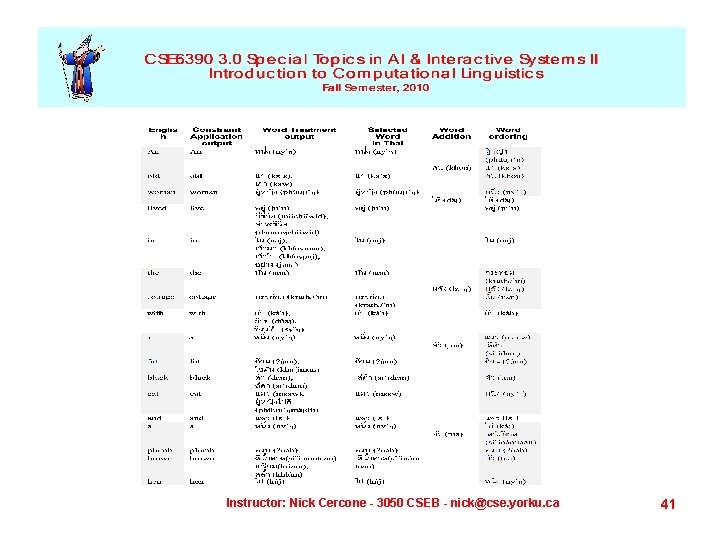
Grammars and lexicons of both SL and TL are required in the TCE analysis process. They are developed principally based on HPSGs. Experiments of ALMT (English to Thai) indicate that TCs can be generated with relative accuracy. The table below shows all the steps in an earlier example of applying ALMT. Instructor: Nick Cercone - 3050 CSEB - nick@cse. yorku. ca 40
Instructor: Nick Cercone - 3050 CSEB - nick@cse. yorku. ca 41
Translation Candidate Evaluation (TCE) The second phase of GRMT, TCE, analyzes the generated translation candidate to determine whether the TC retains the meaning of the source language. TCE analyzes both the SL and the TC in parallel, then compares the parses semantically alone, since there are syntactic level differences between languages. If the semantic results are the same, the TC will be deemed an appropriate translation. If the semantic results are different, the TC will be repaired in the third phase, Repair and Iterate. TCE comprises two modules: the analyzer and semantic comparison. Instructor: Nick Cercone - 3050 CSEB - nick@cse. yorku. ca 42
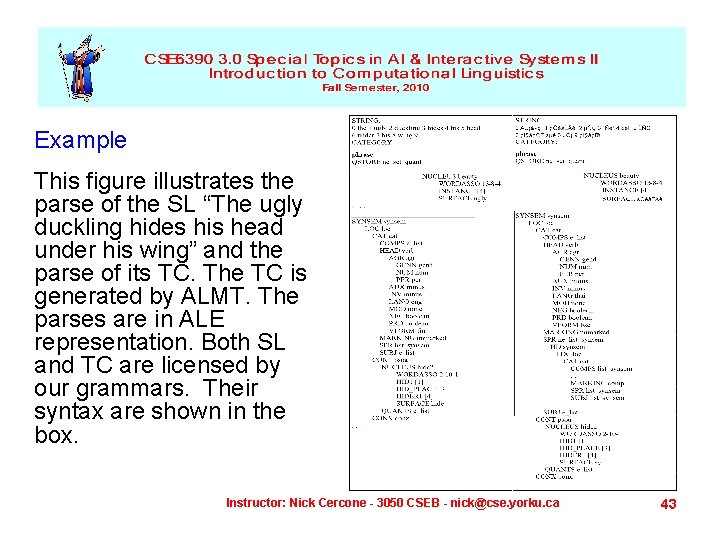
Example This figure illustrates the parse of the SL “The ugly duckling hides his head under his wing” and the parse of its TC. The TC is generated by ALMT. The parses are in ALE representation. Both SL and TC are licensed by our grammars. Their syntax are shown in the box. Instructor: Nick Cercone - 3050 CSEB - nick@cse. yorku. ca 43
Semantic Extraction extracts the semantic information of the SL and the TC from their parses so that we can compare the meaning of the TC with that of the SL. The semantic representation of an expression in GRMT is based on the HPSG representation provided. The features CONT, CONX and QSTORE hold the semantics of the object. The semantic representation described in CONT value of hide corresponds to the situation in which (the hider) hides (the hid) in (or under, from, . . . ) (the hid_place). Instructor: Nick Cercone - 3050 CSEB - nick@cse. yorku. ca 44
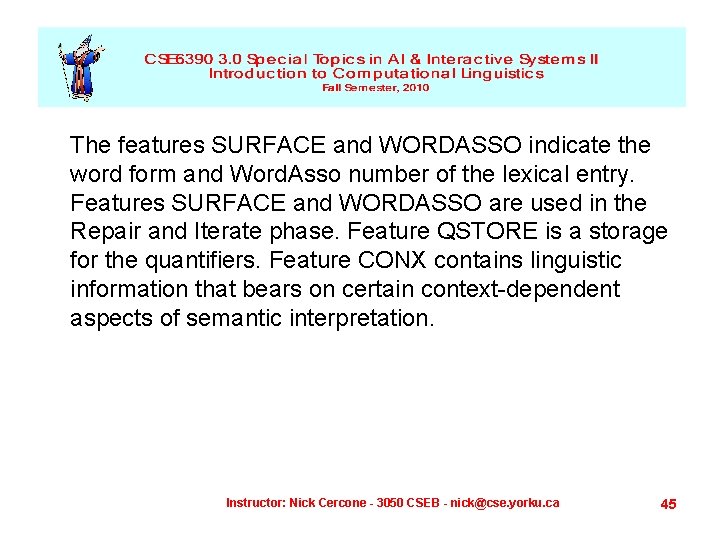
The features SURFACE and WORDASSO indicate the word form and Word. Asso number of the lexical entry. Features SURFACE and WORDASSO are used in the Repair and Iterate phase. Feature QSTORE is a storage for the quantifiers. Feature CONX contains linguistic information that bears on certain context-dependent aspects of semantic interpretation. Instructor: Nick Cercone - 3050 CSEB - nick@cse. yorku. ca 45
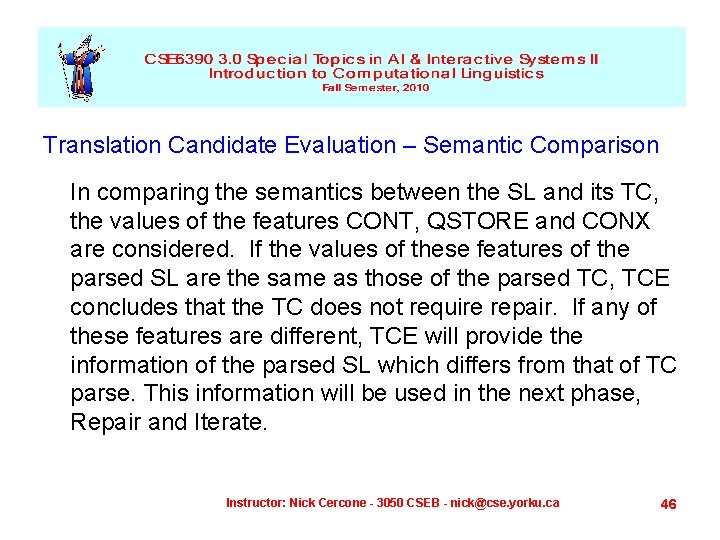
Translation Candidate Evaluation – Semantic Comparison In comparing the semantics between the SL and its TC, the values of the features CONT, QSTORE and CONX are considered. If the values of these features of the parsed SL are the same as those of the parsed TC, TCE concludes that the TC does not require repair. If any of these features are different, TCE will provide the information of the parsed SL which differs from that of TC parse. This information will be used in the next phase, Repair and Iterate. Instructor: Nick Cercone - 3050 CSEB - nick@cse. yorku. ca 46
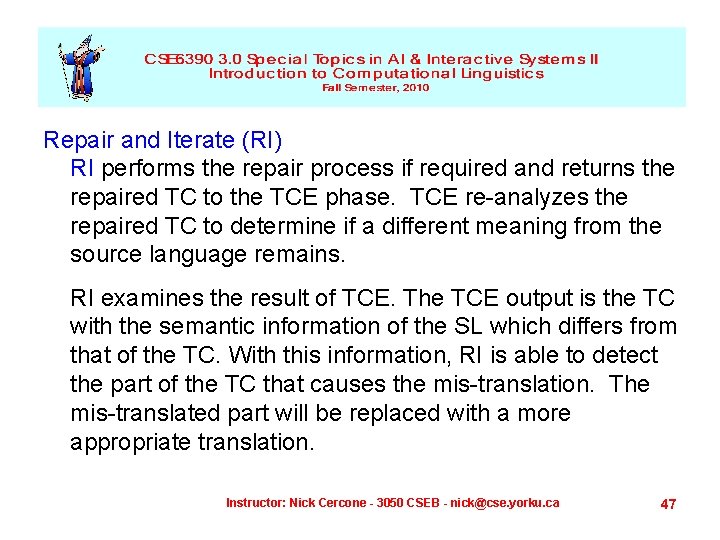
Repair and Iterate (RI) RI performs the repair process if required and returns the repaired TC to the TCE phase. TCE re-analyzes the repaired TC to determine if a different meaning from the source language remains. RI examines the result of TCE. The TCE output is the TC with the semantic information of the SL which differs from that of the TC. With this information, RI is able to detect the part of the TC that causes the mis-translation. The mis-translated part will be replaced with a more appropriate translation. Instructor: Nick Cercone - 3050 CSEB - nick@cse. yorku. ca 47
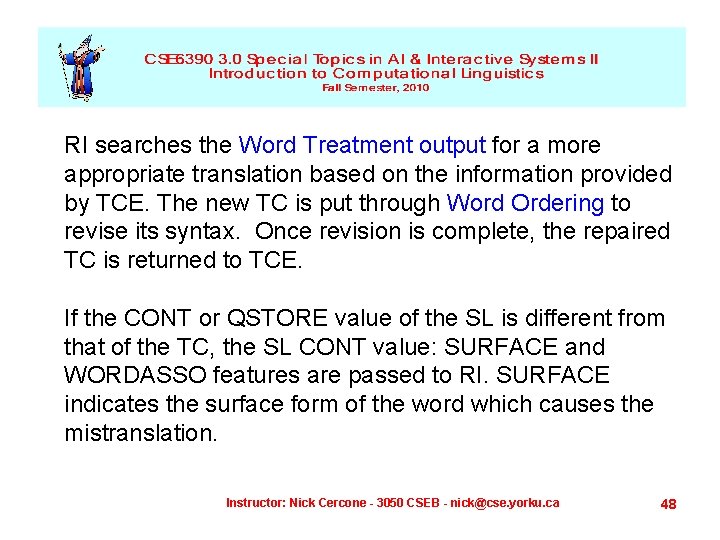
RI searches the Word Treatment output for a more appropriate translation based on the information provided by TCE. The new TC is put through Word Ordering to revise its syntax. Once revision is complete, the repaired TC is returned to TCE. If the CONT or QSTORE value of the SL is different from that of the TC, the SL CONT value: SURFACE and WORDASSO features are passed to RI. SURFACE indicates the surface form of the word which causes the mistranslation. Instructor: Nick Cercone - 3050 CSEB - nick@cse. yorku. ca 48
WORDASSO specifies the proper meaning of the word in question in terms of Word. Asso number. To repair CONT or QSTORE of the TC, RI re-selects the corresponding word in the TL for the word specified in SURFACE. The re-selection is done by searching Word Treatment output for the corresponding word which has the same Word. Asso number as specified in WORDASSO. Instructor: Nick Cercone - 3050 CSEB - nick@cse. yorku. ca 49
In the case that the CONX value of the SL differs from that of the TC, the SL CONX value: the BEARER and NAME features are passed to RI. BEARER specifies the index which associates with the certain name specified in the NAME value. RI repairs the TC by associating the right names to the right indices based on the information provided by TCE. Instructor: Nick Cercone - 3050 CSEB - nick@cse. yorku. ca 50
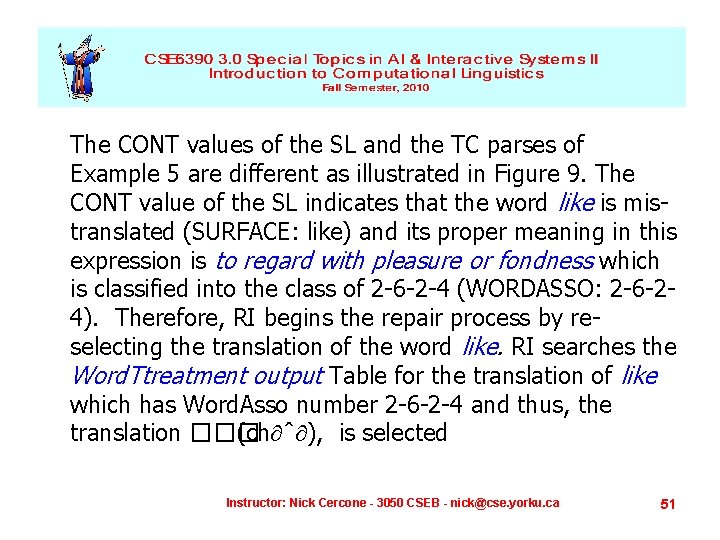
The CONT values of the SL and the TC parses of Example 5 are different as illustrated in Figure 9. The CONT value of the SL indicates that the word like is mistranslated (SURFACE: like) and its proper meaning in this expression is to regard with pleasure or fondness which is classified into the class of 2 -6 -2 -4 (WORDASSO: 2 -6 -24). Therefore, RI begins the repair process by reselecting the translation of the word like. RI searches the Word. Ttreatment output Table for the translation of like which has Word. Asso number 2 -6 -2 -4 and thus, the translation ��� (ch ˆ ), is selected Instructor: Nick Cercone - 3050 CSEB - nick@cse. yorku. ca 51
Key Features of GRMT Simplicity Each step performed by GRMT is straightforward to carry out. Modularity GRMT’s translation process is separated into three modules: ALMT, TCE and RI. Each module is comprised of sub-modules for easy modification and maintenance. Extendibility GRMT is intended to be easily extendible to any other language. Since each component is separated not only in the translation process components but also in the knowledge bases, each component can be extended easily to a larger domain. Instructor: Nick Cercone - 3050 CSEB - nick@cse. yorku. ca 52
Multilinguality depends on the modularity and extendibility. GRMT is highly modular and extendible in two major ways. The treatment of SL and TL are independent. Required SL and TL knowledge bases are developed separately, hence it is easy to add new languages. For example, SL-constraints (e. g. , plurality, continuous tense, etc. ) required to translate English into Thai can be applied to translate English into Chinese and Japanese since these languages share those characteristics. Instructor: Nick Cercone - 3050 CSEB - nick@cse. yorku. ca 53
French and Spanish share the same syntactic features with English, features which differ from those of Thai, Chinese and Japanese, then GRMT requires six analyzers and two sets of constraints to perform the translation between the two language families. Transfer MT requires 6 SL analyzers, 6 TL generations and 18 sets of transfer rules. Instructor: Nick Cercone - 3050 CSEB - nick@cse. yorku. ca 54
Summary NLU by computer is an enviable goal and many uses of this technology have already been put to the test. Has research progressed to the point where it will actually be possible to begin to build the “ideal” NL system? As knowledge representation ideas become more precisely formulated, such an evolution is happening. Instructor: Nick Cercone - 3050 CSEB - nick@cse. yorku. ca 55
Despite these developments, the ability to incorporate knowledge is still a major source of difficulty confronting the designer of the ideal NL system. Much knowledge representation is not explicitly aimed at NLU, and less yet at the problem of integrating knowledge into the interpretation processes. Much work is highly theoretical. Finally, knowledge representation is a vast area of inquiry. It appears that the ideal NL system is still some way off, at least in its full splendor. Nevertheless, the indicators are all very positive. Instructor: Nick Cercone - 3050 CSEB - nick@cse. yorku. ca 56
Concluding Remarks On Problems Our choicest plans have fallen through, our airiest castles tumbled over, because of lines we neatly drew and later neatly stumbled over. Instructor: Nick Cercone - 3050 CSEB - nick@cse. yorku. ca 57