
INTRODUCTION TO THE COURSE OF THEORETICAL PHONETICS PLAN
- Slides: 15
INTRODUCTION TO THE COURSE OF THEORETICAL PHONETICS
PLAN 1. Phonetics as a branch of linguistics. 2. The work of the organs of speech. 3. Methods of investigating the sound matter of the language. 4. The importance of phonetics as a theoretical discipline. 5. Phonetics and its connection with social sciences. 6. Theories of teaching pronunciation in current TEFL / TESOL practices.
Phonetics is a branch of linguistics that studies human speech sounds and their production and pronunciation. Phonetics as a branch of linguistics. Phonetics is subdivided into: - Practical/normative (studies the material form of phonetic phenomena in relation to meaning) - Theoretical (studies the functioning of phonetic units in the language) Phonetics is itself divided into two major components: - Segmental phonetics, which is concerned with individual sounds. - Suprasegmental phonetics that studies larger units of connected speech: syllables, words, phrases and texts.
Traditional branches of phonetics: 1. articulatory phonetics is the branch of phonetics concerned with describing the speech sounds of the world's languages in terms of their articulations, that is, the movements and/or positions of the vocal organs. 2. acoustic phonetics is the study of the acoustic characteristics of speech, including an analysis and description of speech in terms of its physical properties, such as frequency, intensity, and duration. 3. auditory phonetics focuses on the perception of sounds or the way in which sounds are heard and interpreted. The means which we discriminate sounds – quality, sensations of pitch, loudness, length, are relevant here. 4. functional phonetics is the branch of phonetics that studies the linguistic function of consonant and vowel sounds, syllabic structure, word accent and prosodic features, such as pitch, stress and tempo. It is typically referred to as phonology.
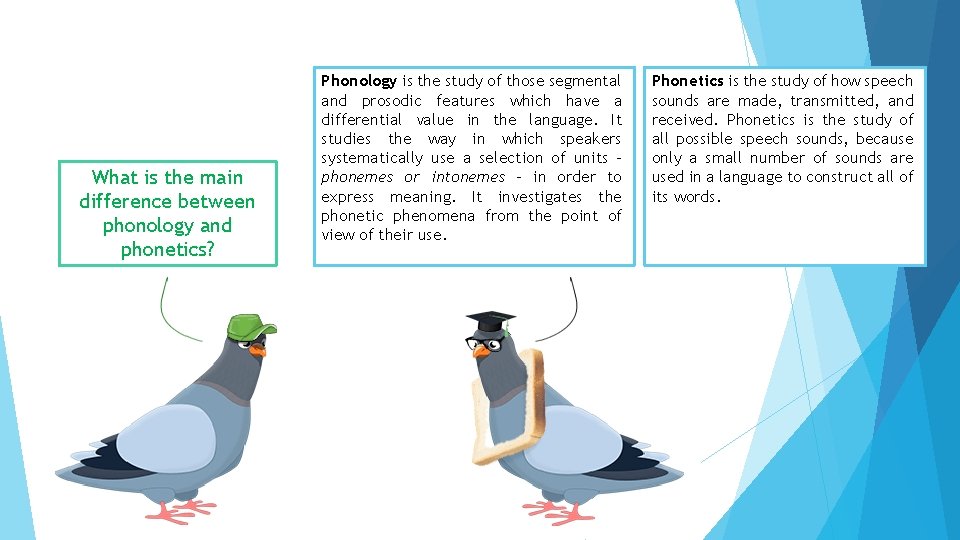
What is the main difference between phonology and phonetics? Phonology is the study of those segmental and prosodic features which have a differential value in the language. It studies the way in which speakers systematically use a selection of units – phonemes or intonemes – in order to express meaning. It investigates the phonetic phenomena from the point of view of their use. Phonetics is the study of how speech sounds are made, transmitted, and received. Phonetics is the study of all possible speech sounds, because only a small number of sounds are used in a language to construct all of its words.
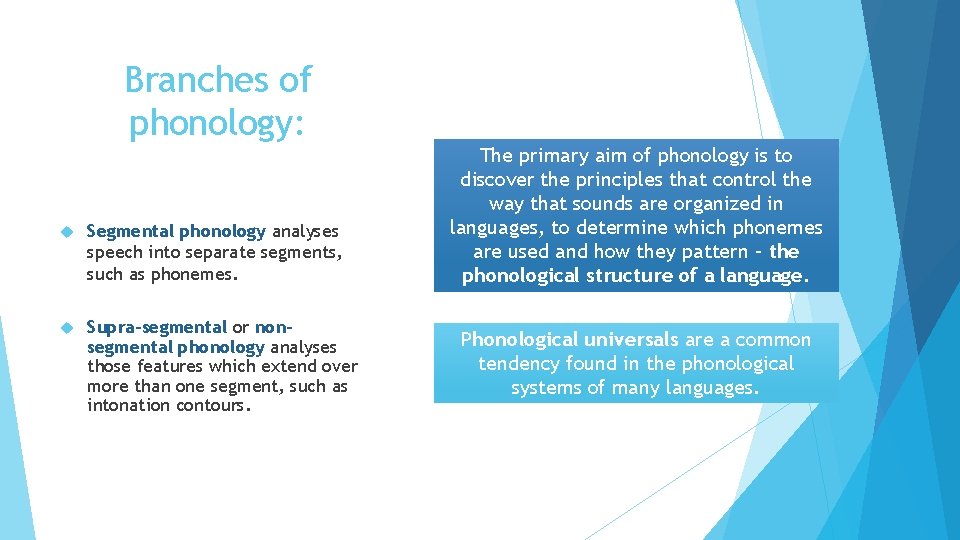
Branches of phonology: Segmental phonology analyses speech into separate segments, such as phonemes. Supra-segmental or nonsegmental phonology analyses those features which extend over more than one segment, such as intonation contours. The primary aim of phonology is to discover the principles that control the way that sounds are organized in languages, to determine which phonemes are used and how they pattern – the phonological structure of a language. Phonological universals are a common tendency found in the phonological systems of many languages.
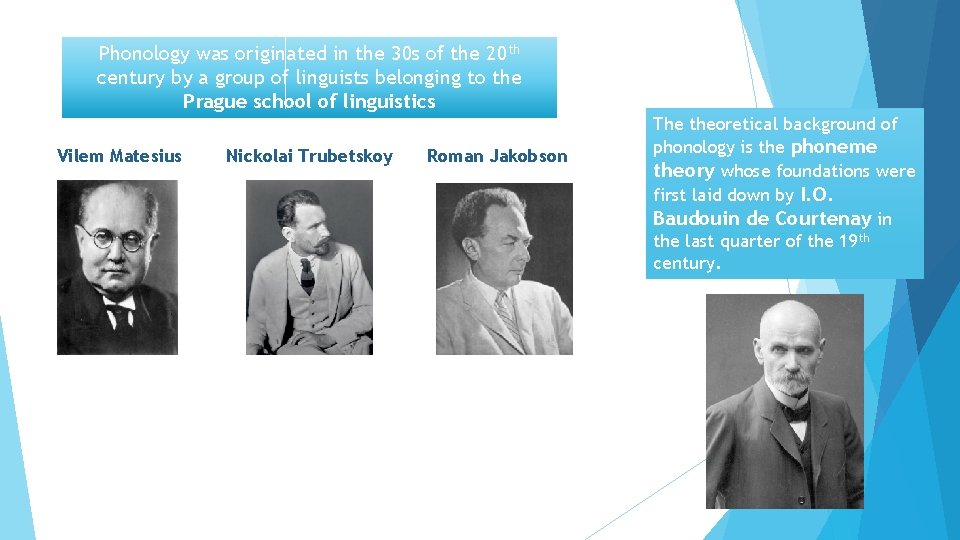
Phonology was originated in the 30 s of the 20 th century by a group of linguists belonging to the Prague school of linguistics Vilem Matesius Nickolai Trubetskoy Roman Jakobson The theoretical background of phonology is the phoneme theory whose foundations were first laid down by I. O. Baudouin de Courtenay in the last quarter of the 19 th century.
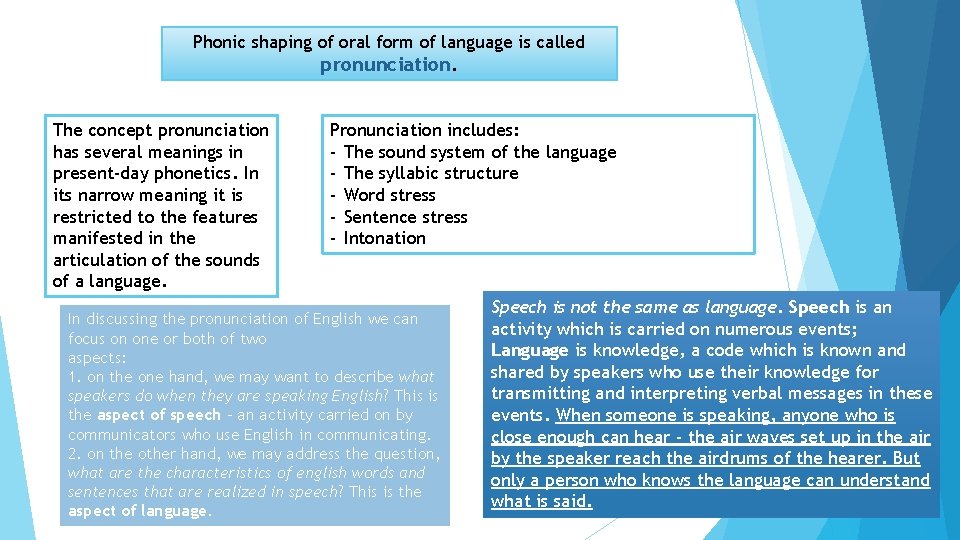
Phonic shaping of oral form of language is called pronunciation. The concept pronunciation has several meanings in present-day phonetics. In its narrow meaning it is restricted to the features manifested in the articulation of the sounds of a language. Pronunciation includes: - The sound system of the language - The syllabic structure - Word stress - Sentence stress - Intonation In discussing the pronunciation of English we can focus on one or both of two aspects: 1. on the one hand, we may want to describe what speakers do when they are speaking English? This is the aspect of speech - an activity carried on by communicators who use English in communicating. 2. on the other hand, we may address the question, what are the сharacteristics of english words and sentences that are realized in speech? This is the aspect of language. Speech is not the same as language. Speech is an activity which is carried on numerous events; Language is knowledge, a code which is known and shared by speakers who use their knowledge for transmitting and interpreting verbal messages in these events. When someone is speaking, anyone who is close enough can hear - the air waves set up in the air by the speaker reach the airdrums of the hearer. But only a person who knows the language can understand what is said.
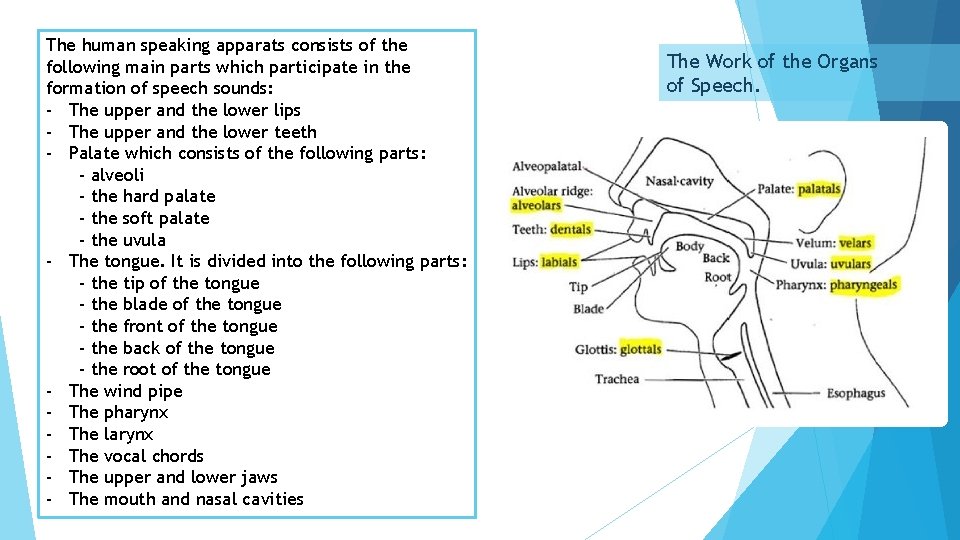
The human speaking apparats consists of the following main parts which participate in the formation of speech sounds: - The upper and the lower lips - The upper and the lower teeth - Palate which consists of the following parts: - alveoli - the hard palate - the soft palate - the uvula - The tongue. It is divided into the following parts: - the tip of the tongue - the blade of the tongue - the front of the tongue - the back of the tongue - the root of the tongue - The wind pipe - The pharynx - The larynx - The vocal chords - The upper and lower jaws - The mouth and nasal cavities The Work of the Organs of Speech.
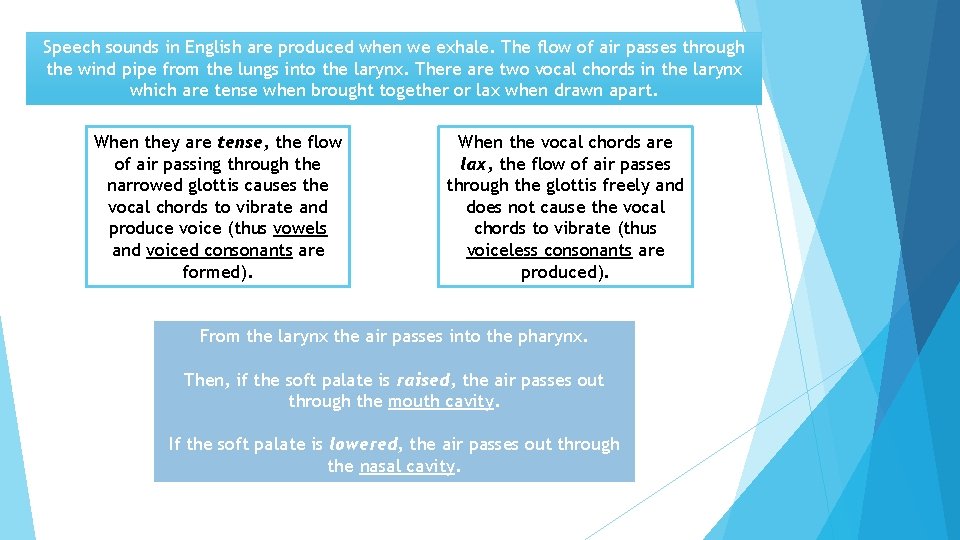
Speech sounds in English are produced when we exhale. The flow of air passes through the wind pipe from the lungs into the larynx. There are two vocal chords in the larynx which are tense when brought together or lax when drawn apart. When they are tense, the flow of air passing through the narrowed glottis causes the vocal chords to vibrate and produce voice (thus vowels and voiced consonants are formed). When the vocal chords are lax, the flow of air passes through the glottis freely and does not cause the vocal chords to vibrate (thus voiceless consonants are produced). From the larynx the air passes into the pharynx. Then, if the soft palate is raised, the air passes out through the mouth cavity. If the soft palate is lowered, the air passes out through the nasal cavity.
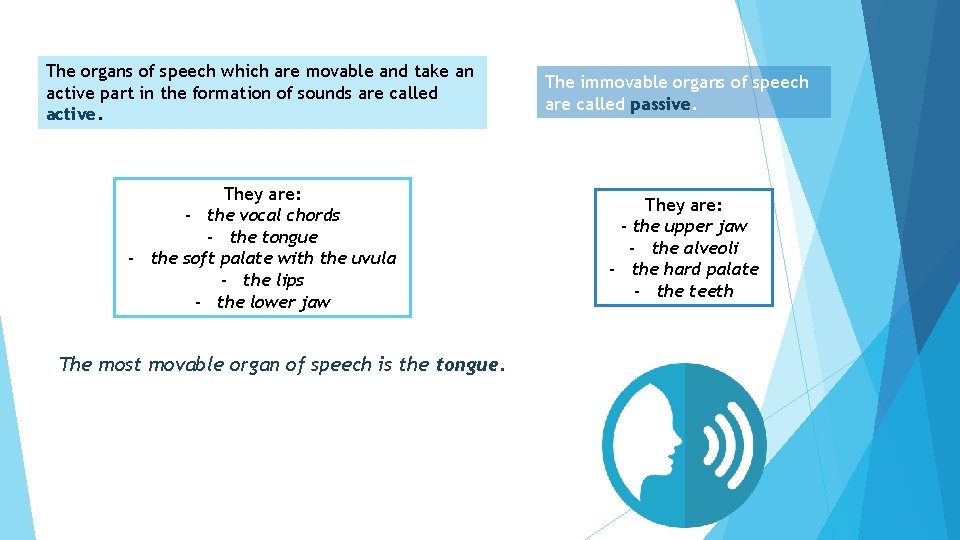
The organs of speech which are movable and take an active part in the formation of sounds are called active. They are: - the vocal chords - the tongue - the soft palate with the uvula - the lips - the lower jaw The most movable organ of speech is the tongue. The immovable organs of speech are called passive. They are: - the upper jaw - the alveoli - the hard palate - the teeth
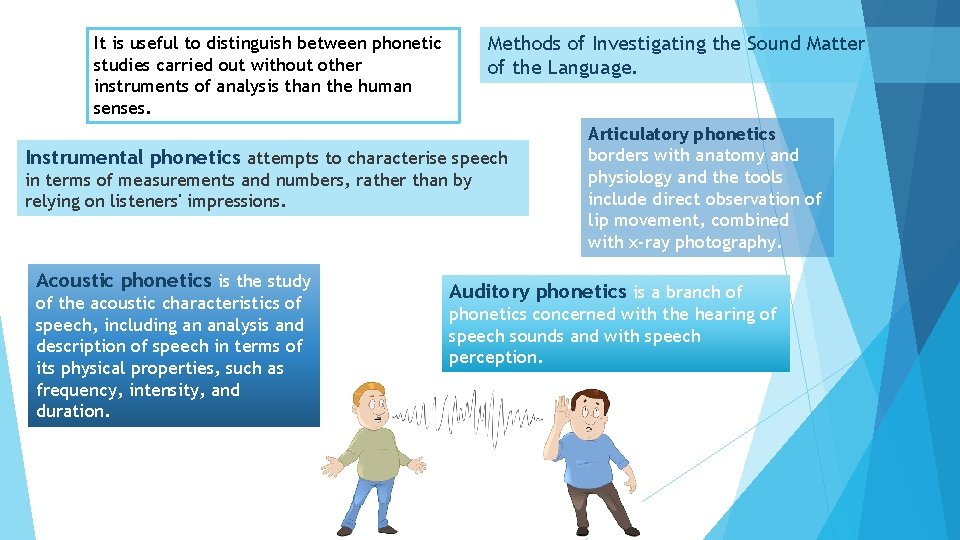
Methods of Investigating the Sound Matter of the Language. It is useful to distinguish between phonetic studies carried out without other instruments of analysis than the human senses. Instrumental phonetics attempts to characterise speech in terms of measurements and numbers, rather than by relying on listeners' impressions. Acoustic phonetics is the study of the acoustic characteristics of speech, including an analysis and description of speech in terms of its physical properties, such as frequency, intensity, and duration. Articulatory phonetics borders with anatomy and physiology and the tools include direct observation of lip movement, combined with x-ray photography. Auditory phonetics is a branch of phonetics concerned with the hearing of speech sounds and with speech perception.
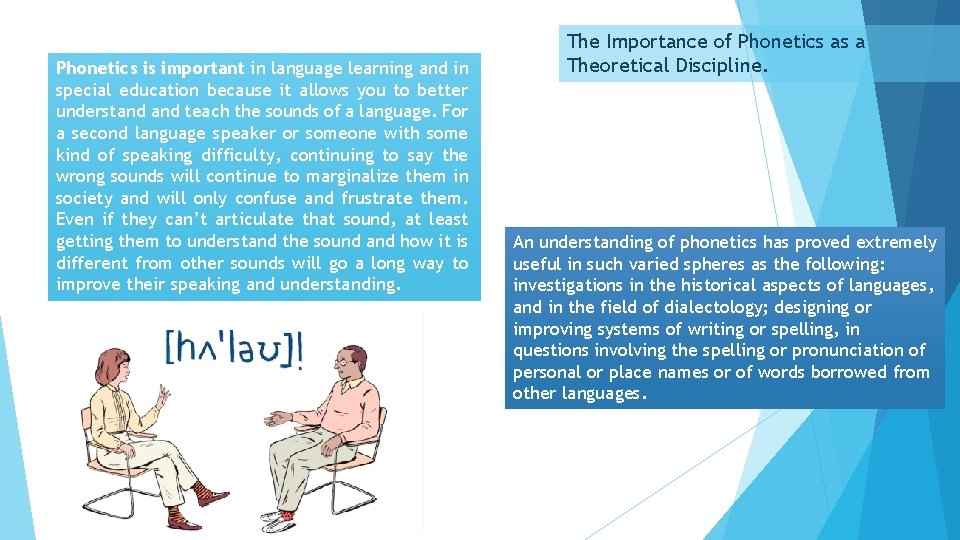
Phonetics is important in language learning and in special education because it allows you to better understand teach the sounds of a language. For a second language speaker or someone with some kind of speaking difficulty, continuing to say the wrong sounds will continue to marginalize them in society and will only confuse and frustrate them. Even if they can’t articulate that sound, at least getting them to understand the sound and how it is different from other sounds will go a long way to improve their speaking and understanding. The Importance of Phonetics as a Theoretical Discipline. An understanding of phonetics has proved extremely useful in such varied spheres as the following: investigations in the historical aspects of languages, and in the field of dialectology; designing or improving systems of writing or spelling, in questions involving the spelling or pronunciation of personal or place names or of words borrowed from other languages.
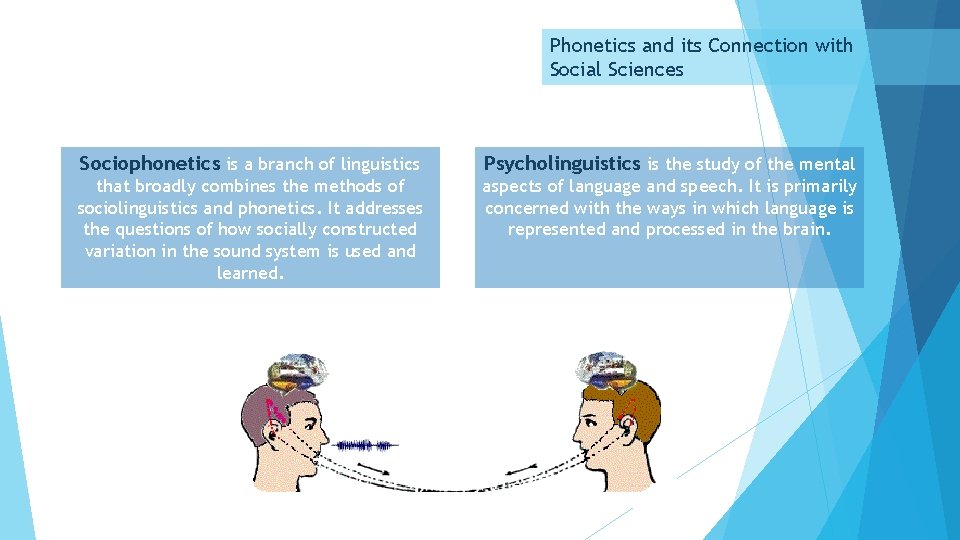
Phonetics and its Connection with Social Sciences Sociophonetics is a branch of linguistics Psycholinguistics is the study of the mental that broadly combines the methods of sociolinguistics and phonetics. It addresses the questions of how socially constructed variation in the sound system is used and learned. aspects of language and speech. It is primarily concerned with the ways in which language is represented and processed in the brain.
Theories of teaching pronunciation in current TEFL/TESOL practices. Pronunciation in the past occupied a central position in theories of oral language proficiency. But it was largely identified with accurate pronunciation of isolated sounds or words. The most neglected aspect of the teaching of pronunciation was the relationship between phoneme articulation and other features of connected speech. Traditional classroom techniques included the use of a transcription, transcription practice, discrimination tasks, tongue twisters, games, and the like. When the Communicative Approach to language teaching began to take over in the mid- late - 1970 s, most of the above -mentioned techniques and materials for teaching pronunciation at the segmental level were rejected as being incompatible with teaching language as communication. Most of the efforts were directed to teaching supra-segmental features of the language: rhythm, stress and intonation, because they have the greatest impact on the comprehensibility of the learner's English. Today pronunciation instruction is moving away from the segmental/supra-segmental debate and toward a more balanced view. This view recognizes that both an inability to distinguish sounds that carry a high functional load, and an inability to distinguish supra-segmental features can have a negative impact on the oral communication and the listening comprehension abilities of normative speakers of English.