
Introduction to the ChinaADS project and accelerator design


- Slides: 51
Introduction to the China-ADS project and accelerator design Jingyu Tang Institute of High Energy Physics, CAS Beijing, China FNAL Seminar, August 18, 2011
Contents u Introduction to the C-ADS project u Some information about China nuclear power u Roadmap of C-ADS program u Organization of the C-ADS project phase I u Preliminary accelerator design u Physics design scheme u Key technology R&D for C-ADS accelerator 2
Introduction to the C-ADS project
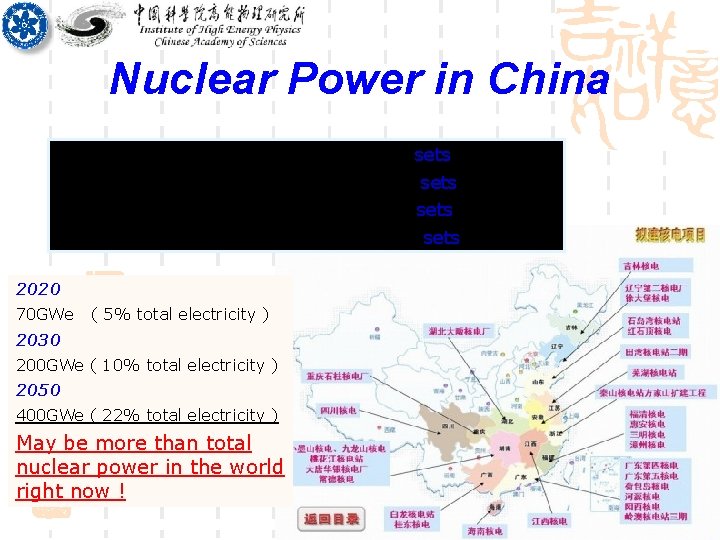
Nuclear Power in China Operating reactors : 10. 23 GWe/13 sets Constructing reactors : 25. 90 GWe/23 sets Prepare to construct : 44. 27 GWe/39 sets Propose to construct: 120. 0 GWe/120 sets 2020 70 GWe ( 5% total electricity ) 2030 200 GWe ( 10% total electricity ) 2050 400 GWe ( 22% total electricity ) May be more than total nuclear power in the world right now !
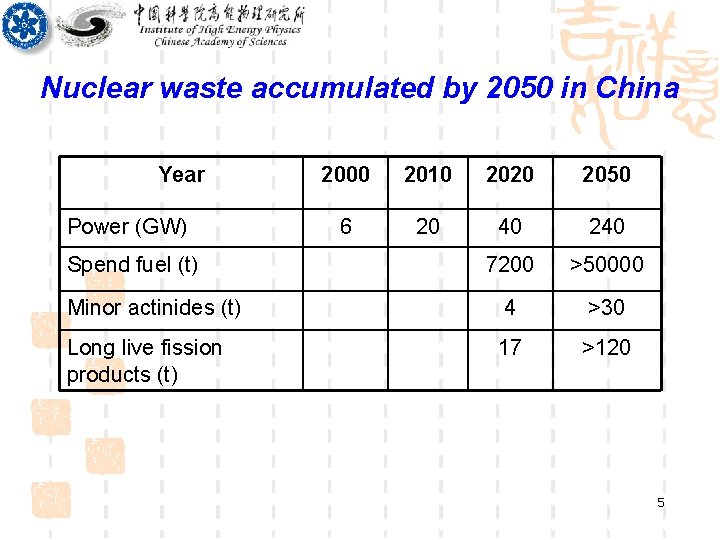
Nuclear waste accumulated by 2050 in China Year 2000 2010 2020 2050 6 20 40 240 7200 >50000 Minor actinides (t) 4 >30 Long live fission products (t) 17 >120 Power (GW) Spend fuel (t) 5
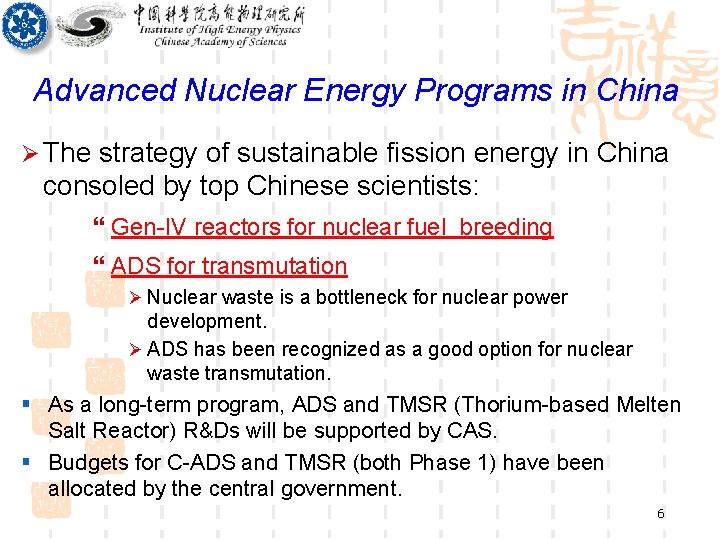
Advanced Nuclear Energy Programs in China Ø The strategy of sustainable fission energy in China consoled by top Chinese scientists: Gen-IV reactors for nuclear fuel breeding ADS for transmutation Ø Nuclear waste is a bottleneck for nuclear power development. Ø ADS has been recognized as a good option for nuclear waste transmutation. § As a long-term program, ADS and TMSR (Thorium-based Melten Salt Reactor) R&Ds will be supported by CAS. § Budgets for C-ADS and TMSR (both Phase 1) have been allocated by the central government. 6
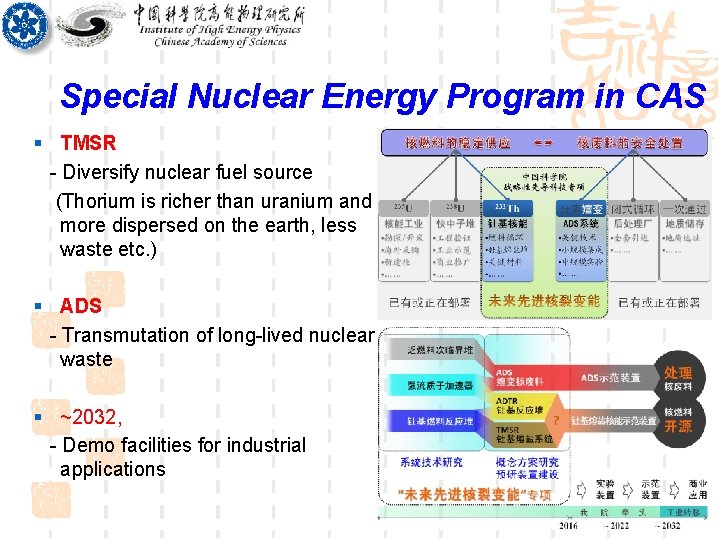
Special Nuclear Energy Program in CAS § TMSR - Diversify nuclear fuel source (Thorium is richer than uranium and more dispersed on the earth, less waste etc. ) § ADS - Transmutation of long-lived nuclear waste § ~2032, - Demo facilities for industrial applications
Schematic of C-ADS Proton Neutron Proton Linear Accelerator (IHEP, IMP) Liquid-metal Target (IMP) Reactor (Pb. Bi coolant ) (IPP, USTC) 8
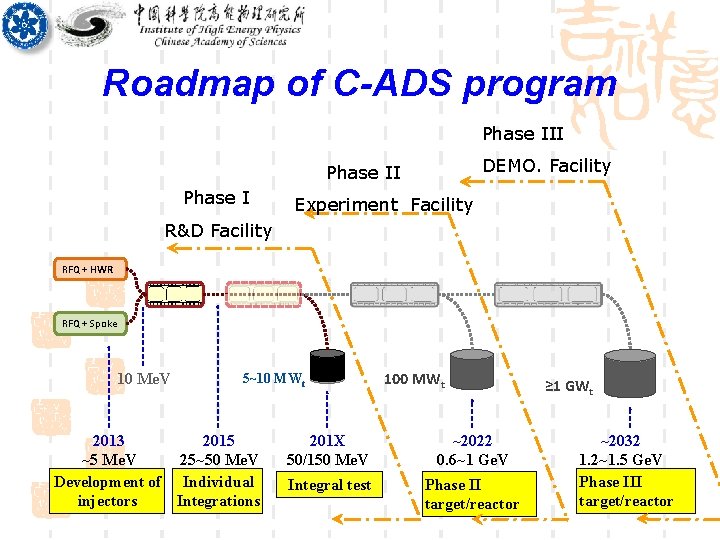
Roadmap of C-ADS program Phase III DEMO. Facility Phase II Phase I Experiment Facility R&D Facility RFQ + HWR RFQ + Spoke 10 Me. V 5~10 MWt 2013 2015 ~5 Me. V 25~50 Me. V Development of Individual Integrations injectors 100 MWt 201 X 50/150 Me. V ~2022 0. 6~1 Ge. V Integral test Phase II target/reactor ≥ 1 GWt ~2032 1. 2~1. 5 Ge. V Phase III target/reactor
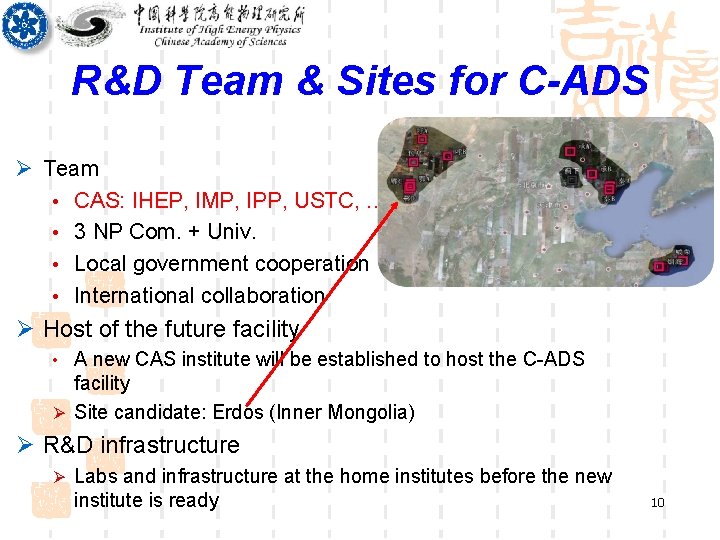
R&D Team & Sites for C-ADS Ø Team • CAS: IHEP, IMP, IPP, USTC, … • 3 NP Com. + Univ. • Local government cooperation • International collaboration Ø Host of the future facility • A new CAS institute will be established to host the C-ADS facility Ø Site candidate: Erdos (Inner Mongolia) Ø R&D infrastructure Ø Labs and infrastructure at the home institutes before the new institute is ready 10
Organization of C-ADS Phases 0&I § Three major systems Ø Accelerator: IHEP as leader, responsible for one injector and the main linac and IMP as collaborator, responsible for another injector Joint IHEP-IMP group on accelerator physics Ø Target: IMP as leader Ø Reactor: IPP (Institute of Plasma Physics, as leader) and USTC (University of Science and Technology of China)
§ Infrastructure (to be built in leading institutes) Ø Superconducting RF test platform Ø Radio-chemistry study platform Ø Pb-Bi core simulation and mock-up platform Ø Nuclear database Ø Integrated test and general technical support platform
Preliminary design of the C-ADS accelerator
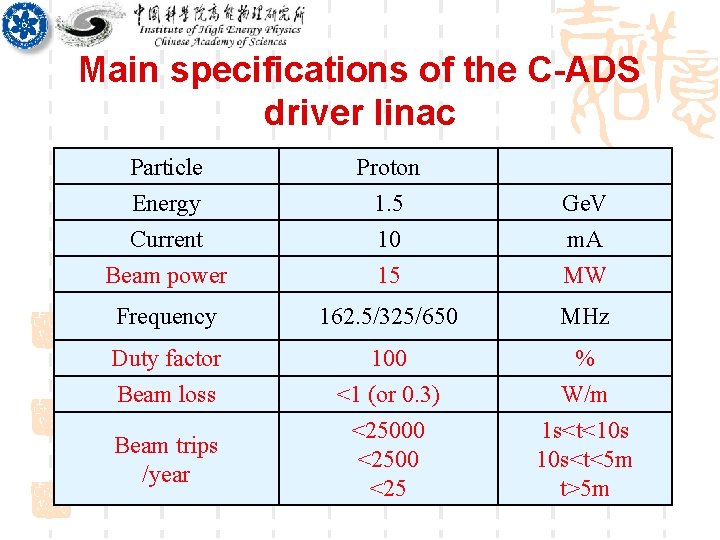
Main specifications of the C-ADS driver linac Particle Energy Current Proton 1. 5 10 Ge. V m. A Beam power 15 MW Frequency 162. 5/325/650 MHz Duty factor Beam loss 100 <1 (or 0. 3) <25000 <25 % W/m 1 s<t<10 s 10 s<t<5 m t>5 m Beam trips /year
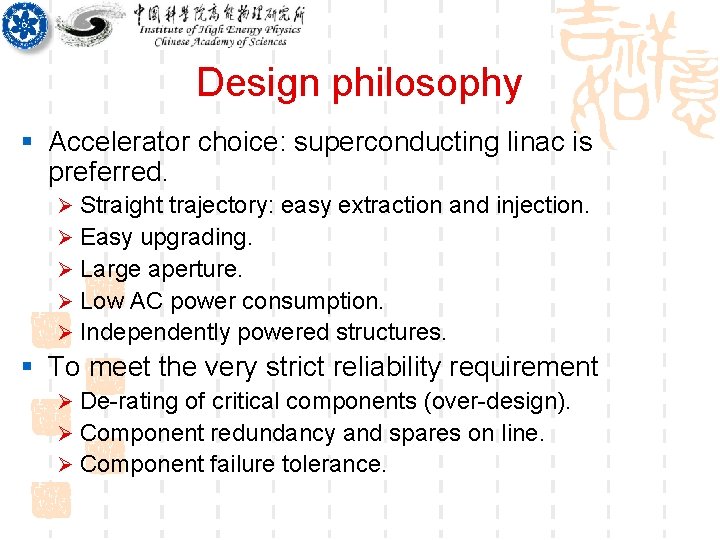
Design philosophy § Accelerator choice: superconducting linac is preferred. Ø Straight trajectory: easy extraction and injection. Ø Easy upgrading. Ø Large aperture. Ø Low AC power consumption. Ø Independently powered structures. § To meet the very strict reliability requirement Ø De-rating of critical components (over-design). Ø Component redundancy and spares on line. Ø Component failure tolerance.
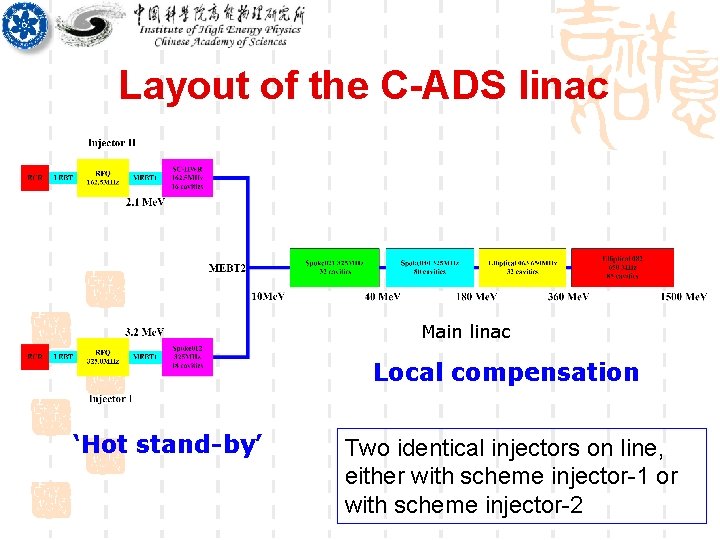
Layout of the C-ADS linac Main linac Local compensation ‘Hot stand-by’ Two identical injectors on line, either with scheme injector-1 or with scheme injector-2
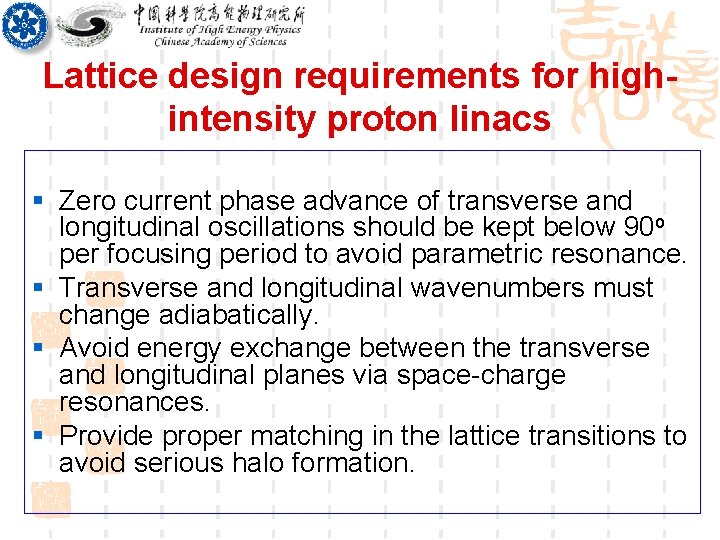
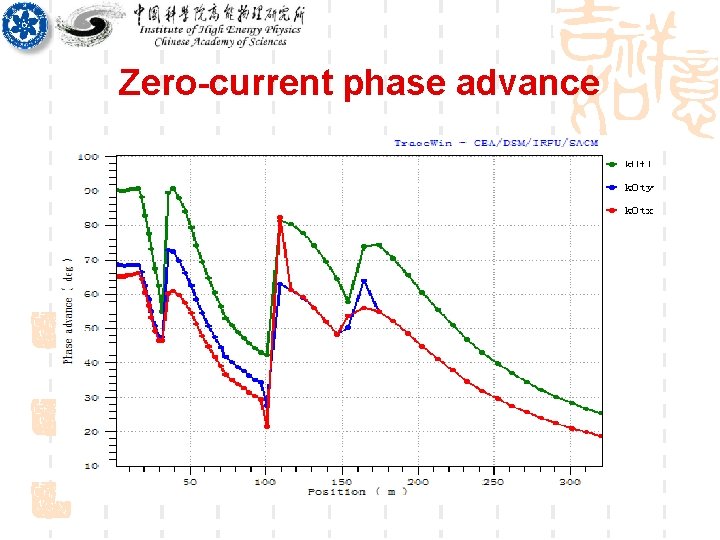
Lattice design requirements for highintensity proton linacs § Zero current phase advance of transverse and longitudinal oscillations should be kept below 90 o per focusing period to avoid parametric resonance. § Transverse and longitudinal wavenumbers must change adiabatically. § Avoid energy exchange between the transverse and longitudinal planes via space-charge resonances. § Provide proper matching in the lattice transitions to avoid serious halo formation.
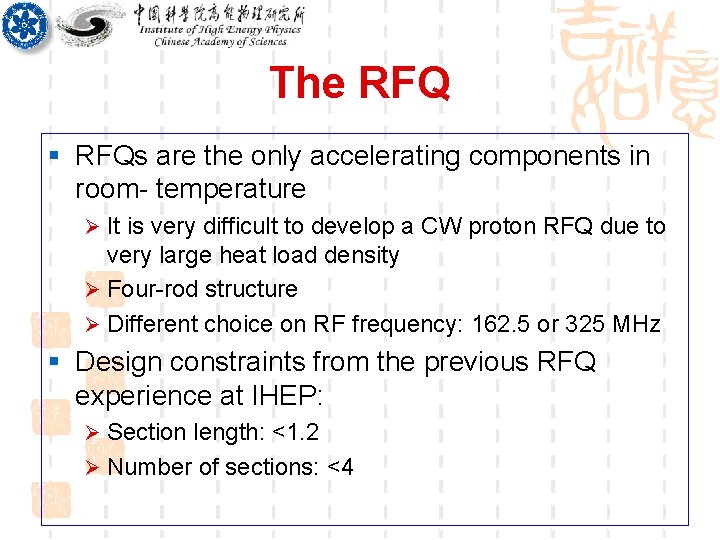
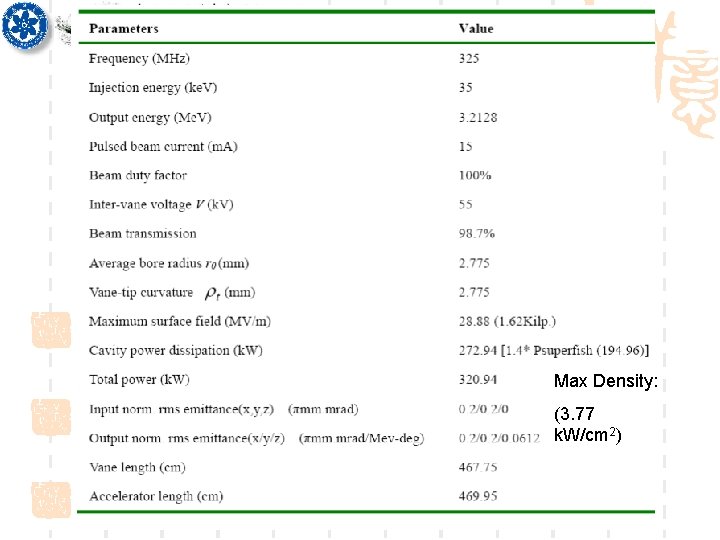
The RFQ § RFQs are the only accelerating components in room- temperature Ø It is very difficult to develop a CW proton RFQ due to very large heat load density Ø Four-rod structure Ø Different choice on RF frequency: 162. 5 or 325 MHz § Design constraints from the previous RFQ experience at IHEP: Ø Section length: <1. 2 Ø Number of sections: <4
Max Density: (3. 77 k. W/cm 2)
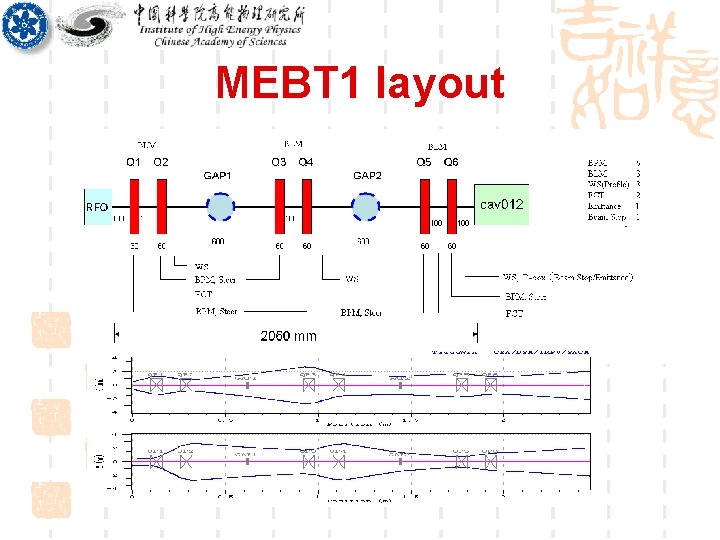
MEBT 1 layout
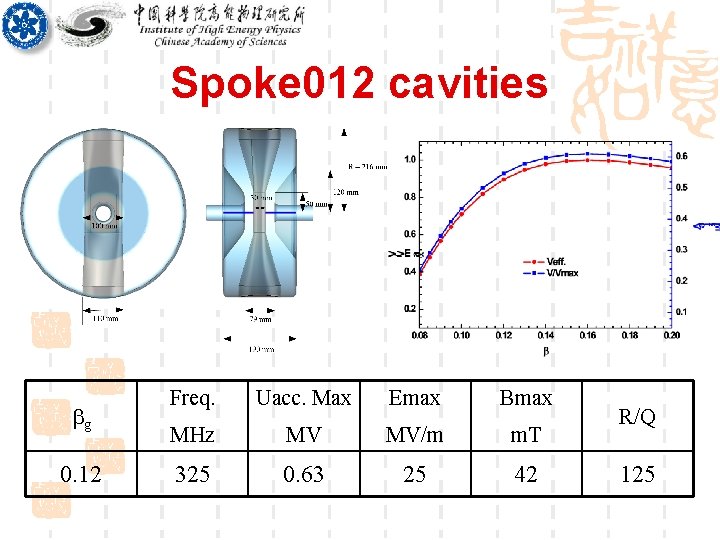
Spoke 012 cavities g 0. 12 Freq. Uacc. Max Emax Bmax MHz MV MV/m m. T 325 0. 63 25 42 R/Q 125
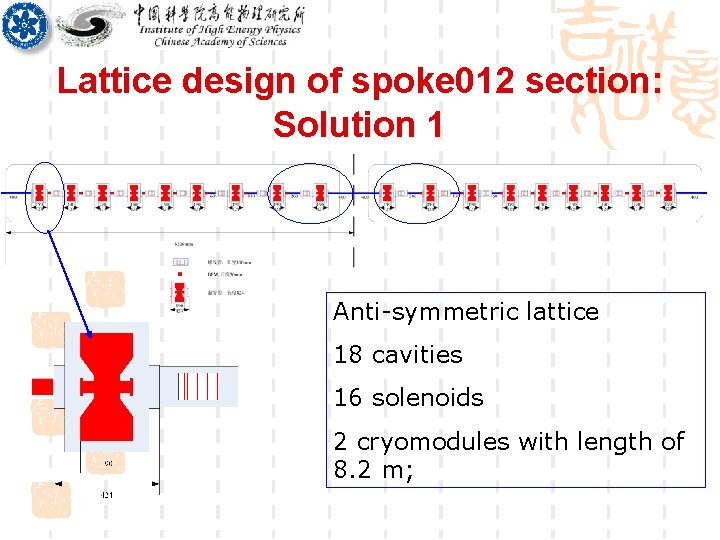
Lattice design of spoke 012 section: Solution 1 Anti-symmetric lattice 18 cavities 16 solenoids 2 cryomodules with length of 8. 2 m;
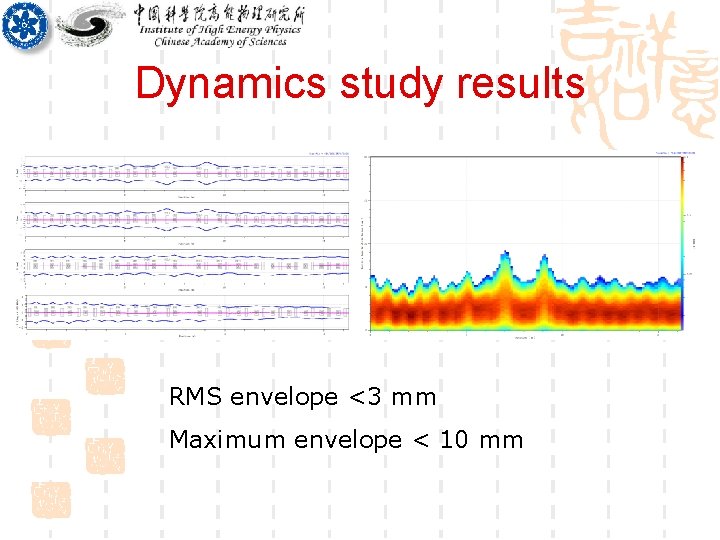
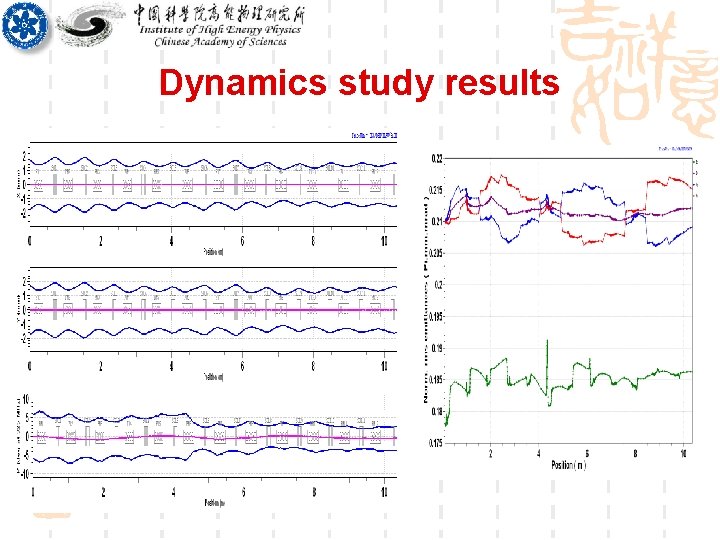
Dynamics study results RMS envelope <3 mm Maximum envelope < 10 mm
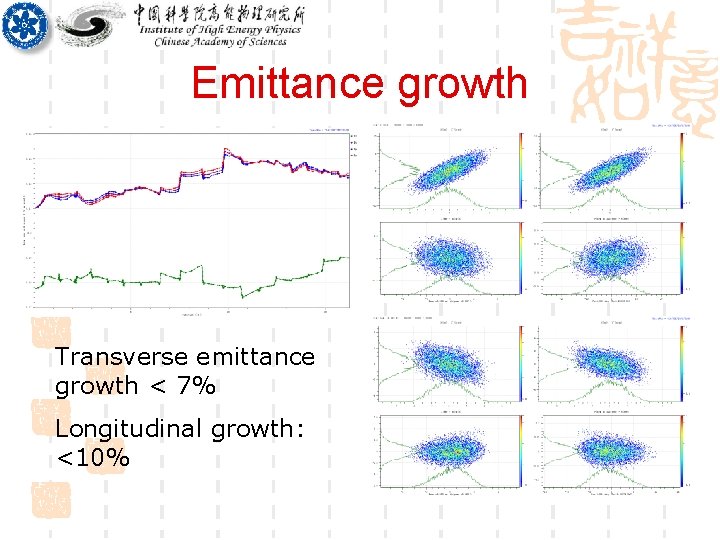
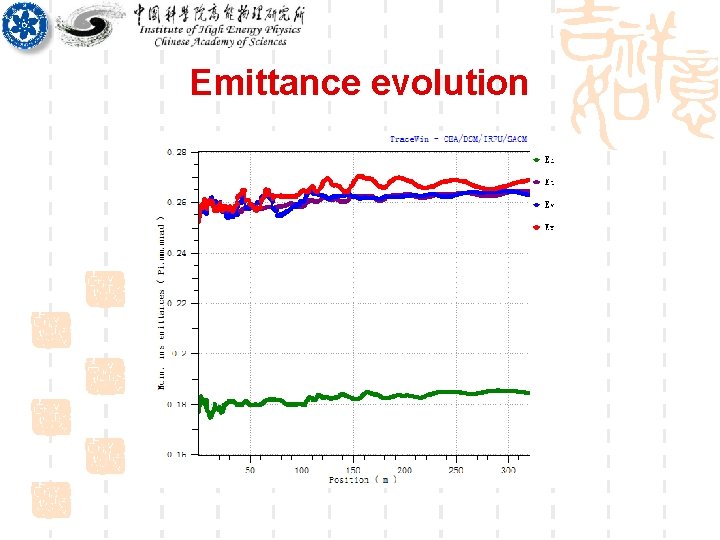
Emittance growth Transverse emittance growth < 7% Longitudinal growth: <10%
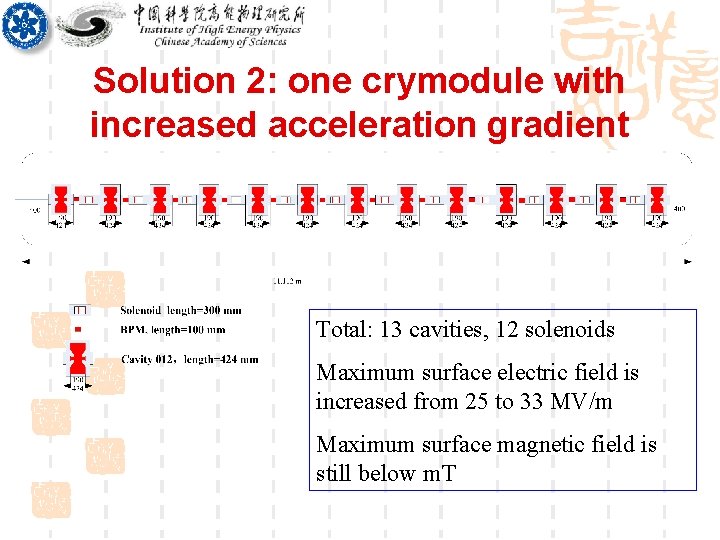
Solution 2: one crymodule with increased acceleration gradient Total: 13 cavities, 12 solenoids Maximum surface electric field is increased from 25 to 33 MV/m Maximum surface magnetic field is still below m. T
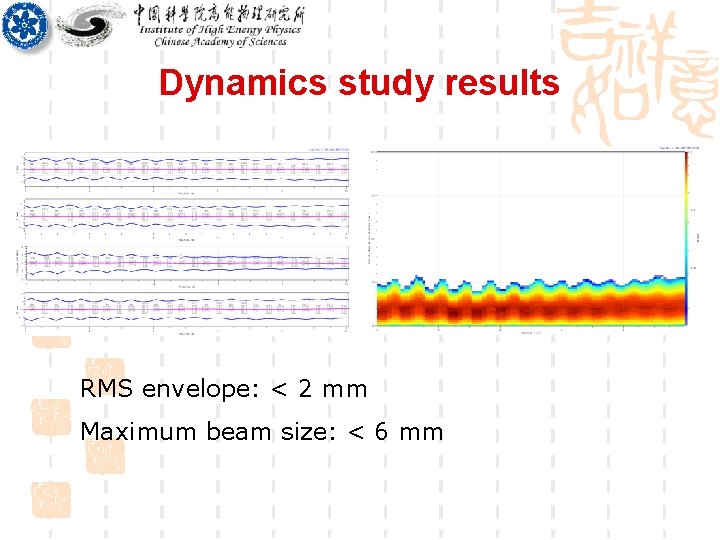
Dynamics study results RMS envelope: < 2 mm Maximum beam size: < 6 mm
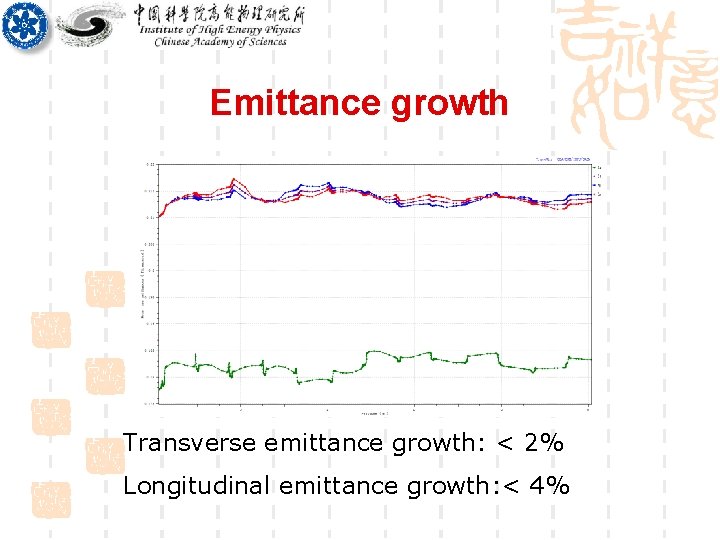
Emittance growth Transverse emittance growth: < 2% Longitudinal emittance growth: < 4%
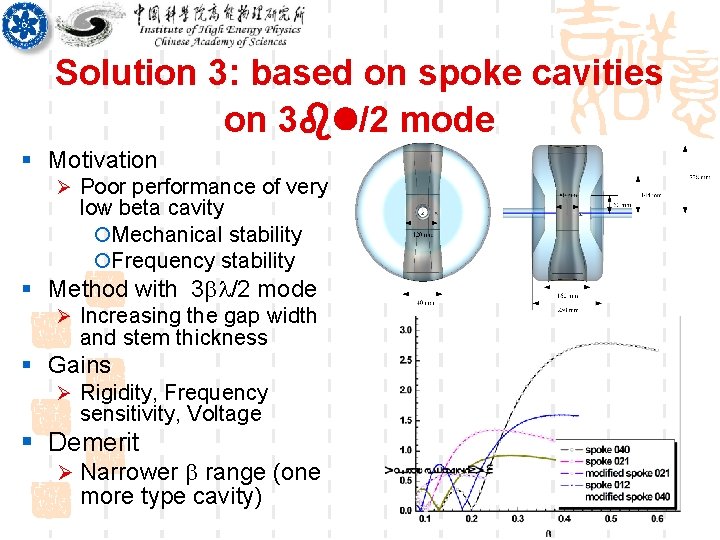
Solution 3: based on spoke cavities on 3 bl/2 mode § Motivation Ø Poor performance of very low beta cavity ¡Mechanical stability ¡Frequency stability § Method with 3 /2 mode Ø Increasing the gap width and stem thickness § Gains Ø Rigidity, Frequency sensitivity, Voltage § Demerit Ø Narrower range (one more type cavity)
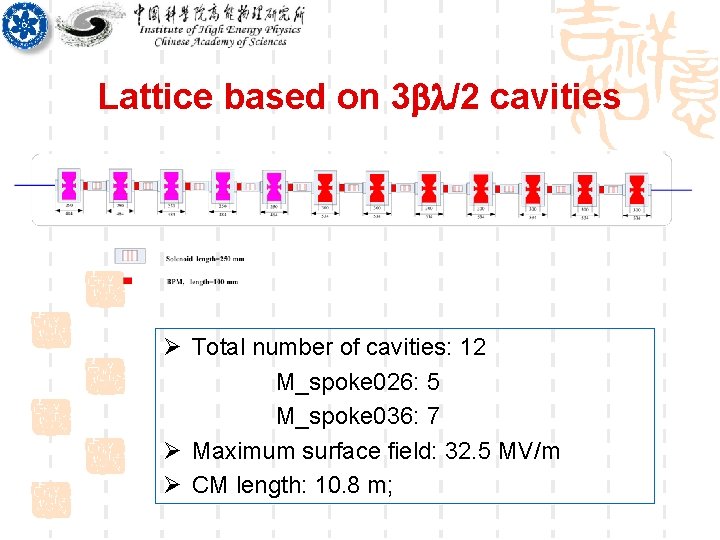
Lattice based on 3 /2 cavities Ø Total number of cavities: 12 M_spoke 026: 5 M_spoke 036: 7 Ø Maximum surface field: 32. 5 MV/m Ø CM length: 10. 8 m;
Dynamics study results
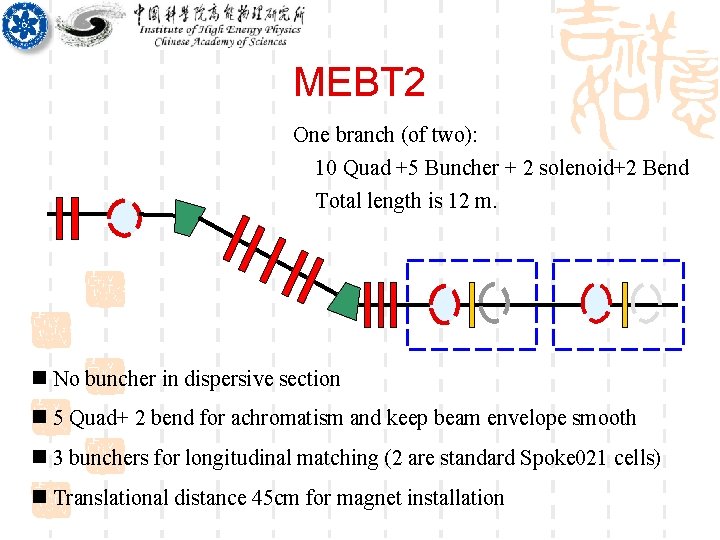
MEBT 2 One branch (of two): 10 Quad +5 Buncher + 2 solenoid+2 Bend Total length is 12 m. n No buncher in dispersive section n 5 Quad+ 2 bend for achromatism and keep beam envelope smooth n 3 bunchers for longitudinal matching (2 are standard Spoke 021 cells) n Translational distance 45 cm for magnet installation
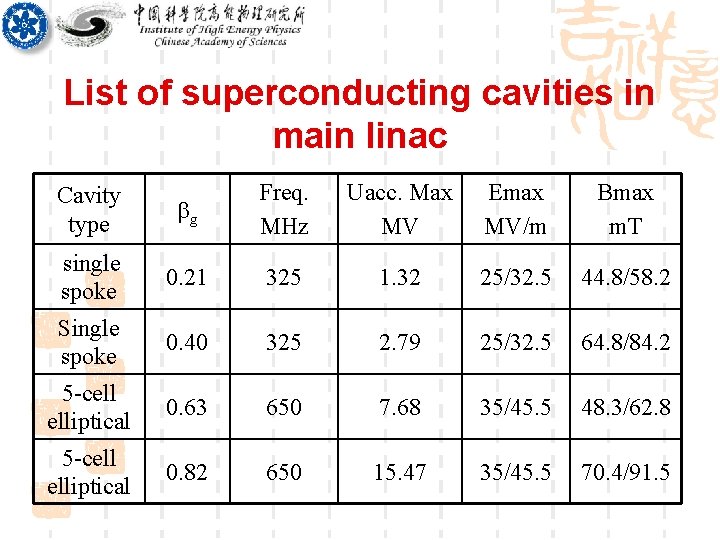
List of superconducting cavities in main linac g Freq. MHz Uacc. Max MV Emax MV/m Bmax m. T single spoke 0. 21 325 1. 32 25/32. 5 44. 8/58. 2 Single spoke 0. 40 325 2. 79 25/32. 5 64. 8/84. 2 5 -cell elliptical 0. 63 650 7. 68 35/45. 5 48. 3/62. 8 5 -cell elliptical 0. 82 650 15. 47 35/45. 5 70. 4/91. 5 Cavity type
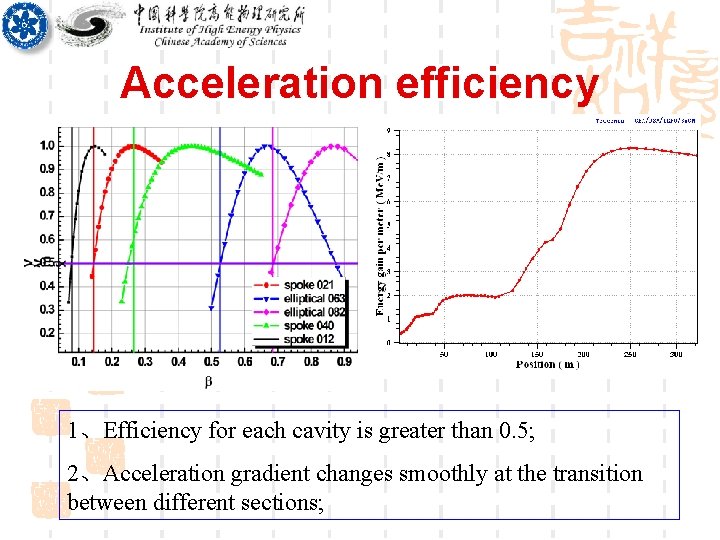
Acceleration efficiency 1、Efficiency for each cavity is greater than 0. 5; 2、Acceleration gradient changes smoothly at the transition between different sections;
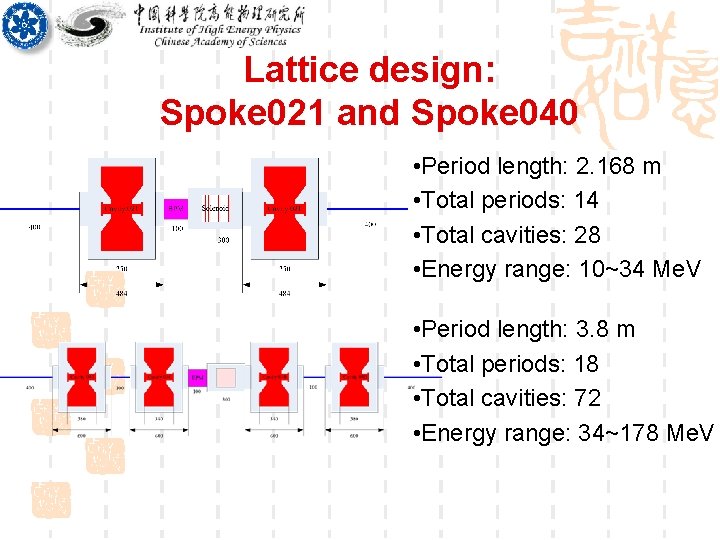
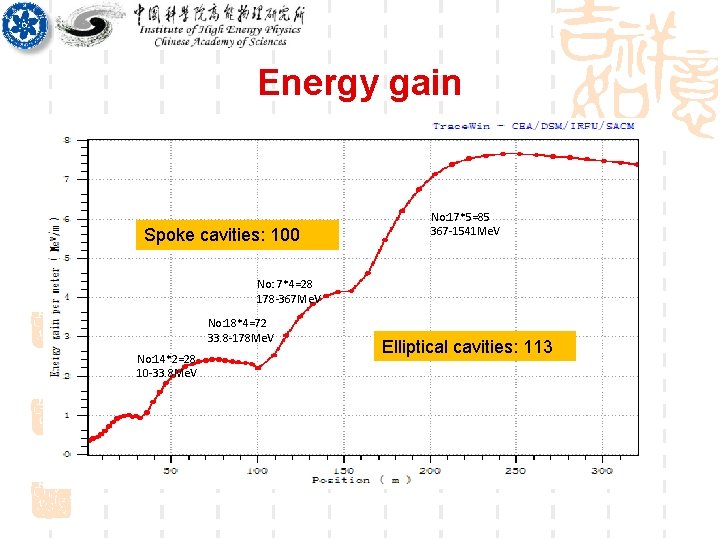
Lattice design: Spoke 021 and Spoke 040 • Period length: 2. 168 m • Total periods: 14 • Total cavities: 28 • Energy range: 10~34 Me. V • Period length: 3. 8 m • Total periods: 18 • Total cavities: 72 • Energy range: 34~178 Me. V
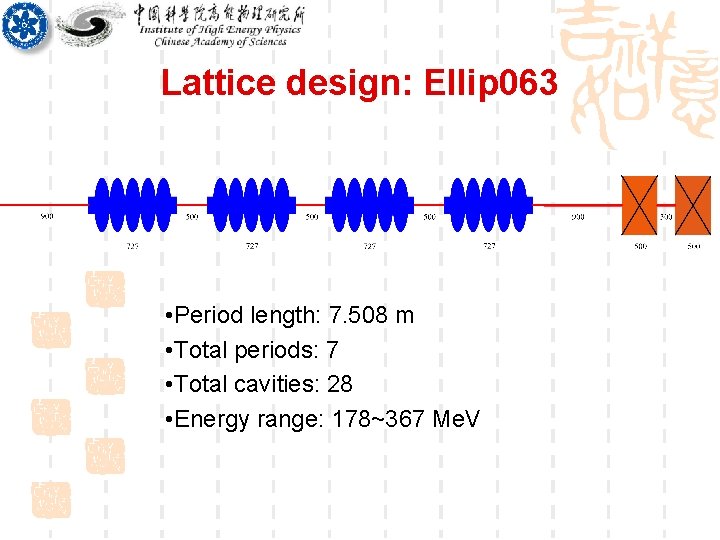
Lattice design: Ellip 063 • Period length: 7. 508 m • Total periods: 7 • Total cavities: 28 • Energy range: 178~367 Me. V
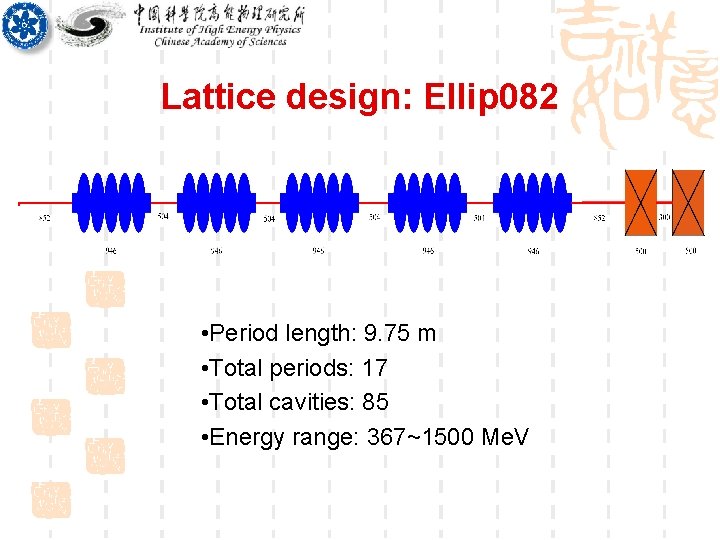
Lattice design: Ellip 082 • Period length: 9. 75 m • Total periods: 17 • Total cavities: 85 • Energy range: 367~1500 Me. V
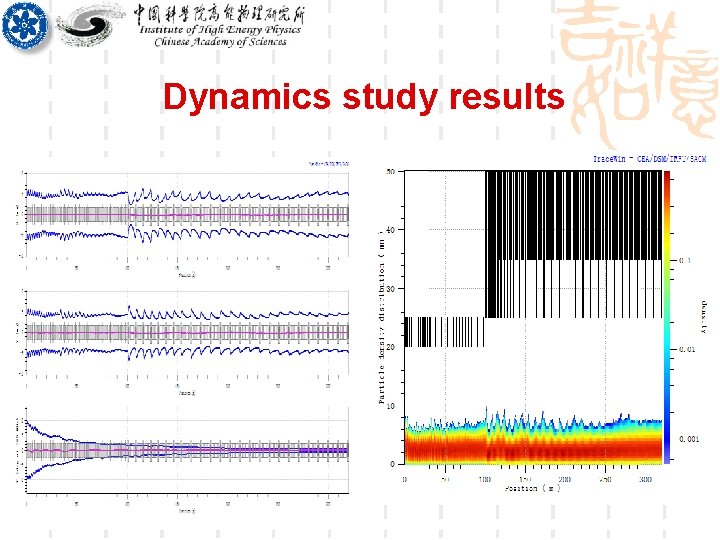
Dynamics study results
Zero-current phase advance
Emittance evolution
Energy gain Spoke cavities: 100 No: 17*5=85 367 -1541 Me. V No: 7*4=28 178 -367 Me. V No: 18*4=72 33. 8 -178 Me. V No: 14*2=28 10 -33. 8 Me. V Elliptical cavities: 113
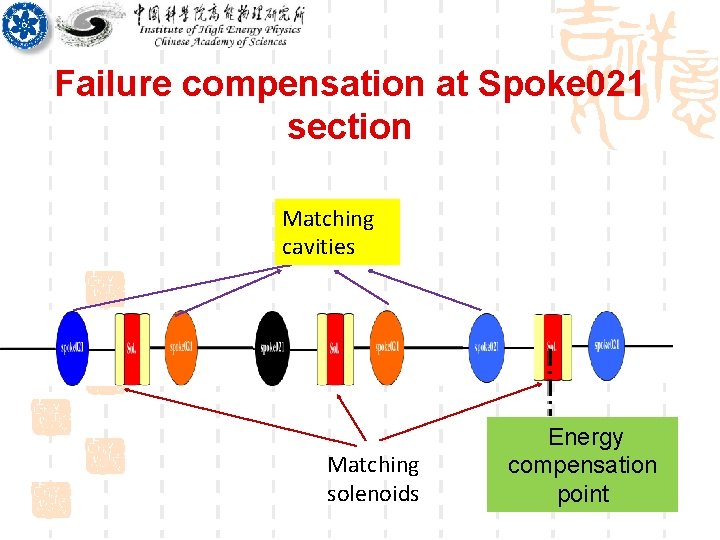
Local compensation of failures § Preliminary studies on local compensation of cavity and solenoid failures have been carried out for Spoke 021 section and Spoke 040 section. § One cavity failure in a cell can be well compensated by adjusting neighboring cavities. (rms emittance growth less than 10%) § One solenoid failure is difficult to be compensated, especially at the beginning of the Spoke 021 section
Failure compensation at Spoke 021 section Matching cavities Matching solenoids Energy compensation point
Key technology R&D for C-ADS linac § Strategy Ø Ø § Parallel developments of different scheme or technical solutions for the injector (IHEP and IMP) Development by steps (Phase 0, I, III) Some key technology R&D Ø Ø Ø Ø Ø Ion Source: stable operation CW RFQ: cooling problem SC Spoke cavities: development, unproven performance SC CH cavities: very challenging (candidate for IMP injector) High power couplers: especially for CW RFQ Cryomodule: long cryomodule with many cavities and solenoids RF power source (CW Klystron, CW SSA, LLRF) Control & Instrumentation 43 …
R&D studies (Phase 0) § The budget has been approved (1. 8 BCHY or 280 M$ in total) ØAccelerator: 640 MCHY (425 M for IHEP and 215 M for IMP) § 2011 -2013 ØPhysics design and technical designs ØDeveloping CW RFQ, SC cavity prototypes (spoke, HWR and CH) for the injectors ØCW test of first 5 Me. V of two injectors ØInfrastructure or laboratory building-up § 2014 -2016 ØTwo different injectors testing with CW, 10 -Me. V and 10 -m. A ØConstruction of main linac section (10 -50 Me. V) ØCW test of the 50 -Me. V linac 44
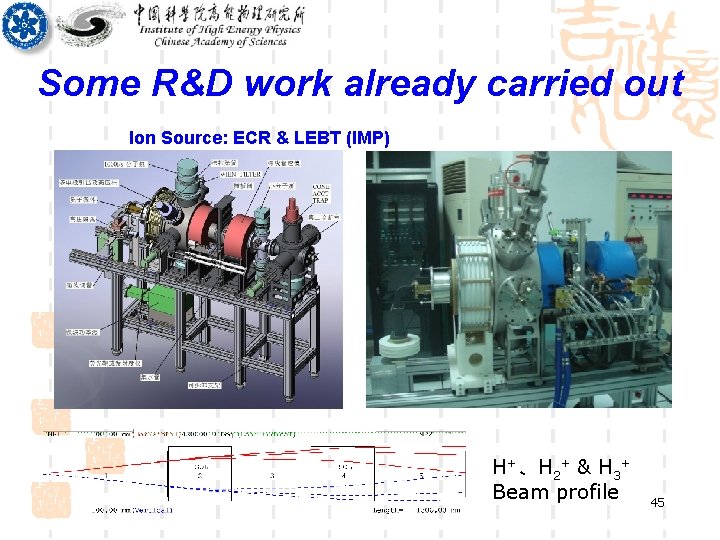
Some R&D work already carried out Ion Source: ECR & LEBT (IMP) H+、H 2+ & H 3+ Beam profile 45
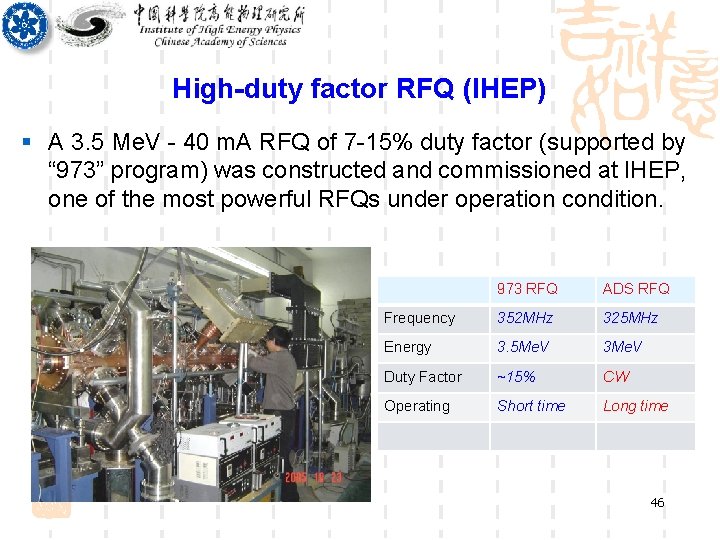
High-duty factor RFQ (IHEP) § A 3. 5 Me. V - 40 m. A RFQ of 7 -15% duty factor (supported by “ 973” program) was constructed and commissioned at IHEP, one of the most powerful RFQs under operation condition. 973 RFQ ADS RFQ Frequency 352 MHz 325 MHz Energy 3. 5 Me. V 3 Me. V Duty Factor ~15% CW Operating Short time Long time 46
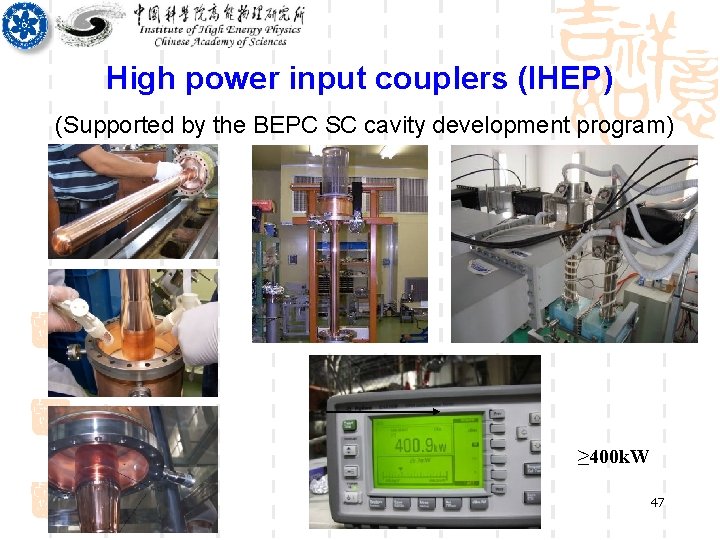
High power input couplers (IHEP) (Supported by the BEPC SC cavity development program) ≥ 400 k. W 47
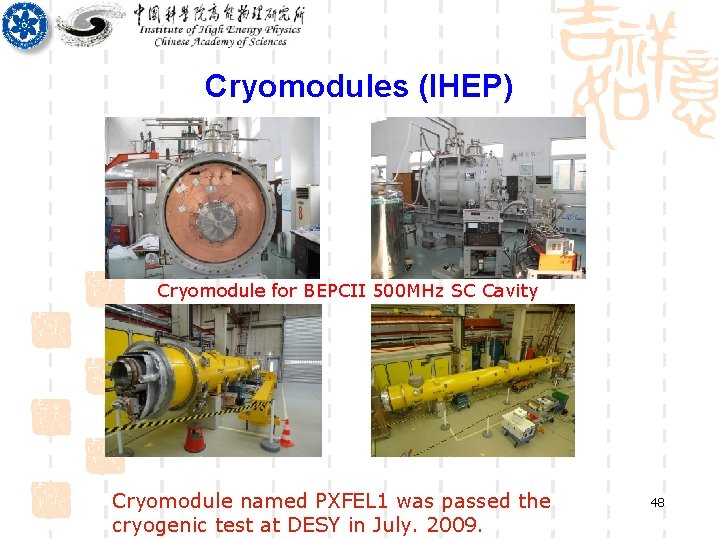
Cryomodules (IHEP) Cryomodule for BEPCII 500 MHz SC Cavity Cryomodule named PXFEL 1 was passed the cryogenic test at DESY in July. 2009. 48
Control & Instrumentation (IHEP) § Controls: Ø Digitalized control system has been developed for the CSNS project, and can be used in the C-ADS Ø EPICS, XAL etc. developed with the CSNS project (BEPCII) § Instrumentation Ø Many beam diagnostic devices have been developed or are under development under the “ 973” program and the CSNS project. They can be used in the C-ADS, such as BLM (including ion chamber, FBLM), BPM, BCT, Wire Scanner, double-slit emittance measurement system. 49
Summary I. Sustainable nuclear energy has high priority in China. II. The C-ADS program has been officially started under the coordination of CAS, and is led by three CAS institutes. III. The R&D phase for the driver linac is to build a SC linac with a CW beam of 50 -Me. V and 10 -m. A, and relevant infrastructure. IV. It is a great challenge to build a high-performance CW proton linac. Strong collaboration with international leading laboratories is very important. This is not only an important step towards the ADS but also a contribution to the accelerator community. 50
Thanks for your attention! 51