
Introduction to the C 2000 Control Law Accelerator

- Slides: 26
Introduction to the C 2000 Control Law Accelerator Part 2 Lori Heustess C 2000 Applications April 8, 2009 Ver 6, 08 April 2009 Slide 1
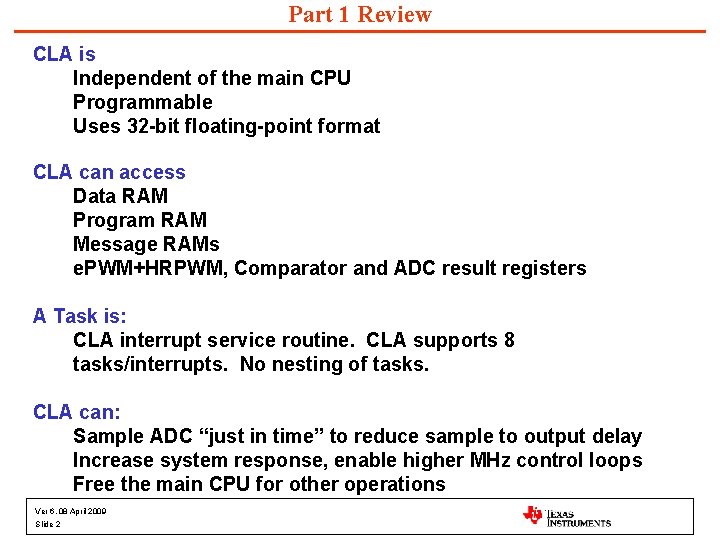
Part 1 Review CLA is Independent of the main CPU Programmable Uses 32 -bit floating-point format CLA can access Data RAM Program RAM Message RAMs e. PWM+HRPWM, Comparator and ADC result registers A Task is: CLA interrupt service routine. CLA supports 8 tasks/interrupts. No nesting of tasks. CLA can: Sample ADC “just in time” to reduce sample to output delay Increase system response, enable higher MHz control loops Free the main CPU for other operations Ver 6, 08 April 2009 Slide 2
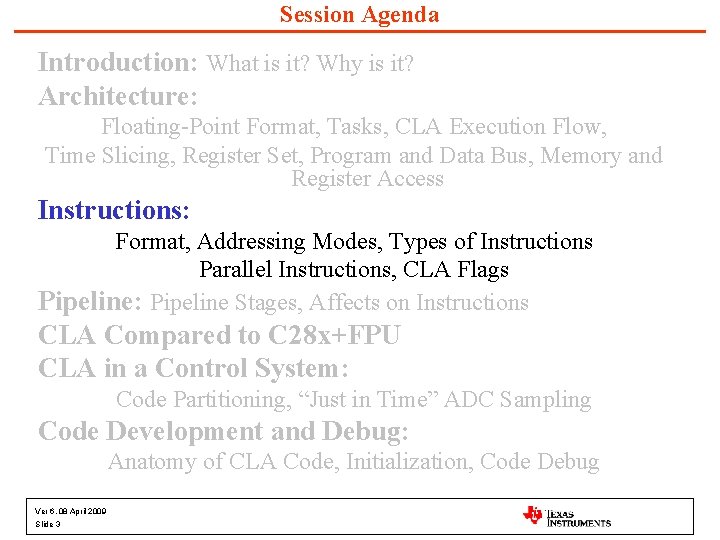
Session Agenda Introduction: What is it? Why is it? Architecture: Floating-Point Format, Tasks, CLA Execution Flow, Time Slicing, Register Set, Program and Data Bus, Memory and Register Access Instructions: Format, Addressing Modes, Types of Instructions Parallel Instructions, CLA Flags Pipeline: Pipeline Stages, Affects on Instructions CLA Compared to C 28 x+FPU CLA in a Control System: Code Partitioning, “Just in Time” ADC Sampling Code Development and Debug: Anatomy of CLA Code, Initialization, Code Debug Ver 6, 08 April 2009 Slide 3
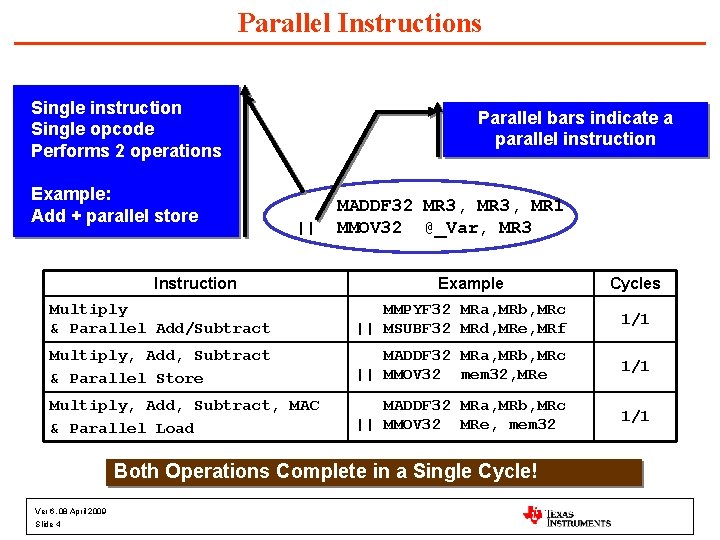
Parallel Instructions Single instruction Single opcode Performs 2 operations Example: Add + parallel store Parallel bars indicate a parallel instruction || Instruction MADDF 32 MR 3, MR 1 MMOV 32 @_Var, MR 3 Example Cycles Multiply & Parallel Add/Subtract MMPYF 32 MRa, MRb, MRc || MSUBF 32 MRd, MRe, MRf 1/1 Multiply, Add, Subtract & Parallel Store MADDF 32 MRa, MRb, MRc || MMOV 32 mem 32, MRe 1/1 Multiply, Add, Subtract, MAC & Parallel Load MADDF 32 MRa, MRb, MRc || MMOV 32 MRe, mem 32 1/1 Both Operations Complete in a Single Cycle! Ver 6, 08 April 2009 Slide 4
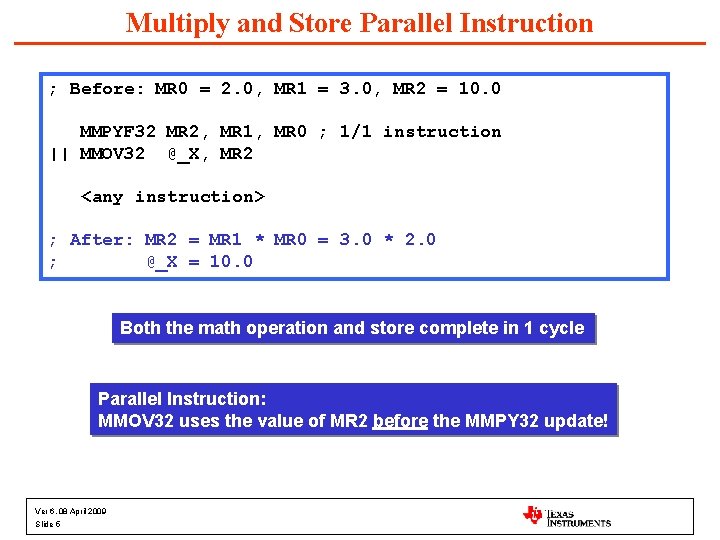
Multiply and Store Parallel Instruction ; Before: MR 0 = 2. 0, MR 1 = 3. 0, MR 2 = 10. 0 MMPYF 32 MR 2, MR 1, MR 0 ; 1/1 instruction || MMOV 32 @_X, MR 2 <any instruction> ; After: MR 2 = MR 1 ? * MR 0 = 3. 0 * 2. 0 ; @_X = ? 10. 0 Both the math operation and store complete in 1 cycle Parallel Instruction: MMOV 32 uses the value of MR 2 before the MMPY 32 update! Ver 6, 08 April 2009 Slide 5
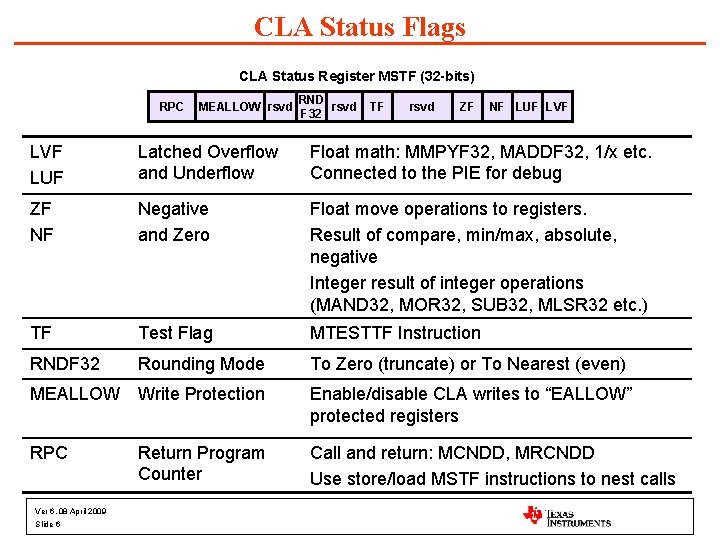
CLA Status Flags CLA Status Register MSTF (32 -bits) RPC MEALLOW rsvd RND rsvd F 32 TF rsvd ZF NF LUF LVF LUF Latched Overflow and Underflow Float math: MMPYF 32, MADDF 32, 1/x etc. Connected to the PIE for debug ZF NF Negative and Zero Float move operations to registers. Result of compare, min/max, absolute, negative Integer result of integer operations (MAND 32, MOR 32, SUB 32, MLSR 32 etc. ) TF Test Flag MTESTTF Instruction RNDF 32 Rounding Mode To Zero (truncate) or To Nearest (even) MEALLOW Write Protection Enable/disable CLA writes to “EALLOW” protected registers RPC Call and return: MCNDD, MRCNDD Use store/load MSTF instructions to nest calls Ver 6, 08 April 2009 Slide 6 Return Program Counter
Session Agenda Introduction: What is it? Why is it? Architecture: Floating-Point Format, Tasks, CLA Execution Flow, Time Slicing, Register Set, Program and Data Bus, Memory and Register Access Instructions: Format, Addressing Modes, Types of Instructions Parallel Instructions, CLA Flags Pipeline: Pipeline Stages, Affects on Instructions CLA Compared to C 28 x+FPU CLA in a Control System: Code Partitioning, “Just in Time” ADC Sampling Code Development and Debug: Anatomy of CLA Code, Initialization, Code Debug Ver 6, 08 April 2009 Slide 7
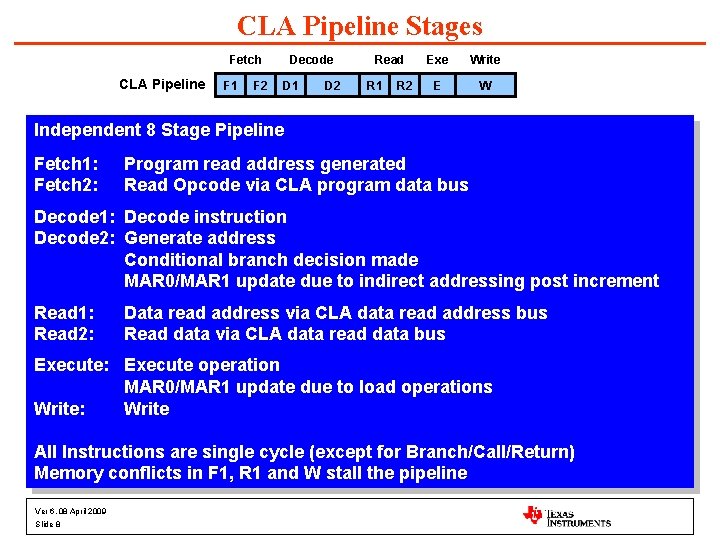
CLA Pipeline Stages Fetch CLA Pipeline F 1 F 2 Decode D 1 D 2 Read R 1 R 2 Exe Write E W Independent 8 Stage Pipeline Fetch 1: Fetch 2: Program read address generated Read Opcode via CLA program data bus Decode 1: Decode instruction Decode 2: Generate address Conditional branch decision made MAR 0/MAR 1 update due to indirect addressing post increment Read 1: Read 2: Data read address via CLA data read address bus Read data via CLA data read data bus Execute: Execute operation MAR 0/MAR 1 update due to load operations Write: Write All Instructions are single cycle (except for Branch/Call/Return) Memory conflicts in F 1, R 1 and W stall the pipeline Ver 6, 08 April 2009 Slide 8
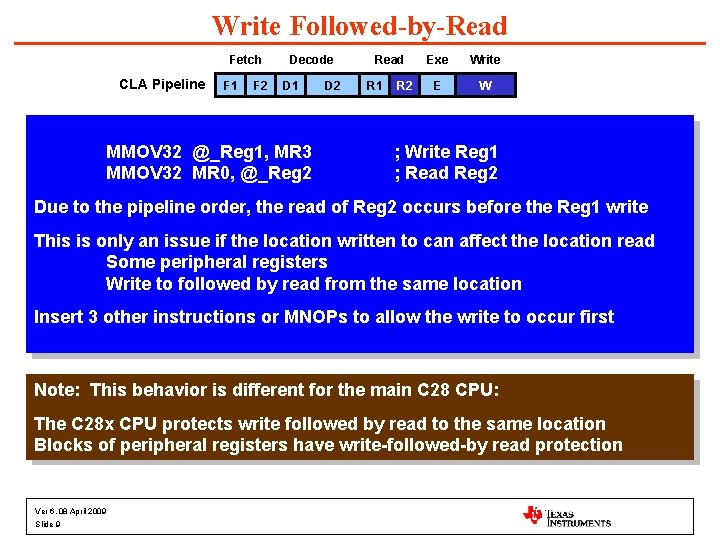
Write Followed-by-Read Fetch CLA Pipeline F 1 F 2 Decode D 1 MMOV 32 @_Reg 1, MR 3 MMOV 32 MR 0, @_Reg 2 D 2 Read R 1 R 2 Exe Write E W ; Write Reg 1 ; Read Reg 2 Due to the pipeline order, the read of Reg 2 occurs before the Reg 1 write This is only an issue if the location written to can affect the location read Some peripheral registers Write to followed by read from the same location Insert 3 other instructions or MNOPs to allow the write to occur first Note: This behavior is different for the main C 28 CPU: The C 28 x CPU protects write followed by read to the same location Blocks of peripheral registers have write-followed-by read protection Ver 6, 08 April 2009 Slide 9
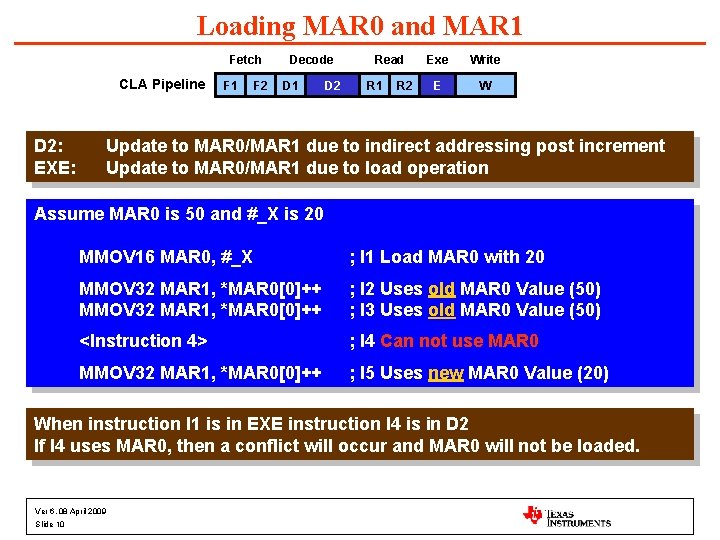
Loading MAR 0 and MAR 1 Fetch CLA Pipeline D 2: EXE: F 1 F 2 Decode D 1 D 2 Read R 1 R 2 Exe Write E W Update to MAR 0/MAR 1 due to indirect addressing post increment Update to MAR 0/MAR 1 due to load operation Assume MAR 0 is 50 and #_X is 20 MMOV 16 MAR 0, #_X ; I 1 Load MAR 0 with 20 MMOV 32 MAR 1, *MAR 0[0]++ ; I 2 Uses old MAR 0 Value (50) ; I 3 Uses old MAR 0 Value (50) <Instruction 4> ; I 4 Can not use MAR 0 MMOV 32 MAR 1, *MAR 0[0]++ ; I 5 Uses new MAR 0 Value (20) When instruction I 1 is in EXE instruction I 4 is in D 2 If I 4 uses MAR 0, then a conflict will occur and MAR 0 will not be loaded. Ver 6, 08 April 2009 Slide 10
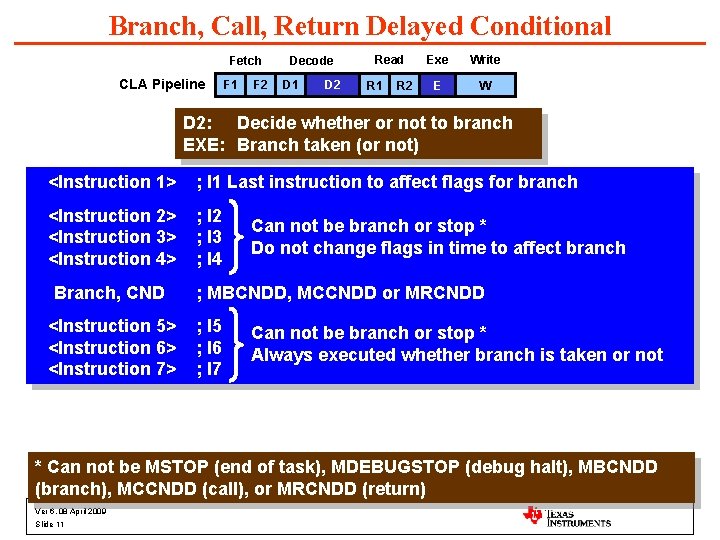
Branch, Call, Return Delayed Conditional Fetch CLA Pipeline F 1 F 2 Decode D 1 D 2 Read R 1 R 2 Exe Write E W D 2: Decide whether or not to branch EXE: Branch taken (or not) <Instruction 1> ; I 1 Last instruction to affect flags for branch <Instruction 2> <Instruction 3> <Instruction 4> ; I 2 ; I 3 ; I 4 Branch, CND <Instruction 5> <Instruction 6> <Instruction 7> Can not be branch or stop * Do not change flags in time to affect branch ; MBCNDD, MCCNDD or MRCNDD ; I 5 ; I 6 ; I 7 Can not be branch or stop * Always executed whether branch is taken or not * Can not be MSTOP (end of task), MDEBUGSTOP (debug halt), MBCNDD (branch), MCCNDD (call), or MRCNDD (return) Ver 6, 08 April 2009 Slide 11
Optimizing Delayed Conditional Branch 6 instruction slots are executed on every branch Use these slots to improve performance Cycle count varies depending on delay slot usage Taken Not Taken 7 1 4 7 7 4 MSTOP, MDEBUGSTOP MBCNDD, MCCNDD MRCNDD are not allowed in delay slots Ver 6, 08 April 2009 Slide 12 MCMPF 32 MR 0, #0. 1 MNOP MBCNDD Skip 1, NEQ MNOP MMOV 32 MR 1, @_Ramp MMOVXI MR 2, #RAMP_MASK MOR 32 MR 1, MR 2 MMOV 32 @_Ramp, MR 1. . . MSTOP Skip 1: MCMPF 32 MR 0, #0. 01 MNOP MBCNDD Skip 2, NEQ MNOP MMOV 32 MR 1, @_Coast MMOVXI MR 2, #COAST_MASK MOR 32 MR 1, MR 2 MMOV 32 @_Coast, MR 1. . . MSTOP Skip 2: MMOV 32 MR 3, @_Steady MMOVXI MR 2, #STEADY_MASK MOR 32 MR 3, MR 2 MMOV 32 @_Steady, MR 3. . . MSTOP Optimized Code MCMPF 32 MTESTTF MNOP MBCNDD MMOV 32 MMOVXI MOR 32 MMOV 32. . . MSTOP MR 0, #0. 1 MR 0, #0. 01 EQ Skip 1: MMOV 32 MMOVXI MOR 32 MBCNDD MMOV 32 MMOVXI MOR 32 MMOV 32. . . MSTOP MR 3, @_Steady MR 2, #STEADY_MASK MR 3, MR 2 Skip 2, NTF MR 1, @_Coast MR 2, #COAST_MASK MR 1, MR 2 @_Coast, MR 1 Skip 2: MMOV 32. . . MSTOP @_Steady, MR 3 Skip 1, NEQ MR 1, @_Ramp MR 2, #RAMP_MASK MR 1, MR 2 @_Ramp, MR 1
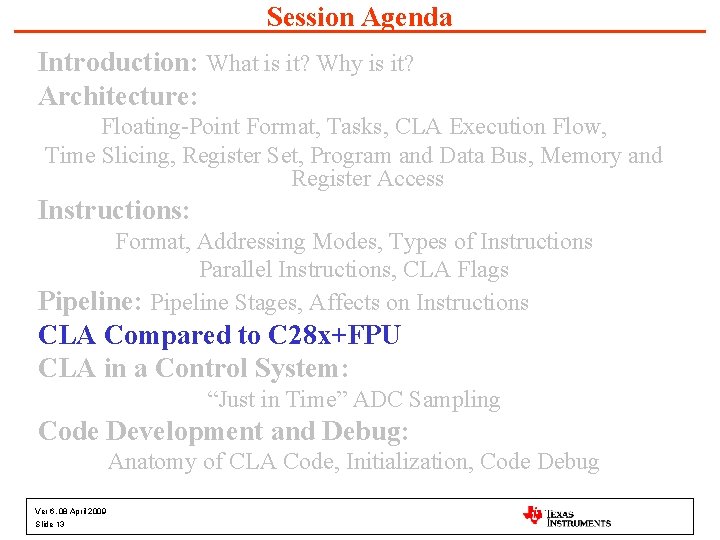
Session Agenda Introduction: What is it? Why is it? Architecture: Floating-Point Format, Tasks, CLA Execution Flow, Time Slicing, Register Set, Program and Data Bus, Memory and Register Access Instructions: Format, Addressing Modes, Types of Instructions Parallel Instructions, CLA Flags Pipeline: Pipeline Stages, Affects on Instructions CLA Compared to C 28 x+FPU CLA in a Control System: “Just in Time” ADC Sampling Code Development and Debug: Anatomy of CLA Code, Initialization, Code Debug Ver 6, 08 April 2009 Slide 13
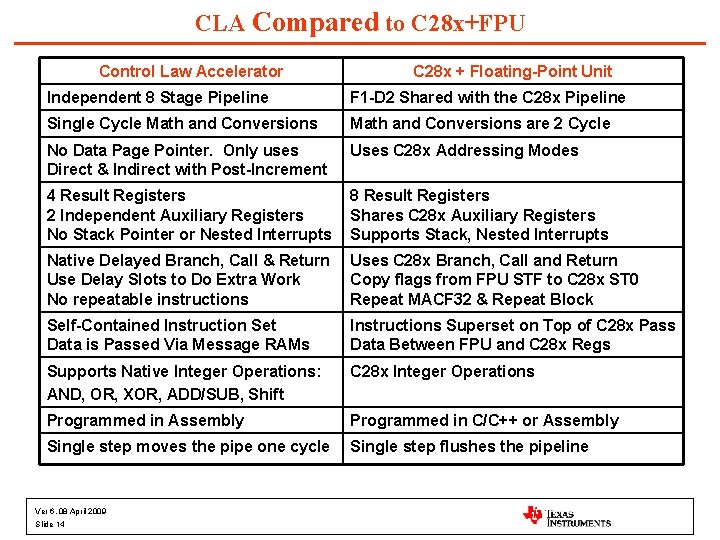
CLA Compared to C 28 x+FPU Control Law Accelerator C 28 x + Floating-Point Unit Independent 8 Stage Pipeline F 1 -D 2 Shared with the C 28 x Pipeline Single Cycle Math and Conversions are 2 Cycle No Data Page Pointer. Only uses Direct & Indirect with Post-Increment Uses C 28 x Addressing Modes 4 Result Registers 2 Independent Auxiliary Registers No Stack Pointer or Nested Interrupts 8 Result Registers Shares C 28 x Auxiliary Registers Supports Stack, Nested Interrupts Native Delayed Branch, Call & Return Use Delay Slots to Do Extra Work No repeatable instructions Uses C 28 x Branch, Call and Return Copy flags from FPU STF to C 28 x ST 0 Repeat MACF 32 & Repeat Block Self-Contained Instruction Set Data is Passed Via Message RAMs Instructions Superset on Top of C 28 x Pass Data Between FPU and C 28 x Regs Supports Native Integer Operations: AND, OR, XOR, ADD/SUB, Shift C 28 x Integer Operations Programmed in Assembly Programmed in C/C++ or Assembly Single step moves the pipe one cycle Single step flushes the pipeline Ver 6, 08 April 2009 Slide 14
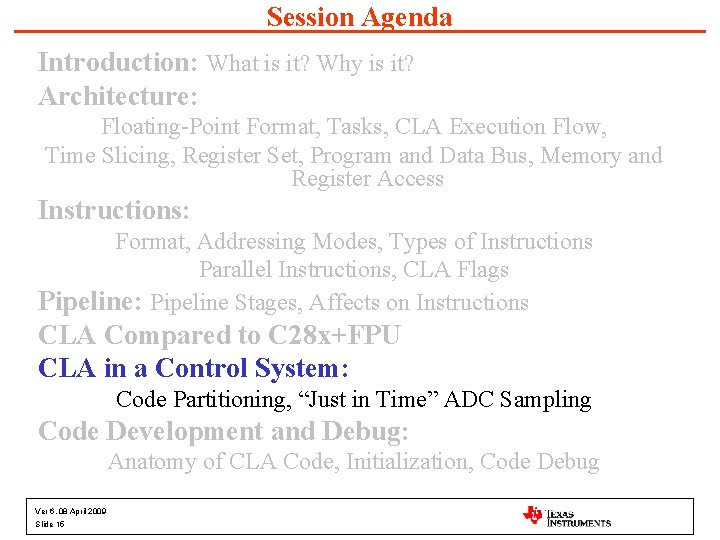
Session Agenda Introduction: What is it? Why is it? Architecture: Floating-Point Format, Tasks, CLA Execution Flow, Time Slicing, Register Set, Program and Data Bus, Memory and Register Access Instructions: Format, Addressing Modes, Types of Instructions Parallel Instructions, CLA Flags Pipeline: Pipeline Stages, Affects on Instructions CLA Compared to C 28 x+FPU CLA in a Control System: Code Partitioning, “Just in Time” ADC Sampling Code Development and Debug: Anatomy of CLA Code, Initialization, Code Debug Ver 6, 08 April 2009 Slide 15
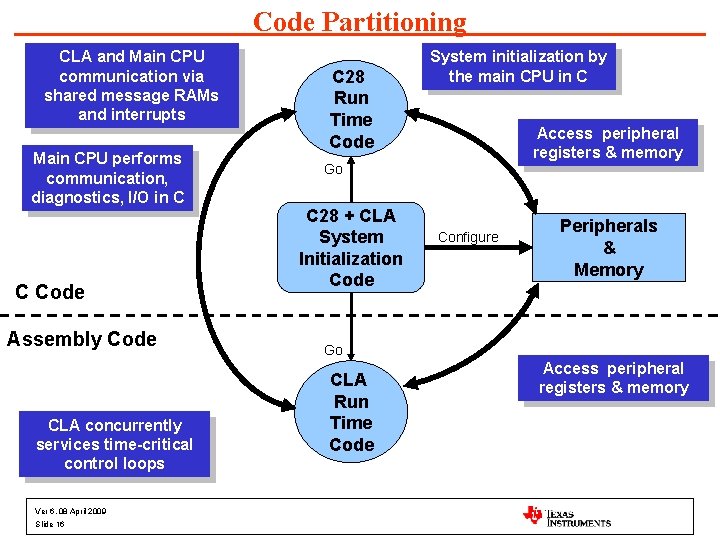
Code Partitioning CLA and Main CPU communication via shared message RAMs and interrupts Main CPU performs communication, diagnostics, I/O in C C Code Assembly Code CLA concurrently services time-critical control loops Ver 6, 08 April 2009 Slide 16 C 28 Run Time Code System initialization by the main CPU in C Access peripheral registers & memory Go C 28 + CLA System Initialization Code Configure Peripherals & Memory Go CLA Run Time Code Access peripheral registers & memory
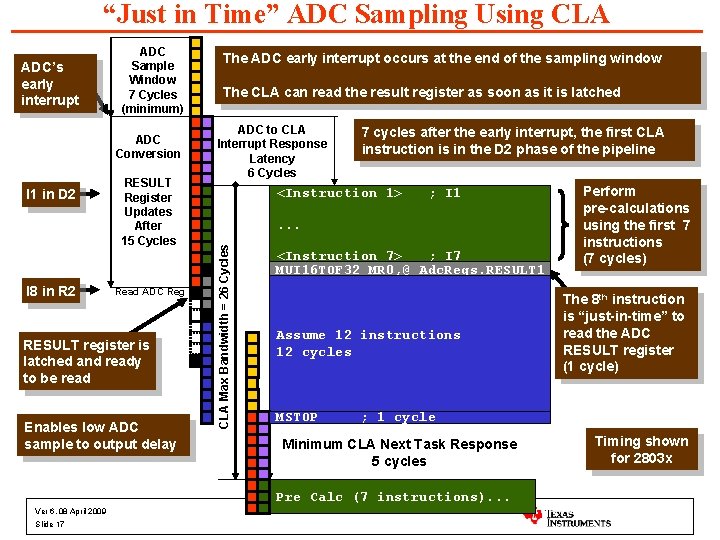
“Just in Time” ADC Sampling Using CLA ADC Conversion I 1 in D 2 I 8 in R 2 RESULT Register Updates After 15 Cycles Read ADC Reg RESULT register is latched and ready to be read Enables low ADC sample to output delay The ADC early interrupt occurs at the end of the sampling window The CLA can read the result register as soon as it is latched ADC to CLA Interrupt Response Latency 6 Cycles 7 cycles after the early interrupt, the first CLA instruction is in the D 2 phase of the pipeline <Instruction 1> ; I 1 . . . CLA Max Bandwidth = 26 Cycles ADC’s early interrupt ADC Sample Window 7 Cycles (minimum) <Instruction 7> ; I 7 MUI 16 TOF 32 MR 0, @_Adc. Regs. RESULT 1 Assume 12 instructions 12 cycles MSTOP Slide 17 The 8 th instruction is “just-in-time” to read the ADC RESULT register (1 cycle) ; 1 cycle Minimum CLA Next Task Response 5 cycles Pre Calc (7 instructions). . . Ver 6, 08 April 2009 Perform pre-calculations using the first 7 instructions (7 cycles) Timing shown for 2803 x
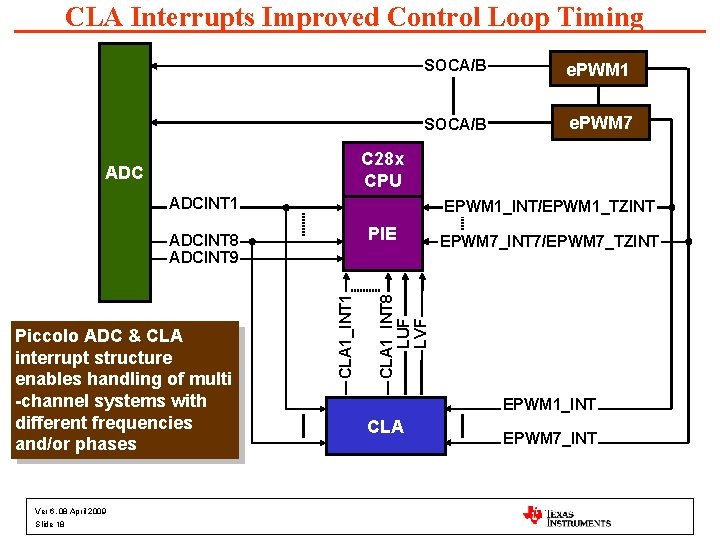
CLA Interrupts Improved Control Loop Timing SOCA/B e. PWM 1 SOCA/B e. PWM 7 C 28 x CPU ADCINT 1 EPWM 1_INT/EPWM 1_TZINT Ver 6, 08 April 2009 Slide 18 CLA 1_INT 1 Piccolo ADC & CLA interrupt structure enables handling of multi -channel systems with different frequencies and/or phases EPWM 7_INT 7/EPWM 7_TZINT CLA 1_INT 8 LUF LVF PIE ADCINT 8 ADCINT 9 EPWM 1_INT CLA EPWM 7_INT
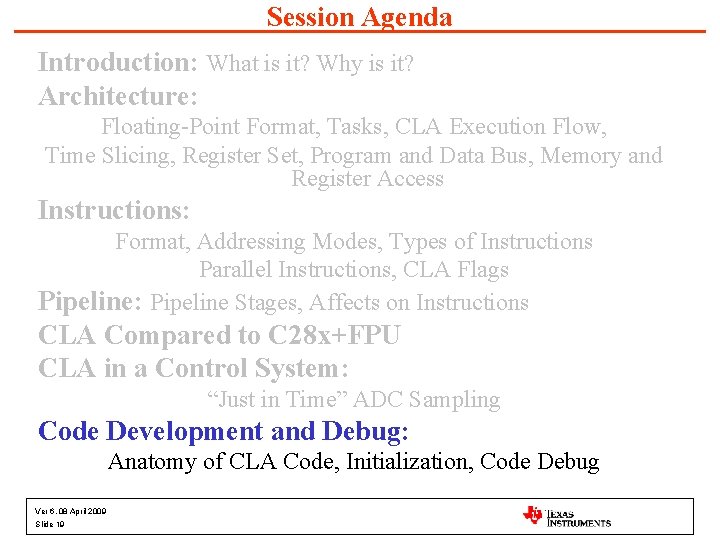
Session Agenda Introduction: What is it? Why is it? Architecture: Floating-Point Format, Tasks, CLA Execution Flow, Time Slicing, Register Set, Program and Data Bus, Memory and Register Access Instructions: Format, Addressing Modes, Types of Instructions Parallel Instructions, CLA Flags Pipeline: Pipeline Stages, Affects on Instructions CLA Compared to C 28 x+FPU CLA in a Control System: “Just in Time” ADC Sampling Code Development and Debug: Anatomy of CLA Code, Initialization, Code Debug Ver 6, 08 April 2009 Slide 19
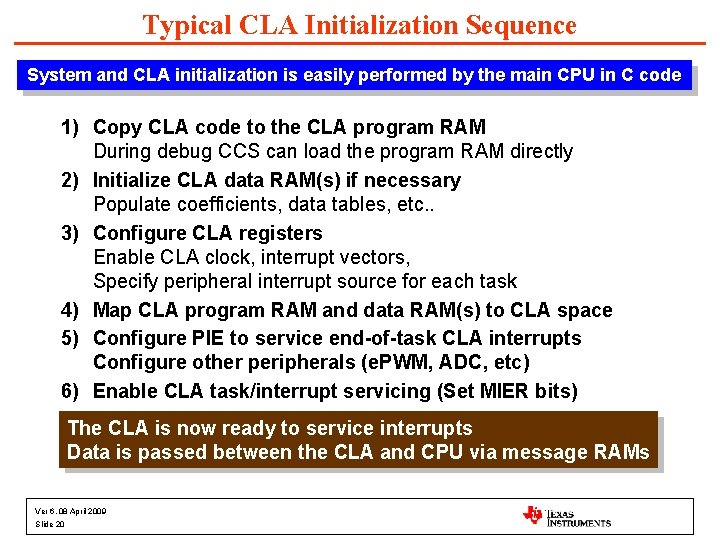
Typical CLA Initialization Sequence System and CLA initialization is easily performed by the main CPU in C code 1) Copy CLA code to the CLA program RAM During debug CCS can load the program RAM directly 2) Initialize CLA data RAM(s) if necessary Populate coefficients, data tables, etc. . 3) Configure CLA registers Enable CLA clock, interrupt vectors, Specify peripheral interrupt source for each task 4) Map CLA program RAM and data RAM(s) to CLA space 5) Configure PIE to service end-of-task CLA interrupts Configure other peripherals (e. PWM, ADC, etc) 6) Enable CLA task/interrupt servicing (Set MIER bits) The CLA is now ready to service interrupts Data is passed between the CLA and CPU via message RAMs Ver 6, 08 April 2009 Slide 20
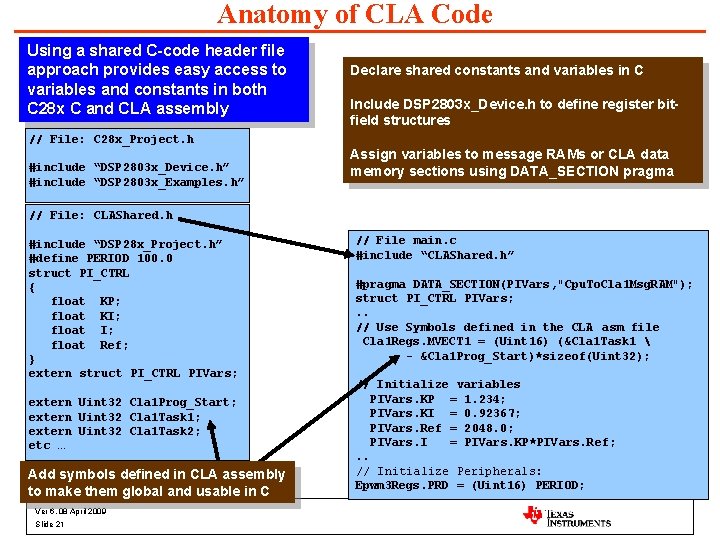
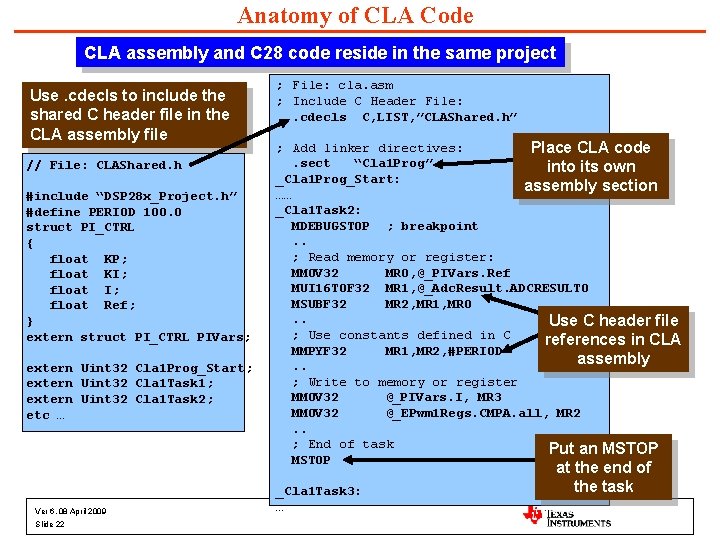
Anatomy of CLA Code Using a shared C-code header file approach provides easy access to variables and constants in both C 28 x C and CLA assembly Declare shared constants and variables in C Include DSP 2803 x_Device. h to define register bitfield structures // File: C 28 x_Project. h #include “DSP 2803 x_Device. h” #include “DSP 2803 x_Examples. h” Assign variables to message RAMs or CLA data memory sections using DATA_SECTION pragma // File: CLAShared. h #include “DSP 28 x_Project. h” #define PERIOD 100. 0 struct PI_CTRL { float KP; float KI; float Ref; } extern struct PI_CTRL PIVars; extern Uint 32 Cla 1 Prog_Start; extern Uint 32 Cla 1 Task 1; extern Uint 32 Cla 1 Task 2; etc … Add symbols defined in CLA assembly to make them global and usable in C Ver 6, 08 April 2009 Slide 21 // File main. c #include “CLAShared. h” #pragma DATA_SECTION(PIVars, "Cpu. To. Cla 1 Msg. RAM"); struct PI_CTRL PIVars; . . // Use Symbols defined in the CLA asm file Cla 1 Regs. MVECT 1 = (Uint 16) (&Cla 1 Task 1 - &Cla 1 Prog_Start)*sizeof(Uint 32); // Initialize variables PIVars. KP = 1. 234; PIVars. KI = 0. 92367; PIVars. Ref = 2048. 0; PIVars. I = PIVars. KP*PIVars. Ref; . . // Initialize Peripherals: Epwm 3 Regs. PRD = (Uint 16) PERIOD;
Anatomy of CLA Code CLA assembly and C 28 code reside in the same project Use. cdecls to include the shared C header file in the CLA assembly file // File: CLAShared. h #include “DSP 28 x_Project. h” #define PERIOD 100. 0 struct PI_CTRL { float KP; float KI; float Ref; } extern struct PI_CTRL PIVars; extern Uint 32 Cla 1 Prog_Start; extern Uint 32 Cla 1 Task 1; extern Uint 32 Cla 1 Task 2; etc … Ver 6, 08 April 2009 Slide 22 ; File: cla. asm ; Include C Header File: . cdecls C, LIST, ”CLAShared. h” ; Add linker directives: Place CLA code. sect “Cla 1 Prog” into its own _Cla 1 Prog_Start: assembly section …… _Cla 1 Task 2: MDEBUGSTOP ; breakpoint. . ; Read memory or register: MMOV 32 MR 0, @_PIVars. Ref MUI 16 TOF 32 MR 1, @_Adc. Result. ADCRESULT 0 MSUBF 32 MR 2, MR 1, MR 0. . Use C header file ; Use constants defined in C references in CLA MMPYF 32 MR 1, MR 2, #PERIOD assembly. . ; Write to memory or register MMOV 32 @_PIVars. I, MR 3 MMOV 32 @_EPwm 1 Regs. CMPA. all, MR 2. . ; End of task Put an MSTOP _Cla 1 Task 3: … at the end of the task
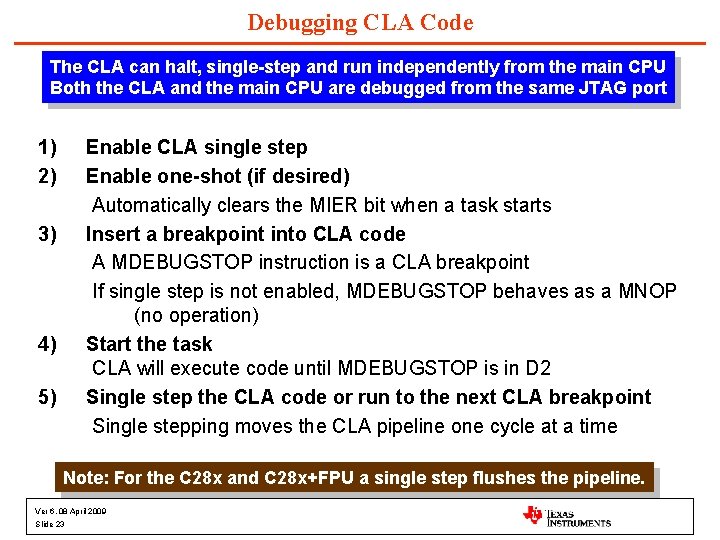
Debugging CLA Code The CLA can halt, single-step and run independently from the main CPU Both the CLA and the main CPU are debugged from the same JTAG port 1) 2) Enable CLA single step Enable one-shot (if desired) Automatically clears the MIER bit when a task starts Insert a breakpoint into CLA code A MDEBUGSTOP instruction is a CLA breakpoint If single step is not enabled, MDEBUGSTOP behaves as a MNOP (no operation) Start the task CLA will execute code until MDEBUGSTOP is in D 2 Single step the CLA code or run to the next CLA breakpoint Single stepping moves the CLA pipeline one cycle at a time 3) 4) 5) Note: For the C 28 x and C 28 x+FPU a single step flushes the pipeline. Ver 6, 08 April 2009 Slide 23
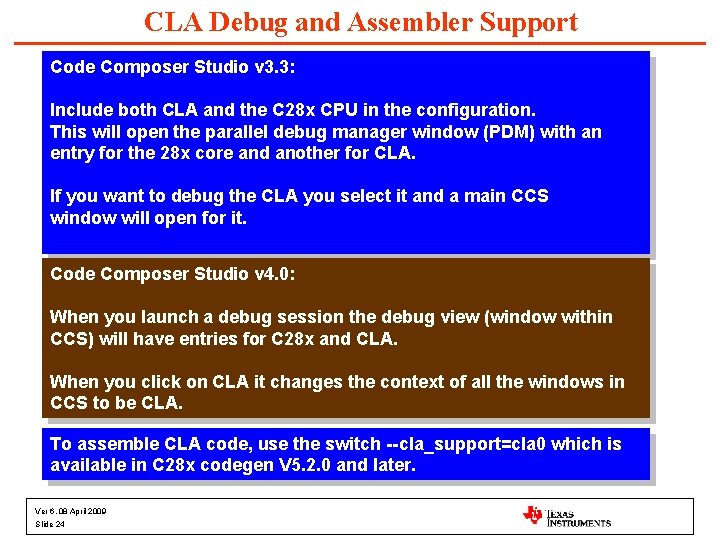
CLA Debug and Assembler Support Code Composer Studio v 3. 3: Include both CLA and the C 28 x CPU in the configuration. This will open the parallel debug manager window (PDM) with an entry for the 28 x core and another for CLA. If you want to debug the CLA you select it and a main CCS window will open for it. Code Composer Studio v 4. 0: When you launch a debug session the debug view (window within CCS) will have entries for C 28 x and CLA. When you click on CLA it changes the context of all the windows in CCS to be CLA. To assemble CLA code, use the switch --cla_support=cla 0 which is available in C 28 x codegen V 5. 2. 0 and later. Ver 6, 08 April 2009 Slide 24
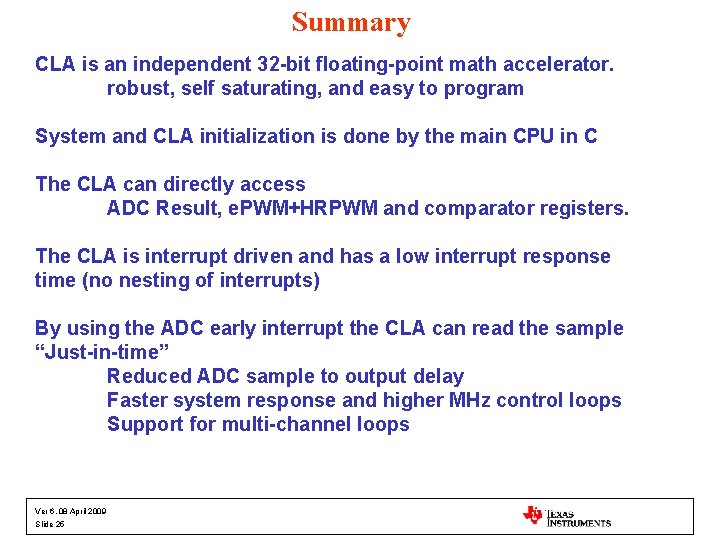
Summary CLA is an independent 32 -bit floating-point math accelerator. robust, self saturating, and easy to program System and CLA initialization is done by the main CPU in C The CLA can directly access ADC Result, e. PWM+HRPWM and comparator registers. The CLA is interrupt driven and has a low interrupt response time (no nesting of interrupts) By using the ADC early interrupt the CLA can read the sample “Just-in-time” Reduced ADC sample to output delay Faster system response and higher MHz control loops Support for multi-channel loops Ver 6, 08 April 2009 Slide 25
Thank you! Watch the TI website for additional CLA material coming in 2009: CLA Debug demonstrations – CCS 3. 3 and CCS 4 Benchmarks CLA Code: Trig functions, DSP functions, Control algorithms and more! Ver 6, 08 April 2009 Slide 26