
Introduction to the ASCA Model for School Counseling
- Slides: 28
Introduction to the ASCA Model for School Counseling Program December 7, 2017 Nita Hill and Brian Mathieson
OSPI/WSCA 3 -Part School Counselor Webinar Series • Today, October 26: State K-12 Comprehensive School Counseling and Guidance Model Implementation • November 15: School Counseling Evaluation Framework • December 7: Introduction to the ASCA / WA Model for School Counseling Program Development ØUtilize up-to-date resources ØShare information and tools Ø Defining the role of a school counselor ØComprehensive school counseling program development 12/1/2020 2
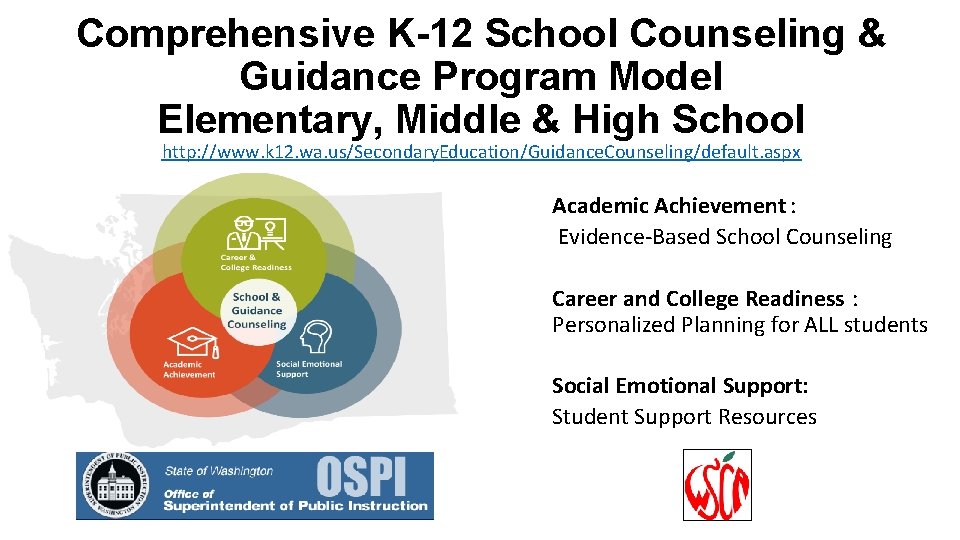
Comprehensive K-12 School Counseling & Guidance Program Model Elementary, Middle & High School http: //www. k 12. wa. us/Secondary. Education/Guidance. Counseling/default. aspx Academic Achievement : Evidence-Based School Counseling Career and College Readiness : Personalized Planning for ALL students Social Emotional Support: Student Support Resources 12/1/2020 3
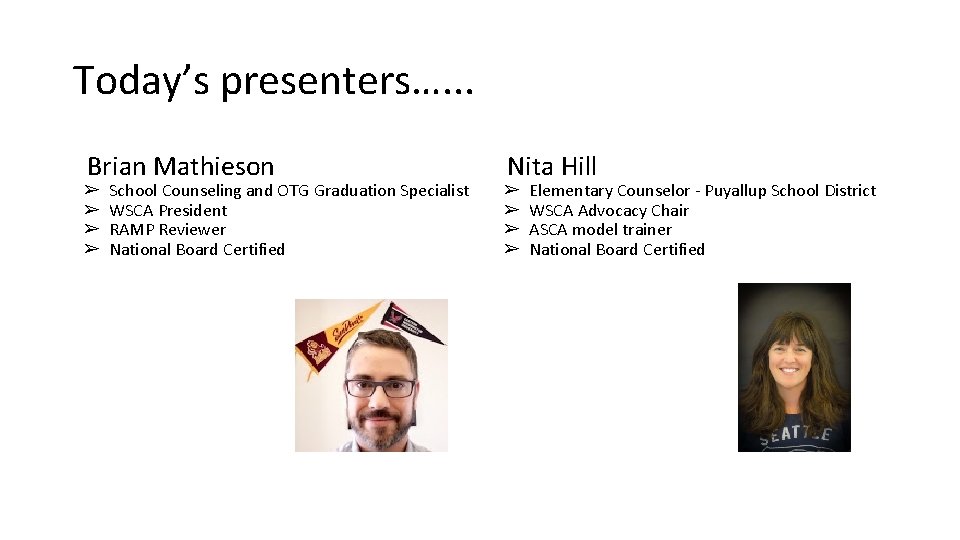
Today’s presenters…. . . Brian Mathieson ➢ ➢ School Counseling and OTG Graduation Specialist WSCA President RAMP Reviewer National Board Certified Nita Hill ➢ ➢ Elementary Counselor - Puyallup School District WSCA Advocacy Chair ASCA model trainer National Board Certified
Goals for today ❖ Share ideas for getting started with implementation ❖ Review Foundation component ❖ Focus on program goals and action planning as a critical component of implementation ❖ Share support resources
• The Washington Comprehensive School Counseling and Guidance Program Model • is the ASCA National Model with Washington state flavor.
Five Bits of Advice for ASCA National Model Implementation • Remember, the purpose of the ASCA National Model is to do more school counseling. • Keep it simple. • The ASCA National Model is even more important when you have a large caseload. • The ASCA National Model gives you the tools you need to take things off your plate. • Take advantage of experts in your district.
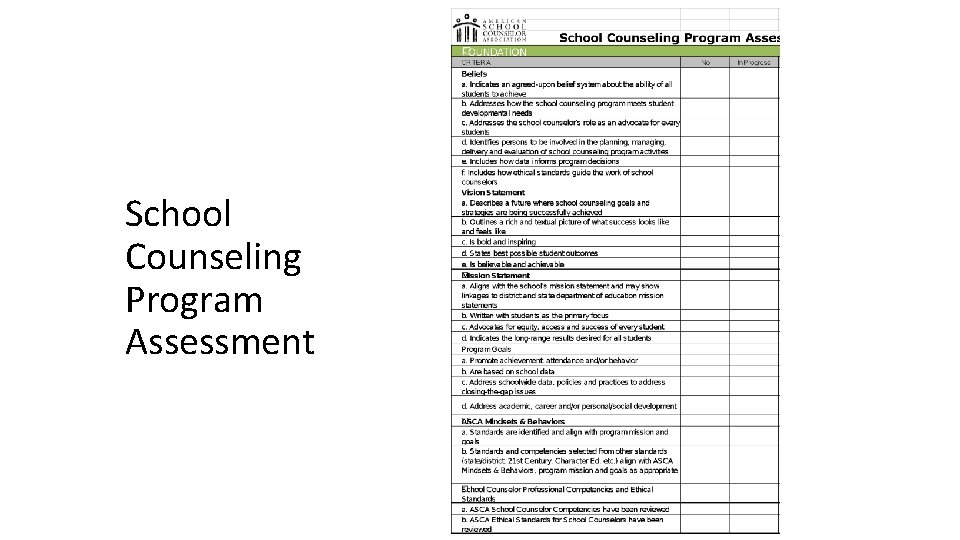
No right way to get started • School Counseling Program Assessment • Foundation (e. g. , Group Beliefs, Vision, Mission, School Data Profile) • Student results oriented (e. g. , SMART Goal, Action Plans)
School Counseling Program Assessment
Foundation • Beliefs – Common understanding regarding students ability to achieve, the counseling program, and our role. • Vision – Bold description of a future wherein the school counselor programs goals are achieved. • Mission – Aligned with the school. Focused on students. Direct to reach vision.
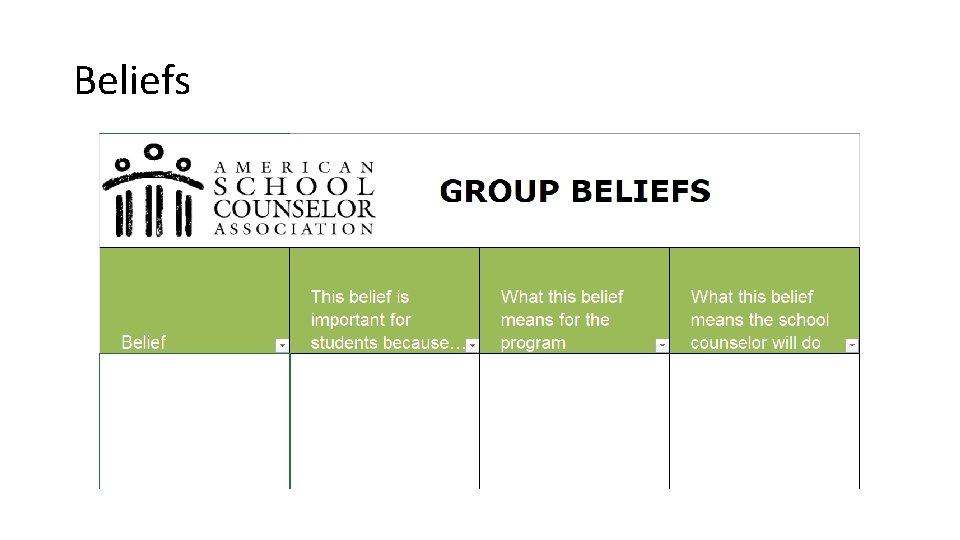
Beliefs
Vision Statement The vision statement creates a clear picture of success for all students • Describes the future world where student outcomes are successfully achieved. • States the best possible outcomes desired for all students that are five to 15 years away. • Aligns with the school and district vision statement or the narrative explains why they are not included. •
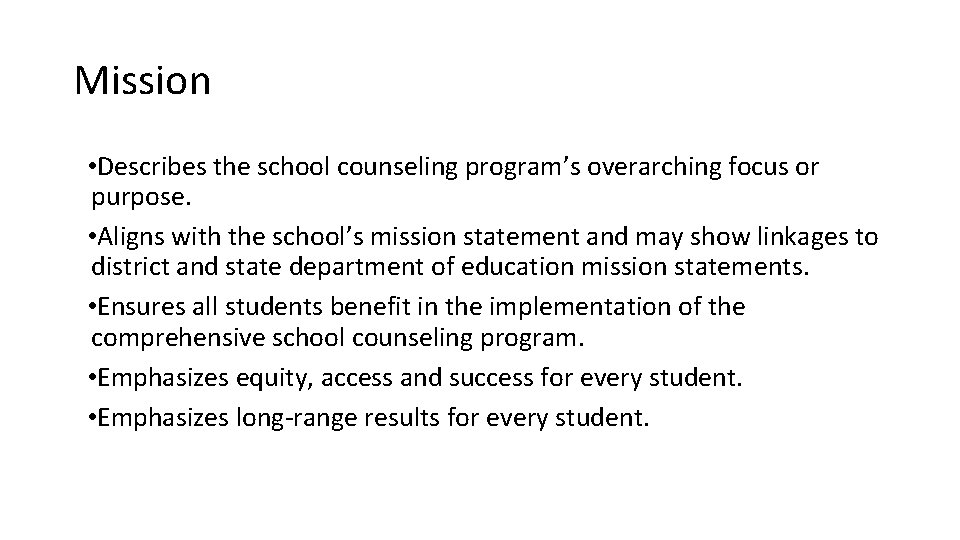
Mission • Describes the school counseling program’s overarching focus or purpose. • Aligns with the school’s mission statement and may show linkages to district and state department of education mission statements. • Ensures all students benefit in the implementation of the comprehensive school counseling program. • Emphasizes equity, access and success for every student. • Emphasizes long-range results for every student.
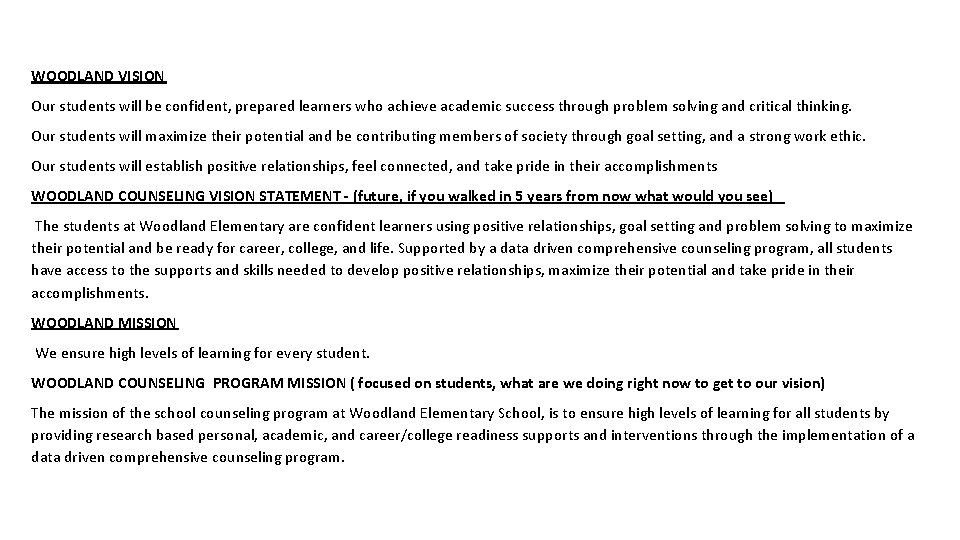
WOODLAND VISION Our students will be confident, prepared learners who achieve academic success through problem solving and critical thinking. Our students will maximize their potential and be contributing members of society through goal setting, and a strong work ethic. Our students will establish positive relationships, feel connected, and take pride in their accomplishments WOODLAND COUNSELING VISION STATEMENT - (future, if you walked in 5 years from now what would you see) The students at Woodland Elementary are confident learners using positive relationships, goal setting and problem solving to maximize their potential and be ready for career, college, and life. Supported by a data driven comprehensive counseling program, all students have access to the supports and skills needed to develop positive relationships, maximize their potential and take pride in their accomplishments. WOODLAND MISSION We ensure high levels of learning for every student. WOODLAND COUNSELING PROGRAM MISSION ( focused on students, what are we doing right now to get to our vision) The mission of the school counseling program at Woodland Elementary School, is to ensure high levels of learning for all students by providing research based personal, academic, and career/college readiness supports and interventions through the implementation of a data driven comprehensive counseling program.
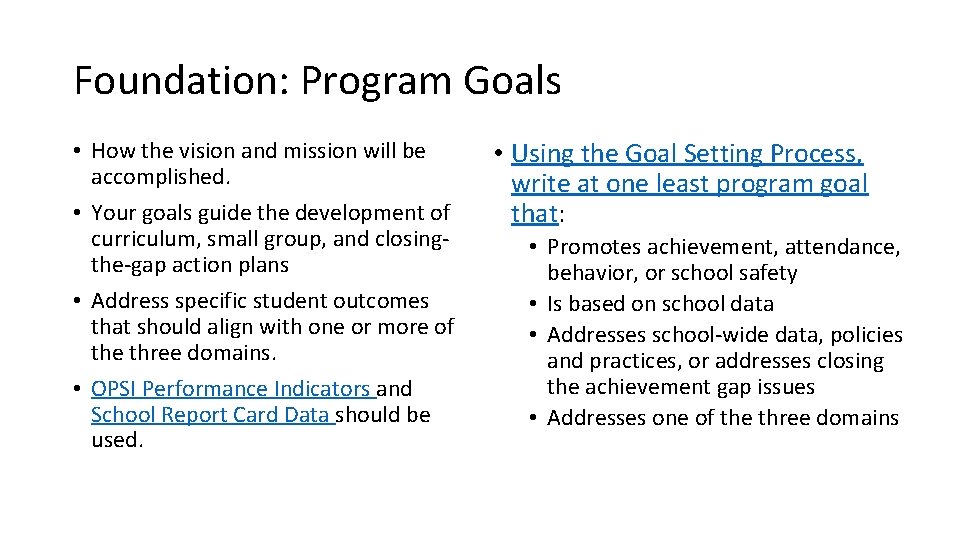
Foundation: Program Goals • How the vision and mission will be accomplished. • Your goals guide the development of curriculum, small group, and closingthe-gap action plans • Address specific student outcomes that should align with one or more of the three domains. • OPSI Performance Indicators and School Report Card Data should be used. • Using the Goal Setting Process, write at one least program goal that: • Promotes achievement, attendance, behavior, or school safety • Is based on school data • Addresses school-wide data, policies and practices, or addresses closing the achievement gap issues • Addresses one of the three domains
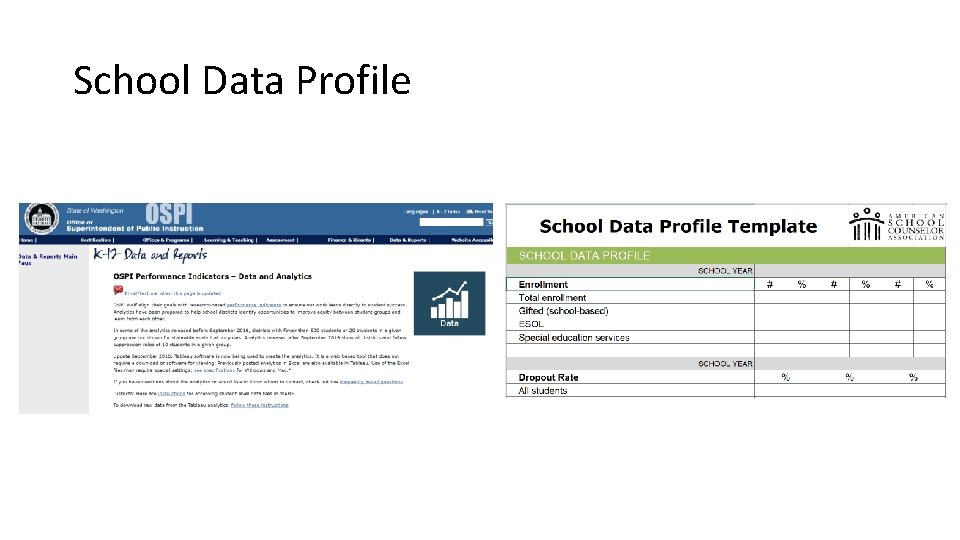
School Data Profile
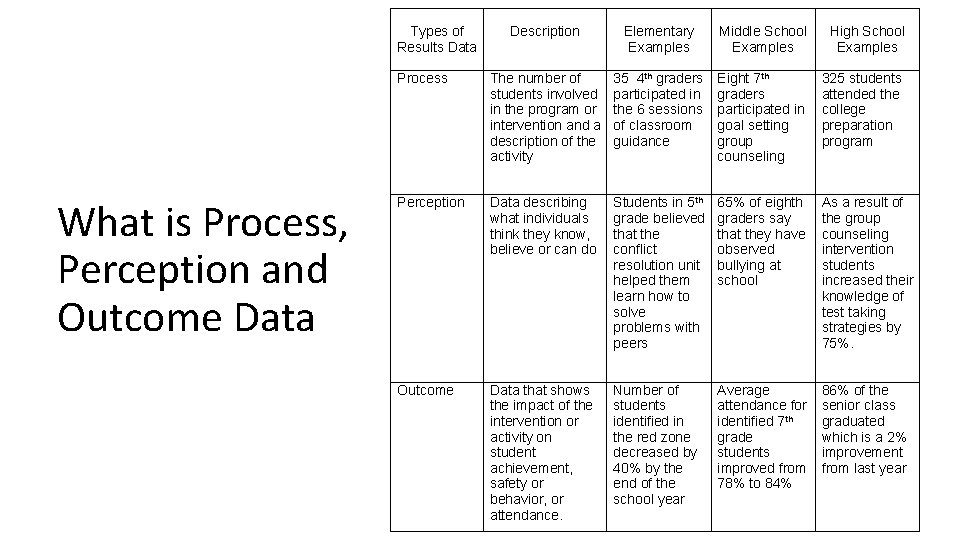
Types of Results Data What is Process, Perception and Outcome Data Description Elementary Examples Middle School Examples th th 35 4 graders Eight 7 participated in graders the 6 sessions participated in of classroom goal setting guidance group counseling High School Examples 325 students attended the college preparation program Process The number of students involved in the program or intervention and a description of the activity Perception Data describing what individuals think they know, believe or can do Students in 5 th grade believed that the conflict resolution unit helped them learn how to solve problems with peers 65% of eighth graders say that they have observed bullying at school As a result of the group counseling intervention students increased their knowledge of test taking strategies by 75%. Outcome Data that shows the impact of the intervention or activity on student achievement, safety or behavior, or attendance. Number of students identified in the red zone decreased by 40% by the end of the school year Average attendance for identified 7 th grade students improved from 78% to 84% 86% of the senior class graduated which is a 2% improvement from last year
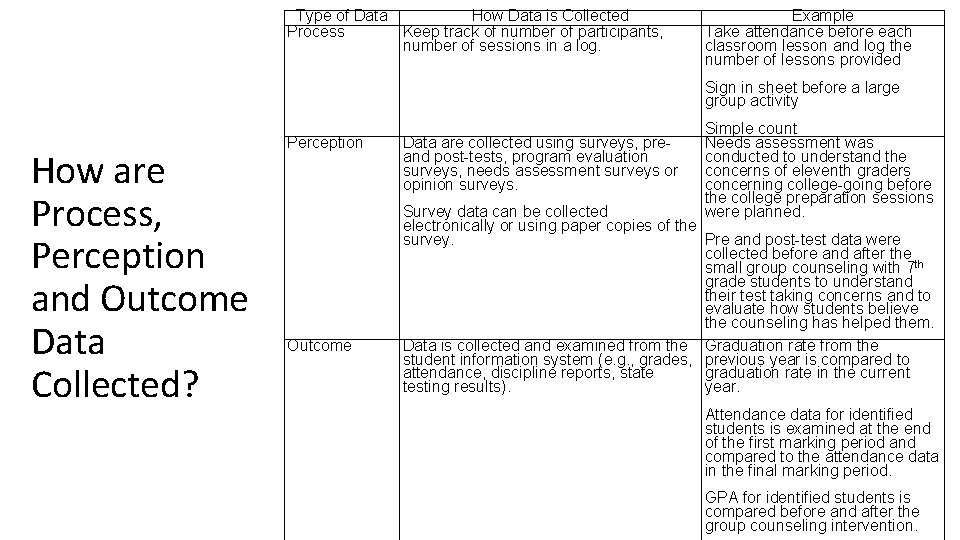
Type of Data How Data is Collected Process Keep track of number of participants, number of sessions in a log. How are Process, Perception and Outcome Data Collected? Perception Outcome Example Take attendance before each classroom lesson and log the number of lessons provided Sign in sheet before a large group activity Simple count Data are collected using surveys, pre- Needs assessment was and post-tests, program evaluation conducted to understand the surveys, needs assessment surveys or concerns of eleventh graders opinion surveys. concerning college-going before the college preparation sessions Survey data can be collected were planned. electronically or using paper copies of the survey. Pre and post-test data were collected before and after the small group counseling with 7 th grade students to understand their test taking concerns and to evaluate how students believe the counseling has helped them. Data is collected and examined from the Graduation rate from the student information system (e. g. , grades, previous year is compared to attendance, discipline reports, state graduation rate in the current testing results). year. Attendance data for identified students is examined at the end of the first marking period and compared to the attendance data in the final marking period. GPA for identified students is compared before and after the group counseling intervention.
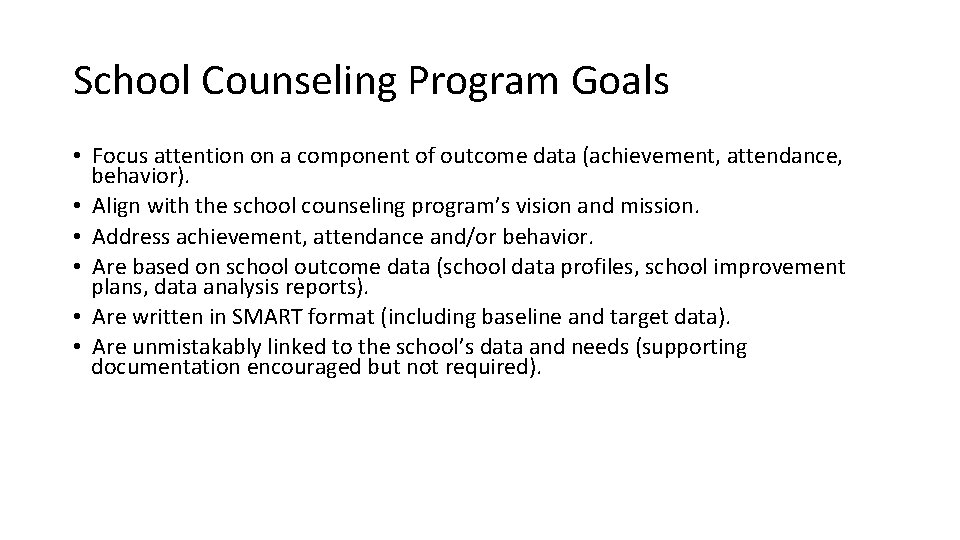
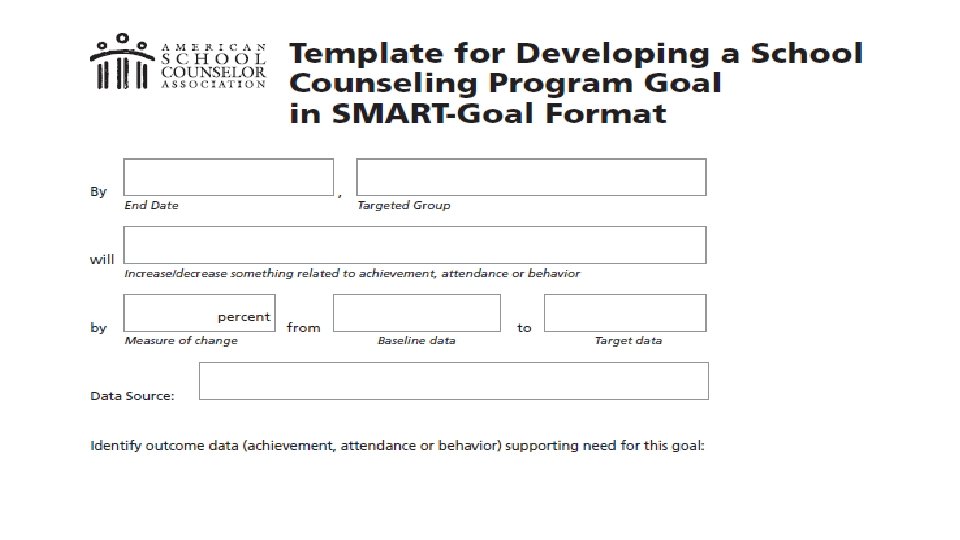
School Counseling Program Goals • Focus attention on a component of outcome data (achievement, attendance, behavior). • Align with the school counseling program’s vision and mission. • Address achievement, attendance and/or behavior. • Are based on school outcome data (school data profiles, school improvement plans, data analysis reports). • Are written in SMART format (including baseline and target data). • Are unmistakably linked to the school’s data and needs (supporting documentation encouraged but not required).
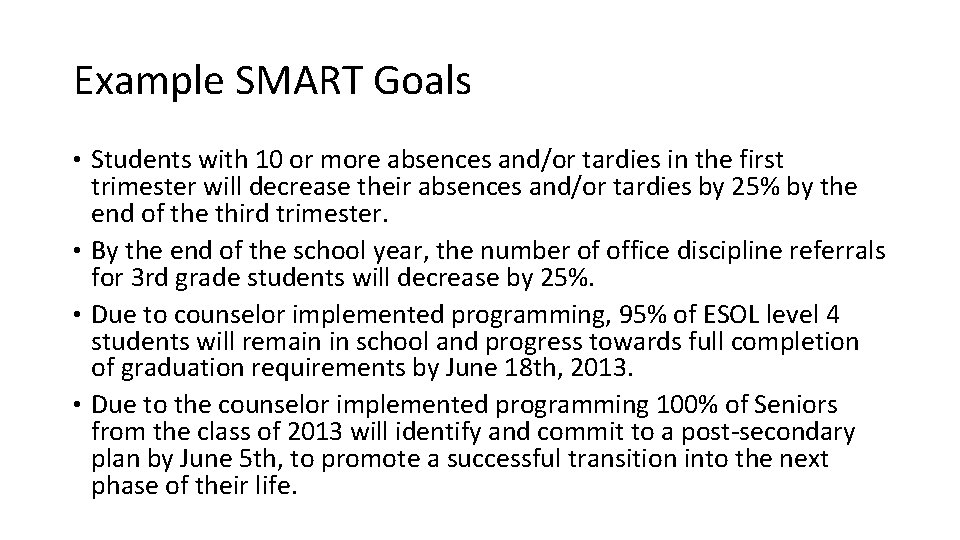
Example SMART Goals • Students with 10 or more absences and/or tardies in the first trimester will decrease their absences and/or tardies by 25% by the end of the third trimester. • By the end of the school year, the number of office discipline referrals for 3 rd grade students will decrease by 25%. • Due to counselor implemented programming, 95% of ESOL level 4 students will remain in school and progress towards full completion of graduation requirements by June 18 th, 2013. • Due to the counselor implemented programming 100% of Seniors from the class of 2013 will identify and commit to a post-secondary plan by June 5 th, to promote a successful transition into the next phase of their life.
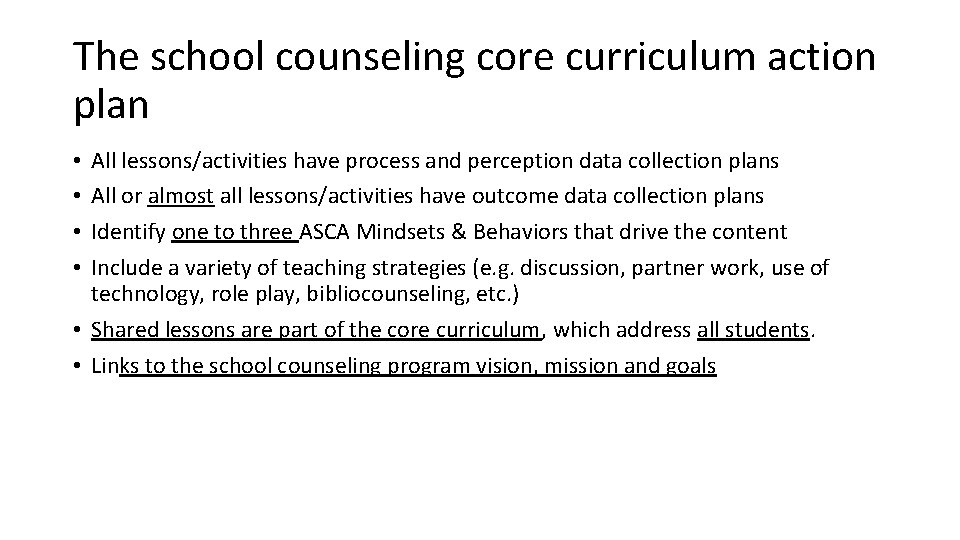
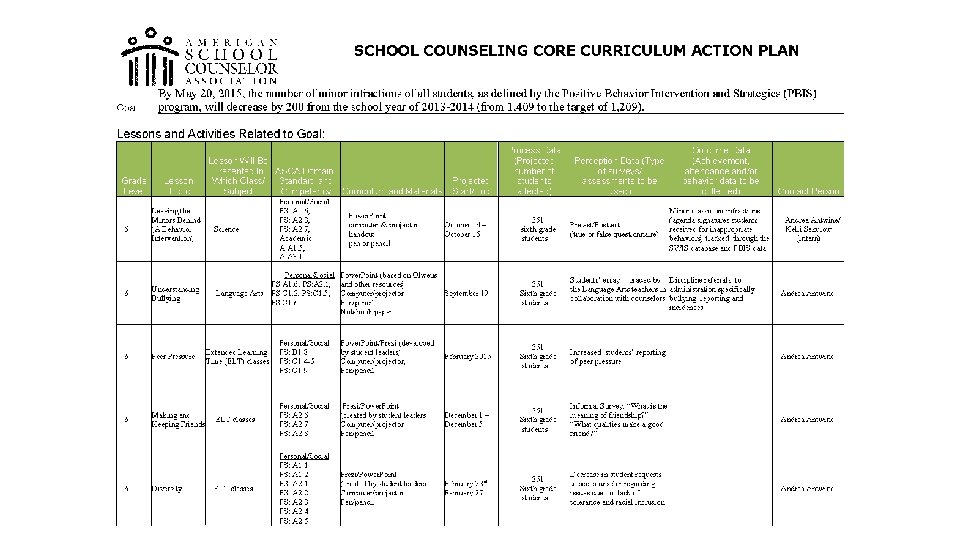
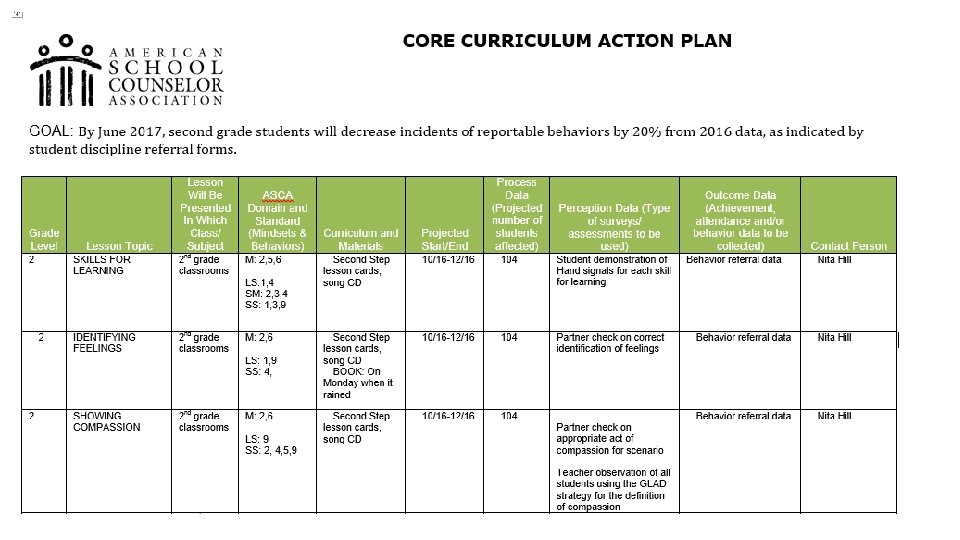
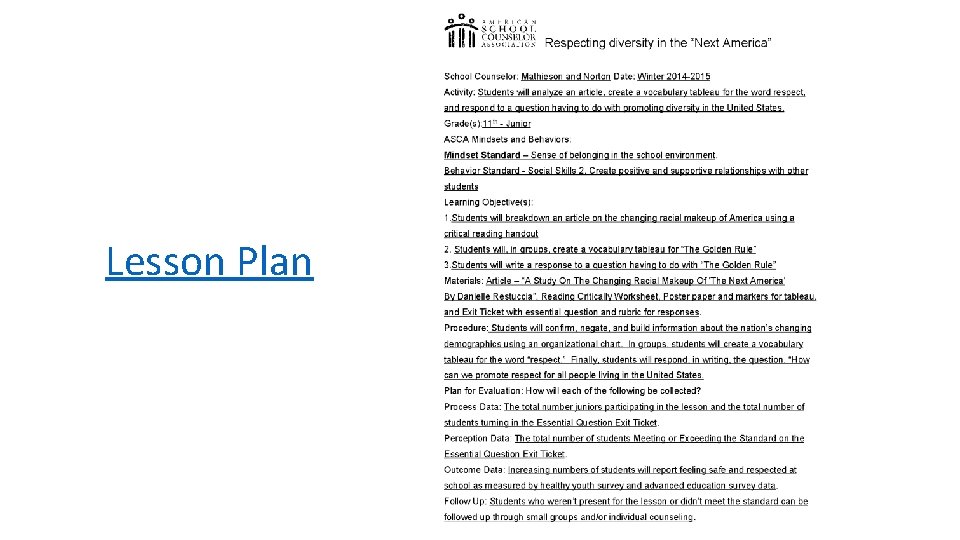
The school counseling core curriculum action plan All lessons/activities have process and perception data collection plans All or almost all lessons/activities have outcome data collection plans Identify one to three ASCA Mindsets & Behaviors that drive the content Include a variety of teaching strategies (e. g. discussion, partner work, use of technology, role play, bibliocounseling, etc. ) • Shared lessons are part of the core curriculum, which address all students. • Links to the school counseling program vision, mission and goals • •
Lesson Plan
Webinars • ASCA National Model – Themes and Foundation • Vision and Mission • Creating Effective School Counseling SMART Goals • ASCA Mindsets & Behaviors for Student Success • Focus on Student Competencies: ASCA Mindsets & Behaviors for Student Success • Using Data to Develop SMART Goals, Lake Braddock Secondary School Vision Statement Mission Statement School Counseling Program Goals ASCA Mindsets & Behaviors for Student Success Annual Agreement Advisory Council Calendars School Counseling Core Curriculum Action Plan and Lesson Plans • School Counseling Core Curriculum Results Report • Small-Group Responsive Services • Closing-the-Gap Results Report • •
Recognized ASCA Model Program (RAMP) designation from the American School Counselor Association • Show your administrators, school board and the community at large that you're committed to delivering a comprehensive, data-driven school counseling program. • The RAMP application process should be the culmination of the implementation of a comprehensive school counseling program. • Once your school has a program in place, you will need at least one entire academic year to collect the data and information needed to fulfill the RAMP application requirements.
WA School Counseling Model/ASCA National Model Trainings • Implementing the Washington Comprehensive School Counseling • • • Model ESD 114, Bremerton, January 12, 2018. Click here to register Implementing the Washington Comprehensive School Counseling Model ESD 105, Yakima, February 6, 2018. Click here to register Implementing the Washington Comprehensive School Counseling Model ESD 101, Spokane, February 23, 2018. Click here to register Implementing the Washington Comprehensive School Counseling Model, Pasco. Information coming soon. Implementing the Washington Comprehensive School Counseling Model, NCESD 171, Wenatchee, April 16, 2018. Registration coming soon. WSCA 2018 Conference , March 7 -9, Sea. Tac Double Tree Hotel.