
Introduction to systems Assistant Professor Konstantinos Tatas Based
Introduction to systems Assistant Professor Konstantinos Tatas Based on “Continuous and Discrete Time Signals and Systems” by M. Mandal and A. Asif

System types • A system usually abstracts a physical process. • Broadly speaking, a system is characterized by its ability to accept a set of input signals xi , for i ∈ {1, 2, . . . , m}, and to produce a set of output signals yj , for j ∈ {1, 2, . . . , n}, in response to the input signals. In other words, a system establishes a relationship between a set of inputs and the corresponding set of outputs. • A system can be CT or DT if its input/output signals are CT or DT, and Multiple-Input Multiple-Output (MIMO), or Single-Input Single-Output (SISO)
System Examples • For linear CT systems, a linear, constant-coefficient differential equation is often used to specify the relationship between its input x(t ) and output y(t ). • For linear DT systems, a linear, constant-coefficient difference equation often describes the relationship between its input x[k] and output y[k]. • The relationship between the input and output signals completely specifies the physical system. In other words, we do not require any other information to analyze the system.
System Classification • Systems can be classified in six important categories 1. linear and non-linear systems 2. time-invariant and time-varying systems 3. systems with and without memory 4. causal and non-causal systems 5. invertible and non-invertible systems 6. stable and unstable systems
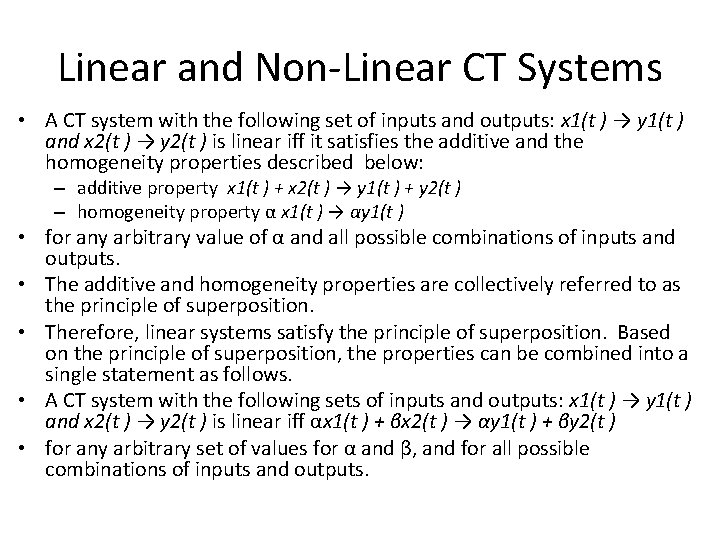
Linear and Non-Linear CT Systems • A CT system with the following set of inputs and outputs: x 1(t ) → y 1(t ) and x 2(t ) → y 2(t ) is linear iff it satisfies the additive and the homogeneity properties described below: – additive property x 1(t ) + x 2(t ) → y 1(t ) + y 2(t ) – homogeneity property α x 1(t ) → αy 1(t ) • for any arbitrary value of α and all possible combinations of inputs and outputs. • The additive and homogeneity properties are collectively referred to as the principle of superposition. • Therefore, linear systems satisfy the principle of superposition. Based on the principle of superposition, the properties can be combined into a single statement as follows. • A CT system with the following sets of inputs and outputs: x 1(t ) → y 1(t ) and x 2(t ) → y 2(t ) is linear iff αx 1(t ) + βx 2(t ) → αy 1(t ) + βy 2(t ) • for any arbitrary set of values for α and β, and for all possible combinations of inputs and outputs.
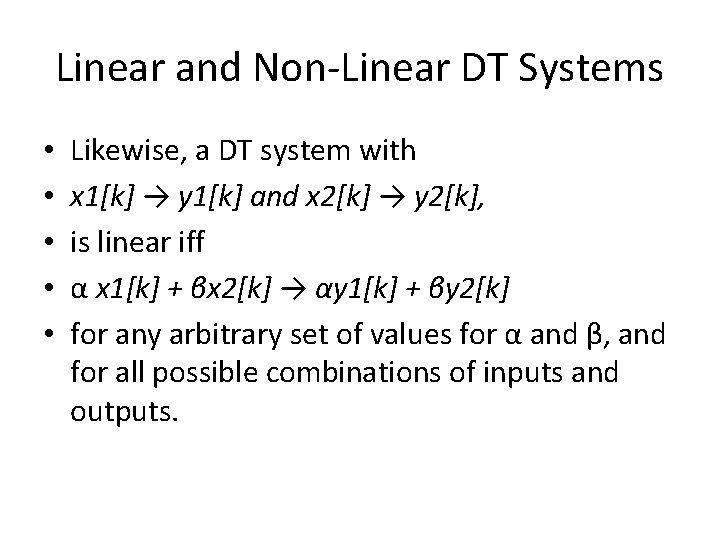
Linear and Non-Linear DT Systems • • • Likewise, a DT system with x 1[k] → y 1[k] and x 2[k] → y 2[k], is linear iff α x 1[k] + βx 2[k] → αy 1[k] + βy 2[k] for any arbitrary set of values for α and β, and for all possible combinations of inputs and outputs.
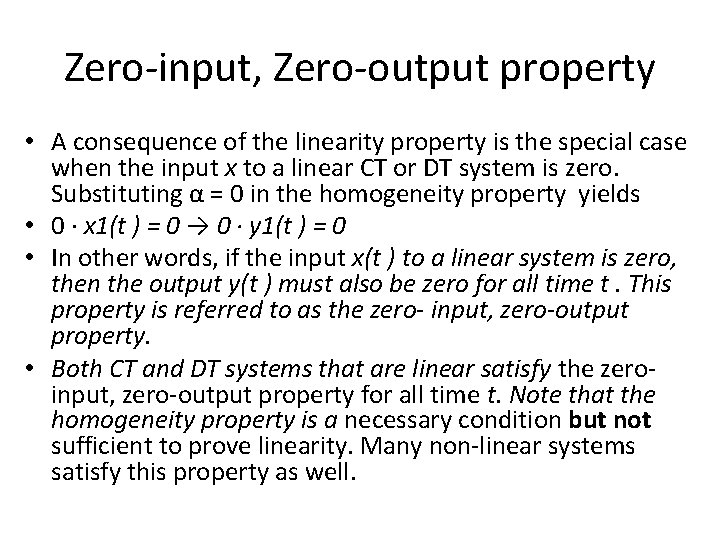
Zero-input, Zero-output property • A consequence of the linearity property is the special case when the input x to a linear CT or DT system is zero. Substituting α = 0 in the homogeneity property yields • 0 · x 1(t ) = 0 → 0 · y 1(t ) = 0 • In other words, if the input x(t ) to a linear system is zero, then the output y(t ) must also be zero for all time t. This property is referred to as the zero- input, zero-output property. • Both CT and DT systems that are linear satisfy the zeroinput, zero-output property for all time t. Note that the homogeneity property is a necessary condition but not sufficient to prove linearity. Many non-linear systems satisfy this property as well.
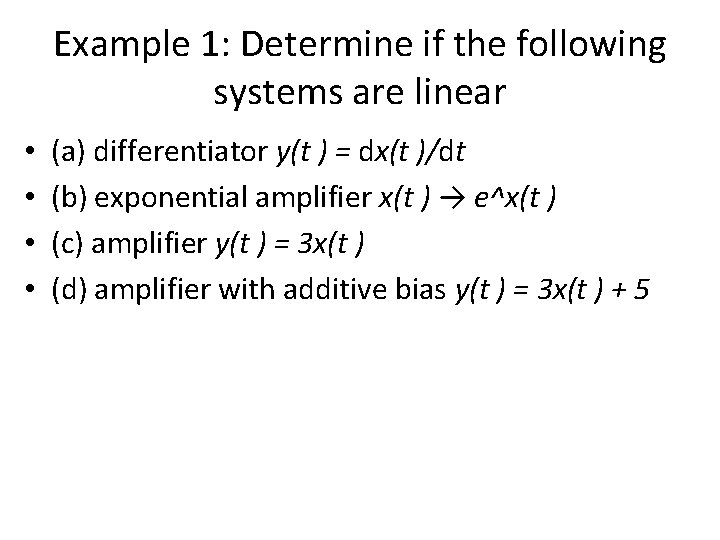
Example 1: Determine if the following systems are linear • • (a) differentiator y(t ) = dx(t )/dt (b) exponential amplifier x(t ) → e^x(t ) (c) amplifier y(t ) = 3 x(t ) (d) amplifier with additive bias y(t ) = 3 x(t ) + 5
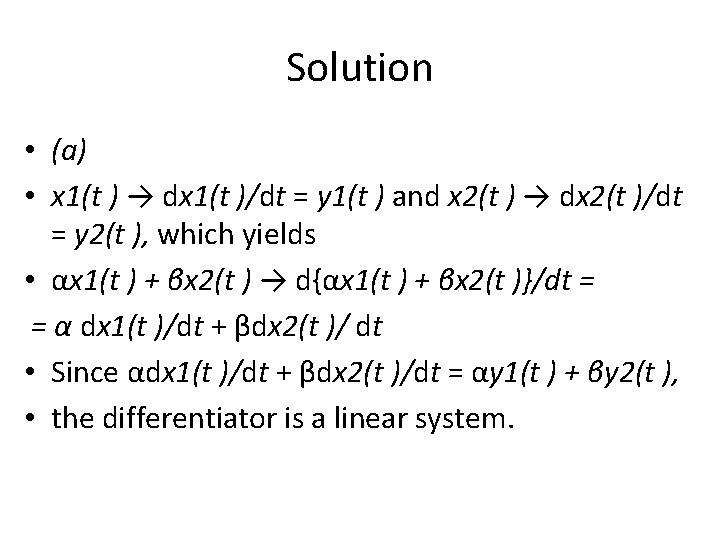
Solution • (a) • x 1(t ) → dx 1(t )/dt = y 1(t ) and x 2(t ) → dx 2(t )/dt = y 2(t ), which yields • αx 1(t ) + βx 2(t ) → d{αx 1(t ) + βx 2(t )}/dt = = α dx 1(t )/dt + βdx 2(t )/ dt • Since αdx 1(t )/dt + βdx 2(t )/dt = αy 1(t ) + βy 2(t ), • the differentiator is a linear system.
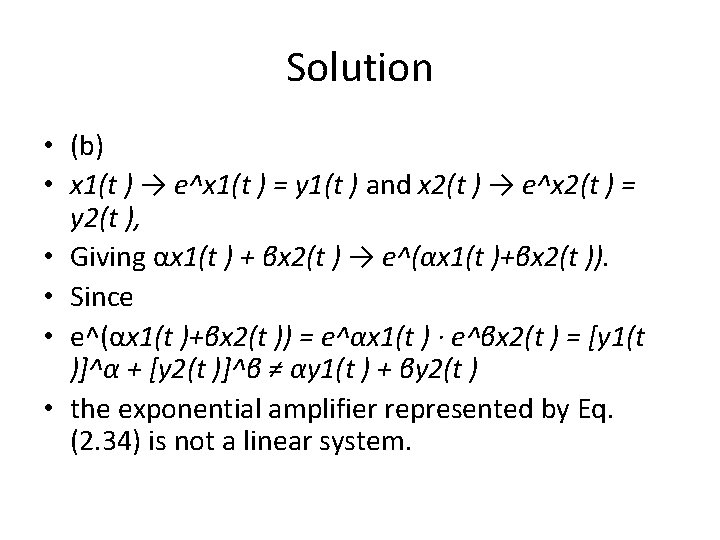
Solution • (b) • x 1(t ) → e^x 1(t ) = y 1(t ) and x 2(t ) → e^x 2(t ) = y 2(t ), • Giving αx 1(t ) + βx 2(t ) → e^(αx 1(t )+βx 2(t )). • Since • e^(αx 1(t )+βx 2(t )) = e^αx 1(t ) · e^βx 2(t ) = [y 1(t )]^α + [y 2(t )]^β ≠ αy 1(t ) + βy 2(t ) • the exponential amplifier represented by Eq. (2. 34) is not a linear system.
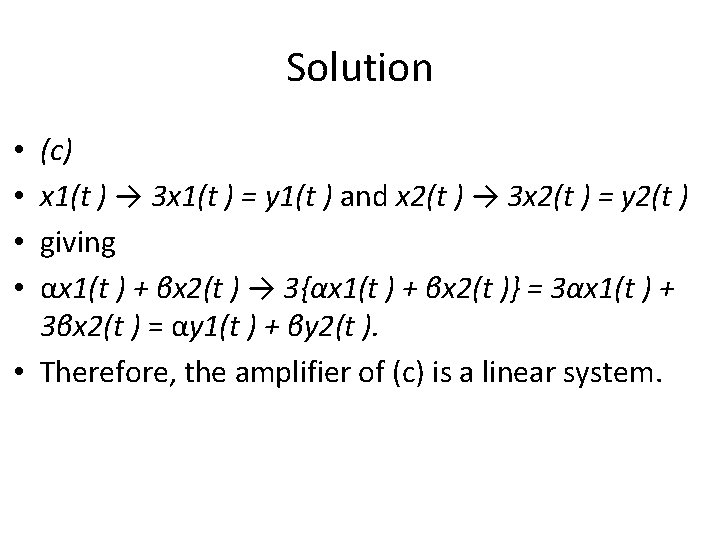
Solution (c) x 1(t ) → 3 x 1(t ) = y 1(t ) and x 2(t ) → 3 x 2(t ) = y 2(t ) giving αx 1(t ) + βx 2(t ) → 3{αx 1(t ) + βx 2(t )} = 3αx 1(t ) + 3βx 2(t ) = αy 1(t ) + βy 2(t ). • Therefore, the amplifier of (c) is a linear system. • •
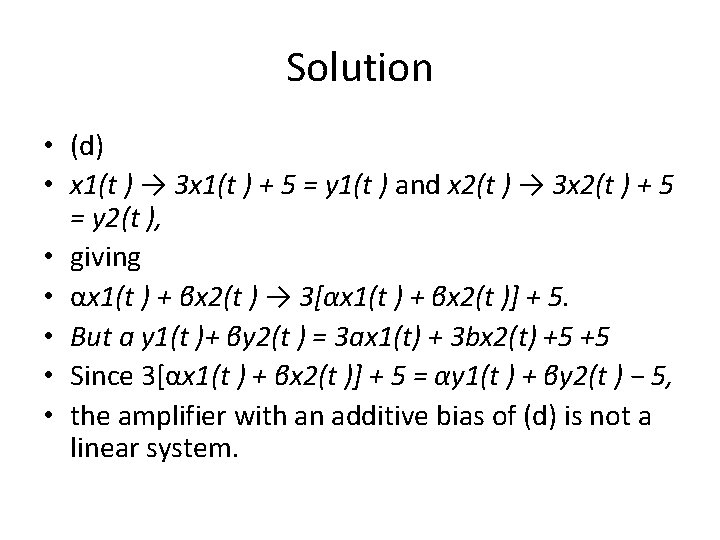
Solution • (d) • x 1(t ) → 3 x 1(t ) + 5 = y 1(t ) and x 2(t ) → 3 x 2(t ) + 5 = y 2(t ), • giving • αx 1(t ) + βx 2(t ) → 3[αx 1(t ) + βx 2(t )] + 5. • But a y 1(t )+ βy 2(t ) = 3 ax 1(t) + 3 bx 2(t) +5 +5 • Since 3[αx 1(t ) + βx 2(t )] + 5 = αy 1(t ) + βy 2(t ) − 5, • the amplifier with an additive bias of (d) is not a linear system.
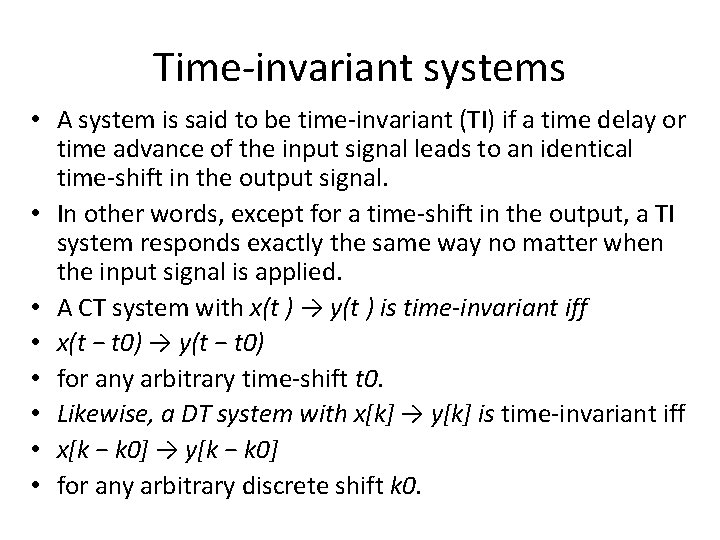
Time-invariant systems • A system is said to be time-invariant (TI) if a time delay or time advance of the input signal leads to an identical time-shift in the output signal. • In other words, except for a time-shift in the output, a TI system responds exactly the same way no matter when the input signal is applied. • A CT system with x(t ) → y(t ) is time-invariant iff • x(t − t 0) → y(t − t 0) • for any arbitrary time-shift t 0. • Likewise, a DT system with x[k] → y[k] is time-invariant iff • x[k − k 0] → y[k − k 0] • for any arbitrary discrete shift k 0.
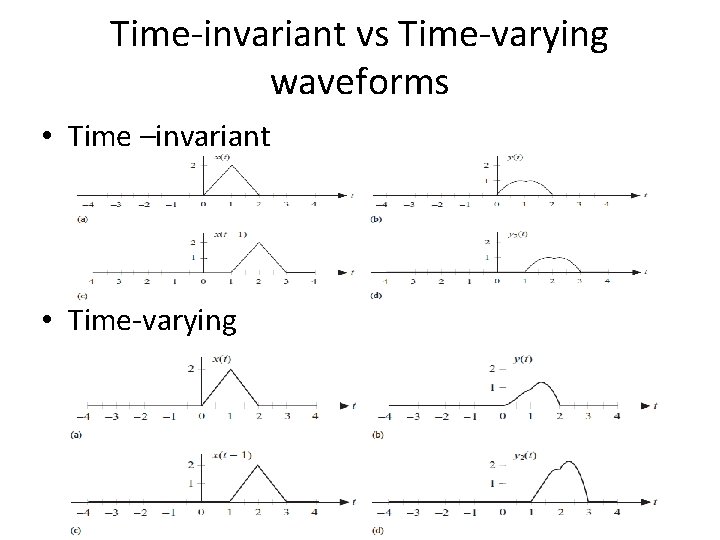
Time-invariant vs Time-varying waveforms • Time –invariant • Time-varying
![Example 2: Determine if the following systems are time-invariant • (i) system I: y[k]](http://slidetodoc.com/presentation_image_h/8f3a576548ac12e17ca7981222e18771/image-15.jpg "Example 2: Determine if the following systems are time-invariant • (i) system I: y[k]")
Example 2: Determine if the following systems are time-invariant • (i) system I: y[k] = 3(x[k] − x[k − 2]) • (ii) system II: y[k] = k x[k]
![Solution • • (i) x[k] → 3(x[k] − x[k − 2]) = y[k] =>](http://slidetodoc.com/presentation_image_h/8f3a576548ac12e17ca7981222e18771/image-16.jpg "Solution • • (i) x[k] → 3(x[k] − x[k − 2]) = y[k] =>")
Solution • • (i) x[k] → 3(x[k] − x[k − 2]) = y[k] => x[k − k 0] → 3(x[k − k 0] − x[k − k 0 − 2]) = y[k − k 0]. Therefore, system (i) is a time-invariant system. (ii) x[k] → kx[k] = y[k] => x[k − k 0] → kx[k − k 0] = y[k − k 0] ≠ (k − k 0)x[k − k 0] Therefore, system II is not time-invariant.
Systems with and without memory • A CT system is said to be without memory (memoryless or instantaneous) if its output y(t ) at time t = t 0 depends only on the values of the applied input x(t ) at the same time t = t 0. • On the other hand, if the response of a system at t = t 0 depends on the values of the input x(t ) in the past or in the future of time t = t 0, it is called a dynamic system, or a system with memory. • Likewise, a DT system is said to be memoryless if its output y[k] at instant k = k 0 depends only on the value of its input x[k] at the same instant k = k 0. Otherwise, the DT system is said to have memory.
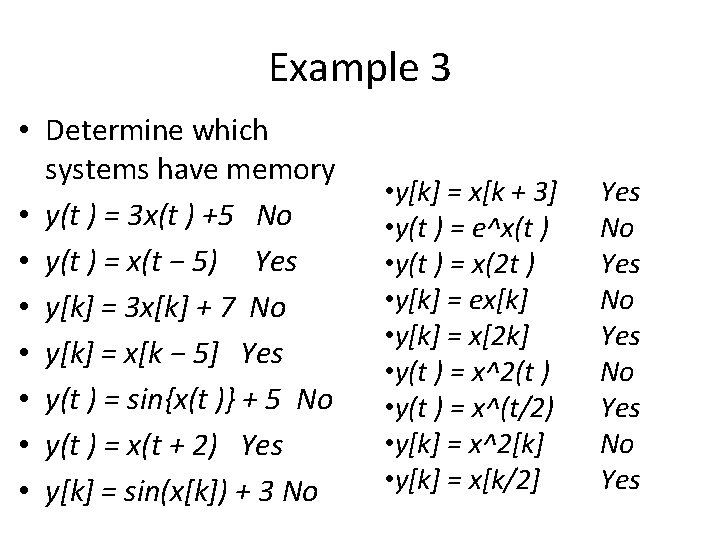
Example 3 • Determine which systems have memory • y(t ) = 3 x(t ) +5 No • y(t ) = x(t − 5) Yes • y[k] = 3 x[k] + 7 No • y[k] = x[k − 5] Yes • y(t ) = sin{x(t )} + 5 No • y(t ) = x(t + 2) Yes • y[k] = sin(x[k]) + 3 No • y[k] = x[k + 3] • y(t ) = e^x(t ) • y(t ) = x(2 t ) • y[k] = ex[k] • y[k] = x[2 k] • y(t ) = x^2(t ) • y(t ) = x^(t/2) • y[k] = x^2[k] • y[k] = x[k/2] Yes No Yes
Causal and non-causal systems • A CT system is causal if the output at time t 0 depends only on the input x(t ) for t ≤ t 0. • Likewise, a DT system is causal if the output at time instant k 0 depends only on the input x[k] for k ≤ k 0. • Asystem that violates the causality condition is called a non-causal (or anticipative) system. • Note that all memoryless systems are causal systems because the output at any time instant depends only on the input at that time instant. • Systems with memory can either be causal or noncausal.
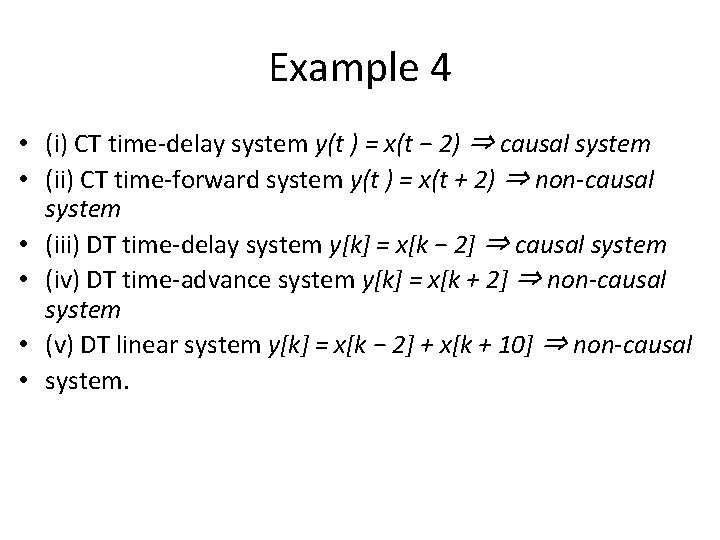
Example 4 • (i) CT time-delay system y(t ) = x(t − 2) ⇒ causal system • (ii) CT time-forward system y(t ) = x(t + 2) ⇒ non-causal system • (iii) DT time-delay system y[k] = x[k − 2] ⇒ causal system • (iv) DT time-advance system y[k] = x[k + 2] ⇒ non-causal system • (v) DT linear system y[k] = x[k − 2] + x[k + 10] ⇒ non-causal • system.
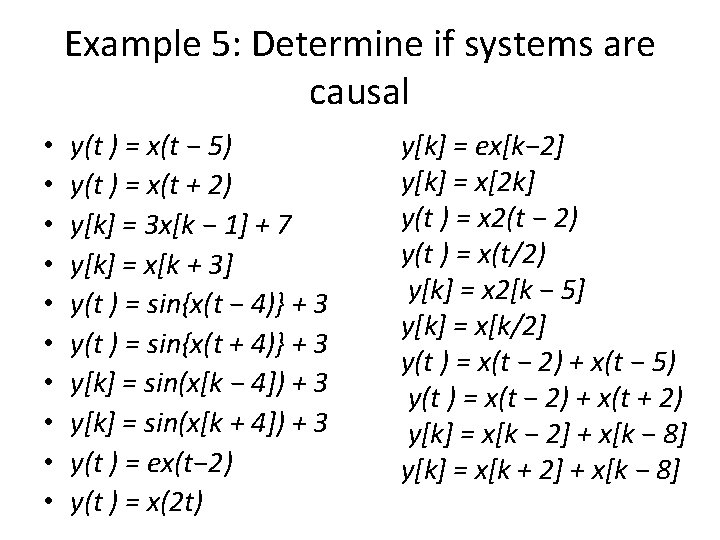
Example 5: Determine if systems are causal • • • y(t ) = x(t − 5) y(t ) = x(t + 2) y[k] = 3 x[k − 1] + 7 y[k] = x[k + 3] y(t ) = sin{x(t − 4)} + 3 y(t ) = sin{x(t + 4)} + 3 y[k] = sin(x[k − 4]) + 3 y[k] = sin(x[k + 4]) + 3 y(t ) = ex(t− 2) y(t ) = x(2 t) y[k] = ex[k− 2] y[k] = x[2 k] y(t ) = x 2(t − 2) y(t ) = x(t/2) y[k] = x 2[k − 5] y[k] = x[k/2] y(t ) = x(t − 2) + x(t − 5) y(t ) = x(t − 2) + x(t + 2) y[k] = x[k − 2] + x[k − 8] y[k] = x[k + 2] + x[k − 8]
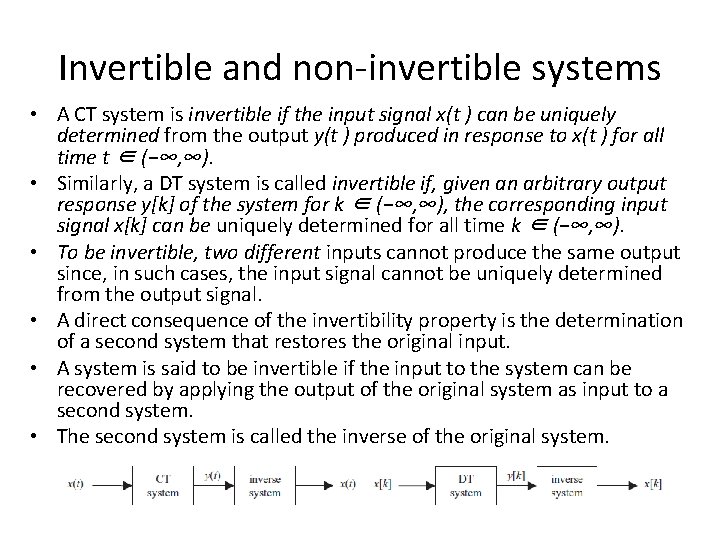
Invertible and non-invertible systems • A CT system is invertible if the input signal x(t ) can be uniquely determined from the output y(t ) produced in response to x(t ) for all time t ∈ (−∞, ∞). • Similarly, a DT system is called invertible if, given an arbitrary output response y[k] of the system for k ∈ (−∞, ∞), the corresponding input signal x[k] can be uniquely determined for all time k ∈ (−∞, ∞). • To be invertible, two different inputs cannot produce the same output since, in such cases, the input signal cannot be uniquely determined from the output signal. • A direct consequence of the invertibility property is the determination of a second system that restores the original input. • A system is said to be invertible if the input to the system can be recovered by applying the output of the original system as input to a second system. • The second system is called the inverse of the original system.
![Example 6: Determine if system is invertible • (i) Incrementally linear system: y[k] =](http://slidetodoc.com/presentation_image_h/8f3a576548ac12e17ca7981222e18771/image-23.jpg "Example 6: Determine if system is invertible • (i) Incrementally linear system: y[k] =")
Example 6: Determine if system is invertible • (i) Incrementally linear system: y[k] = 2 x[k] + 7. The input– output relationship is expressed as follows: x[k] = (y[k] − 7)/2. • The above expression shows that given an output signal, the input can be uniquely determined. Therefore, the system is invertible. • (ii) Exponential output: y[k] = e^x[k]. The input–output relationship is expressed as follows: x[k] = ln(y[k]) • The above expression shows that given an output signal, the input can be uniquely determined. Therefore, the system is invertible. • (iii) Increasing ramped output: y[k] = k x[k]. The input–output relationship is expressed as follows: x[k] = y[k]/k. • The input signal can be uniquely determined for all time instant k, except at k = 0. Therefore, the system is not invertible.
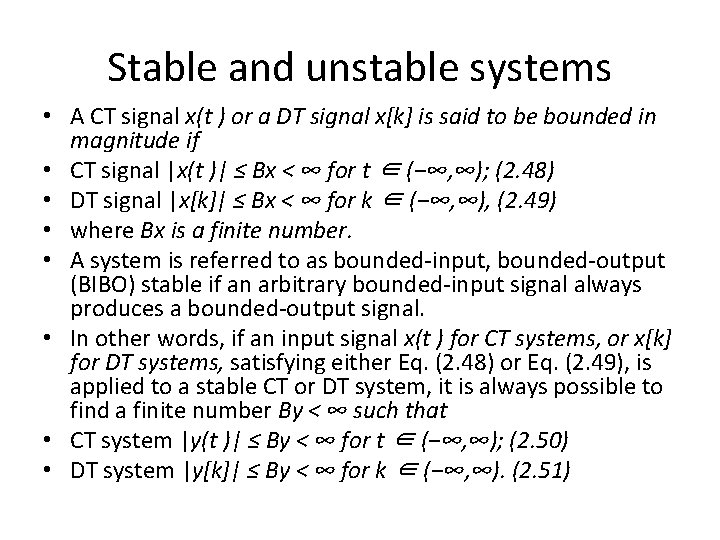
Stable and unstable systems • A CT signal x(t ) or a DT signal x[k] is said to be bounded in magnitude if • CT signal |x(t )| ≤ Bx < ∞ for t ∈ (−∞, ∞); (2. 48) • DT signal |x[k]| ≤ Bx < ∞ for k ∈ (−∞, ∞), (2. 49) • where Bx is a finite number. • A system is referred to as bounded-input, bounded-output (BIBO) stable if an arbitrary bounded-input signal always produces a bounded-output signal. • In other words, if an input signal x(t ) for CT systems, or x[k] for DT systems, satisfying either Eq. (2. 48) or Eq. (2. 49), is applied to a stable CT or DT system, it is always possible to find a finite number By < ∞ such that • CT system |y(t )| ≤ By < ∞ for t ∈ (−∞, ∞); (2. 50) • DT system |y[k]| ≤ By < ∞ for k ∈ (−∞, ∞). (2. 51)
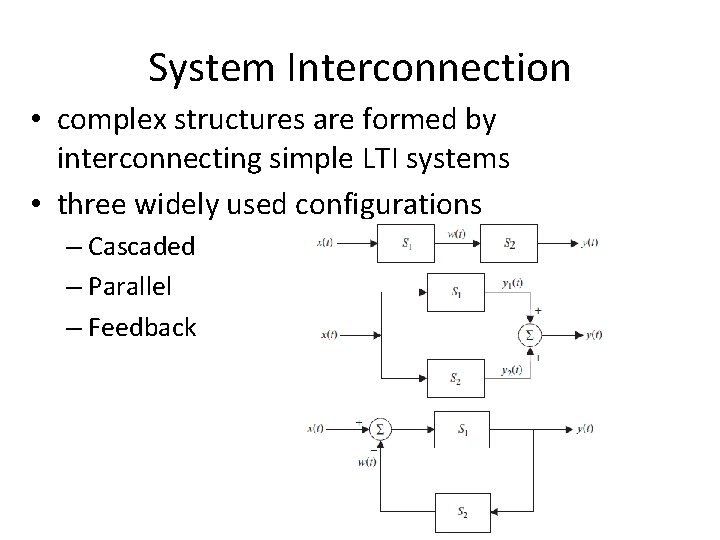
System Interconnection • complex structures are formed by interconnecting simple LTI systems • three widely used configurations – Cascaded – Parallel – Feedback
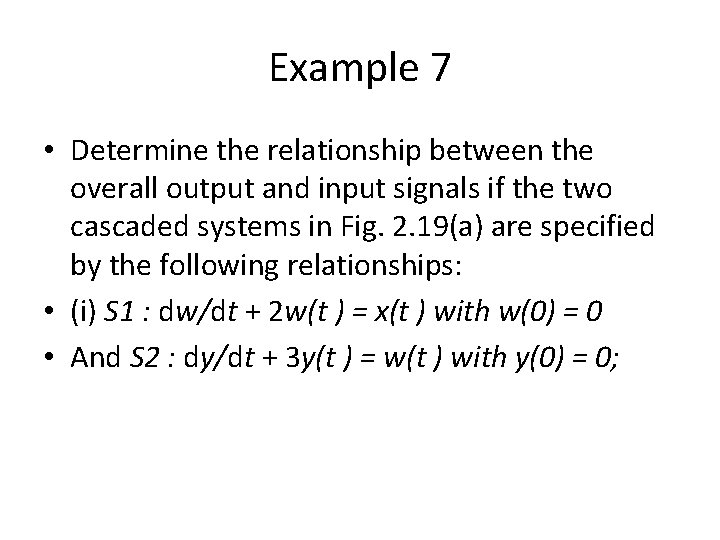
Example 7 • Determine the relationship between the overall output and input signals if the two cascaded systems in Fig. 2. 19(a) are specified by the following relationships: • (i) S 1 : dw/dt + 2 w(t ) = x(t ) with w(0) = 0 • And S 2 : dy/dt + 3 y(t ) = w(t ) with y(0) = 0;
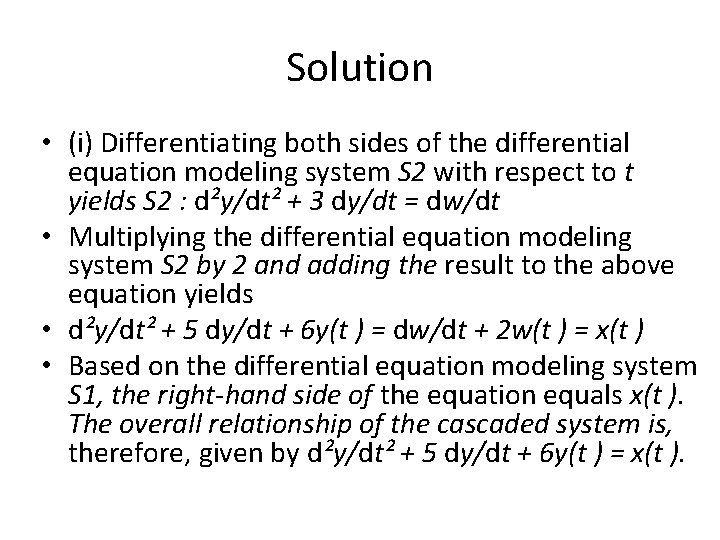
Solution • (i) Differentiating both sides of the differential equation modeling system S 2 with respect to t yields S 2 : d²y/dt² + 3 dy/dt = dw/dt • Multiplying the differential equation modeling system S 2 by 2 and adding the result to the above equation yields • d²y/dt² + 5 dy/dt + 6 y(t ) = dw/dt + 2 w(t ) = x(t ) • Based on the differential equation modeling system S 1, the right-hand side of the equation equals x(t ). The overall relationship of the cascaded system is, therefore, given by d²y/dt² + 5 dy/dt + 6 y(t ) = x(t ).
![Example 8 • S 1 : w[k] − w[k − 1] = x[k] with](http://slidetodoc.com/presentation_image_h/8f3a576548ac12e17ca7981222e18771/image-28.jpg "Example 8 • S 1 : w[k] − w[k − 1] = x[k] with")
Example 8 • S 1 : w[k] − w[k − 1] = x[k] with w[0] = 0 • and • S 2 : y[k] − 2 y[k − 1] = w[k] with y[0] = 0.
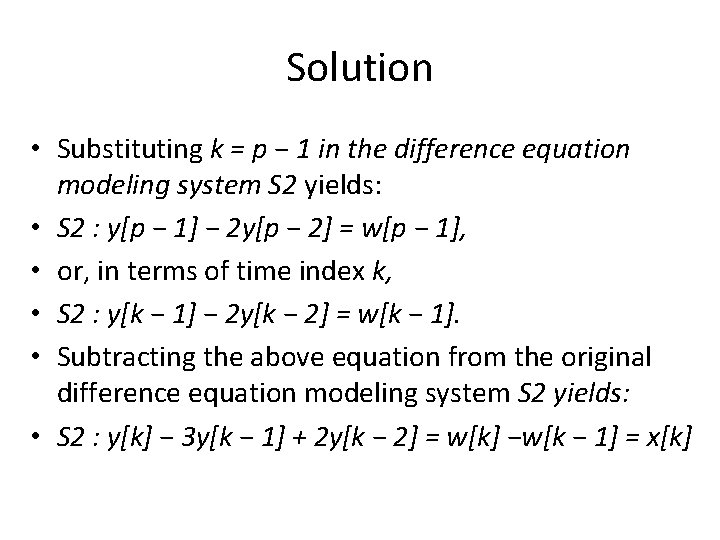
Solution • Substituting k = p − 1 in the difference equation modeling system S 2 yields: • S 2 : y[p − 1] − 2 y[p − 2] = w[p − 1], • or, in terms of time index k, • S 2 : y[k − 1] − 2 y[k − 2] = w[k − 1]. • Subtracting the above equation from the original difference equation modeling system S 2 yields: • S 2 : y[k] − 3 y[k − 1] + 2 y[k − 2] = w[k] −w[k − 1] = x[k]
Parallel Configuration • The parallel configuration is shown in Fig. 2. 19(b), where a single input is applied simultaneously to two systems S 1 and S 2. • The overall output response is obtained by adding the outputs of the individual systems. • In other words, if • S 1 : x(t ) → y 1(t ) and S 2 : x(t ) → y 2(t ), then Sparallel : x(t ) → y 1(t ) + y 2(t ). • As for the series configuration, the system formed by a parallel combination of two linear systems is also linear. Similarly, if the two systems S 1 and S 2 are time-invariant, then the overall parallel system is also time-invariant.
Example 9 • Determine the relationship between the overall output and input signals if the two parallel systems are specified by the following relationships: • (i) S 1 : y 1(t ) = x(t ) + dx/dt • and S 2 : y 2(t ) = x(t ) + 3 dx/dt + 5 d²x/dt² • (ii) S 1 : y 1[k]=x[k] − x[k − 1] and S 2 : y 2[k]=x[k] − 2 x[k − 1] − x[k − 2].
Solution • (i) The response of the overall system is obtained by adding the two differential equations modeling the individual systems. The resulting expression is given by y 1(t) + y 2(t) = 2 x(t) + 4 dx/dt + 5 d²x/dt² • Since y(t ) = y 1(t) + y 2(t), the response of the overall system is given by • y(t ) = 2 x(t) + 4 dx/dt + 5 d²x/dt² • (ii) The response of the overall system is obtained by adding the two difference equations modeling the individual systems. The resulting expression is given by • y 1[k] + y 2[k] = 2 x[k] − 3 x[k − 1] − x[k − 2]. • Since y[k] = y 1[k] + y 2[k], the response of the overall system is given by • y[k] = 2 x[k] − 3 x[k − 1] − x[k − 2].
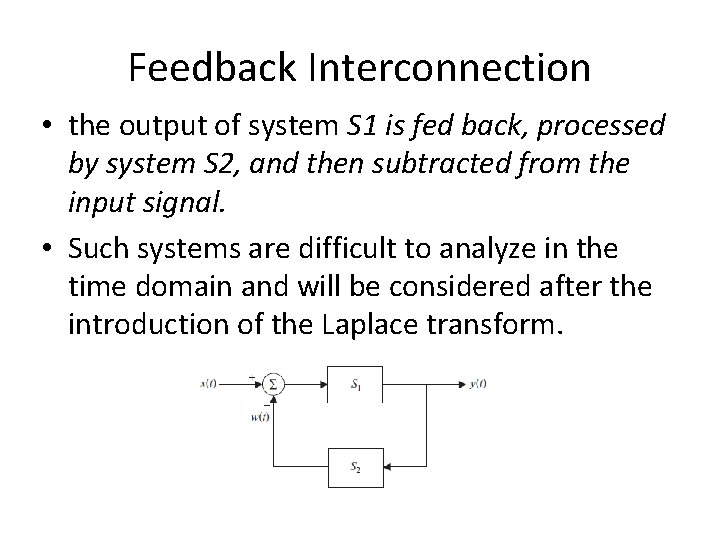
Feedback Interconnection • the output of system S 1 is fed back, processed by system S 2, and then subtracted from the input signal. • Such systems are difficult to analyze in the time domain and will be considered after the introduction of the Laplace transform.
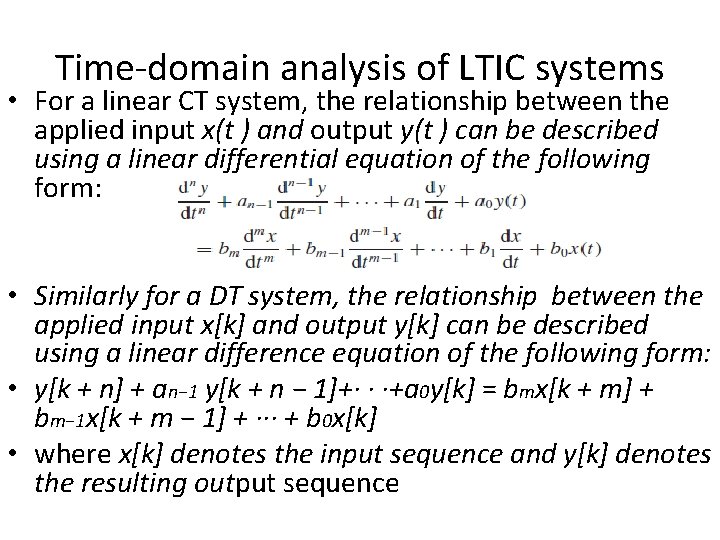
Time-domain analysis of LTIC systems • For a linear CT system, the relationship between the applied input x(t ) and output y(t ) can be described using a linear differential equation of the following form: • Similarly for a DT system, the relationship between the applied input x[k] and output y[k] can be described using a linear difference equation of the following form: • y[k + n] + an− 1 y[k + n − 1]+· · ·+a 0 y[k] = bmx[k + m] + bm− 1 x[k + m − 1] + ··· + b 0 x[k] • where x[k] denotes the input sequence and y[k] denotes the resulting output sequence
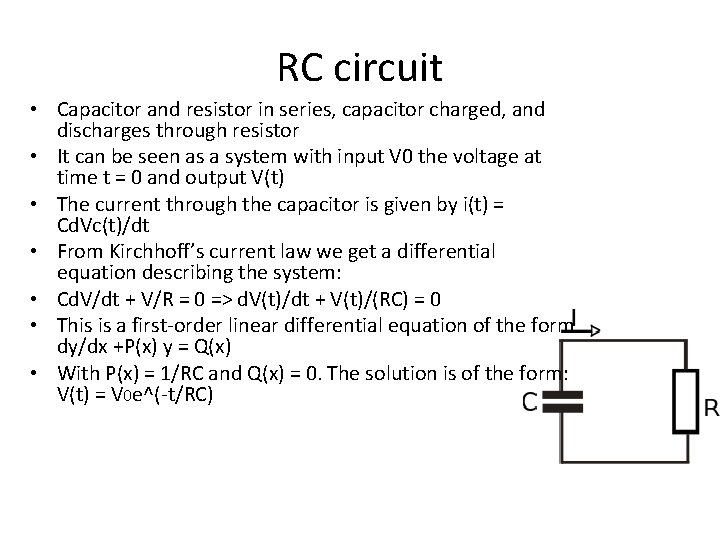
RC circuit • Capacitor and resistor in series, capacitor charged, and discharges through resistor • It can be seen as a system with input V 0 the voltage at time t = 0 and output V(t) • The current through the capacitor is given by i(t) = Cd. Vc(t)/dt • From Kirchhoff’s current law we get a differential equation describing the system: • Cd. V/dt + V/R = 0 => d. V(t)/dt + V(t)/(RC) = 0 • This is a first-order linear differential equation of the form dy/dx +P(x) y = Q(x) • With P(x) = 1/RC and Q(x) = 0. The solution is of the form: V(t) = V 0 e^(-t/RC)
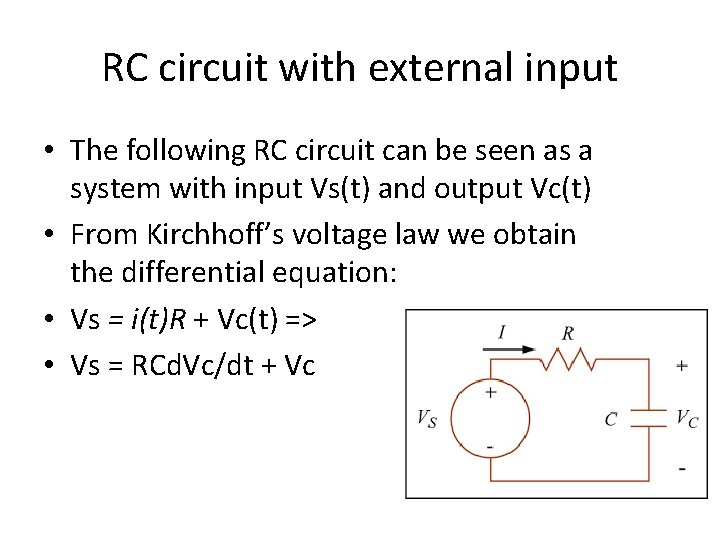
RC circuit with external input • The following RC circuit can be seen as a system with input Vs(t) and output Vc(t) • From Kirchhoff’s voltage law we obtain the differential equation: • Vs = i(t)R + Vc(t) => • Vs = RCd. Vc/dt + Vc
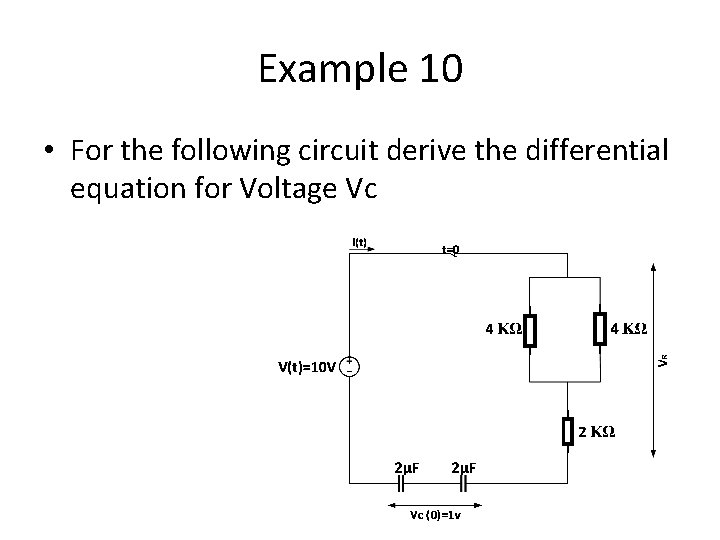
Example 10 • For the following circuit derive the differential equation for Voltage Vc
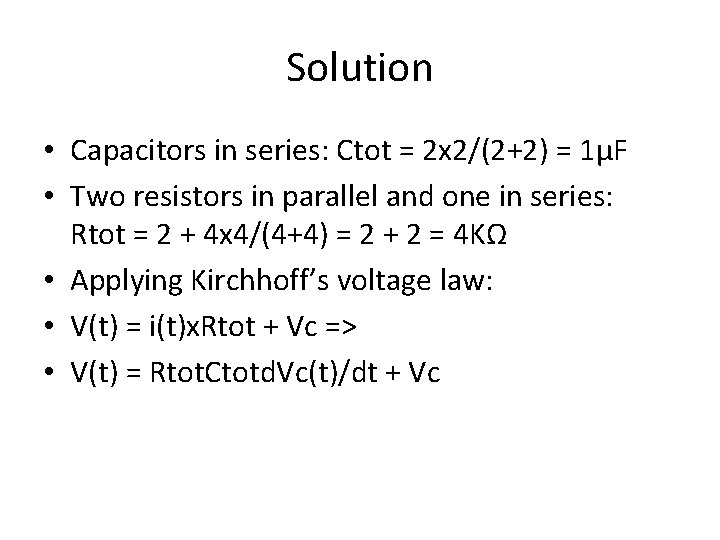
Solution • Capacitors in series: Ctot = 2 x 2/(2+2) = 1μF • Two resistors in parallel and one in series: Rtot = 2 + 4 x 4/(4+4) = 2 + 2 = 4 KΩ • Applying Kirchhoff’s voltage law: • V(t) = i(t)x. Rtot + Vc => • V(t) = Rtot. Ctotd. Vc(t)/dt + Vc
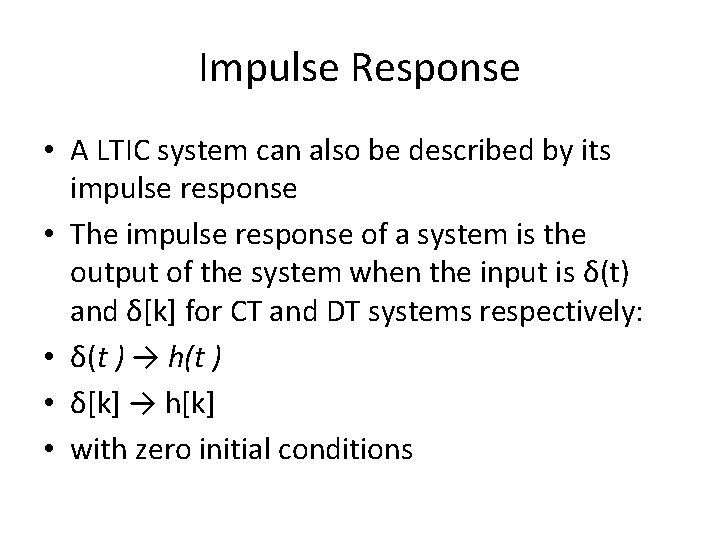
Impulse Response • A LTIC system can also be described by its impulse response • The impulse response of a system is the output of the system when the input is δ(t) and δ[k] for CT and DT systems respectively: • δ(t ) → h(t ) • δ[k] → h[k] • with zero initial conditions
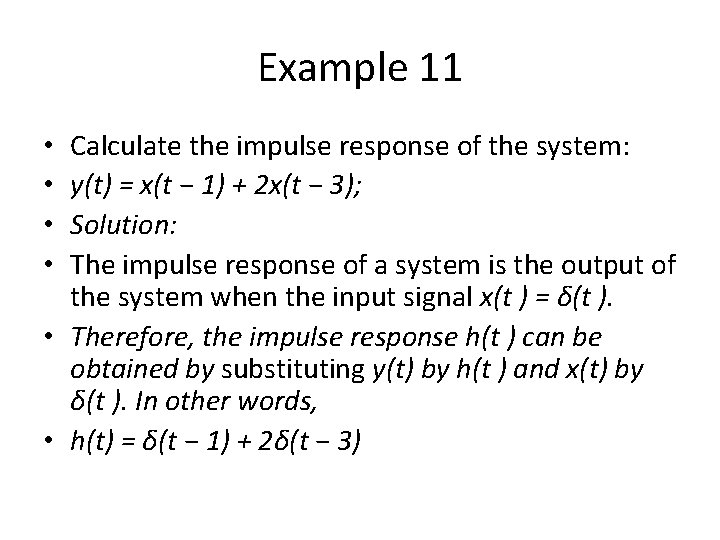
Example 11 Calculate the impulse response of the system: y(t) = x(t − 1) + 2 x(t − 3); Solution: The impulse response of a system is the output of the system when the input signal x(t ) = δ(t ). • Therefore, the impulse response h(t ) can be obtained by substituting y(t) by h(t ) and x(t) by δ(t ). In other words, • h(t) = δ(t − 1) + 2δ(t − 3) • •
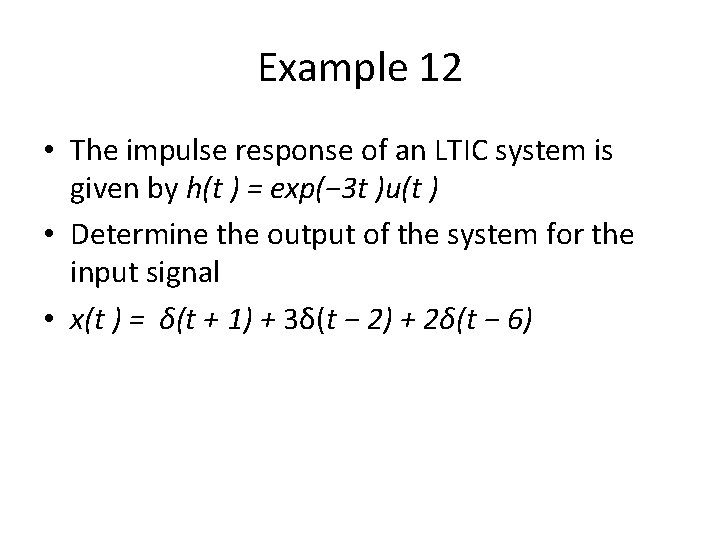
Example 12 • The impulse response of an LTIC system is given by h(t ) = exp(− 3 t )u(t ) • Determine the output of the system for the input signal • x(t ) = δ(t + 1) + 3δ(t − 2) + 2δ(t − 6)
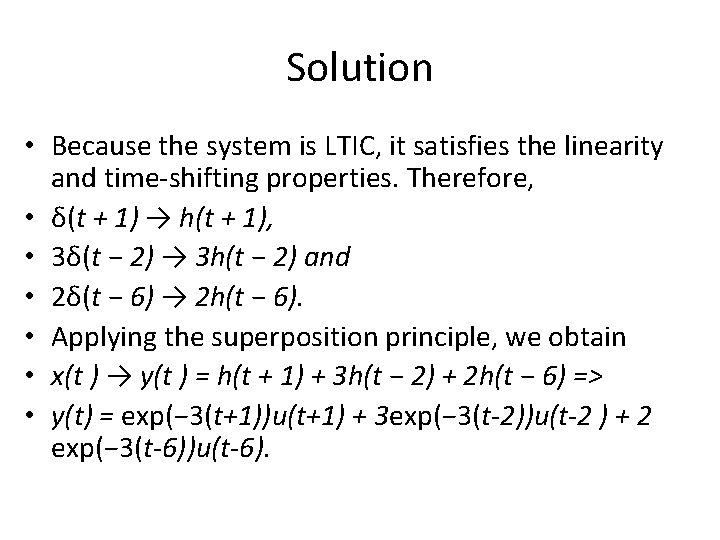
Solution • Because the system is LTIC, it satisfies the linearity and time-shifting properties. Therefore, • δ(t + 1) → h(t + 1), • 3δ(t − 2) → 3 h(t − 2) and • 2δ(t − 6) → 2 h(t − 6). • Applying the superposition principle, we obtain • x(t ) → y(t ) = h(t + 1) + 3 h(t − 2) + 2 h(t − 6) => • y(t) = exp(− 3(t+1))u(t+1) + 3 exp(− 3(t-2))u(t-2 ) + 2 exp(− 3(t-6))u(t-6).
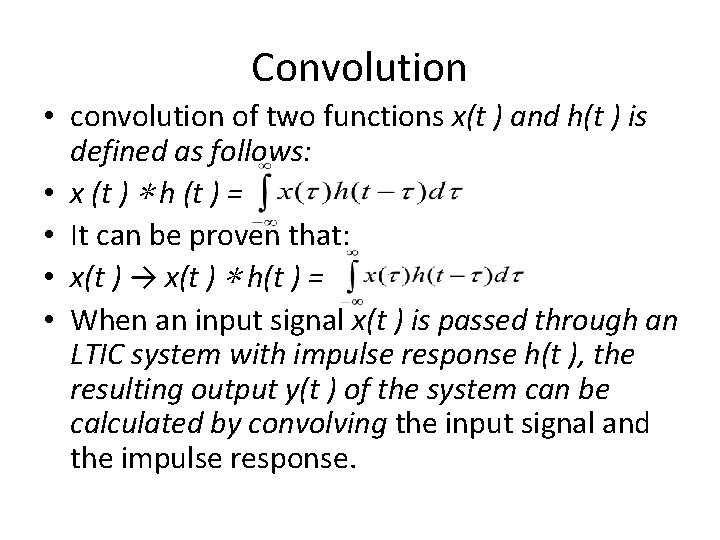
Convolution • convolution of two functions x(t ) and h(t ) is defined as follows: • x (t ) ∗ h (t ) = • It can be proven that: • x(t ) → x(t ) ∗ h(t ) = • When an input signal x(t ) is passed through an LTIC system with impulse response h(t ), the resulting output y(t ) of the system can be calculated by convolving the input signal and the impulse response.
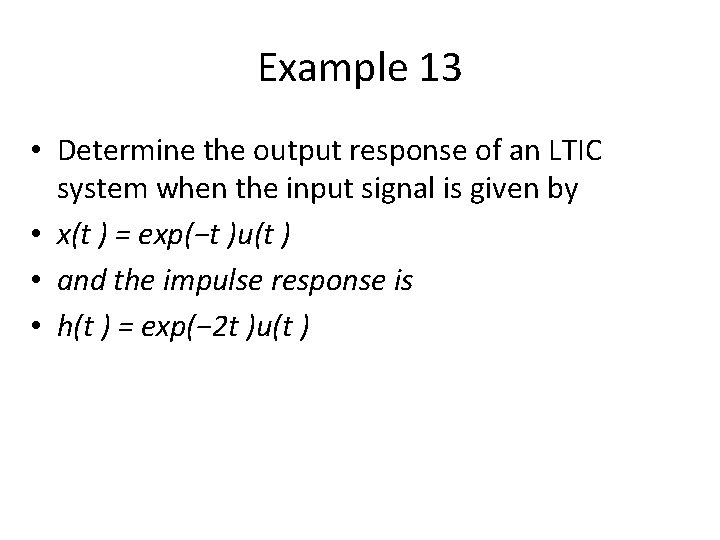
Example 13 • Determine the output response of an LTIC system when the input signal is given by • x(t ) = exp(−t )u(t ) • and the impulse response is • h(t ) = exp(− 2 t )u(t )
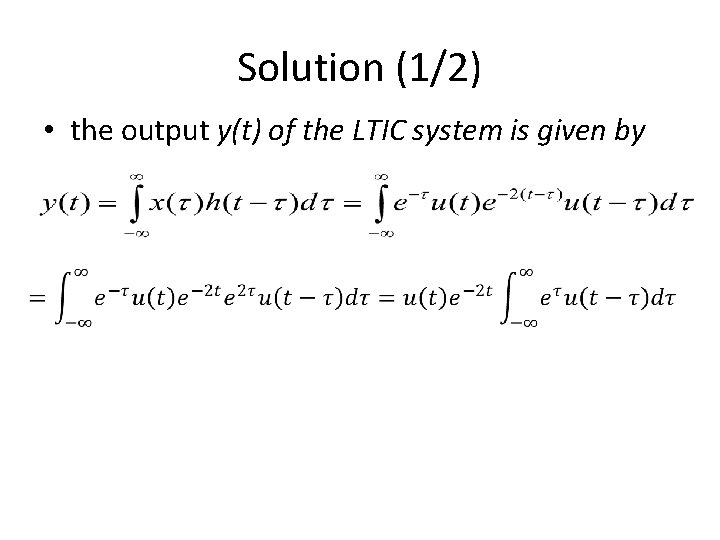
Solution (1/2) • the output y(t) of the LTIC system is given by
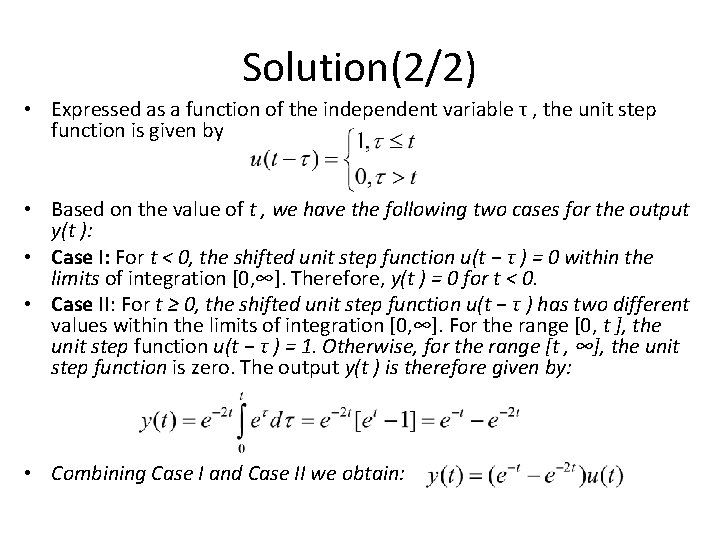
Solution(2/2) • Expressed as a function of the independent variable τ , the unit step function is given by • Based on the value of t , we have the following two cases for the output y(t ): • Case I: For t < 0, the shifted unit step function u(t − τ ) = 0 within the limits of integration [0, ∞]. Therefore, y(t ) = 0 for t < 0. • Case II: For t ≥ 0, the shifted unit step function u(t − τ ) has two different values within the limits of integration [0, ∞]. For the range [0, t ], the unit step function u(t − τ ) = 1. Otherwise, for the range [t , ∞], the unit step function is zero. The output y(t ) is therefore given by: • Combining Case I and Case II we obtain:
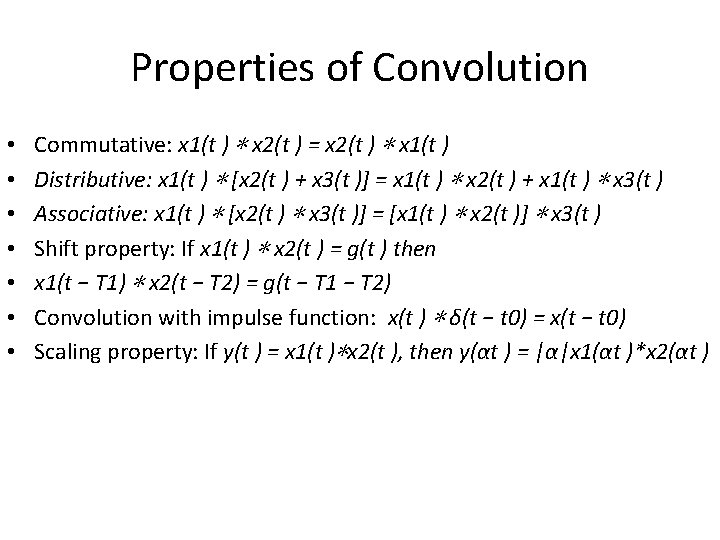
Properties of Convolution • • Commutative: x 1(t ) ∗ x 2(t ) = x 2(t ) ∗ x 1(t ) Distributive: x 1(t ) ∗ [x 2(t ) + x 3(t )] = x 1(t ) ∗ x 2(t ) + x 1(t ) ∗ x 3(t ) Associative: x 1(t ) ∗ [x 2(t ) ∗ x 3(t )] = [x 1(t ) ∗ x 2(t )] ∗ x 3(t ) Shift property: If x 1(t ) ∗ x 2(t ) = g(t ) then x 1(t − T 1) ∗ x 2(t − T 2) = g(t − T 1 − T 2) Convolution with impulse function: x(t ) ∗ δ(t − t 0) = x(t − t 0) Scaling property: If y(t ) = x 1(t )∗x 2(t ), then y(αt ) = |α|x 1(αt )*x 2(αt )
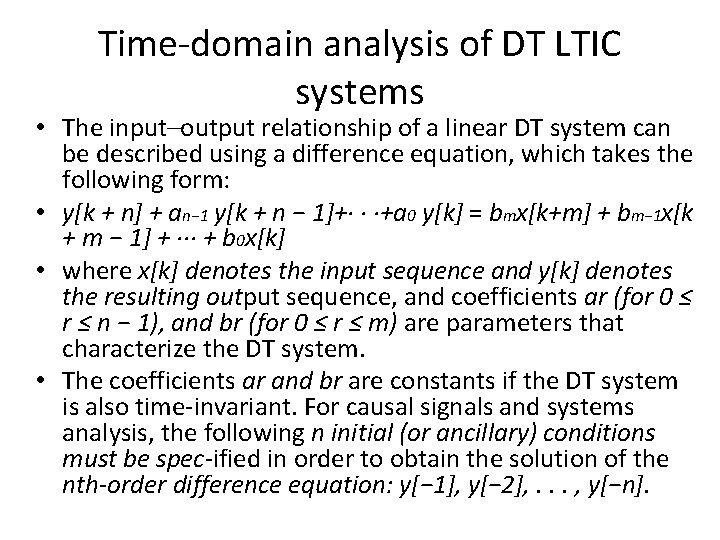
Time-domain analysis of DT LTIC systems • The input–output relationship of a linear DT system can be described using a difference equation, which takes the following form: • y[k + n] + an− 1 y[k + n − 1]+· · ·+a 0 y[k] = bmx[k+m] + bm− 1 x[k + m − 1] + ··· + b 0 x[k] • where x[k] denotes the input sequence and y[k] denotes the resulting output sequence, and coefficients ar (for 0 ≤ r ≤ n − 1), and br (for 0 ≤ r ≤ m) are parameters that characterize the DT system. • The coefficients ar and br are constants if the DT system is also time-invariant. For causal signals and systems analysis, the following n initial (or ancillary) conditions must be spec-ified in order to obtain the solution of the nth-order difference equation: y[− 1], y[− 2], . . . , y[−n].
![Example 14 • The DT sequence x[k] = 2 ku[k] is applied at the](http://slidetodoc.com/presentation_image_h/8f3a576548ac12e17ca7981222e18771/image-49.jpg "Example 14 • The DT sequence x[k] = 2 ku[k] is applied at the")
Example 14 • The DT sequence x[k] = 2 ku[k] is applied at the input of a DT system described by the following difference equation: • y[k + 1] − 0. 4 y[k] = x[k] • By iterating the difference equation from the ancillary condition y[− 1] = 4, compute the output response y[k] of the DT system for 0 ≤ k ≤ 5.
![Solution • Express y[k + 1] − 0. 4 y[k] = x[k] as follows:](http://slidetodoc.com/presentation_image_h/8f3a576548ac12e17ca7981222e18771/image-50.jpg "Solution • Express y[k + 1] − 0. 4 y[k] = x[k] as follows:")
Solution • Express y[k + 1] − 0. 4 y[k] = x[k] as follows: • y[k] = 0. 4 y[k − 1] + x[k − 1] = 0. 4 y[k − 1] + 2(k − 1) u(k − 1) • By iterating from k = 0, the output response is computed as follows: • y[0] = 0. 4 y[− 1] = 1. 6, • y[1] = 0. 4 y[0] + 2 × 0 = 0. 64, • y[2] = 0. 4 y[1] + 2 × 1 = 2. 256, • y[3] = 0. 4 y[2] + 2 × 2 = 4. 902, • y[4] = 0. 4 y[3] + 2 × 3 = 7. 961, • y[5] = 0. 4 y[4] + 2 × 4 = 11. 184
![Zero-input and zero-state response • The output response y[k] can be expressed as •](http://slidetodoc.com/presentation_image_h/8f3a576548ac12e17ca7981222e18771/image-51.jpg "Zero-input and zero-state response • The output response y[k] can be expressed as •")
Zero-input and zero-state response • The output response y[k] can be expressed as • y[k] = yzi[k] + yzs[k], • where yzi[k] denotes the zero-input response (or the natural response) of the • system and yzs[k] denotes the zero-state response (or the forced response) of the DT system. • The zero-input component yzi[k] for a DT system is the response produced by the system because of the initial conditions, and is not due to any external input. • To calculate the zero-input component yzi[k], we assume that the applied input sequence x[k] = 0. On the other hand, the zero -state response yzs[k] arises due to the input sequence and does not depend on the initial conditions of the system. • To calculate the zero-state response yzs[k], the initial conditions are assumed to be zero.
Example 15 • Solve example 14 by calculating the zero-input and zero-state outputs
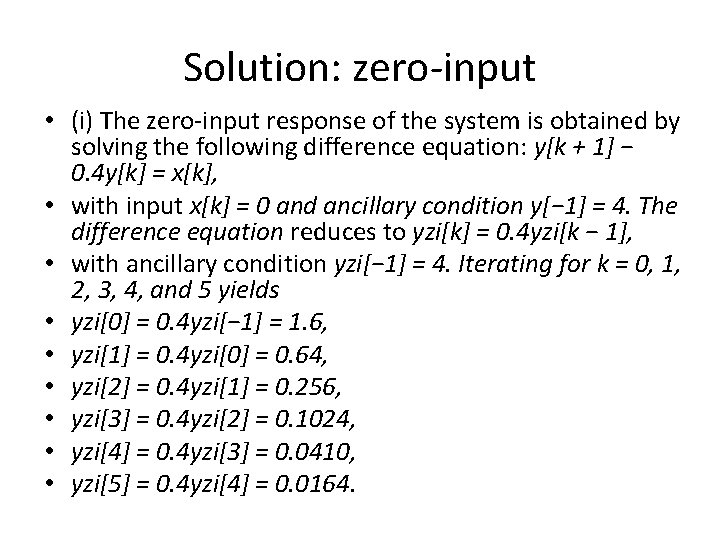
Solution: zero-input • (i) The zero-input response of the system is obtained by solving the following difference equation: y[k + 1] − 0. 4 y[k] = x[k], • with input x[k] = 0 and ancillary condition y[− 1] = 4. The difference equation reduces to yzi[k] = 0. 4 yzi[k − 1], • with ancillary condition yzi[− 1] = 4. Iterating for k = 0, 1, 2, 3, 4, and 5 yields • yzi[0] = 0. 4 yzi[− 1] = 1. 6, • yzi[1] = 0. 4 yzi[0] = 0. 64, • yzi[2] = 0. 4 yzi[1] = 0. 256, • yzi[3] = 0. 4 yzi[2] = 0. 1024, • yzi[4] = 0. 4 yzi[3] = 0. 0410, • yzi[5] = 0. 4 yzi[4] = 0. 0164.
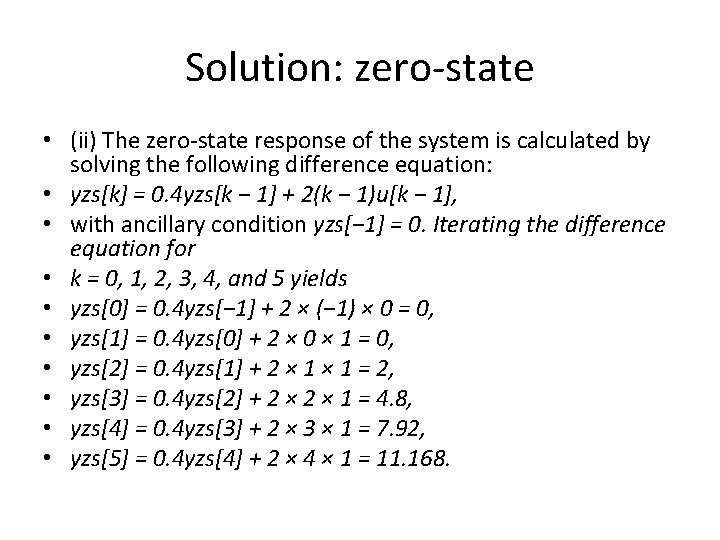
Solution: zero-state • (ii) The zero-state response of the system is calculated by solving the following difference equation: • yzs[k] = 0. 4 yzs[k − 1] + 2(k − 1)u[k − 1], • with ancillary condition yzs[− 1] = 0. Iterating the difference equation for • k = 0, 1, 2, 3, 4, and 5 yields • yzs[0] = 0. 4 yzs[− 1] + 2 × (− 1) × 0 = 0, • yzs[1] = 0. 4 yzs[0] + 2 × 0 × 1 = 0, • yzs[2] = 0. 4 yzs[1] + 2 × 1 = 2, • yzs[3] = 0. 4 yzs[2] + 2 × 1 = 4. 8, • yzs[4] = 0. 4 yzs[3] + 2 × 3 × 1 = 7. 92, • yzs[5] = 0. 4 yzs[4] + 2 × 4 × 1 = 11. 168.
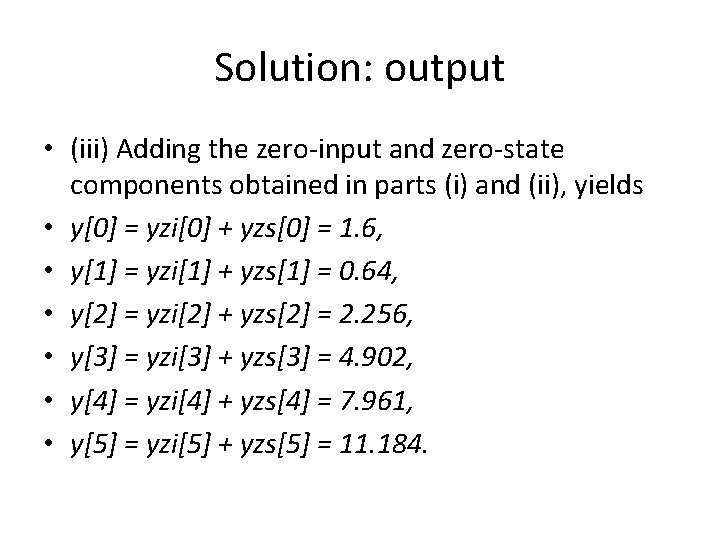
Solution: output • (iii) Adding the zero-input and zero-state components obtained in parts (i) and (ii), yields • y[0] = yzi[0] + yzs[0] = 1. 6, • y[1] = yzi[1] + yzs[1] = 0. 64, • y[2] = yzi[2] + yzs[2] = 2. 256, • y[3] = yzi[3] + yzs[3] = 4. 902, • y[4] = yzi[4] + yzs[4] = 7. 961, • y[5] = yzi[5] + yzs[5] = 11. 184.
![Impulse response of a DT LTIC system • The impulse response h[k] of an](http://slidetodoc.com/presentation_image_h/8f3a576548ac12e17ca7981222e18771/image-56.jpg "Impulse response of a DT LTIC system • The impulse response h[k] of an")
Impulse response of a DT LTIC system • The impulse response h[k] of an LTID system is the output of the system when a unit impulse δ[k] is applied at the input of the LTID system. • The impulse response can be expressed as follows: • δ[k] → h[k] • with zero ancillary conditions.
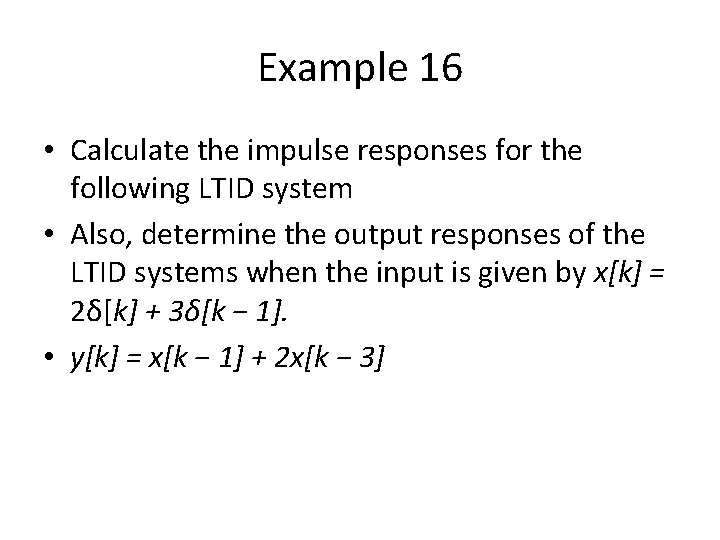
Example 16 • Calculate the impulse responses for the following LTID system • Also, determine the output responses of the LTID systems when the input is given by x[k] = 2δ[k] + 3δ[k − 1]. • y[k] = x[k − 1] + 2 x[k − 3]
Solution (1/2) • The impulse response of a system is the output of the system when the input sequence x[k] = δ[k]. Therefore, the impulse response h[k] of system (i) can be obtained by substituting y[k] by h[k] and x[k] by δ[k]. In other words, the impulse response for system (i) is given by • h[k] = δ[k − 1] + 2δ[k − 3]. • To evaluate the output response resulting from the input sequence x[k] = 2δ[k] + 3δ[k − 1], we use the linearity and time-invariance properties of the system. The outputs resulting from the two terms 2δ[k] and 3δ[k − 1] in the input sequence are as follows: • 2δ[k] → 2 h[k] = 2δ[k − 1] + 4δ[k − 3] and • 3δ[k − 1] → 3 h[k − 1] = 3δ[k − 2] + 6δ[k − 4].
![Solution (2/2) • Applying the superposition principle, the output y[k] to input x[k] =](http://slidetodoc.com/presentation_image_h/8f3a576548ac12e17ca7981222e18771/image-59.jpg "Solution (2/2) • Applying the superposition principle, the output y[k] to input x[k] =")
Solution (2/2) • Applying the superposition principle, the output y[k] to input x[k] = 2δ[k] +3δ[k − 1] is given by • 2δ[k] + 3δ[k − 1] → 2 h[k] + 3 h[k − 1] or • y[k] = (2δ[k − 1] + 4δ[k − 3]) + (3δ[k − 2] + 6δ[k − 4]) = 2δ[k − 1] + 3δ[k − 2] + 4δ[k − 3] + 6δ[k − 4]).
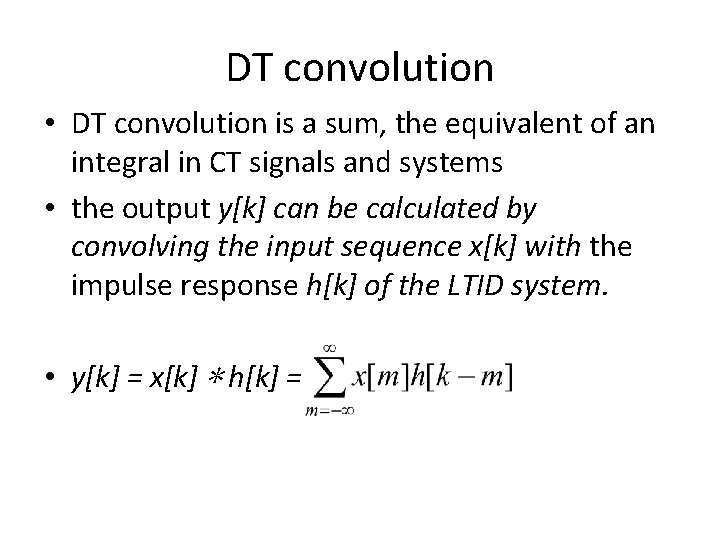
DT convolution • DT convolution is a sum, the equivalent of an integral in CT signals and systems • the output y[k] can be calculated by convolving the input sequence x[k] with the impulse response h[k] of the LTID system. • y[k] = x[k] ∗ h[k] =
![Properties of convolution • Commutative: x 1[k] ∗ x 2[k] = x 2[k] ∗](http://slidetodoc.com/presentation_image_h/8f3a576548ac12e17ca7981222e18771/image-61.jpg "Properties of convolution • Commutative: x 1[k] ∗ x 2[k] = x 2[k] ∗")
Properties of convolution • Commutative: x 1[k] ∗ x 2[k] = x 2[k] ∗ x 1[k] • Distributive: x 1[k] ∗ {x 2[k] + x 3[k]} = x 1[k] ∗ x 2[k] + x 1[k] ∗ x 3[k] • Associative: x 1[k] ∗ {x 2[k] ∗ x 3[k]} = {x 1[k] ∗ x 2[k]} ∗ x 3[k] • Shift: If x 1[k] ∗ x 2[k] = g[k], then • x 1[k − k 1] ∗ x 2[k − k 2] = g[k − k 1 − k 2] • Length of convolution: Let the non-zero lengths of the convolution operands x 1[k] and x 2[k] be denoted by K 1 and K 2 time units, respectively. It can be shown that the non-zero length of the linear convolution (x 1[k] ∗ x 2[k]) is K 1 + K 2 − 1 time units
![MATLAB examples • Consider the following two DT sequences x[k] and h[k]: • Compute](http://slidetodoc.com/presentation_image_h/8f3a576548ac12e17ca7981222e18771/image-62.jpg "MATLAB examples • Consider the following two DT sequences x[k] and h[k]: • Compute")
MATLAB examples • Consider the following two DT sequences x[k] and h[k]: • Compute the convolution y[k] = x[k] ∗ h[k] using MATLAB.
![Solution >> kx = [-1 0 1]; % time indices where x is nonzero](http://slidetodoc.com/presentation_image_h/8f3a576548ac12e17ca7981222e18771/image-63.jpg "Solution >> kx = [-1 0 1]; % time indices where x is nonzero")
Solution >> kx = [-1 0 1]; % time indices where x is nonzero >> x = [-1 1 2]; % Sample values for DT sequence x >> kh = [-1 0 1 2 3]; % time indices where y is nonzero >> h = [3 1 -2 3 -2]; % Sample values for DT sequence y >> y = conv(x, h); % Convolve x with h >> ky = kx(1)+kh(1): kx(length(kx))+kh(length(kh)); % ky= time indices for y
MATLAB examples • plot the output of the system described by the equation y 1[k]=y 1[k-1]+x[k] for input x[k] = 2 u[k], for k = 0 to 10, with initial condition y[-1] = 0.
![k = [-1: 10]; for i=1: length(k) x(i)=2; end y 1(1)=0; %initial condition for](http://slidetodoc.com/presentation_image_h/8f3a576548ac12e17ca7981222e18771/image-65.jpg "k = [-1: 10]; for i=1: length(k) x(i)=2; end y 1(1)=0; %initial condition for")
k = [-1: 10]; for i=1: length(k) x(i)=2; end y 1(1)=0; %initial condition for i=2: length(k) y 1(i)=y 1(i-1)+x(i); end plot(k, y 1, '*'), grid
- Slides: 65