
INTRODUCTION TO SYSTEMS ANALYSIS AND DESIGN AN AGILE
- Slides: 34
INTRODUCTION TO SYSTEMS ANALYSIS AND DESIGN: AN AGILE, ITERATIVE APPROACH SATZINGER | JACKSON | BURD CHAPTER Chapter 22 Systems Analysis and Design in a Changing World, 6 th Edition 1
Investigating System Requirements Chapter 2 Introduction to Systems Analysis and Design: An Agile, Iteractive Approach 6 th Ed Satzinger, Jackson & Burd © 2012 Cengage Learning. All Rights Reserved. This edition is intended for use outside of the U. S. only, with content that may be different from the U. S. Edition. May not be scanned, copied, duplicated, or posted to a publicly accessible website, in whole or in part.
Chapter 2 Outline l l l Systems Analysis Activities What Are Requirements? Models and Modeling Stakeholders Information-Gathering Techniques Documenting Workflows with Activity Diagrams Introduction to Systems Analysis and Design, 6 th Edition © 2012 Cengage Learning. All Rights Reserved. This edition is intended for use outside of the U. S. only, with content that may be different from the U. S. Edition. May not be scanned, copied, duplicated, or posted to a publicly accessible website, in whole or in part. 3
Learning Objectives l l l Describe the activities of systems analysis Explain the difference between functional and nonfunctional requirements Describe the role of models in systems analysis Identify and understand different kinds of stakeholders and their contributions to requirements definition Describe information-gathering techniques and determine when each is best applied Develop activity diagrams to model workflows Introduction to Systems Analysis and Design, 6 th Edition © 2012 Cengage Learning. All Rights Reserved. This edition is intended for use outside of the U. S. only, with content that may be different from the U. S. Edition. May not be scanned, copied, duplicated, or posted to a publicly accessible website, in whole or in part. 4
Overview l l l Chapter 1 introduced the system development lifecycle (SDLC) and demonstrated its use for a small project This chapter expands the SDLC processes to cover a wider range of concepts, tools and techniques Core process 3: Discover and understand the details of the problem or need—is the main focus of systems analysis Systems analysis activities are detailed in this chapter A larger Ridgeline Mountain Outfitters (RMO) project is introduced that will be used throughout the text to illustrate analysis and design Introduction to Systems Analysis and Design, 6 th Edition © 2012 Cengage Learning. All Rights Reserved. This edition is intended for use outside of the U. S. only, with content that may be different from the U. S. Edition. May not be scanned, copied, duplicated, or posted to a publicly accessible website, in whole or in part. 5
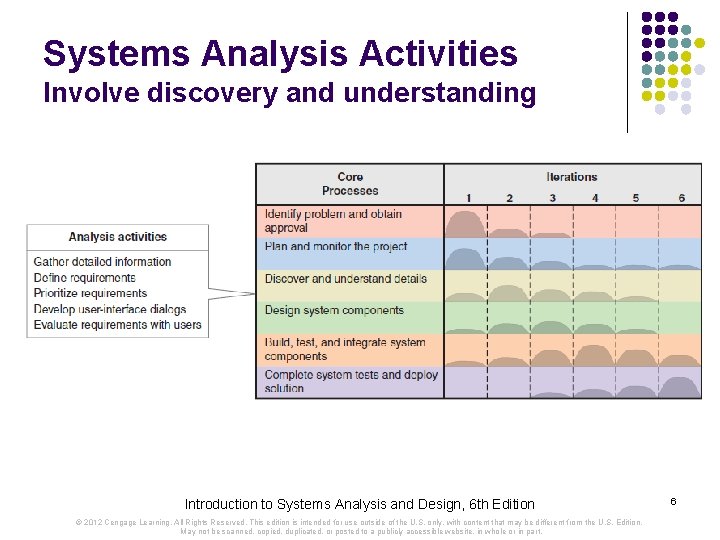
Systems Analysis Activities Involve discovery and understanding Introduction to Systems Analysis and Design, 6 th Edition © 2012 Cengage Learning. All Rights Reserved. This edition is intended for use outside of the U. S. only, with content that may be different from the U. S. Edition. May not be scanned, copied, duplicated, or posted to a publicly accessible website, in whole or in part. 6
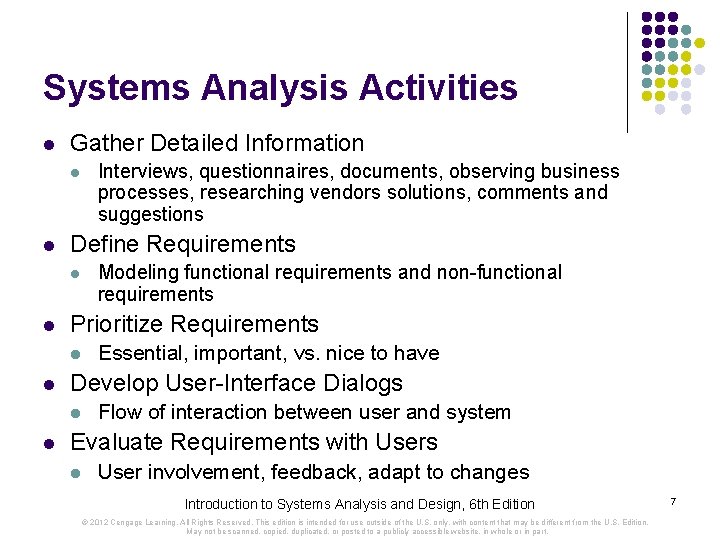
Systems Analysis Activities l Gather Detailed Information l l Define Requirements l l Essential, important, vs. nice to have Develop User-Interface Dialogs l l Modeling functional requirements and non-functional requirements Prioritize Requirements l l Interviews, questionnaires, documents, observing business processes, researching vendors solutions, comments and suggestions Flow of interaction between user and system Evaluate Requirements with Users l User involvement, feedback, adapt to changes Introduction to Systems Analysis and Design, 6 th Edition © 2012 Cengage Learning. All Rights Reserved. This edition is intended for use outside of the U. S. only, with content that may be different from the U. S. Edition. May not be scanned, copied, duplicated, or posted to a publicly accessible website, in whole or in part. 7
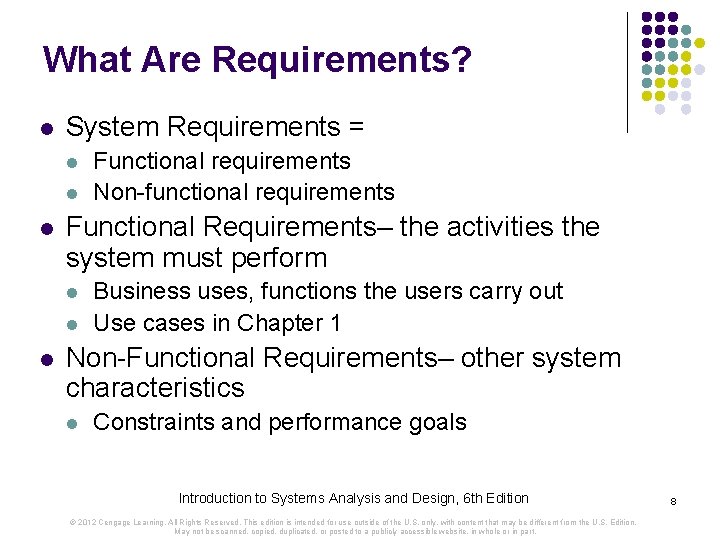
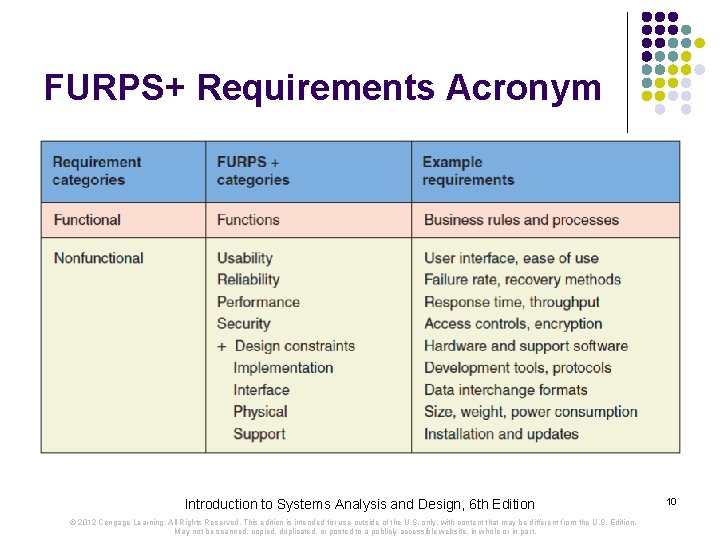
What Are Requirements? l System Requirements = l l l Functional Requirements– the activities the system must perform l l l Functional requirements Non-functional requirements Business uses, functions the users carry out Use cases in Chapter 1 Non-Functional Requirements– other system characteristics l Constraints and performance goals Introduction to Systems Analysis and Design, 6 th Edition © 2012 Cengage Learning. All Rights Reserved. This edition is intended for use outside of the U. S. only, with content that may be different from the U. S. Edition. May not be scanned, copied, duplicated, or posted to a publicly accessible website, in whole or in part. 8
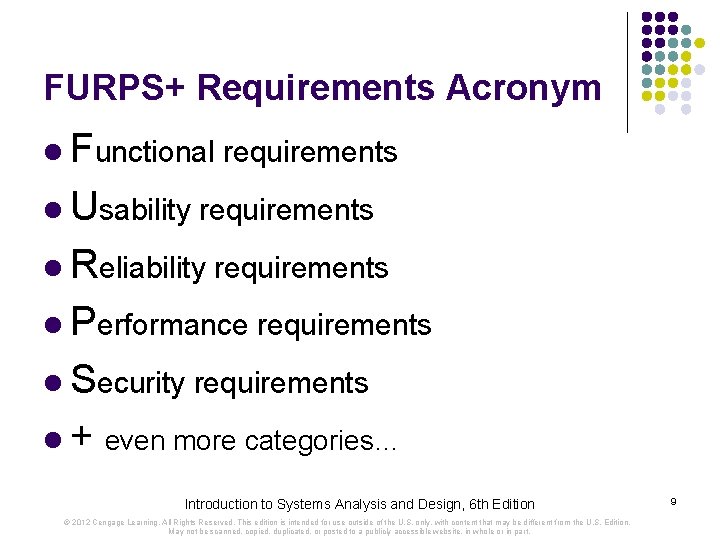
FURPS+ Requirements Acronym l Functional requirements l Usability requirements l Reliability requirements l Performance requirements l Security requirements l + even more categories… Introduction to Systems Analysis and Design, 6 th Edition © 2012 Cengage Learning. All Rights Reserved. This edition is intended for use outside of the U. S. only, with content that may be different from the U. S. Edition. May not be scanned, copied, duplicated, or posted to a publicly accessible website, in whole or in part. 9
FURPS+ Requirements Acronym Introduction to Systems Analysis and Design, 6 th Edition © 2012 Cengage Learning. All Rights Reserved. This edition is intended for use outside of the U. S. only, with content that may be different from the U. S. Edition. May not be scanned, copied, duplicated, or posted to a publicly accessible website, in whole or in part. 10
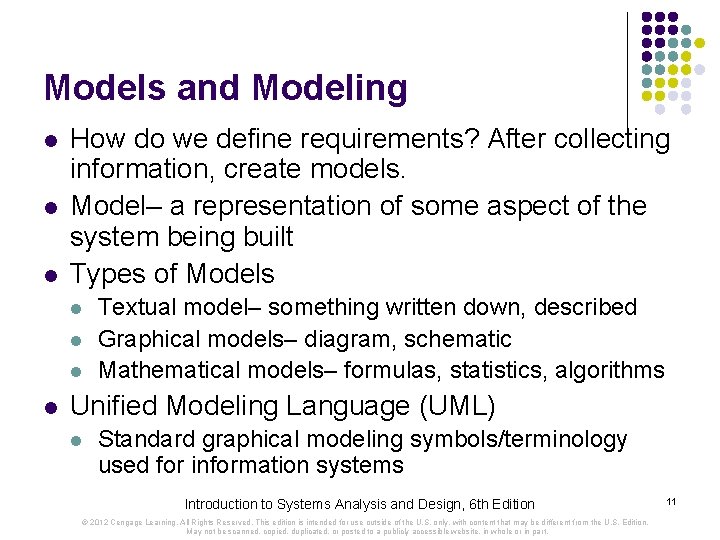
Models and Modeling l l l How do we define requirements? After collecting information, create models. Model– a representation of some aspect of the system being built Types of Models l l Textual model– something written down, described Graphical models– diagram, schematic Mathematical models– formulas, statistics, algorithms Unified Modeling Language (UML) l Standard graphical modeling symbols/terminology used for information systems Introduction to Systems Analysis and Design, 6 th Edition © 2012 Cengage Learning. All Rights Reserved. This edition is intended for use outside of the U. S. only, with content that may be different from the U. S. Edition. May not be scanned, copied, duplicated, or posted to a publicly accessible website, in whole or in part. 11
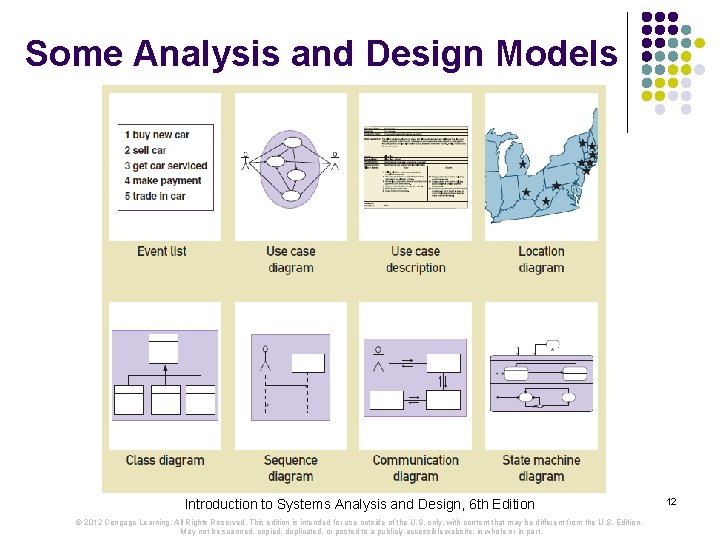
Some Analysis and Design Models Introduction to Systems Analysis and Design, 6 th Edition © 2012 Cengage Learning. All Rights Reserved. This edition is intended for use outside of the U. S. only, with content that may be different from the U. S. Edition. May not be scanned, copied, duplicated, or posted to a publicly accessible website, in whole or in part. 12
Reasons for Modeling l l l Learning from the modeling process Reducing complexity by abstraction Remembering all the details Communicating with other development team members Communicating with a variety of users and stakeholders Documenting what was done for future maintenance/enhancement Introduction to Systems Analysis and Design, 6 th Edition © 2012 Cengage Learning. All Rights Reserved. This edition is intended for use outside of the U. S. only, with content that may be different from the U. S. Edition. May not be scanned, copied, duplicated, or posted to a publicly accessible website, in whole or in part. 13
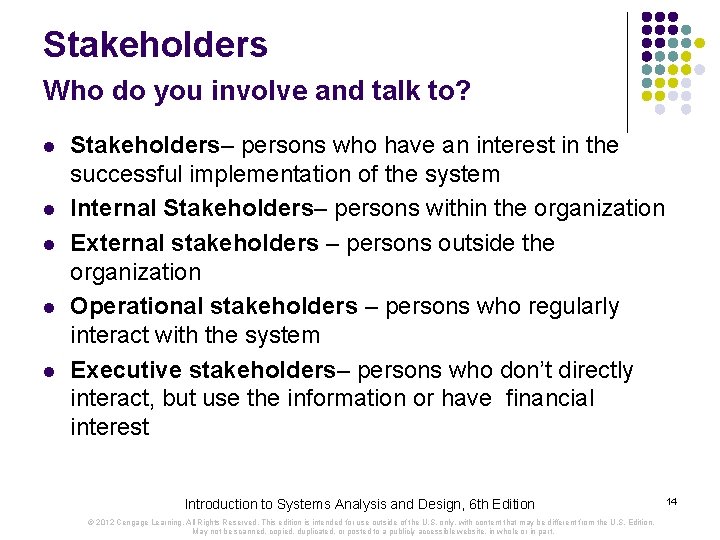
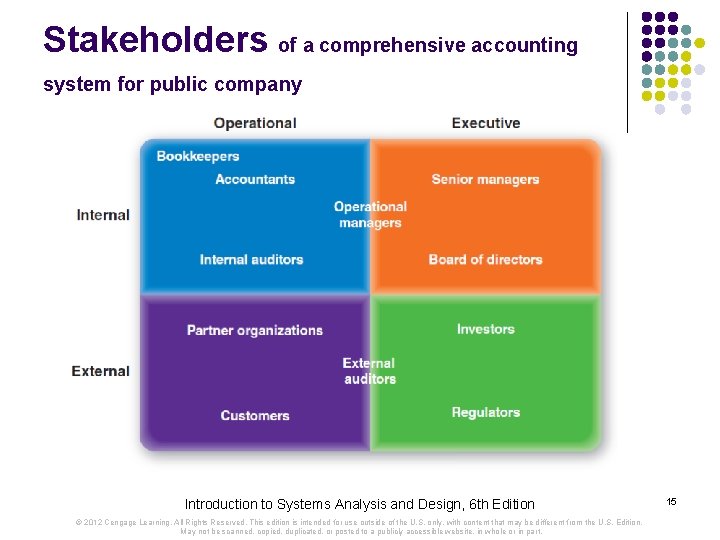
Stakeholders Who do you involve and talk to? l l l Stakeholders– persons who have an interest in the successful implementation of the system Internal Stakeholders– persons within the organization External stakeholders – persons outside the organization Operational stakeholders – persons who regularly interact with the system Executive stakeholders– persons who don’t directly interact, but use the information or have financial interest Introduction to Systems Analysis and Design, 6 th Edition © 2012 Cengage Learning. All Rights Reserved. This edition is intended for use outside of the U. S. only, with content that may be different from the U. S. Edition. May not be scanned, copied, duplicated, or posted to a publicly accessible website, in whole or in part. 14
Stakeholders of a comprehensive accounting system for public company Introduction to Systems Analysis and Design, 6 th Edition © 2012 Cengage Learning. All Rights Reserved. This edition is intended for use outside of the U. S. only, with content that may be different from the U. S. Edition. May not be scanned, copied, duplicated, or posted to a publicly accessible website, in whole or in part. 15
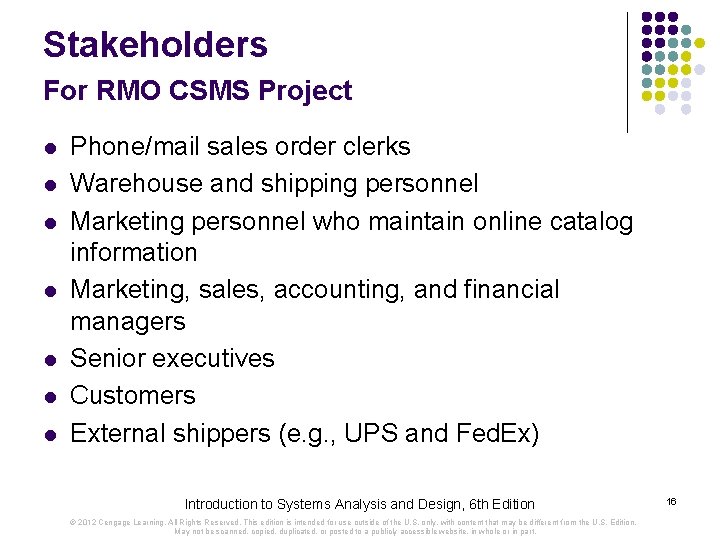
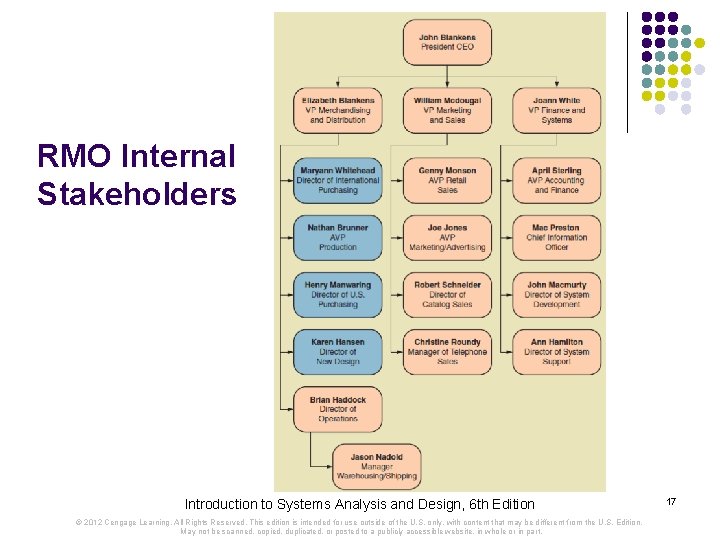
Stakeholders For RMO CSMS Project l l l l Phone/mail sales order clerks Warehouse and shipping personnel Marketing personnel who maintain online catalog information Marketing, sales, accounting, and financial managers Senior executives Customers External shippers (e. g. , UPS and Fed. Ex) Introduction to Systems Analysis and Design, 6 th Edition © 2012 Cengage Learning. All Rights Reserved. This edition is intended for use outside of the U. S. only, with content that may be different from the U. S. Edition. May not be scanned, copied, duplicated, or posted to a publicly accessible website, in whole or in part. 16
RMO Internal Stakeholders Introduction to Systems Analysis and Design, 6 th Edition © 2012 Cengage Learning. All Rights Reserved. This edition is intended for use outside of the U. S. only, with content that may be different from the U. S. Edition. May not be scanned, copied, duplicated, or posted to a publicly accessible website, in whole or in part. 17
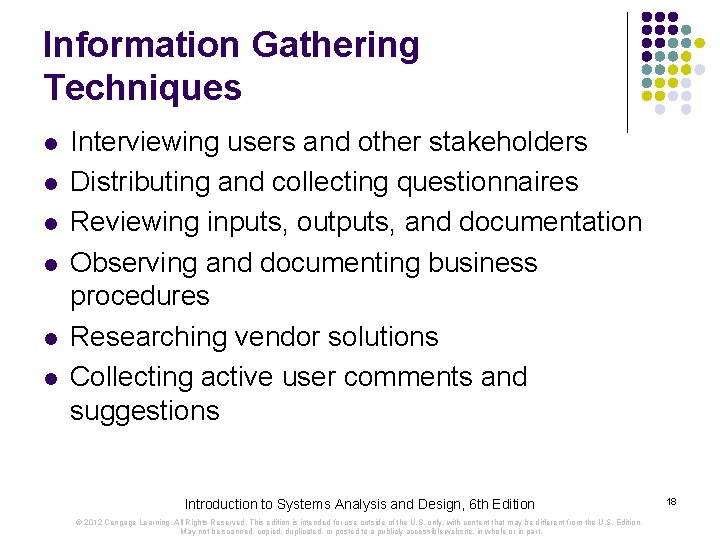
Information Gathering Techniques l l l Interviewing users and other stakeholders Distributing and collecting questionnaires Reviewing inputs, outputs, and documentation Observing and documenting business procedures Researching vendor solutions Collecting active user comments and suggestions Introduction to Systems Analysis and Design, 6 th Edition © 2012 Cengage Learning. All Rights Reserved. This edition is intended for use outside of the U. S. only, with content that may be different from the U. S. Edition. May not be scanned, copied, duplicated, or posted to a publicly accessible website, in whole or in part. 18
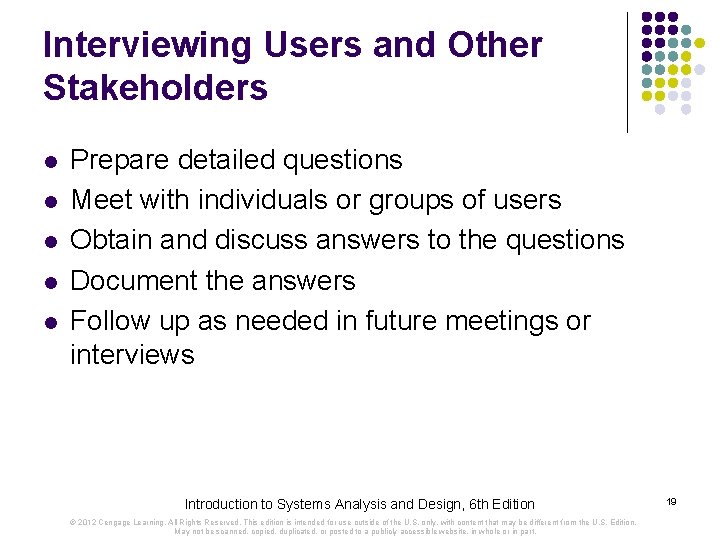
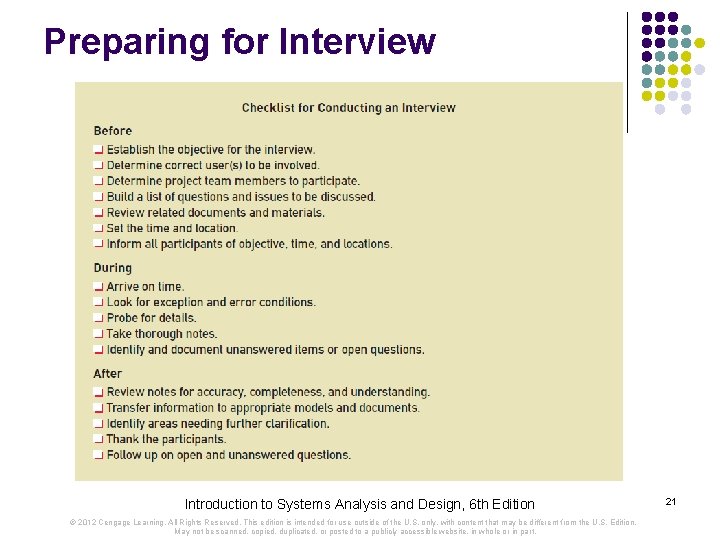
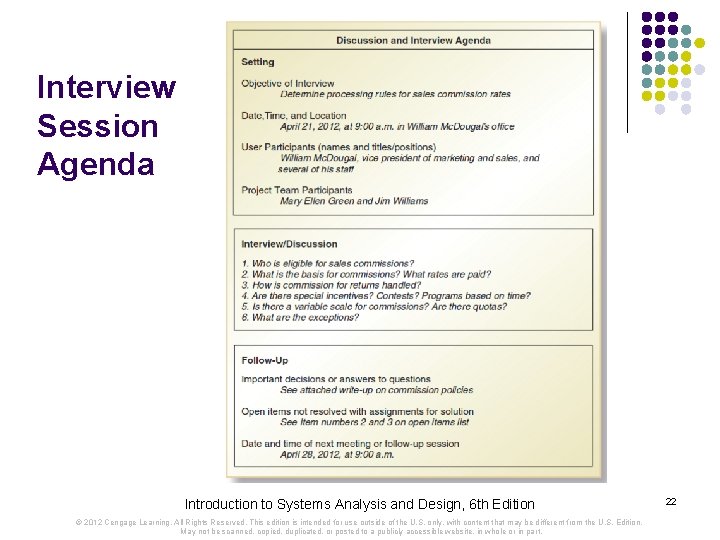
Interviewing Users and Other Stakeholders l l l Prepare detailed questions Meet with individuals or groups of users Obtain and discuss answers to the questions Document the answers Follow up as needed in future meetings or interviews Introduction to Systems Analysis and Design, 6 th Edition © 2012 Cengage Learning. All Rights Reserved. This edition is intended for use outside of the U. S. only, with content that may be different from the U. S. Edition. May not be scanned, copied, duplicated, or posted to a publicly accessible website, in whole or in part. 19
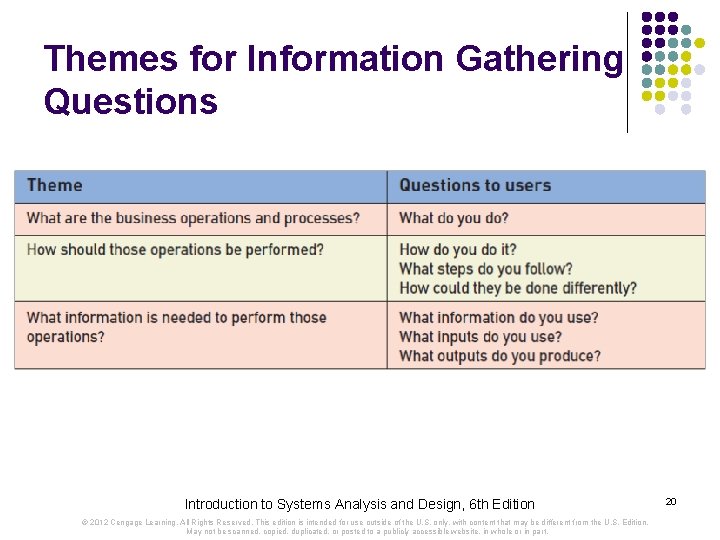
Themes for Information Gathering Questions Introduction to Systems Analysis and Design, 6 th Edition © 2012 Cengage Learning. All Rights Reserved. This edition is intended for use outside of the U. S. only, with content that may be different from the U. S. Edition. May not be scanned, copied, duplicated, or posted to a publicly accessible website, in whole or in part. 20
Preparing for Interview Introduction to Systems Analysis and Design, 6 th Edition © 2012 Cengage Learning. All Rights Reserved. This edition is intended for use outside of the U. S. only, with content that may be different from the U. S. Edition. May not be scanned, copied, duplicated, or posted to a publicly accessible website, in whole or in part. 21
Interview Session Agenda Introduction to Systems Analysis and Design, 6 th Edition © 2012 Cengage Learning. All Rights Reserved. This edition is intended for use outside of the U. S. only, with content that may be different from the U. S. Edition. May not be scanned, copied, duplicated, or posted to a publicly accessible website, in whole or in part. 22
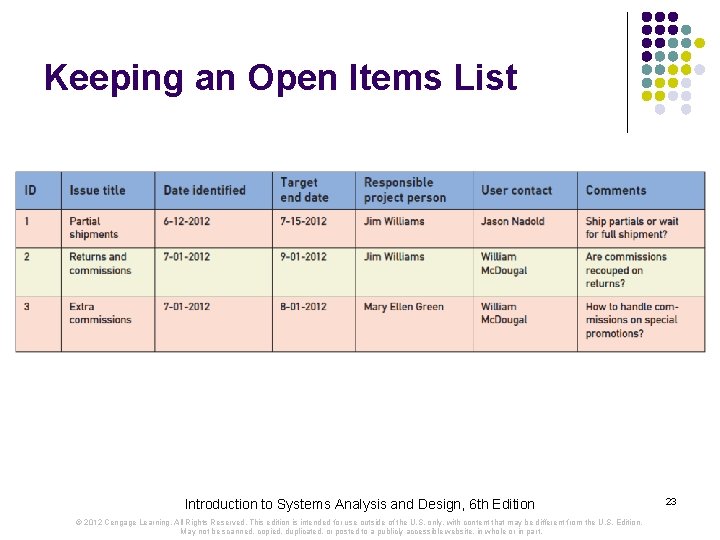
Keeping an Open Items List Introduction to Systems Analysis and Design, 6 th Edition © 2012 Cengage Learning. All Rights Reserved. This edition is intended for use outside of the U. S. only, with content that may be different from the U. S. Edition. May not be scanned, copied, duplicated, or posted to a publicly accessible website, in whole or in part. 23
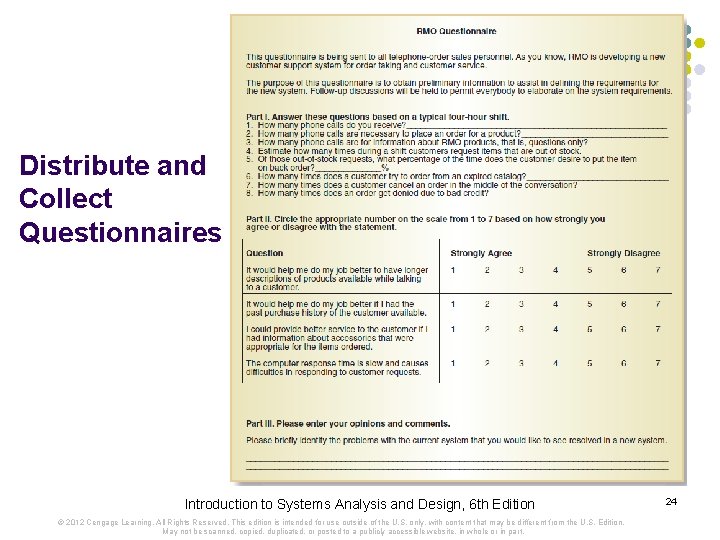
Distribute and Collect Questionnaires Introduction to Systems Analysis and Design, 6 th Edition © 2012 Cengage Learning. All Rights Reserved. This edition is intended for use outside of the U. S. only, with content that may be different from the U. S. Edition. May not be scanned, copied, duplicated, or posted to a publicly accessible website, in whole or in part. 24
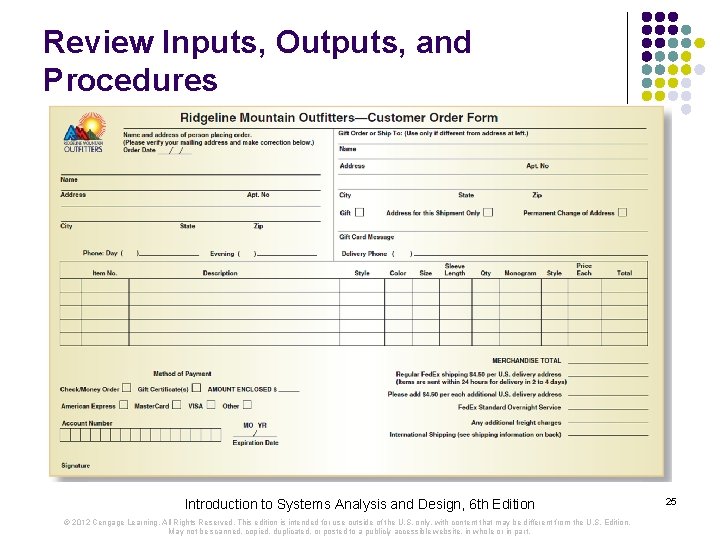
Review Inputs, Outputs, and Procedures Introduction to Systems Analysis and Design, 6 th Edition © 2012 Cengage Learning. All Rights Reserved. This edition is intended for use outside of the U. S. only, with content that may be different from the U. S. Edition. May not be scanned, copied, duplicated, or posted to a publicly accessible website, in whole or in part. 25
Additional Techniques l Observe and Document Business Processes l l l Research Vendor Solutions l l l Watch and learn Document with Activity diagram (next section) See what others have done for similar situations White papers, vendor literature, competitors Collect Active User Comments and Suggestions l l Feedback on models and tests Users know it when they see it Introduction to Systems Analysis and Design, 6 th Edition © 2012 Cengage Learning. All Rights Reserved. This edition is intended for use outside of the U. S. only, with content that may be different from the U. S. Edition. May not be scanned, copied, duplicated, or posted to a publicly accessible website, in whole or in part. 26
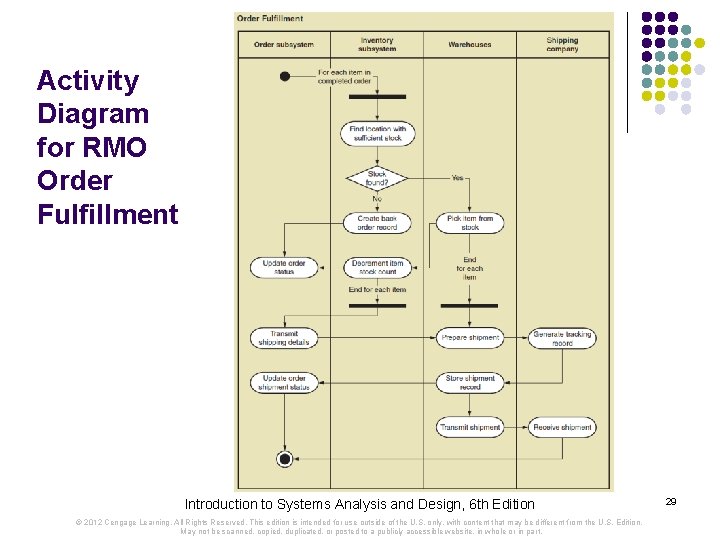
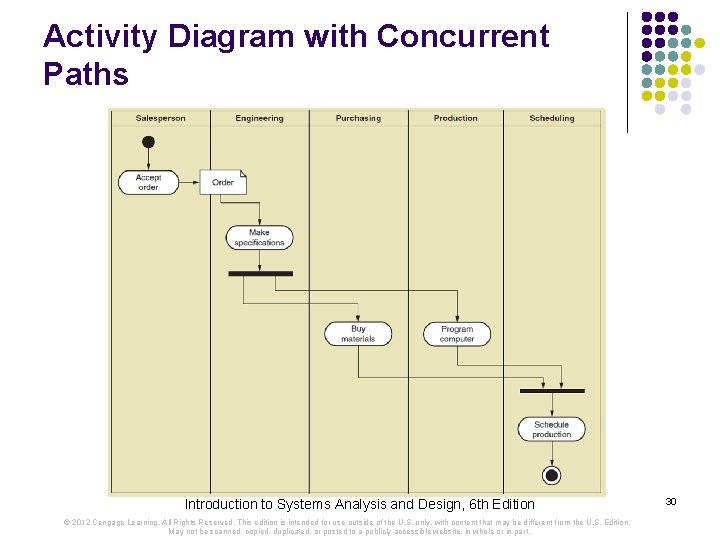
Documenting Workflows with Activity Diagrams l l Workflow– sequence of processing steps that completely handles one business transaction or customer request Activity Diagram– describes user (or system) activities, the person who does each activity, and the sequential flow of these activities l l Useful for showing a graphical model of a workflow A UML diagram Introduction to Systems Analysis and Design, 6 th Edition © 2012 Cengage Learning. All Rights Reserved. This edition is intended for use outside of the U. S. only, with content that may be different from the U. S. Edition. May not be scanned, copied, duplicated, or posted to a publicly accessible website, in whole or in part. 27
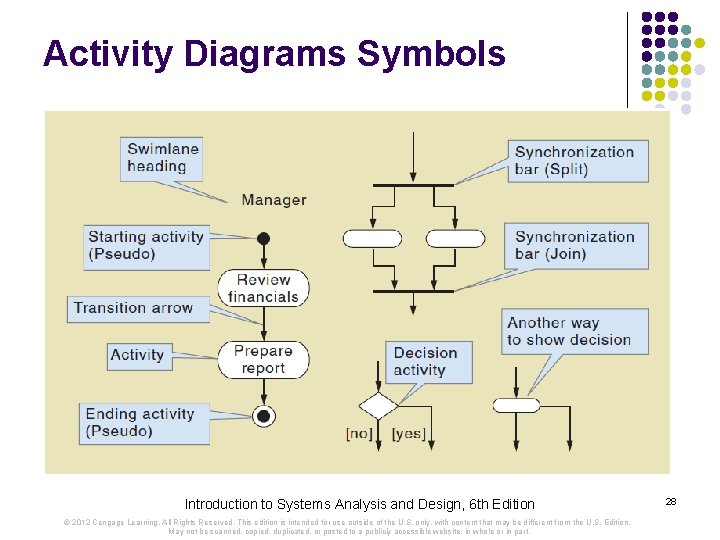
Activity Diagrams Symbols Introduction to Systems Analysis and Design, 6 th Edition © 2012 Cengage Learning. All Rights Reserved. This edition is intended for use outside of the U. S. only, with content that may be different from the U. S. Edition. May not be scanned, copied, duplicated, or posted to a publicly accessible website, in whole or in part. 28
Activity Diagram for RMO Order Fulfillment Introduction to Systems Analysis and Design, 6 th Edition © 2012 Cengage Learning. All Rights Reserved. This edition is intended for use outside of the U. S. only, with content that may be different from the U. S. Edition. May not be scanned, copied, duplicated, or posted to a publicly accessible website, in whole or in part. 29
Activity Diagram with Concurrent Paths Introduction to Systems Analysis and Design, 6 th Edition © 2012 Cengage Learning. All Rights Reserved. This edition is intended for use outside of the U. S. only, with content that may be different from the U. S. Edition. May not be scanned, copied, duplicated, or posted to a publicly accessible website, in whole or in part. 30
Summary l l l Systems analysis activates correspond to the core SDLC process Discover and understand details System projects originate from the information system strategic plan, which contains an technology architecture plan and an application architecture plan The RMO CSMS Project will be used throughout the text as an example of analysis and design Introduction to Systems Analysis and Design, 6 th Edition © 2012 Cengage Learning. All Rights Reserved. This edition is intended for use outside of the U. S. only, with content that may be different from the U. S. Edition. May not be scanned, copied, duplicated, or posted to a publicly accessible website, in whole or in part. 31
Summary l l Systems analysis involves defining system requirements– functional and non-functional Analysis activities include l l l Gather detailed information Define requirements Prioritize requirements Develop user-interface dialogs Evaluate requirements with users FURPS+ is the acronym for functional, usability, reliability, performance, and security requirements Introduction to Systems Analysis and Design, 6 th Edition © 2012 Cengage Learning. All Rights Reserved. This edition is intended for use outside of the U. S. only, with content that may be different from the U. S. Edition. May not be scanned, copied, duplicated, or posted to a publicly accessible website, in whole or in part. 32
Summary l l l Models and modeling are used to explore and document requirements A model represents some aspect of a system, and can include textual, graphical, and mathematical models Unified Modeling Language (UML) is the standard set of notations and terminology for information systems models Introduction to Systems Analysis and Design, 6 th Edition © 2012 Cengage Learning. All Rights Reserved. This edition is intended for use outside of the U. S. only, with content that may be different from the U. S. Edition. May not be scanned, copied, duplicated, or posted to a publicly accessible website, in whole or in part. 33
Summary l l l Stakeholders are the people who have an interest in the success of the project There are internal vs. external stakeholders and operational vs. executive stakeholders Information gathering techniques are used to collect information about the project l l Interviews, questionnaires, reviewing documents, observing business processes, researching vendors, comments and suggestions The UML Activity Diagram is used to document (model) workflows after collecting information Introduction to Systems Analysis and Design, 6 th Edition © 2012 Cengage Learning. All Rights Reserved. This edition is intended for use outside of the U. S. only, with content that may be different from the U. S. Edition. May not be scanned, copied, duplicated, or posted to a publicly accessible website, in whole or in part. 34