
Introduction to Systematic Theology Chapter 1 Definition of
- Slides: 16
Introduction to Systematic Theology Chapter 1
Definition of Systematic Theology • Systematic theology is any study that answers the question, “What does the whole Bible teach us today? ” about any given topic. �
Relationship to Other Disciplines • Historical Theology • Philosophical Theology • Apologetics • Old Testament Theology • New Testament Theology • Biblical Theology
Application to Life • “What does the whole Bible teach us today? ” • The Trinity • The deity of Christ • The doctrine of prayer
Systematic Theology and Disorganized Theology • A carefully organized approach can ensure all topics receive thorough consideration. • Topics can be treated in much more detail. • Doctrinal summaries can be formulated with much more accuracy. • It must find and treat all of the relevant Bible passages for a particular topic.
Beliefs Must Be Based on Scripture • It is Scripture alone and not “conservative evangelical tradition” or any other human authority that must function as the normative authority for what we should believe.
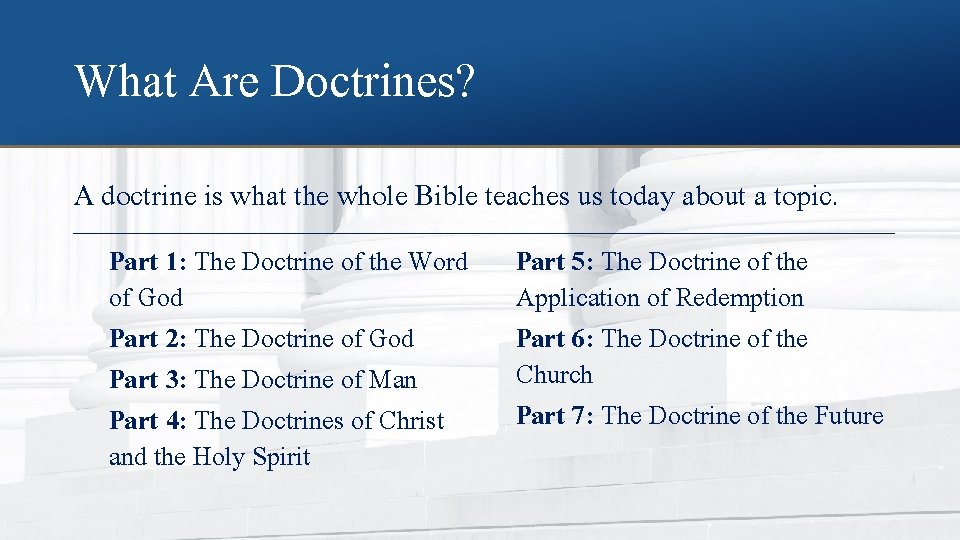
What Are Doctrines? A doctrine is what the whole Bible teaches us today about a topic. Part 1: The Doctrine of the Word of God Part 2: The Doctrine of God Part 3: The Doctrine of Man Part 4: The Doctrines of Christ and the Holy Spirit Part 5: The Doctrine of the Application of Redemption Part 6: The Doctrine of the Church Part 7: The Doctrine of the Future
Systematic Theology and Christian Ethics • The emphasis of systematic theology is on what God wants us to believe and know. • The emphasis in Christian ethics is on what God wants us to do and what attitudes he wants us to have.
Initial Assumptions of This Book • The Bible is true and our only absolute standard of truth. • The God who is spoken of in the Bible exists and is who the Bible says he is.
Why Should Christians Study Theology? 1. The Basic Reason: Matt 28: 19– 20 2. The Benefits to Our Lives: • It helps us to overcome our wrong ideas. • It helps us make better decisions about doctrine later on. • It helps us to grow as Christians. 3. Major doctrines have significant impact on other doctrines and the Christian life; minor doctrines have little impact on these.
A Note on Objections to the Study of Systematic Theology 1. “The Conclusions Are ‘Too Neat’ to be True. ” • We must ask where Scripture is being misinterpreted. • If Scripture is entirely true, we would expect its teachings to fit together. 2. “The Choice of Topics Dictates the Conclusions. ” • Our goal is to look at every topic that concerns us today and to discover what the whole Bible teaches about them. • Arrange our study in any sequence and the conclusions will remain the same.
A Note on Objections to the Study of Systematic Theology 3. “You Can’t Just Get Doctrine Directly from the Pages of Scripture. ” • For many theologians outside the evangelical world, the words of the Bible are merely human words and the writings of great theologians are of similar value and authority in theological study. • The work of other theologians is helpful, but the Bible is the final authority.
How Should Christians Study Systematic Theology? 1. With Prayer (Ps 119: 18; Eph 1: 16– 18) 2. With Humility (1 Pet 5: 5; Jas 3: 13– 18) 3. With Reason • We are free to use our reasoning to draw deductions from any passage of Scripture so long as these deductions do not contradict the clear teaching of Scripture.
How Should Christians Study Systematic Theology? 4. With Help From Others (1 Cor 12: 28) 5. By Collecting and Understanding All the Relevant Passages of Scripture on Any Topic • Find all the relevant verses • Read, make notes, and try to summarize the points made • Summarize the teachings into one or more points that the Bible affirms about that subject
How Should Christians Study Systematic Theology? 6. With Rejoicing and Praise (Ps 19: 8; 119: 14, 103, 111, 162; Rom 11: 33– 36)
Special Terms • apologetics • biblical theology • Christian ethics • contradiction • doctrine • dogmatic theology • historical theology • major doctrine • minor doctrine • New Testament theology • Old Testament theology • paradox • philosophical theology • presupposition • systematic theology