
Introduction to Syntax Lecture in Nomie Elhadads CUNY



- Slides: 53
Introduction to Syntax Lecture in Noémie Elhadad’s CUNY Class Statistical Natural Language Processing CSc 84010 - Fall 2006 Owen Rambow rambow@cs. columbia. edu November 15 2006
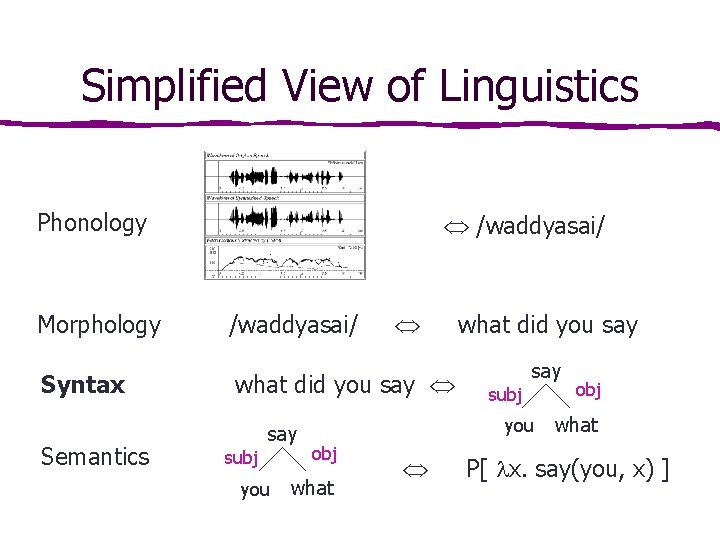
What is Syntax? • Study of structure of language • Roughly, goal is to relate surface form (what we perceive when someone says something) to semantics (what that utterance means)
What is Syntax Not? • Phonology: study of sound systems and how sounds combine • Morphology: study of how words are formed from smaller parts (morphemes) • Semantics: study of meaning of language
What is Syntax? (2) • Study of structure of language • Specifically, goal is to relate an interface to morphological component to an interface to a semantic component • Note: interface to morphological component may look like written text • Representational device is tree structure
Simplified View of Linguistics Phonology Morphology Syntax Semantics /waddyasai/ what did you say subj you obj what P[ x. say(you, x) ]
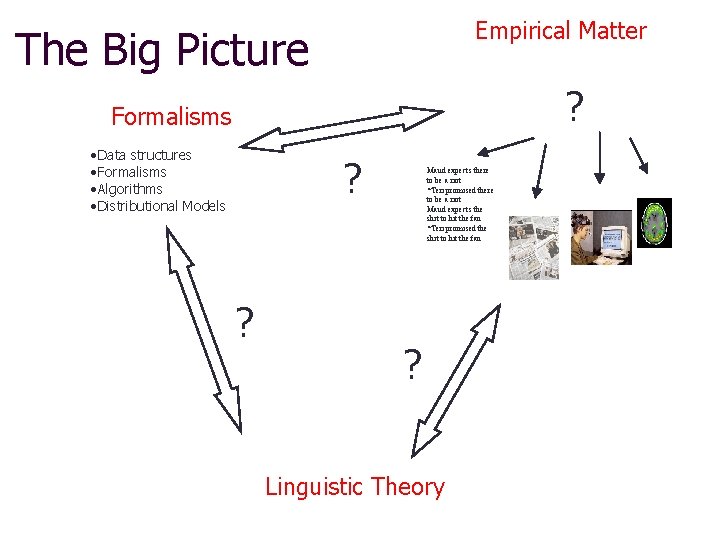
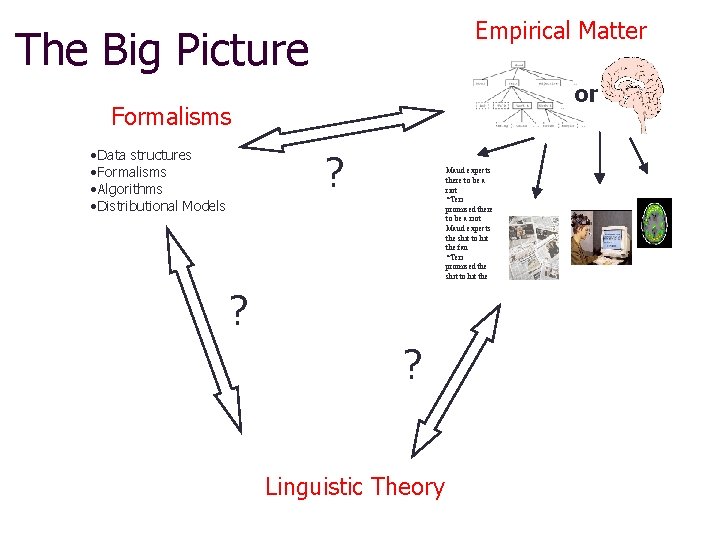
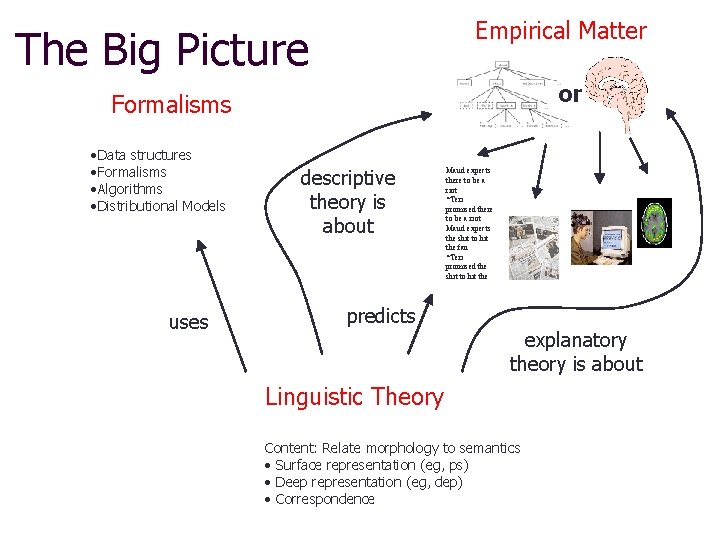
Empirical Matter The Big Picture ? Formalisms • Data structures • Formalisms • Algorithms • Distributional Models ? ? Maud expects there to be a riot *Teri promised there to be a riot Maud expects the shit to hit the fan *Teri promised the shit to hit the fan ? Linguistic Theory
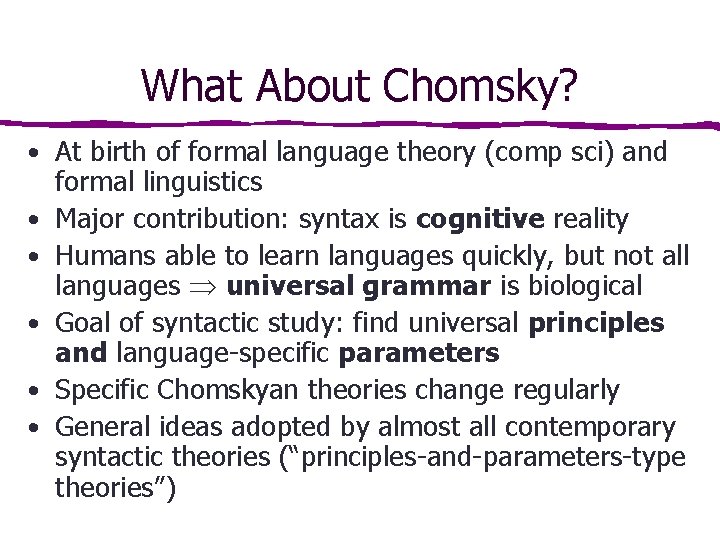
What About Chomsky? • At birth of formal language theory (comp sci) and • • • formal linguistics Major contribution: syntax is cognitive reality Humans able to learn languages quickly, but not all languages universal grammar is biological Goal of syntactic study: find universal principles and language-specific parameters Specific Chomskyan theories change regularly General ideas adopted by almost all contemporary syntactic theories (“principles-and-parameters-type theories”)
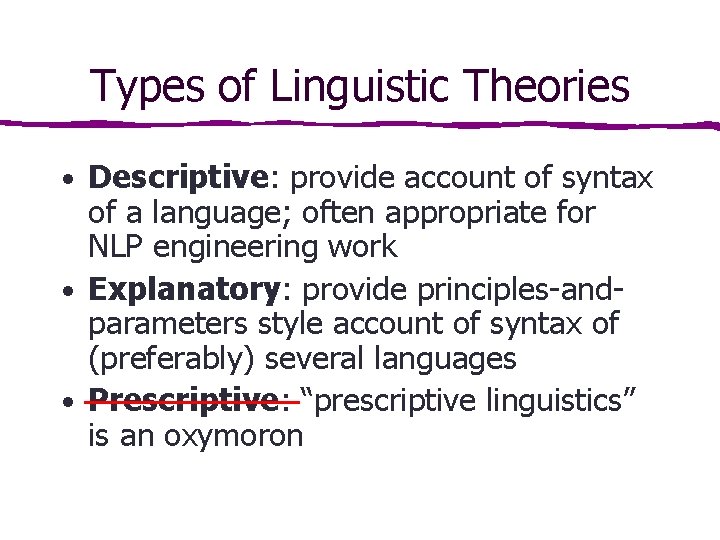
Types of Linguistic Theories • Descriptive: provide account of syntax of a language; often appropriate for NLP engineering work • Explanatory: provide principles-andparameters style account of syntax of (preferably) several languages • Prescriptive: “prescriptive linguistics” is an oxymoron
Empirical Matter The Big Picture or Formalisms • Data structures • Formalisms • Algorithms • Distributional Models ? Maud expects there to be a riot *Teri promised there to be a riot Maud expects the shit to hit the fan *Teri promised the shit to hit the ? ? Linguistic Theory
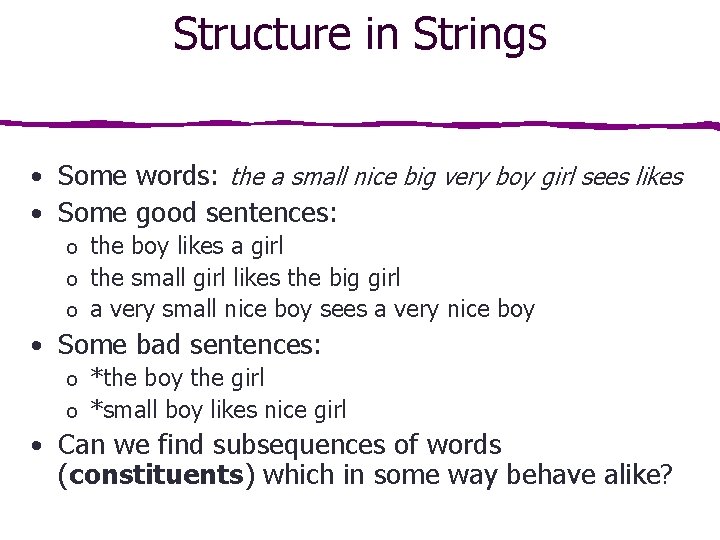
Structure in Strings • Some words: the a small nice big very boy girl sees likes • Some good sentences: the boy likes a girl o the small girl likes the big girl o a very small nice boy sees a very nice boy o • Some bad sentences: *the boy the girl o *small boy likes nice girl o • Can we find subsequences of words (constituents) which in some way behave alike?
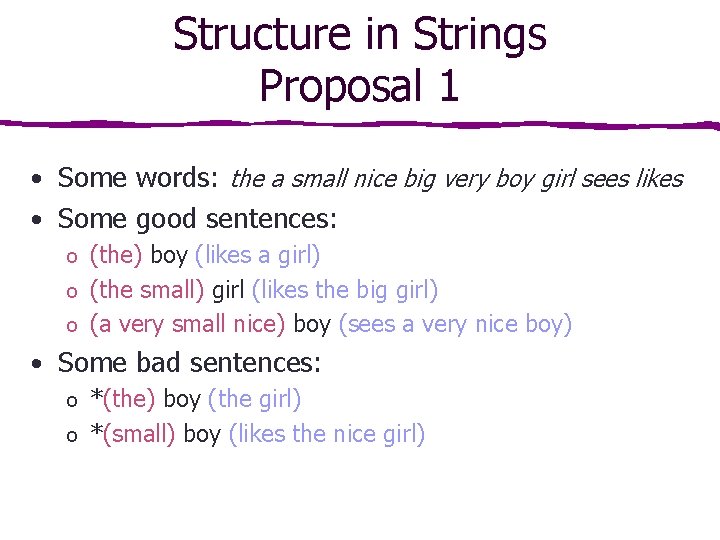
Structure in Strings Proposal 1 • Some words: the a small nice big very boy girl sees likes • Some good sentences: (the) boy (likes a girl) o (the small) girl (likes the big girl) o (a very small nice) boy (sees a very nice boy) o • Some bad sentences: *(the) boy (the girl) o *(small) boy (likes the nice girl) o
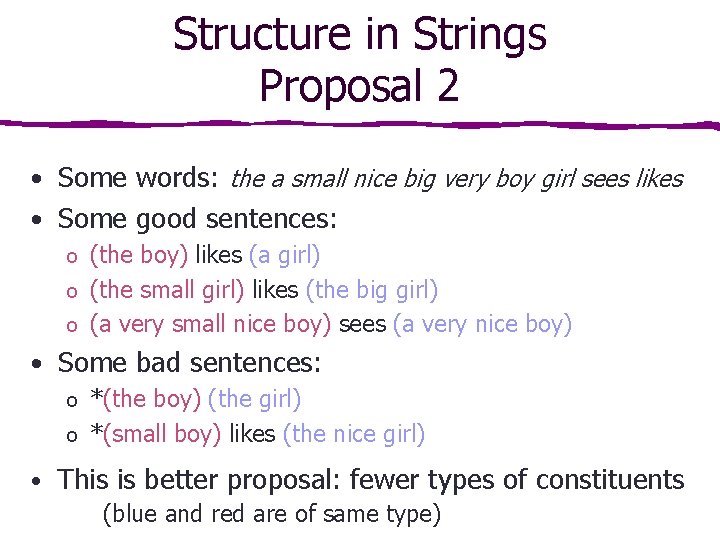
Structure in Strings Proposal 2 • Some words: the a small nice big very boy girl sees likes • Some good sentences: (the boy) likes (a girl) o (the small girl) likes (the big girl) o (a very small nice boy) sees (a very nice boy) o • Some bad sentences: *(the boy) (the girl) o *(small boy) likes (the nice girl) o • This is better proposal: fewer types of constituents (blue and red are of same type)
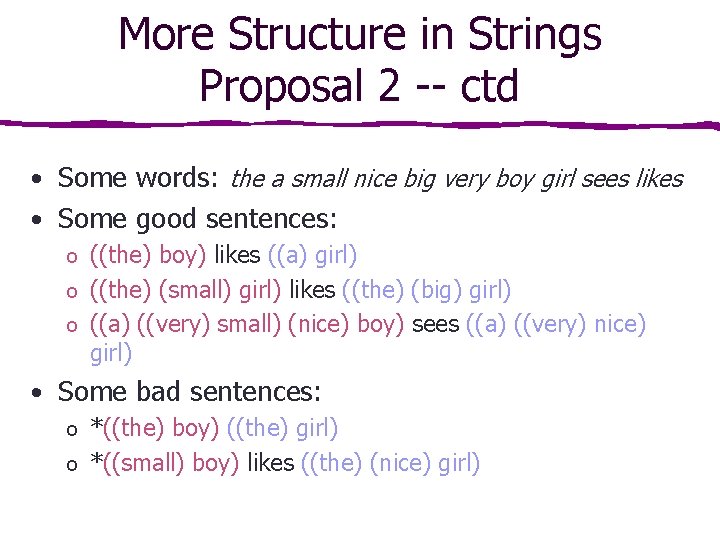
More Structure in Strings Proposal 2 -- ctd • Some words: the a small nice big very boy girl sees likes • Some good sentences: ((the) boy) likes ((a) girl) o ((the) (small) girl) likes ((the) (big) girl) o ((a) ((very) small) (nice) boy) sees ((a) ((very) nice) girl) o • Some bad sentences: *((the) boy) ((the) girl) o *((small) boy) likes ((the) (nice) girl) o
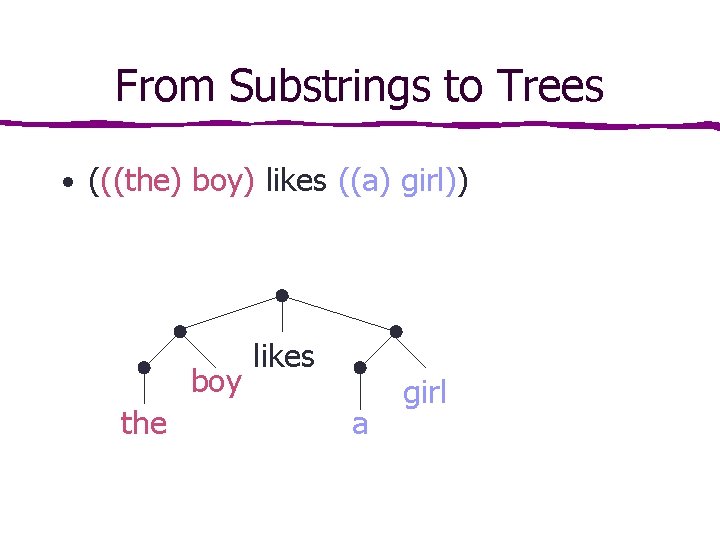
From Substrings to Trees • (((the) boy) likes ((a) girl)) boy the likes a girl
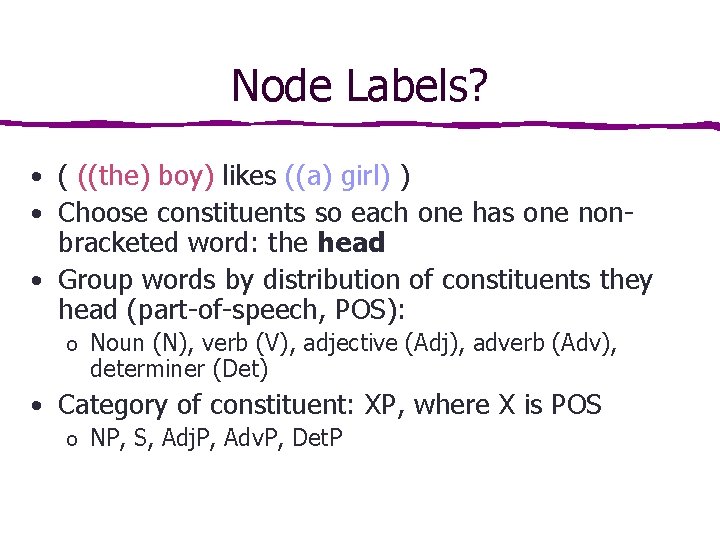
Node Labels? • ( ((the) boy) likes ((a) girl) ) • Choose constituents so each one has one non- bracketed word: the head • Group words by distribution of constituents they head (part-of-speech, POS): o Noun (N), verb (V), adjective (Adj), adverb (Adv), determiner (Det) • Category of constituent: XP, where X is POS o NP, S, Adj. P, Adv. P, Det. P
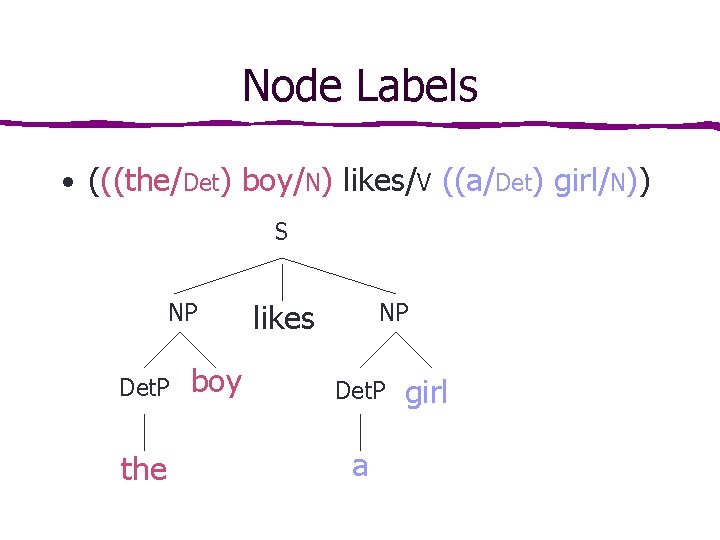
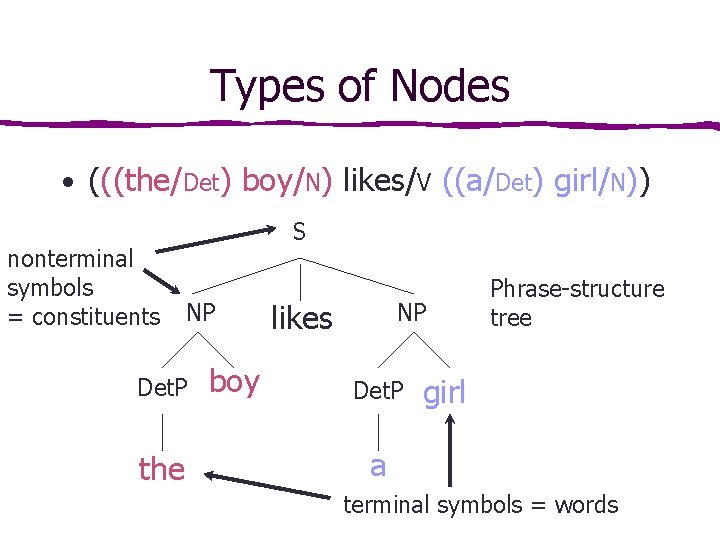
Node Labels • (((the/Det) boy/N) likes/V ((a/Det) girl/N)) S NP Det. P the boy likes NP Det. P a girl
Types of Nodes • (((the/Det) boy/N) likes/V ((a/Det) girl/N)) nonterminal symbols = constituents S NP Det. P the boy likes NP Det. P Phrase-structure tree girl a terminal symbols = words
Determining Part-of-Speech o noun or adjective? Øa blue seat Ø a very blue seat Ø this seat is blue a child seat *a very child seat *this seat is child Ø blue and child are not the same POS Ø blue is Adj, child is Noun
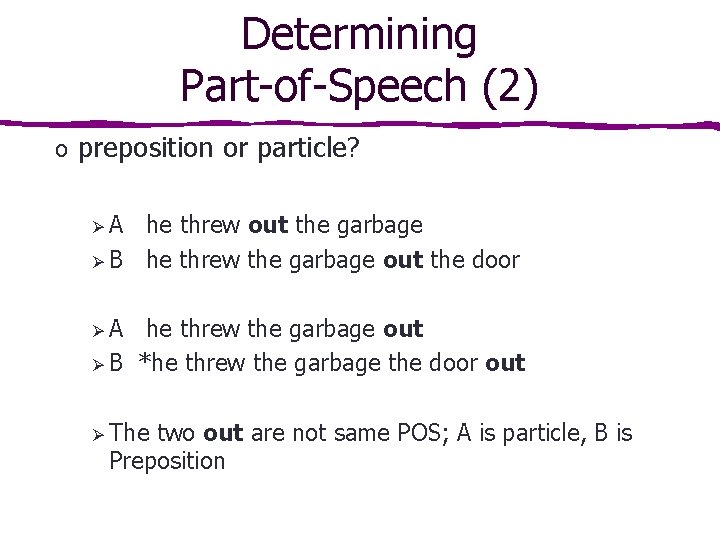
Determining Part-of-Speech (2) o preposition or particle? ØA he threw out the garbage Ø B he threw the garbage out the door ØA he threw the garbage out Ø B *he threw the garbage the door out Ø The two out are not same POS; A is particle, B is Preposition
Word Classes (=POS) • Heads of constituents fall into distributionally defined classes • Additional support for class definition of word class comes from morphology
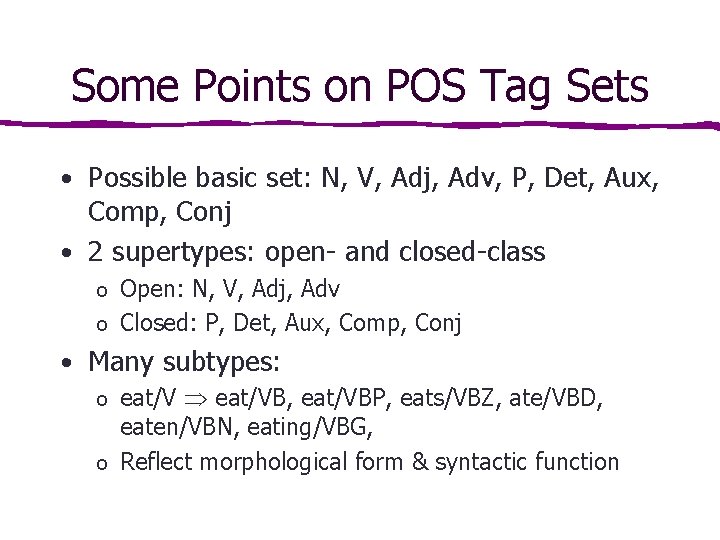
Some Points on POS Tag Sets • Possible basic set: N, V, Adj, Adv, P, Det, Aux, Comp, Conj • 2 supertypes: open- and closed-class Open: N, V, Adj, Adv o Closed: P, Det, Aux, Comp, Conj o • Many subtypes: eat/VB, eat/VBP, eats/VBZ, ate/VBD, eaten/VBN, eating/VBG, o Reflect morphological form & syntactic function o
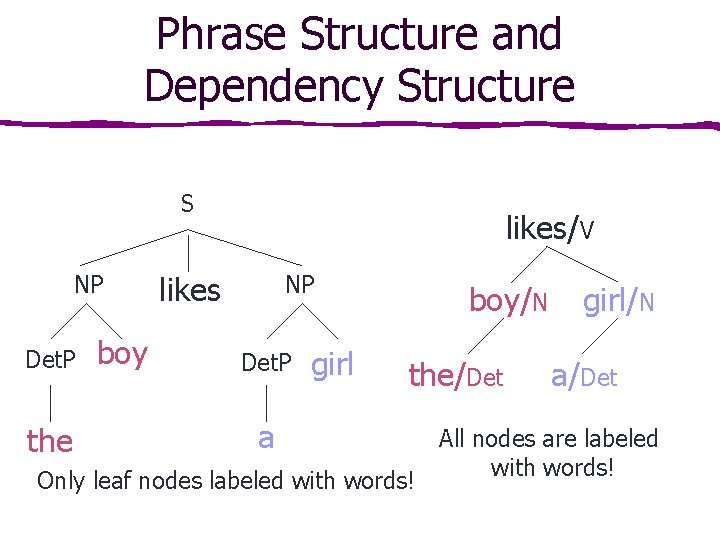
Phrase Structure and Dependency Structure S NP Det. P the boy likes/V likes NP Det. P girl boy/N the/Det a Only leaf nodes labeled with words! girl/N a/Det All nodes are labeled with words!
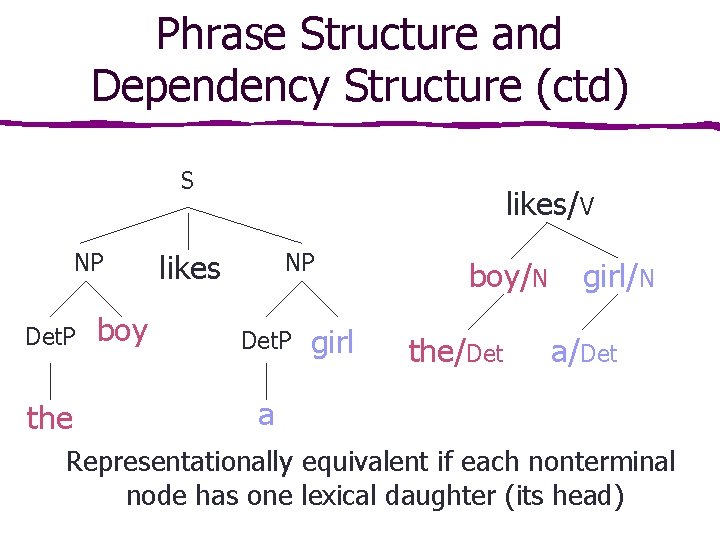
Phrase Structure and Dependency Structure (ctd) S NP Det. P the boy likes/V likes NP Det. P girl boy/N the/Det girl/N a/Det a Representationally equivalent if each nonterminal node has one lexical daughter (its head)
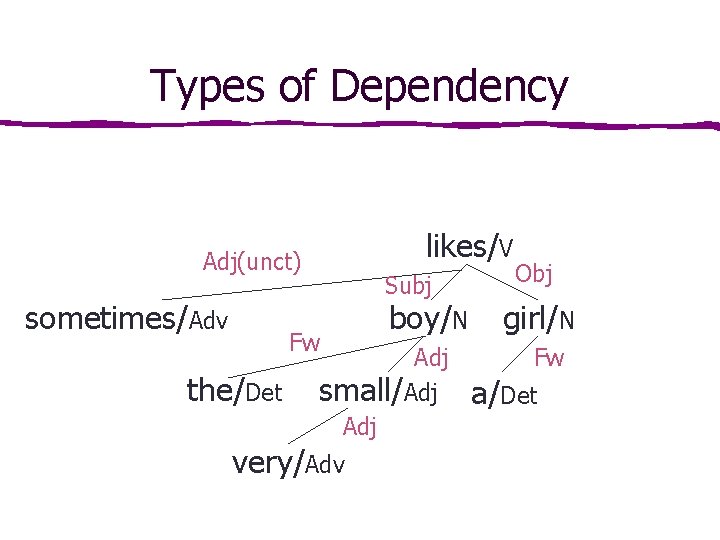
Types of Dependency likes/V Adj(unct) sometimes/Adv Subj Fw the/Det boy/N Adj small/Adj very/Adv Obj girl/N Fw a/Det
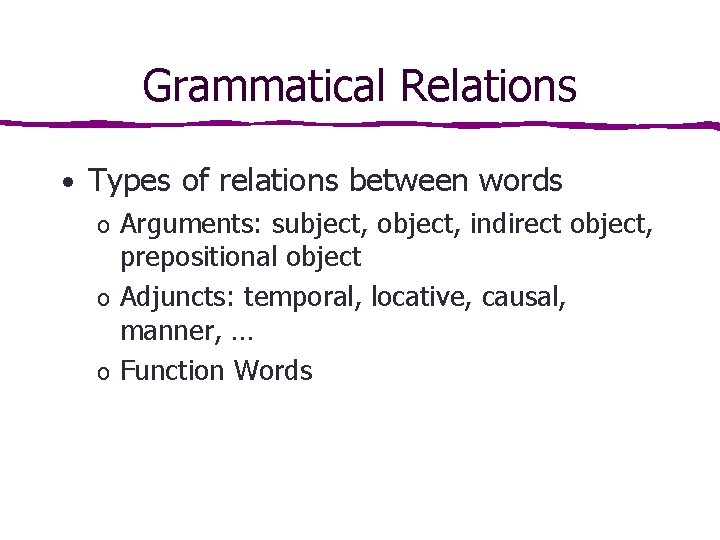
Grammatical Relations • Types of relations between words o Arguments: subject, object, indirect object, prepositional object o Adjuncts: temporal, locative, causal, manner, … o Function Words
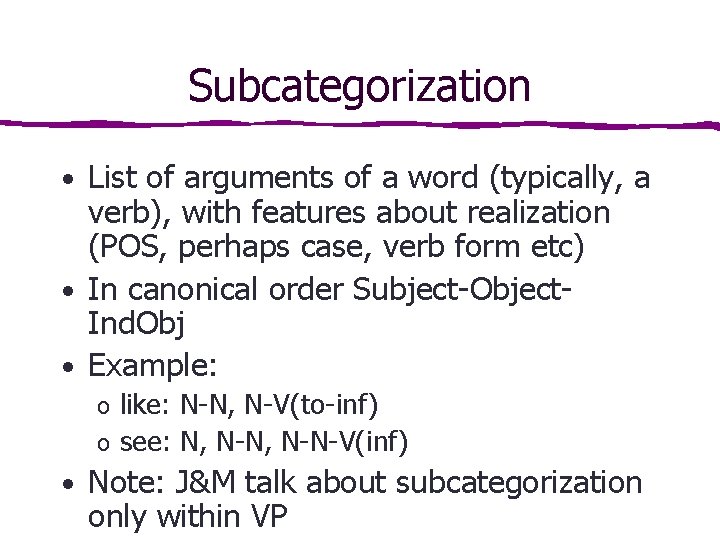
Subcategorization • List of arguments of a word (typically, a verb), with features about realization (POS, perhaps case, verb form etc) • In canonical order Subject-Object. Ind. Obj • Example: like: N-N, N-V(to-inf) o see: N, N-N-V(inf) o • Note: J&M talk about subcategorization only within VP
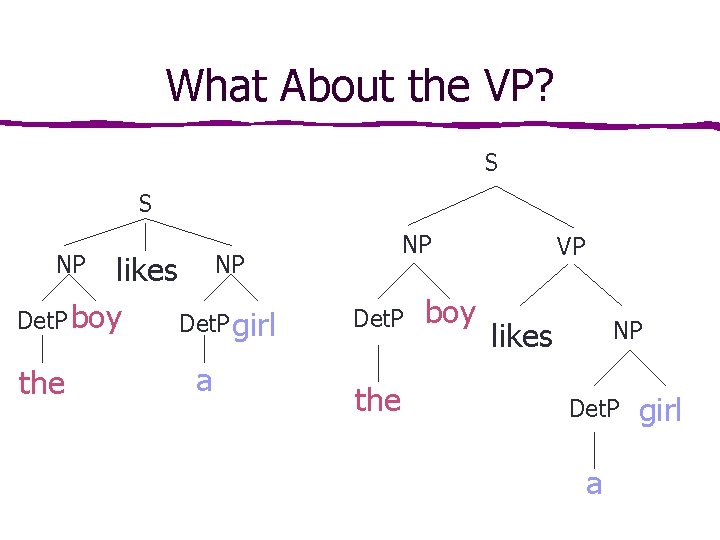
What About the VP? S S likes NP Det. P boy Det. P girl NP NP the a Det. P the boy VP likes NP Det. P a girl
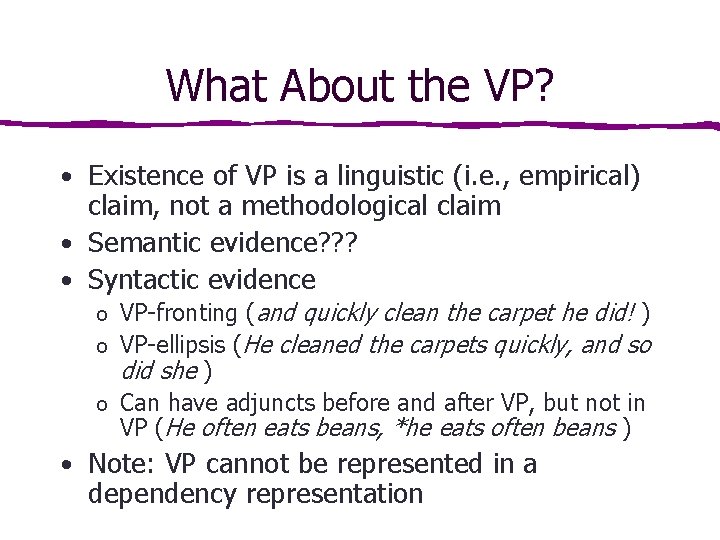
What About the VP? • Existence of VP is a linguistic (i. e. , empirical) claim, not a methodological claim • Semantic evidence? ? ? • Syntactic evidence VP-fronting (and quickly clean the carpet he did! ) o VP-ellipsis (He cleaned the carpets quickly, and so did she ) o Can have adjuncts before and after VP, but not in VP (He often eats beans, *he eats often beans ) o • Note: VP cannot be represented in a dependency representation
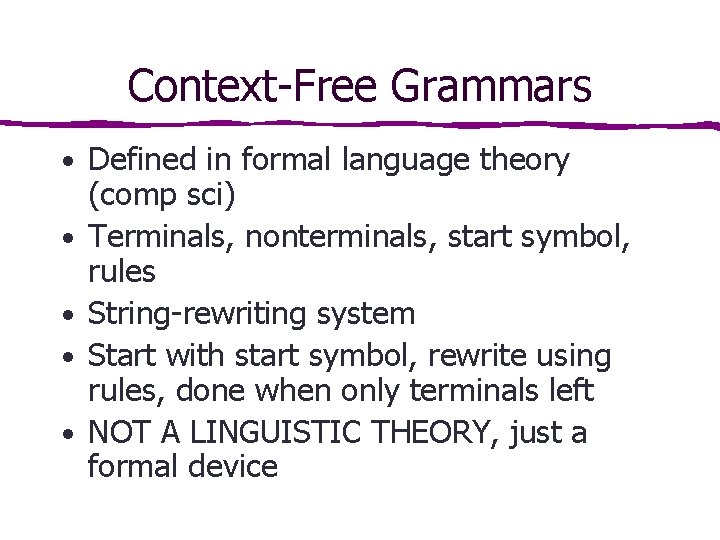
Context-Free Grammars • Defined in formal language theory • • (comp sci) Terminals, nonterminals, start symbol, rules String-rewriting system Start with start symbol, rewrite using rules, done when only terminals left NOT A LINGUISTIC THEORY, just a formal device
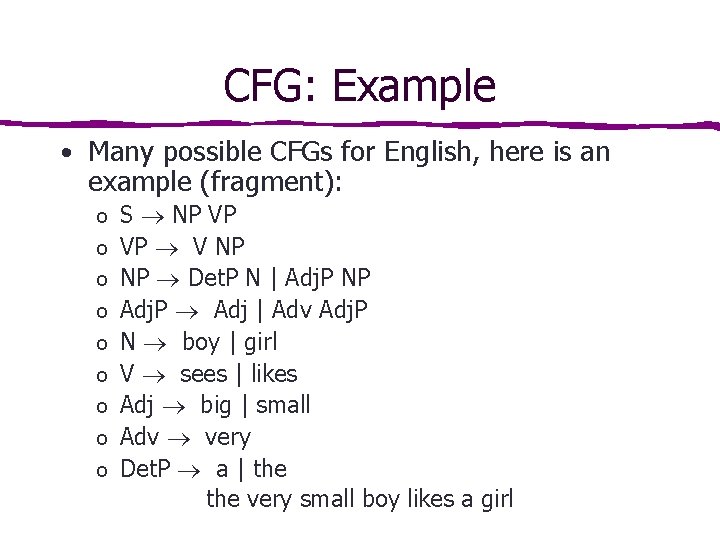
CFG: Example • Many possible CFGs for English, here is an example (fragment): o o o o o S NP VP VP V NP NP Det. P N | Adj. P NP Adj. P Adj | Adv Adj. P N boy | girl V sees | likes Adj big | small Adv very Det. P a | the very small boy likes a girl
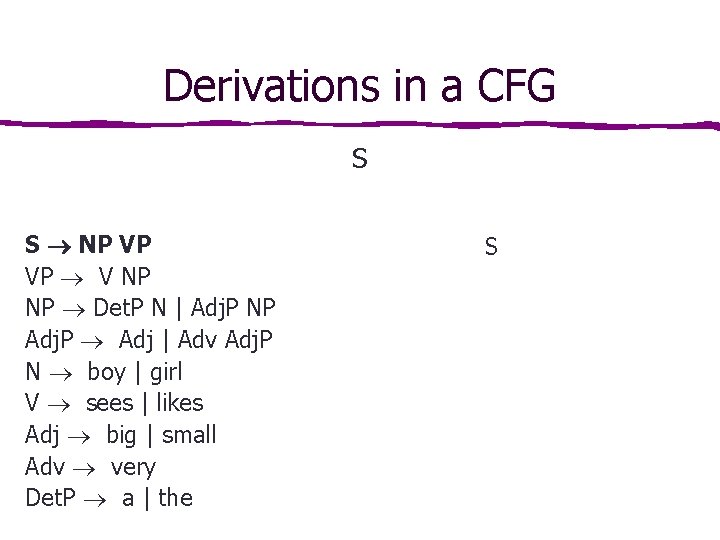
Derivations in a CFG S S NP VP VP V NP NP Det. P N | Adj. P NP Adj. P Adj | Adv Adj. P N boy | girl V sees | likes Adj big | small Adv very Det. P a | the S
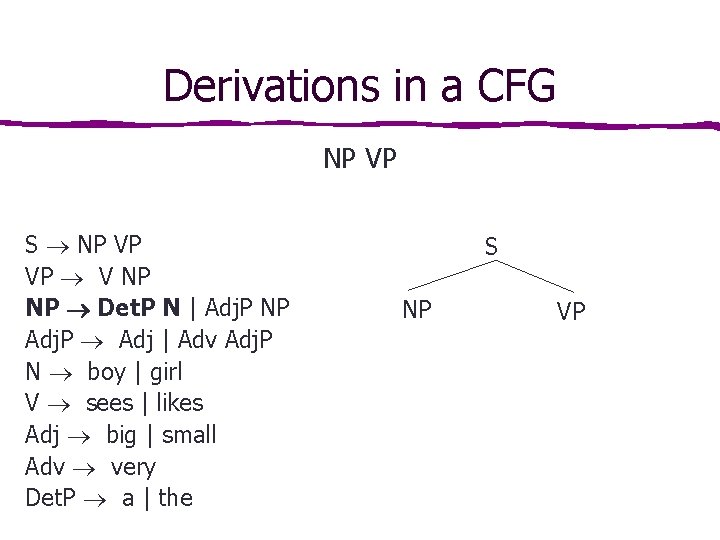
Derivations in a CFG NP VP S NP VP VP V NP NP Det. P N | Adj. P NP Adj. P Adj | Adv Adj. P N boy | girl V sees | likes Adj big | small Adv very Det. P a | the S NP VP
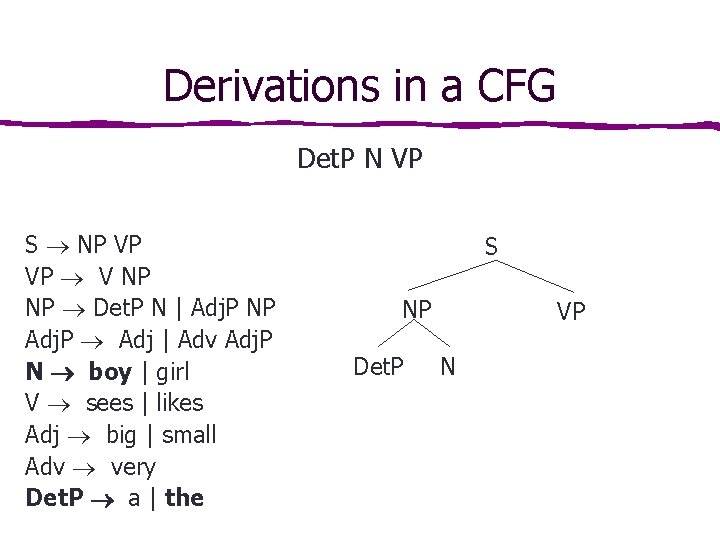
Derivations in a CFG Det. P N VP S NP VP VP V NP NP Det. P N | Adj. P NP Adj. P Adj | Adv Adj. P N boy | girl V sees | likes Adj big | small Adv very Det. P a | the S NP Det. P VP N
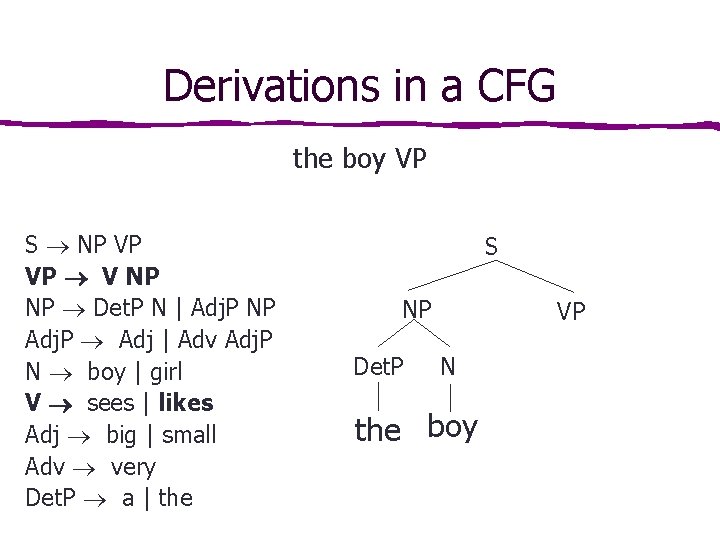
Derivations in a CFG the boy VP S NP VP VP V NP NP Det. P N | Adj. P NP Adj. P Adj | Adv Adj. P N boy | girl V sees | likes Adj big | small Adv very Det. P a | the S NP Det. P VP N the boy
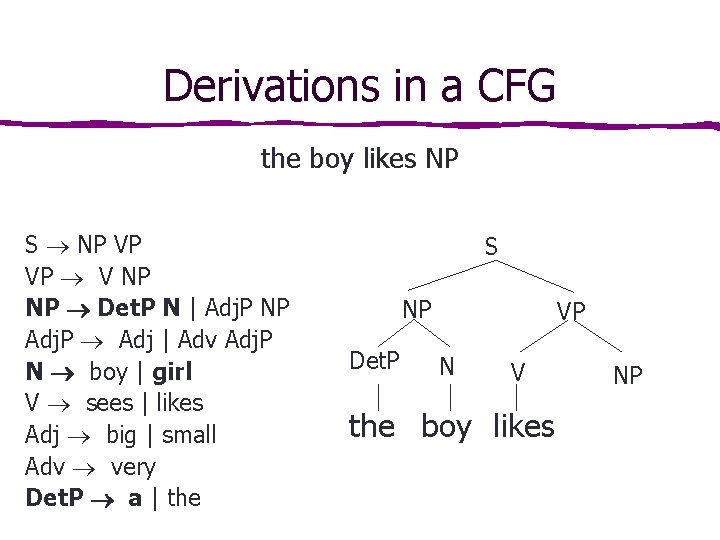
Derivations in a CFG the boy likes NP S NP VP VP V NP NP Det. P N | Adj. P NP Adj. P Adj | Adv Adj. P N boy | girl V sees | likes Adj big | small Adv very Det. P a | the S NP Det. P VP N V the boy likes NP
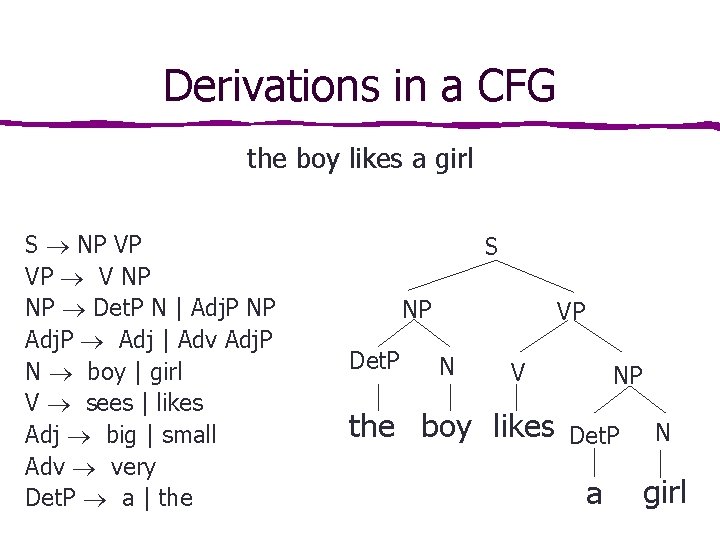
Derivations in a CFG the boy likes a girl S NP VP VP V NP NP Det. P N | Adj. P NP Adj. P Adj | Adv Adj. P N boy | girl V sees | likes Adj big | small Adv very Det. P a | the S NP Det. P VP N V the boy likes NP Det. P N a girl
Derivations in a CFG; Order of Derivation Irrelevant NP likes Det. P girl S NP VP VP V NP NP Det. P N | Adj. P NP Adj. P Adj | Adv Adj. P N boy | girl V sees | likes Adj big | small Adv very Det. P a | the S NP VP V likes NP Det. P N girl
Derivations of CFGs • String rewriting system: we derive a string (=derived structure) • But derivation history represented by phrase-structure tree (=derivation structure)!
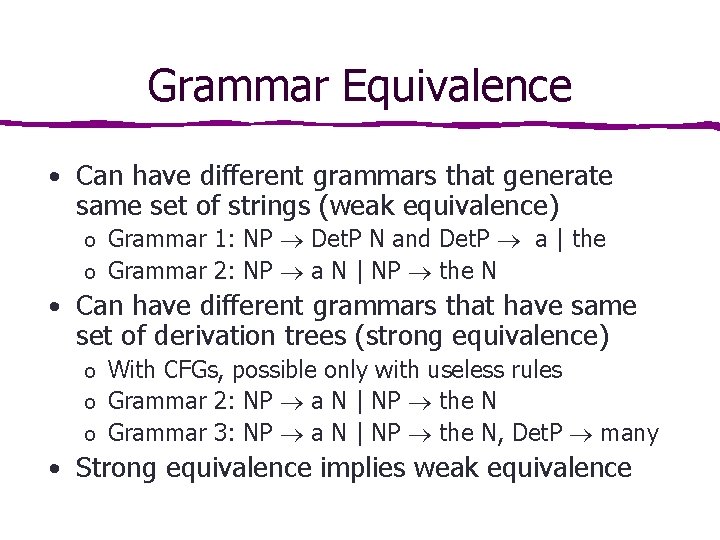
Grammar Equivalence • Can have different grammars that generate same set of strings (weak equivalence) Grammar 1: NP Det. P N and Det. P a | the o Grammar 2: NP a N | NP the N o • Can have different grammars that have same set of derivation trees (strong equivalence) With CFGs, possible only with useless rules o Grammar 2: NP a N | NP the N o Grammar 3: NP a N | NP the N, Det. P many o • Strong equivalence implies weak equivalence
Normal Forms &c • There are weakly equivalent normal forms (Chomsky Normal Form, Greibach Normal Form) • There are ways to eliminate useless productions and so on • See your formal language textbook
GOTO SLIDES 8. PDF, Look at slides 3 to 57
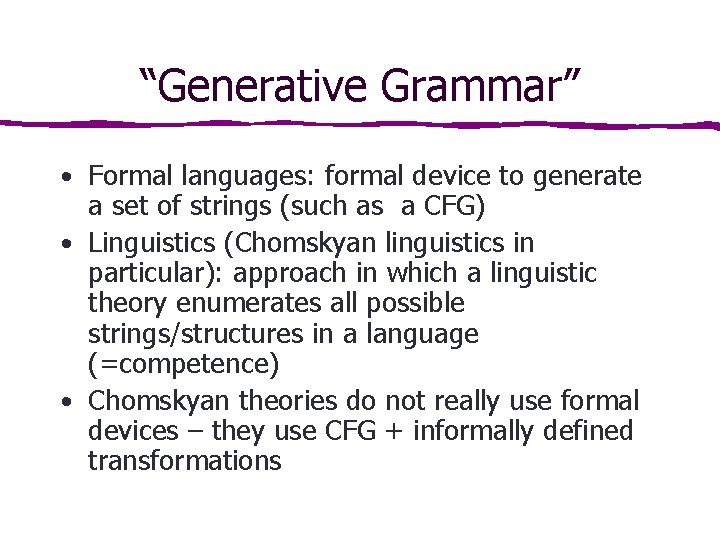
“Generative Grammar” • Formal languages: formal device to generate a set of strings (such as a CFG) • Linguistics (Chomskyan linguistics in particular): approach in which a linguistic theory enumerates all possible strings/structures in a language (=competence) • Chomskyan theories do not really use formal devices – they use CFG + informally defined transformations
Nobody Uses Simple CFGs (Except Intro NLP Courses) • All major syntactic theories (Chomsky, LFG, HPSG, TAG-based theories) represent both phrase structure and dependency, in one way or another • All successful parsers currently use statistics about phrase structure and about dependency • Derive dependency through “head percolation”: for each rule, say which daughter is head
Massive Ambiguity of Syntax • For a standard sentence, and a grammar with wide coverage, there are 1000 s of derivations! • Example: o The large portrait painter told the delegation that he sent money orders in a letter on Wednesday
Penn Treebank (PTB) • Syntactically annotated corpus of newspaper texts (phrase structure) • The newspaper texts are naturally occurring data, but the PTB is not! • PTB annotation represents a particular linguistic theory (but a fairly “vanilla” one) • Particularities Very indirect representation of grammatical relations (need for head percolation tables) o Completely flat structure in NP (brown bag lunch, pink-and-yellow child seat ) o Has flat Ss, flat VPs o
Types of syntactic constructions • Is this the same construction? o An elf decided to clean the kitchen o An elf seemed to clean the kitchen An elf cleaned the kitchen • Is this the same construction? o An elf decided to be in the kitchen o An elf seemed to be in the kitchen An elf was in the kitchen
Types of syntactic constructions (ctd) • Is this the same construction? There is an elf in the kitchen o *There decided to be an elf in the kitchen o There seemed to be an elf in the kitchen • Is this the same construction? It is raining/it rains o ? ? It decided to rain/be raining o It seemed to rain/be raining
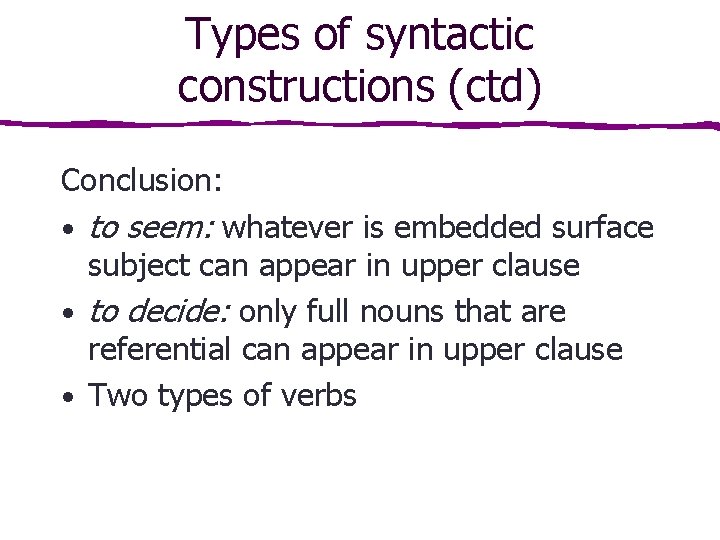
Types of syntactic constructions (ctd) Conclusion: • to seem: whatever is embedded surface subject can appear in upper clause • to decide: only full nouns that are referential can appear in upper clause • Two types of verbs
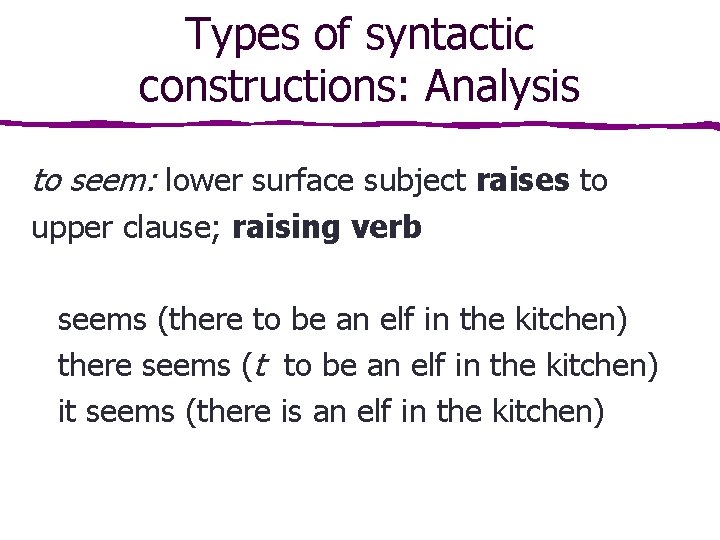
Types of syntactic constructions: Analysis to seem: lower surface subject raises to upper clause; raising verb seems (there to be an elf in the kitchen) there seems (t to be an elf in the kitchen) it seems (there is an elf in the kitchen)
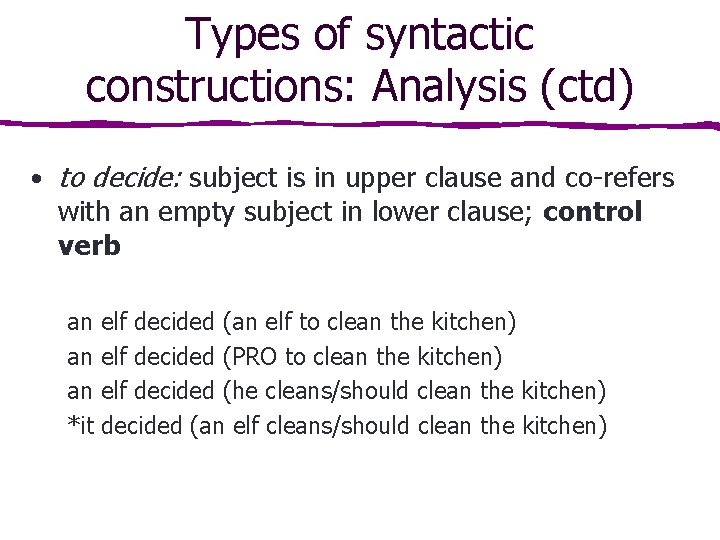
Types of syntactic constructions: Analysis (ctd) • to decide: subject is in upper clause and co-refers with an empty subject in lower clause; control verb an elf decided (an elf to clean the kitchen) an elf decided (PRO to clean the kitchen) an elf decided (he cleans/should clean the kitchen) *it decided (an elf cleans/should clean the kitchen)
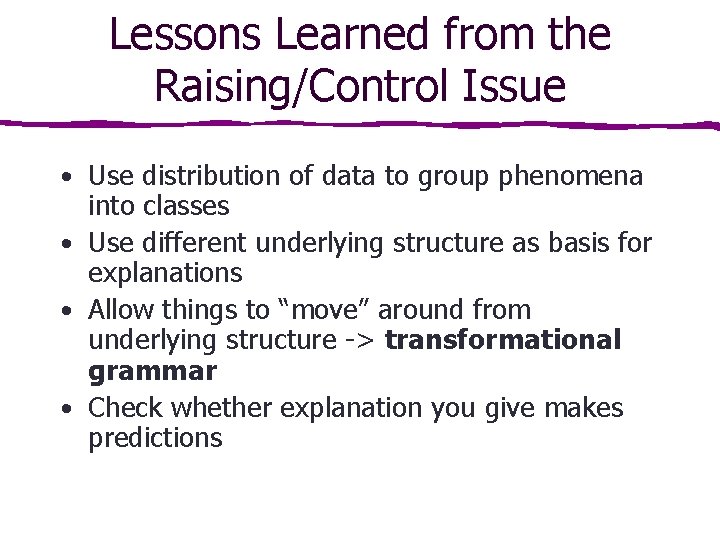
Lessons Learned from the Raising/Control Issue • Use distribution of data to group phenomena into classes • Use different underlying structure as basis for explanations • Allow things to “move” around from underlying structure -> transformational grammar • Check whether explanation you give makes predictions
Empirical Matter The Big Picture or Formalisms • Data structures • Formalisms • Algorithms • Distributional Models uses descriptive theory is about predicts Maud expects there to be a riot *Teri promised there to be a riot Maud expects the shit to hit the fan *Teri promised the shit to hit the explanatory theory is about Linguistic Theory Content: Relate morphology to semantics • Surface representation (eg, ps) • Deep representation (eg, dep) • Correspondence
Additional material on linguistic analyses in TAG: GOTO slides 9. pdf, slides 3 to end