
Introduction to Symmetry Handbook of Constraint Programming Chapter
Introduction to Symmetry Handbook of Constraint Programming, Chapter 10 Presentation by: Robert Woodward Advanced CP, Fall 2009 1
Overview • Introduction • Group Theory – Cauchy form, Cyclic form – Composition, inverse, associativity, group, order of group – Generators • Conclusion 2
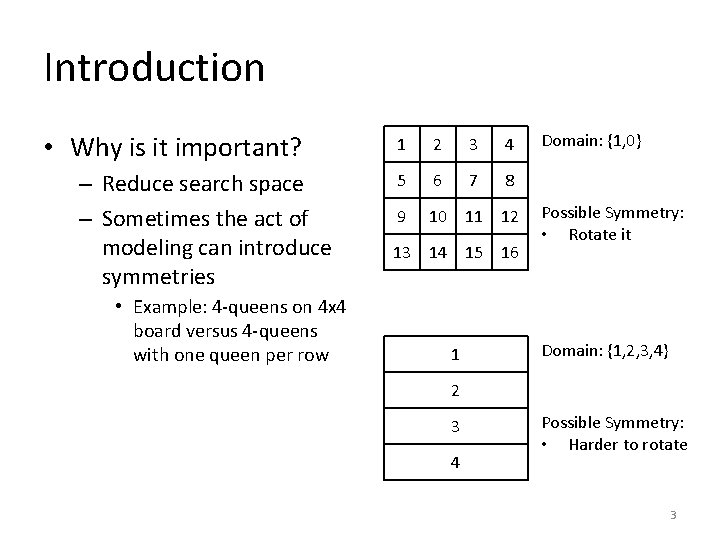
Introduction • Why is it important? – Reduce search space – Sometimes the act of modeling can introduce symmetries • Example: 4 -queens on 4 x 4 board versus 4 -queens with one queen per row 1 2 3 4 5 6 7 8 9 10 11 12 13 14 15 16 1 Domain: {1, 0} Possible Symmetry: • Rotate it Domain: {1, 2, 3, 4} 2 3 4 Possible Symmetry: • Harder to rotate 3
Overview • Introduction • Group Theory – Cauchy form, Cyclic form – Composition, inverse, associativity, group, order of group – Generators • Conclusion 4
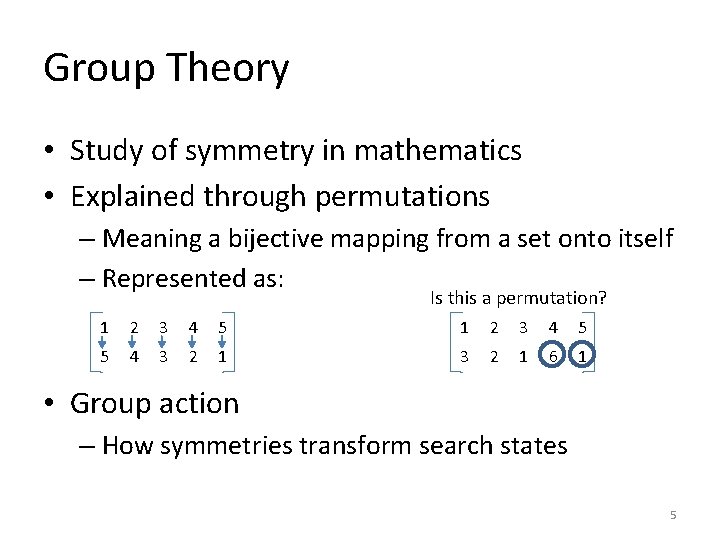
Group Theory • Study of symmetry in mathematics • Explained through permutations – Meaning a bijective mapping from a set onto itself – Represented as: Is this a permutation? 1 2 3 4 5 5 4 3 2 1 6 1 • Group action – How symmetries transform search states 5
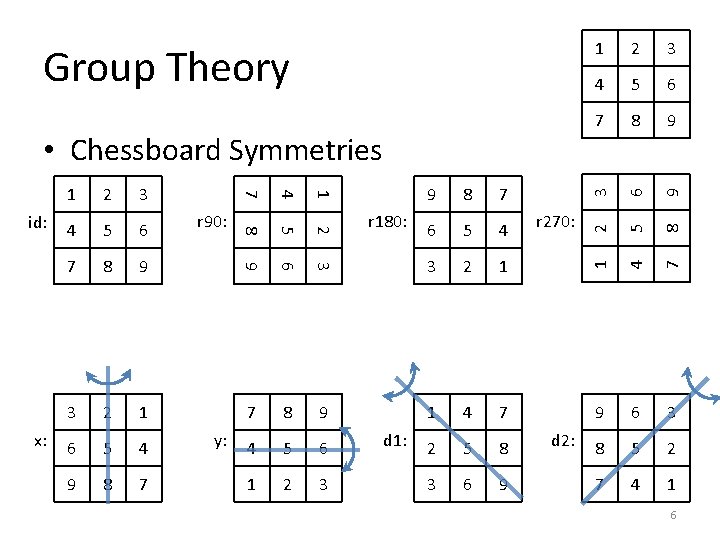
Group Theory 6 5 4 3 2 1 8 9 1 4 7 9 6 3 6 5 4 4 5 6 2 5 8 8 5 2 9 8 7 1 2 3 3 6 9 7 4 1 2 r 180: d 1: r 270: d 2: 9 7 5 7 8 1 y: 8 7 6 2 9 6 9 3 8 5 9 7 4 8 6 3 7 r 90: 5 2 6 4 3 5 3 9 1 4 4 3 8 x: 2 7 id: 1 2 1 • Chessboard Symmetries 1 6
Group Theory • Symmetries & permutations – Permutation is a one-to-one correspondence (i. e. , bijection) between a set and itself – Each symmetry defines a permutation of the set elements – Permutations can be written in Cauchy form • Cauchy form has two rows of numbers – Top row is a complete set of numbers (ascending) – Second row is what number the top row maps to 7
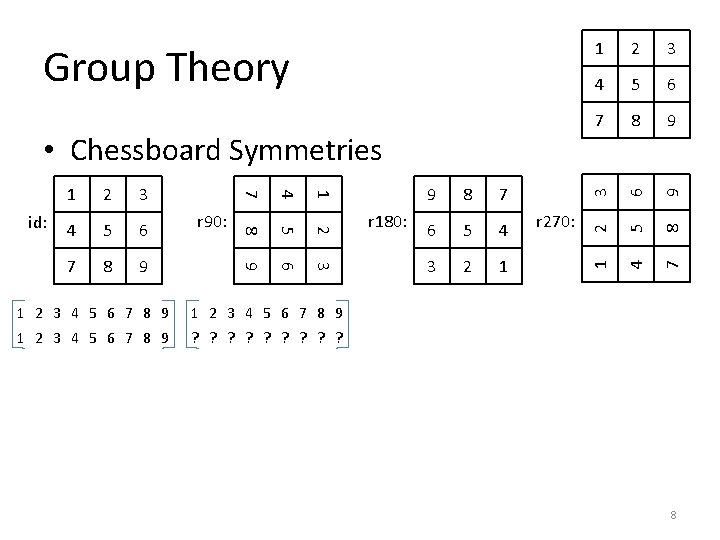
1 2 3 4 5 6 7 8 9 ? ? ? ? ? 3 2 1 r 270: 9 4 9 8 5 8 7 6 7 5 7 6 4 8 5 2 r 180: 9 4 1 3 9 2 8 1 7 r 90: 6 6 5 5 4 4 9 3 8 2 7 id: 1 3 3 • Chessboard Symmetries 2 6 Group Theory 1 8
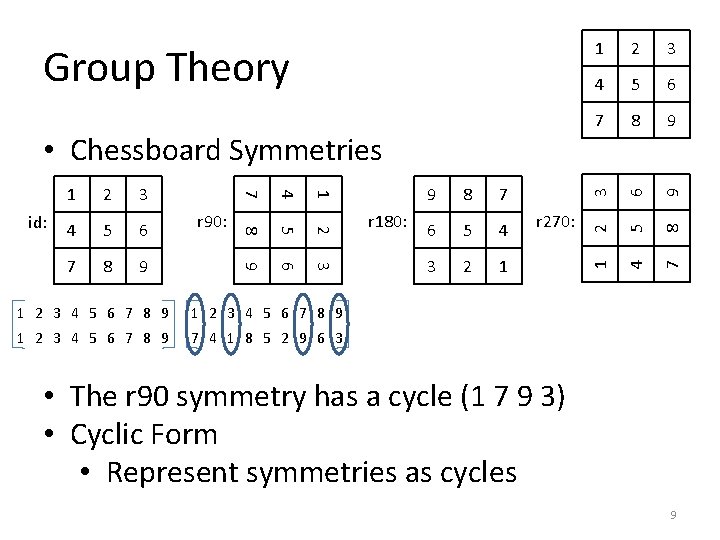
1 2 3 4 5 6 7 8 9 7 4 1 8 5 2 9 6 3 3 2 1 r 270: 9 4 9 8 5 8 7 6 7 5 7 6 4 8 5 2 r 180: 9 4 1 3 9 2 8 1 7 r 90: 6 6 5 5 4 4 9 3 8 2 7 id: 1 3 3 • Chessboard Symmetries 2 6 Group Theory 1 • The r 90 symmetry has a cycle (1 7 9 3) • Cyclic Form • Represent symmetries as cycles 9
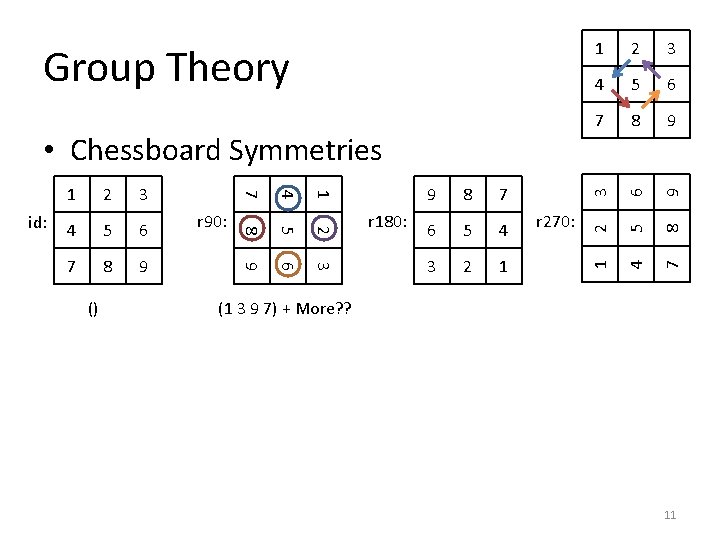
() 3 2 1 r 270: 9 4 9 8 5 8 7 6 7 5 7 6 4 8 5 2 r 180: 9 4 1 3 9 2 8 1 7 r 90: 6 6 5 5 4 4 9 3 8 2 7 id: 1 3 3 • Chessboard Symmetries 2 6 Group Theory 1 (1 3 9 7) + More? ? 11
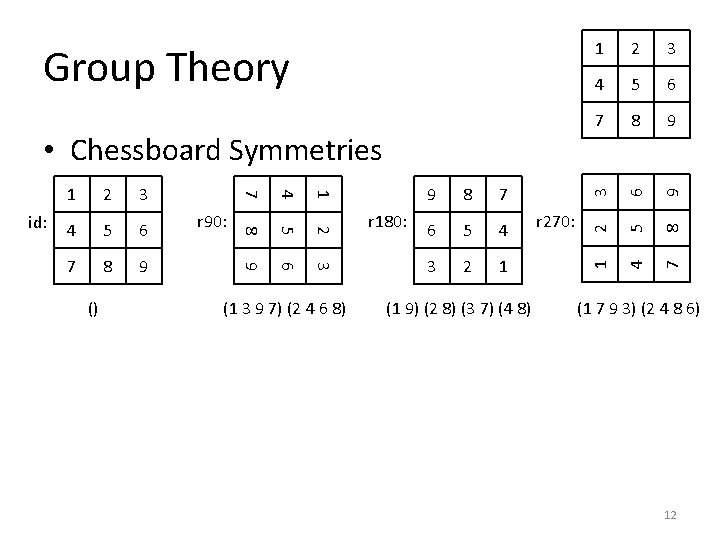
() (1 3 9 7) (2 4 6 8) 3 2 1 (1 9) (2 8) (3 7) (4 8) r 270: 9 4 9 8 5 8 7 6 7 5 7 6 4 8 5 2 r 180: 9 4 1 3 9 2 8 1 7 r 90: 6 6 5 5 4 4 9 3 8 2 7 id: 1 3 3 • Chessboard Symmetries 2 6 Group Theory 1 (1 7 9 3) (2 4 8 6) 12
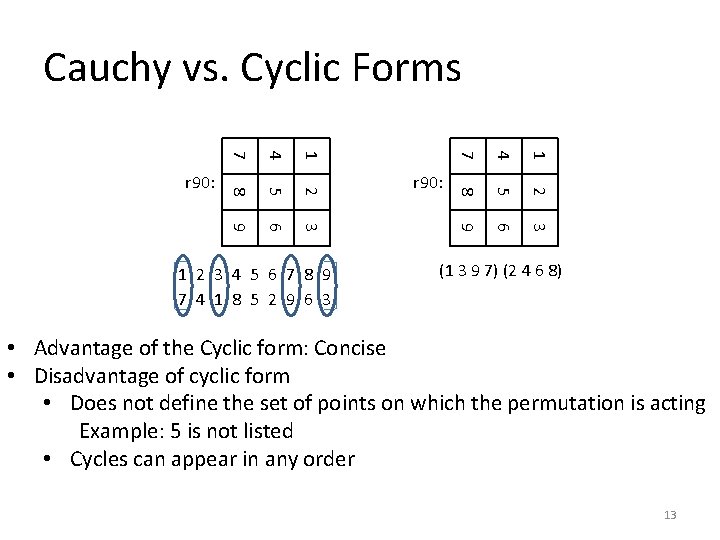
Cauchy vs. Cyclic Forms 1 5 2 6 3 3 4 2 6 9 5 9 8 8 1 2 3 4 5 6 7 8 9 7 4 1 8 5 2 9 6 3 r 90: 7 1 4 7 r 90: (1 3 9 7) (2 4 6 8) • Advantage of the Cyclic form: Concise • Disadvantage of cyclic form • Does not define the set of points on which the permutation is acting Example: 5 is not listed • Cycles can appear in any order 13
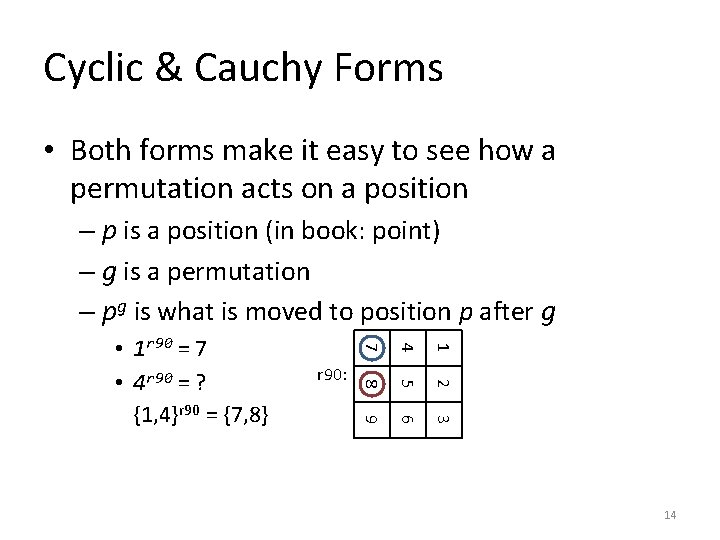
Cyclic & Cauchy Forms • Both forms make it easy to see how a permutation acts on a position – p is a position (in book: point) – g is a permutation – pg is what is moved to position p after g 4 1 8 5 2 9 6 3 r 90: 7 • 1 r 90 = 7 • 4 r 90 = ? {1, 4}r 90 = {7, 8} 14
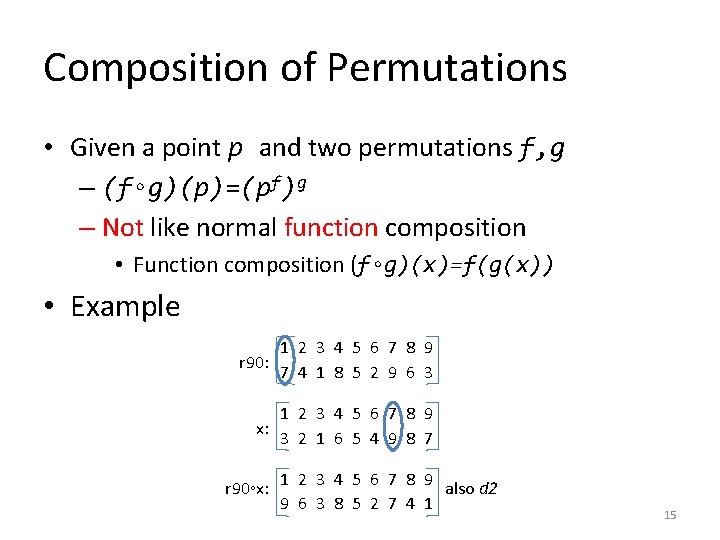
Composition of Permutations • Given a point p and two permutations f, g – (f◦g)(p)=(pf)g – Not like normal function composition • Function composition (f◦g)(x)=f(g(x)) • Example 1 2 3 4 5 6 7 8 9 r 90: 7 4 1 8 5 2 9 6 3 1 2 3 4 5 6 7 8 9 x: 3 2 1 6 5 4 9 8 7 r 90◦x: 1 2 3 4 5 6 7 8 9 also d 2 9 6 3 8 5 2 7 4 1 15
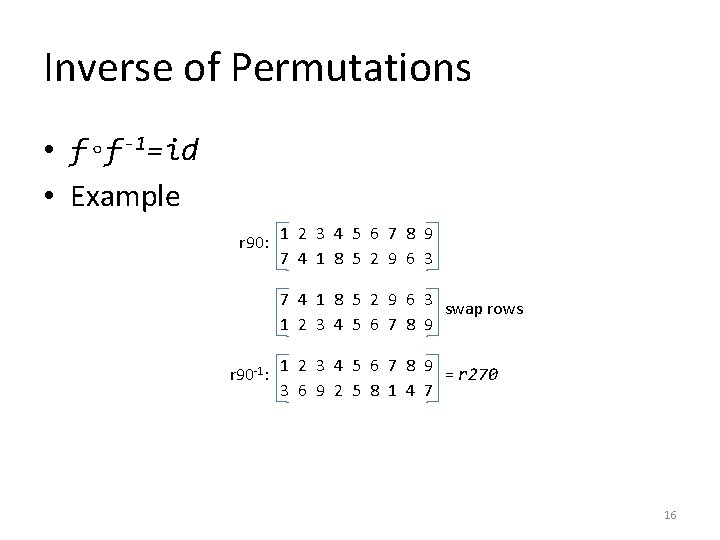
Inverse of Permutations • f◦f-1=id • Example r 90: 1 2 3 4 5 6 7 8 9 7 4 1 8 5 2 9 6 3 swap rows 1 2 3 4 5 6 7 8 9 r 90 -1: 1 2 3 4 5 6 7 8 9 = r 270 3 6 9 2 5 8 1 4 7 16
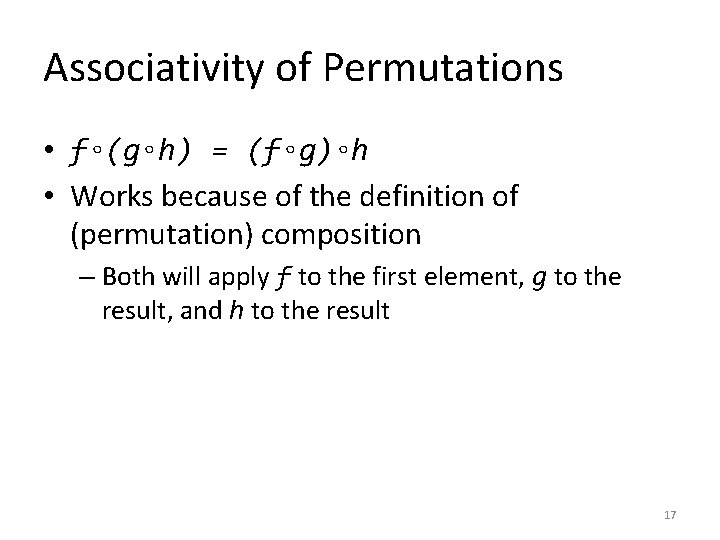
Associativity of Permutations • f◦(g◦h) = (f◦g)◦h • Works because of the definition of (permutation) composition – Both will apply f to the first element, g to the result, and h to the result 17
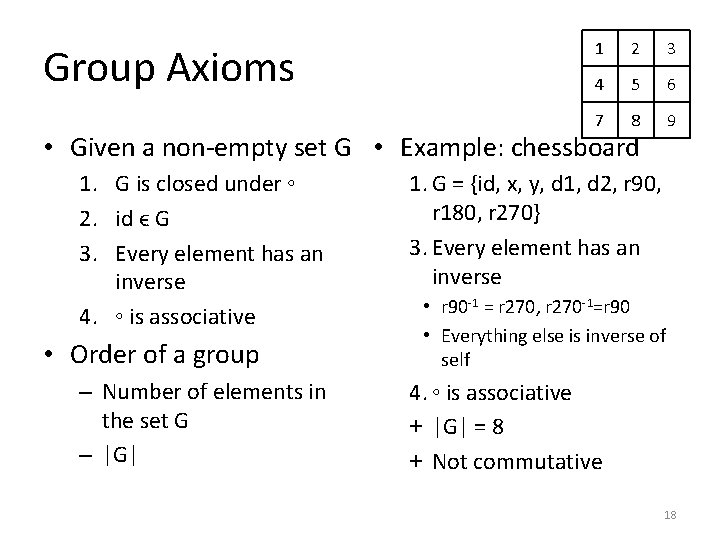
Group Axioms 1 2 3 4 5 6 7 8 9 • Given a non-empty set G • Example: chessboard 1. G is closed under ◦ 2. id ϵ G 3. Every element has an inverse 4. ◦ is associative • Order of a group – Number of elements in the set G – |G| 1. G = {id, x, y, d 1, d 2, r 90, r 180, r 270} 3. Every element has an inverse • r 90 -1 = r 270, r 270 -1=r 90 • Everything else is inverse of self 4. ◦ is associative + |G| = 8 + Not commutative 18
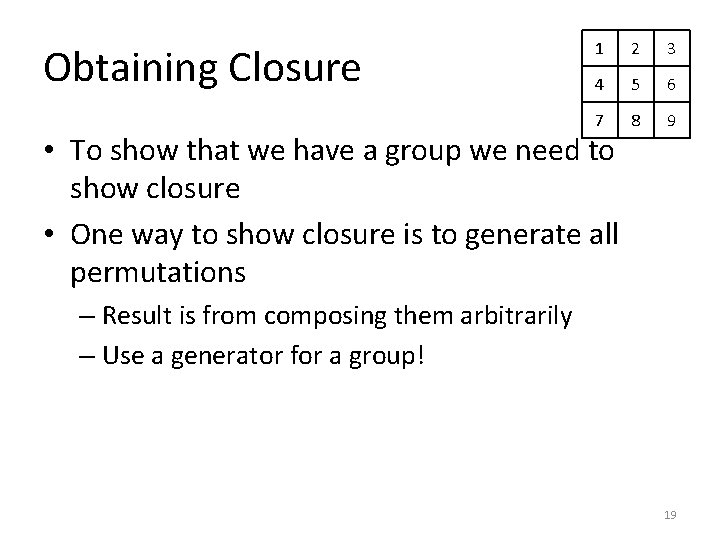
Obtaining Closure 1 2 3 4 5 6 7 8 9 • To show that we have a group we need to show closure • One way to show closure is to generate all permutations – Result is from composing them arbitrarily – Use a generator for a group! 19
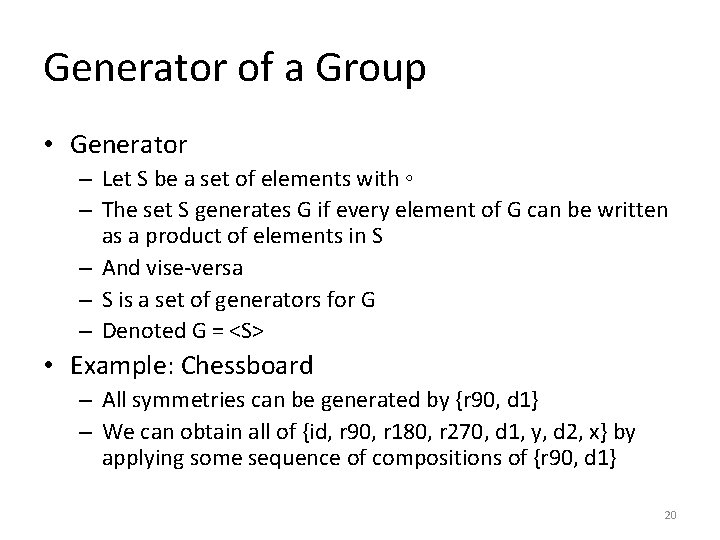
Generator of a Group • Generator – Let S be a set of elements with ◦ – The set S generates G if every element of G can be written as a product of elements in S – And vise-versa – S is a set of generators for G – Denoted G = <S> • Example: Chessboard – All symmetries can be generated by {r 90, d 1} – We can obtain all of {id, r 90, r 180, r 270, d 1, y, d 2, x} by applying some sequence of compositions of {r 90, d 1} 20
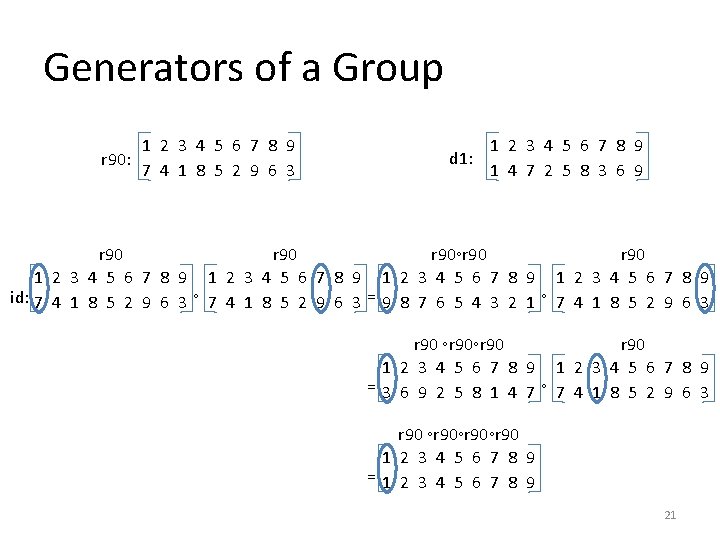
Generators of a Group 1 2 3 4 5 6 7 8 9 r 90: 7 4 1 8 5 2 9 6 3 1 2 3 4 5 6 7 8 9 d 1: 1 4 7 2 5 8 3 6 9 r 90◦r 90 1 2 3 4 5 6 7 8 9 id: 7 4 1 8 5 2 9 6 3 ◦ 7 4 1 8 5 2 9 6 3 = 9 8 7 6 5 4 3 2 1 ◦ 7 4 1 8 5 2 9 6 3 r 90 ◦r 90 1 2 3 4 5 6 7 8 9 =3 6 9 2 5 8 1 4 7◦ 7 4 1 8 5 2 9 6 3 r 90 ◦r 90◦r 90 1 2 3 4 5 6 7 8 9 =1 2 3 4 5 6 7 8 9 21
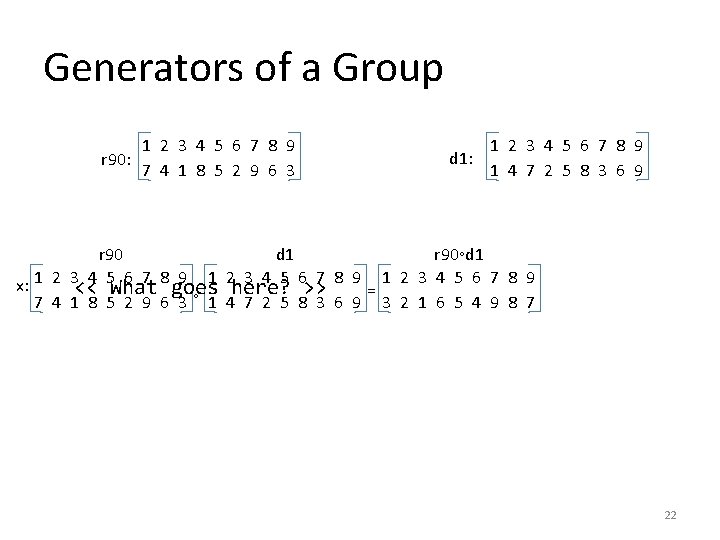
Generators of a Group 1 2 3 4 5 6 7 8 9 r 90: 7 4 1 8 5 2 9 6 3 1 2 3 4 5 6 7 8 9 d 1: 1 4 7 2 5 8 3 6 9 r 90 d 1 r 90◦d 1 4 5 6 7 8 9 1 2 3 4 5 6 7 8 9 x: 1 2 3<< What goes here? >> = 7 4 1 8 5 2 9 6 3◦ 1 4 7 2 5 8 3 6 9 3 2 1 6 5 4 9 8 7 22
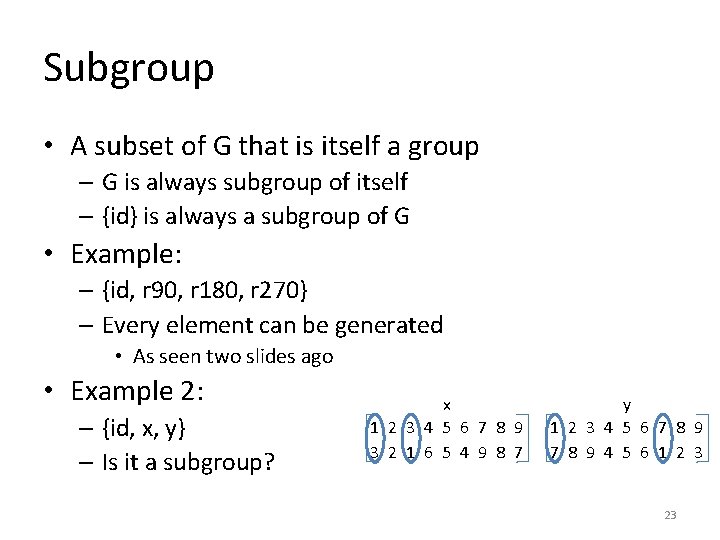
Subgroup • A subset of G that is itself a group – G is always subgroup of itself – {id} is always a subgroup of G • Example: – {id, r 90, r 180, r 270} – Every element can be generated • As seen two slides ago • Example 2: – {id, x, y} – Is it a subgroup? x 1 2 3 4 5 6 7 8 9 3 2 1 6 5 4 9 8 7 y 1 2 3 4 5 6 7 8 9 4 5 6 1 2 3 23
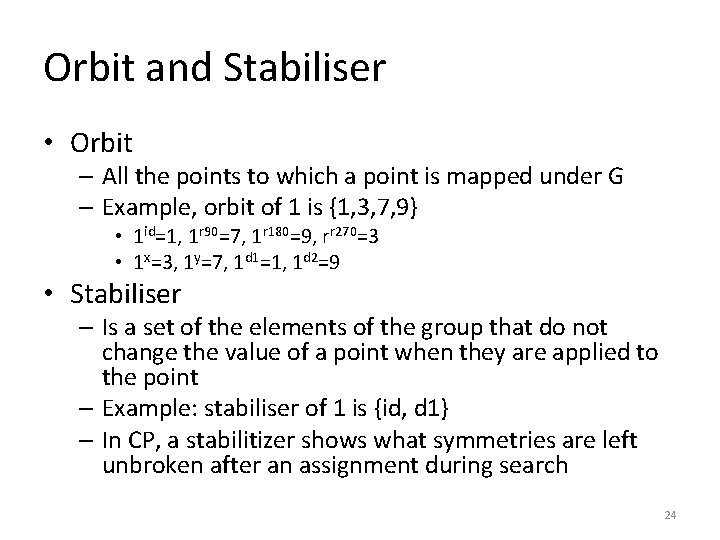
Orbit and Stabiliser • Orbit – All the points to which a point is mapped under G – Example, orbit of 1 is {1, 3, 7, 9} • 1 id=1, 1 r 90=7, 1 r 180=9, rr 270=3 • 1 x=3, 1 y=7, 1 d 1=1, 1 d 2=9 • Stabiliser – Is a set of the elements of the group that do not change the value of a point when they are applied to the point – Example: stabiliser of 1 is {id, d 1} – In CP, a stabilitizer shows what symmetries are left unbroken after an assignment during search 24
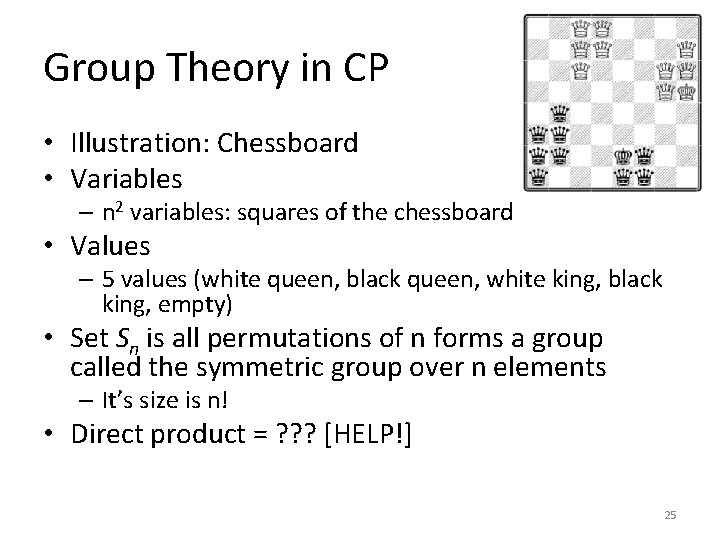
Group Theory in CP • Illustration: Chessboard • Variables – n 2 variables: squares of the chessboard • Values – 5 values (white queen, black queen, white king, black king, empty) • Set Sn is all permutations of n forms a group called the symmetric group over n elements – It’s size is n! • Direct product = ? ? ? [HELP!] 25
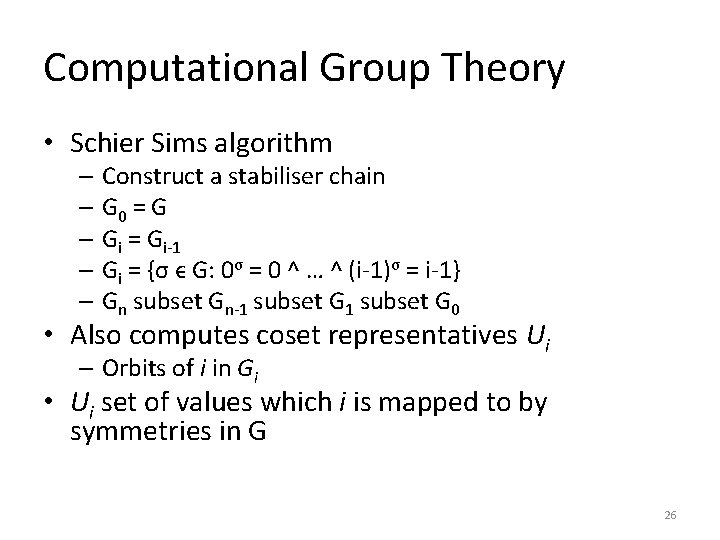
Computational Group Theory • Schier Sims algorithm – Construct a stabiliser chain – G 0 = G – Gi = Gi-1 – Gi = {σ ϵ G: 0σ = 0 ^ … ^ (i-1)σ = i-1} – Gn subset Gn-1 subset G 0 • Also computes coset representatives Ui – Orbits of i in Gi • Ui set of values which i is mapped to by symmetries in G 26
Overview • Introduction • Group Theory – Cauchy form, Cyclic form – Composition, inverse, associativity, group, order of group – Generators • Conclusion 38
Conclusion • Symmetry limits the search space • Symmetry is group theory – Represented as permutations • Past / Current research has a lot of different definitions regarding symmetry – Most of it is either solution symmetry or problem symmetry 39
Thank you! • Any questions? • PS: Symmetry is cool 40
Typos • Page 334 – Paragraph after Example 10. 7 – Second, a group element g operates by the composition operator to permute the values o. F other elements in the group. • Page 336 – Example 10. 17 – Values: white queen, black queen, white king, black queen king • Page 338 – Second paragraph after Definition 10. 19 – “Two values ai and bi are symmetric for all solutions if…” 41
- Slides: 29