
Introduction to Sustainability These notes available via the
Introduction to Sustainability

These notes available via the online course outline at: http: //www. brocku. ca/tren/ courses/tren 3 p 18
TREN 1 F 90 Introduction to Sustainability u u u Definitions – environment – policy – scale – jurisdiction Defining Sustainable Development About Interdisciplinarity
Definitions, tools and frameworks
en·vi·ron·ment in-'v. I-r&(n)-m&nt, -'v. I(-&)r(n)- [n] 1 : the circumstances, objects, or conditions by which one is surrounded 2 a : the complex of physical, chemical, and biotic factors (as climate, soil, and living things) that act upon an organism or an ecological community and ultimately determine its form and survival b : the aggregate of social and cultural conditions that influence the life of an individual or community. - Merriam-Webster Online Dictionary, 2004
environment the totality of surrounding conditions. [n]
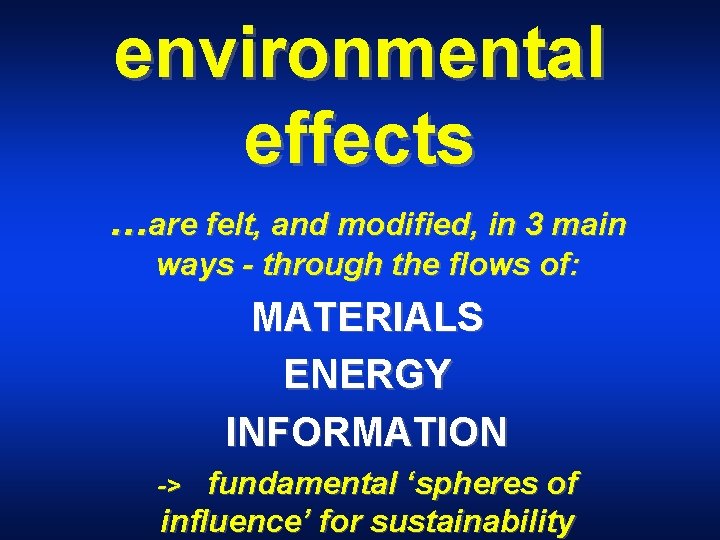
environmental effects …are felt, and modified, in 3 main ways - through the flows of: MATERIALS ENERGY INFORMATION fundamental ‘spheres of influence’ for sustainability ->
policy …a course or general plan of action to be adopted by a government, party, person, etc. - Concise Oxford Dictionary
policy …a selected, planned line of conduct in the light of which individual decisions are made and coordination achieved - Webster’s Encyclopedic Dictionary
conceptual tools for understanding sustainability
scale - an ordered series of graduated quantities, values, degrees, etc. - relative magnitude - Webster’s Encyclopedic Dictionary
scale may be: - physical / geographical – ranking based upon size, dimension, geographical subunit, etc. - ecological – individual, deme, community, population - jurisdictional – local, municipal, regional, federal, global
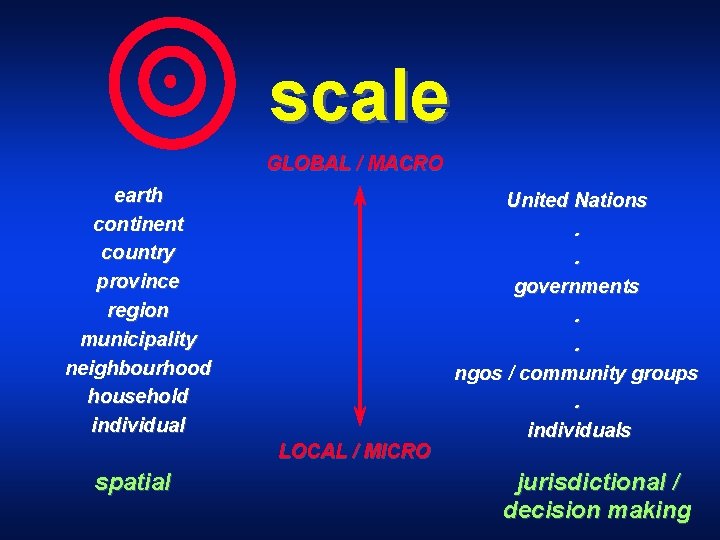
scale GLOBAL / MACRO earth continent country province region municipality neighbourhood household individual LOCAL / MICRO spatial United Nations. . governments. . ngos / community groups. individuals jurisdictional / decision making
jurisdiction - the legal power to administer and enforce the law - the exercising of this power - the region within which this power is valid or in which a person has authority - Webster’s Encyclopedic Dictionary
Defining Sustainable Development
Sustainable development: u meeting the needs of the present without compromising the ability of future generations to meet their own needs. – World Commission on Environment and Development (1987): Our Common Future
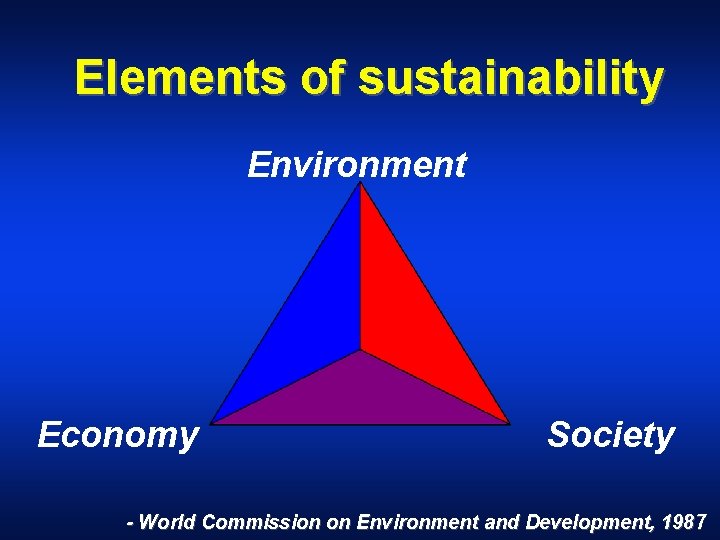
Elements of sustainability Environment Economy Society - World Commission on Environment and Development, 1987
the sustainable development triangle
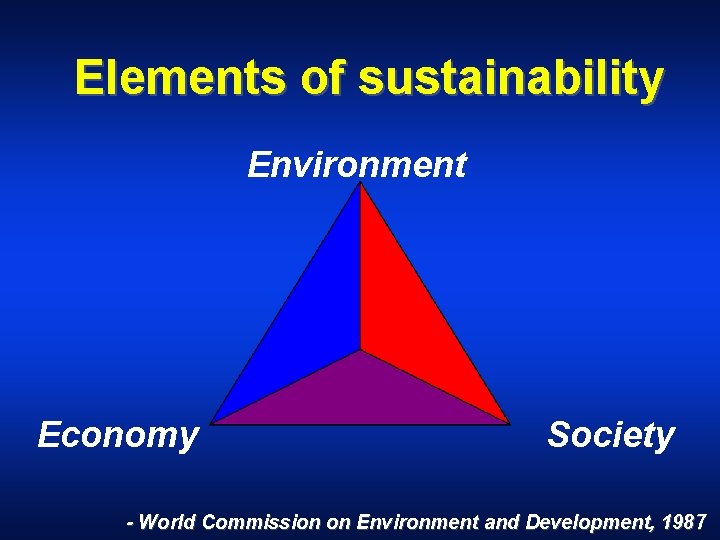
Elements of sustainability Environment Economy Society - World Commission on Environment and Development, 1987
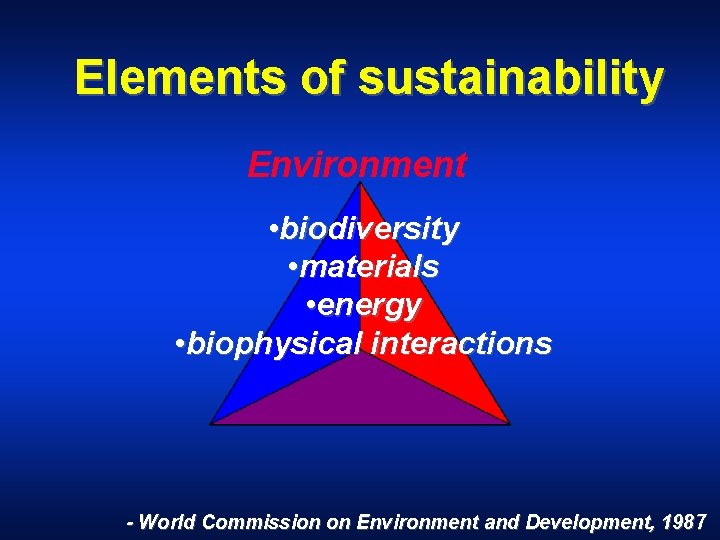
Elements of sustainability Environment • biodiversity • materials • energy • biophysical interactions - World Commission on Environment and Development, 1987
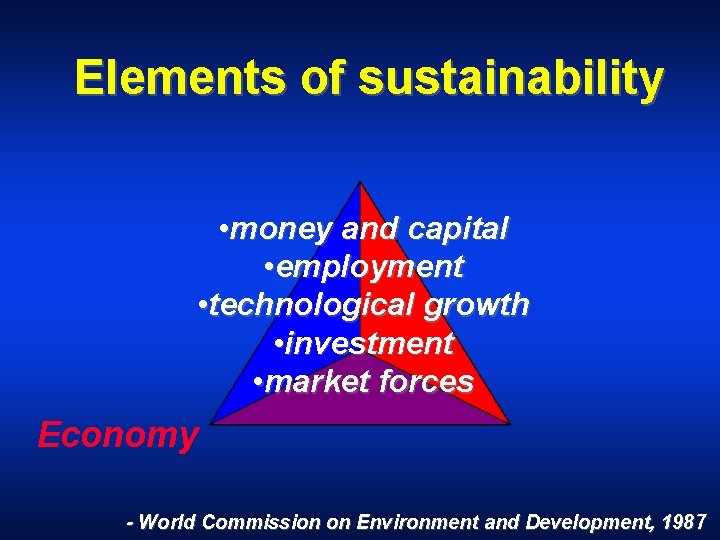
Elements of sustainability • money and capital • employment • technological growth • investment • market forces Economy - World Commission on Environment and Development, 1987
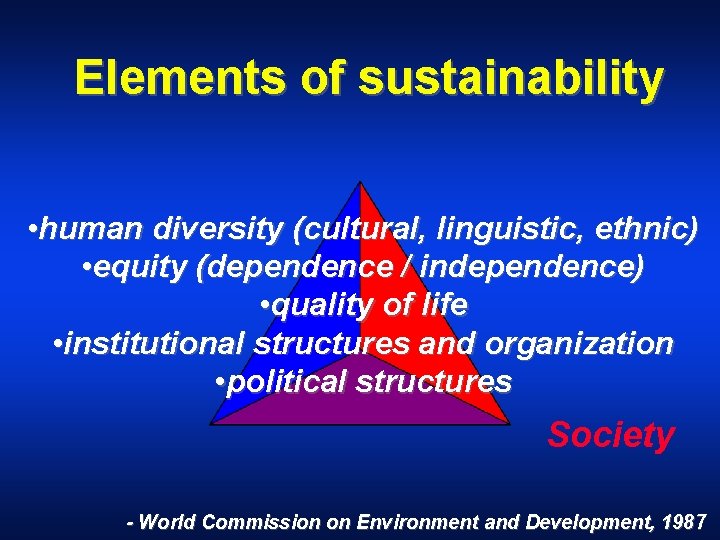
Elements of sustainability • human diversity (cultural, linguistic, ethnic) • equity (dependence / independence) • quality of life • institutional structures and organization • political structures Society - World Commission on Environment and Development, 1987
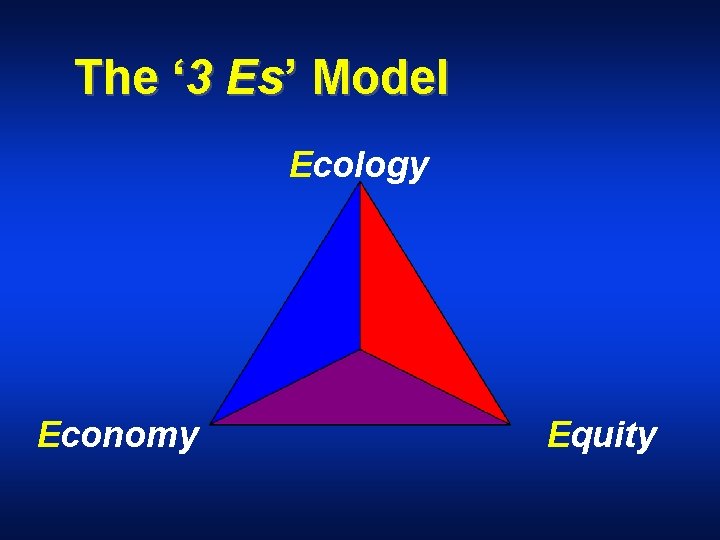
The ‘ 3 Es’ Model Ecology Economy Equity
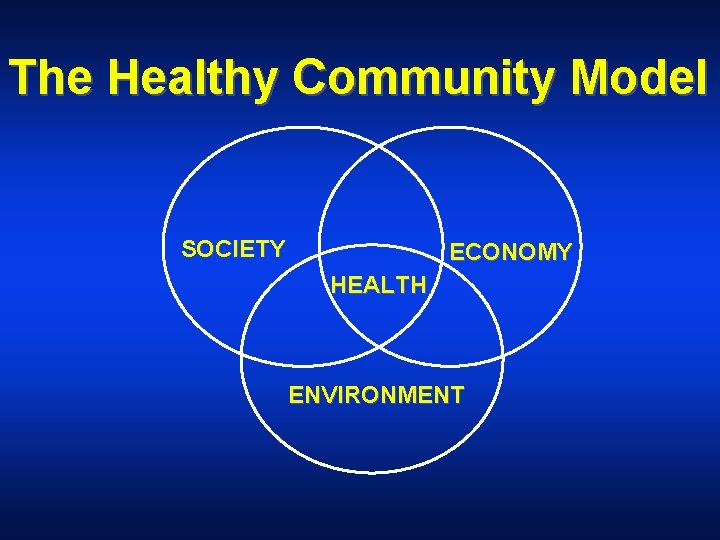
The Healthy Community Model SOCIETY ECONOMY HEALTH ENVIRONMENT
Sustainability: PROBLEMS u u u Depletion of finite resources – fuels, soil, minerals, species Over-use of renewable resources – forests, fish & wildlife, fertility, public funds Pollution – air, water, soil Inequity – economic, political, social, gender Species loss – endangered species and spaces - WCED, 1987
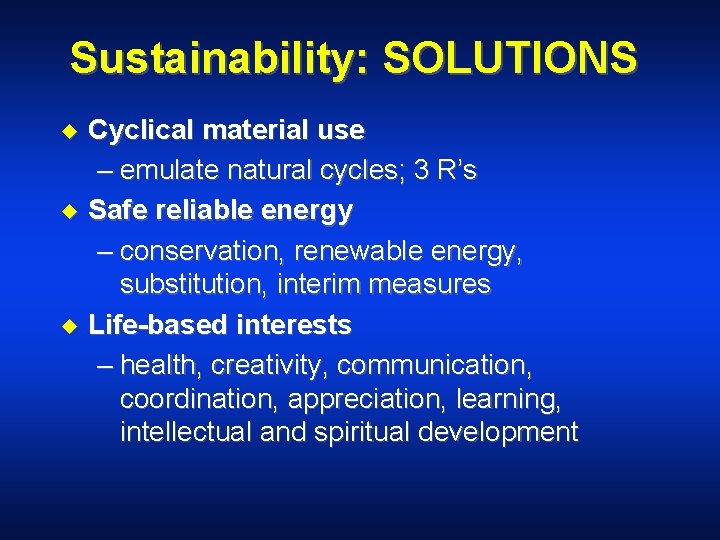
Sustainability: SOLUTIONS u u u Cyclical material use – emulate natural cycles; 3 R’s Safe reliable energy – conservation, renewable energy, substitution, interim measures Life-based interests – health, creativity, communication, coordination, appreciation, learning, intellectual and spiritual development
Two key sustainable development concepts: EQUITY LIMITS TO GROWTH -WCED 1987
Two key sustainable development concepts: the concept of needs, particularly the essential needs of the world’s poor EQUITY -WCED 1987
Two key sustainable development concepts: EQUITY • the quality of being fair or impartial; fairness; impartiality • something that is fair and just. -dictionary. com
Contrast with: EQUALITY • the state or quality of being equal; correspondence in quantity, degree, value, rank, or ability. • uniform character, as of motion or surface. -dictionary. com
Two key sustainable development concepts: the idea of limitations (ecological, technological, and social) which affect the environment’s ability to meet present and future needs LIMITS TO GROWTH -WCED 1987
Two key sustainable development concepts: LIMITS TO GROWTH - quantitative and qualitative limits - living within the regenerative and assimilative capacities of the planet -WCED 1987
Sustainable development. . . u implies limits Not predefined absolute limits, but limitations imposed by: – the ability of the biosphere to absorb the effects of human activities – adaptability of human social and political organization – technology
Sustainable development and economic growth Economic growth must be made: – less material intensive (‘dematerialization of the economy’) – less energy intensive – more equitable in its impacts u Economic growth may be reduced or curtailed to meet limitations imposed by environment, technology, or society
Institutional gaps impeding sustainable development 2 major gaps: u fragmented decision making – narrow mandates, jurisdictional rigidity, lack of communication and coordination u lack of accountabiity – failure to make the bodies whose policy actions degrade the environment responsible for their actions

materials and energy
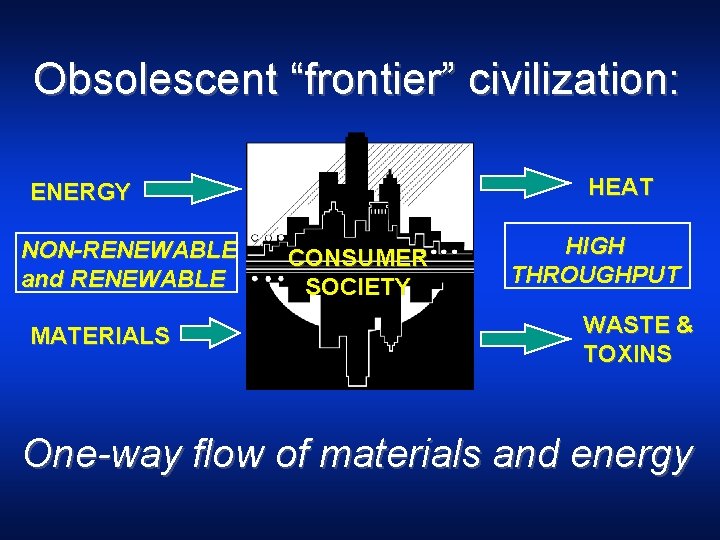
Obsolescent “frontier” civilization: ENERGY NON-RENEWABLE CONSUMER and RENEWABLE CONVENTIONAL SOCIETY URBAN SYSTEM MATERIALS HEAT HIGH THROUGHPUT WASTE & TOXINS One-way flow of materials and energy
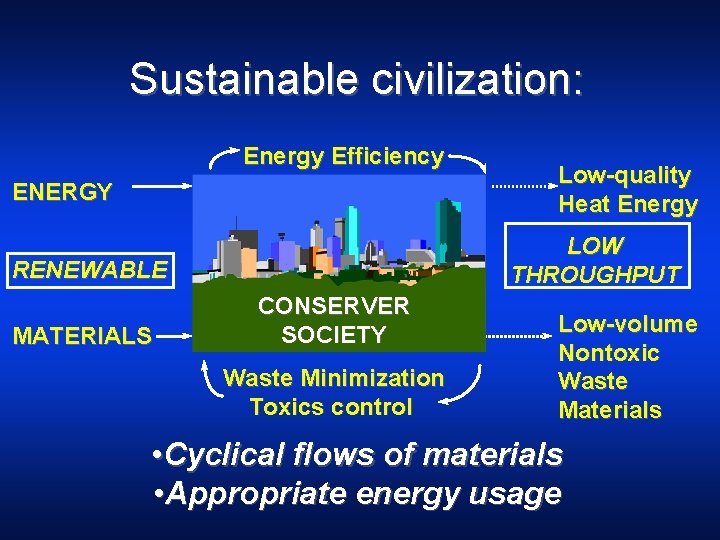
Sustainable civilization: Energy Efficiency ENERGY LOW THROUGHPUT RENEWABLE MATERIALS Low-quality Heat Energy CONSERVER SOCIETY Waste Minimization Toxics control Low-volume Nontoxic Waste Materials • Cyclical flows of materials • Appropriate energy usage
information and decision making
Sustainable development. . . u considers future and present needs when making decisions about: – resource and energy use – technological development – direction of investments – social, political & institutional change. . . etc.
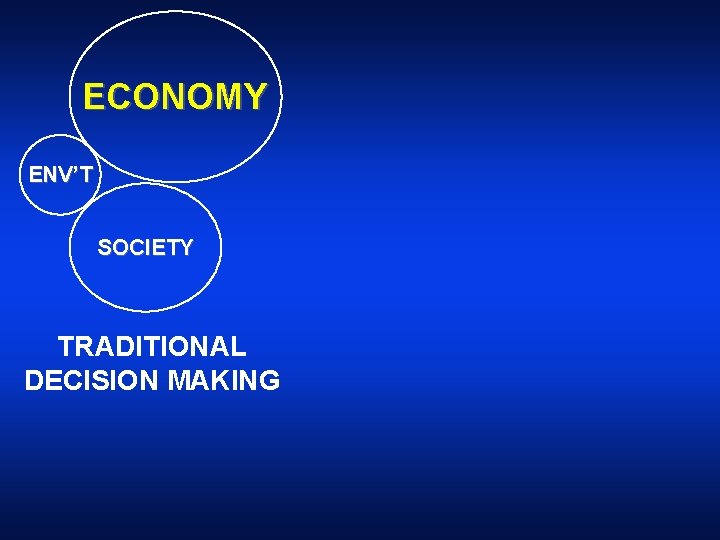
ECONOMY ENV’T SOCIETY TRADITIONAL DECISION MAKING
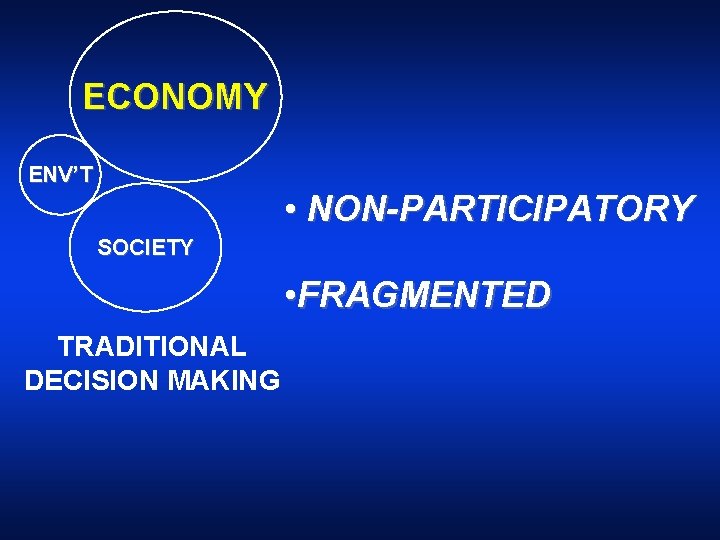
ECONOMY ENV’T • NON-PARTICIPATORY SOCIETY • FRAGMENTED TRADITIONAL DECISION MAKING
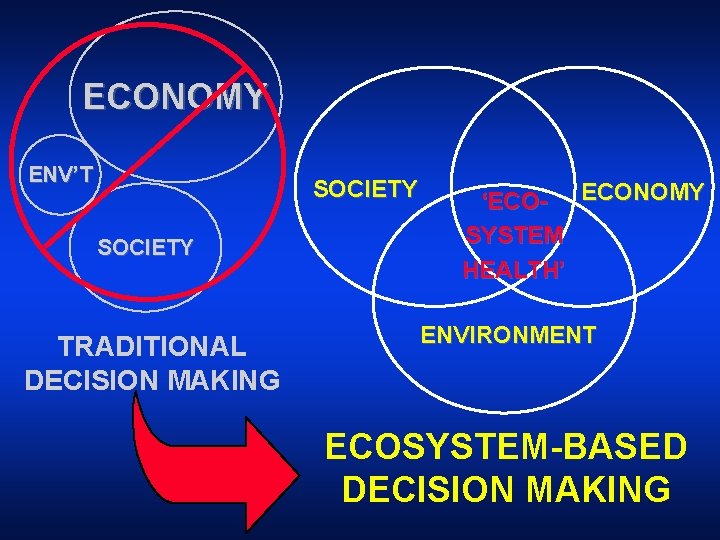
ECONOMY ENV’T SOCIETY TRADITIONAL DECISION MAKING ‘ECO- ECONOMY SYSTEM HEALTH’ ENVIRONMENT ECOSYSTEM-BASED DECISION MAKING
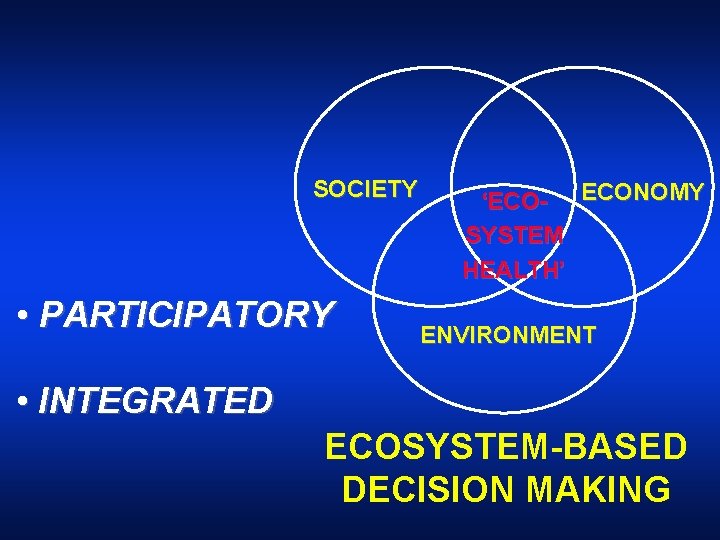
SOCIETY • PARTICIPATORY ‘ECO- ECONOMY SYSTEM HEALTH’ ENVIRONMENT • INTEGRATED ECOSYSTEM-BASED DECISION MAKING
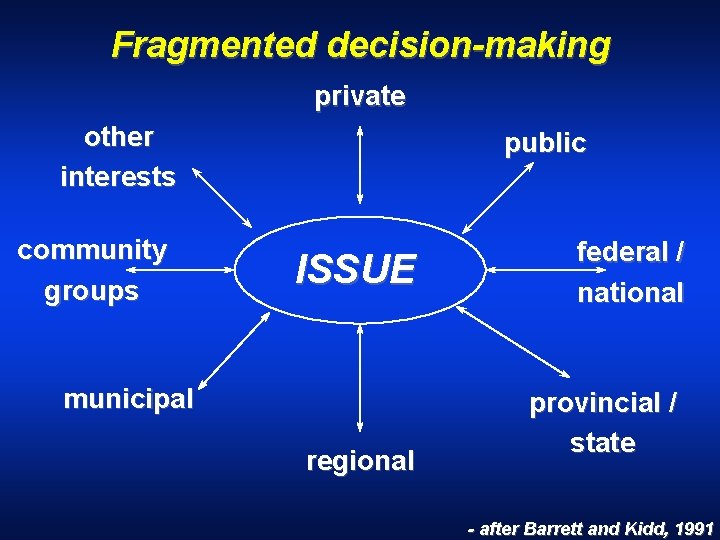
Fragmented decision-making private other interests community groups public ISSUE municipal regional federal / national provincial / state - after Barrett and Kidd, 1991
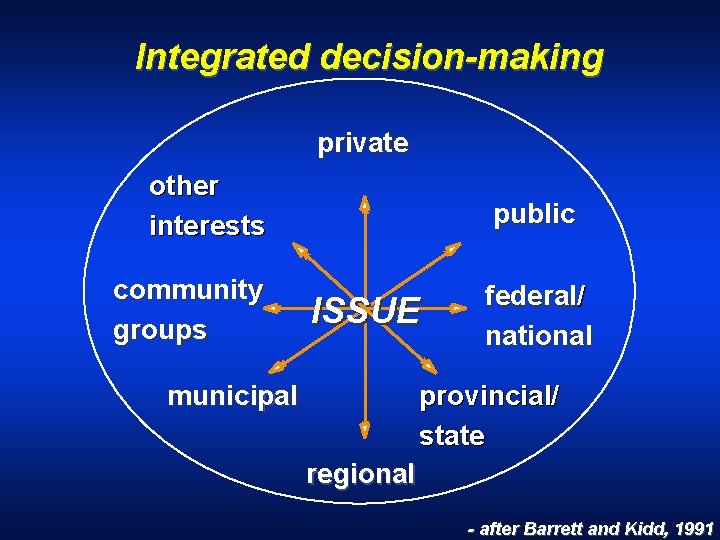
Integrated decision-making private other interests community groups public ISSUE municipal federal/ federal national provincial/ state regional - after Barrett and Kidd, 1991
decision making • reactive
decision making • reactive (‘end of pipe’)
decision making • anticipatory • reactive
decision making • anticipatory (planning for change) • reactive
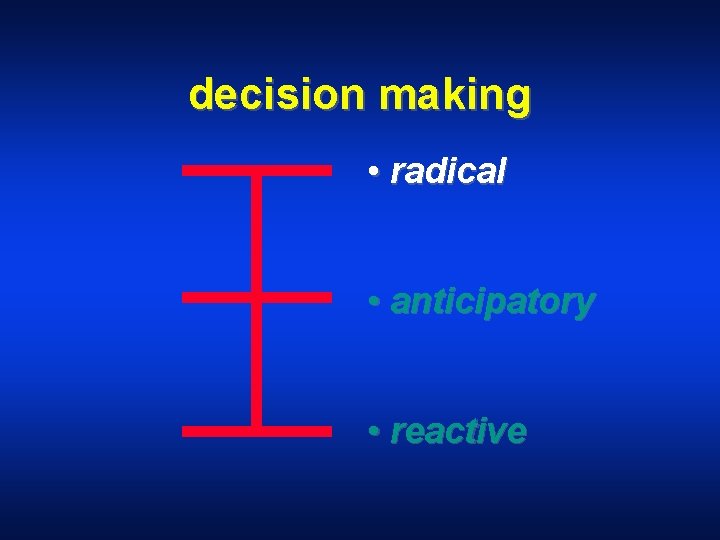
decision making • radical • anticipatory • reactive
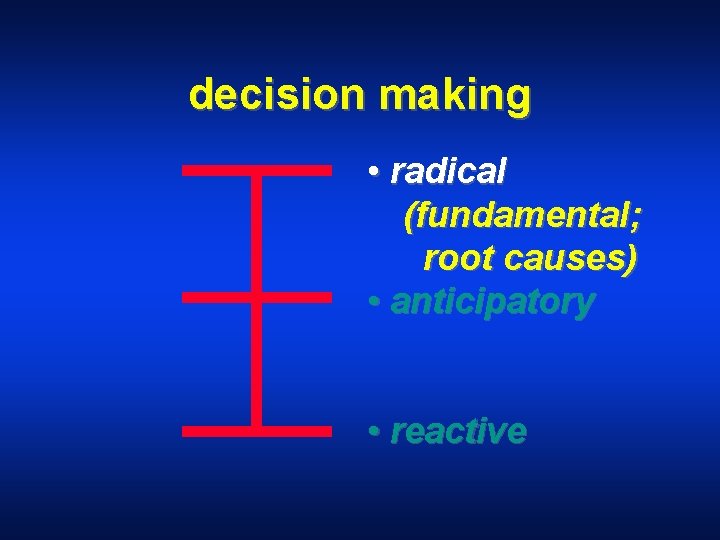
decision making • radical (fundamental; root causes) • anticipatory • reactive
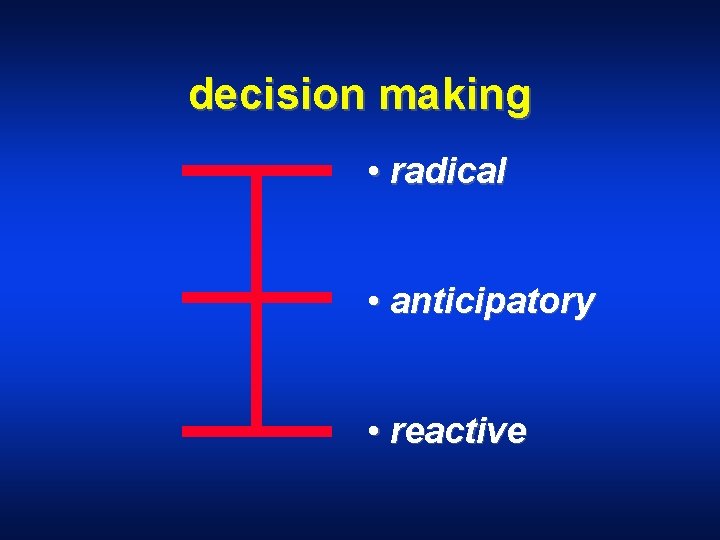
decision making • radical • anticipatory • reactive
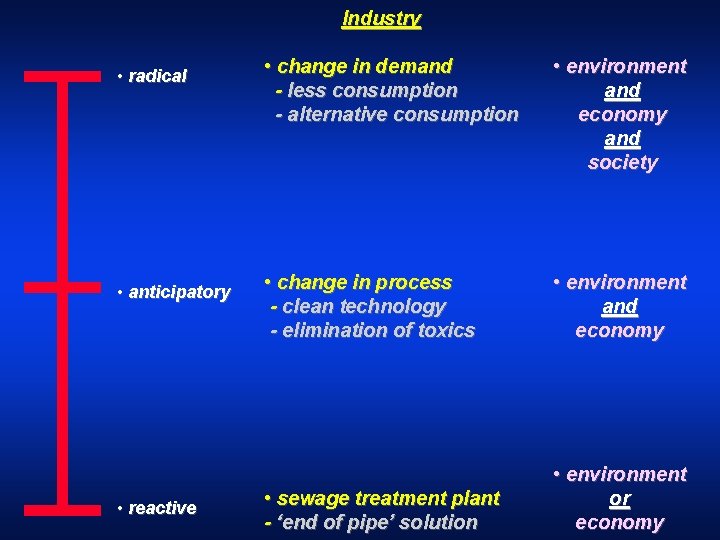
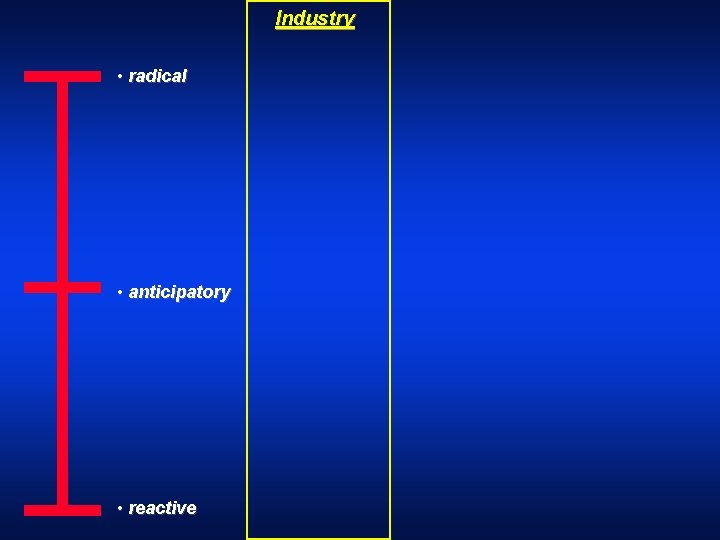
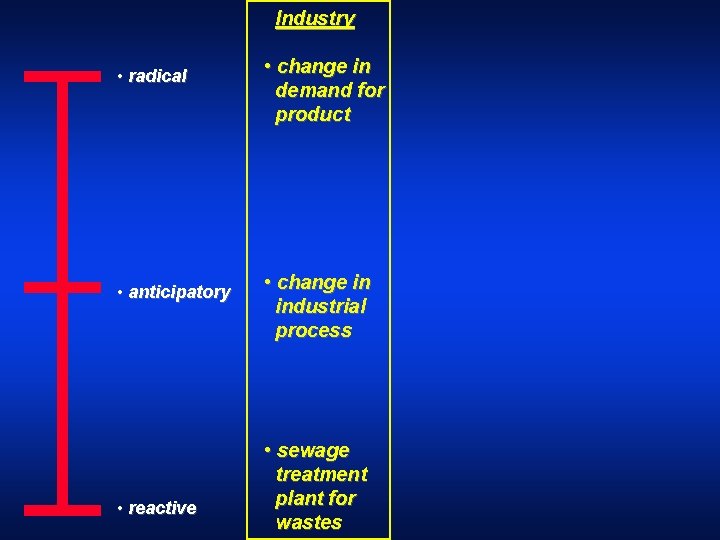
Industry • radical • anticipatory • reactive • change in demand - less consumption - alternative consumption • environment and economy and society • change in process - clean technology - elimination of toxics • environment and economy • sewage treatment plant - ‘end of pipe’ solution • environment or economy
Historical example: u based Northern Telecom in Canada u 42 plants in various countries u manufacturer of electronic components (telecommunications) u 1988: 1000+ tonnes of CFCs per year u 1992: 0 tonnes of CFCs used per year
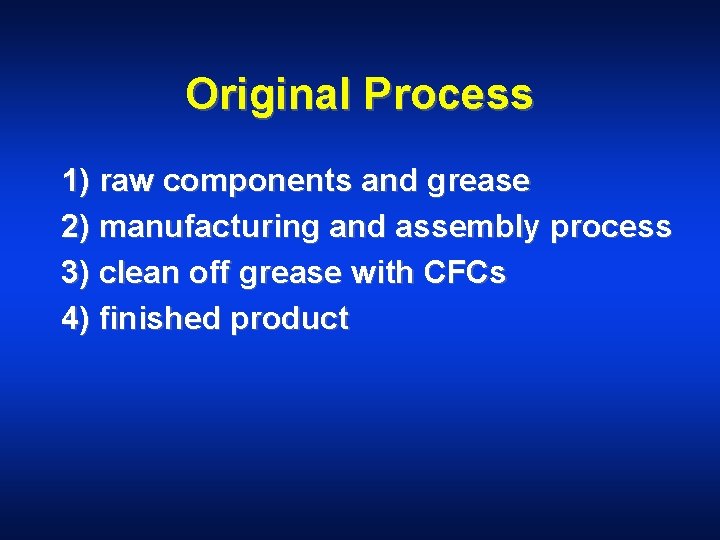
Original Process 1) raw components and grease 2) manufacturing and assembly process 3) clean off grease with CFCs 4) finished product

Revised process 1) raw components, no grease 2) manufacturing and assembly process 3) no need to clean off grease with CFCs 4) finished product
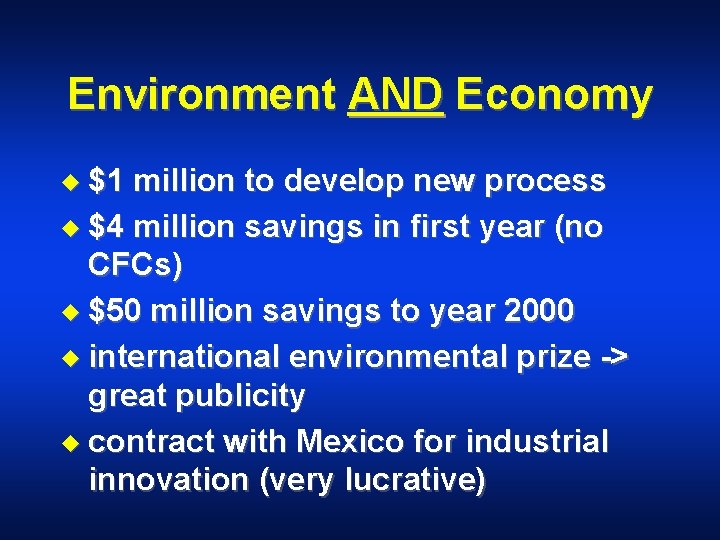
Environment AND Economy u $1 million to develop new process u $4 million savings in first year (no CFCs) u $50 million savings to year 2000 u international environmental prize -> great publicity u contract with Mexico for industrial innovation (very lucrative)
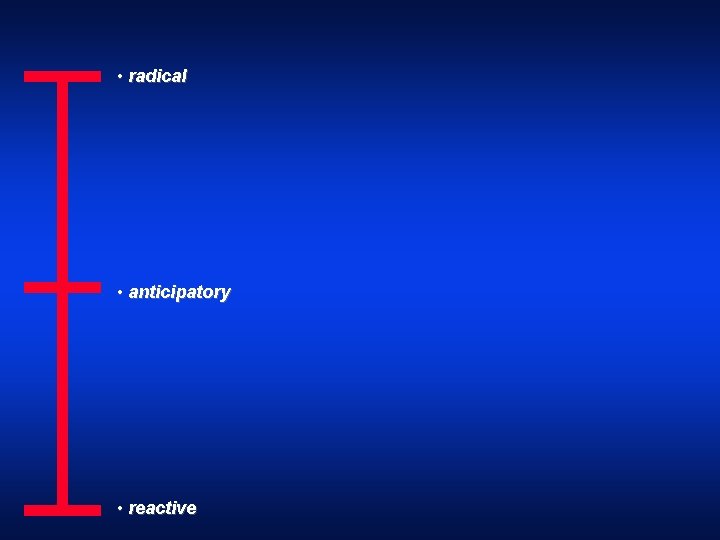
• radical • anticipatory • reactive
Industry • radical • anticipatory • reactive
Industry • radical • anticipatory • reactive • change in demand for product • change in industrial process • sewage treatment plant for wastes
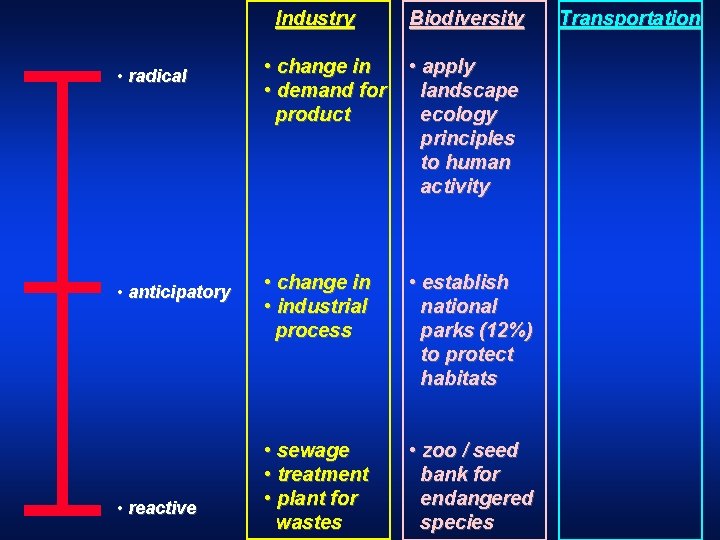
Industry • radical • anticipatory • reactive Biodiversity • change in • demand for product • apply landscape ecology principles to human activity • change in • industrial process • establish national parks (12%) to protect habitats • sewage • treatment • plant for wastes • zoo / seed bank for endangered species Transportation
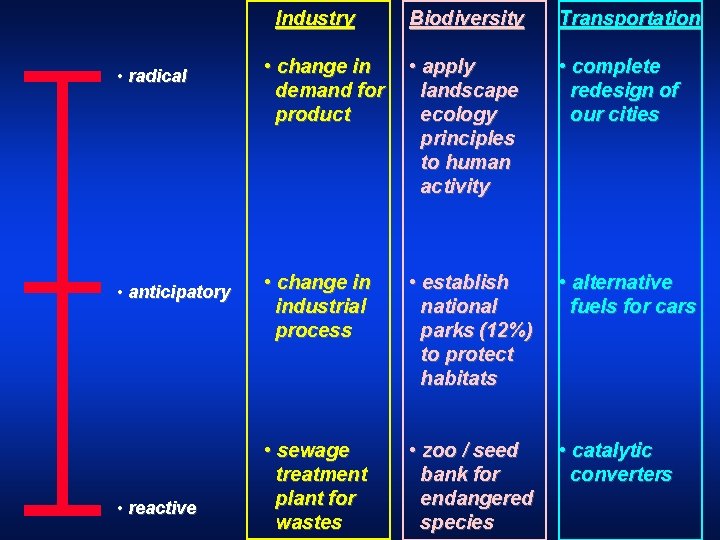
Industry • radical • anticipatory • reactive Biodiversity Transportation • change in demand for product • apply landscape ecology principles to human activity • complete redesign of our cities • change in industrial process • establish national parks (12%) to protect habitats • alternative fuels for cars • sewage treatment plant for wastes • zoo / seed bank for endangered species • catalytic converters
values, ideologies and strategies values ideology strategies
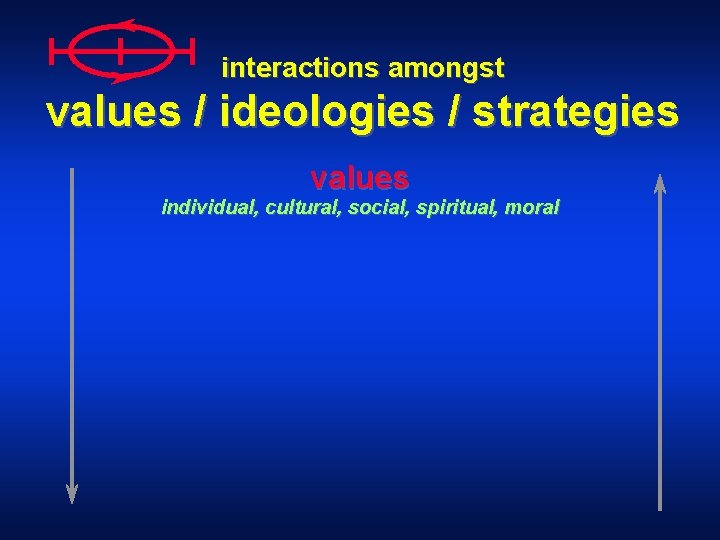
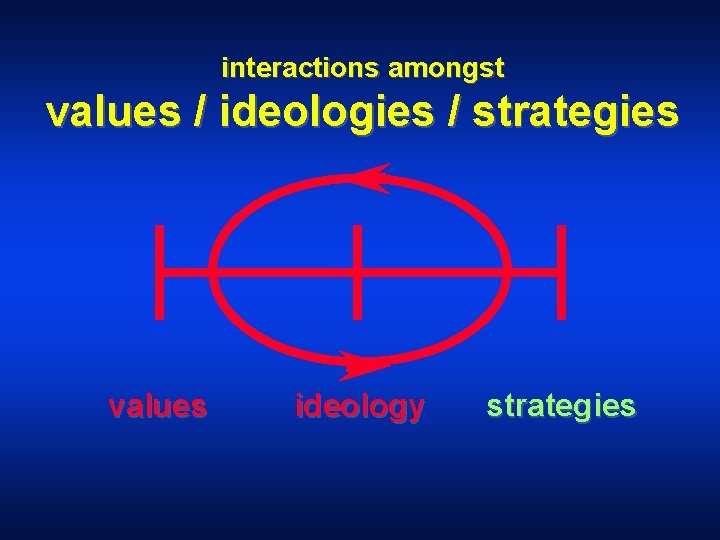
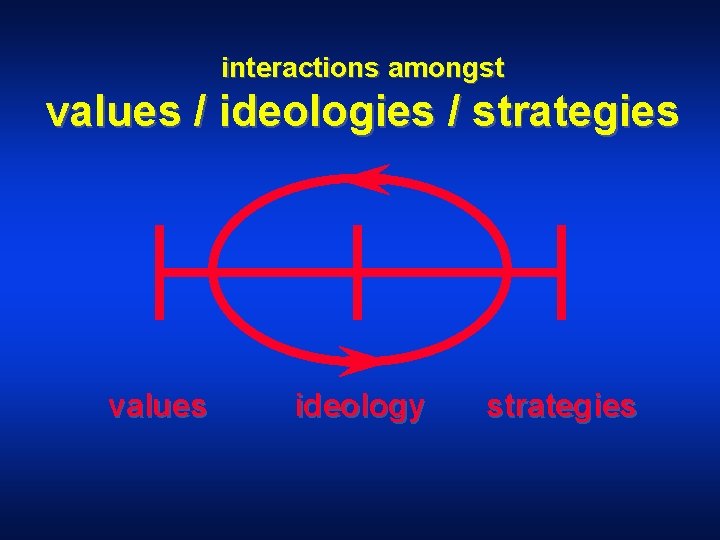
interactions amongst values / ideologies / strategies values individual, cultural, social, spiritual, moral
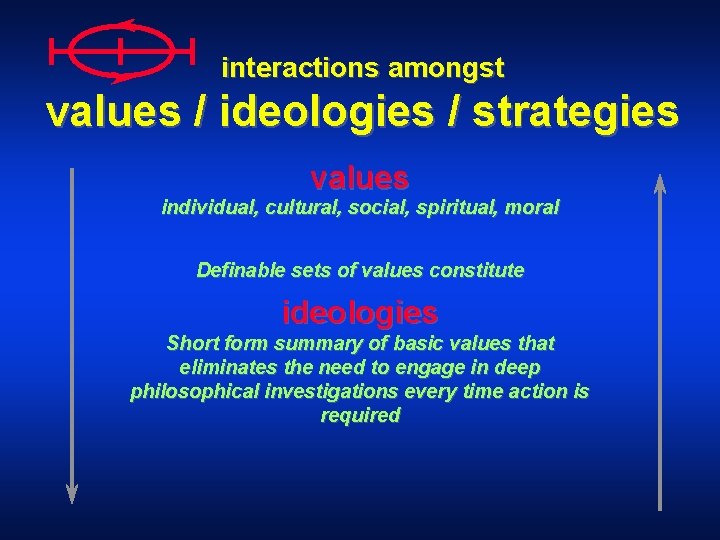
interactions amongst values / ideologies / strategies values individual, cultural, social, spiritual, moral Definable sets of values constitute ideologies Short form summary of basic values that eliminates the need to engage in deep philosophical investigations every time action is required
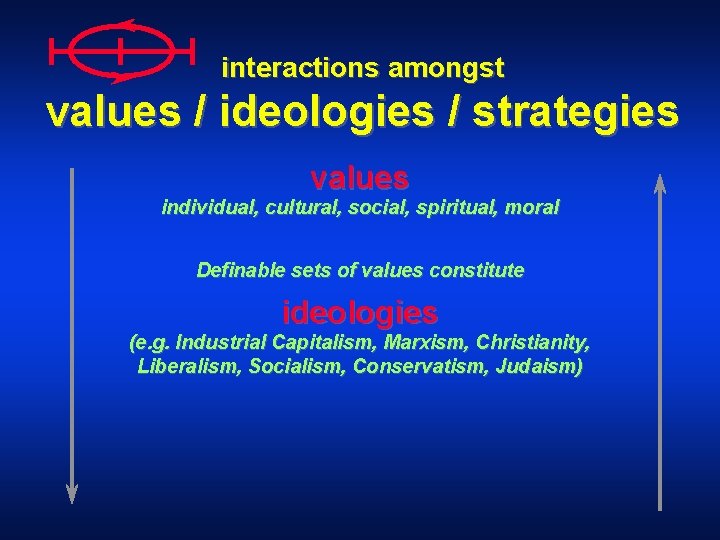
interactions amongst values / ideologies / strategies values individual, cultural, social, spiritual, moral Definable sets of values constitute ideologies (e. g. Industrial Capitalism, Marxism, Christianity, Liberalism, Socialism, Conservatism, Judaism)
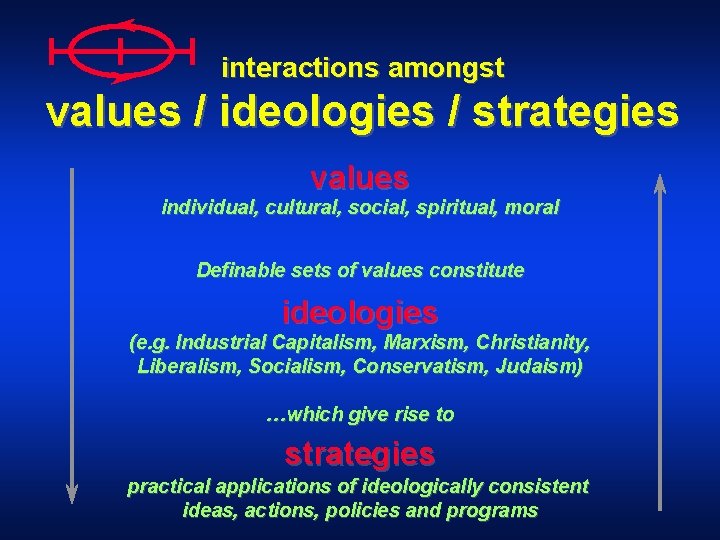
interactions amongst values / ideologies / strategies values individual, cultural, social, spiritual, moral Definable sets of values constitute ideologies (e. g. Industrial Capitalism, Marxism, Christianity, Liberalism, Socialism, Conservatism, Judaism) …which give rise to strategies practical applications of ideologically consistent ideas, actions, policies and programs
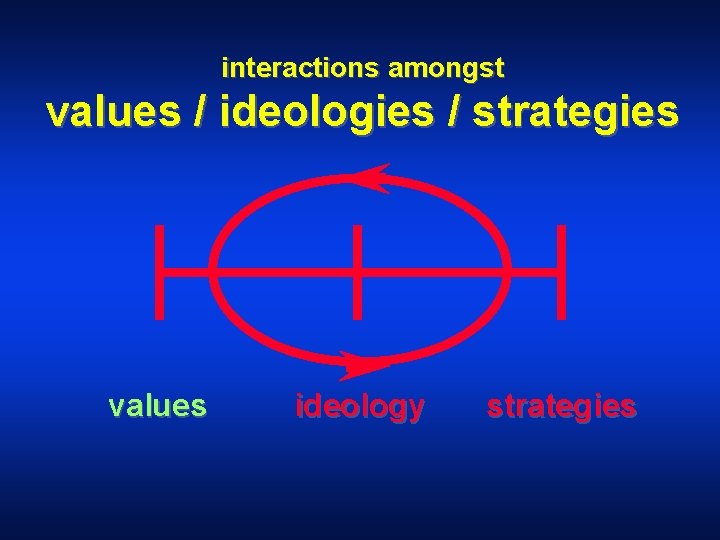
interactions amongst values / ideologies / strategies values ideology strategies
environmental values • holistic perspective • everything is connected to everything else • parts can only be understood in the context of the whole • nature as a living organism or system values ideology strategies (after Macdonald, D. 1991. The Politics of Pollution. Mc. Clelland Stewart, Toronto: p. 33)
environmental values • humans living within nature -> inherent value of other organisms and inanimate objects • limits to growth values ideology strategies (after Macdonald, D. 1991. The Politics of Pollution. Mc. Clelland Stewart, Toronto: p. 33)
environmental values • appropriate technology • matching the scope and scale of technology to the task at hand • principles of durability and efficiency values ideology strategies • recognition that new technology brings both benefits and problems
environmental values • appropriate scale • appropriate sizes for institutions, social organizations, communities • accessible and accountable decision-making values ideology in public and private sectors strategies
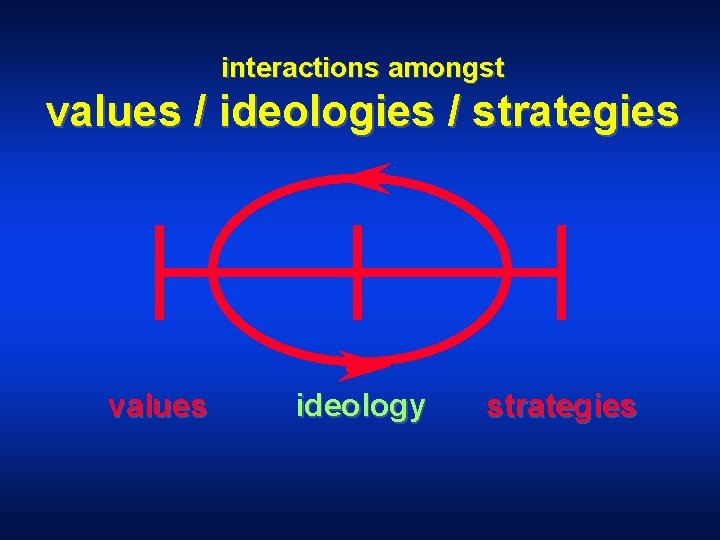
interactions amongst values / ideologies / strategies values ideology strategies
examples of environmental ideologies • technological optimism • sustainable development (Brundtland Commission) • social ecology (Murray Bookchin) • deep ecology (Arne Naess) • ecofeminism (Françoise D’Eaubonne) values ideology • various ‘green’ political parties strategies many variants: e. g. , alliances with socialism, feminism, peace movement, etc.
interactions amongst values / ideologies / strategies values ideology strategies
environmental strategies and strategists • reform environmentalism (traditional bureacracies and political action) • direct action and intervention (e. g. Earth First!) • single-issue lobbying / intervention groups (e. g. , Save the Rouge Valley System) • permanent organizations (e. g. , Greenpeace) • alliances and coalitions (e. g. , Canadian Coalition on Acid Rain) • round tables, forums (e. g. , National Round Table on the Environment and the Economy)
interactions amongst values / ideologies / strategies values ideology strategies
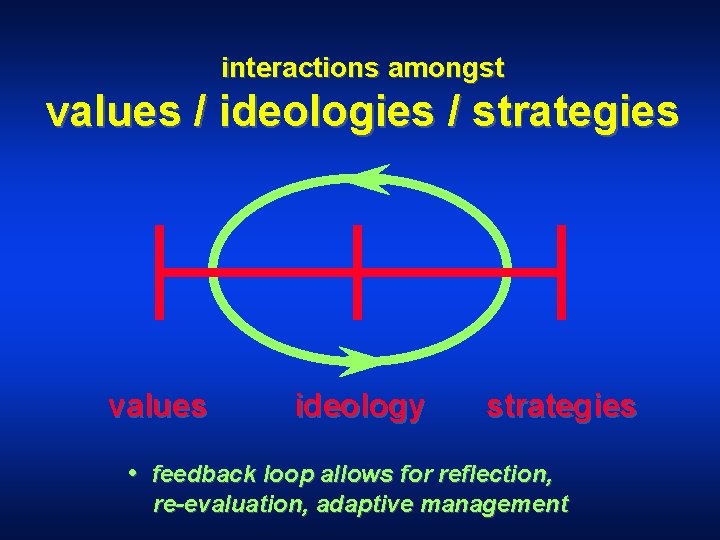
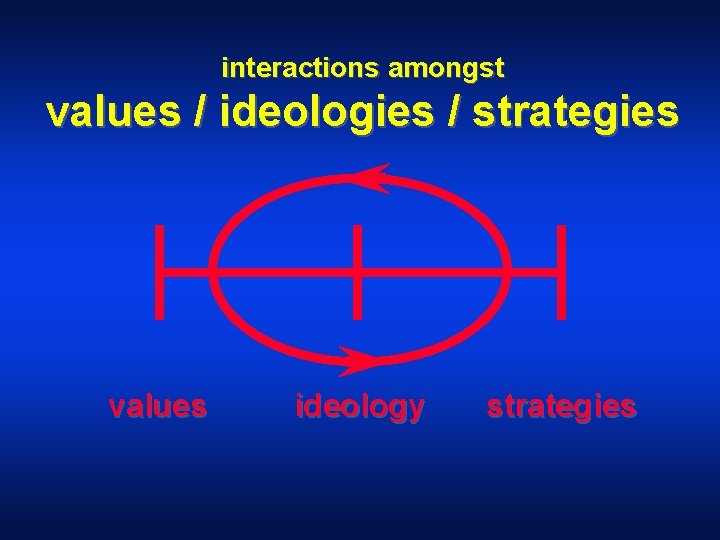
interactions amongst values / ideologies / strategies values ideology strategies • feedback loop allows for reflection, re-evaluation, adaptive management
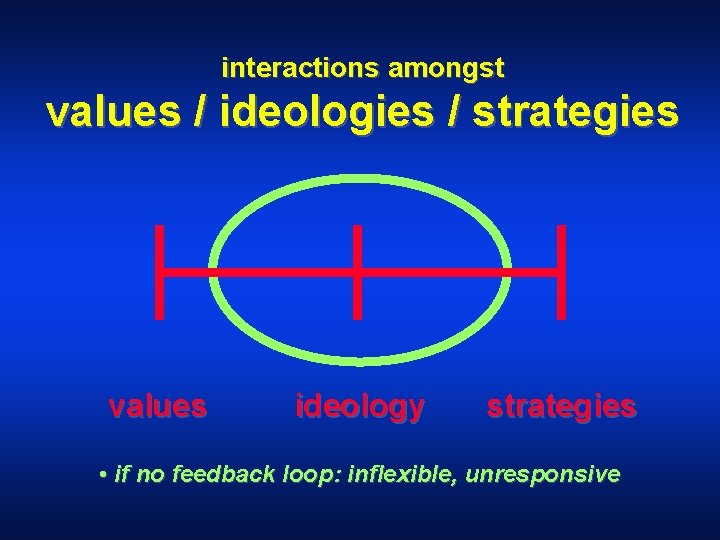
interactions amongst values / ideologies / strategies values ideology strategies • if no feedback loop: inflexible, unresponsive
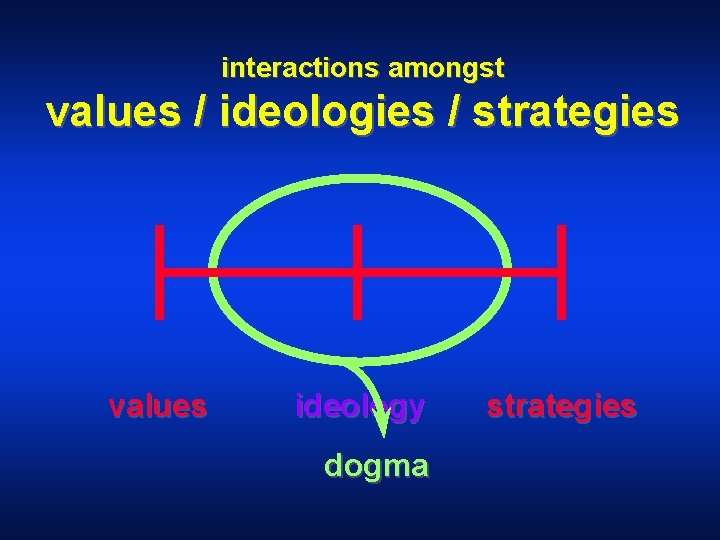
interactions amongst values / ideologies / strategies values ideology dogma strategies
interactions amongst values / ideologies / strategies values ideology strategies
Sustainability: How do we move from rhetoric to reality?
principles
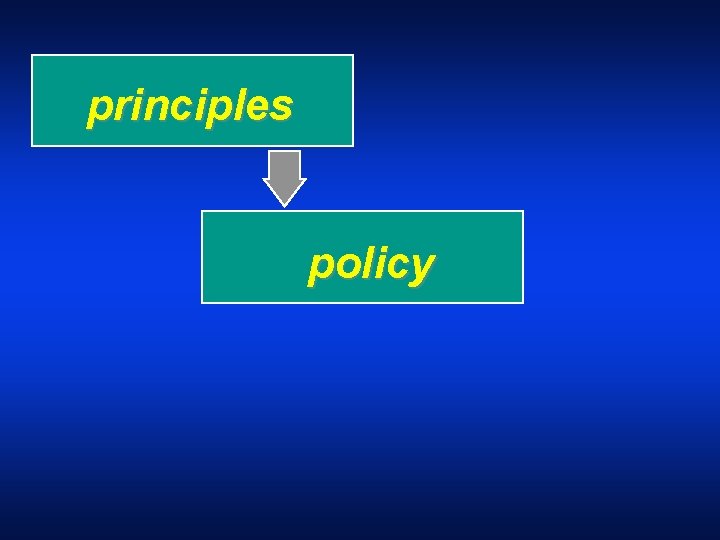
principles policy
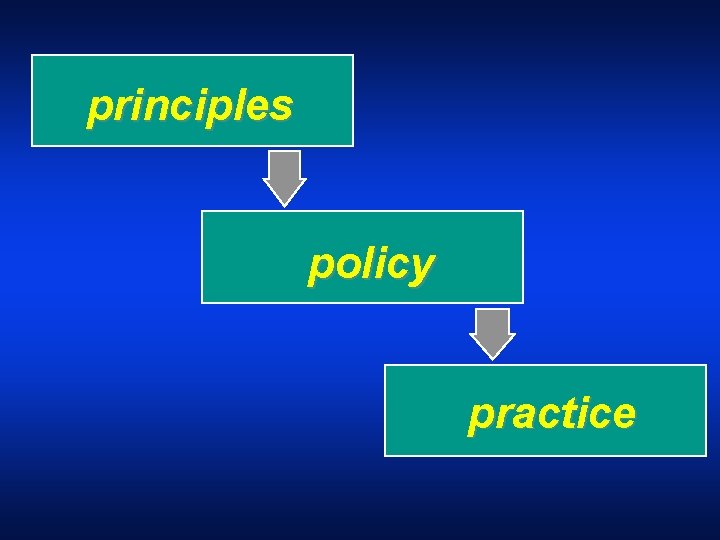
principles policy practice
To be useful, principles of sustainability must: u be easily understood u be applicable in many contexts u be transferrable across scales u translate well from fundamental values into applied policy and practical action u identify possibilities for radical transformative change AND positive incremental change
Some Principles of Sustainability in the literature: u u u u u Our Common Future (WCED 1987) Principles defining sustainable development (OSEM 1989) Defining a sustainable society (Robinson et al. 1990, 1996) Agenda 21 (1992) Six principles of sustainable development (ORTEE 1992) Guideposts for a sustainable future (Nickerson 1993) Framework for Sustainable Development (CIDA 1994) The Natural Step (Robert et al. 1994) Sustainability Principles (ORTEE 1994), etc.
Recent compilation of Principles of Sustainability http: //iisd 1. iisd. ca/sd/principle. asp -IISD (Winnipeg)
One example: Guideposts for Sustainability (after Nickerson, 1993) Activities are sustainable when they: 1. 2. 3. Use materials in continuous cycles. Use continuously reliable sources of energy. Encourage desirable human traits (equity; creativity; communication; coordination; appreciation; intellectual and spiritual development).
Guideposts for Sustainability Activities are not sustainable when they: 4. 5. 6. 7. 8. Require continual inputs of non-renewable resources. Use renewable resources faster than their rate of renewal. Cause cumulative degradation of the environment. Require resources in quantities that could never be available for people everywhere. Lead to the extinction of other life forms.

About Interdisciplinarity

What do you answer if someone asks you, – What is your major? – What are your career goals? – What is your ethnic origin?
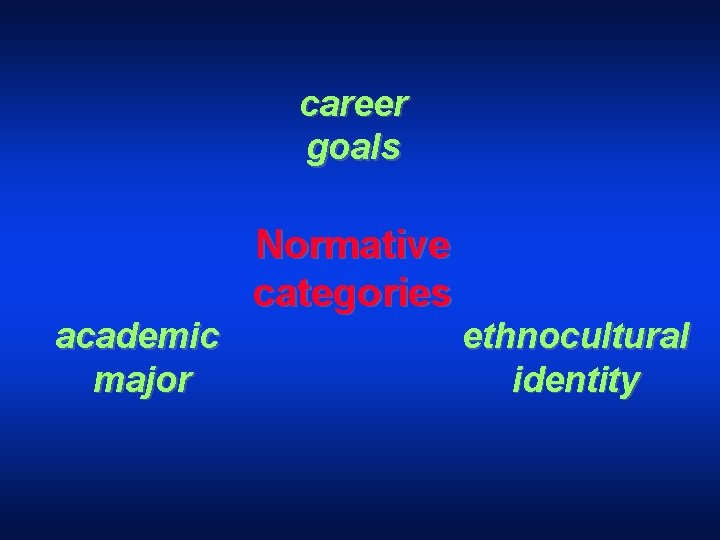
career goals Normative categories academic major ethnocultural identity
Normative categories
Normative “disciplines” categories
disciplinary Multidisciplinary Interdisciplinary Transdisciplinary - what are the differences? Reference: Stefanovic, Ingrid. 1996. Interdisciplinarity and Wholeness: Lessons from Eco-Research. Environments 23(3): 74 -94.
Disciplinary: u of or pertaining to a discrete branch of learning u knowledge boundaries within generally accepted
Disciplinary: u often associated with discipline-specific vocabularies, methods, and assumptions u Examples of disciplines: sociology, philosophy, biology, political science, chemistry, economics, geography, mathematics. . .
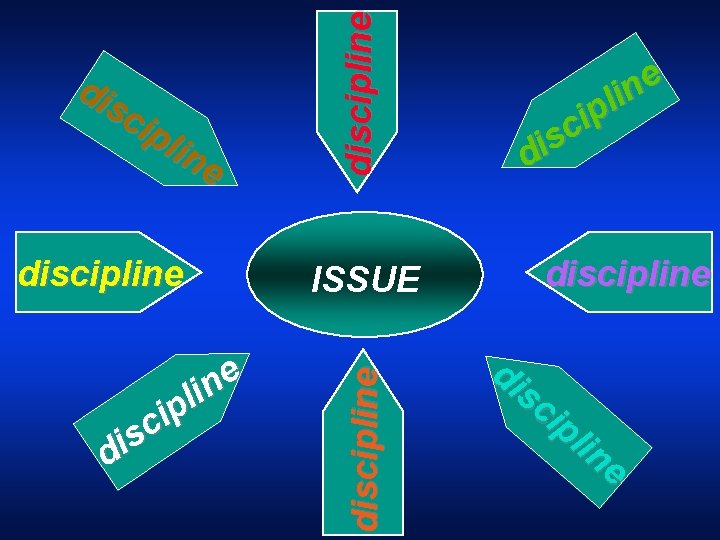
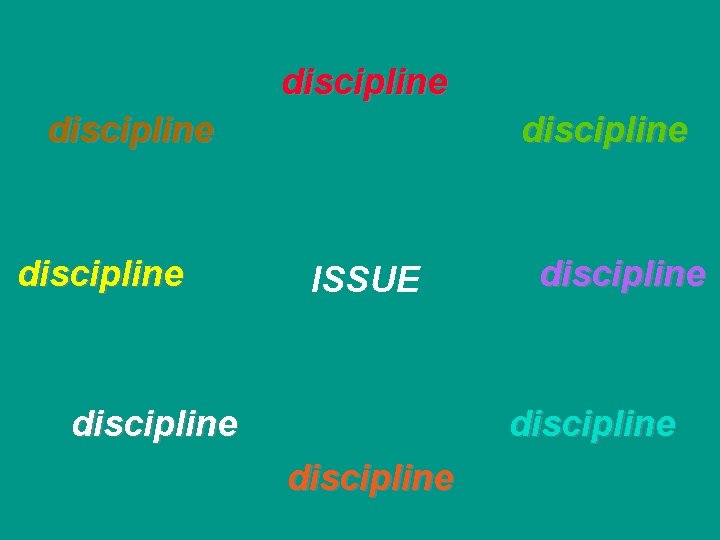
Multidisciplinary: u standard disciplinary approaches are applied to a common research question, problem or issue u insights achieved through an approach which is essentially additive rather than integrative
Multidisciplinary: ua spontaneous coalescence of these disparate approaches is anticipated u arguably the approach which produces the most substantive research results

ISSUE
discipline e n i l p i c s di discipline ISSUE discipline dis cip lin e e n i l p i c s di discipline di sc ip lin e
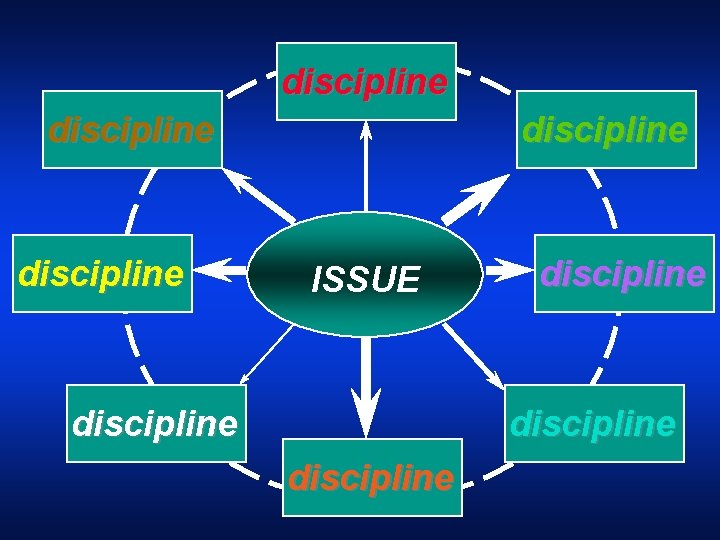
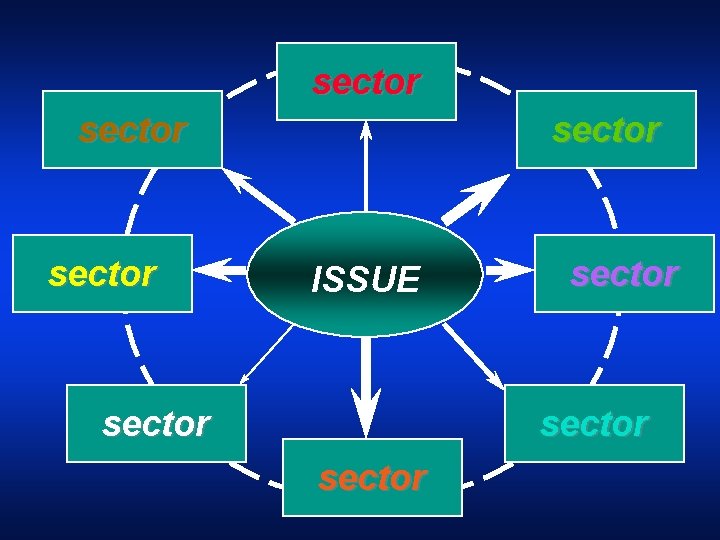
Interdisciplinary: u the issue, problem, or concern defines the disciplinary expertise which is brought to bear …arguably the most effective policyoriented problem-solving approach
Interdisciplinary: ua level of integration which involves more than an additive analysis of the disciplinary perspectives u insights are achieved through an approach which is explicitly integrative -> an a priori attempt is made at synthesis across disciplinary boundaries

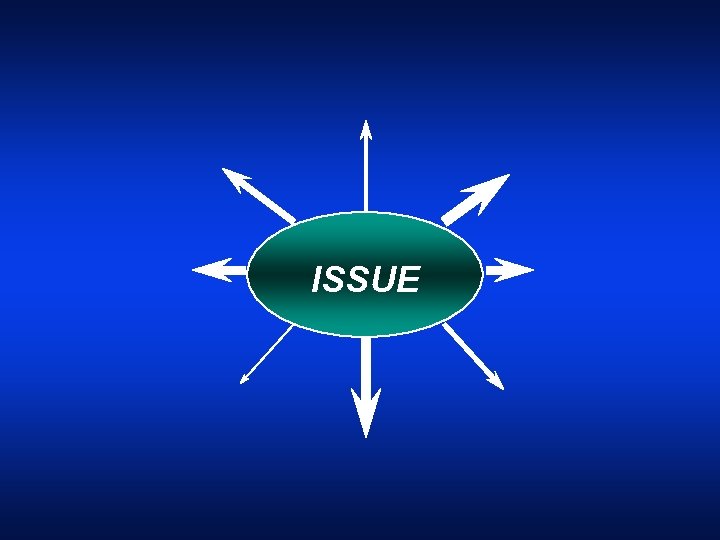
ISSUE
ISSUE
discipline ISSUE discipline
sector ISSUE sector
Transdisciplinary: u recognizes the interconnectedness of all aspects of reality and knowledge u Goal: distinctions amongst disciplines are eliminated completely
Transdisciplinary: u “an attempt to transcend the dynamics of a dialectical synthesis to grasp the total dynamics of reality as a whole” u Examples of transdisciplinary endeavour: – general systems theory – phenomenology
discipline ISSUE discipline
- Slides: 112