
INTRODUCTION TO SUCCESSION PLANNING by Tom Byler Agenda
INTRODUCTION TO SUCCESSION PLANNING by Tom Byler
Agenda ■ What is Succession Planning? ■ Why Plan the Succession of your business? ■ Objectives ■ Succession Planning Process ■ Enhancing Business Value ■ Sample Succession Plan
WHAT IS SUCCESSION PLANNING?
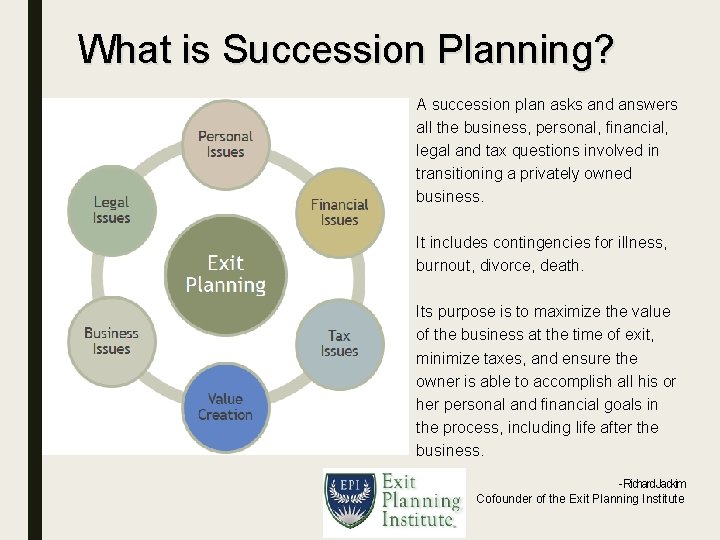
What is Succession Planning? A succession plan asks and answers all the business, personal, financial, legal and tax questions involved in transitioning a privately owned business. It includes contingencies for illness, burnout, divorce, death. Its purpose is to maximize the value of the business at the time of exit, minimize taxes, and ensure the owner is able to accomplish all his or her personal and financial goals in the process, including life after the business. -Richard. Jackim Cofounder of the Exit Planning Institute
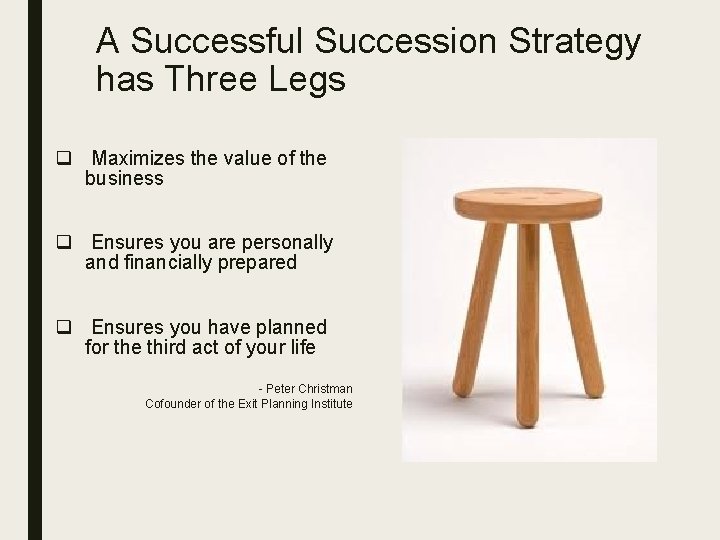
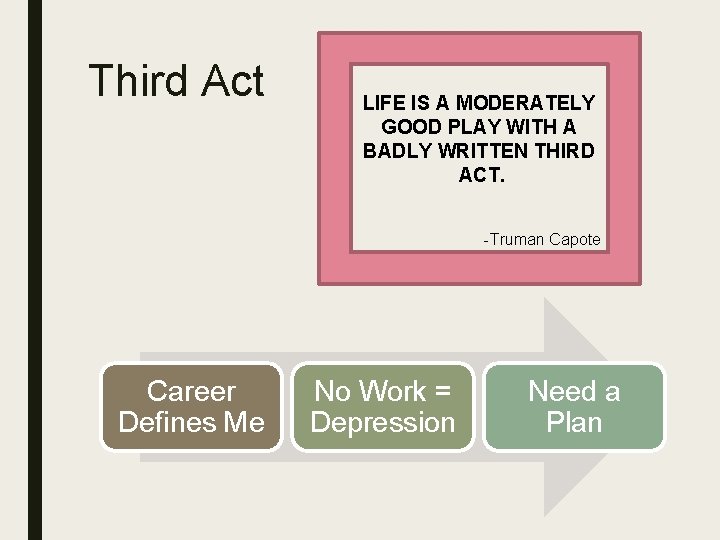
A Successful Succession Strategy has Three Legs q Maximizes the value of the business q Ensures you are personally and financially prepared q Ensures you have planned for the third act of your life - Peter Christman Cofounder of the Exit Planning Institute
A Succession Plan Contains… ■ Succession Objectives and timetable ■ Current Estimate of Business Value ■ Transition strategy ■ Plan for Increasing Value Prior to Transition ■ Risk Mitigation Strategies ■ Plan for third act ■ Utilizes team of advisors – cepa, attorney, financial planner, cpa, banker, insurance agent
WHY PLAN THE SUCCESSION/E XIT OF YOUR BUSINESS?
Why Plan The Succession of Your Business? ■ Align business objectives and personal objectives ■ Know what to expect ■ Opportunity to increase business value – Develop your organization and operations – Reduce owner dependency – Improve financial performance – Resolve issues impacting value ■ Corporate structure impacts tax strategy – LLC, S-Corp, C-Corp ■ Improve chances of a positive outcome ■ An effective plan takes time!
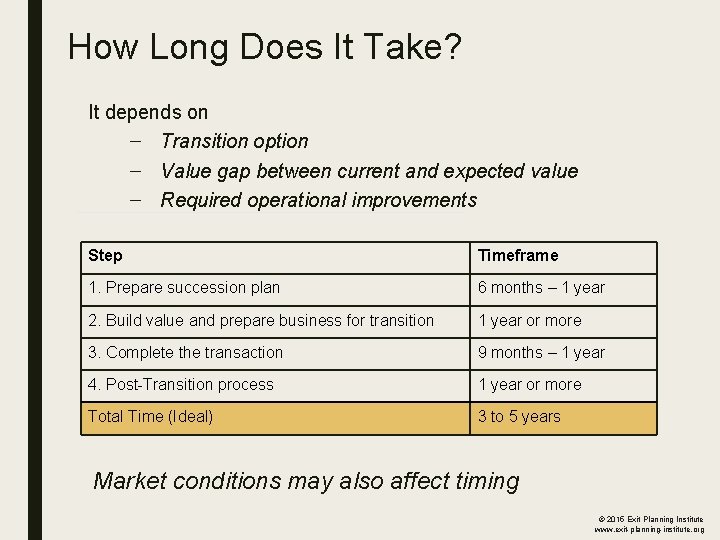
How Long Does It Take? It depends on – Transition option – Value gap between current and expected value – Required operational improvements Step Timeframe 1. Prepare succession plan 6 months – 1 year 2. Build value and prepare business for transition 1 year or more 3. Complete the transaction 9 months – 1 year 4. Post-Transition process 1 year or more Total Time (Ideal) 3 to 5 years Market conditions may also affect timing © 2015 Exit Planning Institute www. exit-planning-institute. org
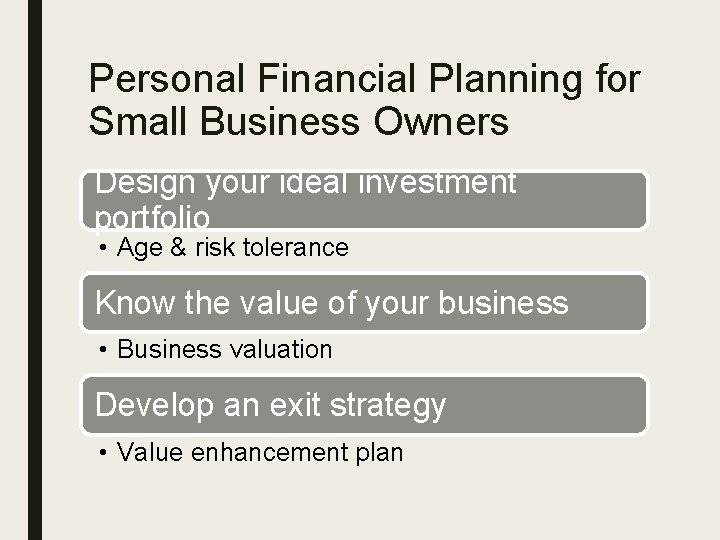
Personal Financial Planning for Small Business Owners Design your ideal investment portfolio • Age & risk tolerance Know the value of your business • Business valuation Develop an exit strategy • Value enhancement plan
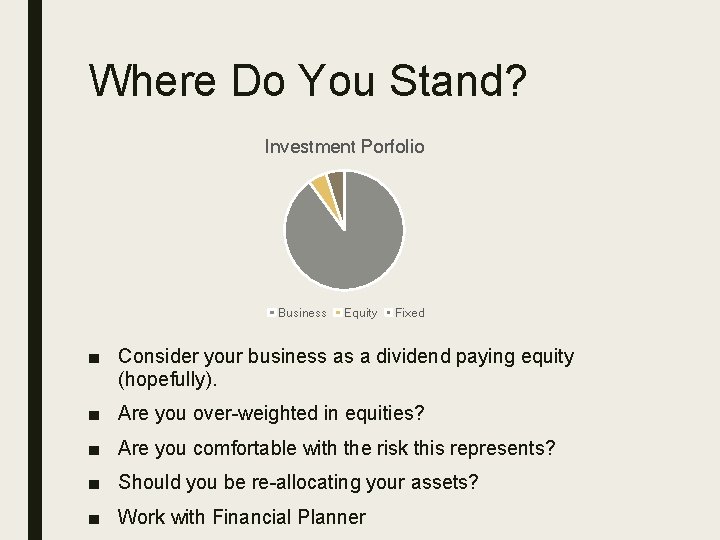
Where Do You Stand? Investment Porfolio Business Equity Fixed ■ Consider your business as a dividend paying equity (hopefully). ■ Are you over-weighted in equities? ■ Are you comfortable with the risk this represents? ■ Should you be re-allocating your assets? ■ Work with Financial Planner
Baby Boomers ■ Baby Boomer Facts: – own 63% of private businesses – 80 -90% of their wealth is in the business – 76% plan to exit in the next 10 years ■ Represent $10 Trillion of wealth that will transfer through business ownership
SUCCESSION OBJECTIVES
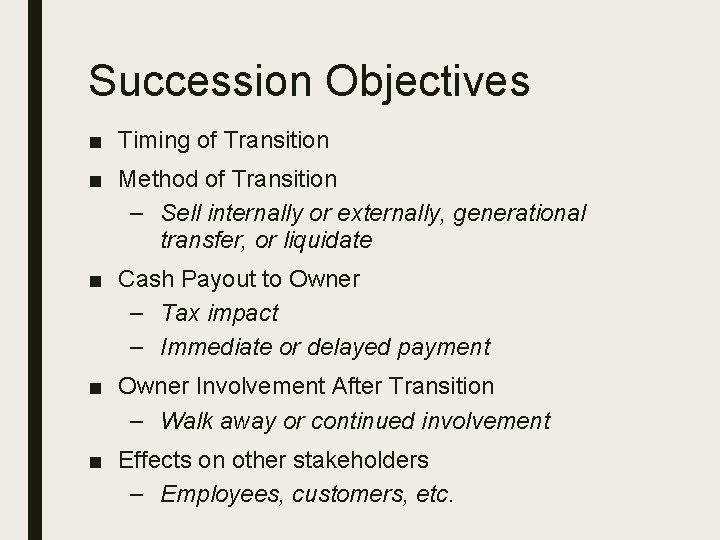
Succession Objectives ■ Timing of Transition ■ Method of Transition – Sell internally or externally, generational transfer, or liquidate ■ Cash Payout to Owner – Tax impact – Immediate or delayed payment ■ Owner Involvement After Transition – Walk away or continued involvement ■ Effects on other stakeholders – Employees, customers, etc.
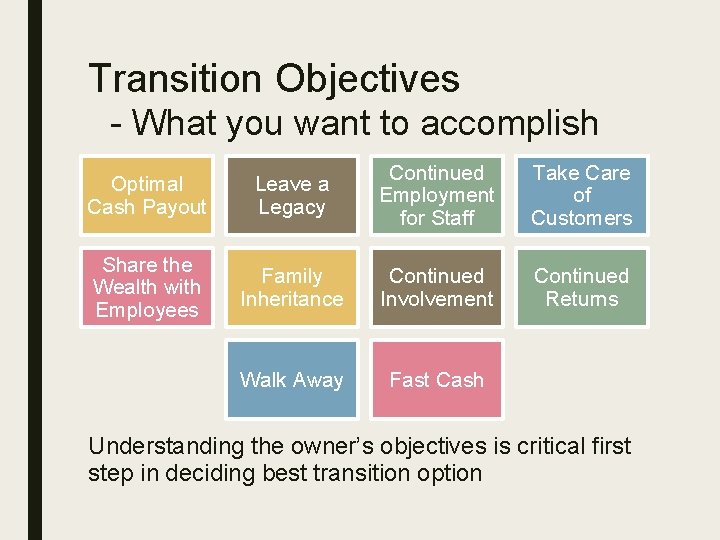
Transition Objectives - What you want to accomplish Optimal Cash Payout Leave a Legacy Continued Employment for Staff Take Care of Customers Share the Wealth with Employees Family Inheritance Continued Involvement Continued Returns Walk Away Fast Cash Understanding the owner’s objectives is critical first step in deciding best transition option
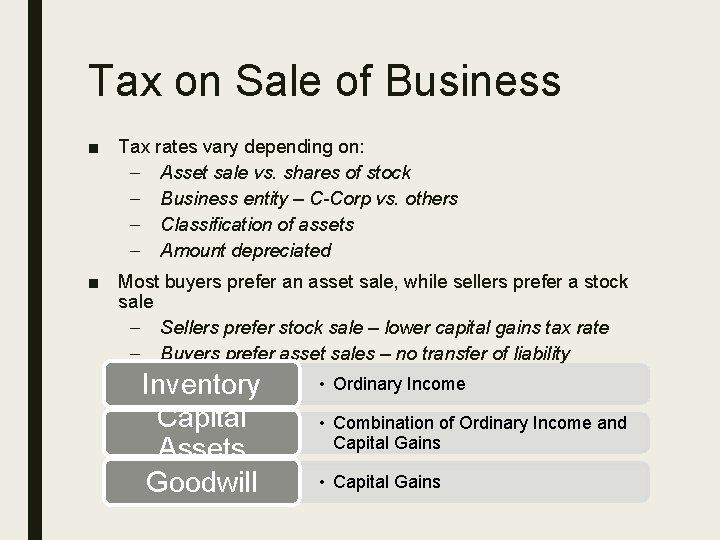
Tax on Sale of Business ■ Tax rates vary depending on: – Asset sale vs. shares of stock – Business entity – C-Corp vs. others – Classification of assets – Amount depreciated ■ Most buyers prefer an asset sale, while sellers prefer a stock sale – Sellers prefer stock sale – lower capital gains tax rate – Buyers prefer asset sales – no transfer of liability Inventory Capital Assets Goodwill • Ordinary Income • Combination of Ordinary Income and Capital Gains • Capital Gains
SUCCESSION PLANNING PROCESS
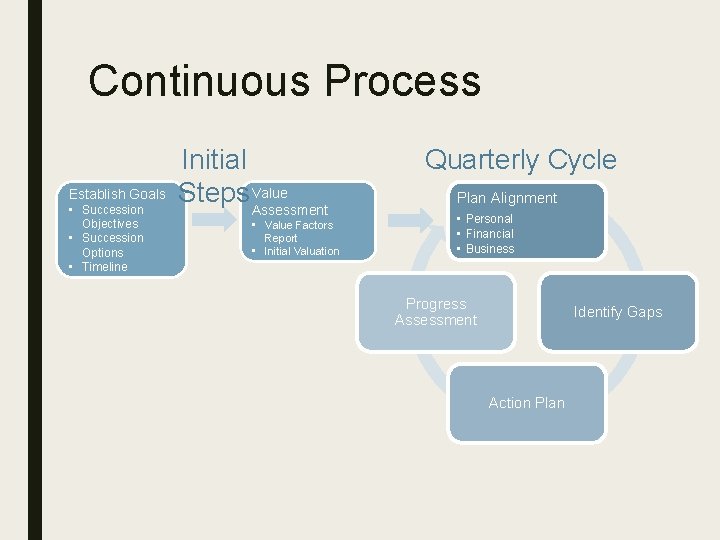
Continuous Process Establish Goals • Succession Objectives • Succession Options • Timeline Initial Steps Value Assessment • Value Factors Report • Initial Valuation Quarterly Cycle Plan Alignment • Personal • Financial • Business Progress Assessment Identify Gaps Action Plan
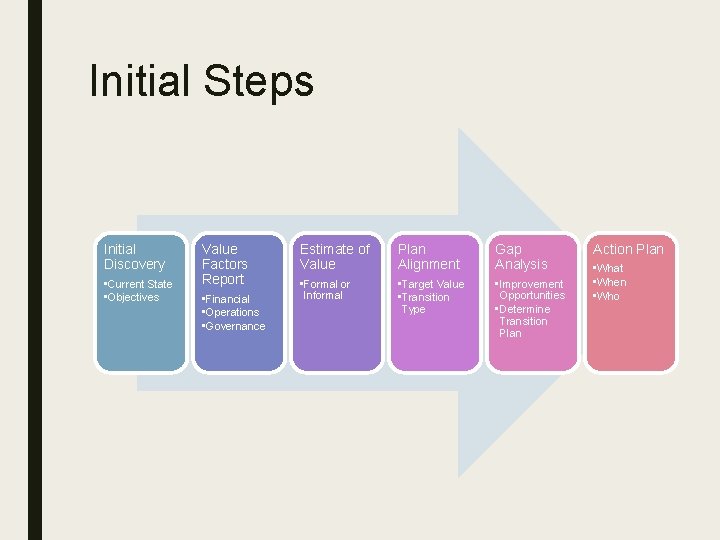
Initial Steps Initial Discovery • Current State • Objectives Value Factors Report • Financial • Operations • Governance Estimate of Value Plan Alignment Gap Analysis • Formal or Informal • Target Value • Transition Type • Improvement Opportunities • Determine Transition Plan Action Plan • What • When • Who
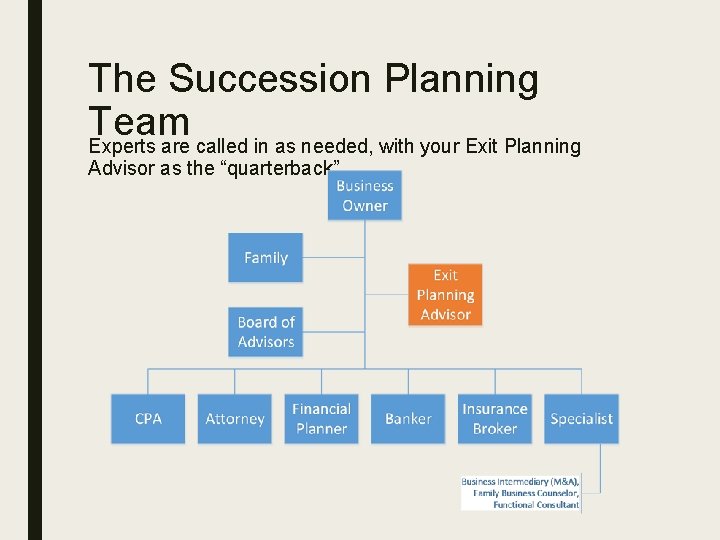
The Succession Planning Team Experts are called in as needed, with your Exit Planning Advisor as the “quarterback”
Options for Valuation Formal ■ can be done for a reasonable cost ■ performed by certified specialist ■ should be done at least once during the exit planning process ■ should also be performed prior to transition Informal ■ can be done by your advisor at no cost ■ are a good alternative when accuracy is not an issue ■ rely heavily on transaction history and advisor judgement ■ are not meant to replace a formal valuation when appropriate
Valuation Rule of Thumb for Small Businesses Business value = SOME multiple of annual Cash Generated ■ Each industry and business can be different ■ Cash Generated = pre-tax profit + owner’s personal expenses in P&L (SDE) ■ Many factors can affect the size of the multiple Remember: Buyers Determine Ultimate Value
What If It Isn’t Enough? Estimated Business Value Expected Business Value
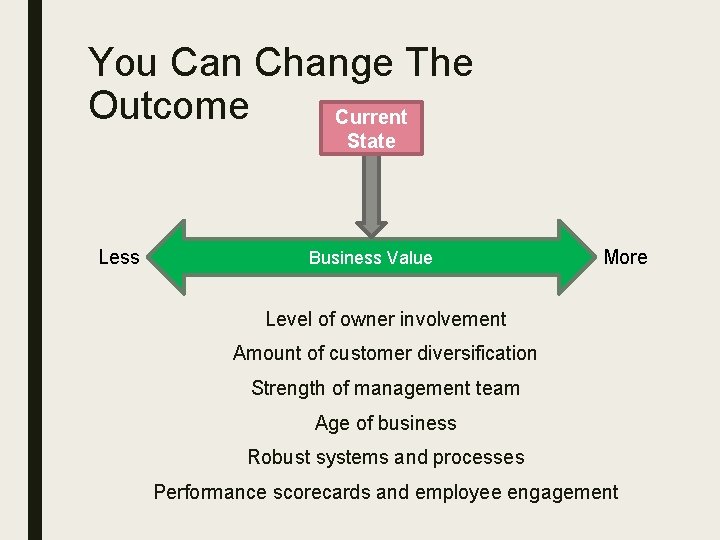
You Can Change The Outcome Current State Less Business Value More Level of owner involvement Amount of customer diversification Strength of management team Age of business Robust systems and processes Performance scorecards and employee engagement
Third Act LIFE IS A MODERATELY GOOD PLAY WITH A BADLY WRITTEN THIRD ACT. -Truman Capote Career Defines Me No Work = Depression Need a Plan
ENHANCING BUSINESS VALUE
Buyer’s Risk ■ Price based on Risk – Reward – Cash is the reward – Risks reduce the value ■ Risk defined from Buyer’s point of view – Is the information accurate? – Will the cash continue to flow after I take over? – Are there any hidden gotchas? Reduced Perceived Risk = Increased Value
Top 3 Strategies to Enhance Business Value 1. Sustainable and Predictable Business Processes – Document core processes – Consistent adherence to procedures – Computer systems 2. De-risk Your Business – Excessive debt or erratic cash flow – Over-reliance on one employee/customer/vendor – Continuity plan 3. Reduce Owner Involvement – The one-month vacation test
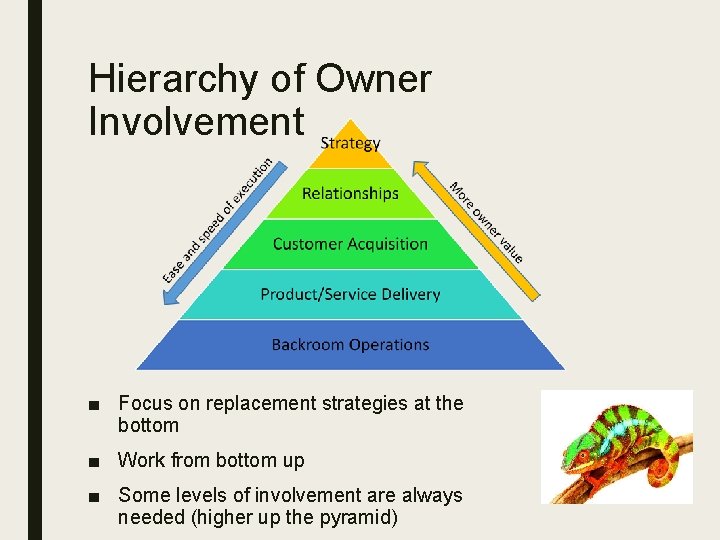
Hierarchy of Owner Involvement ■ Focus on replacement strategies at the bottom ■ Work from bottom up ■ Some levels of involvement are always needed (higher up the pyramid)
Speaking of Risk… ■ A higher power may have a different plan ■ What happens to the business in unplanned exit? – Death or disability ■ Who will run the operations? ■ What happens to the employees? The assets? The customers? ■ Funding through insurance and a plan can address this. ■ Some form of a Continuity Plan is important
SAMPLE SUCCESSION PLAN
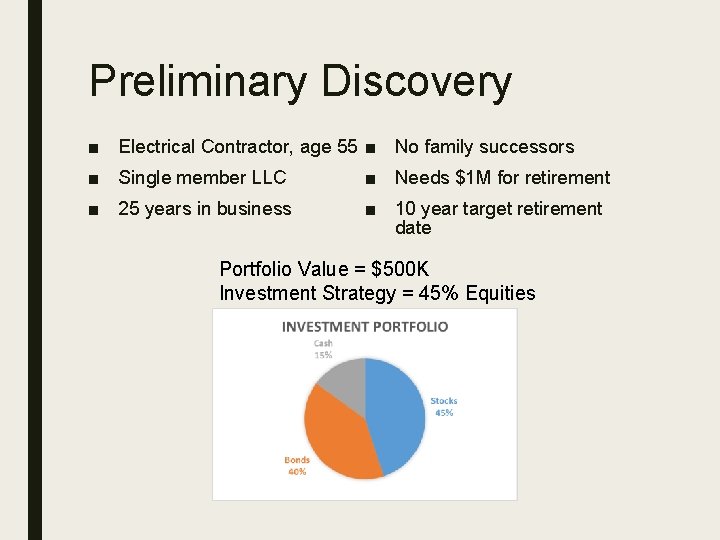
Preliminary Discovery ■ Electrical Contractor, age 55 ■ No family successors ■ Single member LLC ■ Needs $1 M for retirement ■ 25 years in business ■ 10 year target retirement date Portfolio Value = $500 K Investment Strategy = 45% Equities
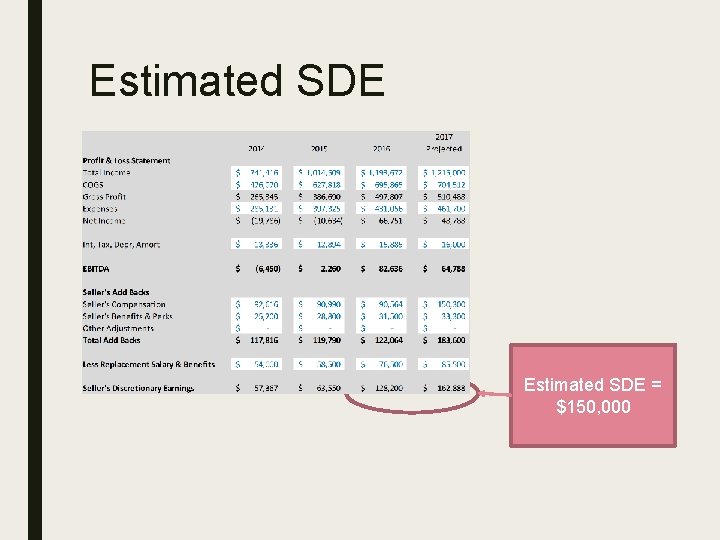
Estimated SDE = $150, 000
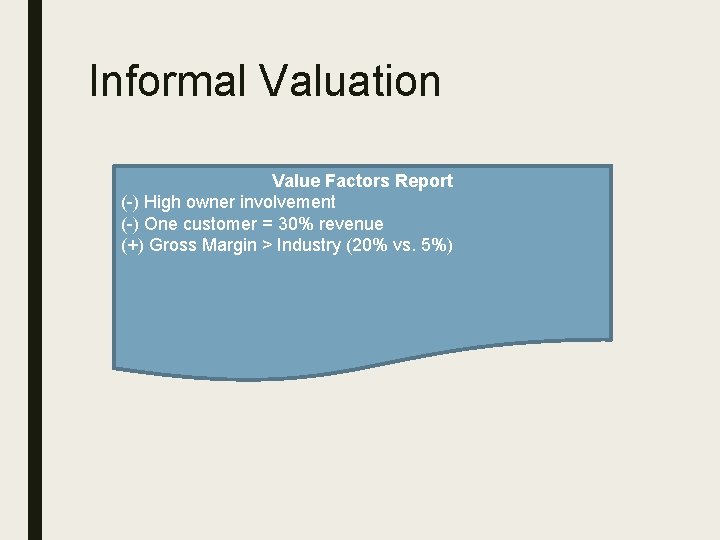
Informal Valuation Value Factors Report (-) High owner involvement (-) One customer = 30% revenue (+) Gross Margin > Industry (20% vs. 5%)
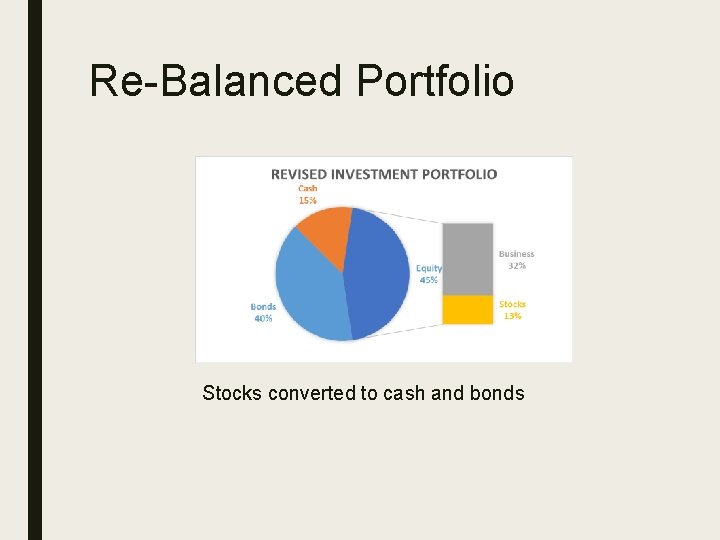
Re-Balanced Portfolio Stocks converted to cash and bonds
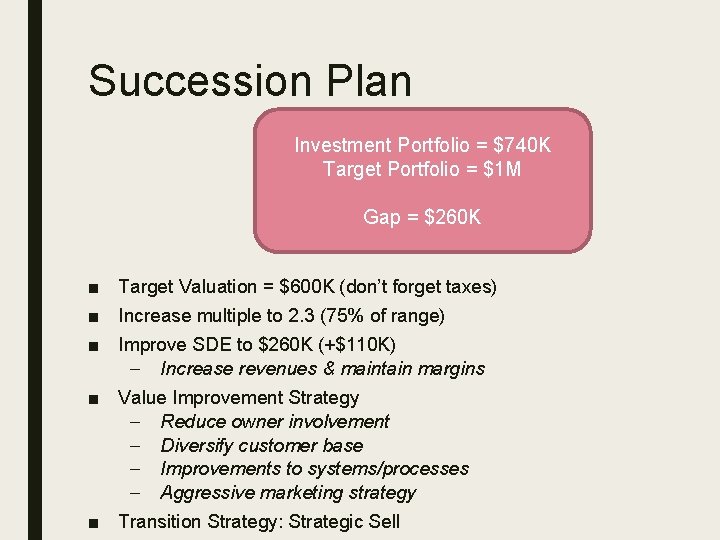
Succession Plan Investment Portfolio = $740 K Target Portfolio = $1 M Gap = $260 K ■ Target Valuation = $600 K (don’t forget taxes) ■ Increase multiple to 2. 3 (75% of range) ■ Improve SDE to $260 K (+$110 K) – Increase revenues & maintain margins ■ Value Improvement Strategy – Reduce owner involvement – Diversify customer base – Improvements to systems/processes – Aggressive marketing strategy ■ Transition Strategy: Strategic Sell
Succession Strategy is Good Business Strategy ■ It is about building, harvesting, and preserving wealth from years of hard work – Know the value of your business, – Set targets and re-align your investment portfolio, – Increase the value of your business, – Prepare your business for sale, – Figure out your “third-act”.
Exit. Map Express ■ Designed for businesses with less than 15 employees – Initial Assessment to establish a baseline – Roadmap for Succession Plan – Looks at key metrics of business – financial, owner dependency, customer/supplier diversification, policies/procedures, continuity plan, after-business plan. – Prepare your business for sale, ready to work with professionals – Attorney, CPA, Banker, Financial Planner, Insurance Agent, etc. – Figure out your “third-act”.
QUESTIONS? TOM BYLER, CEPA TBYLER@EMPORIA. EDU
- Slides: 39