
Introduction to strain and borehole strainmeter data Evelyn
Introduction to strain and borehole strainmeter data Evelyn Roeloffs USGS 3 March 2014
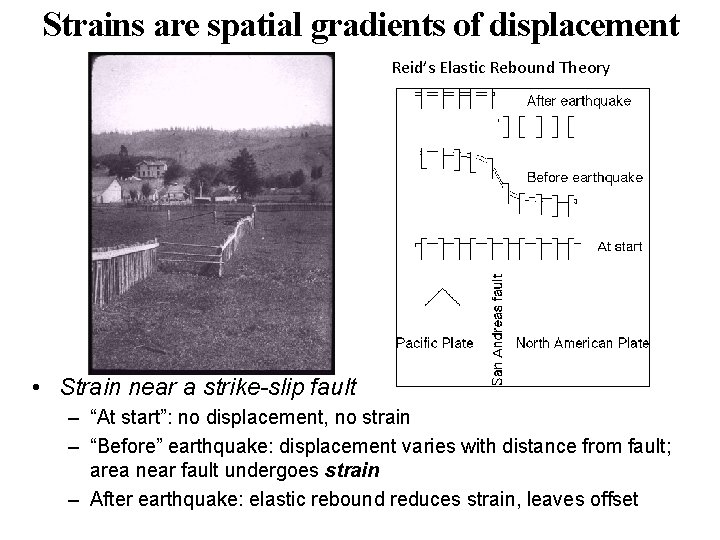
Strains are spatial gradients of displacement Reid’s Elastic Rebound Theory • Strain near a strike-slip fault – “At start”: no displacement, no strain – “Before” earthquake: displacement varies with distance from fault; area near fault undergoes strain – After earthquake: elastic rebound reduces strain, leaves offset



Strain, tilt, and stress: Basic math and mechanics • Basic assumptions – 1) "small" region: • The region is small enough that displacement throughout the region is adequately approximated using displacement at a single point and its spatial derivatives – 2) "small" strains: • Generally we will be speaking of strains in the range 10 -10 (0. 1 nanostrain) to 10 -4 (100 microstrain). – 3) Only changes matter • For example, we will consider strain changes caused by atmospheric pressure fluctuations, but we will not be concerned with the more or less constant overburden pressure.
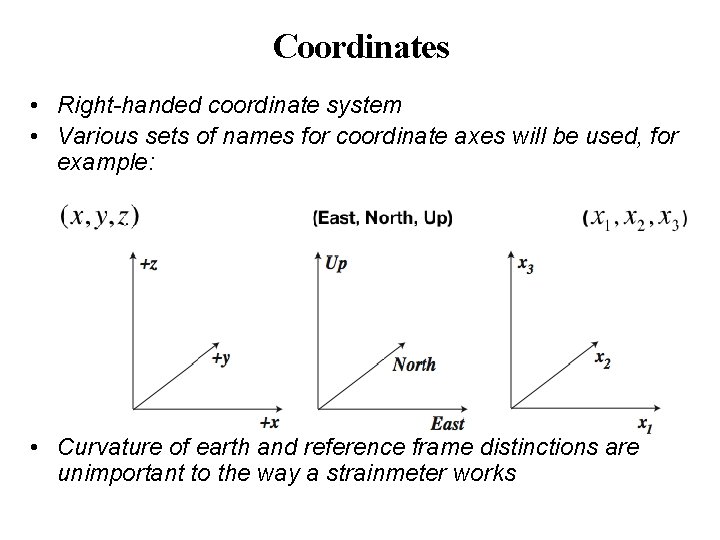
Coordinates • Right-handed coordinate system • Various sets of names for coordinate axes will be used, for example: • Curvature of earth and reference frame distinctions are unimportant to the way a strainmeter works
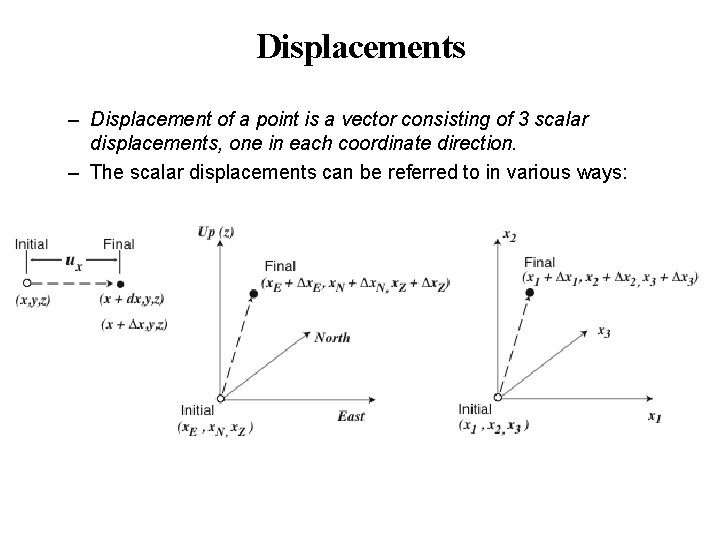
Displacements – Displacement of a point is a vector consisting of 3 scalar displacements, one in each coordinate direction. – The scalar displacements can be referred to in various ways:
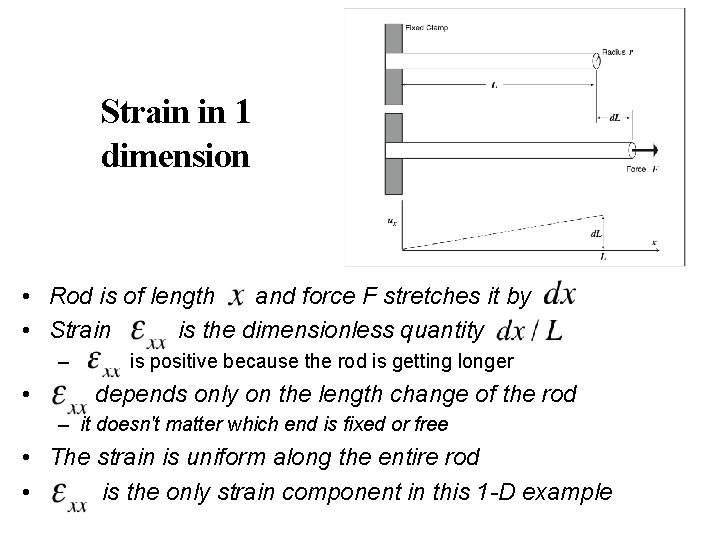
Strain in 1 dimension • Rod is of length and force F stretches it by • Strain is the dimensionless quantity – • is positive because the rod is getting longer depends only on the length change of the rod – it doesn't matter which end is fixed or free • The strain is uniform along the entire rod • is the only strain component in this 1 -D example

"Units" of strain and sign conventions • Strain is dimensionless but often referred to as if it had units: – 1% strain is a strain of 0. 01 = 10, 000 microstrain = 10, 000 ppm – 1 mm change in a 1 -km baseline is a strain of 10 -6= 1 microstrain=1 ppm – 0. 001 mm change in a 1 -km baseline is a strain of 10 -9= 1 nanostrain = 1 ppb • Sign conventions that minimize mathematical confusion: – Increases of length, area, or volume (expansion) are positive strains. – Shear strains are positive for displacement increasing in the relevant coordinate direction • In some publications, contractional strains are described as positive – In geotechnical literature contraction (and compressional stress) are referred to as positive. – Published work on volumetric strainmeter data describes contraction as positive.
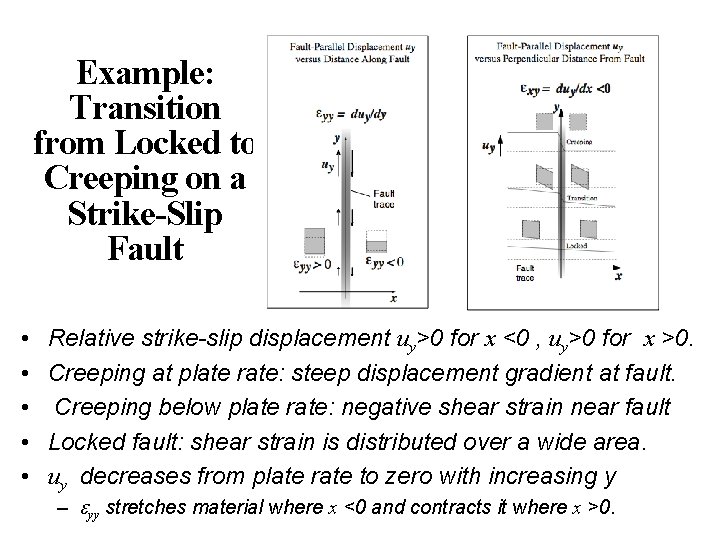
Example: Transition from Locked to Creeping on a Strike-Slip Fault • • • Relative strike-slip displacement uy>0 for x <0 , uy>0 for x >0. Creeping at plate rate: steep displacement gradient at fault. Creeping below plate rate: negative shear strain near fault Locked fault: shear strain is distributed over a wide area. uy decreases from plate rate to zero with increasing y – yy stretches material where x <0 and contracts it where x >0.
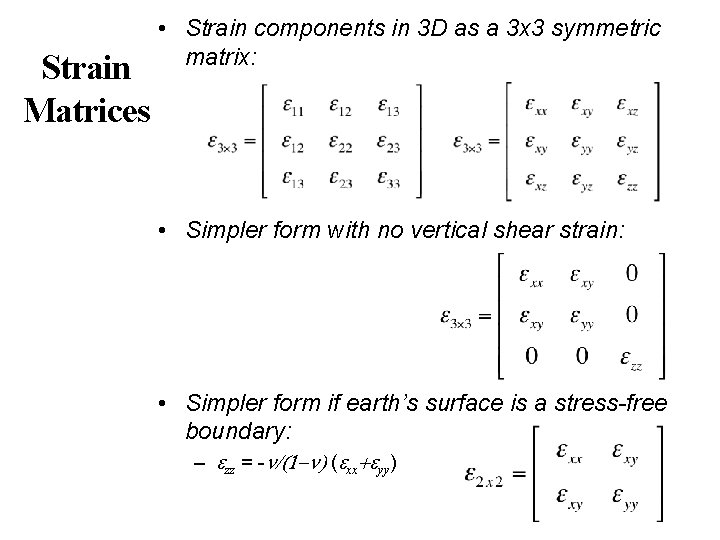
Strain Matrices • Strain components in 3 D as a 3 x 3 symmetric matrix: • Simpler form with no vertical shear strain: • Simpler form if earth’s surface is a stress-free boundary: – zz = - ( xx yy)
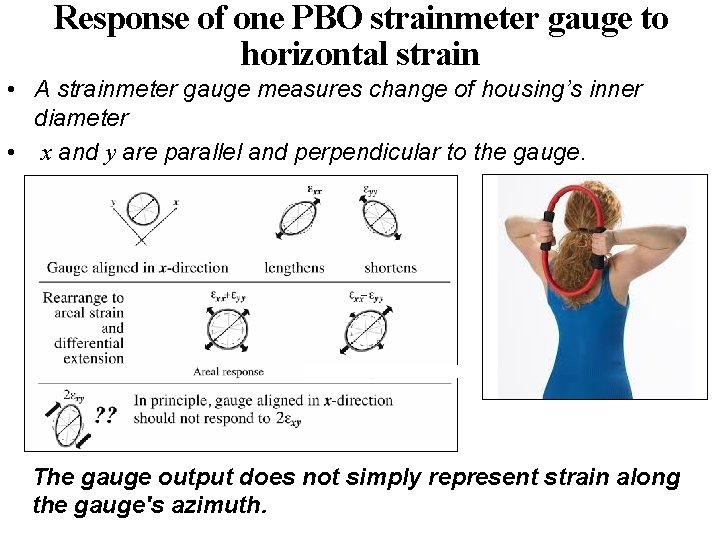
Response of one PBO strainmeter gauge to horizontal strain • A strainmeter gauge measures change of housing’s inner diameter • x and y are parallel and perpendicular to the gauge. The gauge output does not simply represent strain along the gauge's azimuth.
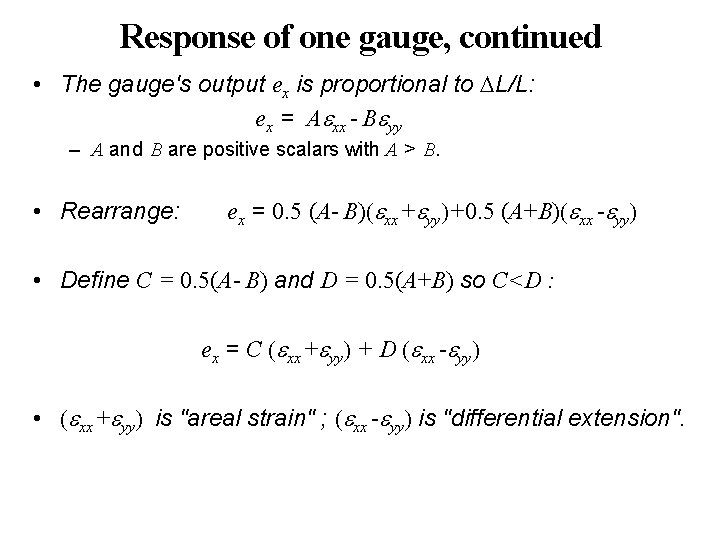
Response of one gauge, continued • The gauge's output ex is proportional to L/L: ex = A xx - B yy – A and B are positive scalars with A > B. • Rearrange: ex = 0. 5 (A- B) xx + yy +0. 5 (A+B) xx - yy • Define C = 0. 5(A- B) and D = 0. 5(A+B) so C<D : ex = C xx + yy + D xx - yy • xx + yy is "areal strain" ; xx - yy is "differential extension".
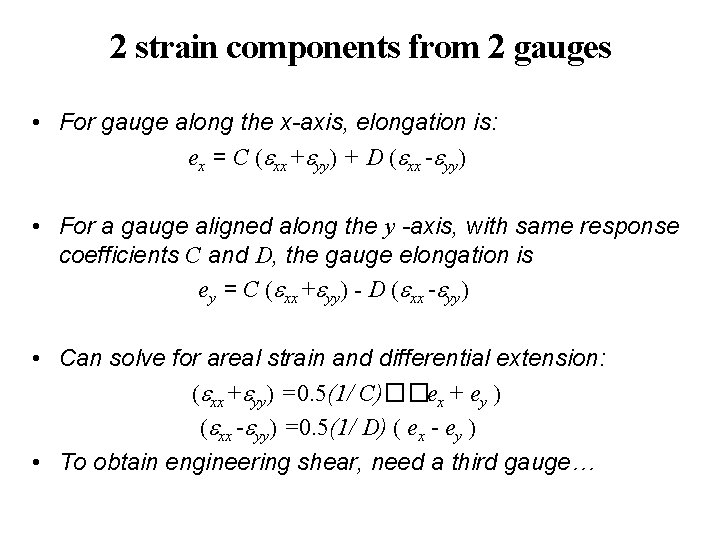
2 strain components from 2 gauges • For gauge along the x-axis, elongation is: ex = C xx + yy + D xx - yy • For a gauge aligned along the y -axis, with same response coefficients C and D, the gauge elongation is ey = C xx + yy - D xx - yy • Can solve for areal strain and differential extension: xx + yy =0. 5(1/ C)��ex + ey xx - yy =0. 5(1/ D) ex - ey • To obtain engineering shear, need a third gauge…
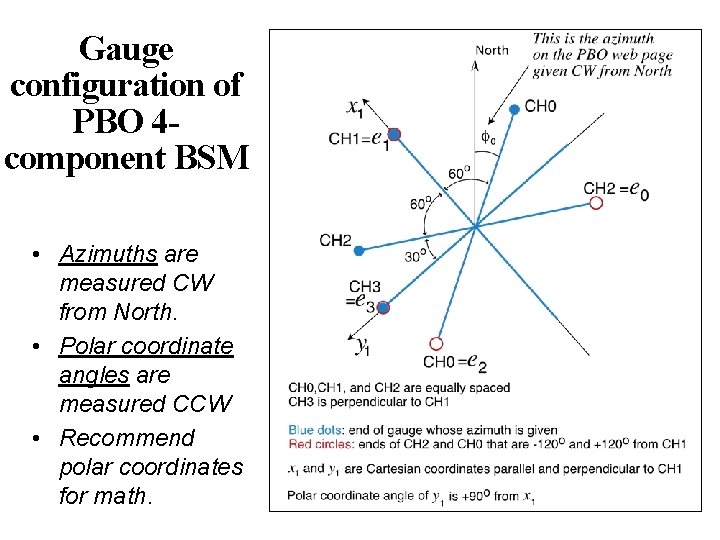
Gauge configuration of PBO 4 component BSM • Azimuths are measured CW from North. • Polar coordinate angles are measured CCW • Recommend polar coordinates for math.
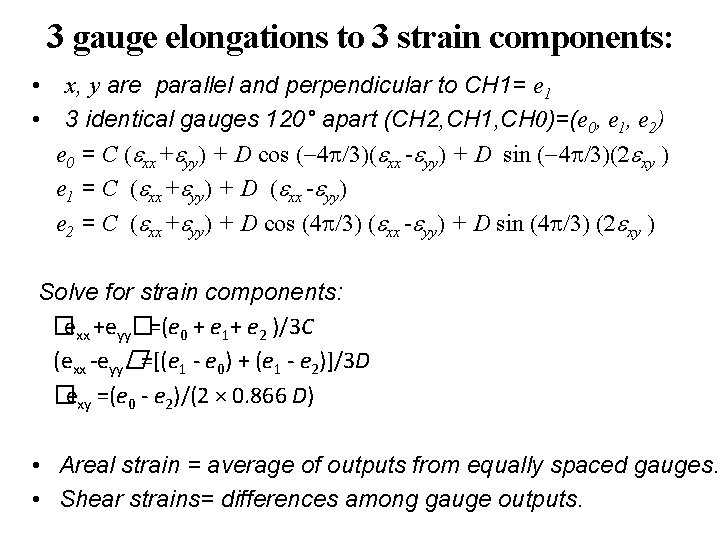
3 gauge elongations to 3 strain components: • • x, y are parallel and perpendicular to CH 1= e 1 3 identical gauges 120° apart (CH 2, CH 1, CH 0)=(e 0, e 1, e 2) e 0 = C xx + yy + D cos xx - yy + D sin xy e 1 = C xx + yy + D xx - yy e 2 = C xx + yy + D cos xx - yy + D sin xy Solve for strain components: �exx +eyy�=(e 0 + e 1+ e 2 )/3 C (exx -eyy�=[(e 1 - e 0) + (e 1 - e 2)]/3 D �exy =(e 0 - e 2)/(2 × 0. 866 D) • Areal strain = average of outputs from equally spaced gauges. • Shear strains= differences among gauge outputs.
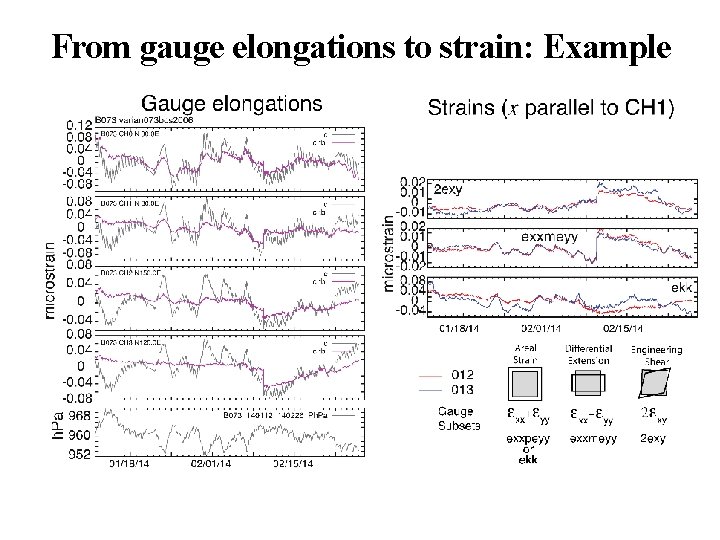
From gauge elongations to strain: Example
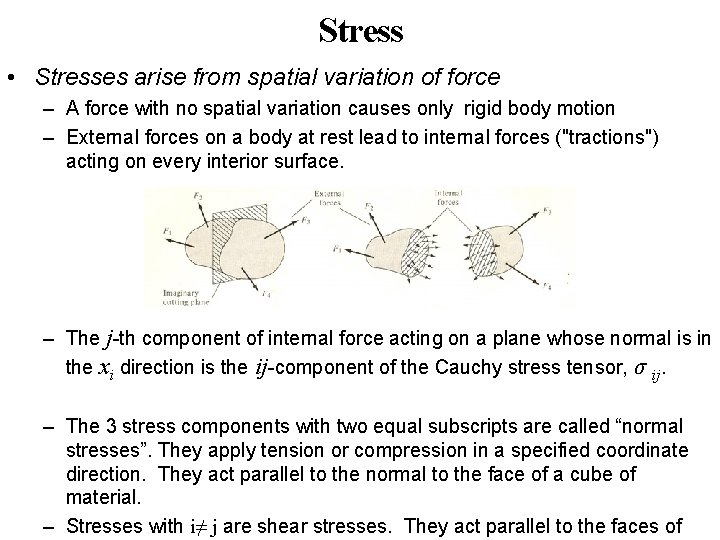
Stress • Stresses arise from spatial variation of force – A force with no spatial variation causes only rigid body motion – External forces on a body at rest lead to internal forces ("tractions") acting on every interior surface. – The j-th component of internal force acting on a plane whose normal is in the xi direction is the ij-component of the Cauchy stress tensor, σ ij. – The 3 stress components with two equal subscripts are called “normal stresses”. They apply tension or compression in a specified coordinate direction. They act parallel to the normal to the face of a cube of material. – Stresses with i≠ j are shear stresses. They act parallel to the faces of
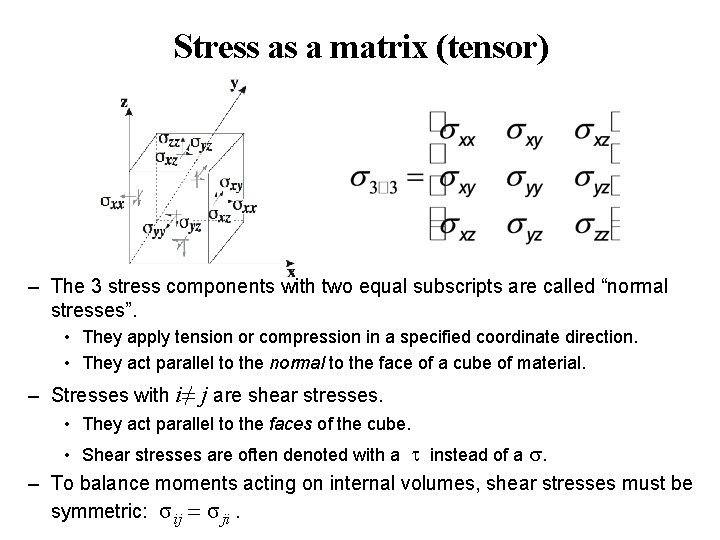
Stress as a matrix (tensor) – The 3 stress components with two equal subscripts are called “normal stresses”. • They apply tension or compression in a specified coordinate direction. • They act parallel to the normal to the face of a cube of material. – Stresses with i≠ j are shear stresses. • They act parallel to the faces of the cube. • Shear stresses are often denoted with a instead of a . – To balance moments acting on internal volumes, shear stresses must be symmetric: σ ij = σ ji.
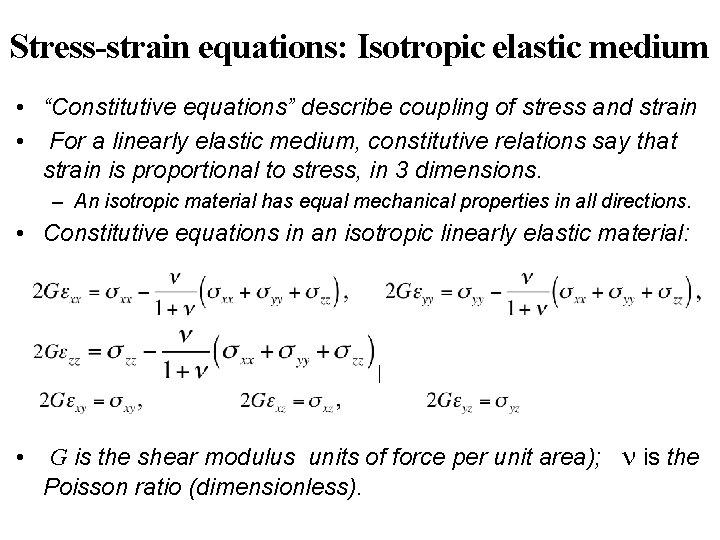
Stress-strain equations: Isotropic elastic medium • “Constitutive equations” describe coupling of stress and strain • For a linearly elastic medium, constitutive relations say that strain is proportional to stress, in 3 dimensions. – An isotropic material has equal mechanical properties in all directions. • Constitutive equations in an isotropic linearly elastic material: • G is the shear modulus units of force per unit area); is the Poisson ratio (dimensionless).
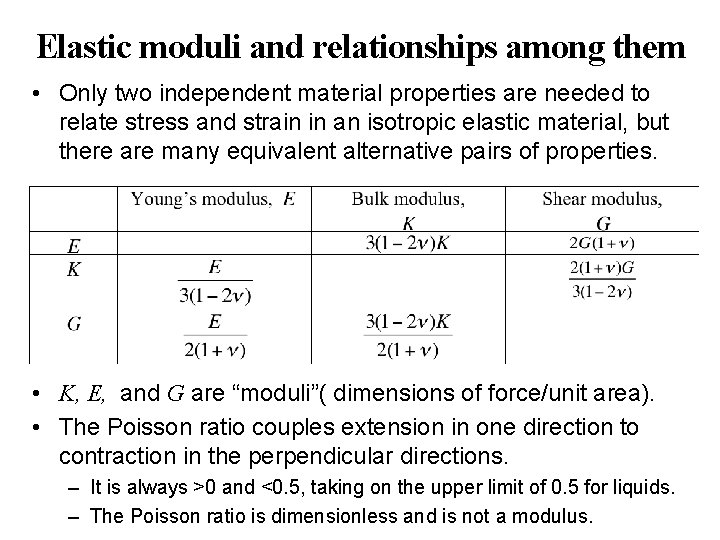
Elastic moduli and relationships among them • Only two independent material properties are needed to relate stress and strain in an isotropic elastic material, but there are many equivalent alternative pairs of properties. • K, E, and G are “moduli”( dimensions of force/unit area). • The Poisson ratio couples extension in one direction to contraction in the perpendicular directions. – It is always >0 and <0. 5, taking on the upper limit of 0. 5 for liquids. – The Poisson ratio is dimensionless and is not a modulus.
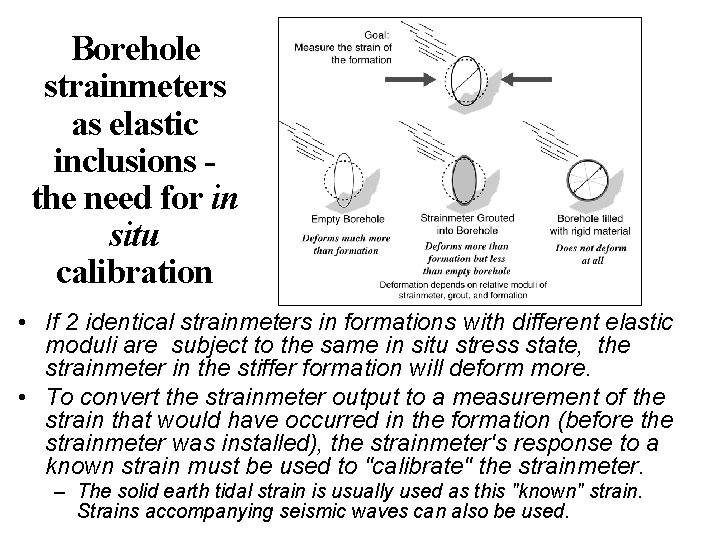
Borehole strainmeters as elastic inclusions the need for in situ calibration • If 2 identical strainmeters in formations with different elastic moduli are subject to the same in situ stress state, the strainmeter in the stiffer formation will deform more. • To convert the strainmeter output to a measurement of the strain that would have occurred in the formation (before the strainmeter was installed), the strainmeter's response to a known strain must be used to "calibrate" the strainmeter. – The solid earth tidal strain is usually used as this "known" strain. Strains accompanying seismic waves can also be used.

Topics for later presentations: • • Removal of atmospheric pressure and earth tide effects Removal of long-term trends Rotating strains to different coordinate systems Seasonal signals
- Slides: 30