
Introduction to Statistics Political Science Class 6 Interactions





- Slides: 25
Introduction to Statistics: Political Science (Class 6) Interactions Between Variables
Remember what regression “does” • Identifies the coefficients that minimize the sum of the squared residuals • For example…
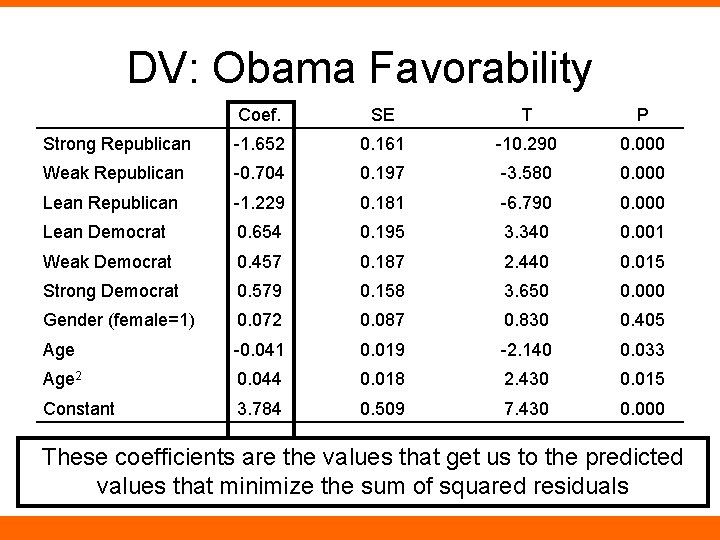
DV: Obama Favorability Coef. SE T P Strong Republican -1. 652 0. 161 -10. 290 0. 000 Weak Republican -0. 704 0. 197 -3. 580 0. 000 Lean Republican -1. 229 0. 181 -6. 790 0. 000 Lean Democrat 0. 654 0. 195 3. 340 0. 001 Weak Democrat 0. 457 0. 187 2. 440 0. 015 Strong Democrat 0. 579 0. 158 3. 650 0. 000 Gender (female=1) 0. 072 0. 087 0. 830 0. 405 Age -0. 041 0. 019 -2. 140 0. 033 Age 2 0. 044 0. 018 2. 430 0. 015 Constant 3. 784 0. 509 7. 430 0. 000 These coefficients are the values that get us to the predicted values that minimize the sum of squared residuals
How? • Simple formula for calculating coefficients in bivariate case. Not simple in multivariate case. • In practice, MV analysis relies on matrix algebra. In theory, this can be done computationally by searching though every iteration of coefficient values.
We have covered • Regression using: – Linear variables – Dichotomous indicators – Squared and logarithmic terms • Today: what if the relationship between a predictor and outcome “depends”?
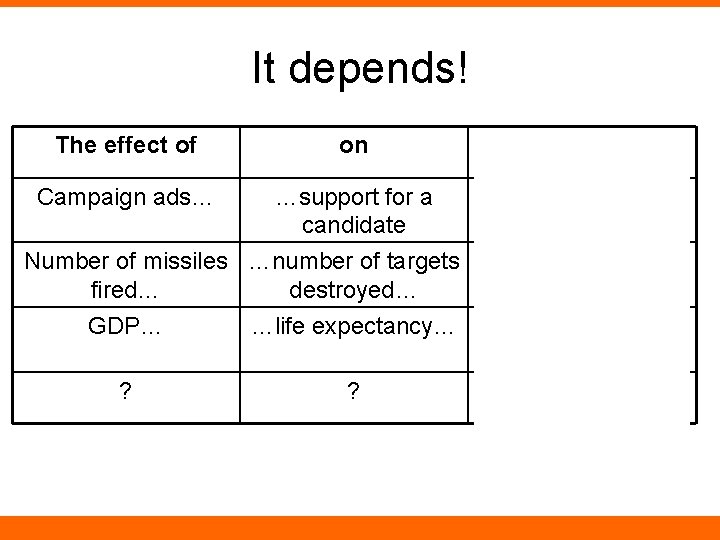
It depends! The effect of on depends on Campaign ads… …support for a candidate …whether a person watches TV. Number of missiles …number of targets …quality of fired… destroyed… targeting systems. GDP… …life expectancy… ? ? …whether the nation is democratic. ?
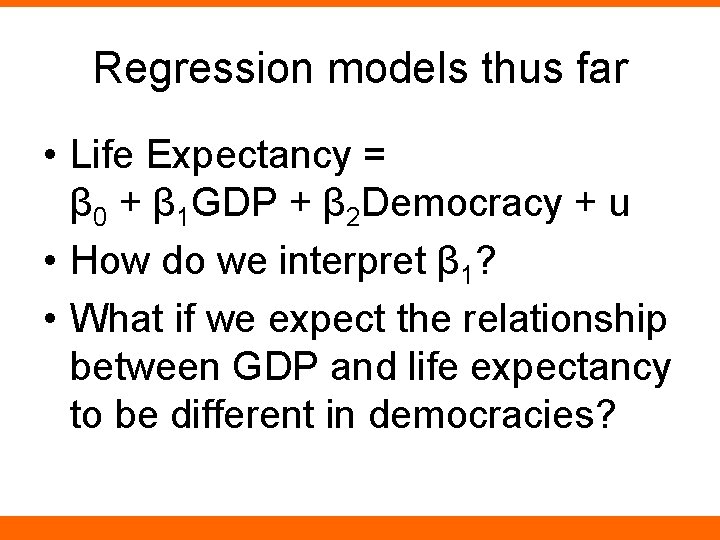
Regression models thus far • Life Expectancy = β 0 + β 1 GDP + β 2 Democracy + u • How do we interpret β 1? • What if we expect the relationship between GDP and life expectancy to be different in democracies?
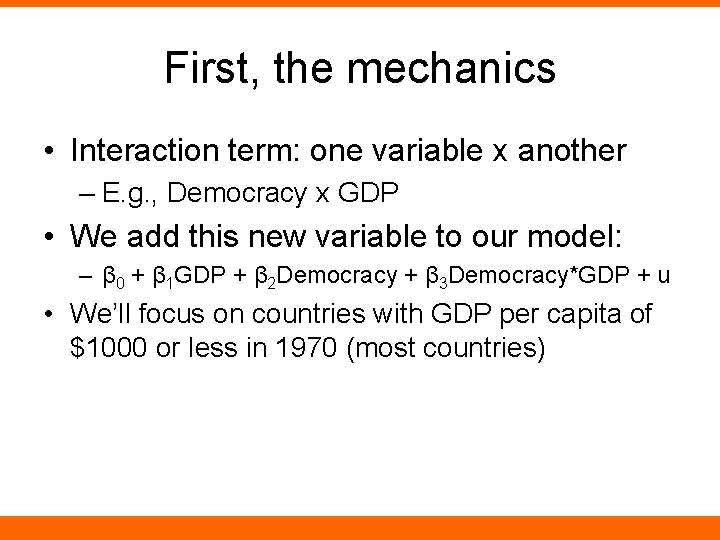
First, the mechanics • Interaction term: one variable x another – E. g. , Democracy x GDP • We add this new variable to our model: – β 0 + β 1 GDP + β 2 Democracy + β 3 Democracy*GDP + u • We’ll focus on countries with GDP per capita of $1000 or less in 1970 (most countries)
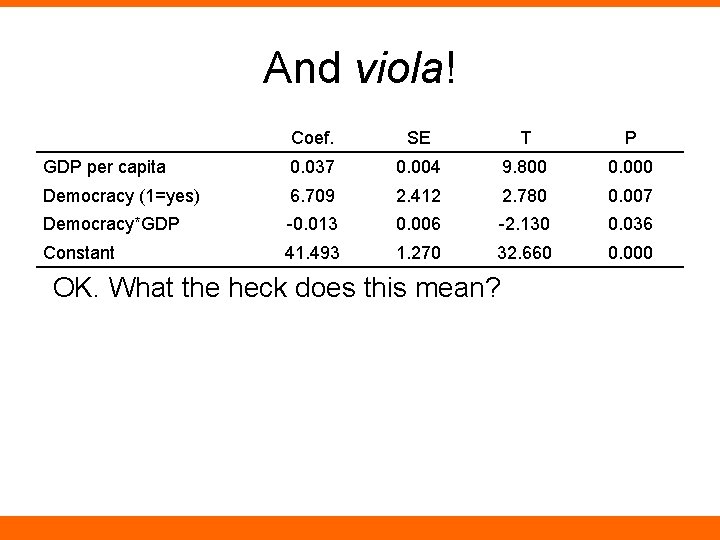
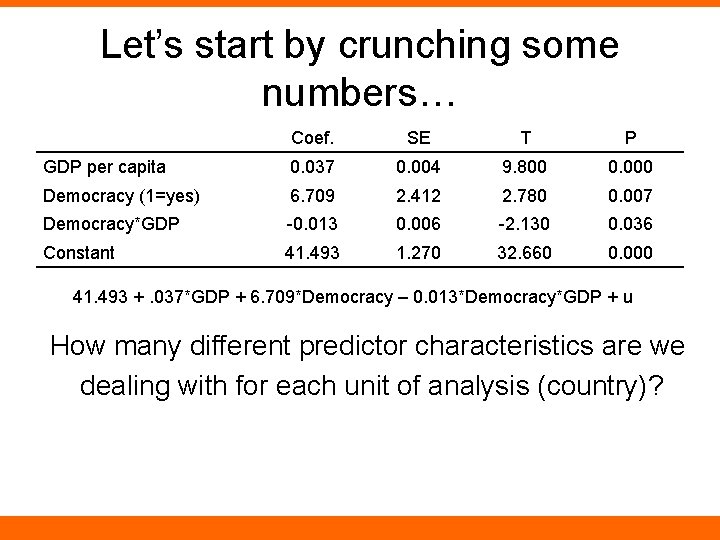
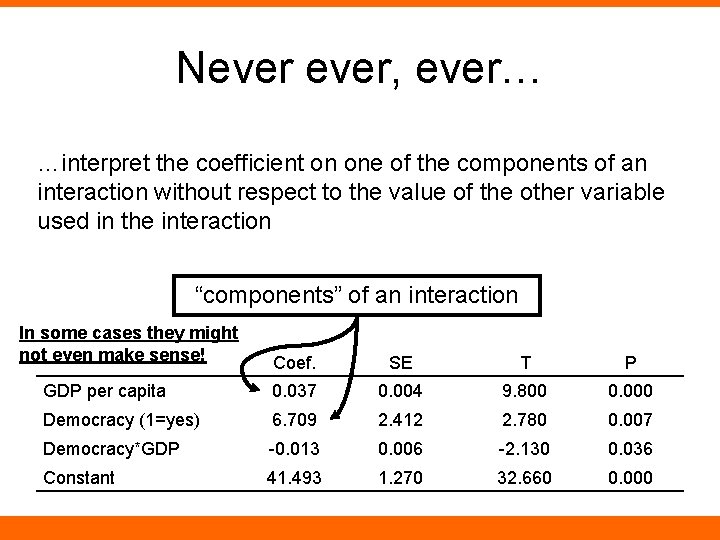
And viola! Coef. SE T P GDP per capita 0. 037 0. 004 9. 800 0. 000 Democracy (1=yes) 6. 709 2. 412 2. 780 0. 007 Democracy*GDP -0. 013 0. 006 -2. 130 0. 036 Constant 41. 493 1. 270 32. 660 0. 000 OK. What the heck does this mean?
Let’s start by crunching some numbers… Coef. SE T P GDP per capita 0. 037 0. 004 9. 800 0. 000 Democracy (1=yes) 6. 709 2. 412 2. 780 0. 007 Democracy*GDP -0. 013 0. 006 -2. 130 0. 036 Constant 41. 493 1. 270 32. 660 0. 000 41. 493 +. 037*GDP + 6. 709*Democracy – 0. 013*Democracy*GDP + u How many different predictor characteristics are we dealing with for each unit of analysis (country)?
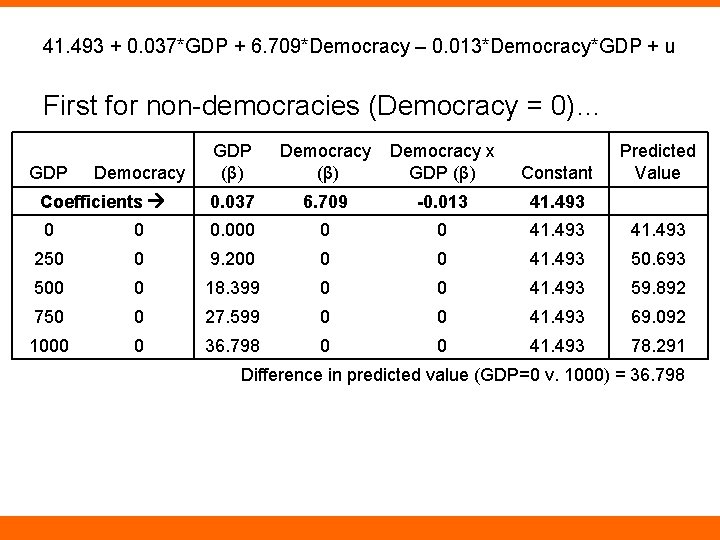
41. 493 + 0. 037*GDP + 6. 709*Democracy – 0. 013*Democracy*GDP + u First for non-democracies (Democracy = 0)… GDP (β) Democracy x GDP (β) Constant Coefficients 0. 037 6. 709 -0. 013 41. 493 0 0 0. 000 0 0 41. 493 250 0 9. 200 0 0 41. 493 50. 693 500 0 18. 399 0 0 41. 493 59. 892 750 0 27. 599 0 0 41. 493 69. 092 1000 0 36. 798 0 0 41. 493 78. 291 GDP Democracy Predicted Value Difference in predicted value (GDP=0 v. 1000) = 36. 798
41. 493 + 0. 037*GDP + 6. 709*Democracy – 0. 013*Democracy*GDP + u Now for democracies (Democracy = 1)… GDP Democracy Coefficients GDP (β) Democracy( Democracy β) x GDP (β) Constant Predicted Value 0. 037 6. 709 -0. 013 41. 493 - 0 1 0. 000 6. 709 0 41. 493 48. 202 250 1 9. 200 6. 709 -3. 1297 41. 493 54. 272 500 1 18. 399 6. 709 -6. 2594 41. 493 60. 342 750 1 27. 599 6. 709 -9. 3891 41. 493 66. 412 1000 1 36. 798 6. 709 -12. 5188 41. 493 72. 482 Difference in predicted value (GDP=0 v. 1000) = 24. 280
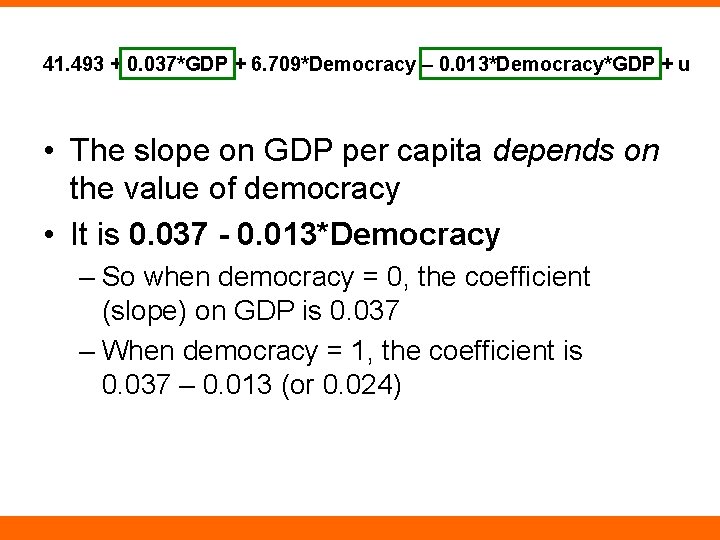
41. 493 + 0. 037*GDP + 6. 709*Democracy – 0. 013*Democracy*GDP + u • The slope on GDP per capita depends on the value of democracy • It is 0. 037 - 0. 013*Democracy – So when democracy = 0, the coefficient (slope) on GDP is 0. 037 – When democracy = 1, the coefficient is 0. 037 – 0. 013 (or 0. 024)
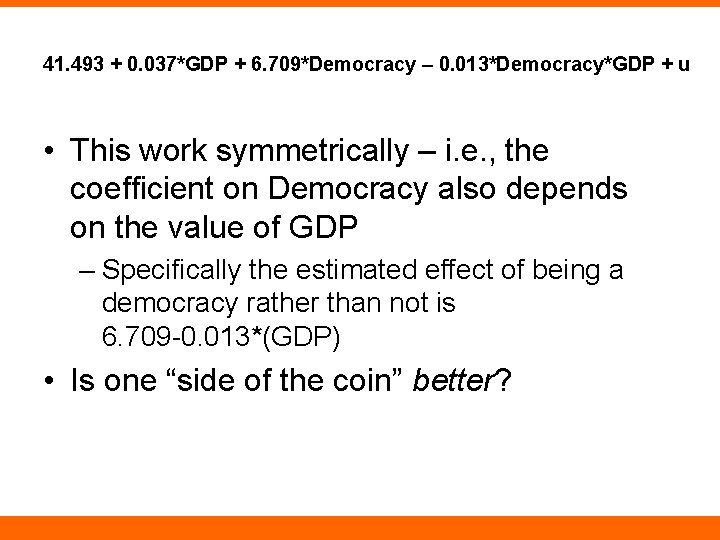
41. 493 + 0. 037*GDP + 6. 709*Democracy – 0. 013*Democracy*GDP + u • This work symmetrically – i. e. , the coefficient on Democracy also depends on the value of GDP – Specifically the estimated effect of being a democracy rather than not is 6. 709 -0. 013*(GDP) • Is one “side of the coin” better?
Never, ever… …interpret the coefficient on one of the components of an interaction without respect to the value of the other variable used in the interaction “components” of an interaction In some cases they might not even make sense! Coef. SE T P GDP per capita 0. 037 0. 004 9. 800 0. 000 Democracy (1=yes) 6. 709 2. 412 2. 780 0. 007 Democracy*GDP -0. 013 0. 006 -2. 130 0. 036 Constant 41. 493 1. 270 32. 660 0. 000
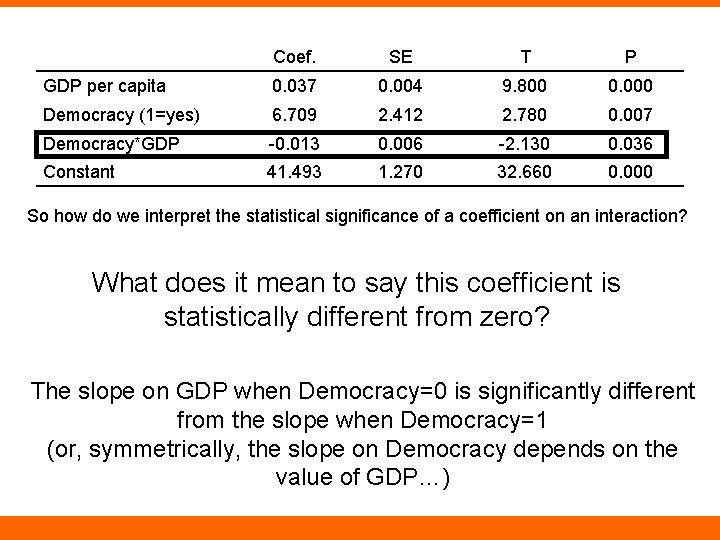
Coef. SE T P GDP per capita 0. 037 0. 004 9. 800 0. 000 Democracy (1=yes) 6. 709 2. 412 2. 780 0. 007 Democracy*GDP -0. 013 0. 006 -2. 130 0. 036 Constant 41. 493 1. 270 32. 660 0. 000 So how do we interpret the statistical significance of a coefficient on an interaction? What does it mean to say this coefficient is statistically different from zero? The slope on GDP when Democracy=0 is significantly different from the slope when Democracy=1 (or, symmetrically, the slope on Democracy depends on the value of GDP…)
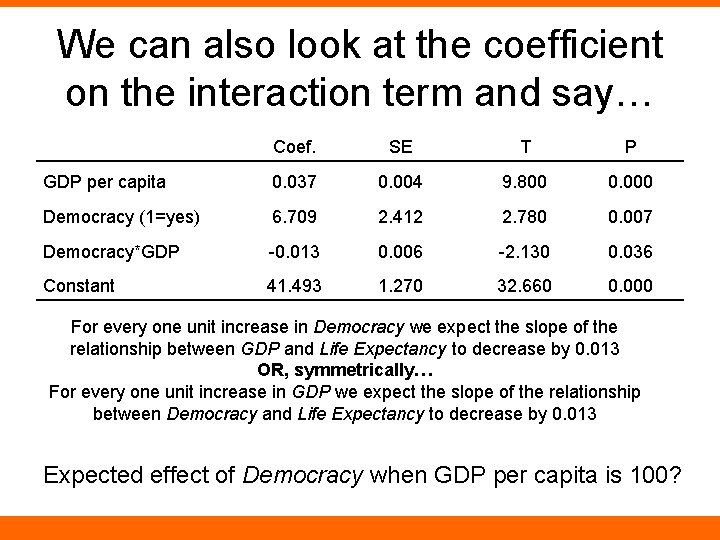
We can also look at the coefficient on the interaction term and say… Coef. SE T P GDP per capita 0. 037 0. 004 9. 800 0. 000 Democracy (1=yes) 6. 709 2. 412 2. 780 0. 007 Democracy*GDP -0. 013 0. 006 -2. 130 0. 036 Constant 41. 493 1. 270 32. 660 0. 000 For every one unit increase in Democracy we expect the slope of the relationship between GDP and Life Expectancy to decrease by 0. 013 OR, symmetrically… For every one unit increase in GDP we expect the slope of the relationship between Democracy and Life Expectancy to decrease by 0. 013 Expected effect of Democracy when GDP per capita is 100?
Support for Comparative Effectiveness Research • For many medical conditions, doctors use different kinds of treatments, and there is no scientific agreement on which is best. For example, a patient may be experiencing a particular type of pain and it is unclear whether the best treatment is a drug, physical therapy, or surgery. Recently there has been discussion about the need for more research to determine which treatments are most effective for which patients. This is sometimes called comparative effectiveness research. Would you support or oppose government funding of research on the effectiveness of different medical treatments? • Strongly Oppose (0) to Strongly Support (100)
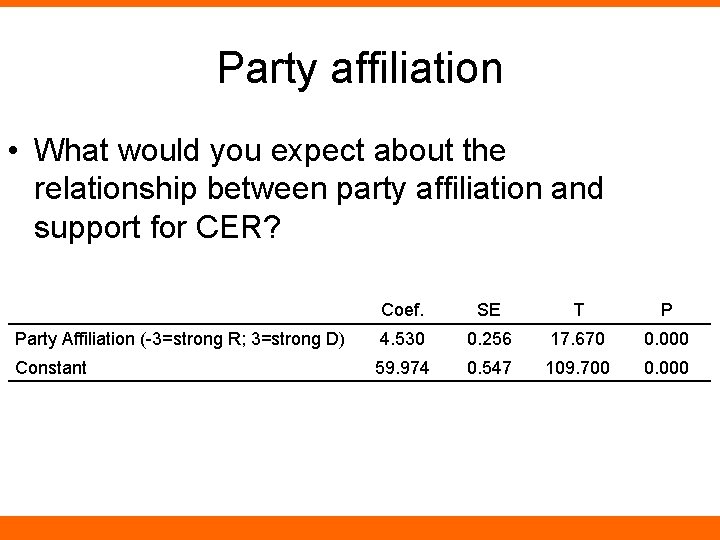
Party affiliation • What would you expect about the relationship between party affiliation and support for CER? Coef. SE T P Party Affiliation (-3=strong R; 3=strong D) 4. 530 0. 256 17. 670 0. 000 Constant 59. 974 0. 547 109. 700 0. 000
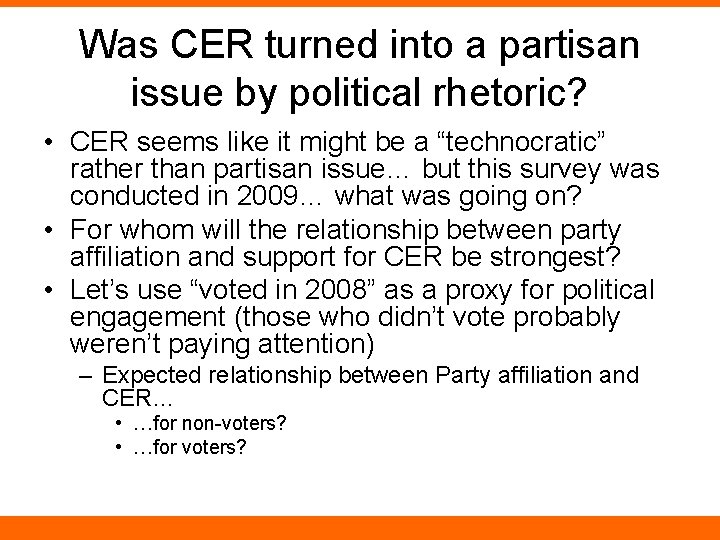
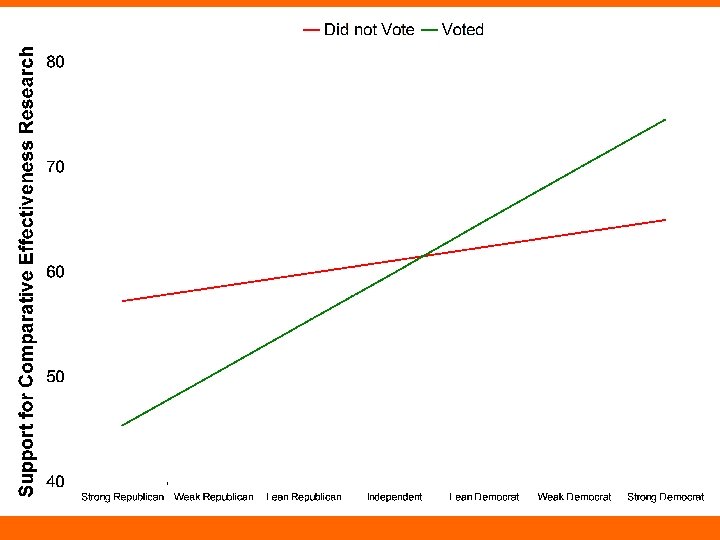
Was CER turned into a partisan issue by political rhetoric? • CER seems like it might be a “technocratic” rather than partisan issue… but this survey was conducted in 2009… what was going on? • For whom will the relationship between party affiliation and support for CER be strongest? • Let’s use “voted in 2008” as a proxy for political engagement (those who didn’t vote probably weren’t paying attention) – Expected relationship between Party affiliation and CER… • …for non-voters? • …for voters?
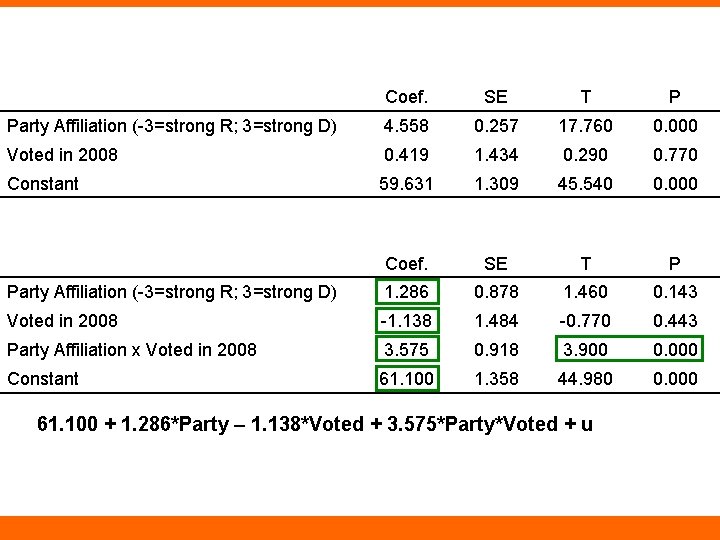
Coef. SE T P Party Affiliation (-3=strong R; 3=strong D) 4. 558 0. 257 17. 760 0. 000 Voted in 2008 0. 419 1. 434 0. 290 0. 770 Constant 59. 631 1. 309 45. 540 0. 000 Coef. SE T P Party Affiliation (-3=strong R; 3=strong D) 1. 286 0. 878 1. 460 0. 143 Voted in 2008 -1. 138 1. 484 -0. 770 0. 443 Party Affiliation x Voted in 2008 3. 575 0. 918 3. 900 0. 000 Constant 61. 100 1. 358 44. 980 0. 000 61. 100 + 1. 286*Party – 1. 138*Voted + 3. 575*Party*Voted + u
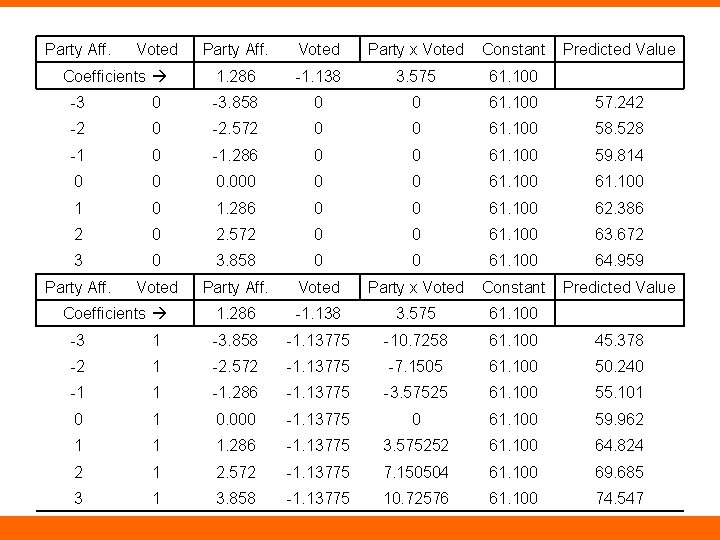
Party Aff. Voted Coefficients Party Aff. Voted Party x Voted Constant 1. 286 -1. 138 3. 575 61. 100 Predicted Value -3 0 -3. 858 0 0 61. 100 57. 242 -2 0 -2. 572 0 0 61. 100 58. 528 -1 0 -1. 286 0 0 61. 100 59. 814 0 0 0. 000 0 0 61. 100 1 0 1. 286 0 0 61. 100 62. 386 2 0 2. 572 0 0 61. 100 63. 672 3 0 3. 858 0 0 61. 100 64. 959 Party Aff. Voted Party x Voted Constant Predicted Value 1. 286 -1. 138 3. 575 61. 100 Coefficients -3 1 -3. 858 -1. 13775 -10. 7258 61. 100 45. 378 -2 1 -2. 572 -1. 13775 -7. 1505 61. 100 50. 240 -1 1 -1. 286 -1. 13775 -3. 57525 61. 100 55. 101 0 1 0. 000 -1. 13775 0 61. 100 59. 962 1 1 1. 286 -1. 13775 3. 575252 61. 100 64. 824 2 1 2. 572 -1. 13775 7. 150504 61. 100 69. 685 3 1 3. 858 -1. 13775 10. 72576 61. 100 74. 547
Notes and Next Time • Homework 2 is due on Thursday (11/18) • Pick up Homework 3 today. It is due on the Tuesday after Fall Break. • Next time: – The “why” and “how” of experiments in political science