
Introduction to Statistics How do we define statistics
- Slides: 14
Introduction to Statistics
How do we define statistics? Statistics is… • The study of how best to collect, analyze, and draw conclusions from data. 2
How do we define statistics? Statistics is… • The study of how best to collect, analyze, and draw conclusions from data. • Statistics is the science of learning from data, and of measuring, controlling, and communicating uncertainty. 3
What can statistics do? • Support investigation across a wide range of fields. 4
What can statistics do? • Support investigation across a wide range of fields. • Help us to learn from real and interesting data. 5
What can statistics do? • Support investigation across a wide range of fields. • Help us to learn from real and interesting data • Advance our understanding of ourselves and our world. 6
Statistics as part of the investigation process When you have a question or problem, the discipline of statistics helps you to: 7
Statistics as part of the investigation process. When you have a question or problem, the discipline of statistics helps you to: 1. Collect relevant data on the topic 8
Statistics as part of the investigation process. When you have a question or problem, the discipline of statistics helps you to: 1. Collect relevant data on the topic 2. Analyze the data 9
Statistics as part of the investigation process. When you have a question or problem, the discipline of statistics helps you to: 1. Collect relevant data on the topic 2. Analyze the data 3. Form a conclusion 10
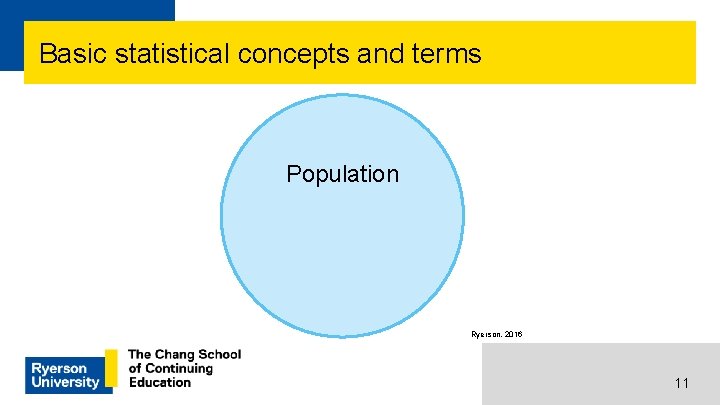
Basic statistical concepts and terms Population Ryerson, 2016 11
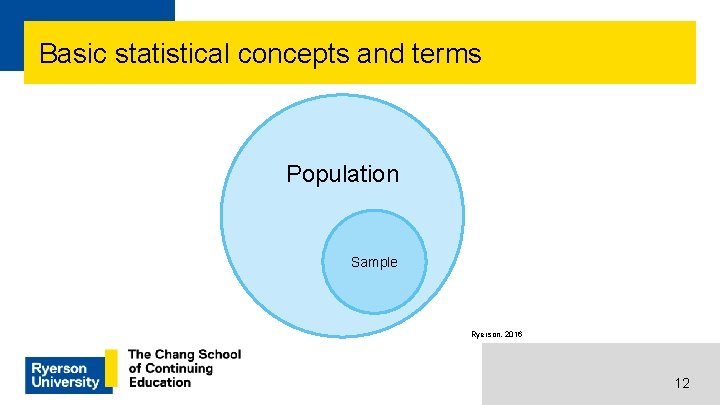
Basic statistical concepts and terms Population Sample Ryerson, 2016 12
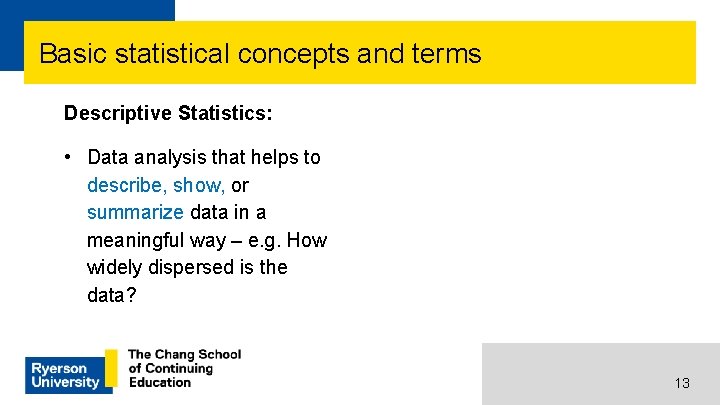
Basic statistical concepts and terms Descriptive Statistics: • Data analysis that helps to describe, show, or summarize data in a meaningful way – e. g. How widely dispersed is the data? 13
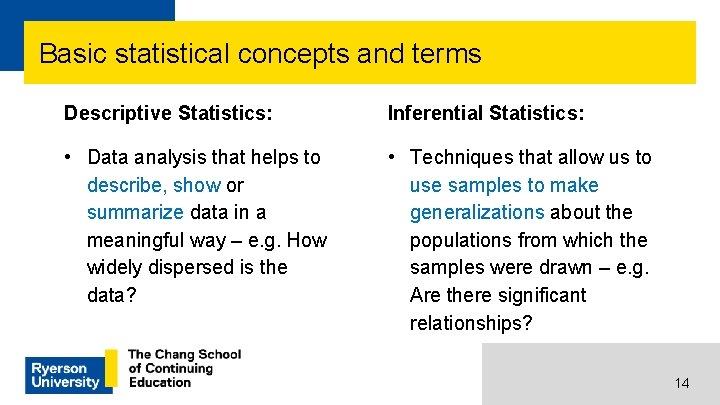
Basic statistical concepts and terms Descriptive Statistics: Inferential Statistics: • Data analysis that helps to describe, show or summarize data in a meaningful way – e. g. How widely dispersed is the data? • Techniques that allow us to use samples to make generalizations about the populations from which the samples were drawn – e. g. Are there significant relationships? 14