
Introduction to Stacks What is a Stack Stack

- Slides: 18
Introduction to Stacks • What is a Stack • Stack implementation using array. • Stack implementation using linked list. • Applications of Stack.
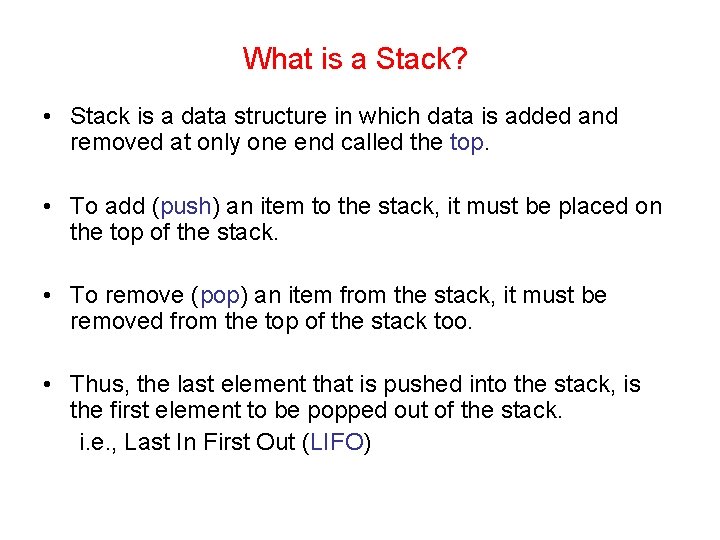
What is a Stack? • Stack is a data structure in which data is added and removed at only one end called the top. • To add (push) an item to the stack, it must be placed on the top of the stack. • To remove (pop) an item from the stack, it must be removed from the top of the stack too. • Thus, the last element that is pushed into the stack, is the first element to be popped out of the stack. i. e. , Last In First Out (LIFO)
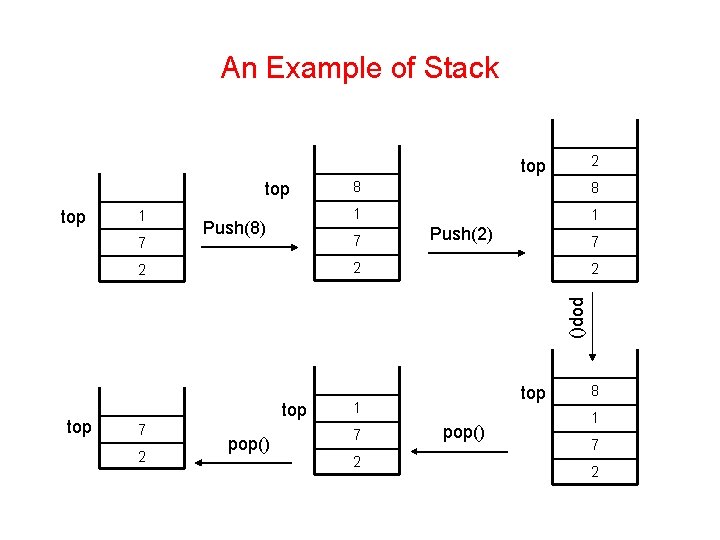
An Example of Stack 2 top top 1 7 Push(8) 8 8 1 1 7 Push(2) 7 2 2 2 p o p () top 7 2 pop() top 1 7 2 pop() 8 1 7 2
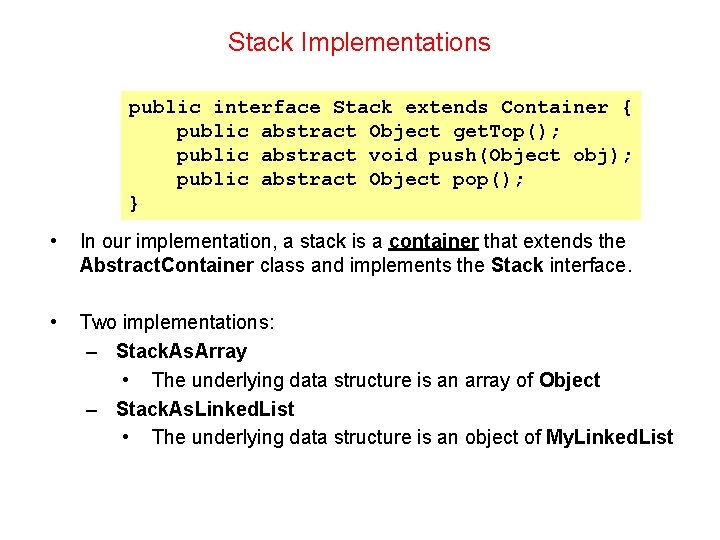
Stack Implementations public interface Stack extends Container { public abstract Object get. Top(); public abstract void push(Object obj); public abstract Object pop(); } • In our implementation, a stack is a container that extends the Abstract. Container class and implements the Stack interface. • Two implementations: – Stack. As. Array • The underlying data structure is an array of Object – Stack. As. Linked. List • The underlying data structure is an object of My. Linked. List
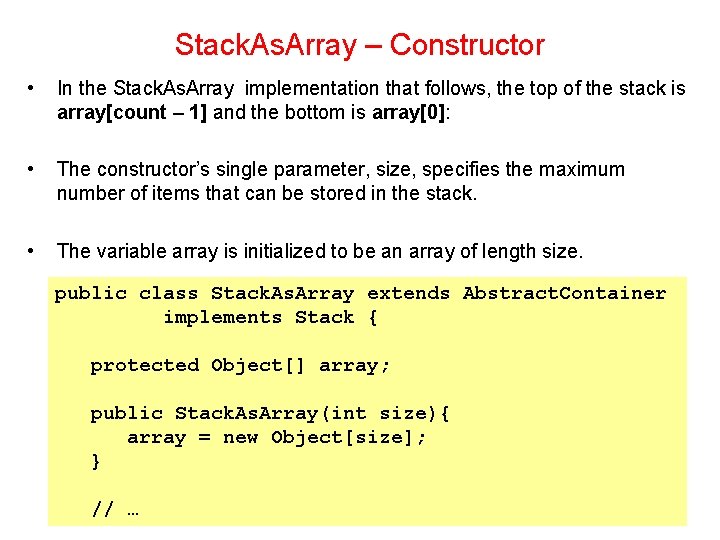
Stack. As. Array – Constructor • In the Stack. As. Array implementation that follows, the top of the stack is array[count – 1] and the bottom is array[0]: • The constructor’s single parameter, size, specifies the maximum number of items that can be stored in the stack. • The variable array is initialized to be an array of length size. public class Stack. As. Array extends Abstract. Container implements Stack { protected Object[] array; public Stack. As. Array(int size){ array = new Object[size]; } // …
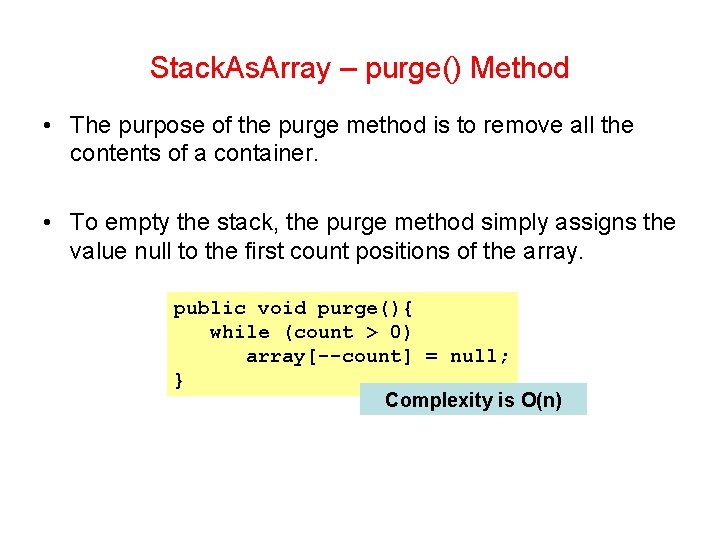
Stack. As. Array – purge() Method • The purpose of the purge method is to remove all the contents of a container. • To empty the stack, the purge method simply assigns the value null to the first count positions of the array. public void purge(){ while (count > 0) array[--count] = null; } Complexity is O(n)
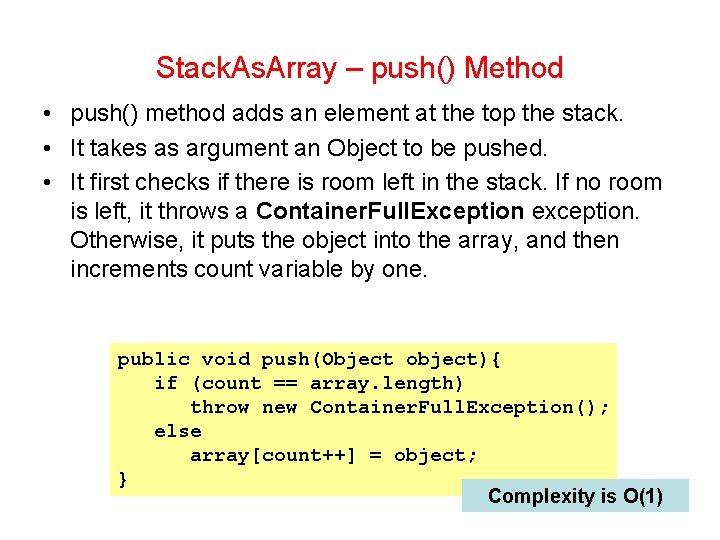
Stack. As. Array – push() Method • push() method adds an element at the top the stack. • It takes as argument an Object to be pushed. • It first checks if there is room left in the stack. If no room is left, it throws a Container. Full. Exception exception. Otherwise, it puts the object into the array, and then increments count variable by one. public void push(Object object){ if (count == array. length) throw new Container. Full. Exception(); else array[count++] = object; } Complexity is O(1)
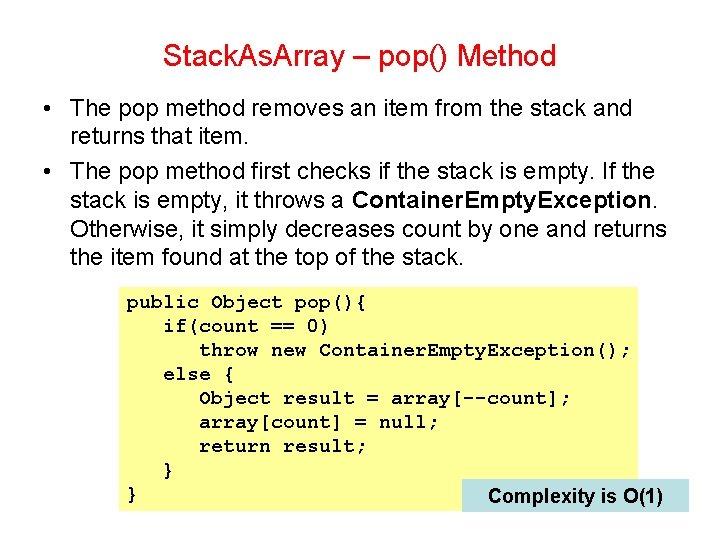
Stack. As. Array – pop() Method • The pop method removes an item from the stack and returns that item. • The pop method first checks if the stack is empty. If the stack is empty, it throws a Container. Empty. Exception. Otherwise, it simply decreases count by one and returns the item found at the top of the stack. public Object pop(){ if(count == 0) throw new Container. Empty. Exception(); else { Object result = array[--count]; array[count] = null; return result; } } Complexity is O(1)
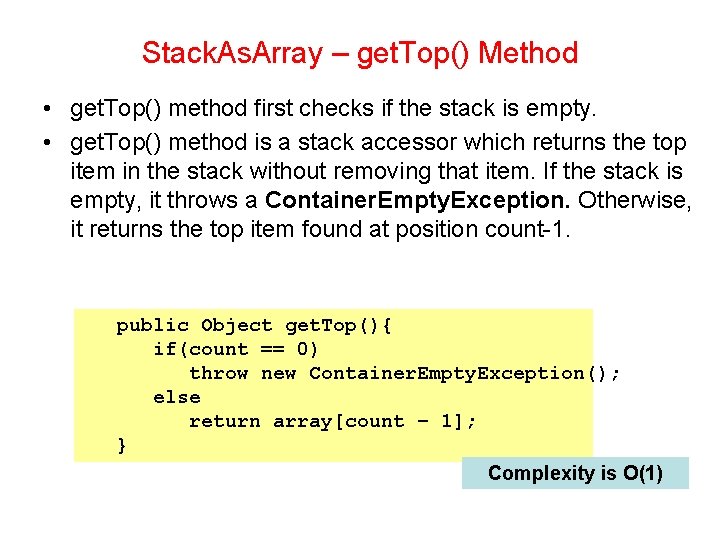
Stack. As. Array – get. Top() Method • get. Top() method first checks if the stack is empty. • get. Top() method is a stack accessor which returns the top item in the stack without removing that item. If the stack is empty, it throws a Container. Empty. Exception. Otherwise, it returns the top item found at position count-1. public Object get. Top(){ if(count == 0) throw new Container. Empty. Exception(); else return array[count – 1]; } Complexity is O(1)
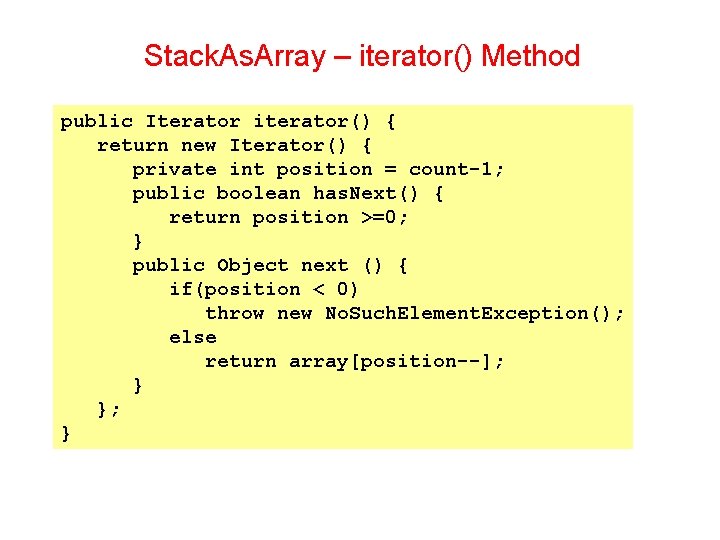
Stack. As. Array – iterator() Method public Iterator iterator() { return new Iterator() { private int position = count-1; public boolean has. Next() { return position >=0; } public Object next () { if(position < 0) throw new No. Such. Element. Exception(); else return array[position--]; } }; }
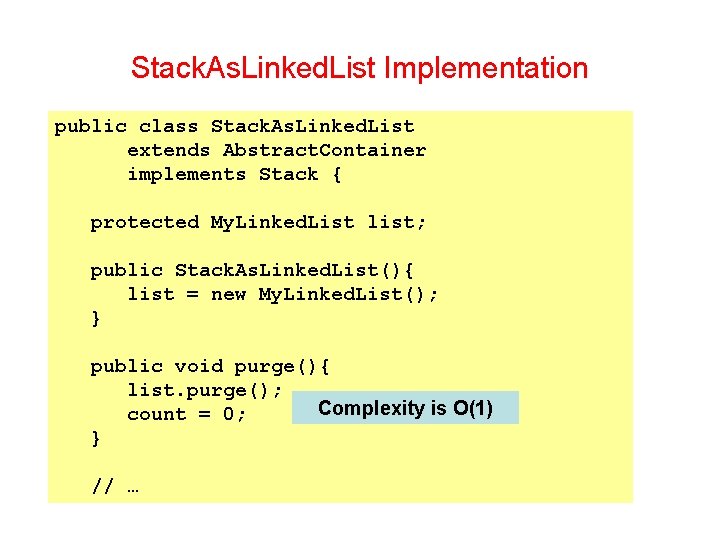
Stack. As. Linked. List Implementation public class Stack. As. Linked. List extends Abstract. Container implements Stack { protected My. Linked. List list; public Stack. As. Linked. List(){ list = new My. Linked. List(); } public void purge(){ list. purge(); Complexity is O(1) count = 0; } // …
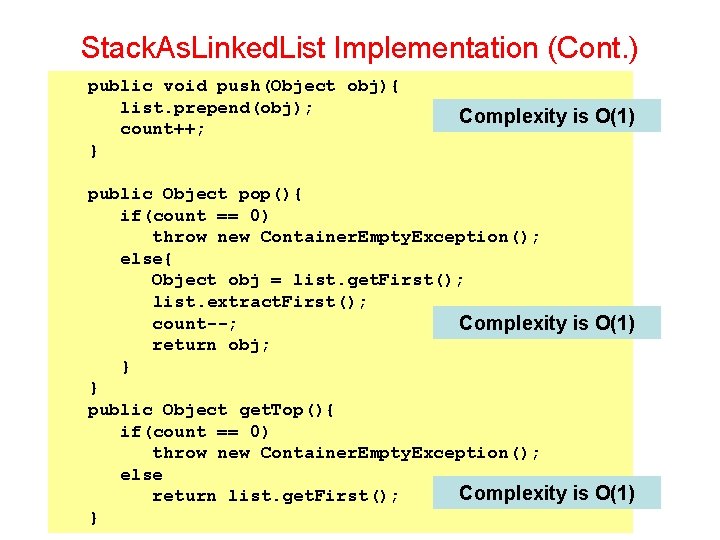
Stack. As. Linked. List Implementation (Cont. ) public void push(Object obj){ list. prepend(obj); count++; } Complexity is O(1) public Object pop(){ if(count == 0) throw new Container. Empty. Exception(); else{ Object obj = list. get. First(); list. extract. First(); count--; Complexity is O(1) return obj; } } public Object get. Top(){ if(count == 0) throw new Container. Empty. Exception(); else Complexity is O(1) return list. get. First(); }
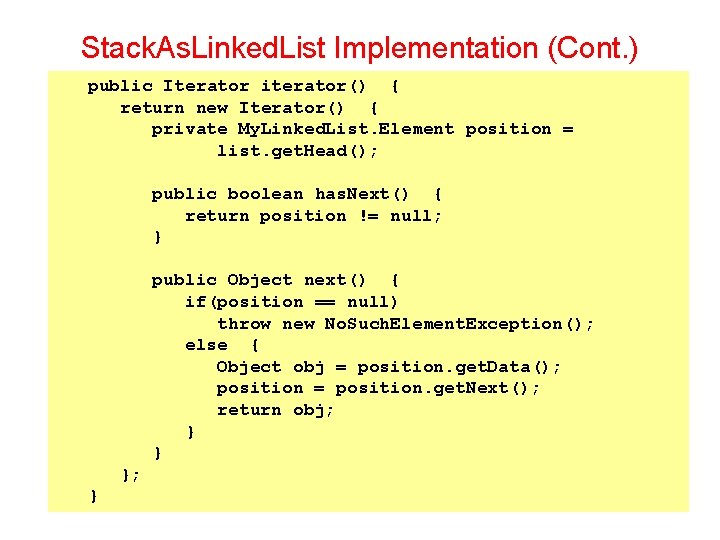
Stack. As. Linked. List Implementation (Cont. ) public Iterator iterator() { return new Iterator() { private My. Linked. List. Element position = list. get. Head(); public boolean has. Next() { return position != null; } public Object next() { if(position == null) throw new No. Such. Element. Exception(); else { Object obj = position. get. Data(); position = position. get. Next(); return obj; } } }; }
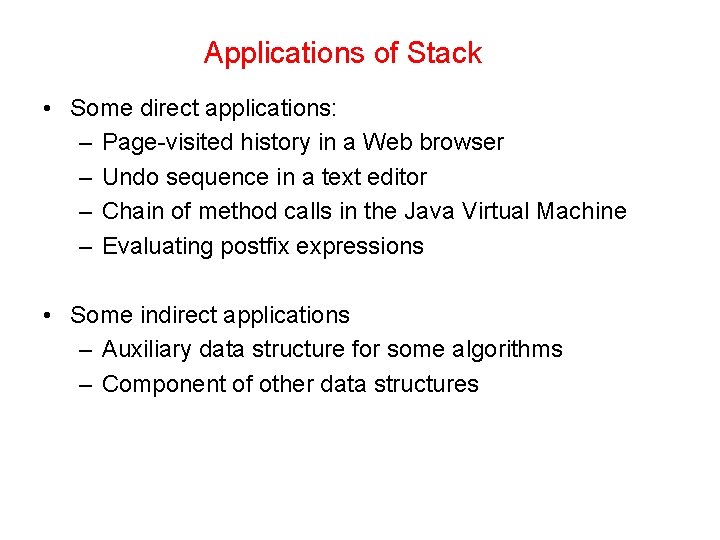
Applications of Stack • Some direct applications: – Page-visited history in a Web browser – Undo sequence in a text editor – Chain of method calls in the Java Virtual Machine – Evaluating postfix expressions • Some indirect applications – Auxiliary data structure for some algorithms – Component of other data structures
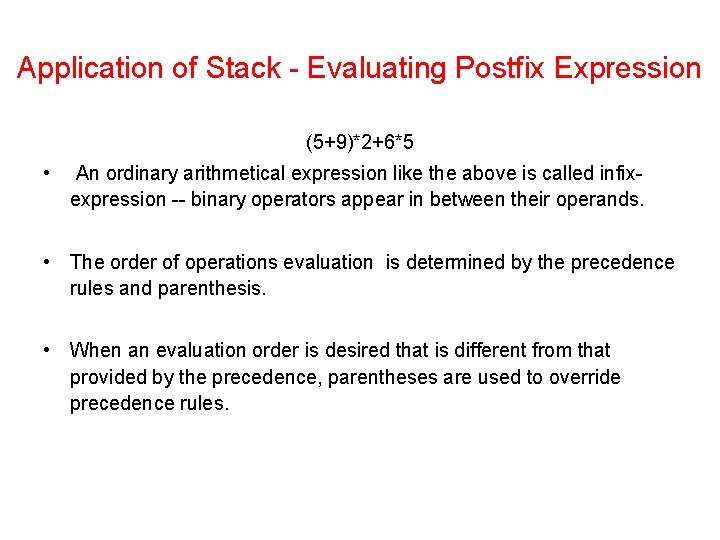
Application of Stack - Evaluating Postfix Expression (5+9)*2+6*5 • An ordinary arithmetical expression like the above is called infixexpression -- binary operators appear in between their operands. • The order of operations evaluation is determined by the precedence rules and parenthesis. • When an evaluation order is desired that is different from that provided by the precedence, parentheses are used to override precedence rules.
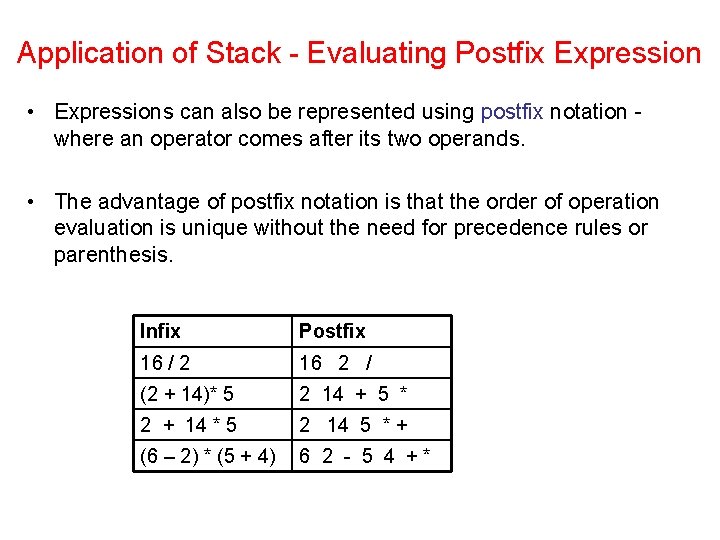
Application of Stack - Evaluating Postfix Expression • Expressions can also be represented using postfix notation where an operator comes after its two operands. • The advantage of postfix notation is that the order of operation evaluation is unique without the need for precedence rules or parenthesis. Infix Postfix 16 / 2 16 2 / (2 + 14)* 5 2 14 + 5 * 2 + 14 * 5 2 14 5 * + (6 – 2) * (5 + 4) 6 2 - 5 4 +*
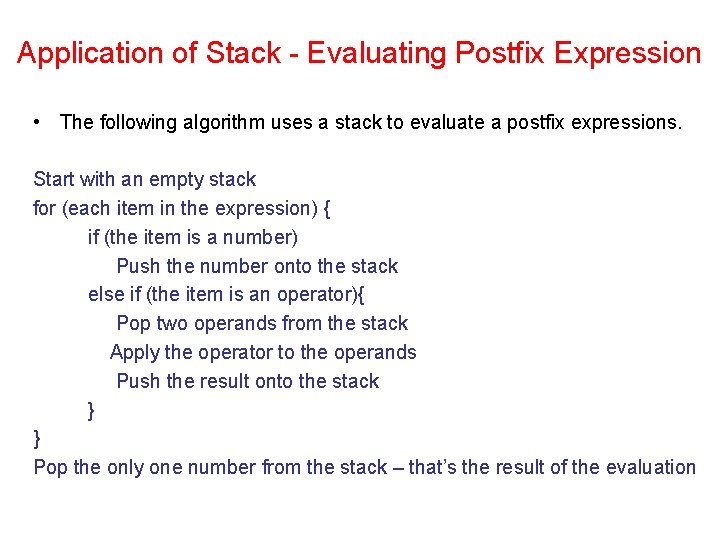
Application of Stack - Evaluating Postfix Expression • The following algorithm uses a stack to evaluate a postfix expressions. Start with an empty stack for (each item in the expression) { if (the item is a number) Push the number onto the stack else if (the item is an operator){ Pop two operands from the stack Apply the operator to the operands Push the result onto the stack } } Pop the only one number from the stack – that’s the result of the evaluation
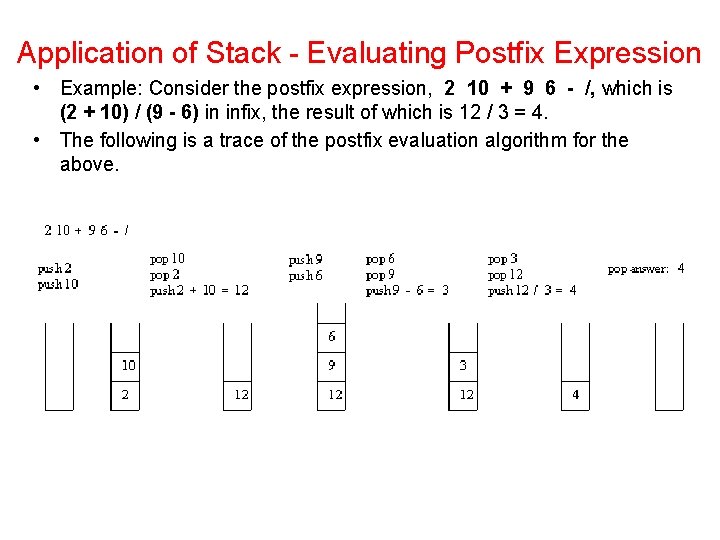
Application of Stack - Evaluating Postfix Expression • Example: Consider the postfix expression, 2 10 + 9 6 - /, which is (2 + 10) / (9 - 6) in infix, the result of which is 12 / 3 = 4. • The following is a trace of the postfix evaluation algorithm for the above.