
Introduction to SSA Dataflow Analysis Revisited Static Single

- Slides: 19
Introduction to SSA Data-flow Analysis Revisited – Static Single Assignment (SSA) Form Liberally Borrowed from U. Delaware and Cooper and Torczon Text
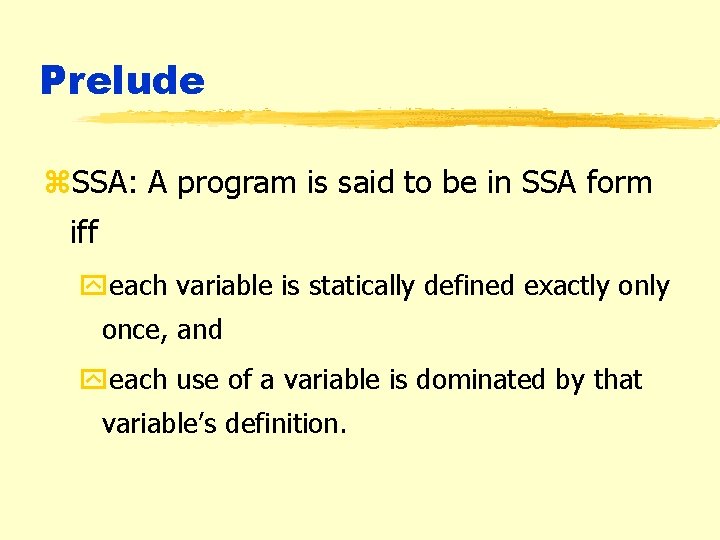
Prelude z. SSA: A program is said to be in SSA form iff yeach variable is statically defined exactly once, and yeach use of a variable is dominated by that variable’s definition.
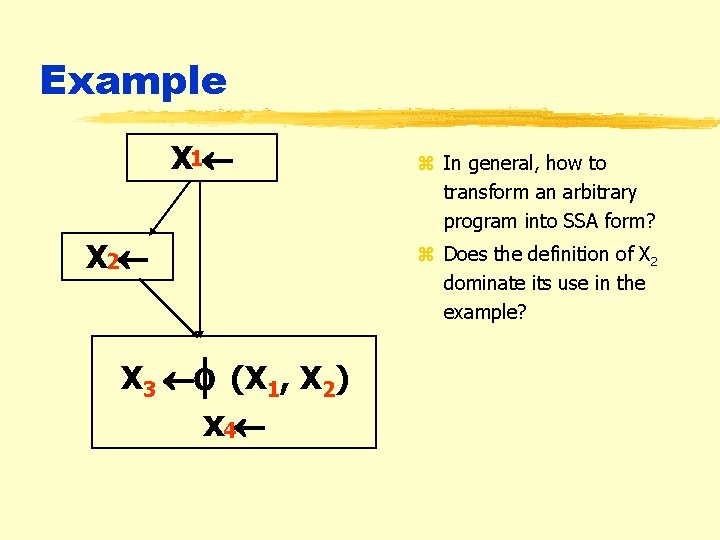
Example X 1 X 2 X 3 (X 1, X 2) x 4 z In general, how to transform an arbitrary program into SSA form? z Does the definition of X 2 dominate its use in the example?
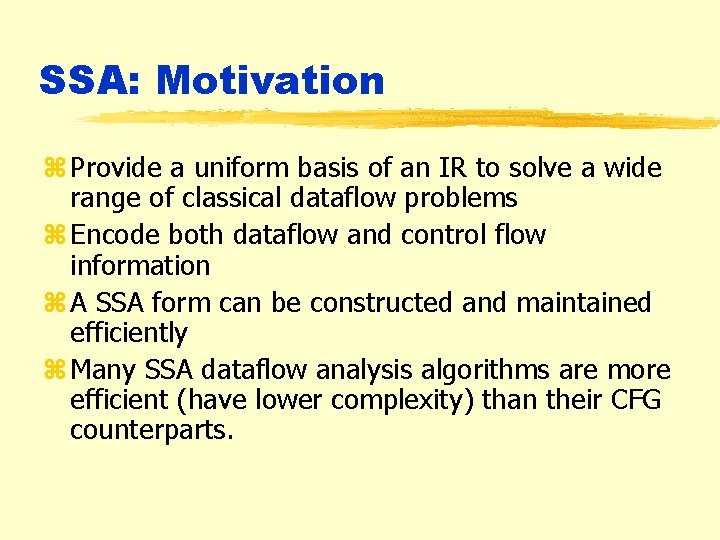
SSA: Motivation z Provide a uniform basis of an IR to solve a wide range of classical dataflow problems z Encode both dataflow and control flow information z A SSA form can be constructed and maintained efficiently z Many SSA dataflow analysis algorithms are more efficient (have lower complexity) than their CFG counterparts.
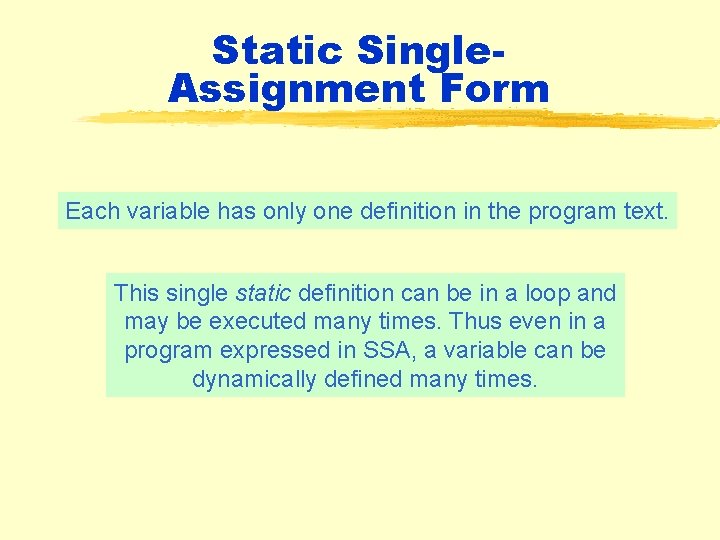
Static Single. Assignment Form Each variable has only one definition in the program text. This single static definition can be in a loop and may be executed many times. Thus even in a program expressed in SSA, a variable can be dynamically defined many times.
Advantages of SSA • Simpler dataflow analysis • No need to use-def/def-use chains, which requires N M space for N uses and M definitions • SSA form relates in a useful way with dominance relation.
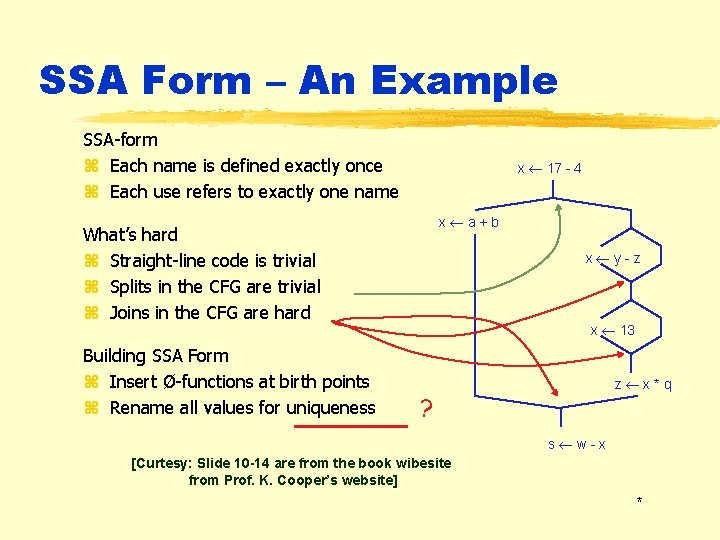
SSA Form – An Example SSA-form z Each name is defined exactly once z Each use refers to exactly one name x 17 - 4 x a+b What’s hard z Straight-line code is trivial z Splits in the CFG are trivial z Joins in the CFG are hard Building SSA Form z Insert Ø-functions at birth points z Rename all values for uniqueness x y-z x 13 z x*q ? s w-x [Curtesy: Slide 10 -14 are from the book wibesite from Prof. K. Cooper’s website] *
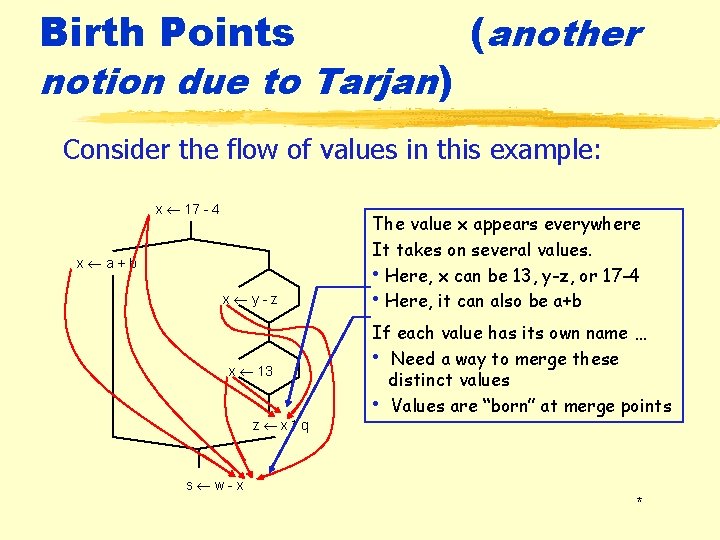
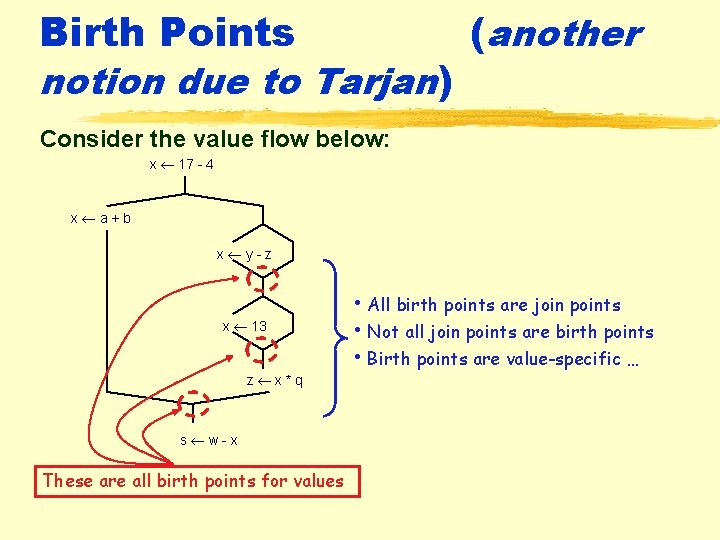
Birth Points (another notion due to Tarjan) Consider the flow of values in this example: x 17 - 4 x a+b x y-z x 13 z x*q The value x appears everywhere It takes on several values. • Here, x can be 13, y-z, or 17 -4 • Here, it can also be a+b If each value has its own name … • Need a way to merge these distinct values • Values are “born” at merge points s w-x *
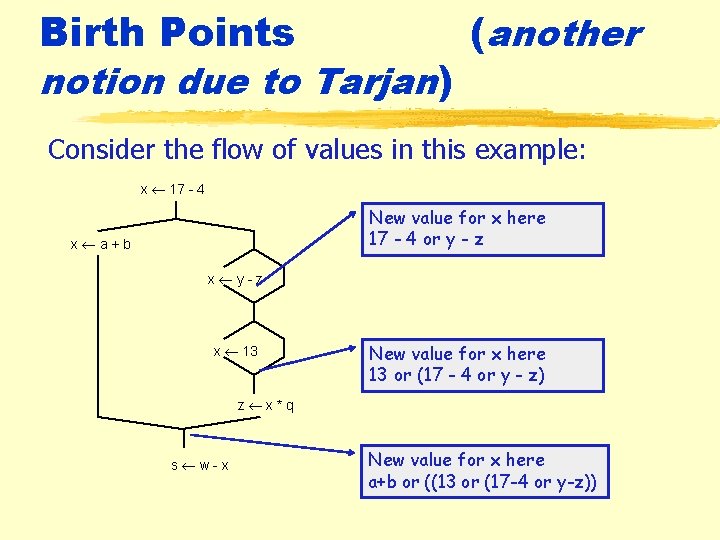
Birth Points (another notion due to Tarjan) Consider the flow of values in this example: x 17 - 4 New value for x here 17 - 4 or y - z x a+b x y-z x 13 New value for x here 13 or (17 - 4 or y - z) z x*q s w-x New value for x here a+b or ((13 or (17 -4 or y-z))
Birth Points (another notion due to Tarjan) Consider the value flow below: x 17 - 4 x a+b x y-z x 13 z x*q s w-x These are all birth points for values • All birth points are join points • Not all join points are birth points • Birth points are value-specific …
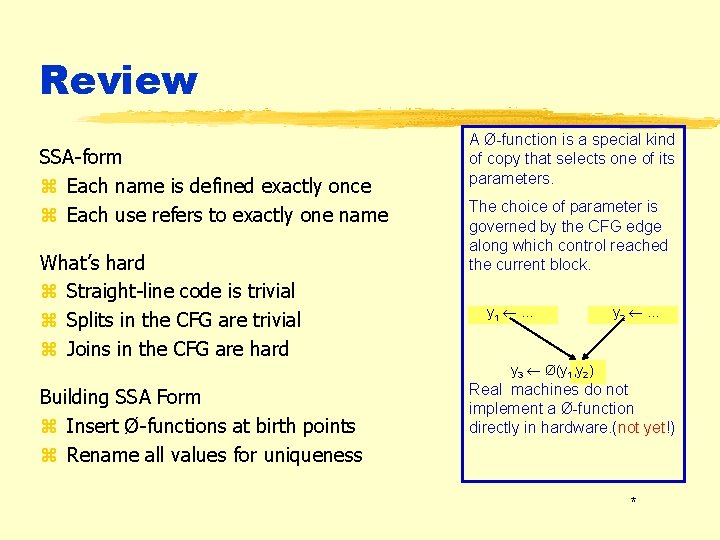
Review SSA-form z Each name is defined exactly once z Each use refers to exactly one name What’s hard z Straight-line code is trivial z Splits in the CFG are trivial z Joins in the CFG are hard A Ø-function is a special kind of copy that selects one of its parameters. The choice of parameter is governed by the CFG edge along which control reached the current block. y 1 . . . y 2 . . . y 3 Ø(y 1, y 2) Building SSA Form z Insert Ø-functions at birth points z Rename all values for uniqueness Real machines do not implement a Ø-function directly in hardware. (not yet!) *
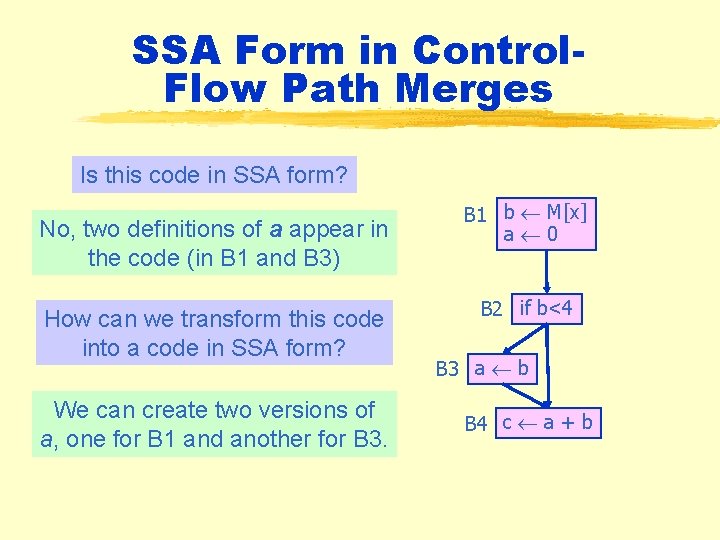
SSA Form in Control. Flow Path Merges Is this code in SSA form? No, two definitions of a appear in the code (in B 1 and B 3) How can we transform this code into a code in SSA form? We can create two versions of a, one for B 1 and another for B 3. B 1 b M[x] a 0 B 2 if b<4 B 3 a b B 4 c a + b
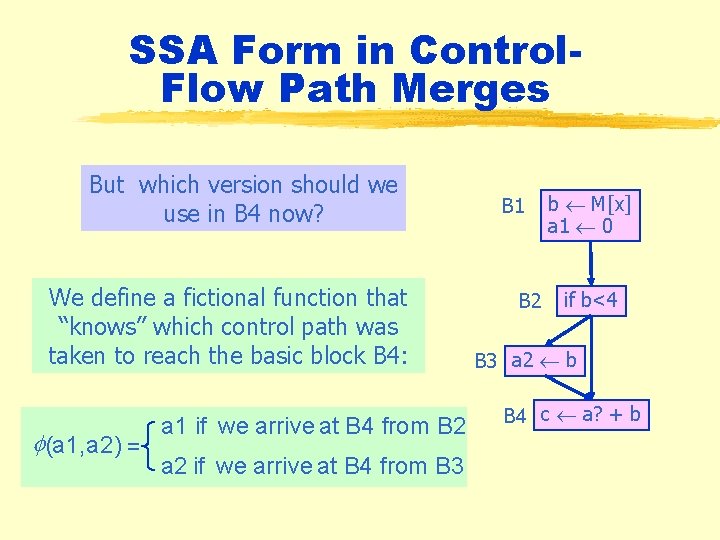
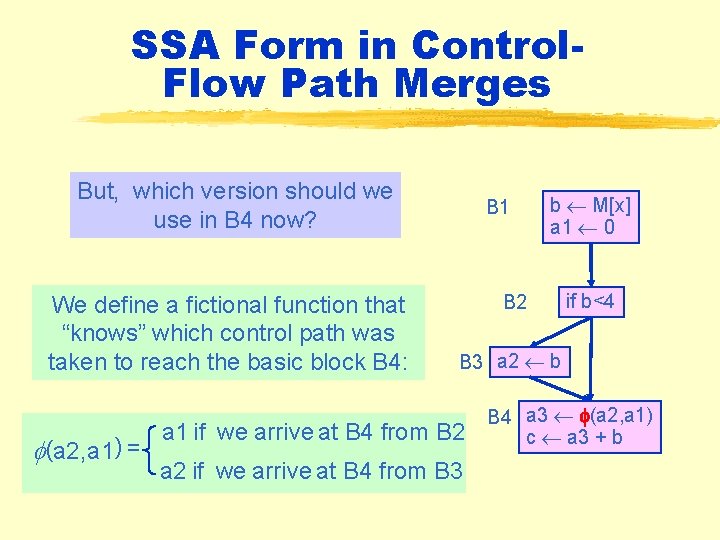
SSA Form in Control. Flow Path Merges But which version should we use in B 4 now? We define a fictional function that “knows” which control path was taken to reach the basic block B 4: f (a 1, a 2 ) = a 1 if we arrive at B 4 from B 2 a 2 if we arrive at B 4 from B 3 B 1 B 2 b M[x] a 1 0 if b<4 B 3 a 2 b B 4 c a? + b
SSA Form in Control. Flow Path Merges But, which version should we use in B 4 now? We define a fictional function that “knows” which control path was taken to reach the basic block B 4: f(a 2, a 1) = B 1 b M[x] a 1 0 B 2 if b<4 B 3 a 2 b a 1 if we arrive at B 4 from B 2 a 2 if we arrive at B 4 from B 3 B 4 a 3 (a 2, a 1) c a 3 + b
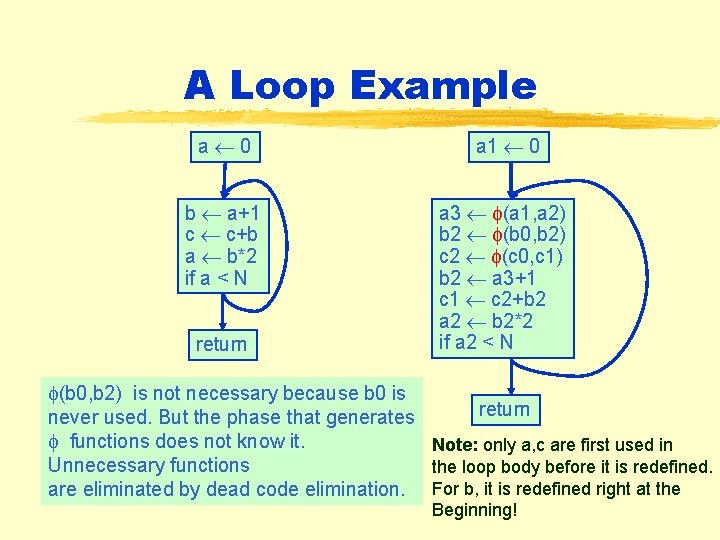
A Loop Example a 0 a 1 0 b a+1 c c+b a b*2 if a < N a 3 (a 1, a 2) b 2 (b 0, b 2) c 2 (c 0, c 1) b 2 a 3+1 c 1 c 2+b 2 a 2 b 2*2 if a 2 < N return (b 0, b 2) is not necessary because b 0 is return never used. But the phase that generates functions does not know it. Note: only a, c are first used in Unnecessary functions the loop body before it is redefined. are eliminated by dead code elimination. For b, it is redefined right at the Beginning!
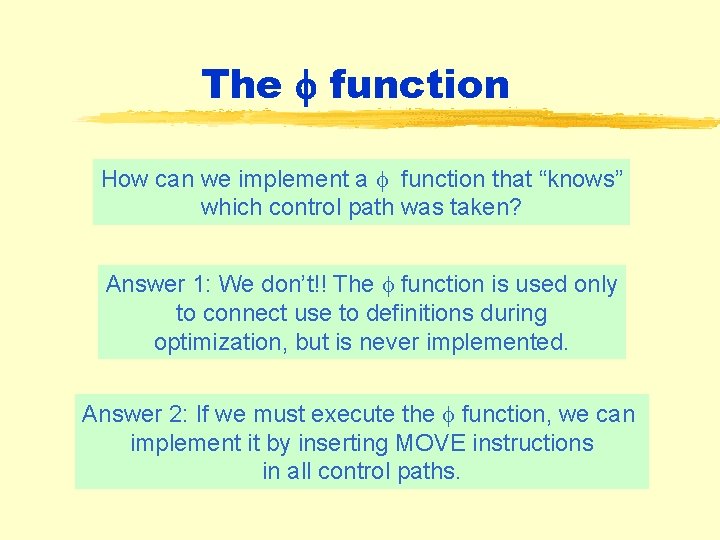
The function How can we implement a function that “knows” which control path was taken? Answer 1: We don’t!! The function is used only to connect use to definitions during optimization, but is never implemented. Answer 2: If we must execute the function, we can implement it by inserting MOVE instructions in all control paths.
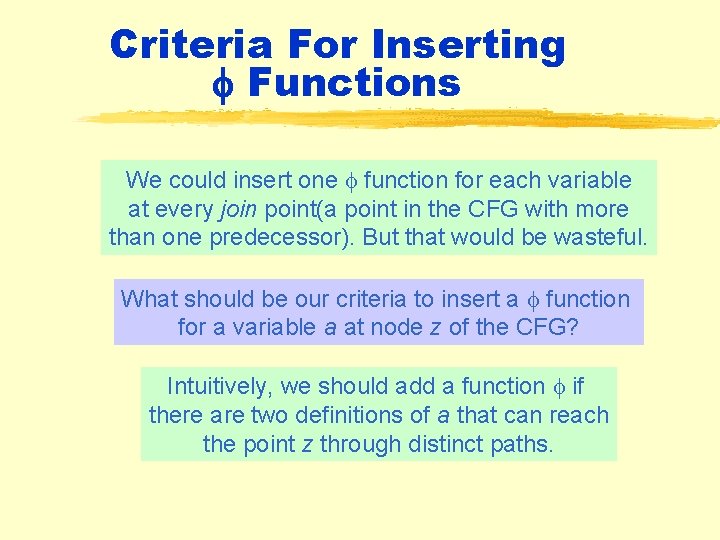
Criteria For Inserting Functions We could insert one function for each variable at every join point(a point in the CFG with more than one predecessor). But that would be wasteful. What should be our criteria to insert a function for a variable a at node z of the CFG? Intuitively, we should add a function if there are two definitions of a that can reach the point z through distinct paths.
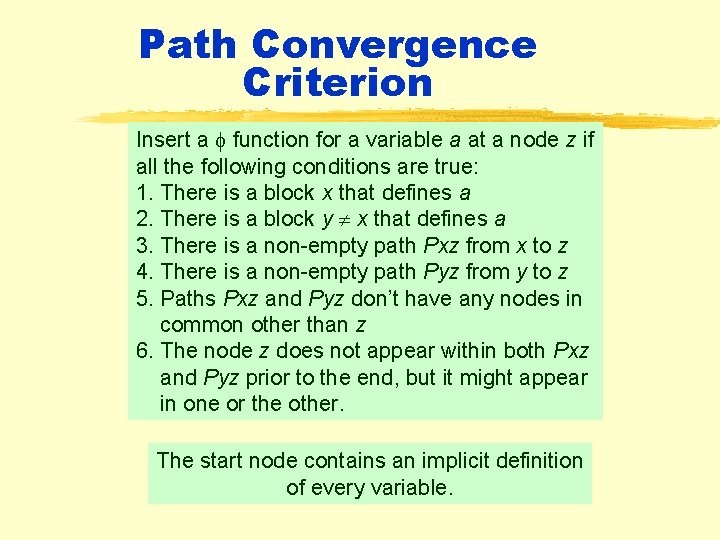
Path Convergence Criterion Insert a function for a variable a at a node z if all the following conditions are true: 1. There is a block x that defines a 2. There is a block y x that defines a 3. There is a non-empty path Pxz from x to z 4. There is a non-empty path Pyz from y to z 5. Paths Pxz and Pyz don’t have any nodes in common other than z 6. The node z does not appear within both Pxz and Pyz prior to the end, but it might appear in one or the other. The start node contains an implicit definition of every variable.
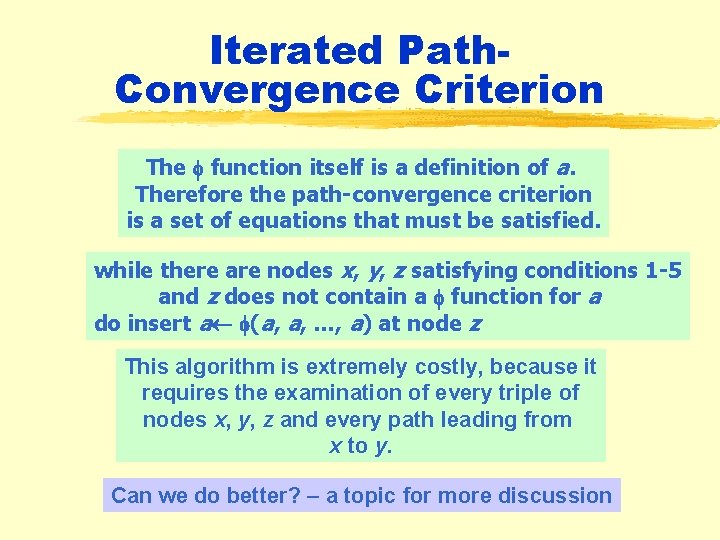
Iterated Path. Convergence Criterion The function itself is a definition of a. Therefore the path-convergence criterion is a set of equations that must be satisfied. while there are nodes x, y, z satisfying conditions 1 -5 and z does not contain a function for a do insert a (a, a, …, a) at node z This algorithm is extremely costly, because it requires the examination of every triple of nodes x, y, z and every path leading from x to y. Can we do better? – a topic for more discussion