
INTRODUCTION TO SPORTS MEDICINE Burns Layers of Skin
INTRODUCTION TO SPORTS MEDICINE Burns
Layers of Skin n Epidermis– Outside layer n Dermis– 2 nd layer – Contains hair follicles, sweat glands, sebaceous glands, blood vessels, nerve endings n Subcutaneous tissue / fat

Types of Burns Chemical n Electrical n Thermal n Radiant (e. g. sunburn) n Inhalation n

Chemical Burns Remove chemical from body contact n Remove clothing n Flush w/watern – Away from other eye – Acid = 10 -15 minutes – Alkali = 20 minutes n Patch both eyes

Thermal Burns 1 st Degree (partial thickness) n 2 nd Degree (partial thickness) n 3 rd Degree (full thickness) n

Thermal Burns n 1 st Degree (partial thickness)– Superficial part of epidermis – Reddened skin
Thermal Burns n 2 nd Degree (partial thickness)– Epidermis & part of dermis – Subcutaneous tissue is not injured – Blisters form
Thermal Burns n 3 rd Degree (full-thickness)– Epidermis, & subcutaneous tissue is injured – Burned area is dry & leathery – Charred and/or chalky white skin – Clotted blood vessels and/or subcutaneous tissue may be visible – Burned area may be w/o feeling or severely painful
Thermal Burns n Rule of Nine’s– Divides surface of body into sections – Each section is approximately 9% of the total body surface area
Thermal Burns n Rule of Nine’s (Adult)– Head (9) – Each arm (9) – Each leg (18) – Front torso / back torso (18) – Genitalia (1)
Thermal Burns n First Aid– Stop burning processn Put out the fire n Immerse in cold water (< 10 minutes; not for 3 rd degree burns) n Prevent hypothermia n Prevent infection
Thermal Burns n First Aid– Cover the burned area w/a dry, sterile dressing – Monitor & support ABCs – Treat for shock – Call EMS / transport to hospital

Thermal Burns n Don’ts– Pull clothes over burned area – Remove pieces of cloth that stick to a burn – Try to clean the burn – Break blisters – Use grease, ointment, petroleum jelly, or any type of medication
Thermal Burns n Don’ts– Use iodine or antiseptics – Touch a burn w/anything unsterile – Change dressings until absolutely necessary – Touch a burn or breathe directly on it – Apply ice (3 rd degree)
Thermal Burns n Don’ts– Use absorbent cotton – Try to remove tar and/or asphalt – Moisten the dressing, unless it involves < 10% of body surface
Thermal Burns n Seriousness of Thermal Burns– Depth (1 st, 2 nd, or 3 rd) – Surface area (“Rule of 9’s”) – Involvement of critical areas (hands, feet, face, genitalia) – Patient’s age (very young, very old) – Patient’s general health / other injuries
Thermal Burns n Critical Burns– All inhalation injuries – Chemical / electrical – Deep acid burns – Burns in pt. w/underlying physical or medical conditions – Burns complicated by respiratory tract injuries, other major injuries, or fx.
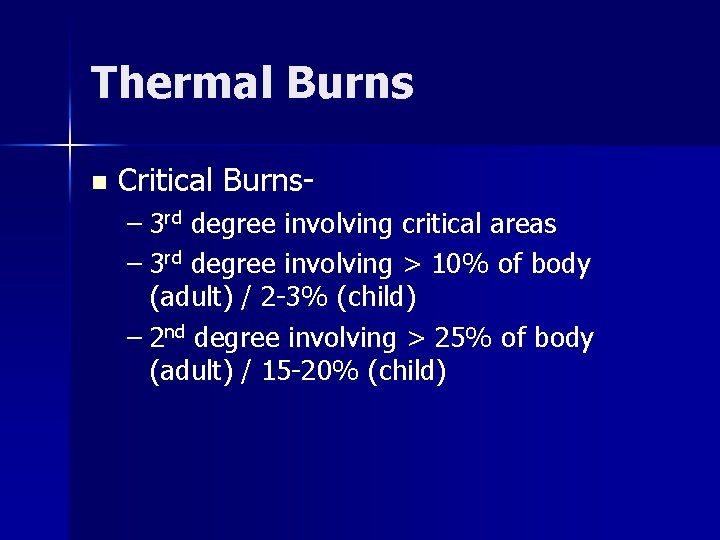
Thermal Burns n Critical Burns– 3 rd degree involving critical areas – 3 rd degree involving > 10% of body (adult) / 2 -3% (child) – 2 nd degree involving > 25% of body (adult) / 15 -20% (child)
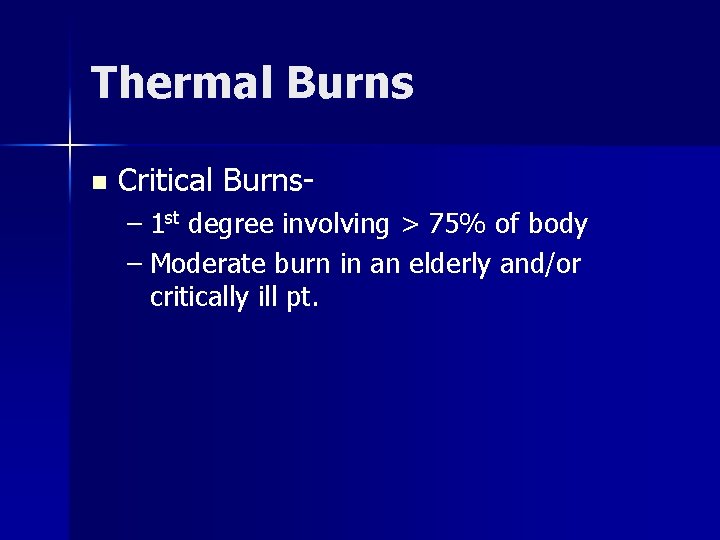
Thermal Burns n Critical Burns– 1 st degree involving > 75% of body – Moderate burn in an elderly and/or critically ill pt.
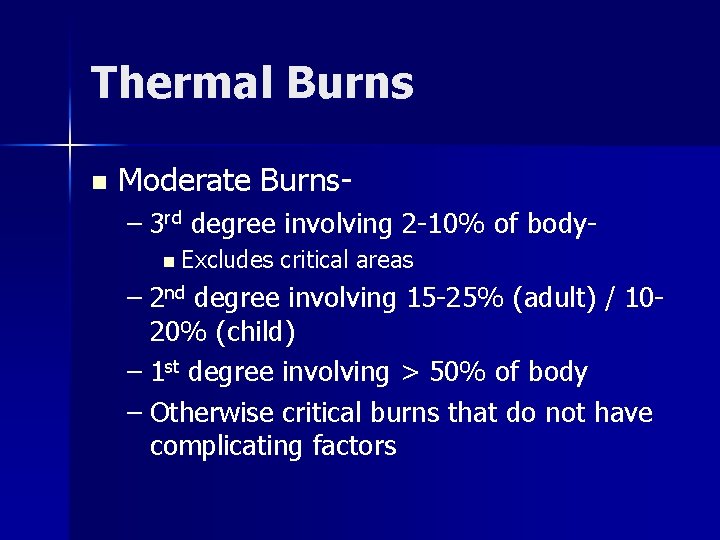
Thermal Burns n Moderate Burns– 3 rd degree involving 2 -10% of bodyn Excludes critical areas – 2 nd degree involving 15 -25% (adult) / 1020% (child) – 1 st degree involving > 50% of body – Otherwise critical burns that do not have complicating factors
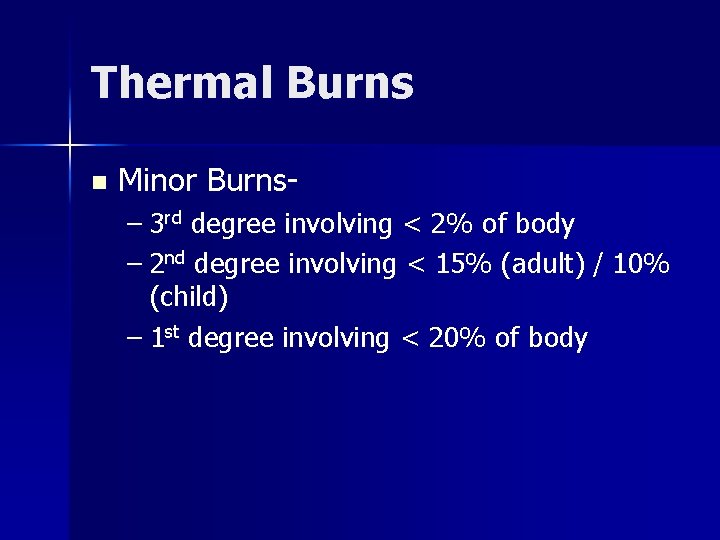
Thermal Burns n Minor Burns– 3 rd degree involving < 2% of body – 2 nd degree involving < 15% (adult) / 10% (child) – 1 st degree involving < 20% of body
- Slides: 21