
Introduction to Speech Eloquent speech is not from
- Slides: 20
Introduction to Speech “Eloquent speech is not from lip to ear, but rather from heart to heart. ” Writing Your Speech Putting all the pieces together Write On! 2015
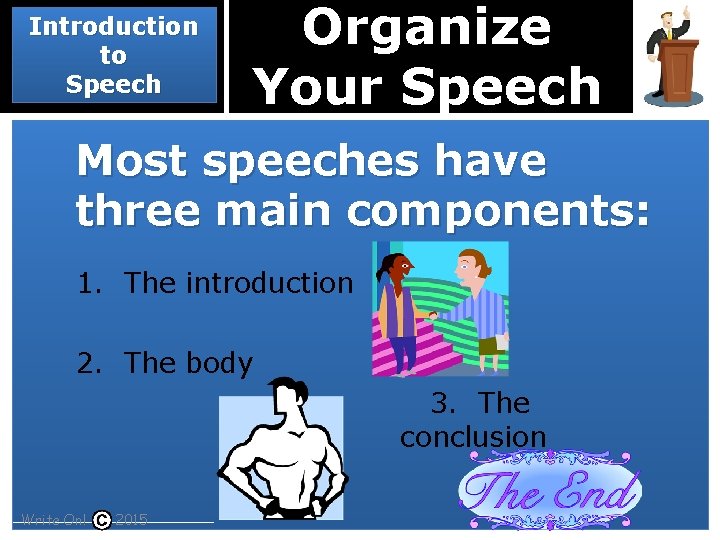
Introduction to Speech Organize Your Speech Most speeches have three main components: 1. The introduction 2. The body 3. The conclusion Write On! 2015
Introduction to Speech Organize Your Speech Introduction The introduction is possibly the most important part of your speech, because you want to grab your audience's attention from the start. So come up with something clever, shocking or interesting right at the very beginning. Here are some possible techniques to use: Write On! 2015
Introduction to Speech Introduction Be dramatic!!!! Say something like, "I have information that will change how you look at yourself every day!” when your presentation is really about a new brand of facial soap. Write On! 2015
Introduction to Speech Introduction Tell a joke Getting people to laugh will loosen them up and make them feel inclined to like you and hear what you have to say. Don't try this if your jokes are usually met by silence or groans. Test out your opening on your most brutally honest of friends. Write On! 2015
Introduction to Speech Introduction Tell a story This will make the audience see you as a person instead of a boring public speaker. Keep the story short (under one minute) and relevant to the rest of your presentation. The point of the story is to lead the audience into your speech, so if your anecdote ends with your dog saving the day, and your speech is about the state of education in America, you might have a hard time tying in your intro to the rest of the speech. Write On! 2015
Introduction to Speech Introduction Pose a question Asking audience members for their input will make them feel involved, even if you're going to answer your own question. Write On! 2015
Stating your main idea Once you’ve grabbed the audiences attention, speak to them directly and tell them what your topic is and your point. Be clear so they know what the rest of your speech is about! Example “Greetings fellow students, I’m sure by know you’ve figured out I will be talking to you about. . . ”
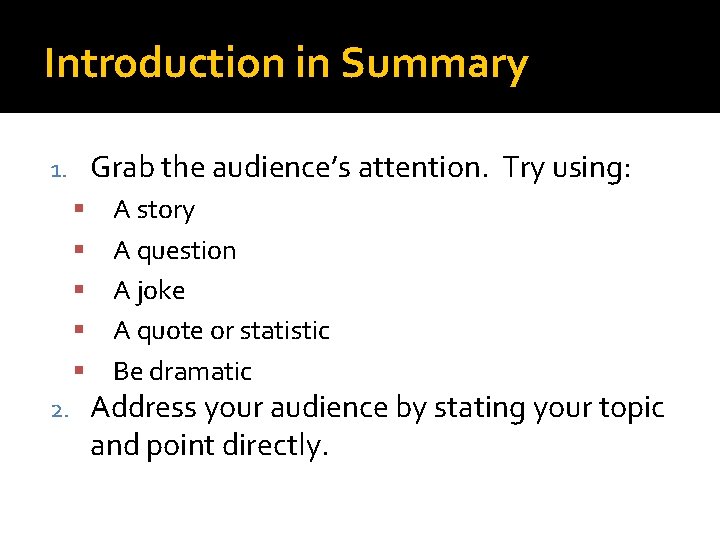
Introduction in Summary Grab the audience’s attention. Try using: 1. 2. A story A question A joke A quote or statistic Be dramatic Address your audience by stating your topic and point directly.
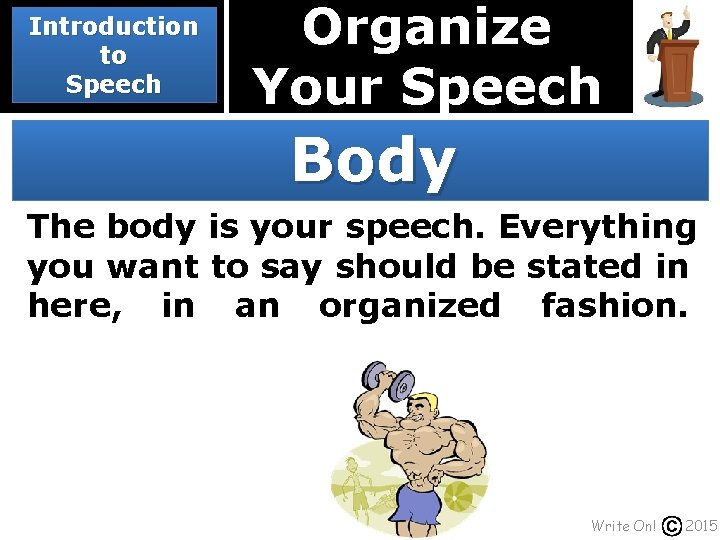
Introduction to Speech Organize Your Speech Body The body is your speech. Everything you want to say should be stated in here, in an organized fashion. Write On! 2015
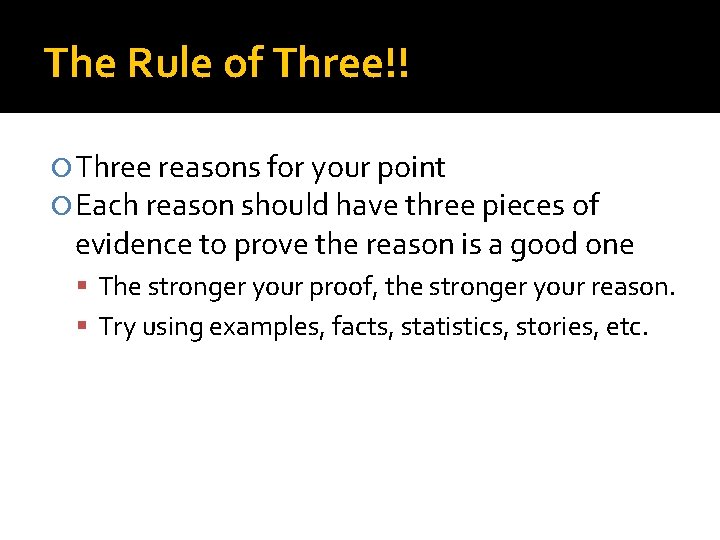
The Rule of Three!! Three reasons for your point Each reason should have three pieces of evidence to prove the reason is a good one The stronger your proof, the stronger your reason. Try using examples, facts, statistics, stories, etc.
Transitions Use transition words to help your audience follow your ideas. Let them know when your are stating a new reason or piece of evidence.
Introduction to Speech Write On! 2015 TIP Vary your word choice. Your speech will get very boring very quickly if you repeatedly use the same words. So use interesting and different words and phrases and keep things new.
Introduction to Speech TIP Whenever possible, describe a feeling or situation in detail. The audience will be able to follow you more easily if you paint a picture instead of continually throwing out dry, emotionless words. One way to do this is to use action verbs. Instead of saying "learn, “ try "elucidate. " Also, imagery can be very effective. Write On! 2015
Introduction to Speech TIP Humor almost always helps. It's even appropriate at eulogies. The essence is in the timing, though. It's a good idea to test out humor on friends prior to the actual presentation. And leave out any humor that is even remotely offensive. Often, selfdeprecating humor (that doesn't completely destroy your credibility as a speaker) works well. Write On! 2015
Writing the body in Summary This is the most important part of your speech and should be where most of your time is spent 1. 3 reasons to support your point 2. 3 piece of evidence to support each reason 3. Use facts, examples, stories, statistics Have fun with it! Use personal details, humor, and interesting words. This section doesn’t have to be boring because it is full of information. Use a variety of transition words to indicate a new idea.
Introduction to Speech Organize Your Speech Conclusion The closing -- the way you end a speech -- is almost as important as the way you begin it. Write On! 2015
Introduction to Speech Organize Your Speech Conclusion The audience will be most restless at the end, and you have to find a way to tie everything together so they don't walk away remembering how badly they were fidgeting. So sum up everything for them in a few concise sentences, and leave them with a witty line. Write On! 2015
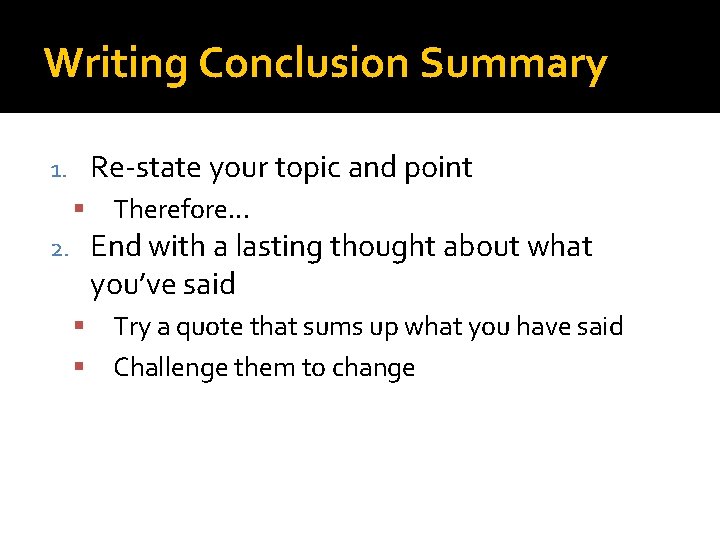
Writing Conclusion Summary Re-state your topic and point 1. Therefore. . . End with a lasting thought about what you’ve said 2. Try a quote that sums up what you have said Challenge them to change
Introduction to Speech Let’s Get to Work! Use your outline to start your speech. Your outline contains your main idea sentence for your intro and research for your body. Add the personal touches, words and details to finish your speech. It should be about 5 paragraphs in length. Write On! 2015