
INTRODUCTION TO SPECIAL EDUCATION AND THE SIX PRINCIPLES
- Slides: 45
INTRODUCTION TO SPECIAL EDUCATION AND THE SIX PRINCIPLES 1
A HISTORY OF DISCRIMINATION • Before special education law was passed -– The special educational needs of children with disabilities were not being fully met; – More than 1/2 of children with disabilities did not receive appropriate educational services that would enable them to have full equality of opportunity 2
A HISTORY OF DISCRIMINATION CONT. – 1, 000 children with disabilities were excluded and did not go through the educational process with their peers – there were many children with disabilities participating in regular school programs whose disabilities prevented them from having a successful educational experience because their disabilities were undetected 3
A HISTORY OF DISCRIMINATION CONT. – Because of the lack of adequate services within the public school system, families were often forced to find services outside the public school system, often at great distance from their residence and at their own expense 4
A HISTORY OF DISCRIMINATION CONT. • In 1972, two federal courts ordered Pennsylvania and District of Columbia to provide a free appropriate public education to all students with disabilities • Advocates began lobbying Congress for federal law and federal money 5
A HISTORY OF DISCRIMINATION CONT. • In 1975, President Ford signed the Education of All Handicapped Children Act of 1975, known as Public Law 94 -142 • This law is now called Individuals with Disabilities Education Act (IDEA) 6
INDIVIDUALS WITH DISABILITIES ACT • IDEA guarantees students with disabilities a free appropriate public education (FAPE) for students three through 21 • There is another federal law for infants with disabilities -- serves birth through two • To receive federal money, state and local agencies must agree to comply with federal law 7
INDIVIDUALS WITH DISABILITIES ACT CONT. • The term special education means specially designed instruction, at no cost to parents, to meet the unique needs of a child with a disability, including – Instruction conducted in the classroom, in the home, in hospitals and institutions and in other settings; and – Instruction in physical education 8
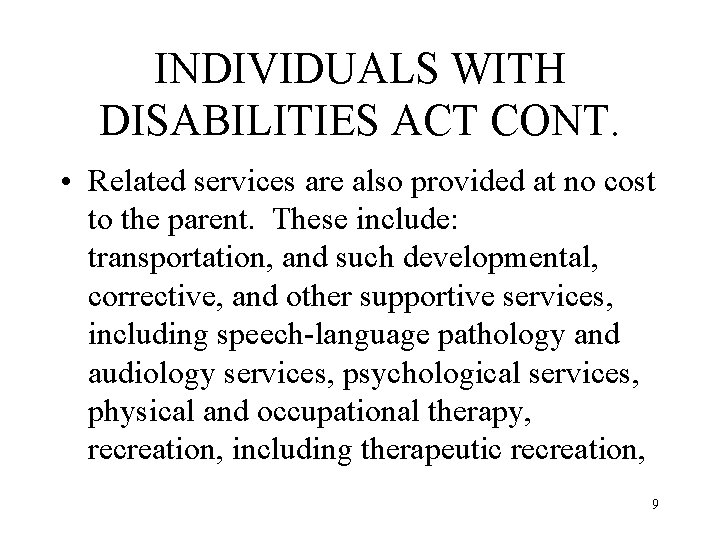
INDIVIDUALS WITH DISABILITIES ACT CONT. • Related services are also provided at no cost to the parent. These include: transportation, and such developmental, corrective, and other supportive services, including speech-language pathology and audiology services, psychological services, physical and occupational therapy, recreation, including therapeutic recreation, 9
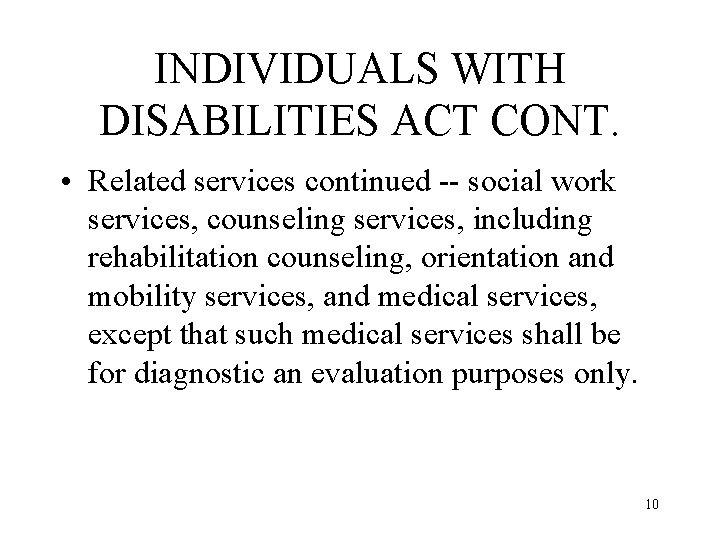
INDIVIDUALS WITH DISABILITIES ACT CONT. • Related services continued -- social work services, counseling services, including rehabilitation counseling, orientation and mobility services, and medical services, except that such medical services shall be for diagnostic an evaluation purposes only. 10
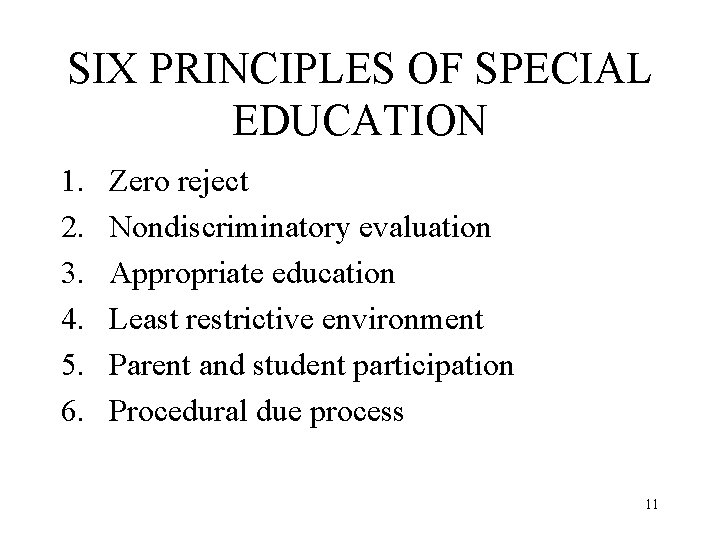
SIX PRINCIPLES OF SPECIAL EDUCATION 1. 2. 3. 4. 5. 6. Zero reject Nondiscriminatory evaluation Appropriate education Least restrictive environment Parent and student participation Procedural due process 11
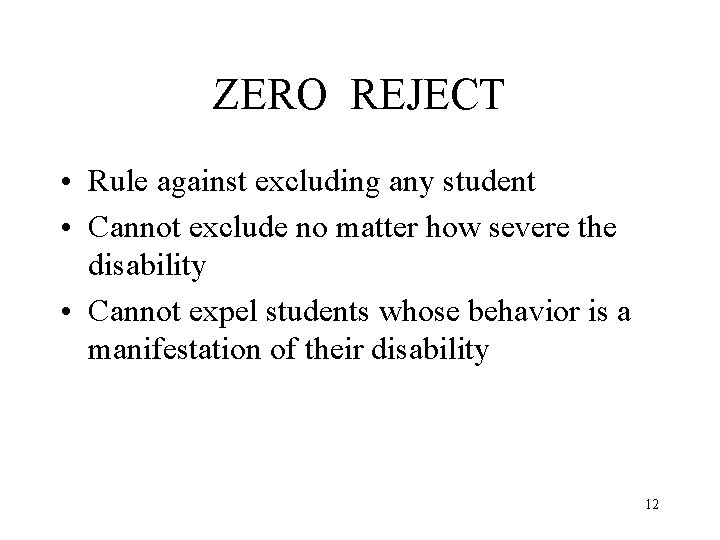
ZERO REJECT • Rule against excluding any student • Cannot exclude no matter how severe the disability • Cannot expel students whose behavior is a manifestation of their disability 12
ZERO REJECT CONT. • Cannot exclude children who have contagious diseases from education with other students unless there is a high risk that the contagious student will infect other students • Also a zero reject law for adults with disabilities -- Americans with Disabilities Act, (ADA), enacted in 1990 13
NONDISCRIMINATORY EVALUATION • Rule requiring schools to evaluate students fairly to determine if they have a disability and, if so, what kind and how extensive a disability they have • Requires state and local agencies to evaluate students in such a way that strengths and weaknesses are revealed 14
NONDISCRIMINATORY EVALUATION CONT. • There is a history of discrimination -- often non-English speaking students were administered English language tests • These tests did not reveal the student’s strengths but instead showed that the student had major deficits • In addition, the tests administered were normed on white middle-class students 15
NONDISCRIMINATORY EVALUATION CONT. • These tests are inappropriate for students from impoverished socioeconomic backgrounds or who were from a different cultural background • Purpose of nondiscriminatory evaluation -to determine if a student has a disability and that the student needs special education and related services 16
NONDISCRIMINATORY EVALUATION CONT. • Three steps in evaluating a student – Screening – Prereferral – Referral • Last step -- IDEA’s nondiscriminatory evaluation procedures -- all tests used must be reliable and valid 17
NONDISCRIMINATORY EVALUATION CONT. • Given the disproportionate number of students from minority backgrounds in special education, it is extremely important during preferral to distinguish between cultural and language differences and learning problems 18
NONDISCRIMINATORY EVALUATION CONT. • FACT -- once students are identified about 98% are likely to remain in special education for their entire academic career! • A teacher’s decision to refer should be based ONLY on the student’s needs -- not on the teacher’s 19
APPROPRIATE EDUCATION • Rule requiring schools to provide individually tailored education for each student based on the evaluation and augmented by related or supplementary services • Key is individualization 20
APPROPRIATE EDUCATION CONT. • The IEP must – be reviewed periodically, but not less than annually, to determine whether the annual goals for the child are being met – must include present levels of educational performance, including how the disability affects the child’s involvement and progress in the general curriculum 21
APPROPRIATE EDUCATION CONT. – For preschool children, the IEP must include how the disability affects the child’s participation in appropriate activities – A statement of measurable annual goals, including benchmarks or short-term objectives, related to meeting the child’s needs that result from the child’s disability to enable the child to be involved in and progress in the general curriculum 22
APPROPRIATE EDUCATION CONT. – Statement of special education and related services and supplementary services to be provided to the child – Explanation of the extent, if any, to which the child will not participate with nondisabled children in the regular class – Statement of modifications in the administration of State or district-wide assessments of student achievement 23
APPROPRIATE EDUCATION CONT. – Statement of the program modifications or supports that will be provided for the child to advance appropriately toward attaining the annual goals, to be involved in and progress in the general curriculum and extracurricular and other nonacademic activities and to be educated and participate with other children with disabilities and nondisabled children 24
APPROPRIATE EDUCATION CONT. – If the IEP team determines that the child will not participate in a State or district-wide assessment, there must be a statement of why that assessment is not appropriate and how the child will be assessed – Projected date for beginning of the services and modifications – The anticipated frequency, location and duration of services and modifications 25
APPROPRIATE EDUCATION CONT. – Statement of how child’s progress toward annual goals will be measured – Statement of how parents will be regularly informed at least as often as parents are informed of their nondisabled children’s progress of • their child’s progress toward annual goals • extent to which progress is sufficient to enable the child to achieve the goals by the end of the year 26
APPROPRIATE EDUCATION CONT. • Don’t need parent consent for an IEP -except at initial placement ARD • Parents must be invited to participate in the process • Short-term objectives or benchmarks must include the condition under which the behavior will occur, behavioral description, and criterion or level of mastery 27
APPROPRIATE EDUCATION CONT. • IEP must specify kind of assessment and evaluation schedule • Two other I plans -– Individualized Family Service Plan (IFSP) - for children with disabilities birth through two – Individual Transition Plan (ITP) – coordinated set of transition activities must be addressed by 16 th birthday and annually at ARD 28
APPROPRIATE EDUCATION CONT. • Supreme Court decisions regarding appropriate education -– Amy Rowley was entitled to an education that benefits her, not to one that develops her to the maximum potential – Ambur Tatro was entitled to clean intermittent cathetherization as a related service 29
LEAST RESTRICTIVE ENVIRONMENT • Rule requiring schools to educate students with disabilities with nondisabled students to the maximum extent appropriate • One of the most important and controversial elements of special education reform • School may not remove student from general education unless he/she cannot be educated successfully there 30
LEAST RESTRICTIVE ENVIRONMENT CONT. • Reasons for LRE – Supreme Court created the principle as a matter of constitutional law – There is a long history of segregation – There is evidence that many students with disabilities can be educated effectively in general ed classes 31
LEAST RESTRICTIVE ENVIRONMENT CONT. – Any kind of segregation in education (especially when minority students were too often misclassified into special education) simply runs against the grain of the U. S. Constitution, which seeks to treat all people equally – Continuum of services -- schools must offer a range of services from less to more restrictive 32
LEAST RESTRICTIVE ENVIRONMENT CONT. – LRE has been very difficult for courts to interpret -- people disagree about its meaning – In early years, courts generally concluded that the greater or more extensive the student’s disability and the need for academic or rehabilitative services, the more separate and less inclusive the student’s education should be 33
LEAST RESTRICTIVE ENVIRONMENT CONT. – More recent cases have taken into account social and physical inclusion – Daniel R. R. vs. State Board of Education, 1989 • Very important case from Texas • Required schools to furnish supplementary aids and services to make curriculum adjustments for the student before removing him/her to more special, less inclusive program 34
LEAST RESTRICTIVE ENVIRONMENT CONT. – Neighborhood schools -- many parents and advocates want students with disabilities to be educated in their neighborhood schools – Clearly, the trend is toward inclusion 35
LEAST RESTRICTIVE ENVIRONMENT CONT. • Inclusion -- not the law -- LRE is the law • Basic components of inclusion -– All students attend school where they would attend if they did not have a disability – Proportion of students with and without disabilities in general classroom is the same as in the school district – Age and grade appropriate placement 36
LEAST RESTRICTIVE ENVIRONMENT CONT. – Zero reject philosophy for general classroom – Intensified support services available for general education – Cooperative learning and peer tutoring emphasized – Goal -- student is a member of the class -- not a visitor 37
LEAST RESTRICTIVE ENVIRONMENT CONT. • Inclusion: – Focuses on abilities and possibilities -- NOT on disabilities and limitations – Is a daily, ongoing process -- NOT just mainstreaming for art, lunch, music and PE – Is characterized by gentleness, individualization, openness and humor -- it is NOT rigid, regimented or authoritarian 38
LEAST RESTRICTIVE ENVIRONMENT CONT. – Is solution oriented -- it is about discovering what is possible -- NOT placing the blame, getting stuck or giving up – Means no one is rejected or locked out -everyone has different skills, talents and gifts to offer 39
LEAST RESTRICTIVE ENVIRONMENT CONT. • Essentials for inclusive schools – Curriculum adaptation – Instructional strategies like cooperative learning and peer instruction – Redeployment of staff – Collaboration among teachers – Professional development – Use of trained paraprofessionals 40
PARENT AND STUDENT PARTICIPATION • Rule requiring schools to collaborate with parents and adolescent students in designing and carrying out special education programs • Parent participation was strengthened in IDEA Reauthorization 1997 41
PROCEDURAL DUE PROCESS • Provides safeguards for students against schools’ actions, including a right to sue in court • Key aspects of due process – Opportunity to examine records – Participation in meetings – Parent involvement in placement decisions – Independent educational evaluation 42
PROCEDURAL DUE PROCESS CONT. – Prior notice – Parent consent – Mediation – Impartial due process hearing – Surrogate parent – Procedural safeguards notice 43
PARENT CONSENT • Parent’s give consent three different times: – Initial consent for assessment – Initial consent for placement in special education – Reevaluation 44
INTRODUCTION TO SPECIAL EDUCATION AND THE SIX PRINCIPLES 45