
Introduction to Spatial Computing CSE 5 ISC Introduction


- Slides: 55
Introduction to Spatial Computing CSE 5 ISC Introduction Some slides adapted from Worboys and Duckham (2004) GIS: A Computing Perspective, Second Edition, CRC Press
Course Logistics § Office hours: § Tuesday and Thursday 11: 30 am – 12: 30 pm § For other times, please send a email to fix an appointment. § Please use “CSE 5 ISC” in the email subject. § Course Web page: § http: //faculty. iiitd. ac. in/~gunturi/courses/mon 16/cse 5 isc/index. html § Course Textbook: § Worboys and Duckham (2004) GIS: A Computing Perspective, Second Edition, CRC Press § Shashi Shekhar and Sanjay Chawla (2003): Spatial Databases: A Tour, Prentice Hall
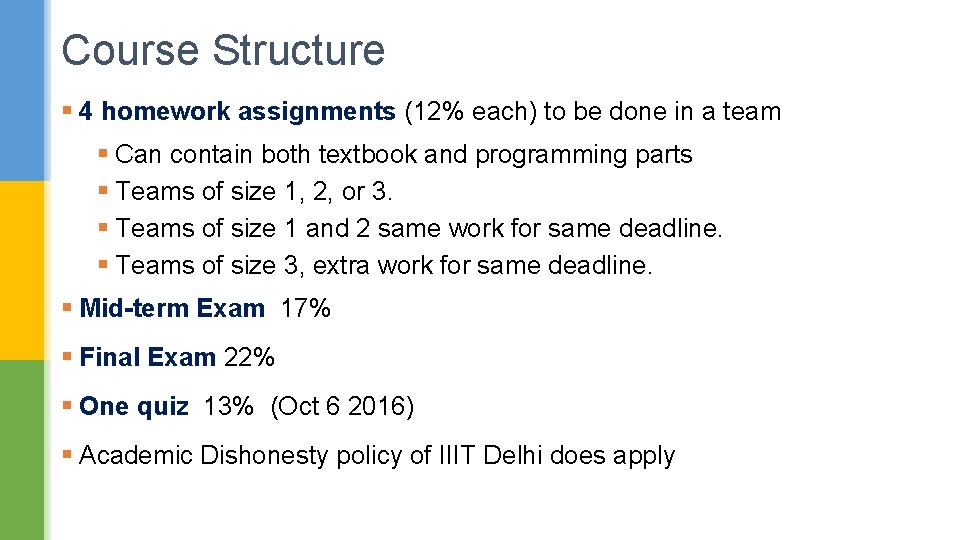
Course Structure § 4 homework assignments (12% each) to be done in a team § Can contain both textbook and programming parts § Teams of size 1, 2, or 3. § Teams of size 1 and 2 same work for same deadline. § Teams of size 3, extra work for same deadline. § Mid-term Exam 17% § Final Exam 22% § One quiz 13% (Oct 6 2016) § Academic Dishonesty policy of IIIT Delhi does apply
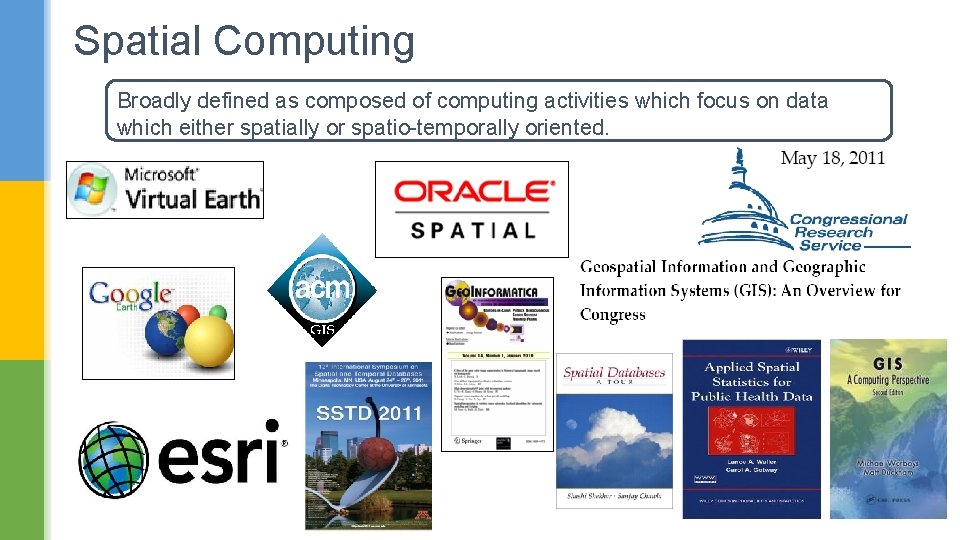
Spatial Computing Broadly defined as composed of computing activities which focus on data which either spatially or spatio-temporally oriented.
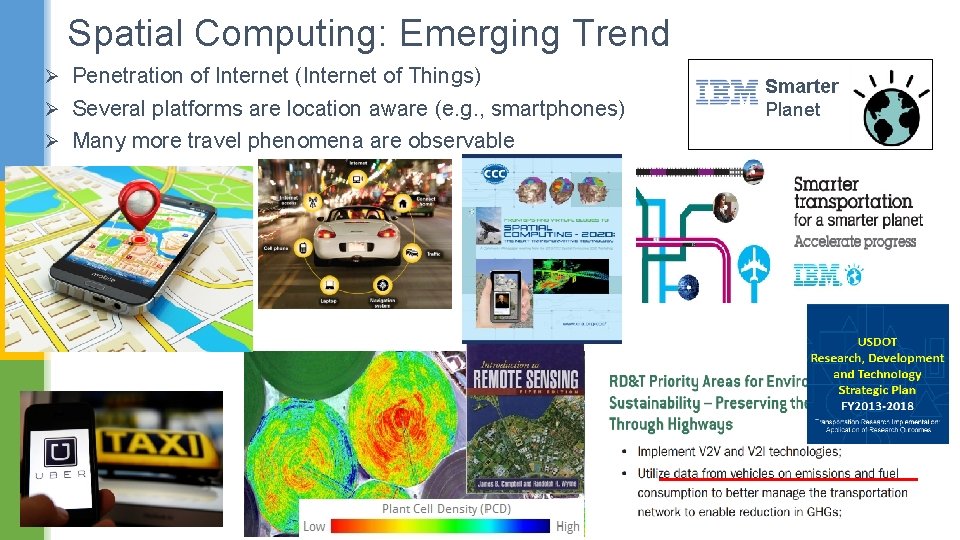
Spatial Computing: Emerging Trend Ø Penetration of Internet (Internet of Things) Ø Several platforms are location aware (e. g. , smartphones) Ø Many more travel phenomena are observable Smarter Planet
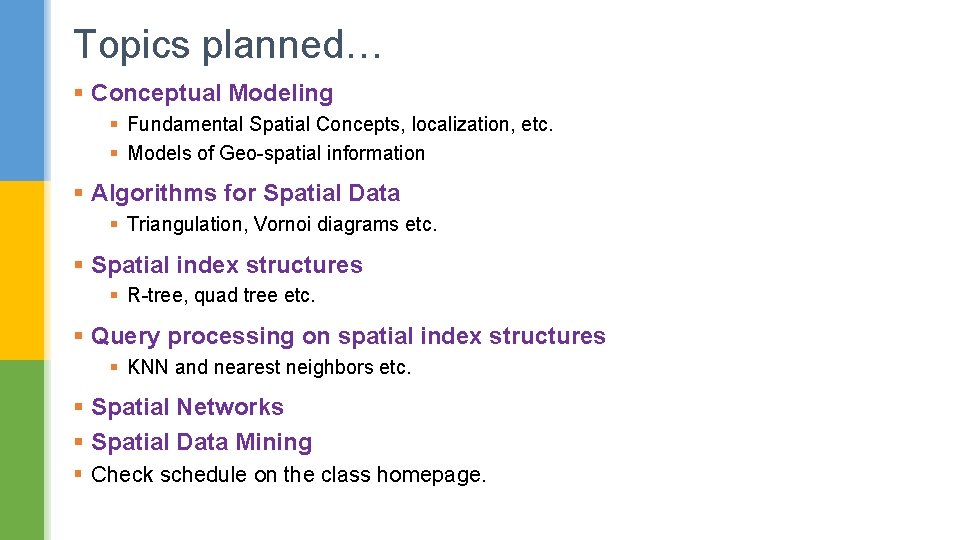
Topics planned… § Conceptual Modeling § Fundamental Spatial Concepts, localization, etc. § Models of Geo-spatial information § Algorithms for Spatial Data § Triangulation, Vornoi diagrams etc. § Spatial index structures § R-tree, quad tree etc. § Query processing on spatial index structures § KNN and nearest neighbors etc. § Spatial Networks § Spatial Data Mining § Check schedule on the class homepage.
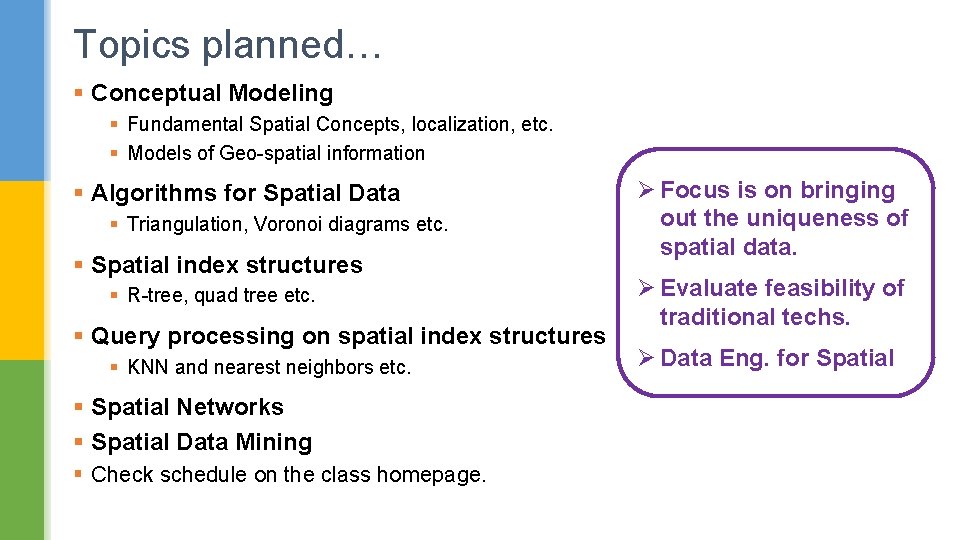
Topics planned… § Conceptual Modeling § Fundamental Spatial Concepts, localization, etc. § Models of Geo-spatial information § Algorithms for Spatial Data § Triangulation, Voronoi diagrams etc. § Spatial index structures § R-tree, quad tree etc. § Query processing on spatial index structures § KNN and nearest neighbors etc. § Spatial Networks § Spatial Data Mining § Check schedule on the class homepage. Ø Focus is on bringing out the uniqueness of spatial data. Ø Evaluate feasibility of traditional techs. Ø Data Eng. for Spatial
Spatial Computing Vs Geographic Information Systems/Science § GIS is the application software to store, retrieve, visualize and analyze geo-spatial data. § Spatial Computing is the core “Computer Science” inside a GIS. § Spatial Computing can go beyond geo-spatial. § Typically Encompasses: § Spatial and spatio-temporal databases § Spatial and spatial-temporal data mining § ……….
Sample Functionalities of GIS Or Problems considered in Spatial Computing
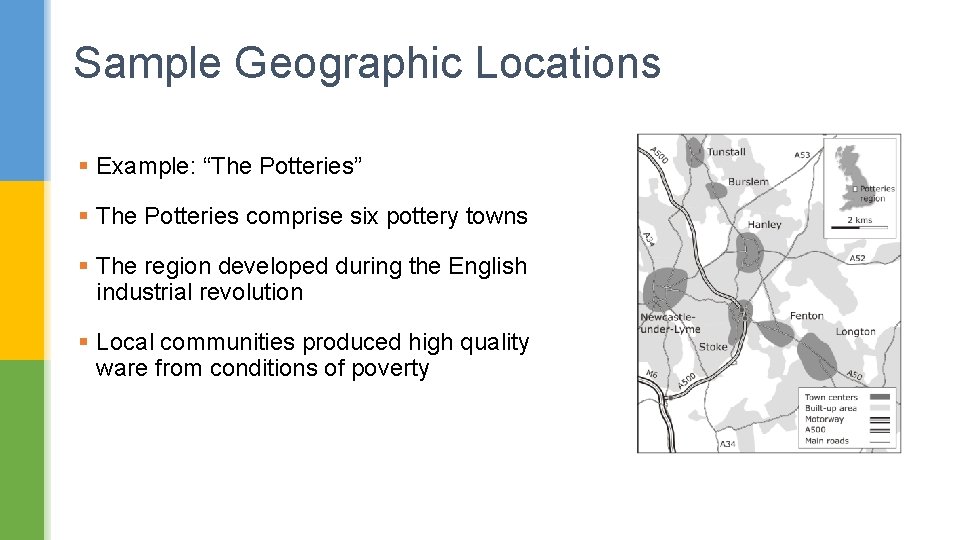
Sample Geographic Locations § Example: “The Potteries” § The Potteries comprise six pottery towns § The region developed during the English industrial revolution § Local communities produced high quality ware from conditions of poverty
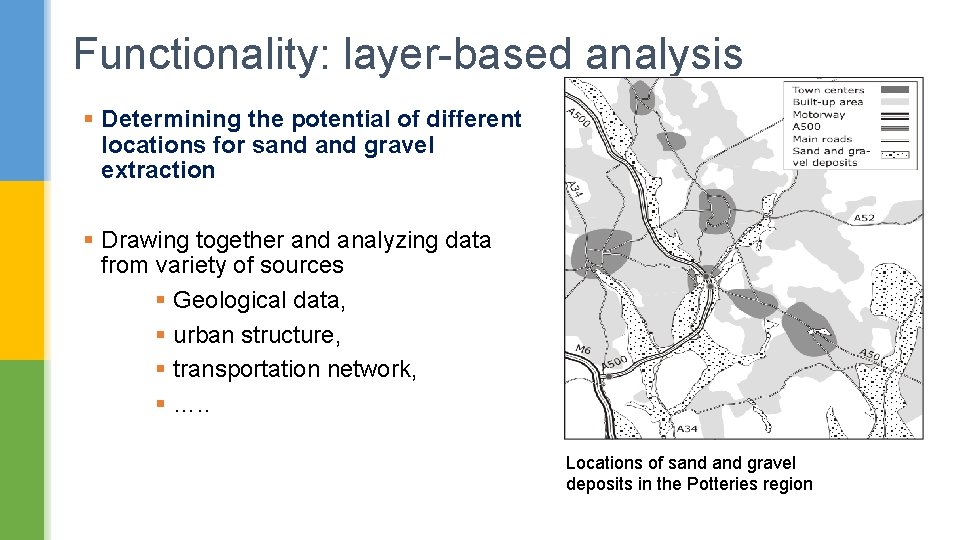
Functionality: layer-based analysis § Determining the potential of different locations for sand gravel extraction § Drawing together and analyzing data from variety of sources § Geological data, § urban structure, § transportation network, § …. . Locations of sand gravel deposits in the Potteries region
Functionality: layer-based analysis Query: find all locations that are within 0. 5 km of a major road, not in a built-up area, and on a sand/gravel deposit 0. 5 km buffer of major roads (not including the motorway Known sand gravel deposits Shaded areas indicate locations that are not built up Overlay of the three other layers giving area that satisfies the query
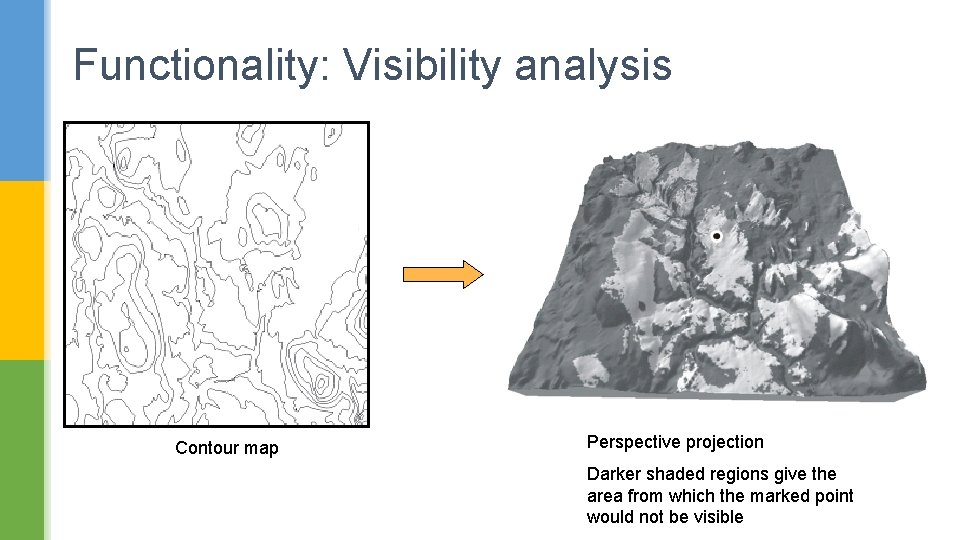
Functionality: Visibility analysis § Sometimes it is important to study the visual impact of proposed new buildings, routes, etc. § Visibility analysis can be used to evaluate visual impact § E. g, it the building in the line of sight of the new building. § Is the route visible from enemy posts, etc. § Usually based upon data sets of topographic elevation at point locations
Functionality: Visibility analysis Contour map Perspective projection Darker shaded regions give the area from which the marked point would not be visible
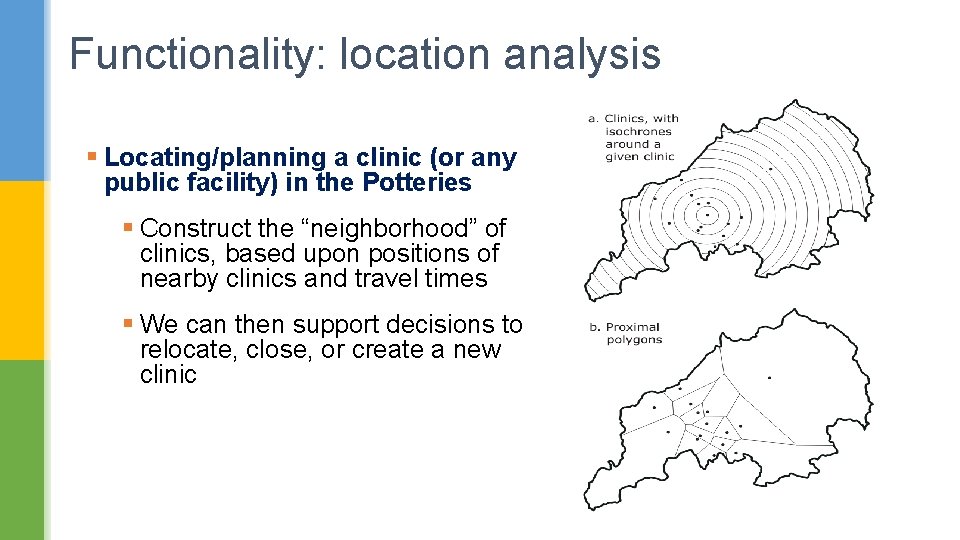
Functionality: location analysis § Locating/planning a clinic (or any public facility) in the Potteries § Construct the “neighborhood” of clinics, based upon positions of nearby clinics and travel times § We can then support decisions to relocate, close, or create a new clinic
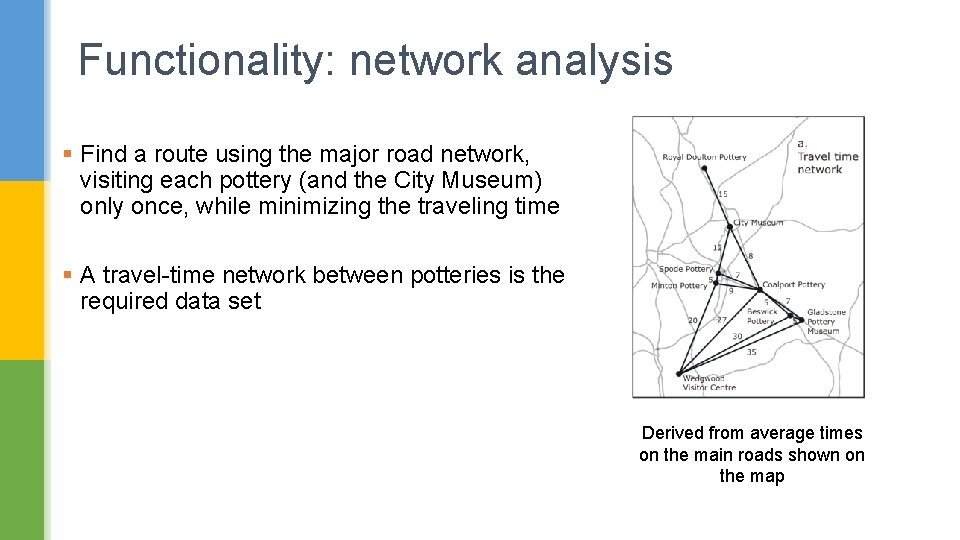
Functionality: network analysis § Find a route using the major road network, visiting each pottery (and the City Museum) only once, while minimizing the traveling time § A travel-time network between potteries is the required data set Derived from average times on the main roads shown on the map
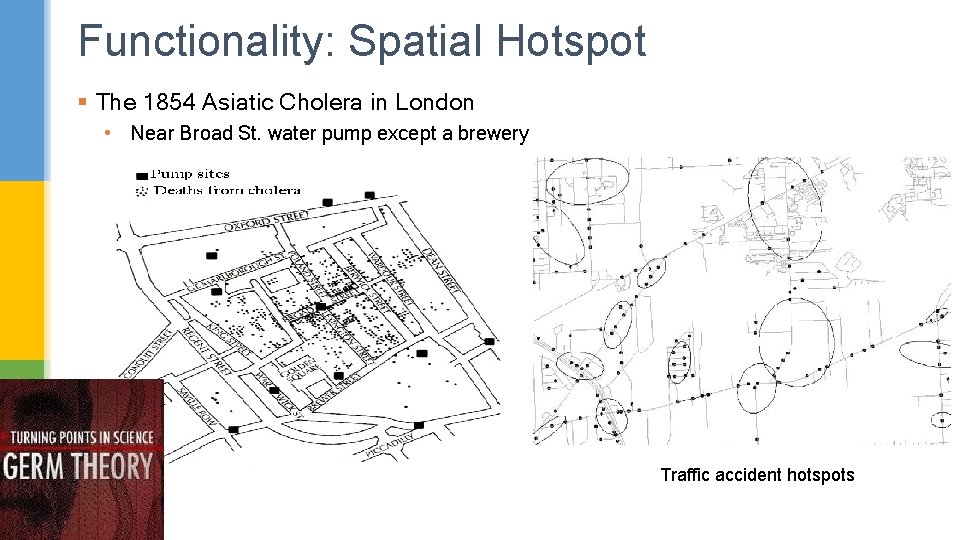
Functionality: Spatial Hotspot § The 1854 Asiatic Cholera in London • Near Broad St. water pump except a brewery Traffic accident hotspots
Introduction to Spatial Data
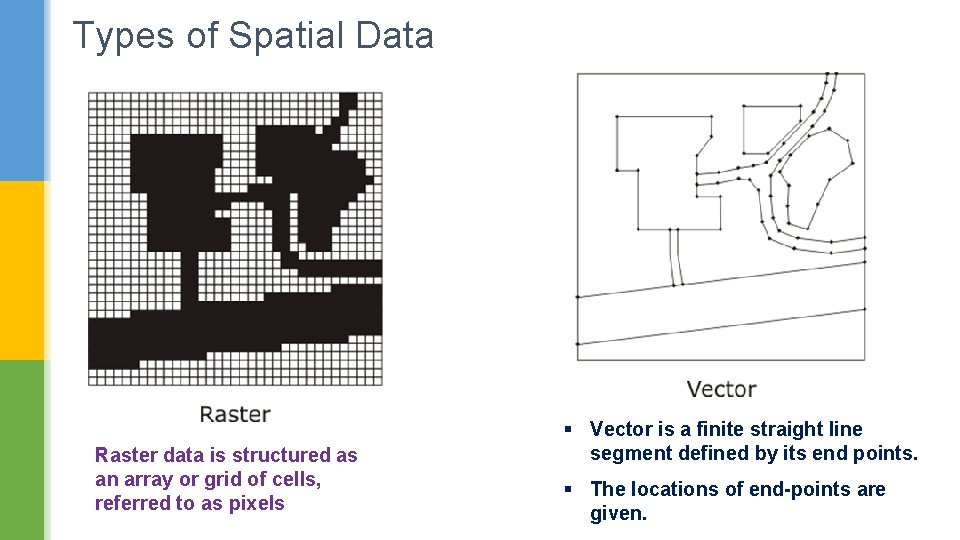
Types of Spatial Data Raster data is structured as an array or grid of cells, referred to as pixels § Vector is a finite straight line segment defined by its end points. § The locations of end-points are given.
Types of Spatial Data § Raster § Natural structures to use in computers § Most programming languages commonly support array handling and operations § Inefficient in terms of usage of computer storage § Vector § More efficient in its use of computer storage § Only points of interest need be stored § Assume a hard edged boundary model of the world
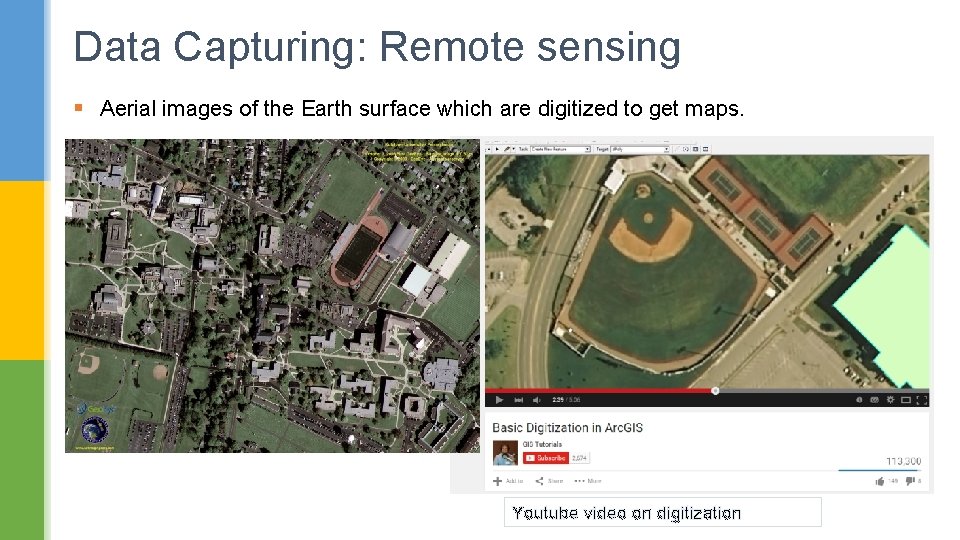
Data Capturing: Remote sensing § Aerial images of the Earth surface which are digitized to get maps. Youtube video on digitization
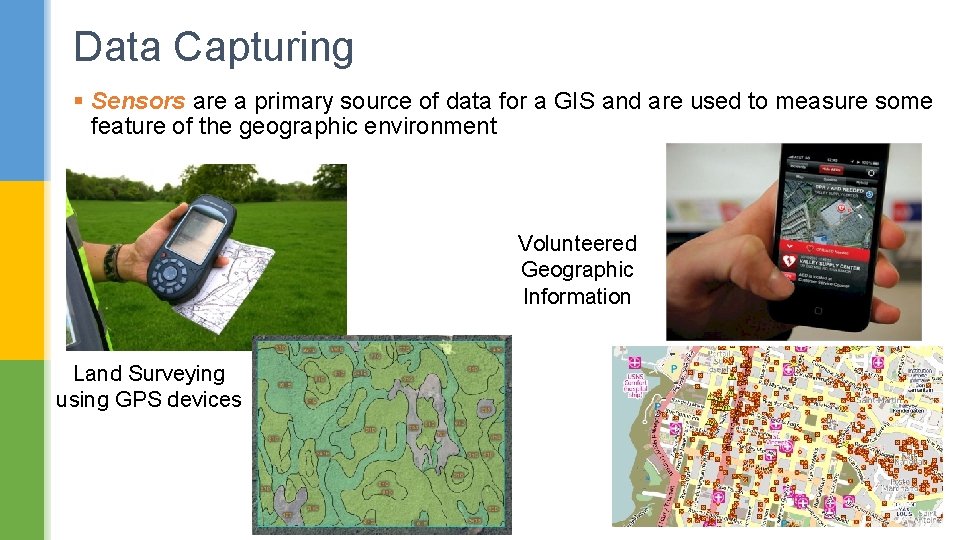
Data Capturing § Sensors are a primary source of data for a GIS and are used to measure some feature of the geographic environment Volunteered Geographic Information Land Surveying using GPS devices
Basics on Geometry
Geometry and Invariance Geometry: provides a formal representation of the abstract properties and structures within a space Invariance: a group of transformations of space under which propositions remain true Ø Distance- translations and rotations Ø Angle and parallelism- translations rotations, and scaling
Euclidean Space § Euclidean Space: coordinatized model of space § Transforms spatial properties into properties of tuples of real numbers § Coordinate frame consists of a fixed, distinguished point (origin) and a pair of orthogonal lines (axes), intersecting in the origin § Point objects § Line objects § Polygonal objects
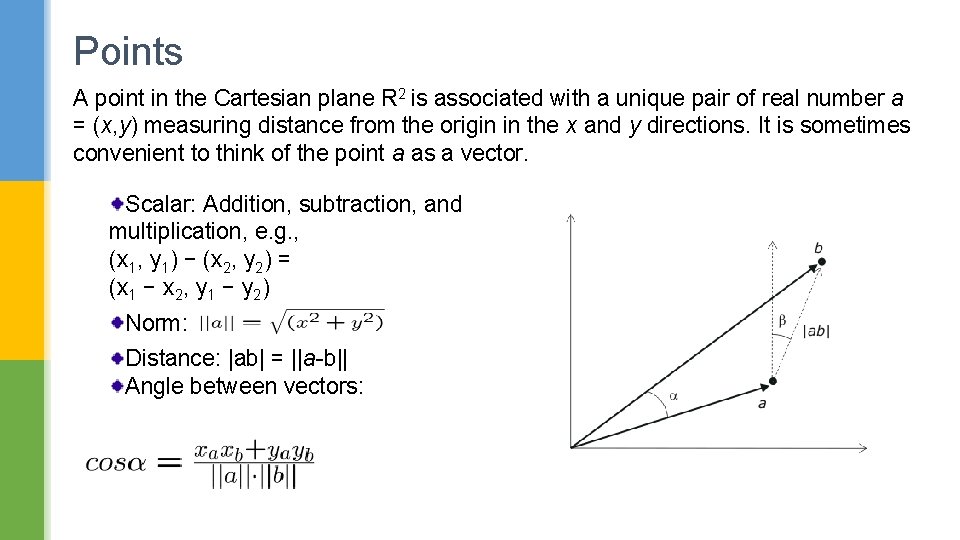
Points A point in the Cartesian plane R 2 is associated with a unique pair of real number a = (x, y) measuring distance from the origin in the x and y directions. It is sometimes convenient to think of the point a as a vector. Scalar: Addition, subtraction, and multiplication, e. g. , (x 1, y 1) − (x 2, y 2) = (x 1 − x 2, y 1 − y 2) Norm: Distance: |ab| = ||a-b|| Angle between vectors:
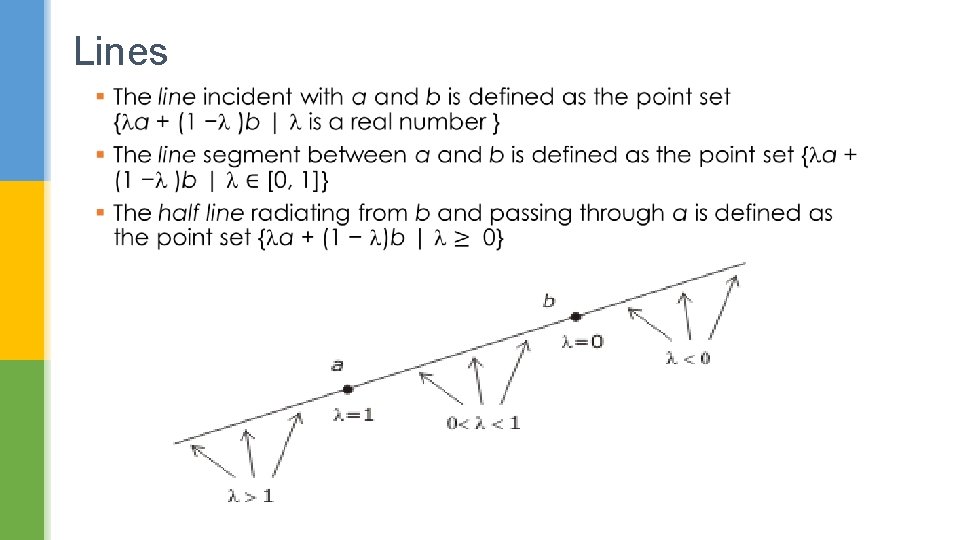
Lines
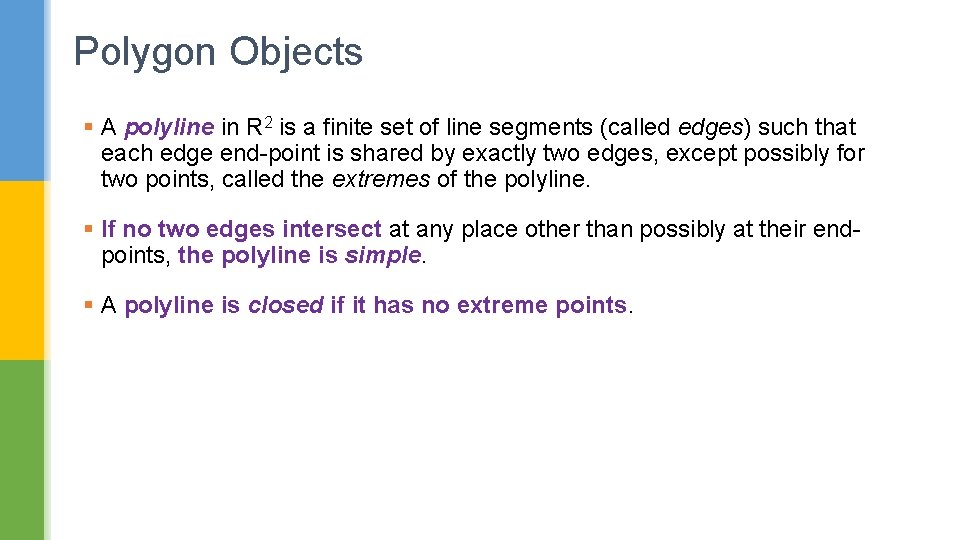
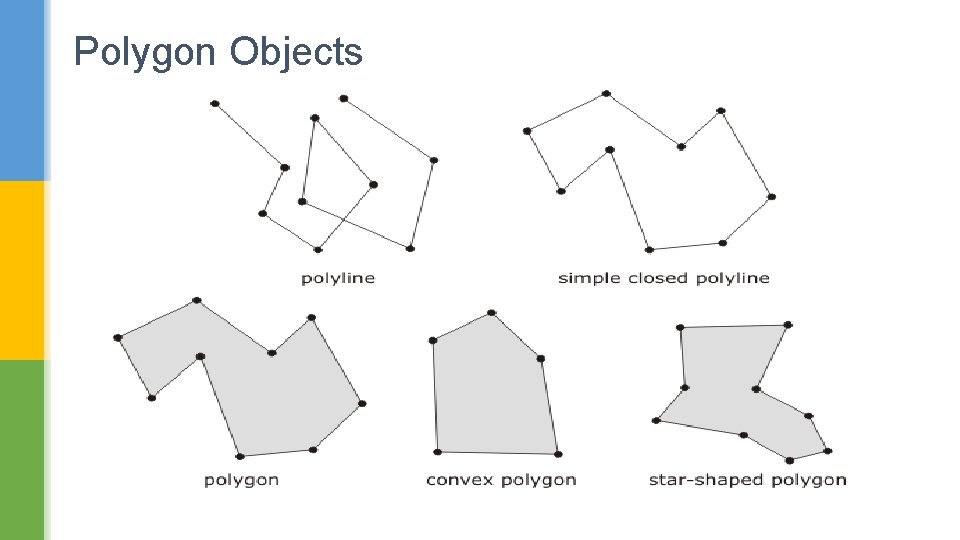
Polygon Objects § A polyline in R 2 is a finite set of line segments (called edges) such that each edge end-point is shared by exactly two edges, except possibly for two points, called the extremes of the polyline. § If no two edges intersect at any place other than possibly at their endpoints, the polyline is simple. § A polyline is closed if it has no extreme points.
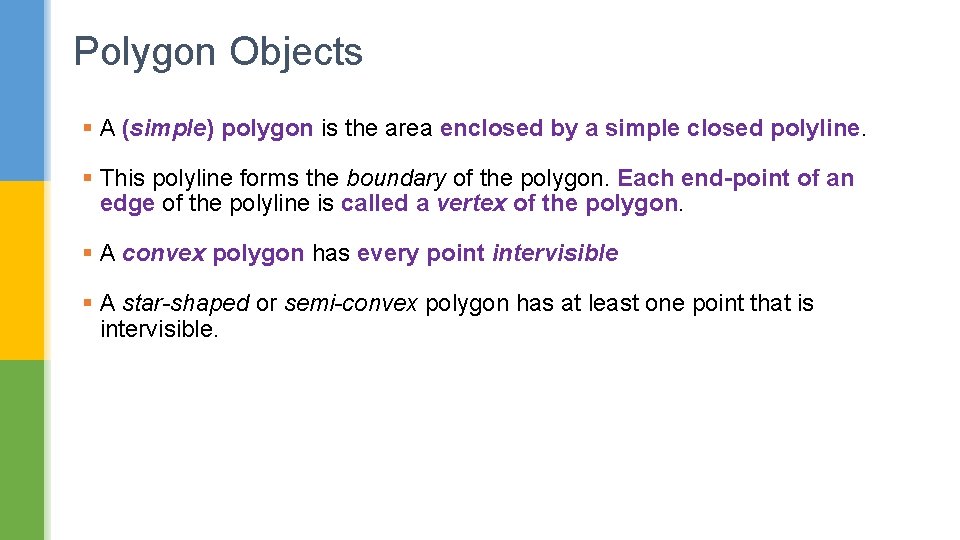
Polygon Objects § A (simple) polygon is the area enclosed by a simple closed polyline. § This polyline forms the boundary of the polygon. Each end-point of an edge of the polyline is called a vertex of the polygon. § A convex polygon has every point intervisible § A star-shaped or semi-convex polygon has at least one point that is intervisible.
Polygon Objects
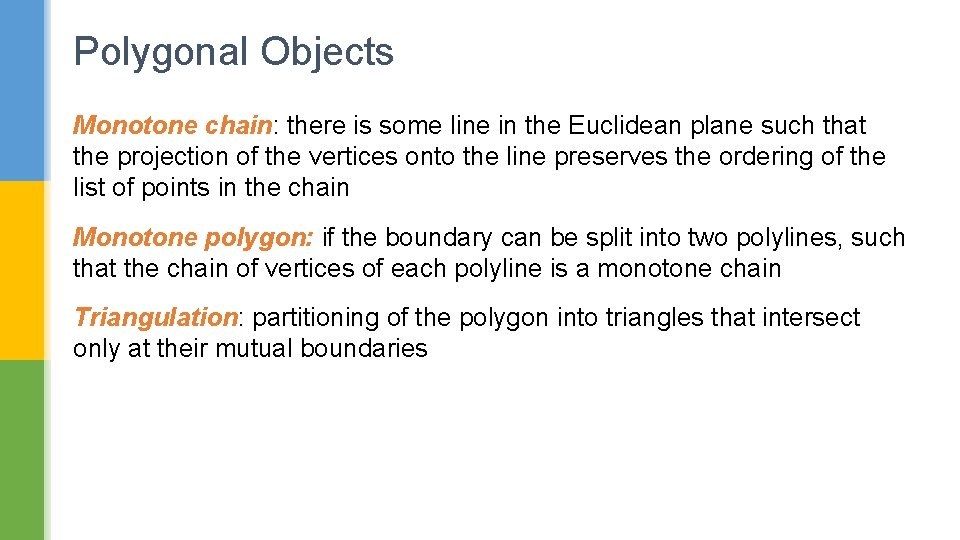
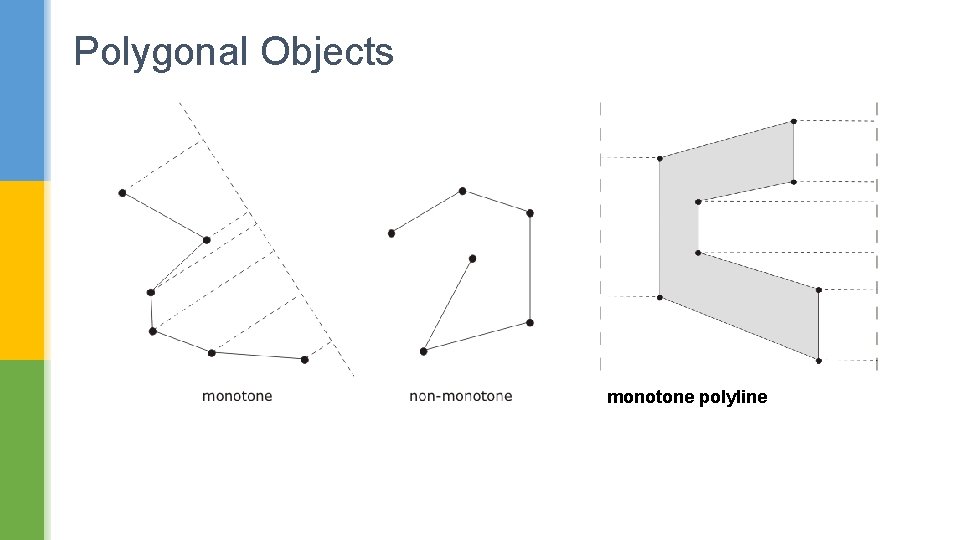
Polygonal Objects Monotone chain: there is some line in the Euclidean plane such that the projection of the vertices onto the line preserves the ordering of the list of points in the chain Monotone polygon: if the boundary can be split into two polylines, such that the chain of vertices of each polyline is a monotone chain Triangulation: partitioning of the polygon into triangles that intersect only at their mutual boundaries
Polygonal Objects monotone polyline
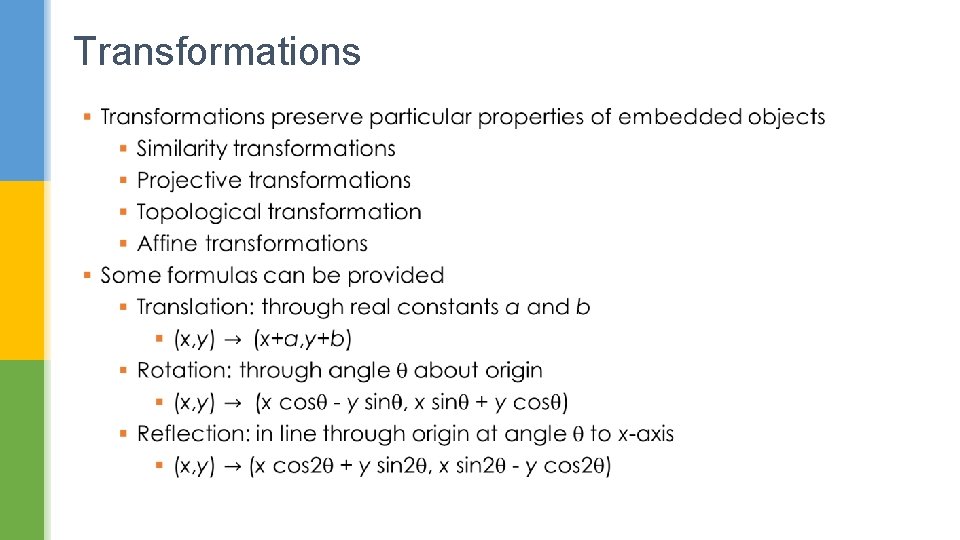
Transformations
Coordinate systems for Earth
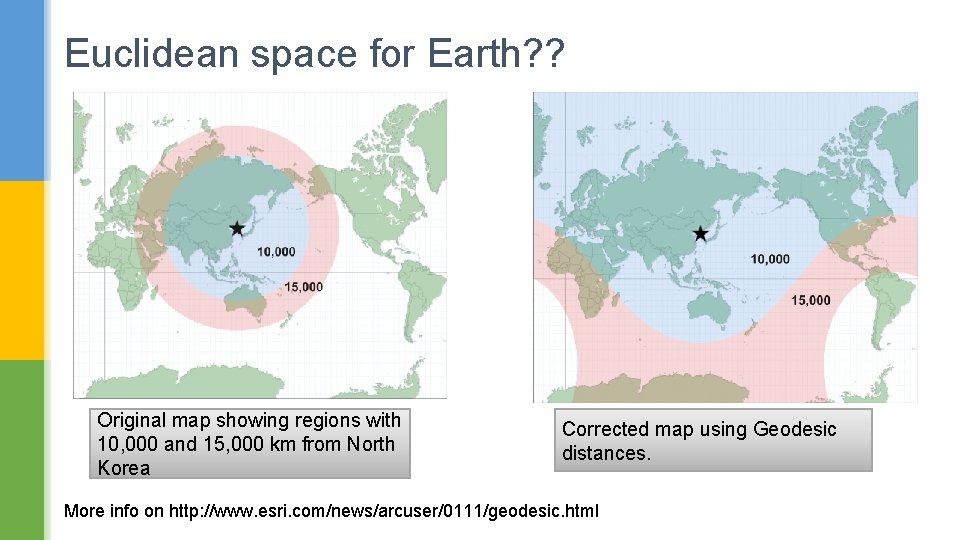
Euclidean space for Earth? ? Original map showing regions with 10, 000 and 15, 000 km from North Korea Corrected map using Geodesic distances. More info on http: //www. esri. com/news/arcuser/0111/geodesic. html
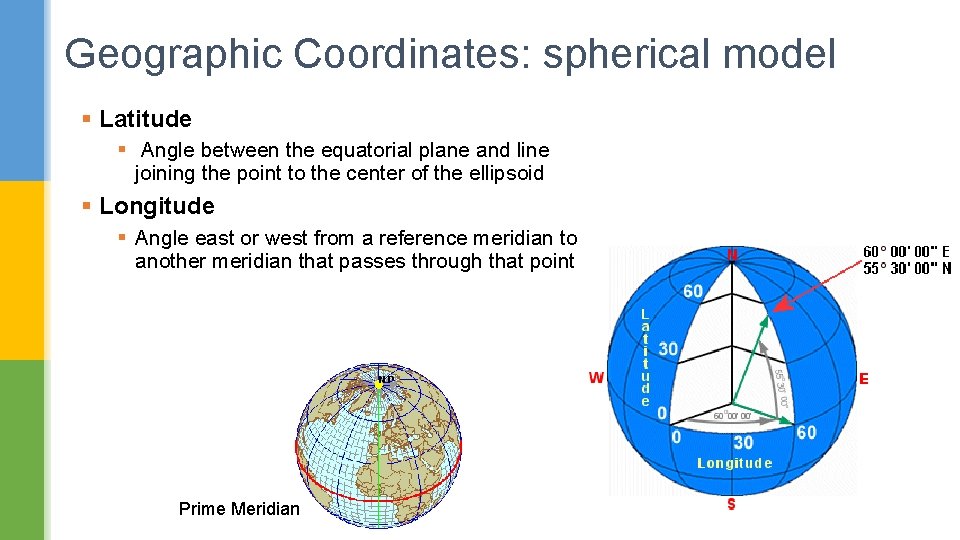
Geographic Coordinates: spherical model § Latitude § Angle between the equatorial plane and line joining the point to the center of the ellipsoid § Longitude § Angle east or west from a reference meridian to another meridian that passes through that point Prime Meridian
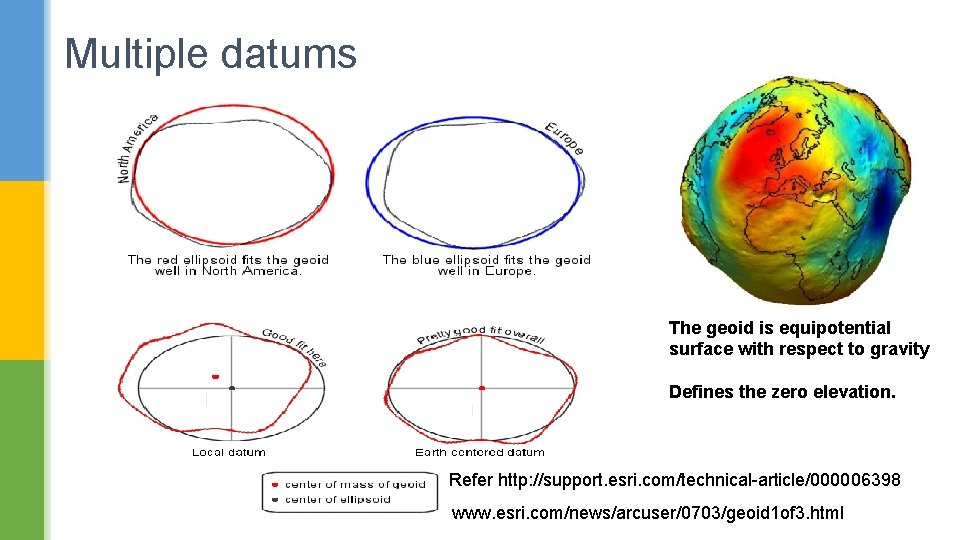
Geodetic Coordinates –Ellipsoid model § Another coordinate system which uses a different set of reference points (Datums) for locating places. § A Datum defines a reference point (or a reference frame) for localizing. § Datum uses an ellipsoid to defines latitude, longitude and altitude coordinates. § Horizontal Datum: For latitude and Longitude § Vertical Datum: For elevation § Multiple standards exist. § WGS 84, AD 83 and ETRS 89 Refer https: //en. wikipedia. org/wiki/Geodetic_datum
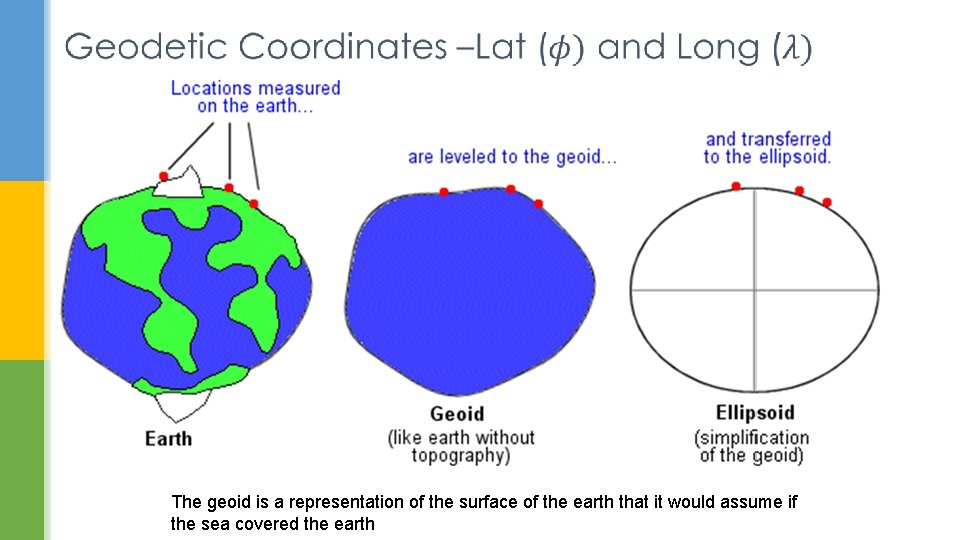
The geoid is a representation of the surface of the earth that it would assume if the sea covered the earth
Multiple datums The geoid is equipotential surface with respect to gravity Defines the zero elevation. Refer http: //support. esri. com/technical-article/000006398 www. esri. com/news/arcuser/0703/geoid 1 of 3. html
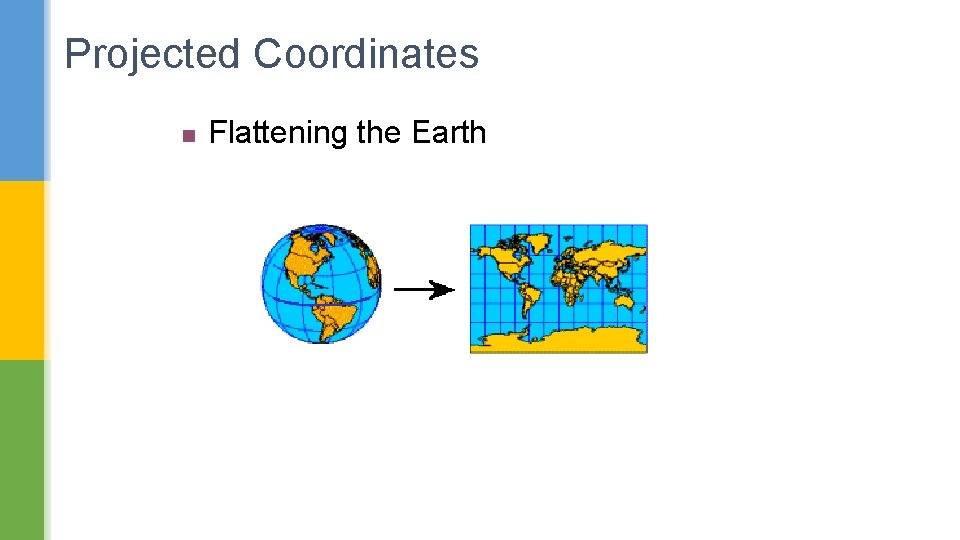
Projected Coordinates n Flattening the Earth
Projected Coordinates n n n A map project can distort one or several of the following properties n Shape n Area n Distance n Direction Some projections specialize in preserving one or several of these features, but none preserve all. Many types are available. For more details refer: https: //en. wikipedia. org/wiki/List_of_map_projections Refer: http: //www. progonos. com/furuti/Map. Proj/Normal/TOC/cart. TOC. html
Map-Projection Distortion: Shape n n Projection can distort the shape of a feature. Conformal Map: Any two lines in the map follow the same angle as the corresponding original lines on the Earth. Conformal maps preserve the shape of smaller, local geographic features, while general shapes of larger features are distorted. In other words, they map infinitesimal circles of constant size anywhere on the Earth to infinitesimal circles of varying sizes on the map. n Other projections distort them into ellipses. n Conformal maps also preserve constant scale locally. http: //www. progonos. com/furuti/Map. Proj/Normal/TOC/cart. TOC. html
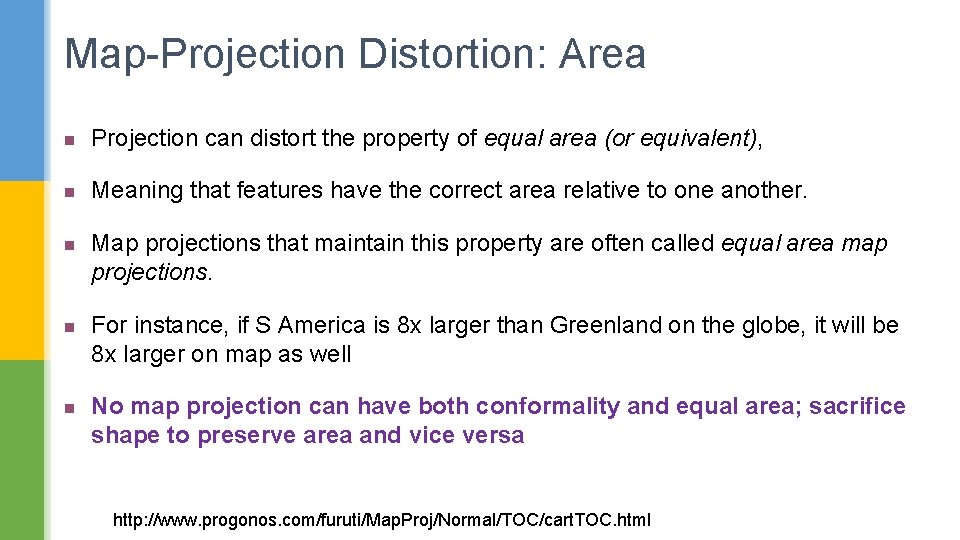
Map-Projection Distortion: Area n Projection can distort the property of equal area (or equivalent), n Meaning that features have the correct area relative to one another. n n n Map projections that maintain this property are often called equal area map projections. For instance, if S America is 8 x larger than Greenland on the globe, it will be 8 x larger on map as well No map projection can have both conformality and equal area; sacrifice shape to preserve area and vice versa http: //www. progonos. com/furuti/Map. Proj/Normal/TOC/cart. TOC. html
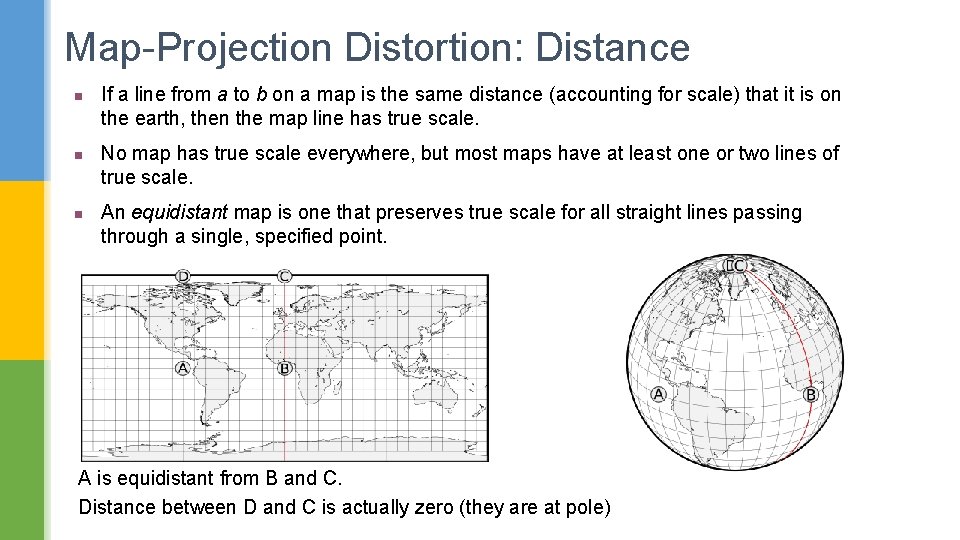
Map-Projection Distortion: Distance n n n If a line from a to b on a map is the same distance (accounting for scale) that it is on the earth, then the map line has true scale. No map has true scale everywhere, but most maps have at least one or two lines of true scale. An equidistant map is one that preserves true scale for all straight lines passing through a single, specified point. A is equidistant from B and C. Distance between D and C is actually zero (they are at pole)
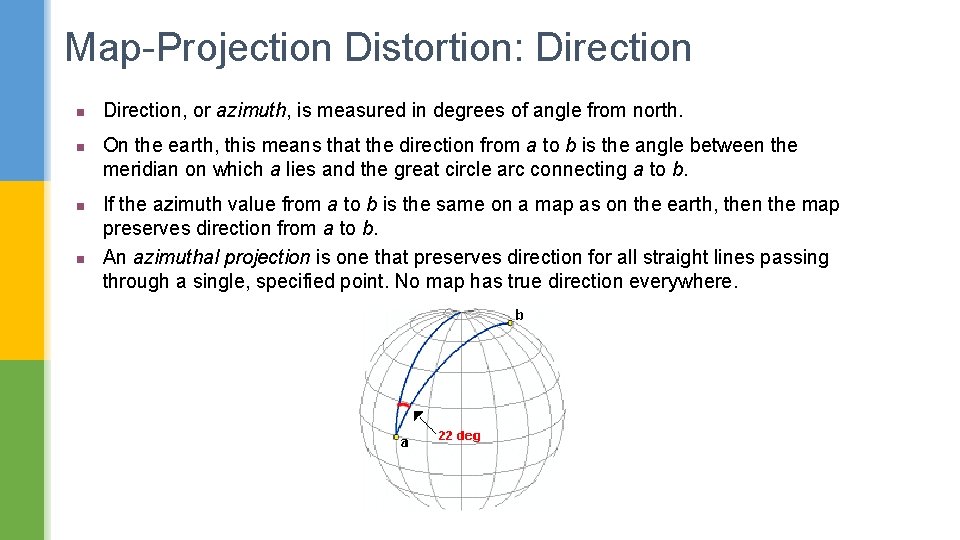
Map-Projection Distortion: Direction n n Direction, or azimuth, is measured in degrees of angle from north. On the earth, this means that the direction from a to b is the angle between the meridian on which a lies and the great circle arc connecting a to b. If the azimuth value from a to b is the same on a map as on the earth, then the map preserves direction from a to b. An azimuthal projection is one that preserves direction for all straight lines passing through a single, specified point. No map has true direction everywhere.
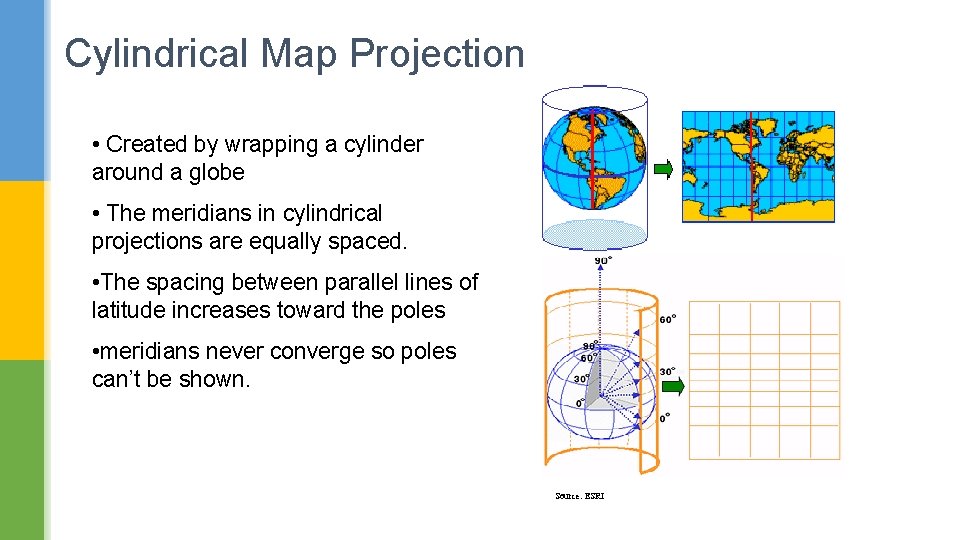
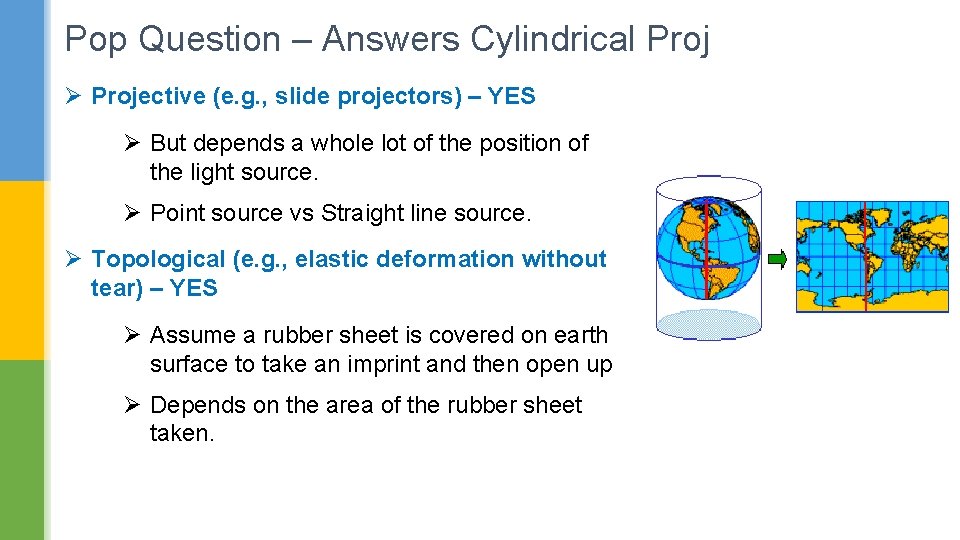
Cylindrical Map Projection • Created by wrapping a cylinder around a globe • The meridians in cylindrical projections are equally spaced. • The spacing between parallel lines of latitude increases toward the poles • meridians never converge so poles can’t be shown. Source: ESRI
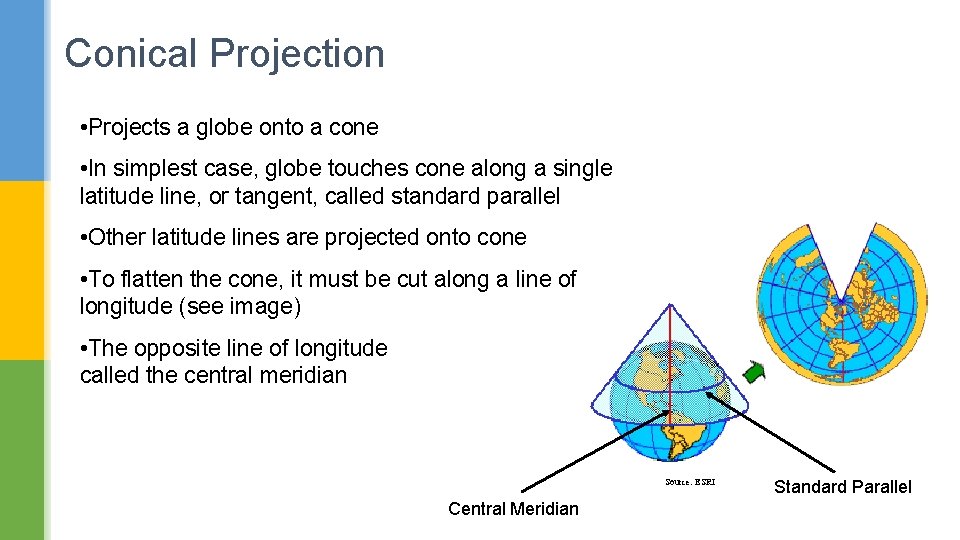
Conical Projection • Projects a globe onto a cone • In simplest case, globe touches cone along a single latitude line, or tangent, called standard parallel • Other latitude lines are projected onto cone • To flatten the cone, it must be cut along a line of longitude (see image) • The opposite line of longitude called the central meridian Source: ESRI Central Meridian Standard Parallel
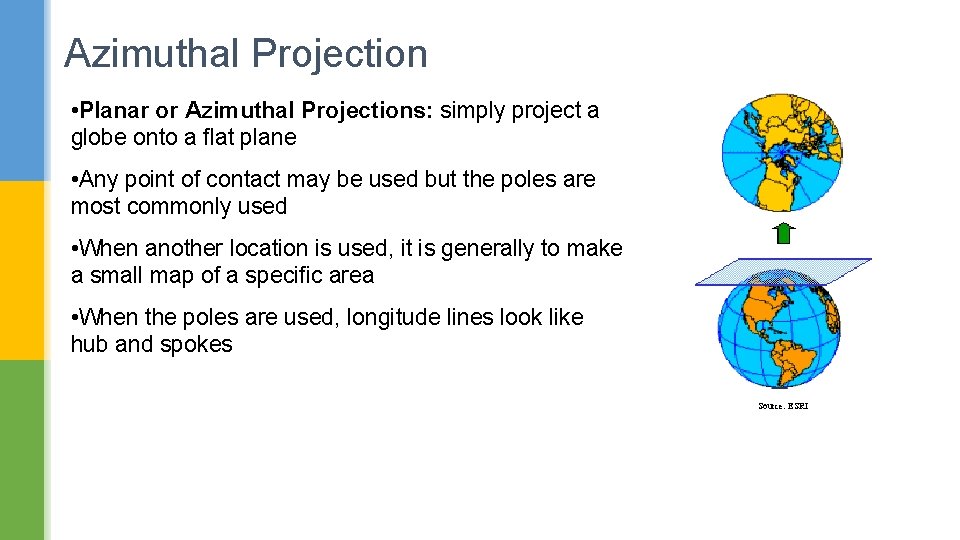
Azimuthal Projection • Planar or Azimuthal Projections: simply project a globe onto a flat plane • Any point of contact may be used but the poles are most commonly used • When another location is used, it is generally to make a small map of a specific area • When the poles are used, longitude lines look like hub and spokes Source: ESRI
Pop Question • Consider the following classes of transformations for Euclidean spaces • Translation – Move all objects linearly in same direction by same amount • Similarity – Either rotate all objects in same direction around an axis OR Perform rotation followed by uniform scaling • Projective – Using a light source and a mapping plane. For this question assume that all objects are on a plane and there is light source outside the plane. • Topological – For this question assume that all objects are on a plane. You can perform elastic deformation of the plane without tear. … Contd on next slide
Pop Question Which of the following are preserved by each of the previous mentioned transformations: (a) Shape Circle should stay as circle and not change to ellipse. (b) Size Relative sizes are maintained. (c) Distance All distances expand or shrink by the same factor. (d) Direction If an object is 45 N of object B it remains so. (e) Occlusion (in front of) If the only way to reach object C from A is through C, then it remains so. Further assume that you can move only in straight lines.
Mathematical Definitions of transformations v Translation (e. g. , moving an object linearly) v Moves every point of a figure or a space by the same amount in a given direction. v Refer: https: //en. wikipedia. org/wiki/Translation_(geometry) v Similarity (e. g. , rotation & scaling) v A circle should stay circle and not change to ellipse. v Refer: https: //en. wikipedia. org/wiki/Similarity_(geometry) v https: //en. wikipedia. org/wiki/Scaling_(geometry) v Projective (e. g. , slide projectors) v Project objects onto a plane; we have a light source and a mapping plane v http: //www. geom. uiuc. edu/docs/reference/CRC-formulas/node 16. html v Topological (e. g. , elastic deformation without tear)
Pop Question • Consider the following classes of transformations for Euclidean spaces • Translation (e. g. , moving an object linearly) • Similarity (e. g. , rotation & scaling) • Projective (e. g. , slide projectors) • Topological (e. g. , elastic deformation without tear) Which of the above transformations are closest to following map projections (a) Cylindrical, (b) Azimuthal projection
Pop Question Term “Closest” should be stressed here. In reality all projections are functions which map a geodetic coordinate to an (X, Y) on a plane. This question should be seen only as a thought provoking exercise rather than a mathematical fact Closest
Pop Question – Answers Cylindrical Proj Ø Projective (e. g. , slide projectors) – YES Ø But depends a whole lot of the position of the light source. Ø Point source vs Straight line source. Ø Topological (e. g. , elastic deformation without tear) – YES Ø Assume a rubber sheet is covered on earth surface to take an imprint and then open up Ø Depends on the area of the rubber sheet taken.
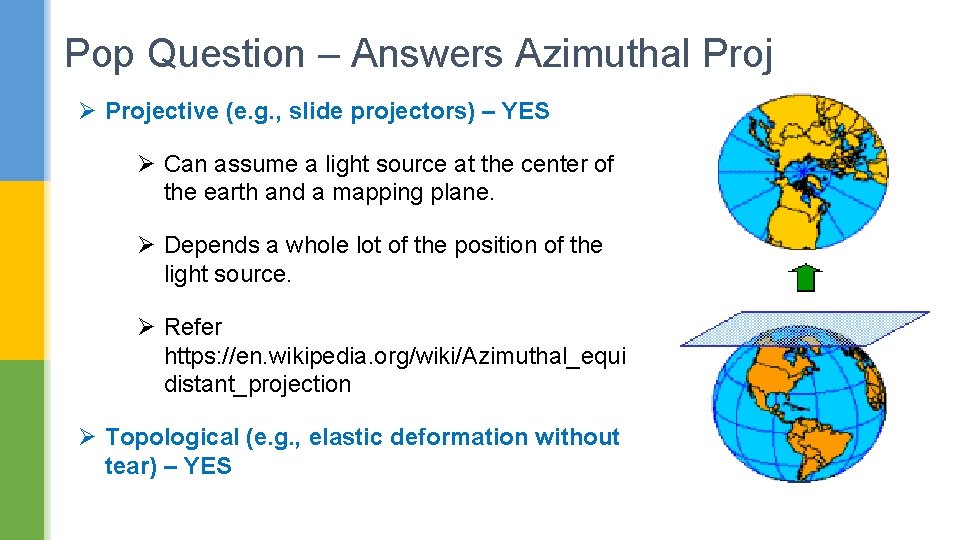
Pop Question – Answers Azimuthal Proj Ø Projective (e. g. , slide projectors) – YES Ø Can assume a light source at the center of the earth and a mapping plane. Ø Depends a whole lot of the position of the light source. Ø Refer https: //en. wikipedia. org/wiki/Azimuthal_equi distant_projection Ø Topological (e. g. , elastic deformation without tear) – YES